It’s possible that I shall make an ass of myself. But in that case one can always get out of it with a little dialectic. I have, of course, so worded my proposition as to be right either way (K.Marx, Letter to F.Engels on the Indian Mutiny)
Sunday, September 27, 2026
Greenland Mines says US pact could strengthen mineral supply
Greenland Mines (NASDAQ: GRML) says the new security agreement involving the US, Denmark and Greenland shows the territory’s importance for critical minerals, securing it and protecting its resources from non-ally countries.
The rare earth and precious metals company said its Greenland projects could form part of a secure allied critical-minerals supply chain. It is also proposing a North Atlantic Critical Metals Corridor linking the territory’s resources with downstream processing and industrial infrastructure in allied countries.
“Today’s announcement underscores what we have long believed: Greenland is becoming one of the most strategically important regions in the world,” Greenland Mines president Bo Møller Stensgaard said. “We believe that the same strategic importance extends to the critical minerals required for defense, advanced technology and energy security.”
Stensgaard added that this new agreement will help advance a framework that strengthens security, cooperation among allies and recognizes Greenland’s importance to the future of the US and other Western countries, especially when it comes to critical minerals.
The deal, announced on Sept. 18, is expected to be signed during the 81st session of the United Nations General Assembly.
Greenland Mines holds two major assets on the island. Its Sarfartoq project in southwest Greenland contains neodymium-praseodymium rare earths, with the potential to provide 34% of all neodymium and praseodymium oxide currently refined outside China at 2025 consumption levels. Skaergaard, in southeast Greenland, has palladium, platinum, gold and vanadium.
Deal to be signed
The security pact builds on longstanding US defence arrangements in Greenland and would allow Washington to expand its military presence without changing the territory’s sovereignty while also prohibiting American adversaries from building their own bases there, CBC reported.
President Donald Trump has pushed for greater US control over Greenland since the beginning of his second term, at times proposing that the US acquire the territory. Denmark and Greenland rejected those proposals and have maintained that Greenland is not for sale.
The new agreement instead preserves Danish sovereignty and Greenlandic self-determination while expanding Washington’s security role. It would also prevent non-North Atlantic Treaty Organization (NATO) countries from building military bases in the region.
Trump posted on Truth Social after the deal was announced that the United States would “FOREVER have the complete ability to do what is necessary in Greenland in order to secure and defend the security of Greenland, and the United States of America.”
For Greenland Mines, the agreement adds a security dimension to the growing Western focus on the island’s mineral potential. The company says Sarfartoq and Skaergaard could eventually help supply materials used in defence and advanced technologies while supporting its broader strategy of linking Greenland production with allied processing capacity.
Sarfartoq to expand
As the new pact could help develop new mineral projects in the territory, the company applied for a new license to gain more ground at Sarfartoq.
If granted, the new license would more than double their footprint in the rare earth and carbonatite district.
“Our strategy is straightforward: advance ST1 toward development, unlock the value of the less-developed known ST zones and systematically test the wider district for the next rare earth discovery,” Stensgaard said.
Shares in Greenland Mines were up 227% to $9.33 apiece by mid-day Monday in New York, valuing the company at $51.5 million.
World’s top rare earth magnet maker gives Xi leverage over US
Baotou City: Epicentre of China’s rare earth industry. Image by Matthew Stinson Creative Commons CC BY-NC 2.0
Baotou, an industrial city near the Gobi Desert, is the Silicon Valley of rare earths. Off Rare Earth Street, research institutes sit alongside a museum devoted to the minerals. Nearby, JL Mag Rare Earth Co., the world’s top maker of high-performance magnets, is building its largest plant yet — an expansion that offers a glimpse of how China plans to defend its commanding position in the supply chain.
Over the past year, the US and its allies have pledged billions of dollars to develop new sources of rare earths outside China. Indispensable to everything from missiles to electric vehicles, the minerals are a potent source of Beijing’s economic leverage. As President Xi Jinping arrives in Washington this week, rare earths are at the top of the trade agenda, with China weighing whether to expand export curbs this fall.
But as the US and others attempt to replicate China’s supply chain, Beijing is trying to redefine it. The country already dominates magnet production, and companies like JL Mag are now expanding into increasingly sophisticated components that incorporate them.
That creates a moving target. Mining rare earths is only the first step. The minerals must be separated and refined, turned into high-performance magnets and then manufactured into usable parts. Even if countries outside China secure enough dysprosium or terbium from new mines in places like Brazil, for example, they could still depend on Chinese companies — and their technology, patents and manufacturing scale — to supply fast-growing industries like robotics.
China’s rare earth magnet exports to the US fell last month, and Beijing hopes to offer additional export licenses as a bargaining chip at the summit, Bloomberg News reported.
JL Mag is Exhibit A. Just a few years ago, the company was best known for making rare earth magnets for air conditioners and wind turbines. Today, it has more than 10 times the current production capacity of its closest US competitor and has emerged as a major supplier to the EV industry, with analysts linking it to customers including Tesla Inc. and Volkswagen.
A review of JL Mag’s corporate filings and interviews with magnet makers in Asia and North America, as well as those familiar with the company’s operations, found that the scale and scope of its expansion far eclipse the nascent projects underway in the West. Little known outside the industry, the company is extending its reach from Baotou to as far away as Monterrey, Mexico, where it wants to shift some processing closer to US clients.
“JL Mag can meet the needs of its customers in a way that US competitors just can’t,” said David Abraham, principal at Materium Strata, a critical minerals advisory and market intelligence firm. “Customers can just give them their specs, and JL Mag basically presses a few buttons on their machines and out comes the product. Catching up to that is incredibly hard.”
Estimates put JL Mag’s share of the global rare earth magnet market at 10% to 20%, with its products used across the world’s top 10 new-energy vehicle brands. By 2028, it plans to add as much as 20,000 tons of annual capacity in Baotou, a 50% increase that would extend its lead in an industry where its three closest rivals are also Chinese.
The expansion is already visible. JL Mag’s Baotou site sits on the block next to Rare Earth Park, where Chinese scientists are carved into a granite wall and stainless-steel cubes embossed with chemical symbols dot the flower beds. At the factory, a recruitment flyer hangs on the front gate. The plant takes more than half an hour to walk around.
Robotics shows where JL Mag wants to go next. Last year, the company launched a business unit dedicated to humanoid robots that reports directly to its chief executive, with plans to expand its presence in the sector. Daiwa Securities has identified the firm as the sole supplier of motor rotors for Tesla’s Optimus robots. Another analyst estimates that JL Mag supplies about 80% of the magnets used in Tesla vehicles.
“They came out of nowhere,” said Constantine Karayannopoulos, the former chief executive officer of Neo Performance Materials Inc., which also operates a magnet plant in China. “To me, there is JL and then there is everybody else. They are a juggernaut. They can take business at any price.”
JL Mag referred questions about its operations and expansion plans to its exchange filings.
The company has long been on Beijing’s radar. In May 2019, Xi stopped at some of JL Mag’s facilities in southern China, touring production lines and inspecting the furnaces used to make rare earth magnets. The visit was celebrated in state media and JL Mag’s publications. To remain “undefeated in fierce competition,” Xi said, according to state media, “we must firmly grasp technological innovation as a strategic foundation.” China’s top trade negotiator, Liu He, stood at his side.
The timing and choice of venue were provocative then and prescient in hindsight. Just 10 days earlier, US President Donald Trump had hiked tariffs on Chinese goods, escalating a trade war that would punctuate his first term in office.
It would take until last year — just after Trump’s “Liberation Day” tariffs — for Xi to pull the trigger. China imposed export controls on rare earths, choking off supplies and threatening swaths of US manufacturing before helping force a trade truce with Washington.
Yet JL Mag has been largely unfazed. US efforts to diversify rare earth flows still face “numerous challenges,” the company said in its latest annual report. Chinese magnet makers will remain the “dominant players.”
In 2024, China accounted for about 94% of global rare earth permanent magnet manufacturing — far exceeding its share of mining — according to the International Energy Agency. That same year, JL Mag says it became the world’s largest magnet producer by both output and sales. Between Xi’s visit in 2019 and 2025, the company’s annual capacity more than quadrupled, according to its historical reports. By next year, it wants to boost that by another 50%, to 60,000 tons.
That advantage is reinforced by clusters like Baotou, where processors, magnet makers and research institutes sit just a few hours by train from the giant Bayan Obo mine. The proximity cuts logistics costs and makes it easier to share suppliers, recruit specialized workers and tap decades of expertise.
By comparison, MP Materials Corp., which operates the only rare earth mine and processing facility in the US, started producing rare earths magnets from its plant in Fort Worth, Texas, last year. After the Trump administration invested $400 million in the company, for a roughly 15% equity stake, MP unveiled plans to spend more than $1.25 billion on a much bigger magnet-making plant in Northlake, Texas, that would eventually bring its production to about 10,000 tons a year.
That expansion would equal about a third of JL Mag’s production in 2025, without factoring in the Chinese firm’s plans to expand.
Other US companies have made similar pledges to build magnet facilities but have little experience and capital to show for it.
Demand, meanwhile, is surging, benefiting JL Mag and Chinese rivals such as Ningbo Yunsheng Co. Ltd. Consumption of rare earths used in permanent magnets has doubled since 2015 and is projected to rise another third by 2030, according to the IEA. Outside China, demand is expected to climb 50% by 2035, with existing and planned magnet projects meeting less than a fifth of it.
“The Western companies are still developing their technology, doing everything from scratch,” said Derek Zhang, a Daiwa Securities analyst. “The Chinese companies can ramp up capacity very easily and the cost is maybe about 1/10th.”
JL Mag was founded by industry outsiders. Two decades ago, Cai Baogui was hunting for his next business opportunity. He grew up in Jiangxi province, the southern heartland of China’s rare earths sector, but had spent his career elsewhere — first as a university lecturer and later as a senior executive overseeing plastics manufacturing operations in Dongguan.
Renewable energy caught his attention after he met the chairman of emerging wind-turbine maker Goldwind, according to a rare interview Cai gave to a Chinese news outlet in 2020. Soon after, he teamed up with two friends, Hu Zhibin and Li Xinnong, to explore making rare earth magnets needed for such machines.
In 2008, the trio launched JL Mag by uniting opposite ends of the supply chain. Ganzhou Rare Earth provided a link to raw materials, while Goldwind became an important early customer. The idea was to move beyond the mining, separation and smelting that dominated the city of Ganzhou’s rare earth industry and capture more value by turning those resources into the magnets that make technologies actually work. JL Mag’s founding philosophy, Cai said, was “long-termism.”
Success was hardly assured. Rare earth prices surged more than tenfold in a matter of months in 2011 before collapsing, according to Cai, who remains the firm’s chief executive officer. If raw materials became too expensive, he said, it would be like having “flour more expensive than bread.”
By 2013 and 2014, Cai recalled, employees were leaving and he faced a choice over whether to abandon the industry.
But by the time Xi visited in 2019 — a moment Cai said “greatly boosted our confidence” — JL Mag had emerged from the downturn with a growing business supplying magnets for wind turbines, ACs and EVs. It had also gone public in Shenzhen the previous year.
Four years later, JL Mag raised about HK$4.2 billion ($540 million) in Hong Kong, giving it access to more capital as it embarked on a massive expansion.
In the years since, government support has accompanied JL Mag’s rapid expansion. The company received tens of millions of dollars in subsidies recognized over the past three years, while local authorities have repeatedly designated its factories as major projects.
Some describe JL Mag as unusually well-positioned to weather even the stormiest stretches in relations with Washington. When Beijing’s rare earth controls disrupted manufacturers abroad last year, JL Mag was among the first Chinese companies granted a general export license. Its US sales revenue rose 40%.
The firm has for years been one of the government’s “favorite sons,” said John Ebert, the longtime US representative for magnet producer Ningbo Yunsheng, which he left this year. “That’s why JL Mag grew so quickly from almost nothing into something.”
For potentially huge new markets like robotics, the company is going all-in.
JL Mag named humanoid robots as its next major growth pillar in its latest annual report. Their joints rely on magnet-powered motors that effectively act as muscles, allowing for precise, agile movement. JL Mag is pushing beyond simply supplying these magnets to making finished components, adding another layer of the supply chain for Western competitors to replicate.
“Moving forward the company will continue to increase its investment in research and development of magnetic components for humanoid robots,” JL Mag said.
China is already an early leader in humanoid robotics, accounting for 97% of global shipments in the first half of 2026, according to one survey.
The potential is substantial. Nomura says humanoids use significantly more rare earth material per motor than EVs. JL Mag expects China to remain dominant, telling Citigroup analysts it will likely still produce 80% of the world’s magnets in 2030.
“Even if Western projects materialize, management believes they may solve the ‘availability’ issue, but are unlikely to compete with China on costs, scale, quality and customization,” Citigroup said in a February report, summarizing JL Mag’s views.
That helps explain another US strategy for reducing China’s leverage: eliminating rare earths from magnets altogether.
Niron Magnetics, a Minnesota-based manufacturer, is pursuing that approach with magnets made from iron and nitrogen. The Pentagon is backing the company as it develops factories capable of eventually producing as much as 11,500 tons annually. Looming restrictions are also helping create a market for alternatives: Starting Jan. 1, the Pentagon will stop procuring certain defense technology containing Chinese rare earth magnets.
But the economics remain daunting. Niron has seen a “massive” influx of inquiries from prospective defense customers ahead of the deadline, said Tom Grainger, its vice president of commercial and corporate development. Demand has already overwhelmed the relatively small company — before it has even begun targeting robotics.
“If you take major economic buckets like labor, or government support, you just can’t compete with China,” Grainger said.
Op-Ed: Oil shock raises risk of metals shock as EV sales accelerate
(The opinions expressed here are those of Andy Home, a columnist for Reuters)
The oil shock caused by the Iran war is re-charging the electric vehicle (EV) market as high gasoline and diesel prices stimulate consumer demand for alternatives.
Economics is becoming as powerful a driver of EV sales as government subsidies and green ideology, particularly in countries most exposed to the loss of oil and gas supply from the Gulf.
This has huge implications for both the oil and metal markets, particularly for critical EV inputs such as lithium, nickel and copper.
Metal bulls lost interest in the EV story a couple of years ago after reality failed to live up to the early hype. Grid storage and data centers are now the hot talking-points for lithium and copper markets, respectively.
But wars in both the Middle East and Ukraine are acting as powerful accelerators of the green transport revolution.
Polar opposites
At a headline level, nothing very much appears to be happening in the EV sector. Global sales of new energy vehicles grew by just 4% year-on-year from January to August, according to consultancy Benchmark Mineral Intelligence (BMI).
That pedestrian growth rate, however, masks wildly differing regional markets.
US President Donald Trump’s elimination of his predecessor’s subsidy scheme has sent the country’s EV sector into steep decline. Sales in August were down 33% year-on-year, bringing the year-to-date contraction to 21%.
US auto manufacturers have pivoted back to conventional engines, cancelling planned investment in new electric models and battery supply chains.
China is another weak spot. The world’s largest EV market saw sales shrink by 12% year-on-year in the January-August period.
But this should be seen in the context of a broader downturn in the domestic vehicle market, which registered a 24% year-on-year drop in total passenger vehicle sales in August. The EV segment of the market has fared relatively well, and the new energy vehicle penetration rate hit a new high of 65% last month.
Not that China’s auto companies are too concerned anyway.
They are exporting record amounts of EVs to the rest of the world.
European sales jumped by 36% year-on-year in August, with year-to-date growth running at 29% as high pump prices combine with government subsidy schemes.
But the most spectacular growth is outside the big three markets. EV sales in the rest of the world have doubled so far this year, according to BMI.
Cost pressures
On a total cost-of-ownership basis, battery EVs have already reached price parity with traditional internal combustion engine vehicles in China, according to analysts at consultancy Wood Mackenzie.
The flood of low-priced Chinese exports at a time of high gasoline prices is rapidly closing the gap in other Asian markets.
But, equally critically, consumer perceptions are changing. For many, buying an EV is no longer a commitment to the green cause but rather an economic choice.
Wood Mackenzie has modeled what it calls an “electric shock” scenario, in which high oil prices both accelerate consumer adoption of battery-powered vehicles and stimulate governments to prioritise reducing fossil-fuel reliance.
With battery performance continuously improving and EV costs falling, a structural shift in the passenger vehicle market could arrive much faster than expected.
The longer the Iran war grinds on and the longer Ukraine targets Russian oil refineries, the more likely that scenario becomes.
Metal stress
If the EV sector is shifting out of the slow lane, it will mean more pressure on already stressed metal supply chains.
Wood Mackenzie assesses that there will be enough metal to meet even accelerated EV demand but — and it’s a big “but” — only if investment in new production capacity is scaled up at the same rate.
Under the company’s shock scenario, copper demand would only grow by an incremental 2% relative to a base-case scenario that assumes global EV sales keep growing at a modest 4% annual pace.
But that means additional new mine capacity would have to rise from the long-term average of 850,000 metric tons per year to 960,000 tons between 2025 and 2040.
Lithium demand would grow by an extra 14% with availability complicated by China’s dominant control of the global supply chain.
Over the last decade, EV metal markets have struggled to match supply with demand, generating a sequence of price booms and busts.
It’s quite possible they’re going to get wrong-footed again as EV sales accelerate just about everywhere outside the US.
The irony is that while the Trump administration has stalled the US transition to vehicle electrification, it has inadvertently persuaded much of the rest of the world that it is time to go green.
Fortune Minerals gets water licence and land use permit for NICO mine in Northwest Territories
Fortune Minerals (TSX: FT) (OTCQB: FTMDF)announced Monday that the water license renewal for the NICO mine and concentrator has been approved by the Minister of Environment and Climate Change for the Northwest Territories after the draft terms recommended by the Wek’èezhìı Land and Water Board (WLWB) were accepted.
The WLWB also issued the land use permit for the project, and with two primary permits issued following receipt of an environmental assessment, the terms and conditions are set for construction and operation of the mine facilities. They also set the amount of security that will be required for the closure and reclamation plan, the company said.
The NICO cobalt-gold-bismuth-copper project is a development stage critical minerals asset consisting of a planned open pit and underground mine and concentrator in the NWT and a dedicated hydrometallurgical facility in Alberta,where concentrates from the mine, and other feed sources, will be processed to value-added products.
The NICO site will be connected to territorial highway system by the already approved NICO project access road, the company said.
Last year, China announced plans to impose export controls on five key metals — tungsten, tellurium, molybdenum, indium and bismuth — in response to US President Trump’s import tariffs.
Bismuth is a scarce industrial metal that has characteristics similar to lead, but is non-toxic, and the industry is currently developing uses for replacing lead.
Hardly any bismuth is currently produced in North America, with the continent relying almost entirely on imports. The NICO deposit contains one of the largest known undeveloped bismuth reserves in the world. It contains 12% of global bismuth reserves as well as 1.1 million in-situ ounces of gold and aims to establish a domestic, reliable North American supply chain, Fortune Minerals has said.
The company said the NICO project will provide a reliable North American supply of battery grade cobalt sulphate, bismuth ingots and copper cement – with more than one million ounces of in-situ gold as a highly liquid and countercyclical co-product.
“The Class A Water License and Land Use Permit renewals are the product of numerous engagements with territorial, federal and indigenous governments and communities, focused on identifying and mitigating potential environmental and social concerns related to the NICO development,” Fortune’s VP, Environmental and Regulatory Affairs, Dr. Richard Schryer said in a news release.
“Fortune Minerals will continue to work with these governments and communities, and through the conditions outlined in the water license to make the NICO mine a successful project.”
Fortune Minerals stock closed the day down 3.4% in Toronto on Monday. The company has a C$97 million ($69 million) market capitalization.
Lohum seeks to buy nickel mines in Indonesia and the Philippines
Indian critical minerals producer Lohum is seeking to buy nickel mines in Indonesia and the Philippines as it targets a tenfold increase in production to meet rising demand for battery minerals, its founder and chief executive said.
India is seeking to sustain its rapid economic growth with increased use of renewable energy and electric vehicles while weaning itself off Chinese supplies and developing its own sources of the critical raw materials, such as nickel, needed for the shift to greener technologies.
Lohum’s CEO Rajat Verma said the aim was to increase nickel production capacity to 10,000 metric tons of nickel a year over the next 18 months.
It currently produces 1,000 tons of nickel a year by processing recycled materials at its plant in the western state of Gujarat.
Talking to potential investors
Verma said the company sought to raise 10 billion rupees ($105 million) in equity and 20 billion rupees in debt over the next 12 to 18 months to fund its overall plans. It is in talks with potential investors, he added, declining to name them.
Depending on possible acquisitions, he said the increased nickel capacity could be even greater.
“If we are able to get access to a good quality mine then we may set up a larger capacity,” he said.
Lohum is also seeking to produce lithium, another critical mineral and plans to invest $100 million in Zimbabwe, where it has secured rights to 10 lithium mining blocks with estimated deposits of 30 million to 40 million tons of ore.
Earlier this month, Lohum made public its plans to become the first Indian company to produce lithium from an overseas asset, saying it will be processing ore into lithium sulphate in Zimbabwe before shipping it to India to be refined into higher value lithium carbonate, needed by battery makers.
As the firm seeks to provide other battery materials, Verma said Lohum was also setting up a 5,000 metric ton a year plant to make cathode active material. The plant in the north Indian state of Uttar Pradesh is expected to be commissioned by March and will require nickel and lithium.
Lohum is also developing a lithium-ion battery-recycling plant in Sharjah, the United Arab Emirates, in partnership with the local government, which is expected to be operational by early next year, Verma said.
China’s dominance of supply chains is particularly marked in rare earths, which are widely distributed across the world, but can be difficult to refine commercially.
Lohum is also scouting for rare earths in Southeast Asia, Verma said, and is setting up a rare earth magnet plant, also in Uttar Pradesh, with capacity of 1,200 metric tons a year.
($1 = 95.81 rupees)
(Reporting by Neha Arora and Sethuraman N R; editing by Mayank Bhardwaj and Barbara Lewis)
Congo plans centralized mining investment agency under US deal, sources say
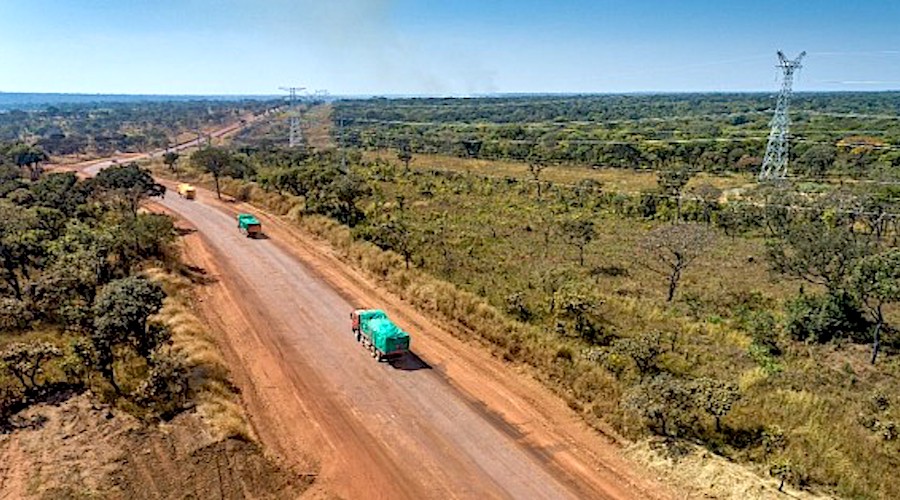
Trucks transporting bulk copper concentrate from the Kamoa-Kakula to the Lualaba smelter via by-pass road connecting the mine to Kolwezi. (Image courtesy of Ivanhoe Mines.)
Democratic Republic of Congo is preparing a one-stop agency for major mining investments as part of reforms linked to its minerals partnership with the US, aiming to cut red tape and attract more Western capital into a sector dominated by Chinese companies, four sources told Reuters.
Congo, the world’s largest cobalt producer and second-largest copper producer, is at the centre of competition among global powers seeking supplies of critical minerals vital to the energy transition and advanced manufacturing.
China, the US and the European Union have all signed minerals agreements with Kinshasa to secure access to its vast resources.
The US deal has already delivered a Washington-backed mining investment through Virtus Minerals and helped boost Congolese copper sales to US and Europe.
One-stop agency
The planned agency would be open to Chinese and other foreign investors as well as US and European firms, according to two government officials, a diplomat and a mining analyst.
The sources declined to be named because they were not authorised to speak publicly.
Congo’s mines and finance ministries did not respond to requests for comment.
The reform, led by the finance and economy ministries, would centralise company registration, licensing, taxation and compliance for major mining investments, reducing approval processes that can currently take months, said the government sources and the analyst.
One government official said the agency would initially focus on joint-venture projects worth more than $1 billion that operate under special fiscal regimes, citing the Chinese-controlled Sicomines copper and cobalt venture as an example.
The official added that legislation establishing the agency still requires promulgation.
“The one-stop shop is intended to cut through the bureaucratic silos that have long complicated mining investment in Congo,” said Eric Ndeh, international director of civil society group Afrewatch. The agency is meant to be operational this year, Ndeh added.
Congo has repeatedly said its drive to attract more Western investment is not intended to replace China but to diversify sources of funding and export markets.
“The paradox is that a reform partly driven by the US-DRC minerals partnership could ultimately make it easier for Chinese, European and American investors alike to do business,” Ndeh said.
(Reporting by Ange Adihe Kasongo and Maxwell Akalaare Adombila. Editing by Mark Potter)
Constellium may drop EU metal recycling plans due to scrap squeeze, CEO says
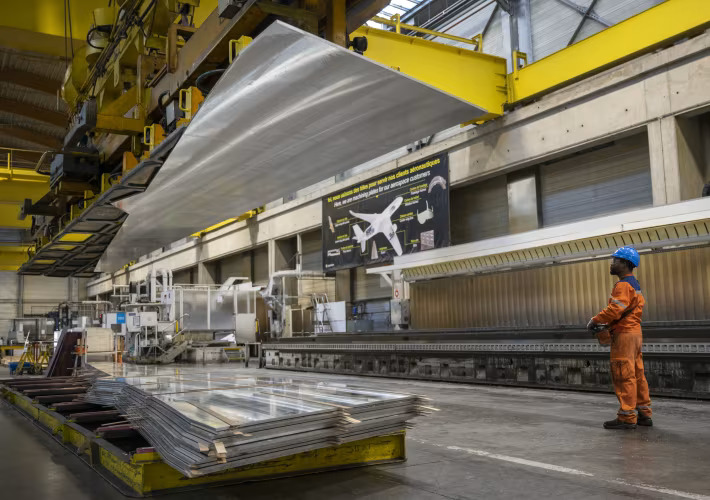
Aluminium products maker Constellium may drop plans to expand recycling in the European Union unless policymakers resolve a scrap shortfall linked to used metal being exported overseas, its CEO said on Tuesday.
The European Commission angered industry representatives this month by abandoning plans to impose an export duty on aluminium scrap, which the industry says is crucial to keeping more of the low-cost raw material in Europe. The EU’s executive is now proposing to curb scrap outflows through waste shipment rules.
Constellium, like other producers in Europe, is sceptical about the waste approach given a large number of non-OECD countries seeking exemptions, CEO Ingrid Joerg told Reuters.
“We have several recycling projects in the pipeline that we are investigating. But if there’s no scrap, they’re not going to happen,” she said.
The projects covered Constellium’s different market segments, such as packaging, auto and aerospace, and could be larger or smaller than a previous €130 million ($148.82 million) recycling expansion at its Neuf-Brisach plant in France, she said, declining further details.
Constellium recycles some of its production in a closed loop but also relies on external scrap.
The loss of scrap to exports is among grievances of an EU aluminium sector also grappling with the bloc’s carbon border-tax scheme and soaring energy prices.
Constellium welcomed changes to the carbon border levy voted by the European Parliament last week, but final adoption was needed swiftly to close loopholes, Joerg said.
The border levy is expected to push up European aluminium premiums, adding to global inflation pressures linked to energy costs, tariffs and Mideast disruption, she said.
Constellium’s US operations were benefiting overall from tariffs, with a high recycling rate and US retention of scrap offsetting the impact of tariffs on Canadian aluminium, she added.
($1 = 0.8735 euros)
(Reporting by Gus Trompiz; Additional reporting by Kate Abnett; Editing by Susan Fenton)
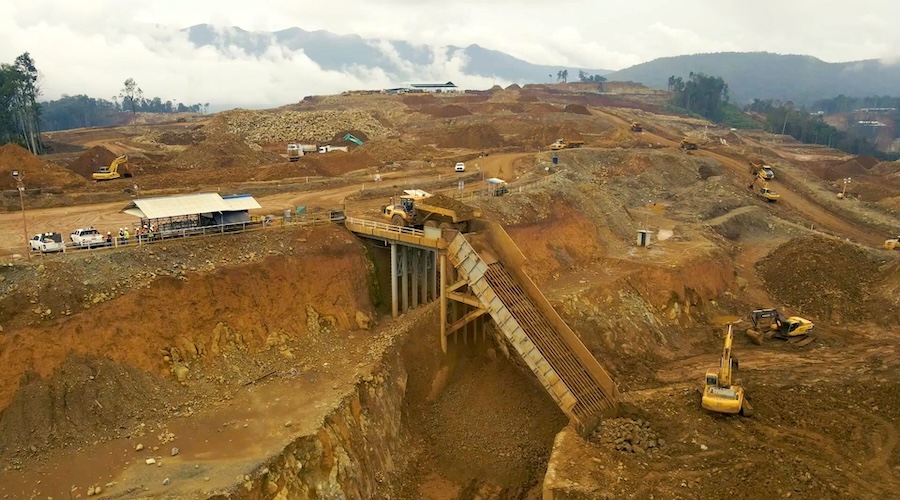
Indonesia nickel hub IMIP says nickel pig iron production cut because of water shortages
Indonesian nickel hub PT Indonesia Morowali Industrial Park (IMIP) on the island of Sulawesi said on Tuesday that a water shortage linked to this year’s El Niño weather pattern has forced some smelters to reduce their nickel pig iron production.
IMIP informed companies at the weekend that they would need to reduce production of nickel pig iron due to water shortages, Bloomberg reported on Tuesday, citing sources.
In response, IMIP spokesperson Dedy Kurniawan confirmed to Reuters that the shortage has led to the reduction of nickel pig iron production at some smelters.
IMIP has not received exact figures from tenants on the extent of the production cuts, Dedy said.
“However, the effect has not caused smelter operations to stop or even led to workforce reductions so far,” Dedy said, adding that the hub and some tenants are adjusting production targets and seeking alternative water supplies.
PT IMIP is the largest nickel-processing hub in resource-rich Indonesia and has over 50 tenants, mainly makers of nickel products used in stainless steel and EV battery materials, according to the company’s website.
Nickel pig iron, a low purity nickel metal and a key input for stainless steel, makes up the majority of Indonesia’s nickel exports.
(Reporting by Fransiska Nangoy; Writing by Stanley Widianto; Editing by David Stanway)
Zimbabwe secures funds for key commodity gateway upgrade
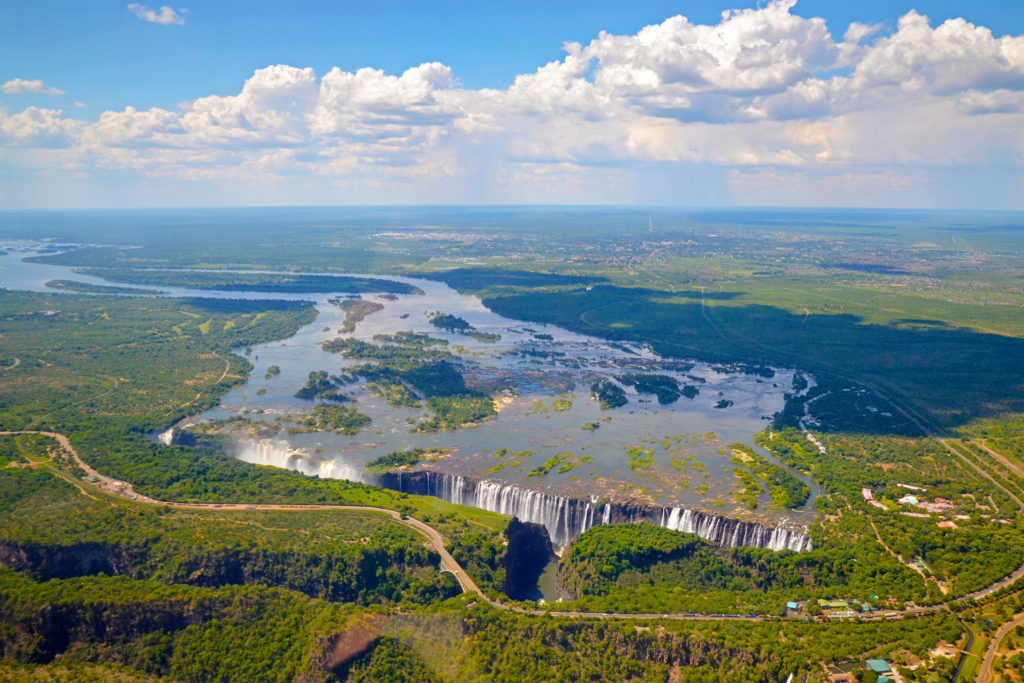
Aerial view of Victoria falls, Zambia. Stock image.
Zimbabwe’s government on Tuesday announced a funding agreement for the upgrade of the Chirundu border with Zambia, to reduce delays on a vital gateway connecting the central African copperbelt to southern African ports.
The deal between Zimbabwe and its private sector partners, the Chirundu Border Consortium, clears the path to construction work, the country’s transport and infrastructure development ministry said in a statement on Tuesday.
The Chirundu border, inaugurated as Africa’s first one-stop border post in 2009, is a key gateway on the North-South Corridor, handling freight between ports in South Africa and Mozambique and the Zambia-DRC Copperbelt.
Traffic through the crossing includes copper, cobalt, fuel, mining equipment, reagents, fertilizers and other traded goods, with trucks often facing bottlenecks and lengthy delays.
The border modernisation project will overhaul old infrastructure, introduce advanced operational and processing systems to reduce delays and congestion at one of Africa’s busiest transit points, the ministry said.
The ministry did not disclose the final investment for the public-private partnership project, but Zimbabwe’s Cabinet has previously said the project would cost $66.8 million and be operated by private investors for 20 years under a concession agreement.
Safaga International, which led the $300 million upgrade of Zimbabwe’s Beitbridge border with South Africa, is leading the Chirundu border project. South Africa’s Strategic Partners Group is also a strategic investor in the project.
Standard Bank (JSE: SBK) is the lead debt arranger and senior lender.
(Reporting by Nelson Banya, Editing by Louise Heavens)
Mining companies built ‘mini armies’ in risky regions: expert
Drilling at Yalea Ridge on the Loulo permit in Mali. (Image courtesy of Barrick Mining .)
Mining companies operating in unstable parts of West Africa have effectively created their own security forces as governments lose control of territory, according to George McLeod, a partner at Critical Risk Team.
In countries such as Burkina Faso and Mali where local governments seem to lose their power, mining companies are able to create their own security strategies to keep operations going no matter who has the power, McLeod told host Adrian Pocobelli on the latest episode of The Northern Miner Podcast.
“What the mining companies have done is turn their mines into many states. Rather than relying on the degrading local militaries, they basically created their own mini armies of security,” McLeod said.
“On a broader level, mining companies don’t necessarily do badly in this type of situation. In a situation where the central government is crumbling and these companies have turned themselves into almost mini states, I guess it’s not really the worst situation for them,” he said. “So I’m not sure that these companies are that unhappy with the current situation.”
McLeod said governments have become almost irrelevant in some areas where mining companies operate.
“Unlike other sectors like manufacturing or services, mines really just need a reliable way to get supplies in and concentrate out; they don’t really need that much more than that,” he said. “And this is a very interesting case study in how mining companies can continue to operate, maybe even thrive in a complete and total power vacuum.”
End of China’s dominance
For McLeod, China is in its last breath of control and influence over the rare earths market and regulations.
“I would say they have at maximum about 3 years left before the west including Australia, the US and Brazil and other countries as well before they get their own refining capacity online,” he said.
China’s tightening of export controls and regulations is accelerating efforts to find alternatives, while technological changes could reduce demand for some rare earths, McLeod said.
“It’s sort of their last gasp before they lose control over this very important segment. There’s substitution taking effect, other technologies being used in electric vehicles that would completely bypass rare earths,” he said. “So given the way the mining sector works and we all know that this has happened in past cycles you know once everybody gets these new processing and mining operations online, then it moves to the opposite situation of a plot.”