Monday, June 08, 2026

Mainers Donate to and Rally With Platner After Reporting on Past Relationships

“If Graham Platner and all of you find a way to build that redemption through this campaign,” Congressman Ro Khanna told a Maine crowd, “maybe you would show a way for this country to start to redeem itself.”


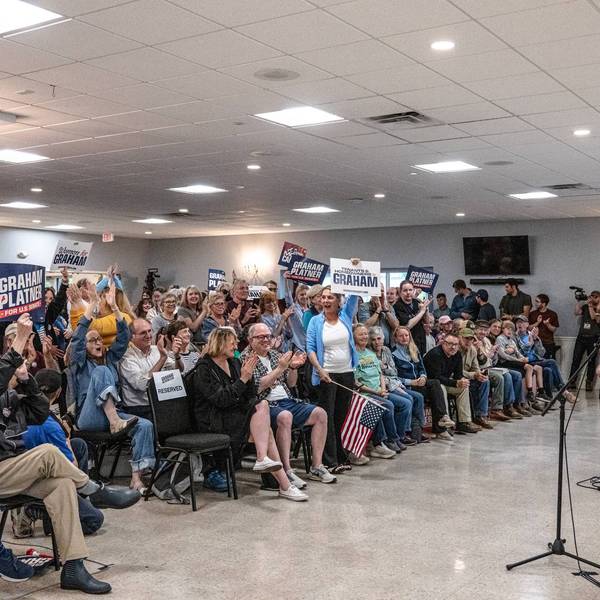
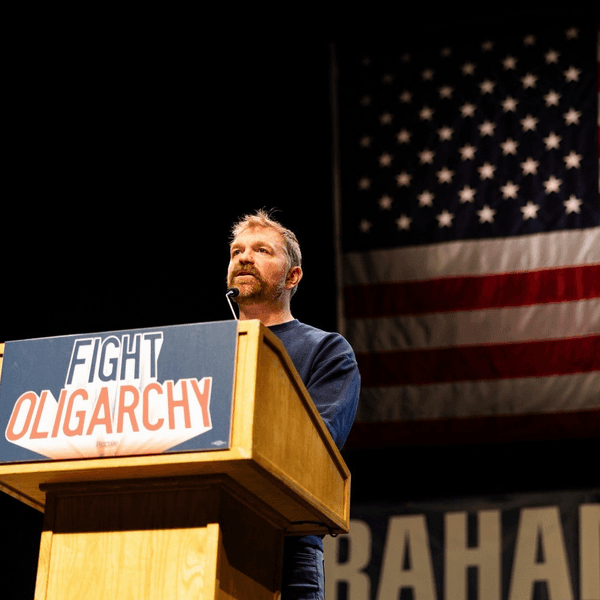
Graham Platner, a Democrat running for US Senate in Maine, speaks to a crowd in Bar Harbor on June 5, 2025.
(Photo by Andrew Estey/Graham for Maine)

Jessica Corbett
Jun 07, 2026
COMMON DREAM


Since The New York Times on Thursday published reporting about some of US Senate candidate Graham Platner’s past relationships—including allegations of physical aggression that the Democrat denied—Mainers have continued to rally with and donate to the political newcomer’s disruptive campaign, which has focused on promoting working-class priorities and defeating the oligarchy.

Maine’s primary is on Tuesday, but Platner has been the presumptive Democratic nominee to challenge Republican Sen. Susan Collins in November since Gov. Janet Mills suspended her campaign over a month ago, citing a lack of financial resources.


Calling Attacks on Platner ‘Politics as Usual’, Mainers Say They Have Back of Working-Class Champion


Platner Campaign Says Fundraising Up, Polling Lead Over Collins Holding, Despite Latest Smear Effort

In the wake of the Times reporting, Platner “raised more money than on any day since Gov. Mills’ withdrawal from the race,” according to his campaign. Specifically, as of 7:00 pm ET Friday, the 41-year-old oyster farmer and combat veteran had collected “over $200,000, from over 5,000 donors, with an average contribution of $40.”

A Graham for Maine spokesperson said in a statement that “the people of Maine know what’s on the ballot Tuesday: not Graham Platner’s past, but whether their voice in the Senate works for them—or billionaires and special interests.”

The Times spoke with more than two dozen people, including six women who had been romantically involved with Platner. The interviews arranged by his campaign were with three exes who now support his candidacy. The other three “offered a far more complicated assessment, describing volatile and ‘toxic’ relationships that were unsettling and at times emotionally wrenching.”

Much of the coverage and commentary has focused on Lyndsey Fifield, who dated Platner from roughly 2013-15. The 40-year-old previously worked for former Republican South Carolina Gov. Nikki Haley’s 2024 presidential campaign and right-wing organizations such as the Heritage Foundation, the US Chamber of Commerce, the Independent Women’s Forum, and Ladies for Kavanaugh—a group she co-founded to support the US Supreme Court nomination of Brett Kavanaugh, who faced sexual misconduct allegations but was still confirmed as a justice by a majority of senators, including Collins.

“I know it looks like a bitter ex-girlfriend Republican trying to take down a Democrat—it has nothing to do with that,” she told the Times. “If he was running as a Republican, I would be doing this exact same thing.”

Fifield said that Platner’s offensive posts on Reddit—an early controversy in his campaign—“reminded me of just how much he hated women,” and she challenged his insistence that he did not know the skull and crossbones tattoo he got with fellow Marines in Croatia closely resembled a Nazi symbol until last fall, when it became another campaign controversy, and he got it covered up.

According to the Times:
Mr. Platner could be rough with her, Ms. Fifield said, particularly when they were drinking, leaving her shaken and sometimes afraid. In the interviews, Ms. Fifield grappled with how to process her experiences. She was quick to note that he “never hit me, he never punched me.”

But she said he regularly grabbed her by the shoulders—sometimes hard enough to leave marks—and, on one occasion, yanked her out of a cab by her wrist after an argument when she wanted to stay in the car.

During one argument, she recalled, he twisted her arm behind her back, shoved her into a bedroom, and held the door closed from the other side so she couldn’t get out, telling her to remain there until she was “calm.” Eventually, Ms. Fifield said, she fell asleep and left the next morning.

“It hurt,” she said. But she added: “It didn’t cause an injury, it didn’t break my arm.”

Platner acknowledged to the newspaper that he had “too often self-medicated with alcohol, and was a far from perfect boyfriend” during what he called a “very dark period of my life,” but he also strongly denied any claims of physical intimidation or altercations with past partners or knowing about the tattoo’s Nazi ties.

Phil Proschko, who served with Platner in the Marines and also got the symbol tattooed on him, said in a brief interview with Zeteo on Friday: “No, we did not purposely get hateful fucking shit because we’re racist people... We got matching tattoos because we were in our 20s, drunk in Croatia, and that’s it. That’s all that fucking happened.”

Platner reiterated his responses to the Times during a nearly 25-minute interview with Chris Hayes on MS NOW. After the host read portions of Fifield’s allegations, Platner said that “anything alleging physicality” and “anything alleging that I knew what my tattoo was” is “simply not true,” and is coming from “someone who’s politically motivated.”

“I’ve been very upfront since the beginning of this campaign that that was a pretty dark period of my life after I came back from my combat service,” added Platner, a veteran of the Afghanistan and Iraq wars.

Hayes also invited the candidate to discuss reporting by the Times and The Wall Street Journal late last month that during an internal vetting process, Platner’s wife, Amy Gertner, told campaign staff that he had exchanged sexual messages with multiple other women early in their marriage, and they had addressed it in counseling—plus Gertner’s video response supporting her husband, which Platner shared on social media.


Since Thursday, some have criticized the Times, with reporters from other outlets saying that the paper “breezed past” the full scope of Fifield’s right-wing work history for an article seen by critics as “a hit job against an anti-oligarchy, anti-Israel populist.”

Fifield also spoke out against the final product, writing in a long social media post on Friday that “it dawned on me that this really was a setup all along. The journalists I trusted who convinced me to share a story I never wanted to tell methodically delayed and twisted this into a gift to the Platner campaign.”

Responding to Fifield’s post, a spokesperson for the Times told Newsweek: “We published accounts provided by several women who were in romantic relationships with Graham Platner. Our story accurately presents each of these accounts as told to our reporters and according to our standards. We stand by our reporting of the accounts from Ms. Fifield and the other women, who provided a revealing look at the behavior of a major candidate for the US Senate.”

After the sexting reports, Mills said that “people have the impression that I ‘withdrew’ or ‘dropped out,’ but I simply suspended active campaigning. I am still on the ballot.” The newer reporting on Platner’s exes has directed fresh attention toward the governor.

As NBC News detailed late Friday:
A source close to Mills told NBC News: “The governor remains on the ballot, and in the wake of this week’s stories, people across Maine are reaching out to tell her they’re voting for her and encouraging her to get fully back into the race.”

One Democrat who had been involved in Mills’ campaign said she would move forward anew only if Platner were to step aside, not to challenge him. The Democrat said losing to him “especially now” would serve as an embarrassment to the outgoing governor.

That person, and others, noted that Tuesday’s primary was not the deadline they are looking at, but rather a mid-July deadline under state law. That’s when Platner would have to step aside to be replaced as the nominee.

Platner made clear during his interview with Hayes that he hasn’t considered stepping aside, and since the Times’ Thursday reporting, MS NOW and Fox News have spoken with various voters on Maine streets who continue to back the candidate:


Platner has stayed on the campaign trail, joining Maine gubernatorial candidate Troy Jackson; Matt Dunlap, who is running for the state’s 2nd Congressional District; and Congressman Ro Khanna (D-Calif.), a potential 2028 presidential candidate, for a “Changing the Tides” rally in Bar Harbor on Friday.

Platner stressed that “we are up against one of the most powerful political systems in the history of the world. It is a system of billionaires and special interests. It is a system of corrupted politicians like Susan Collins... who for years has given us some charade that she’s a moderate, that she stands up against her party, that she cares more about her constituents more than she cares about those that donate money to her. We see through it.”

He also addressed the various controversies throughout his campaign, saying: “Since the beginning, Maine, you had my back. When hurtful things I said on the internet a decade ago came out into the public, as I shared my personal journey through PTSD and darkness, of recovery and accountability and growth, Maine had my back.”

“Now, as every single piece of that past and journey gets dug up, litigated, and weaponized, you have my back,” he told a cheering crowd. “And when politically motivated, serious, and false accusations are made against me, Maine, you have my back. The state of Maine raised me, and the state of Maine saved me. And to all of you out there, Maine, I will always have your back.”


Meanwhile, Khanna, a Philadelphia-born son of immigrants, said during the event that “sometimes I think we’re broken right now as a country,” with so many Americans who “feel unseen, unheard, undervalued.”

“We can barely talk to each other. Sometimes it feels like we’re having different conversations, even about the situation we see with Graham and Amy... no ability to have dialogue,” he continued. “For this country to heal, we need to find some way of having grace. We need to find some way of having redemption. We need to find some way of saying that if someone... felt hurt by Graham in a past relationship, we can listen to them, and we can listen to Graham, and we can have conversations as mature Americans, as fellow citizens.”

“If Graham Platner and all of you find a way to build that redemption through this campaign, through this transformation,” he added, “maybe you would show a way for this country to start to redeem itself, because we sure need that as we approach this 250th anniversary.”

From Senate Minority Leader Chuck Schumer (D-NY), who initially backed Mills in the Maine primary, to Sen. Bernie Sanders (I-Vt.), an early supporter of Platner who caucuses with Democrats and twice sought their presidential nomination, the party “is united” behind “a single goal,” Khanna also told the crowd. “We will defeat Susan Collins in November.”

Sanders renewed his support for Platner in a Saturday social media post highlighting key campaign issues:


US Sen. Brian Schatz (D-Hawaii) is set to help rally donors for Platner during a virtual event on Sunday. As Politico noted: “The event is the first public stamp of approval from Schatz, who has not endorsed Platner previously. Making it even more notable is Schatz’s status as a rising leader in the party: He is currently deputy conference secretary and chief deputy whip for the Senate Democratic Caucus, and he has secured the votes—and Chuck Schumer’s endorsement—to take over the No. 2 role next year.”
‘Now Is the Time to Organize,’ Says Medicare for All Coalition

“The American people are hungry for bold ideas that reform fundamental institutions that have failed them for too long. And they are looking for leaders who will take on powerful interests and fight for working people.”


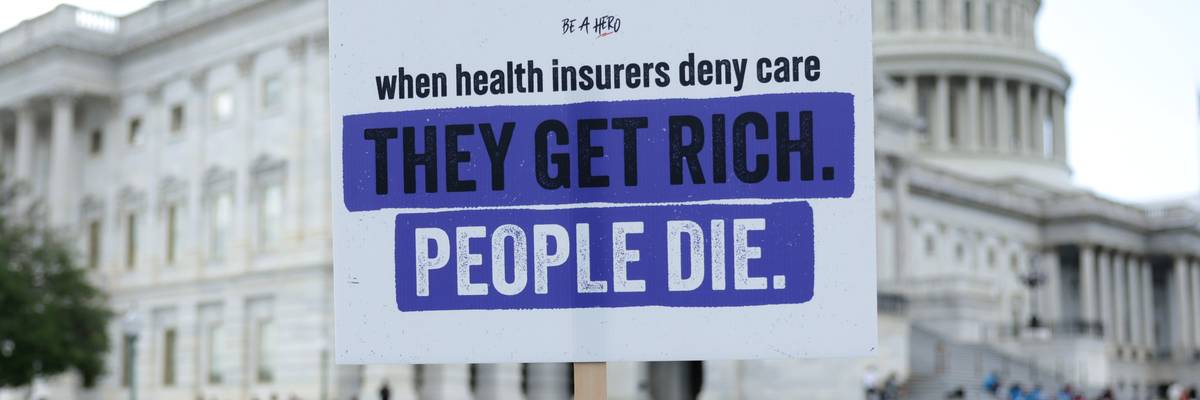
An advocate holds a sign during a news conference on Medicare Advantage plans in front of the US Capitol on July 25, 2023 in Washington, DC.
(Photo: Alex Wong/Getty Images)

Jessica Corbett
Jun 08, 2026
COMMON DREAMS

As Americans endure the high prices of food, gasoline, housing, medication, and more under President Donald Trump and the Republican-controlled Congress, a coalition of over 325 organizations argued Monday that “now is the time for Medicare for All.”

“Our democracy is struggling, and the status quo is not working. Too many corporate-backed politicians continue to push for a ‘business as usual’ approach while wages stagnate, public goods and services erode, and billionaires amass grotesque amounts of wealth,” says the coalition’s open letter.

“How can one feel optimism for our future when over 40% of us are carrying around the burden of medical debt?” the letter asks, citing data from KFF. “How can we plan for our futures when we can’t afford to go to the doctor or cover rent?”

According to the coalition:
We need an agenda that working-class people and everyday Americans can rally behind. Without one, far-right, fascist politicians are filling that void. This fascist agenda redirects people’s rightful anger at our system’s failures to unjustly place blame on immigrants, low-income people, and people of color. It’s time to acknowledge that failing to provide transformational policies and hope to the working class has allowed fascism to rise and hold on to power. It’s time to challenge the corrupt CEOs who profit off despair. To show people real solutions that can work.

No one can fix our rigged economy overnight. Our structural inequality is decades in the making. But one piece of the solution is to take on one of the largest industries in our country: healthcare.


On Capitol Hill, Sen. Bernie Sanders (I-Vt.) and Reps. Pramila Jayapal (D-Wash.) and Debbie Dingell (D-Mich.) have repeatedly introduced the Medicare for All Act. While support for the bill among elected Democrats and the US public has grown, the legislation hasn’t progressed in either chamber, which are both narrowly controlled by the GOP.

However, “we may face a once-in-a-generation opportunity to legislate on healthcare in 2029,” notes the letter. While the midterms are less than five months away, enacting a federal Medicare for All system would likely require electing more members of Congress and a new president who would support such legislation in the November 2028 election.

“We need to rally behind the boldest possible reform, Medicare for All, that brings together the broadest possible movement, not overly complex incremental measures that prop up the same systems we’re seeing fail under the weight of attacks by Trump and Republicans,” the groups argued. “The American people are hungry for bold ideas that reform fundamental institutions that have failed them for too long. And they are looking for leaders who will take on powerful interests and fight for working people.”

“Now is the time to organize and inspire!” the coalition stressed. “A small minority of skeptical healthcare policy wonks may try to convince us to scale back, that structural change isn’t winnable. The reality is that alternative proposals don’t move us towards Medicare for All and complicate our already broken system. Halfway measures allow corporations to continue profiting off the sick.”


The letter urges members of Congress “to stop listening to the political consultants and start listening to the people,” and Americans nationwide to “join us in dreaming of an economy that works for all of us. Where workers get paid a living wage and have expanded and enforced rights. A future where people can afford safe, healthy, and affordable housing and utilities. Where schools are robustly funded.”

“A core part of that vision is making healthcare a human right,” the letter emphasizes. “Americans understand we must get corporate greed out of our healthcare system once and for all.”

The letter was circulated Monday by the consumer watchdog Public Citizen, whose healthcare policy advocate, Eagan Kemp, said in a statement that “the massive momentum for Medicare for All should serve as a wake-up call to all who profit from our broken healthcare system and those who do their bidding.”

“Everyday Americans are tired of watching the pigs at the healthcare trough gorge themselves day after day while hundreds of millions of people in the wealthiest country in the world suffer from inadequate access to care, delays and denials, and crushing medical debt,” Kemp argued. “Medicare for All would end the ability of corporations to put greed ahead of people’s needs and would finally guarantee that everyone in the US can get the care they require.”

“The movement for Medicare for All is growing by leaps and bounds because the people are demanding change,” he added. “It is time those in power meet the moment and fight for the healthcare system we need and that the people are demanding, Medicare for All.”

Coalition members include the Democratic Socialists of America, Indivisible, MoveOn, National Nurses United, National Organization for Women, One Fair Wage, Our Revolution, People’s Action Institute, Physicians for a National Health Program, Progressive Democrats of America, RootsAction, Sunrise Movement, United We Dream Action, and other organizations that advocate for people with disabilities, seniors, women’s rights, workers, and more.


Senate Dems Demand Release of Legal Opinion Behind Trump Lie That Iran War Has ‘Terminated’

“Is there something in the rationale they don’t want us to see?” asked Sen. Tim Kaine.


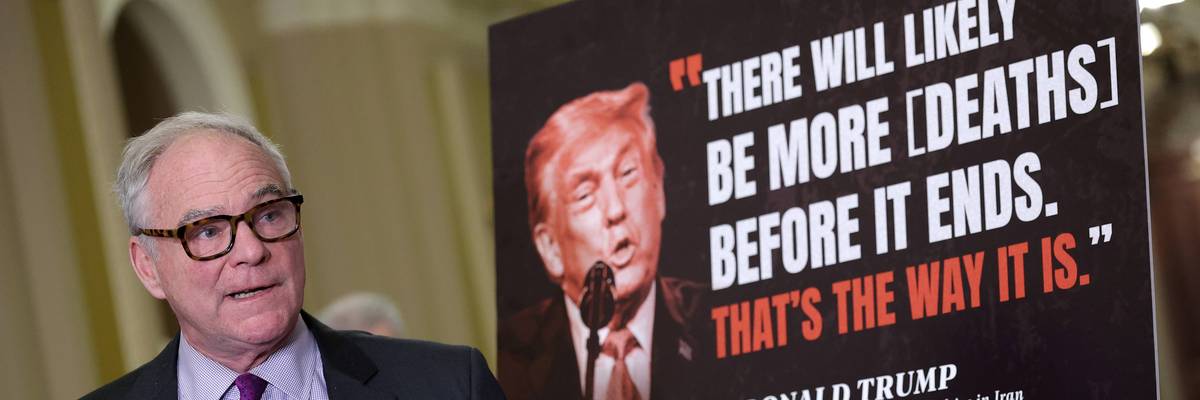
US Sen. Tim Kaine (D-Va.) speaks to reporters following the weekly Senate Democrat policy luncheon at the US Capitol on March 3, 2026 in Washington, DC.
(Photo by Kevin Dietsch/Getty Images)

Jake Johnson
Jun 08, 2026
COMMON DREAMS


As a fresh exchange of attacks between Israel and Iran over the weekend and into Monday threatened to plunge the region deeper into war, dozens of Democrats in the US Senate are demanding that the Trump administration publicly release its legal justification for declaring the war “terminated.”

“The ongoing naval operations and related efforts to conduct a blockade against Iran constitute hostilities,” the Democratic lawmakers wrote in a letter to President Donald Trump on Sunday. “Furthermore, the United States and Iran, and their associated partners and proxies, have continued to use lethal force in contravention of the ceasefire, which also constitute hostilities.”

Trump claimed in a notification to Congress in early May that the “hostilities” he launched against Iran in late February—without approval from lawmakers as required under the US Constitution and War Powers Resolution of 1973—have “terminated” due to the ceasefire deal reached in April. Trump administration officials have also asserted that the truce, which critics have said is a ceasefire in name only, paused the WPR’s 60-day clock, after which the president is required to immediately withdraw US forces from hostilities.

The Democratic lawmakers—led by Sens. Adam Schiff (Calif.), Tim Kaine (Va.), and Chuck Schumer (NY)—wrote in their Sunday letter that “we would not need to discuss the War Powers Resolution if this were a war authorized by Congress, but it is not.” The senators demanded the release of the Office of Legal Counsel (OLC) opinion underlying the administration’s claim that the Iran war has “terminated,” along with any other relevant documentation.

“Your administration has not explained to the Congress or the American people why you believe the Constitution permits launching a war of this magnitude—including the loss of US servicemembers’ lives, scores of civilians killed in Iran and the broader region, and staggering economic and geopolitical costs—without authorization from Congress as Article I requires,” the senators wrote. “The facts, history, and law affirm that the hostilities that began on February 28 are active and ongoing, in violation of international law and the War Powers Resolution of 1973.”

The letter was sent days after the House of Representatives approved a war powers resolution aimed at pushing Trump to end the Iran war, which has roiled global energy markets, threatened a global food crisis, and driven up costs in across the US economy. Three Republicans broke ranks to support the resolution.

The House-approved measure was a “concurrent resolution,” meaning it would not have the force of law even if the GOP-controlled Senate also passed it. In May, the Senate advanced a separate resolution led by Kaine that would have legal force, but Trump would be able to veto the measure if it reached his desk.

During a Senate hearing last week, Kaine pressed US Secretary of State Marco Rubio on why the administration has not allowed lawmakers to review the OLC’s formal legal opinions pertaining to the Iran war.

“Is there something in the rationale they don’t want us to see?” Kaine asked.
‘Schumer Is Far Out of Touch’: 80% of New York Democrats Oppose US Weapons Transfers to Israel

“If current party leadership is unwilling to represent their own voters and the majority of Americans, then it is time for new leadership.”


Senate Minority Leader Chuck Schumer (D-NY) speaks during the Senate Democrats’ news conference in the US Capitol on April 14, 2026.
(Photo by Bill Clark/CQ-Roll Call, Inc via Getty Images)

Jake Johnson
Jun 08, 2026
COMMON DREAMS

A poll released Monday shows that around 80% of Democratic voters in New York oppose US weapons transfers to Israel, putting Senate Minority Leader Chuck Schumer—a stalwart supporter of Israel—way out of step with his voter base.

The survey, conducted by Data for Progress and published by the Institute for Middle East Understanding (IMEU) Policy Project, found that 82% of New York Democrats—and 60% of the state’s voters overall—believe the US “should restrict taxpayer-funded weapons to Israel until it stops attacking civilians in Gaza.” The poll also found that 76% of Democratic voters in the state would favor the US Senate voting to halt the transfer of US bombs to Israel, which has repeatedly used American weaponry to commit grave war crimes.

The poll was conducted roughly a month after Schumer and Sen. Kirsten Gillibrand (D-NY) broke with the overwhelming majority of their Democratic colleagues in voting against two resolutions aimed at blocking Trump administration sales of 1,000-pound bombs and bulldozers to the Israeli government.

The resolutions were spearheaded by Sen. Bernie Sanders (I-Vt.), who polled more favorably than Schumer among New York voters overall—as did New York City Mayor Zohran Mamdani and Rep. Alexandria Ocasio-Cortez (D-NY), who has been floated as a possible primary challenger to Schumer in 2028.

“New York State voters, especially Democrats, aren’t being represented by their senators,” the IMEU Policy Project wrote on social media, adding that “Schumer is far out of touch with New York voters on funding Israel.”

A majority of New York voters (51%), and 70% of Democrats, believe Israel is committing genocide in Gaza, according to the new poll, a position that Schumer has rejected—putting him in conflict with both his own constituents and leading Holocaust scholars and human rights organizations.

“When Sens. Chuck Schumer and Kirsten Gillibrand voted against blocking the bombs and bulldozers Israel is using to destroy Palestinian and Lebanese homes, they were not just voting against the vast majority of their own Senate caucus and Democratic voters, but they were voting against the majority of New Yorkers they’re elected to represent,” Margaret DeReus, the IMEU Policy Project’s executive director, said in a statement. “If current party leadership is unwilling to represent their own voters and the majority of Americans, then it is time for new leadership.”
‘Unsettling’ Accounts of HHS Leadership Fuel Calls for RFK Jr. to Resign

“Every day that goes by without Secretary Kennedy’s long overdue resignation is a day American lives are put further in harm’s way,” said the director of Protect Our Care’s Public Health Project.


US Health and Human Services Secretary Robert F. Kennedy Jr. testifies during a Senate Finance Committee hearing on April 22, 2026 in Washington, DC.
(Photo by Heather Diehl/Getty Images)

Jessica Corbett
Jun 07, 2026
COMMON DREAMS


While public health advocates have sounded the alarm about Robert F. Kennedy Jr. since senators confirmed President Donald Trump’s “profoundly unqualified” nominee to lead the US Department of Health and Human Services over a year ago, The New York Times’ Sunday reporting on his job performance at HHS sparked fresh calls for his resignation.

HHS “affects the health of 340 million Americans and provides healthcare to 40% of the population through Medicare and Medicaid,” explained the Times, which interviewed a dozen people who have had contact with Kennedy as secretary and other department employees. His nearly 16-month tenure has already featured a measles outbreak that killed two children in Texas last year, the recent hantavirus cases among cruise passengers, and the ongoing Ebola crisis in Africa.


As the newspaper detailed:
Mr. Kennedy has shown little interest in managing the details of work in his department, according to multiple colleagues. Instead, they say, he is single-mindedly focused on his top priorities, including food recommendations and pesticide exposures, and hunting for evidence to support his long-held beliefs that vaccines are harmful.

Deeply mistrustful of career civil officials, the secretary has surrounded himself with a close circle of handpicked advisers and stacked agencies with political appointees aligned with his views. While major posts have sat vacant and a wave of veteran health experts and scientists have departed, Mr. Kennedy has remained isolated from much of the department’s top staff.

The paper highlighted the National Institutes of Health posts held by acting directors as well as the lack of a surgeon general (Trump’s picks keep stalling in the GOP-controlled Senate), Food and Drug Administration commissioner (Marty Makary resigned in May, reportedly over a controversial vape policy sought by Big Tobacco), and Centers for Disease Control and Prevention chief (Kennedy fired CDC’s Susan Monarez in August after they clashed on vaccine policy, which led other officials to step down). Courtney Spencer, the secretary’s newly appointed top spokesperson, claimed that the department is “aggressively recruiting top talent to fill every remaining vacancy.”

As for Kennedy’s schedule when he’s in Washington, DC, “he spends much of his day in closed-door meetings, according to those who work with him, and has little direct engagement with his staff,” the Times reported. Sources pointed to his history of skipping gatherings with the leaders of the department’s 13 operating divisions, and some described him as “checked out.”


White House spokesperson Kush Desai signaled support for the Trump appointee’s performance so far, telling the Times that the department’s “rapid and comprehensive response” to the Ebola outbreak proved that “under Secretary Kennedy’s leadership, HHS continues to safeguard the health and wellness of the American people.”

However, Kayla Hancock, director of Protect Our Care’s Public Health Project, said in a statement that “accounts from within the Trump HHS paint an unsettling picture of RFK Jr.'s absentee leadership amid public health crises both present and looming.”

“Trump’s health secretary hasn’t stepped foot inside the CDC in nearly a year despite historic measles outbreaks inflamed by his own anti-vax propaganda,” she stressed, summarizing the reporting. “When Kennedy does show up to the HHS office—typically for just six hours a day, which must be nice—he isolates himself from top staff and ignores lawmaker requests for months on end.”

Hancock noted that “while Kennedy can’t be bothered to involve himself in spiraling health threats like Ebola, he finds plenty of time to do a shirtless photo spread with Kid Rock, babble for hours on... his taxpayer-funded vanity podcast on topics like teen sperm, and orchestrate a wasteful department-wide fishing expedition for any data he can use to breathe life into his debunked anti-vax agenda.”

“Worse, while RFK Jr. is unwilling to do his job, he’s perpetuated a dangerous HHS leadership void for months, refusing to fill vital roles with actual competent, qualified people who would pick up his slack,” she added. “Every day that goes by without Secretary Kennedy’s long overdue resignation is a day American lives are put further in harm’s way.”


The reporting builds on warnings from experts since Kennedy took over HHS. Last September, nearly every living former director or acting director of CDC jointly argued in the Times that RFK Jr. “is endangering every American’s health.” The following month, six previous US surgeons general collectively wrote in The Washington Post that they had a duty to alert Americans that Kennedy is a danger to public health. In February, The Lancet, one of the world’s most prestigious medical journals, marked his “one year of failure” with an editorial cataloging his broken promises and “destruction that... might take generations to repair.”

Journalist Seth Abramson‬ ‪responded to the Times article with a new warning: “Do not doubt that if a major pandemic hits, millions of Americans will die because of this grotesque man. *Millions*. And not a single person in America better say that we didn’t know it was coming. The alarm bells have been ringing nonstop that this sick buffoon is going to kill innocent people.”

Thousands March in Albania After PM Says Pristine Land ‘Belongs’ to Kushner-Backed Group

“One week later, we are still here, stronger than yesterday,” said one group opposing a proposed luxury resort project supported by Jared Kushner.


An aerial view shows a large crowd of protesters gathered outside the prime minister’s office in Tirana, Albania on June 7, 2026.

(Photo by Vlasov Sulaj/NurPhoto via Getty Images)


Jake Johnson
Jun 08, 2026

Albanians took to the streets in droves for the eighth consecutive day on Sunday to protest a proposed $1.6 billion luxury resort complex backed by US President Donald Trump’s son-in-law, Jared Kushner, one of several investors in the project, which opponents say is both corrupt and disastrous for wetlands and wildlife.

“One week later, we are still here, stronger than yesterday,” said the Albanian Ornithological Society, a leading critic of the proposed development. “Millions around the world are united in one voice for nature, for justice, and for the protection of what belongs to everyone, standing for every protected area in Albania.”


‘Nation is Not For Sale’: Thousands of Albanians Protest Kushner Resort Plans in Protected Wetland

Albanian Prime Minister Edi Rama has vocally defended the project amid mounting public backlash, saying in a recent interview that the land marked for development “belongs to the investors,” not the Albanian people.

Rama also criticized the thousands of people who have turned out to protest the luxury hotel project as well as international media coverage of the demonstrations, saying that “there is no chance” that “the projects in Albania will be defined by street protests.”


Demonstrators, many raising pink flamingo cutouts to decry the project’s expected impacts on the vulnerable bird and other wildlife, have demanded cancellation of the resort project and Rama’s resignation, accusing him of steamrolling environmental concerns to bolster the country’s tourism industry and curry favor with the Trump administration. Kushner currently works for the administration as a “special peace envoy.”

“We are stronger than your bulldozers,” chanted demonstrators over the weekend.


As The New York Times reported last year, Rama heads the government committee that gave “Kushner and his business partners the right to move ahead with accelerated negotiations to build the luxury resort on a 111-acre section of the 2.2-square-mile island of Sazan that will be connected by ferry to the mainland.”

“Mr. Kushner’s Affinity Partners, a private equity company backed with about $4.6 billion in money mostly from Saudi Arabia and other Middle East sovereign wealth funds, is pursuing the Albania project along with Asher Abehsera, a real estate executive that Mr. Kushner has previously teamed up with to build projects in Brooklyn, New York,” the Times added.

Lea Ypi, an Albanian academic, wrote in an op-ed for The Guardian on Monday that “Albanians know that real-estate speculation without state support means ordinary citizens will struggle to buy a flat or pay the rent.”

“They know that luxury tourism means holidays in your own country become a privilege for the few,” Ypi added. “With no unions to speak of and a labor movement that only appears in communist-era footage of May Day parades, work conditions are so exploitative that only those from countries even more desperate are willing to take the jobs that arise.”
‘We’ve Been Four Days Without Light’: Cubans Describe Suffering After Four-Month US Oil Blockade

The oil embargo has also devastated Cuba’s tourism industry, with multiple international hotel chains abandoning the country.


Residents collect water from tanker trucks and carry containers through the streets amid widespread shortages in Havana, Cuba, on June 5, 2026.
(Photo by Magdalena Chodownik/Anadolu via Getty Images)


Brad Reed
Jun 08, 2026
COMMON DREAMS

The US military for the last four months has been blockading oil shipments from entering Cuba, and residents living on the island are saying the situation is growing increasingly dire.

In a Monday report from The Guardian, several Cubans described how their lives have been thrown into turmoil by the Trump administration’s oil blockade, which began shortly after the US military invaded Venezuela and abducted President Nicolás Maduro earlier this year.

As noted by The Guardian, Cuba’s gas stations have now been empty for months because of the blockade, and the state’s power company struggles to keep electricity on for even a few hours every day.

One unnamed doctor in Havana who spoke to The Guardian said that “we’ve been four days without light” in his apartment building, and warned that the fuel shortages would cause even more severe crises on the island the longer they persist.

“Without electricity, water is also a problem,” the doctor said. “And there are mosquitoes everywhere.”

Havana resident Martha Pérez told The Guardian that she has had to buy gas from “an online supermarket,” but added that “the price is US$29 a bottle when it used to be just a few cents when I bought it from the state.”

As reported by The Associated Press on Monday, Cubans have been buying fuel on the black market at exorbitant prices that most people cannot afford.

Rather than pay such high sums for gas, many Cubans have simply given up driving all together.

Auto body shop owner Diriel Valdez told the AP that his business has been severely hurt by the oil embargo because Cubans aren’t bothering to have their cars maintained or repaired amidst the fuel shortages.

“People don’t want to do major repairs anymore,” Valdez said. “A lot of them have their cars parked. They don’t have much hope that they’ll be circulating the way they used to.”

Adding to the economic misery, The Wall Street Journal reported on Saturday that many international businesses that have operated in Cuba for years are now pulling out due to the cost of maintaining operations.

The oil embargo has been particularly harsh on Cuba’s tourism industry, and the Journal reported that “Spanish hotel giants Iberostar and Meliá have said they are giving up management of at least a dozen Cuban hotels each,” while “Royalton Hotels & Resorts, a Canadian operator, ceased operations after grappling with a collapse in tourism.”


Trump Can’t End His Disastrous War Against Iran Until He Gets Israel Under Control

The rapid return to war over recent days is a stark reminder that, while the US chose how to start this conflict, it has only one vote on how to end it.


A woman passes in front of an anti-American mural on April 12, 2026 in Tehran, Iran. On April 8 President Donald Trump announced a two-week ceasefire between the US and Iran, conditional on shipping being allowed to resume through the Strait of Hormuz. Peace talks held in Pakistan have since stalled, reportedly over Iran’s nuclear stockpile and continued blockade of the Strait of Hormuz.
(Photo by Majid Saeedi/Getty Images)


Connor Echols
Jun 08, 2026
Responsible Statecraft

Amid a rapid escalation between Israel and Iran, Yemen’s Houthis have rejoined the Iran war, launching a volley of missiles at Israel and pledging to implement a “complete and total ban” of Israeli shipping in the Red Sea. It’s safe to say that the tenuous ceasefire in the Middle East is now unraveling.

President Donald Trump demanded that all parties deescalate, writing on Truth Social Monday morning that “Final negotiations on ‘Peace’ are proceeding” so long as “ignorance or stupidity” don’t get in their way. But the latest developments suggest that the United States has limited control over the path of the conflict, which is now entering its fourth month.


After Iran struck Israel on Sunday in what Tehran described as retaliation for Israeli ceasefire violations in Lebanon, Trump publicly urged Israeli Prime Minister Benjamin Netanyahu to stand by and wait for negotiations to bear fruit. “I call the shots,” Trump told the Financial Times. “Netanyahu doesn’t call the shots.”

Just a few hours later, Israel launched strikes across Iran, hitting what it called “strategic defense systems.” Iranian officials said Israel also hit a petrochemical plant in southwestern Iran.

The rapid return to war is a stark reminder that, while the US chose how to start this conflict, it has only one vote on how to end it. Israel has shown little interest in bringing the war to a close, and many influential pro-Israel voices in the US argue that Trump must “finish the job” and overthrow the Iranian government. And, while Iran has made clear that Lebanon must be part of any ceasefire, Israeli officials remain determined to keep up the fight against Hezbollah, including through large-scale attacks on Beirut.

Trump’s public demands that Israel deescalate suggest that the US is trying to create at least some public separation between its actions and Israel’s. But Iran is weary from years of staccato conflict with Israel and determined to make the most of the leverage it has gained by blockading the Strait of Hormuz.

In practice, this means Tehran is no longer willing to distinguish between US and Israeli attacks. “No one believes the Zionist regime acts without coordination with the United States,” a spokesperson for Iran’s foreign ministry said Monday.

Still, Iran has so far avoided launching new attacks on US assets in the Middle East. This relative restraint may be due to Tehran’s desire to maintain options for future escalation. Another possible explanation is that Iran believes recent reports indicating that Trump has privately said he won’t return to war unless Tehran kills more US soldiers.

The reentry of the Houthis into the war throws an uncertain variable into these calculations. The group earned sympathy throughout the Middle East for its attacks on Israel in retaliation for alleged Israeli war crimes in Gaza. With Israeli forces bogged down on multiple fronts, the Houthis now seemingly see another opportunity to increase their legitimacy and pursue their long-standing goal of confronting Israel.

If the Houthis follow through on their threats to block Israeli shipping, then the Trump administration will face significant pressure to help Israel reopen the key strategic waterway, which is now a crucial pathway for exporting Persian Gulf oil from Arab states because of the Hormuz closure. But even the US military has shown a limited ability to force the Houthis to stand down, despite the best efforts of both the Biden and Trump administrations in recent years.

It will take time to determine the exact impact of the Houthi threats to Israeli shipping. Previous Houthi attempts to partially blockade the Red Sea have already forced many shipping companies to reroute around Africa rather than traveling through the Suez Canal. While the Houthis have generally claimed to target only Israeli ships, the group has used a broad definition to define what counts as Israeli, making it difficult for companies to determine whether they are free to pass.

Meanwhile, Iran is signaling that it wants to stop the latest round of escalation with Israel, saying in a statement Monday that it will stop its attacks so long as Israeli forces halt strikes in Lebanon. The message is clear: if Trump wants a deal with Iran, then he’ll have to restrain Israel first.


© 2023 Responsible Statecraft


Connor Echols
Connor Echols is a reporter for Responsible Statecraft. He was previously an associate editor at the Nonzero Foundation, where he co-wrote a weekly foreign policy newsletter. Echols recently completed a fellowship with the Arabic Center for Study Abroad in Amman, Jordan, and he received his bachelor's degree from Northwestern University, where he studied journalism and Middle East and North African Studies.
Full Bio >


Trump Is Trying to Shoot His Way Out of US Decline—It Won’t Work

The president wants a 50% increase over last year’s Pentagon budget, to $1.5 trillion; a wiser policy would be to rethink how the US is to co-exist with other nations in what is emerging as a multipolar world.


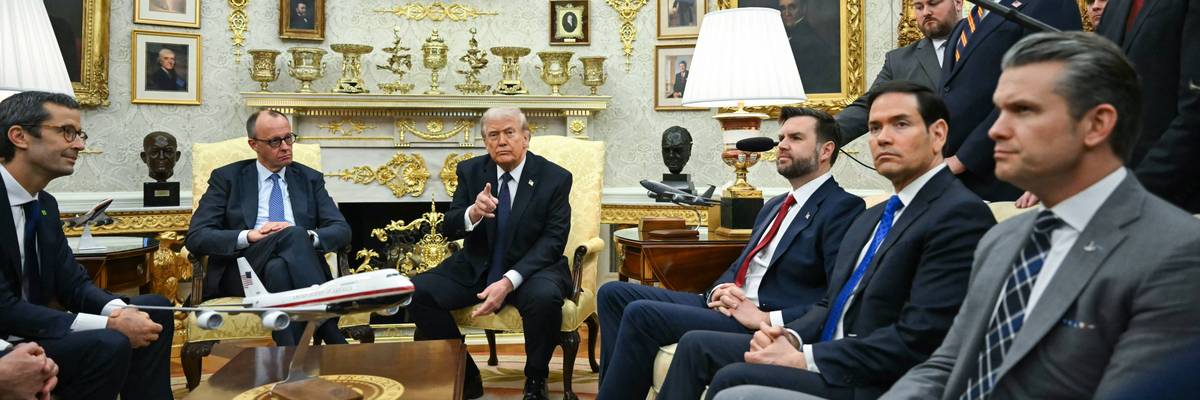
US President Donald Trump speaks during a meeting with German Chancellor Friedrich Merz in the Oval Office of the White House in Washington, DC on March 3, 2026.
(Photo by Andrew Caballero-Reynolds/ AFP via Getty Images)

Robert Freeman
Jun 08, 2026
Common Dreams

The US empire is in decline. Compare it today to where it was only 30 years ago, following the collapse of the Soviet Union. It was a “hyperpower,” then, almost inconceivably dominant with no challengers on Earth.

Since then, China has surpassed the US economically. Russia is rated No.1 militarily. The US has to borrow close to $2+ trillion per year (the annual federal budget deficit) just to keep the lights on. Its government based on checks and balances is under assault by a sleazy felon who wants to be king. It is wracked by social divisions that presage civil war.

President Donald Trump’s proposed solution to these problems is to shoot our way out. He wants a 50% increase over last year’s Pentagon budget, to $1.5 trillion. It is stupid in the measure to which it is excessive. It is suicidal to the extent it will degrade our security and our chances of improving national prosperity.

A wiser policy would be to rethink how the US is to co-exist with other nations in what is emerging as a multipolar world. That’s a big rethink. There’s another rethink coming as well: how we run the economy and what it is that actually accounts for national well-being.

The era when the US could dominate, intimidate, and expropriate the rest of the world is over. If it continues to push military power as its primary path forward it will continue to produce catastrophe.

Neither of these “rethinkings”—neither security nor the economy—will be easy. Both will go against existing failed doctrines and the powerful interests that back them. But, without doing this, we face the certainty of continuing national decline.

The highest-level rationale for rejecting a 50% increase in the Pentagon’s budget is that the military simply doesn’t win wars. Sure, it can knock off defenseless, pipsqueak principalities like Grenada, or Serbia, or Libya. But whenever it goes up against a committed adversary, especially one that fights back, it loses.

It lost in Vietnam to a nation of rice farmers that hadn’t even entered the industrial age. It killed more than 3 million Vietnamese, 4 million Southeast Asians when you count Laos and Cambodia. Yet, it lost.

It lost in Iraq, despite Iraq having been bombed for the prior decade, since the first Gulf War in 1991. Even in losing, the US killed more than a million Iraqis and spawned ISIS, one of the most virulent terrorist organizations ever let loose on the world.

It lost in Afghanistan, despite 20 years of trying to win. Afghanistan was a fourth-world country, with the Taliban literally living in caves. The Taliban had only hand-held firearms. No air force. No artillery. No satellite intelligence. The US still managed to lose.

Ukraine isn’t over, yet, but it is lost. Russia has crushed every one of the fabled “wonder weapons” the US has thrown at it. Remember when Trump was going to end the Ukraine war “on Day One”? We’re now past Day 500. It hasn’t ended because Trump is too weak to take the Loss on his watch. But it is lost.

Iran is the most recent—and damaging—case of catastrophic US military failure. It has a military budget one-one hundredth that of the US. Yet, Iran has “humiliated” the US, at least in the words of German Chancellor, Friedrich Merz. Neocon heavyweight Robert Kagan recently wrote, “It’s hard to think of a time when the United States suffered a total defeat in a conflict, a setback so decisive that the strategic loss could be neither repaired nor ignored.”

None of these outcomes are equivocal. None are ambiguous. Is that the kind of outfit we want to give a 50% raise to when it can never come close to accomplishing its essential mission? And when it never learns from its repeated failures?

This is one of the major rethinks that will have to be conducted before any thought can be given to giving even one extra dollar to the Pentagon. We need to hear from the leadership what, exactly, is going to change. And we don’t mean fiddling at the margins. We mean at the core of the institution. For example…

US weapons systems are not made to be able to win in battle. They are made to deliver maximum profits to the weapons makers. Consider…

The Patriot missile system is easily baited with low-cost drones into giving away its location and radar signature. “Here I am! Here I am!” It is then a sitting duck for cruise missiles, hypersonic missiles, even swarms of the same low-cost drones.

The HIMARS rocket launcher uses common GPS as part of its guidance system. This is easily jammed resulting in missiles sometimes landing kilometers away from their intended targets. Its greatest value might be that every battery reliably drains $20 million from US taxpayers.

The M-1 Abrams tank wears a gigantic “shoot me” sign as soon as it’s spotted by one of the Russian drones that saturate the skies over Ukraine. The phrase “Fish in a barrel” comes to mind.

The bigger problem—bigger than weapons that don’t work—is that the US economy is not set up to support sustained, high intensity warfare. It gave up that capability decades ago, when it decided to de-industrialize so its companies could make more money building their stuff in China.

This is one of the reasons the US, via its proxy, Ukraine, has not been able to defeat Russia: it simply cannot supply the amount of ammunition Ukraine would need to prevail. Russia is firing 5-10 times the amount of artillery Ukraine is, and there’s literally nothing the US can do about it.

It would take decades to rebuild the weapons-focused industrial capacity the US possessed in the 1960s. Given the failure of the larger military enterprise in the US, there is no certainty that, once delivered, it would not be ill-conceived, misdirected, or already obsolete. In fact, given the Pentagon’s track record, the likelihood is that it would be all three.

The deepest problem for the US in grappling with increased Pentagon funding is rooted in its world view.

That was formed in the aftermath of World War II and reinforced following the collapse of the Soviet Union, in 1991. After both events, the US stood astride the world like a colossus, unchallenged in its ability to destroy any other country. Heady stuff but the world doesn’t sit still.

Countries do not acquiesce in their own destruction. They organize themselves to fight back; they collaborate with other countries for collective self-defense; and they employ asymmetric strategies to defeat predators, as Vietnam and Afghanistan did, and as Iran has just done. The US military hasn’t gotten the memo.

The unprovoked Iran debacle has boosted the fortunes of Russia and China, the US’ principal rivals. It has elevated Iran to being the hegemon in the Persian Gulf. That rise is abetted by a quartet of Islamic powers that are tired of US and Israeli bullying: Pakistan, Turkey, Egypt, and Saudi Arabia. They are forming an “Islamic NATO” to keep the US and Israel out of the Gulf. This is super important.

Since World War II, the Middle East has been one of the most important regions in the world because of its vast oil wealth. A 1945 US State Department memo stated that “Arab oil resources constitute a stupendous source of strategic power and one of the greatest material prizes in world history.”

It is the Trump Pentagon, the Pete Hegseth Pentagon, that has destroyed the US’ control of that “greatest material prize in world history.” Actually, it’s even worse than that. By forcing 50% higher oil prices on the rest of the world, the US is draining wealth from every country on Earth. Many of those countries were already economically tenuous. There’s not a one that doesn’t despise the US for the extortion.

Is that an organization to which we want to grant an additional half a trillion dollars a year? Every year? So it can wreak more destruction on US fortunes? Before it rethinks itself and how it can contribute responsibly to US well-being in the world? It’s not even fatuous. It’s insane.

So, if a $1.5 trillion budget for the military is not the solution to the US woes, what is?

The US could more plausibly revive its fortunes in the world by investing the would-be increase in Pentagon spending into the civilian economy, instead.

It should invest in the nation’s people—education—so as to improve the economy’s productivity. It should invest in the nation’s infrastructure to increase the economy’s efficiency. It should invest in scientific research and development to boost innovation. And, it should re-invest in alternative energy to build resilience.

Productivity. Efficiency. Innovation. Resilience. Those are what built the US in the 20th century. They are the real foundations of national well-being. None of them are mysteries as far as how they lead to a better economy and a stronger state. None are conceptually hard to carry out.

Donald Trump is doing exactly the opposite.

He is gutting education, rescinding major infrastructure projects, savaging scientific research, and in all ways possible dismantling alternative energy. Those avenues all go against the essence of Trumpism, which is looting, shifting national resources and wealth to the already wealthy—Trump’s base.

Looting is what Trump’s proposed increase in the Pentagon budget is really all about. It is the Mother of All Trump Grifts. It is 277 times larger than his laughable $1.8 billion Slush Fund. It wants to hide the grift under the quasi-sacrosanct cover of military spending.

But it doesn’t begin to even acknowledge, to say nothing of fix, the deep failings in the military. It actively damages the economy by diverting scarce resources to parasitic looting that inflicts more harm than it heals.

Trump’s proposal improves the fortunes of the already very wealthy, as all things from Trump do. It lards them with $500 billion of unaccountable giveaways every year. It is a payoff to his rich backers and to the military Trump thinks he’s going to need to finish his overthrow of the government when the time comes, in 2028.

The era when the US could dominate, intimidate, and expropriate the rest of the world is over. If it continues to push military power as its primary path forward it will continue to produce catastrophes like Vietnam, Iraq, Afghanistan, Ukraine, and Iran, all of which have degraded US power, influence, and standing in the world.

Alternatively, it can invest in the economy, in the American people, to create higher growth, income, equality, resilience, and prosperity. Instead of trying to shoot our way out of our self-inflicted decline, we can try to think our way out, earn our way out, work our way out. It’s not certain. Nothing ever is. But it has so much more dignity and likelihood of success about it.


Our work is licensed under Creative Commons (CC BY-NC-ND 3.0). Feel free to republish and share widely.


Robert Freeman

Robert Freeman is the Founder and Executive Director of The Global Uplift Project, a leading provider of educational infrastructure for the developing world. He is the author of The Best One Hour History series whose titles include World War I, The Cold War, The Vietnam War, and many others.
Full Bio >


Scholar Says Trump Disaster in Iran Helps Prove That Era of ‘American Empire Is Over’

Jennifer Kavanagh, senior fellow and director of military analysis at Defense Priorities, said US military retrenchment is needed on a global scale.


Brad Reed
Jun 08, 2026
COMMON DREAMS

President Donald Trump’s illegal war with Iran has gone so poorly that it portends the end of the American-led global order, foreign policy scholar Jennifer Kavanagh wrote in an analysis published Monday by The American Conservative.

Despite Trump’s repeated declarations of a total US victory over Iran, Kavanagh wrote that the continued closure of the Strait of Hormuz has revealed the limits of the American military, which in 2025 had a budget of nearly $1 trillion.

Kavanagh, senior fellow and director of military analysis at Defense Priorities, argued that the Iran war has been particularly damaging to US power because it has drained US munitions supplies and has still achieved none of the major objectives Trump outlined at the start of the conflict.

“Some estimates suggest the United States has burned through 1,000 Tomahawk missiles, nearly 50% of its Patriot and THAAD stockpiles, and significant portions of advanced stand-off weapons like PRSM and JASSM missiles,” Kavanagh wrote. “The constraints on US military power created by these shortages will be consequential and enduring.”

In practical terms, Kavanagh said, this means the US simply cannot meet key commitments for the foreseeable future, such as supporting the defense of Taiwan in the case of an attack by China.

Kavanagh emphasized that American policymakers should reduce US military commitments around the world and not cling to a global order that is no longer sustainable.

“The period of US military dominance—and of American empire—is over,” Kavanagh wrote. “The resulting future will be less comfortable for the United States, but its changes are overdue and its challenges manageable. With the right moves today, American retrenchment can leave the United States, and the world, better off.”

This retrenchment, wrote Kavanagh, would refocus American defense strategy solely on defending US territory and “ensuring access to key economic markets.” In practice, this would mean closing military bases and ending deployments in Europe and the Middle East, a “narrowing” of security guarantees to NATO allies, and explicitly stating that it would not defend Taiwan in the face of an attack from China, which Kavanagh said would “reduce the risk of a war with China that at this point the United States is unprepared to fight.”

“These changes in posture and alliance commitments would amount to a massive transformation of American foreign policy,” Kavanagh acknowledged, “but the result would be a sustainable military position, consistent with US capabilities and resources and tailored to protecting US interests.”


There Is No Military Solution to the Middle East’s Political Issues

As difficult as it may be to imagine it now, what will be required is to work toward a regional security framework built on non-aggression, non-interference, and respect for the sovereignty of all states, and an end to the Israeli occupation and denial of Palestinian rights.


A flag of Iran hangs from a damaged residential building that, according to Iranian authorities, was hit by a strike on March 4 during the US-Israeli military campaign on April 14, 2026 in southeastern Tehran, Iran.
(Photo by Majid Saeedi/Getty Images)

James Zogby
Jun 08, 2026
Common Dreams


Back when the Obama administration was negotiating a nuclear agreement with Iran, I asked National Security Council officials, “Why are you expending all of your economic leverage, and political and diplomatic resources on stopping Iran from developing a bomb they don’t have (and even if they did, could never use), while these same resources could be mobilized to pressure Iran to end its meddlesome behaviors that are destabilizing countries across the region?”

Despite this reservation, when the Joint Comprehensive Plan of Action was announced, I supported it for three reasons. First, “the nuclear deal” was a negotiated settlement, which is always better than conflict. And despite White House spokespeople saying otherwise, Catherine Ashton, a top British diplomat involved in the negotiations, offered assurances that the deal was only a first step and that Iran’s behaviors would be next on the agenda. My hope was that sane minds would prevail and the initiated process might lead to a regional security compact and framework for peace.

The second reason was the way Republicans were working overtime to sabotage the agreement. It was unconscionable that they invited a foreign leader, Israeli Prime Minister Benjamin Netanyahu, to address a joint session of Congress to urge members of Congress to vote against their own president. That was unacceptable interference in US politics.

The third (and maybe most unexpected) reason was the reaction to the JCPOA inside Iran. In a poll we conducted months after the deal was announced, we found a significant change in Iranian public opinion. Our earlier polls had demonstrated Iranians largely in favor of the regime’s spending money on allies in Lebanon, Syria, Iraq, and Yemen. With the hint of peace, Iranians turned their priorities inward, with declining support for the regime’s foreign involvements. Instead of resources going abroad, Iranians wanted them to be used at home to create employment and opportunity. They also elevated their demands for greater personal freedom and political rights.

A decade after the JCPOA, the Middle East and the Gulf region are in a more precarious place than ever.

When, after Donald Trump’s election, he cancelled the Iran deal and began threatening the regime, we repeated the poll. The results had reverted. When citizens feel their country is being threatened, they tend to be less critical or to “rally around the flag.”

In the ensuing years, amid continuing signs of hostility from all sides—US, Israel, and Iran—the situation has shown no promise of improvement. Despite promising a better agreement, Trump did nothing more than deepen the animosity. The Biden administration was handed the thankless task of bringing a dead deal back to life—a task to which they never appeared to be fully committed. For its part, Iran continued to behave as a bad regional actor, all the while making threats and building its military capabilities.

Left on their own, the Arab Gulf states sought to create stability out of the possibility of chaos with which they were forced to contend. Unlike Iran, which had decided to use its wealth to export its influence and its anti-Western ideology, the Arab Gulf states had taken a different path, focusing on development, tourism, and trade. Their continued prosperity required a stable regional environment. And so, amid the tensions between the US and Israel and Iran, these Arab states made diplomatic and economic overtures to Iran, hoping for a more secure environment in the Gulf. They even hoped that the lure of joint prosperity and security might move the Iranians to join them in pursuing a more stable and prosperous future and convince the Israelis to resolve the longstanding wound of Palestinian dispossession and occupation, fostering conditions for regional peace. There was to be no such luck!

Israel wanted the economic benefits of regional peace but was unwilling to play its part. It intensified its occupation and the repression and strangulation of Palestinians. Then came October 7, and the region exploded. In short order, as Israel was pursuing a genocidal war in Gaza, Iran’s ally in Lebanon became engaged in a fateful and costly exchange with Israel in the north, a miscalculation with devastating consequences. The Israelis launched a deadly bombing campaign killing thousands of Lebanese, including Hezbollah’s leader. Months later, Israel and the US attacked Iran and killed Iran’s spiritual leader. Iran returned fire setting off a broader confrontation.

Negotiations produced what were called “cease fires” during which Palestinian and Lebanese death tolls continued to mount. When, egged on by Israel and Republican neocons, President Trump decided to “finish the job” by defeating the Iranian regime, the conflict took on a new character. Iran intensified its attacks on neighboring Arab Gulf states that housed US bases and closed the Straits of Hormuz, cutting off 20% of the world’s oil and gas supplies and negatively impacting the Gulf region’s economies.

Reading some of the Israeli, Arab, and US press is enough to make one pull out one’s hair. Some Israeli commentators from the far-right (and their American neocon acolytes) remain convinced that all that’s needed is another massive bombing campaign, coupled with yet a few more “targeted assassinations”—as if those tactics, which Israel has used repeatedly, will be any more successful than they’ve been in the past.

Meanwhile, hard-line Arab opinion writers celebrate the “brilliance” of Iranian tactics. It’s hard to see how incurring the enmity of their neighbors and putting their own and the region’s economic futures at risk can be construed as anything but reckless.

The US media is even more confounding, with its apparent addiction to breathlessly and uncritically following the barrage of confusing and contradictory posts coming from the president.

And so, a decade after the JCPOA, the Middle East and the Gulf region are in a more precarious place than ever. Although the situation is far more complicated than a decade ago, and the enmity on all sides so much deeper, the way forward is recognition that piecemeal approaches to the region, playing whack-a-mole, have only made the region less secure.

As difficult as it may be to imagine it now, what will be required is to work toward a regional security framework built on non-aggression, non-interference, and respect for the sovereignty of all states, and an end to the Israeli occupation and denial of Palestinian rights. This entails the recognition that there are no military solutions to the region’s political issues. In fact, each round of violence only exacerbates existing problems. It’s a tall order requiring leadership that is smart, courageous, and visionary. That may not exist today, but it’s necessary—and it’s the goal toward which we must direct our efforts.


Our work is licensed under Creative Commons (CC BY-NC-ND 3.0). Feel free to republish and share widely.


James Zogby
Dr. James J. Zogby is the author of Arab Voices (2010) and the founder and president of the Arab American Institute (AAI), a Washington, D.C.-based organization which serves as the political and policy research arm of the Arab American community. Since 1985, Dr. Zogby and AAI have led Arab American efforts to secure political empowerment in the U.S. Through voter registration, education and mobilization, AAI has moved Arab Americans into the political mainstream. Dr. Zogby has also been personally active in U.S. politics for many years; in 1984 and 1988 he served as Deputy Campaign manager and Senior Advisor to the Jesse Jackson Presidential campaign. In 1988, he led the first ever debate on Palestinian statehood at that year's Democratic convention in Atlanta, GA. In 2000, 2008, and 2016 he served as an advisor to the Gore, Obama, and Sanders presidential campaigns.
Full Bio >