Sunday, September 20, 2026

Interpreting A Volcano’s ‘Bulges’ And Predicting The Next Explosive Eruption


Ol Doinyo Lengai in Tanzania. Credit: Photo courtesy of D. Sarah Stamps.

September 20, 2026

By Eurasia Review

Key Takeaways:

A modest magma pulse. D. Sarah Stamps’ Virginia Tech team says a 2024 bulge at Tanzania’s Ol Doinyo Lengai came from about 1 million cubic meters of magma (~400 Olympic pools) entering a reservoir ~3 km (1.8 miles) down—Frontiers in Earth Science, 18 Sept 2026.

Not an evacuation trigger. Stamps: the volume is modest and does not appear to be rising toward the crater. The volcano already has a bubbling lava lake and usually explodes every 10–15 years; she would worry more after a large quake (last explosive episode followed a M5.9) or magma moving shallower over time.

Ground sensors as an early alert. Since 2016 the team has run six GNSS stations (millimeter-scale motion) and two broadband seismometers—the only continuous ground GNSS/seismic net there, she said—aimed at giving the Tanzania Geological Survey more lead time if an explosive eruption is coming.

In 2024, D. Sarah Stamps’ team detected and tracked a short-lived bulge in the land around a volcano in Tanzania. In a paper published, Stamps identified the cause of the uplift: a million cubic meters of magma pouring into an existing magma reservoir about 1.8 miles underground.

Stamps said the amount of magma is modest and not a cause for concern. But the finding demonstrates the effectiveness of Virginia Tech’s early-stage alert system for volcanic activity.

Stamps explained the research, which was published in Frontiers in Earth Science in September 2026.


What question is your research is trying to answer?

“This particular volcano, Ol Doinyo Lengai, is very active. A lava lake is currently bubbling and erupting effusively. We’re most concerned with trying to figure out when the volcano is going to erupt explosively so that the people living in the area have ample time to prepare and respond to any decisions made by the Tanzania Geological Survey about evacuations.”

Are we due for an explosive eruption?

“On average, there’s an explosive eruption every 10 to 15 years. We do expect one within our lifetime, and we hope that our monitoring and modeling efforts will be worthwhile.”

What are we seeing now?

“With as much certainty as we can get from numerical modeling, we found that the signal was due to an influx of magma into an already existing magma reservoir about 3 kilometers underground.”

How much magma?

“The volume of the magma intrusion is about a million cubic meters. You could think of that as 400 Olympic-size swimming pools, which is a modest amount.”


Is there cause for concern?

“The intrusion we’re presenting in this paper is not of huge concern. There’s a little more magma being injected into a system that we know exists, but the detected magma does not appear to be moving closer to the crater.”

What would indicate a cause for concern?

“The last time it erupted explosively, there was a magnitude 5.9 earthquake first. I would be more concerned if there was a significant earthquake, and then we started to monitor observable surface deformation changes. Also, if we observe the magma moving from a deeper to a shallower location over time, that suggests the magma is moving up the volcanic vent. That would be concerning.”

If you observed these concerning indicators, how much time would we have before an explosive eruption?

“Some volcanoes erupt explosively each time they erupt. Ol Doinyo Lengai alternates between erupting effusively and explosively. Part of the reason we’re continuing to monitor it is to figure out this particular volcano’s time delay.”

How are you monitoring Ol Doinyo Lengai?

“In 2016, we installed six Global Navigation Satellite System instruments on the ground. They track the horizontal and vertical motions of the surface to within 1 millimeter. We also have two broadband seismic stations to detect earthquake activity. Plus, we supplement the continuous network with episodic benchmark measurements.”

Are other teams monitoring this volcano?

“There are some satellite-based observations, like through NASA, but our team is currently the only one doing ground-based continuous GNSS and consistent ground-based seismic monitoring.”

How can this work help nearby communities prepare for the ‘big one’?


“We’ve now collected over a decade of observations. We have a better understanding of what magma movements underground match what we observe over this time period. This work can help us better understand when the volcano is getting closer to an explosive eruption based on what we’re observing at the surface.”


Dutch police clash with hundreds of far-right protesters at anti-immigration rally


By Sertac Aktan
Published on

Dutch riot police clashed with around 500 far-right protesters in The Hague during an anti-immigration rally. Police used water cannons and dogs after demonstrators threw fireworks and performed Nazi salutes.

Dutch riot police clashed on Saturday with around 500 far-right protesters in the centre of The Hague, using baton charges, specialist dogs, and water cannon to disperse the crowd after violence erupted.

Demonstrators pelted officers with fireworks and other projectiles, shouted anti-semitic chants, and performed Nazi salutes during the "We Are The People" rally, which was organised to protest government policies on immigration and asylum.

"We're losing our country. We're literally losing our country to mass migration," 31-year-old mechanic Thijs Jansen told news agencies at the scene.

Protesters had intended to march through the city, but local authorities banned the procession and ordered the crowd to disperse after clashes broke out at the Malieveld, a central park where demonstrators had gathered. Mounted police made several arrests during the operation.

Justice Minister David van Weel condemned the "disgusting scenes" on social media platform X, calling for an "extremely firm" response to violence against law enforcement and the use of hate speech.

"Thanks to all the police officers who are once again standing up for our democratic rule of law," van Weel wrote.

Saturday’s unrest follows similar violence a year prior during a right-wing demonstration in the city, when rioters set a police car on fire and targeted the headquarters of the centrist D66 party, currently led by Prime Minister Rob Jetten.

Five Years Of Civil War In Myanmar: A Nation Adrift In Crisis – Analysis


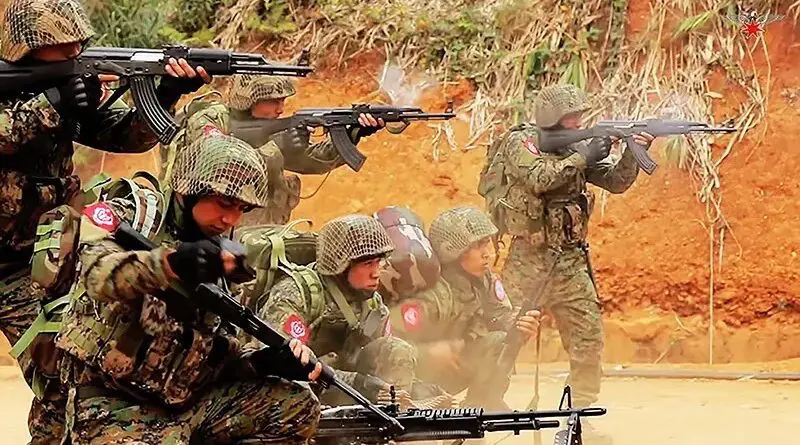
File photo of Arakan Army soldiers in Myanmar. Photo Credit: Arakan Army

September 20, 2026

By Sachin Yadav


Key Takeaways:

Five years after the coup. The Tatmadaw seized power on 1 February 2021; by early 2026 monitors put junta control below 40% of townships. The Arakan Army holds about 70% of Rakhine (14 of 17 townships) and is pushing on Sittwe. Estimates in the piece: more than 100,000 dead.

A vote under fire. Phased elections ran 28 Dec 2025–25 Jan 2026 and were widely called neither free nor fair. Min Aung Hlaing took the presidency in April 2026. Open-source counts: 408 air attacks in the voting window (at least 170 civilians dead); a 22 Jan Bhamo strike said to kill up to 50. Arrests under an election law: 324 men and 80 women. Also cited: paramotor and cluster-munition use.

Economy and aid collapse. About $100 billion in output lost since the coup; World Bank growth ~2% in FY2026/27; inflation 24% then 16%. Poverty estimates: 31% (2024, pre-quake) to ~46% (2025). In 2026: 16.2 million need aid, 3.6 million displaced; March 2025 M7.7 quake killed over 3,600. Amnesty and UN investigators: terror as strategy has failed; they want access and accountability.

On February 1, 2021, Myanmar’s military, known as the Tatmadaw, seized power in a coup, arresting State Counsellor Aung San Suu Kyi and other leaders of the elected National League for Democracy (NLD) government. General Min Aung Hlaing justified the takeover by alleging fraud in the November 2020 election, in which the NLD had won a landslide victory. What began as a political power grab quickly triggered mass civil disobedience, as millions of citizens, including doctors, teachers, and civil servants, walked off their jobs in protest.

The military responded with brutal force, gunning down peaceful demonstrators in the streets. As the crackdown intensified, the resistance movement transformed. Ordinary citizens took up arms, forming People’s Defense Forces (PDFs) and aligning with a parallel National Unity Government (NUG) in exile. These new fighters joined forces with Myanmar’s long-established ethnic armed organizations, such as the Arakan Army, the Kachin Independence Army, and the Karen National Union, groups that had been resisting central rule for decades. What started as scattered protests had, within a year, hardened into a full-scale, multi-front civil war spanning nearly all of Myanmar’s 14 states and regions.
Five Years On: A Country Fractured

Five years since the coup, Myanmar remains locked in one of the world’s most complex and underreported conflicts. The military’s grip on the country has visibly weakened. By early 2026, credible monitoring organizations estimated that the junta controlled fewer than 40% of Myanmar’s townships, a dramatic collapse from near-total control immediately after the coup. On the other hand, resistance forces have made striking territorial gains. The Arakan Army now controls nearly 70% of Rakhine State, having captured 14 of the state’s 17 townships, and is now pushing to seize the state capital, Sittwe.


Yet military dominance on the map has not translated into peace. According to the estimates, more than 1,00,000 people have lost their lives over the past five years. In an attempt to project legitimacy, the junta organized national elections. These were held in three heavily controlled phases between December 28, 2025, and January 25, 2026, and have been widely dismissed as fraudulent, engineered to secure a military-backed party’s victory. Foreign governments, including Australia, noted that the elections were held amid ongoing violence and repression, without meaningful participation from opposition parties, and did not meet conditions for being free, fair, or inclusive. Following the vote, Min Aung Hlaing assumed the presidency in April 2026 and has tried to project himself as a leader committed to peace, using state visits to India and China to build some diplomatic legitimacy.

The election period itself was marked by extreme violence rather than calm. Open-source monitoring documented 408 military air attacks during the voting period alone, which killed at least 170 civilians. On January 22, a military airstrike on a populated area in Bhamo Township, Kachin State, reportedly killed up to 50 civilians with no combatants reported present. The junta also used the election to justify a fresh wave of political repression and 324 men and 80 women were arrested under a unilaterally adopted election protection law, including for minor online activity, with one person sentenced to 49 years in prison for posting anti-election material.


Rights groups describe an escalating pattern of attacks on civilians using increasingly indiscriminate methods. In the lead-up to the elections, the junta ramped up airstrikes on schools, hospitals, religious sites and displacement camps, and expanded its use of armed drones, paramotors and gyrocopters, creating new threats to civilians. On October 6, 2025, a military paramotor attack on a Buddhist festival in Sagaing Region killed at least 24 people, including three children, and more than 135 such paramotor attacks have been recorded since December 2024. Myanmar’s military also continues to rely on weapons banned under international law. The country remains one of the four countries in the world that still use internationally prohibited cluster munitions and antipersonnel landmines.
The Economic Collapse

Myanmar’s economy has been devastated by five years of conflict, compounding earlier damage from the COVID-19 pandemic. The economy has lost nearly $100 billion since the coup, with Gross Domestic Product (GDP) not expected to recover to pre-pandemic levels for years. Independent trackers put the scale of the contraction even more starkly, estimating an economy contracted by over 9% since 2021, reversing the economic progress of the previous decade.

World Bank data illustrates a country limping along rather than recovering. Myanmar’s nominal GDP for 2026 is projected at roughly $65-75 billion, with growth of around 2 to 4%. That modest rebound masks deep structural weakness. The World Bank notes growth is projected at just 2% for FY2026/27, and describes the economic outlook as remaining subdued. This stands in sharp contrast to the pre-coup era as from 2011 to 2019, Myanmar experienced high economic growth, averaging 6% a year, alongside significant poverty reduction driven by reforms and the lifting of international sanctions


Inflation has eaten away at household purchasing power. Inflation was 24% in FY2025/26 and expected to be 16% in FY2026/27, driven by ongoing supply and demand-side constraints including power outages, labor shortages, and trade and exchange rate restrictions. There has been some recent relief on the currency front, though as food inflation eased to 16.2% and non-food inflation to 20.8%, reflecting a stronger Kyat, stricter food price controls, and improved supply conditions, with the Kyat appreciating by about 15% against the U.S. dollar by January 2026

Energy shortages have crippled productivity nationwide. In January 2025, daily electricity demand of 4,400 megawatts far exceeded daily generation of just 1,701 megawatts, a major constraint on manufacturing and services, worsened by conflict-related and earthquake damage to power infrastructure. Satellite data corroborates the scale of economic contraction as night-time luminosity fell by 15.1% over five months to May 2025 compared with the same period in 2024.

The human cost of this collapse is measured in rising poverty. In 2024, before the earthquake, the poverty rate was estimated at 31% and simulations suggested poverty could rise a further 2.8% points due to the earthquake’s impact. Other estimates put the number of people below the poverty line even higher. Approximately 46% of the population was estimated to be below the national poverty line in 2025 and changes in poverty across states show a strong positive correlation with the intensity of local conflict.

A Deepening Humanitarian Emergency

The human toll of Myanmar’s war is staggering and still growing. In 2026, an estimated 16.2 million people require lifesaving humanitarian assistance, including 4.9 million children. Also nearly 3.6 million people are now internally displaced in Myanmar amid escalating airstrikes, acute food insecurity and worsening humanitarian conditions. Food security has become a critical concern. Nearly one quarter of Myanmar’s population now faces high levels of acute food insecurity, while more than one third are in urgent need of humanitarian assistance. Nature has compounded the man-made disaster. In March 2025, a devastating magnitude 7.7 earthquake killed over 3,600 people and injured over 5,000. The earthquake caused extensive damage, layering on top of an already dire crisis.

Accountability efforts remain limited even as evidence of atrocities mounts. Investigators, including the head of the Independent Investigative Mechanism for Myanmar said that there is evidence that civilians across the country have endured atrocities that may amount to serious international crimes. Rights organizations argue the military’s approach has fundamentally failed on its own terms. Amnesty International has described the past five years as illustrating the Myanmar military’s failed strategy of asserting control by killing and terrorizing civilians.


Conclusion


Five years after a single coup shattered a fragile democratic experiment, Myanmar stands as a stark warning about how quickly progress can unravel and how long recovery can take once it does. The country’s economy has been set back by nearly a decade, its people face one of the world’s most severe and least-resourced humanitarian emergencies, and its political future remains as uncertain as ever, with a military that has entrenched its power through violence rather than restored the democratic transition it destroyed. As the conflict enters its sixth year, rights groups and U.N. officials alike are calling for renewed international attention, sustained humanitarian access and genuine accountability, without which, they warn, Myanmar’s people will continue to bear the cost of a war with no end in sight.


About Sachin Yadav
Sachin Yadav is a Ph.D. scholar in International Studies at Jamia Hamdard, New Delhi With a background in economics and education. His research focuses on South Asia, India’s Neighbourhood and Geoeconomics.
View all posts by Sachin Yadav →

MEDICAL MISOGYNY

Women dominate Europe's health workforce but earn 19% less per hour, WHO warns

Women in health earn 19% less than men, WHO warns.
Copyright Cleared/Canva


By Marta Iraola Iribarren
Published on


Despite dominating Europe's health and care sector, women hold just over half of its top-paying jobs, according to a new WHO report.

Women in healthcare in Europe — a sector where they dominate— earn 19% less per hour than men on average, the World Health Organization (WHO) warns in a new report.

The health and care sector is the fourth-largest employer and the single largest employer of women in the WHO European Region. Women account for 77% of the workforce in healthcare, compared with 45% in all other sectors combined. However, they make up only 55% of the sector’s top earners.

“Women make up the majority of the people who keep Europe’s health systems running, yet they’re paid less than their male counterparts, a gap that compounds over a lifelong career," said Natasha Azzopardi Muscat, director of the Division for Health Systems, at WHO Europe.

The gender pay gap — the difference in average wages between men and women who are engaged in paid employment — in hourly pay is widest at higher wage levels, ranging from a 2% gap among the lowest earners to over 22% at the top of the wage distribution.

The sector is especially important for women’s employment, the report found. It represents almost 17% of all women’s employment, compared with 5% for men.

These findings follow the same pattern documented across the wider labour market: heightened structural inequality that intensifies at higher wage and seniority levels.

Globally, the health sector mirrors Europe, with women earning on average 24% less than men — a wider gap than in many other industries.

What is behind this difference?

The authors noted that some of the healthcare sector’s pay gap can be explained by differences in work-related factors such as age, education, sector of employment — public versus private and employment type — full-time versus part-time.

Adjusting for those four factors brings the hourly pay gap down from 19% to 6% and the monthly pay gap down from 28% to 10%.

However, the remaining pay gap can’t be explained by anything measured in the data.

“Most of this gap isn’t down to women working fewer hours, being younger or working in different parts of the sector," Azzopardi Muscat explained. “It comes down to how the sector values women’s work. Age, education, working hours and public versus private sector employment only helps explain some of it.”

According to WHO, the report points to deeper structural factors, such as the undervaluation of care work, occupational segregation and potential discrimination in pay-setting practices.

The more feminised an occupational category is, the less it pays — a pattern that holds across managerial, professional and technical roles alike. Managerial jobs in health and care, for instance, employ more women than management roles in other sectors and pay less for it: €22 per hour on average, against €24.70 in comparable roles elsewhere.

The broader cost of the gap

The gender pay gap remains one of the most persistent forms of labour market inequality, the WHO noted.

Considering how many women work in health and care, this gap can have important economic and social consequences.

The report noted this inequality may lead to lower lifetime earnings and pension entitlements, increase women’s risk of poverty, reduce returns to education and undermine sustainable economic growth.

“It means lower pensions, less financial security in older age, and a higher risk of poverty for women who’ve spent their working lives caring for others,” said Azzopardi Muscat.

“This isn’t a coincidence, and it isn’t about qualifications. Women are being paid less for the same work and passed over for the roles that pay more.”

Closing gender pay gaps is therefore both an equity imperative and an investment in a stronger and more sustainable health workforce, the international health agency noted.

To that end, they suggest targeted actions, from ensuring salary transparency and facilitating female representation in decision-making positions to addressing gender norms and stereotypes.

GENDER MANIPULATION
Testosterone Screening For 2M Troops Comes With No Cost Estimate


An aerial view of the Pentagon building, Washington, D.C. Photo Credit: Navy Petty Officer 2nd Class Alexander Kubitza, DOD

September 20, 2026
The Center Square
By Brett Rowland


Key Takeaways:

No price tag. Screening is ordered for ~2 million troops age 30-plus. DHA guidance says how many will be tested or treated is “not currently known.” The Center Square got no cost estimate from DHA or the Pentagon press office.

Not a performance drug. Hegseth’s 15 July memo and Parnell (17 Sept) call it readiness and “Operator Syndrome.” The clinical note: testosterone is not a performance enhancer; treat a confirmed deficiency only.

Questionnaire, then blood. Despite a July claim of annual tests for everyone over 30, providers screen symptoms first. Auchus and Frueh called that evidence-based. Therapy may help sex, body composition, and bone—not energy or cognition. Congress had no cost figure Friday.


(The Center Square) – The Pentagon is ordering testosterone screening for some 2 million troops without saying what it will cost, and its own clinical guidance says it does not know how many service members it will test or treat.

The screening applies to every active-duty and reserve service member age 30 and older, a population of about 2 million. But the guidance the Defense Health Agency issued this week says the numbers to be screened, tested, diagnosed and treated “are not currently known,” and no prior guidance projected them.


The department has not said what any of this will cost. The Center Square asked for a cost estimate in July, when the mandate was announced, and again this week. The Defense Health Agency, which issued the guidance, declined to answer questions about it and referred them to the Pentagon press office, which did not respond to a request for comment this week and did not provide a cost estimate in July. Neither the July memo nor the clinical guidance carries a price tag, or says whether the screening and any resulting treatment will be funded through the existing Military Health System budget or a new request.

The department has framed the program as a readiness measure. Secretary of War Pete Hegseth’s July 15 memo ordering the screening said that “applying lessons learned from treating Operator Syndrome across the Total Force including targeted testosterone therapy directly optimizes Warfighter readiness,” and Chief Pentagon Spokesman Sean Parnell said in a Sept. 17 statement that the effort would help sustain “a healthy, capable, and decisively dominant fighting force.”

The guidance issued under that memo does not support using testosterone to boost performance in healthy troops. It states that testosterone “is not a performance enhancer” and that “guidance premised on performance enhancement rather than on treatment of a diagnosed deficiency is not supportable on the current evidence.” The guidance treats testosterone deficiency as a diagnosis to be confirmed and treated, not a fitness edge to be issued across the force.

Dr. Richard Auchus, an endocrinologist at the University of Michigan, told The Center Square the guidance is “largely evidence-based,” screening for symptoms before ordering blood tests, an approach “consistent with society guidelines and good clinical practice.” He said he was “relieved” the document was “not recommending broadly blood-test based screening everyone over 30.”

The guidance also differs from how the program has been described. In July, a Pentagon official told The Center Square that “everyone over 30 years old will be tested annually.” But the guidance does not call for testing everyone. It directs providers to screen with a symptom and risk-factor questionnaire and to order a blood test only when that screen is positive or a risk factor is present.

The program’s clinical premise traces to “Operator Syndrome,” a term coined in 2020 by psychologist Chris Frueh to describe a cluster of health problems, including brain injury, sleep disruption and hormonal dysfunction, in special operations forces. Hegseth’s memo cited it as justification for testing across the force. Frueh, who reviewed the new guidance, told The Center Square it was “very good.”

The guidance is candid about the limits of what testosterone does. It says the therapy helps sexual function, body composition and bone density, but that the evidence “does not support its use to improve energy, vitality, physical function, or cognition.” It notes that the American College of Physicians recommends against prescribing it for those reasons, and that in a major trial, testosterone did no better than a placebo at improving men’s energy or how far they could walk.

The House Armed Services Committee’s majority and minority offices did not immediately respond to questions Friday about whether they received a cost estimate for the program.


About The Center Square
The Center Square was launched in May 2019 to fulfill the need for high-quality statehouse and statewide news across the United States. The focus of their work is state- and local-level government and economic reporting.
View all posts by The Center Square →
The Race To Build A Pandemic-Proof World


September 20, 2026
UN News
By Daniel Dickinson


Key Takeaways:

The bill from COVID. WHO: more than 7 million lives lost. Guterres called the response “human ingenuity and human failure”—vaccines at record speed, care and shots last for the poorest. Viruses ignore borders; over 60% of new human infections start in animals.

A treaty still half-built. The WHO Pandemic Agreement passed in May 2025. The Pathogen Access and Benefit-Sharing annex—samples in, vaccines and tests out—was still being negotiated; 60 ratifications are needed before the pact is law. Also planned: a supply-and-logistics net and a coordinating finance pot.

What the UN list wants next. Stop outbreaks early, keep essential care running, spread manufacturing, and lock in predictable money and legal coordination so the next wave is not another scramble.

Six years after COVID-19 killed millions, battered health systems, disrupted lives and brought the global economy to a virtual standstill, the world is still grappling with how we can prepare better for the next pandemic.

The need is even greater amid growing threats to global stability and security from emerging infectious diseases as well as climate-related crises and conflicts.

What happened?

Over seven million lives were lost due to COVID-19, according to the UN World Health Organization (WHO).

The pandemic did not just claim lives. It shattered economies, disrupted entire health systems and exposed how unevenly rich and poor countries could access vaccines, tests and treatments.

The global response to the pandemic was described by UN Secretary-General António Guterres as a “story of human ingenuity and human failure”. Vaccines were developed at record speed, but the lack of preparedness meant the most vulnerable had the least access to care and suffered most.


Why it matters

Viruses, like COVID-19, do not respect borders.

An outbreak detected in one country can quickly spread across the world, putting people everywhere at risk.

That makes surveillance, data sharing, research and development – as well as access to vaccines, diagnostics and treatments – all international priorities.

It’s also why human, animal and environmental health are now treated as one connected system. Over 60 per cent of emerging infectious diseases jump to humans from animals, so rigorous surveillance at that human-animal-environment interface is critical.

The equity gap

COVID-19 laid bare stark inequities over who had access to vaccines, tests and treatments first. Richer countries with manufacturing capacity were far better prepared than poorer ones.

But, the equity issue is broader than access to vaccines, therapeutics and diagnostics. It also includes equitable access to skills, resources and financing.

Closing that gap is the core argument for treating prevention, preparedness and response as an international rather than a purely national issue.

A global pandemic agreement


The COVID-19 pandemic was a wake-up call to the world.

Global collaboration is key to preventing and responding to future pandemics. As UN Secretary-General Guterres has warned, “We must not repeat the mistakes of the past when the next pandemic strikes, as we know it will. That means working together.”

The international community has made progress.

The landmark WHO Pandemic Agreement, the first binding global accord on pandemic prevention, preparedness and response, was adopted in May 2025.

But, adoption is just the beginning.

Negotiators from countries still have to agree the Pathogen Access and Benefit-Sharing (PABS) annex to the agreement. That’s the mechanism for sharing virus samples and, in return, guaranteeing countries in need can access the resulting vaccines, diagnostics and treatments.

With negotiations on the annex advancing on Friday, once it is adopted by the World Health Assembly, the treaty can open for signature and national ratification.

It needs 60 ratifications to legally enter into force.

The agreement also establishes a global supply chain and logistics network to get medical supplies to countries during emergencies, and a new “coordinating financial mechanism” to support strengthening and expanding capacities for pandemic prevention, preparedness and response.

What needs to change?

To be better prepared before the next pandemic, the international community needs to focus on: Preventing outbreaks before they start and containing them from spreading
Stronger preparedness, ensuring capacities and resources are in place, including for research and development

A more robust response that ensures continuity of essential health services.
The availability of surge and manufacturing capacity that is geographically spread with sustainable supply chains

Underpinning all of this is the need for sustainable and predictable financing and a legal architecture for international coordination and collaboration.
OLDE FASHIONED IMPERIALISM
Panama Strengthens Maritime, Border, And Cybersecurity Capabilities With US Support – Analysis

The U.S. Embassy in Panama delivered a Cybersecurity Operations Center, five refrigerated trucks, two mobile maintenance vehicles, generator spare parts, and 400 communications sets for special operations to the SENAFRONT, June 17, 2026. (Photo: U.S. Embassy in Panama)

September 20, 2026
Diálogo Américas
By Lorena Baires


Key Takeaways:

$5 million kit in June. The U.S. gave SENAFRONT and SENAN refrigerated trucks, mobile workshops, two RHIBs, a nav system, generator parts, 400 comms sets, and cyber operations centers. Ambassador Kevin Marino Cabrera tied it to Trump–Mulino work against cartels.

Drones and boats. On 3 July, Panama stood up SENAFRONT’s COANT drone company under Plan Firmeza. Four U.S. unmanned aircraft were already in country for SENAN. January 2026: four more U.S. RHIBs worth $1.5 million. SENAN (14 July) cited 490 drug packages seized off Isla Grande.

A bigger 2026 bill. A 2025 security MOU covers training and exercises. The embassy puts 2026 cooperation at about $100 million. Ex-SENAFRONT deputy Luis Carlos Trejos: stitch border, sea, air, and cyber so cartels cannot use the Canal corridor.


Panama continues to strengthen its security forces’ ability to monitor its land borders, maritime domain, and digital networks in a more coordinated manner to counter threats posed by transnational organized crime.

As part of that effort, the United States delivered more than $5 million in maritime, border, and cybersecurity equipment in June to Panama’s National Border Service (SENAFRONT) and National Air and Naval Service (SENAN), the U.S. Embassy indicated.


The delivery included five refrigerated trucks, two mobile maintenance vehicles, two rigid-hull inflatable boats, a specialized navigation system, generator spare parts, 400 communications sets for special operations, and Cybersecurity Operations Centers for both SENAFRONT and SENAN, local media outlet Telemetro reported.

“Under President Trump’s leadership and in partnership with President Mulino, the United States is delivering critical support to defeat criminal cartels and strengthen security,” said U.S. Ambassador to Panama Kevin Marino Cabrera. “Every dollar invested here prevents cartels from profiting by invading our partner nations.”

The equipment enhances capabilities to combat the illicit trafficking of drugs, weapons, and people while improving mobility, communications, and logistical support for units deployed in remote areas, where geography poses persistent operational challenges.
COANT expands border surveillance with unmanned systems

On July 3, Panama’s Ministry of Public Security established SENAFRONT’s Unmanned Aerial Operations Company (COANT), a specialized unit that will expand strategic surveillance, provide real-time aerial intelligence, and strengthen border security through unmanned aircraft systems. Minister of Public Security Frank Alexis Ábrego presented the unit as part of Plan Firmeza, the government’s strategy to strengthen security in hard-to-reach border areas and more effectively confront transnational criminal networks.


U.S. cooperation also included unmanned aerial capabilities for SENAN. In July, Minister Ábrego announced that four unmanned aircraft systems donated by the U.S. government were already in Panama and that operators were undergoing specialized training.
Maritime interdiction and protection of the interoceanic waterway

For SENAN, the boats and navigation system strengthen maritime surveillance and interdiction capabilities, as well as the protection of strategic areas and counternarcotics operations along Panama’s coasts, which criminal organizations use to move illicit shipments.

Earlier, in January 2026, SENAN received four semi-rigid inflatable boats valued at $1.5 million from the United States. The donation strengthened its patrol, interdiction, and rapid response capabilities against drug trafficking while also supporting the security of the Panama Canal.

According to Luis Carlos Trejos, former deputy director of SENAFRONT, the integration of border, maritime, aerial, and cyber capabilities is essential to countering hybrid transnational organized crime because it brings intelligence together for early warning and maximizes the efficient use of resources in the field.


“Integrating tactical and intelligence resources to disrupt the cartels’ economic activities demonstrates that cooperative security works when efforts are directed toward peace and development,” Trejos told Diálogo. “Cooperation with the United States is a strategic pillar for transforming Panama’s maritime security.”
Bilateral cooperation strengthens capabilities

The security memorandum of understanding signed by Panama and the United States in 2025 expanded bilateral cooperation through training, exercises, and capability exchanges to address shared threats and strengthen national security.

“National security creates the peace necessary for progress and democracy to thrive,” Trejos said. “It is therefore essential to continually strengthen these capabilities, because Panama occupies a geostrategic position of enormous importance to regional and global economic development. Criminal organizations recognize that reality as well and seek to exploit it for their own benefit.”

The equipment transfer forms part of the expanded cooperation between Panama and the United States. According to the U.S. Embassy, that cooperation is expected to reach an estimated value of $100 million during 2026 and includes security equipment and other support programs.

Beyond the delivery of new equipment, strengthening maritime, border, aerial, and cyber capabilities reflects Panama’s broader effort to respond more effectively to threats that operate across multiple domains. For other countries facing similar challenges, Panama’s experience underscores the importance of combining technology, training, and international cooperation to enhance the state’s ability to monitor, deter, and respond to transnational threats.


About Diálogo Américas
Diálogo Américas is a professional magazine published by U.S. Southern Command as an international forum for security issues in Latin America.
View all posts by Diálogo Américas →


China's Ulanqab plans 5mn server racks in AI compute race with US

China's Ulanqab plans 5mn server racks in AI compute race with US
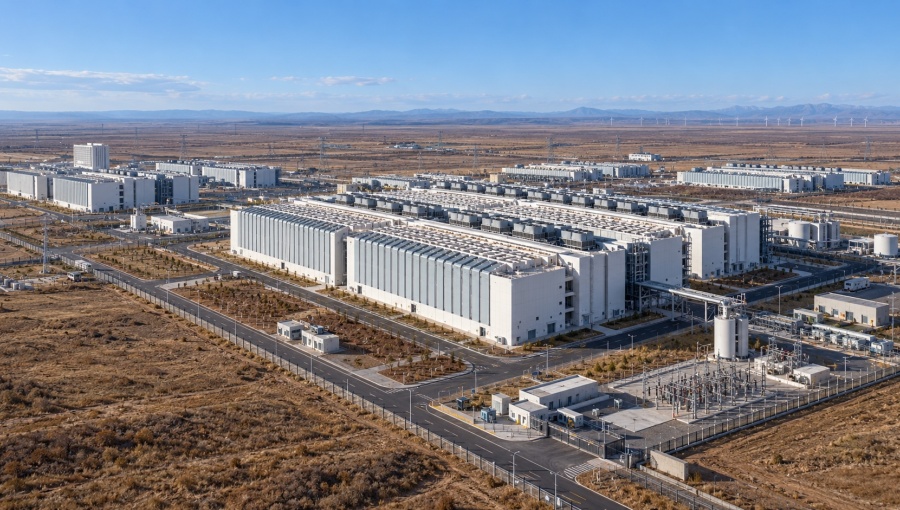
A windswept prefecture of 1.5mn people on the Mongolian plateau already uses nearly 1% of China's electricity as the country's tech giants pile in with data centres. / bne IntelliNews
By Ben Aris in Berlin September 17, 2026

A remote prefecture in China's Inner Mongolia is becoming a global centre of AI computing power. Ulanqab, home to 1.5mn people on the grasslands of the Mongolian plateau, consumes nearly 1% of all the electricity used in China, and its demand is growing by double digits every year.

Spread across the prefecture's households, that load would work out at about 105,000 kWh each a year, roughly 10 times the consumption of an average American home, by his calculation. The power is going into servers.

Over the past few years Ulanqab has signed investment agreements worth more than CNY500bn ($74bn) with China's largest technology companies, and the build-out planned there runs to more than 5mn data centre racks, according to Science and Technology Daily, the newspaper of China's Ministry of Science and Technology.

Set that against Elon Musk's Colossus supercomputer in Memphis, Tennessee, which xAI markets as the world's largest AI supercomputer. On xAI's own count of 200,000 chips, Colossus fills something like 5,000-6,000 racks, Bertrand estimated, which implies roughly a thousand times as many racks. The comparison does not measure equivalent computing power: Chinese standard racks are rated at 2.5 kW, while modern Nvidia AI cabinets can draw more than 100 kW.

"What we see appearing in this Inner Mongolian steppe may be the closest thing to a world brain humanity has ever built - a place where a large share of the world's thinking will physically happen," commentator Arnaud Bertrand wrote on X on September 14.

Anthropic chief executive Dario Amodei said China presented the hardest problem for his proposal to slow AI development, CNBC reported on September 13.

If AI turns out to be the defining technology of the century, as Bertrand argues both Washington and Beijing believe, that makes Ulanqab "one of the single most relevant geopolitical places in the world right now", he wrote.

From cloud valley to token capital.

Inner Mongolia signed 12 commercial deals worth CNY186.46bn ($27.6bn) at a green computing and AI conference in Hohhot on August 22, with China Telecom (SHA: 601728), chipmaker Cambricon Technologies (SHA: 688256) and Volcano Engine, the cloud platform of TikTok owner ByteDance, among the signatories. Active processing power in Ulanqab had by then reached 172,000 PFlops, with more than 95% of it allocated to AI work.

The largest single project so far belongs to Envision, the Shanghai-based wind turbine and battery maker, which commissioned its Galaxy campus in Ulanqab in August. The company says the 2 GW AI campus runs on renewable power and contains the world's largest single data centre building.

The Chinese business magazine Caixin devoted an in-depth report on August 14 to how the city turned itself into an AI powerhouse. Inner Mongolia is one of eight national computing hubs designated under Beijing's "East Data, West Computing" programme, which shifts data processing from the crowded, power-hungry coast to the resource-rich interior.

Cheap wind and cold air

Electricity makes up 55% of a data centre's cost, according to a McKinsey Global Institute study published in June, so the price of power decides where the servers go.

Inner Mongolia is China's "green power bank", regularly producing more wind and solar electricity than it can use at home. Envision finished a 12.8 GWh battery storage cluster across the region at the end of 2025, with sites in Ulanqab, Hohhot, Ordos and elsewhere, to soak up the surplus.

The surplus comes cheap: firm wind power backed by batteries cost about $59/MWh in Inner Mongolia in 2025, against $88-94/MWh in Brazil, Germany and Australia, the International Renewable Energy Agency (Irena) said in May.

Ulanqab's wind already runs a 1 GW electrolysis plant supplying Sinopec's green hydrogen pipeline to Beijing, nearly 400 km away, and the cool plateau climate trims the bill for keeping servers from overheating.

The data centre boom is the latest expression of China's rise as the first Electrostate, an economy built on cheap electrons, and of its position as the world's green energy champion, building two-thirds of the world's new wind and solar plants.

Racks are not chips

Chinese planners typically count data centre capacity in "standard racks" rated at 2.5 kW, while a single cabinet of the latest Nvidia AI servers draws more than 100 kW, so a rack-for-rack comparison with Colossus overstates the gap.

Measured in power, 5mn standard racks come to about 12.5 GW, in line with the planned capacity for Ulanqab reported by the newsletter AI Weekly. That is still more than six times the size of Envision's Galaxy campus. China's total data centre capacity is on course to top 60 GW by 2030, doubling the sector's power demand, according to Rystad Energy.

China's handicap lies in the chips. American hardware keeps a 9:1 lead in raw computing performance, according to American Enterprise Institute researcher Ryan Fedasiuk, and even in the most optimistic 2028 scenario Huawei would supply at most an eighth of the compute available in the US. The AEI's most pessimistic case still has domestic AI chips meeting a third of China's compute demand by 2028, up from about a fifth in 2026.

Chinese chips burn more electricity per calculation than their American rivals, which puts a premium on power that is abundant and cheap. Abundant wind power could lower operating costs, but does not by itself close the chip-performance gap.

Demand to fill it

Daily token requests to AI models across China jumped from about 100bn in early 2024 to 140 trillion by March 2026, and Inner Mongolia has started building a trade platform in the Hohhot free trade zone to sell clean computing power and access to Chinese AI models to foreign developers.

Neighbouring Mongolia unveiled plans for a renewable-powered data centre in August, pitching the same cool, dry climate and wind and solar resources, plus a location between China and Russia.

Bertrand said he had travelled to Inner Mongolia twice without hearing of Ulanqab before he began researching it. "It's really surprising this hasn't been talked about more because the scale is beyond anything else, and by an immense margin," he wrote.


High tech FDI into China climbs even as total inflows fall

High tech FDI into China climbs even as total inflows fall
/ Li Yang - UnsplashFacebook
By IntelliNews - New Taipei Bureau September 19, 2026

Foreign direct investment into China's high-tech industries rose 35.1% year on year to CNY200.26bn ($29.88bn) in the first eight months of 2026, even as total inflows declined, Xinhua reported on September 19.

The divergence points to a shift in the composition of foreign capital entering the world's second-largest economy, where Beijing has been courting research centres and advanced manufacturing plants while overall investor appetite has cooled. High-tech sectors accounted for 41.7% of all FDI in the period, up 12.4 percentage points from a year earlier, according to the Ministry of Commerce.

Actual FDI in use across all sectors fell 5.3% to CNY479.95bn. A total of 42,582 new foreign-invested enterprises were established, an increase of 0.3%.

Manufacturing drew CNY119.55bn, while the service sector took CNY350.42bn. Investment in research and development and design services jumped 74%, services for the commercialisation of scientific and technological achievements rose 64.2%, and electronic and telecommunications equipment manufacturing gained 41.9%.

Zhang Xiaotao, director of the International Investment Research Center at the Central University of Finance and Economics, said the country's growing pull in high-tech sectors marks a shift in what attracts global capital, from cost-driven to "innovation-driven," he told Xinhua

By source country, actual investment from France grew 39.2%, from Switzerland 16.7% and from South Korea 16.5%, with flows routed via free ports included.

South Korean semiconductor equipment maker STI is building a chip manufacturing base in Guangzhou with total investment of about CNY12.4bn, while German automotive parts group Schaeffler is adding CNY1bn to a humanoid robotics plant in Jiangsu province.

In June, Beijing issued a 15-measure action plan on foreign investment covering market access, investment procedures and protections for foreign investors. A revised Catalog of Encouraged Industries for Foreign Investment took effect on February 1, directing capital towards advanced manufacturing, modern services and the central, western and northeastern regions.


Trump’s war on Huawei spreads through Africa

Trump’s war on Huawei spreads through Africa
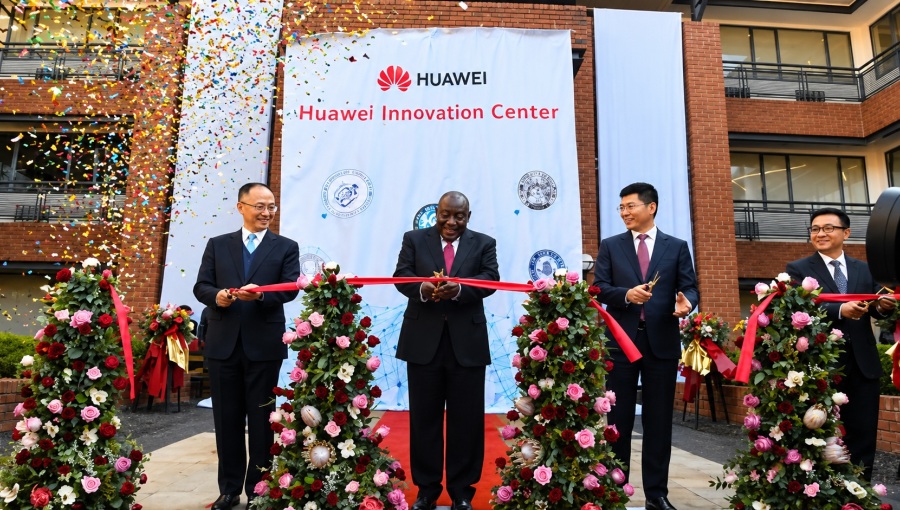
/ HuaweiFacebook
By bne IntelliNews September 20, 2026

A $99.6mn US government loan to Africell in Angola would be unremarkable beside the sums being spent on Africa’s telecoms infrastructure were it not for what Washington wants the money to buy.

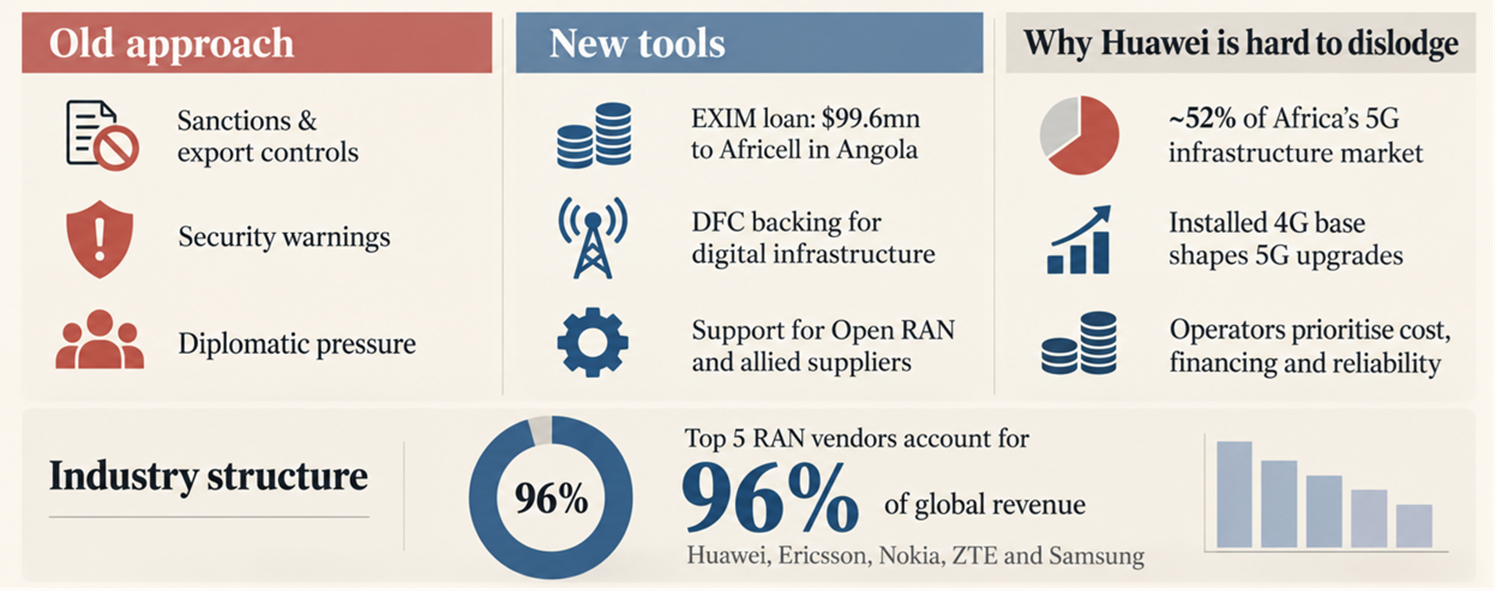
The Export-Import Bank of the United States announced this month that it would finance American and European network technology for the US-owned mobile operator. Reuters described the loan as part of the Trump administration’s effort to counter Huawei overseas, citing an estimate from Counterpoint Research that the Chinese company supplies about 52% of Africa’s 5G infrastructure.

Five days later, another arm of the US government widened the picture. The US International Development Finance Corporation approved an equity investment in WIOCC Group, whose fibre networks, wholesale connectivity and data-centre infrastructure span 30 African countries. DFC said the investment would support US technology companies and advance American strategic interests on the continent.

The two transactions fit a broader US approach to competing with Huawei despite lacking an American equivalent. Rather than trying to replace the Chinese group with a single US supplier, Washington is using public finance to support an alternative ecosystem built around European network equipment, American technology and non-Chinese digital infrastructure.

The Africell loan addresses the equipment side of that approach by financing Africell’s purchase of alternative network technology. The WIOCC investment suggests that the same strategic logic is extending to fibre, data centres and wholesale connectivity, infrastructure on which US technology companies depend. Neither deal amounts to an African telecoms strategy on its own, but together they show how Washington’s long confrontation with Huawei is acquiring a more financial dimension.

From pressure to finance

Donald Trump’s campaign against the Chinese group began much earlier. During his first term, the administration restricted Huawei’s access to US technology and launched the Clean Network initiative, pressing governments and operators to exclude suppliers Washington considered security risks. Eswatini became the first African country to join the programme in early 2021.

US officials argued that Huawei’s presence in critical communications networks created espionage and data-security risks because of the company’s relationship with Beijing and its obligations under Chinese law. Huawei has consistently rejected allegations that its equipment could be used for spying.

Africa presented a harder commercial problem.

Huawei had already spent years supplying equipment across the continent, building relationships with operators and governments and becoming embedded in existing networks. Unlike in markets where governments were prepared to restrict Chinese vendors, African operators also had to contend with the economics of expanding coverage in countries where capital was scarce and average revenue per customer was often low.

Washington recognised some of that problem even during Trump’s first term. When Eswatini joined the Clean Network, senior State Department official Keith Krach said EXIM had been given authority to finance 5G projects using equipment from trusted non-US suppliers such as Ericsson (STO: ERIC B; NASDAQ: ERIC), Nokia (HEL: NOKIA; NYSE: NOK) and Samsung Electronics (KRX: 005930; LSE: SMSN). US financing, he argued, could help close the cost gap with Huawei and ZTE (SZSE: 000063; HKEX: 0763).

The idea is therefore not entirely new. What is becoming more visible is the use of public capital to put it into practice.

Africell offers an unusually convenient starting point. It describes itself as Africa’s only US-owned mobile-network operator and has operations in Angola, the Democratic Republic of the Congo, Sierra Leone and The Gambia. Africell says its Angola business has attracted more than 8mn customers, while the group currently reports more than 15mn subscribers across its four markets.

Its network also already follows the kind of supplier model Washington would like to encourage. Nokia announced in 2021 that it would provide radio, core and IP technology for Africell’s Angola launch. US financing can therefore support European network hardware alongside American components, software and other technology.
The missing US champion

The structure of the global equipment market helps explain that approach.

The global radio access network (RAN) industry remains extraordinarily concentrated. Huawei, Ericsson, Nokia, ZTE and Samsung accounted for 96% of worldwide RAN revenue in the first half of 2026, according to Dell’Oro Group. Two of those companies are Chinese, two European and one South Korean. None is American.

That leaves Washington reliant on a combination of public financing, European radio equipment and American semiconductors, software, cloud and networking technology.

Open Radio Access Network (Open RAN) technology fits into the same strategy. By making interfaces between network components more interoperable, Open RAN is intended to reduce operators’ dependence on tightly integrated systems from a single supplier. US policymakers across successive administrations have put substantial funding behind open and interoperable networks, including through the $1.5bn Public Wireless Supply Chain Innovation Fund launched under the Biden administration. The Trump administration has since redirected part of that effort towards AI-native network architecture.

The administrations have differed in approach, but the attraction for Washington is consistent. A more fragmented network architecture creates room for US technology companies even if they do not manufacture complete mobile networks.

Huawei’s installed-base advantage

Huawei’s advantages, however, extend beyond the architecture of its equipment.

Chinese lenders historically played a significant role in financing African communications infrastructure. Boston University’s Chinese Loans to Africa database estimates that Chinese lenders committed about $15.7bn to African information and communications technology projects between 2000 and 2023. The model helped finance infrastructure in markets where governments and operators could otherwise struggle to raise capital.

That source of finance has since receded sharply. Boston University found no new Chinese loan commitments to African ICT projects in 2024, describing the sector as increasingly market-driven. Overall Chinese lending to Africa is also far below the levels reached during the early years of the Belt and Road Initiative.

The decline in sovereign lending does not amount to a broader Chinese retreat from Africa. IntelliNews reported in August that Chinese Belt and Road investment announcements in Africa reached a record $33.5bn in the first half of 2026, with the model increasingly shifting from state-backed lending towards direct corporate investment in productive assets.

The change therefore concerns the form of Chinese capital more than its disappearance. For Huawei, however, financing is only part of the advantage.

Huawei has retained an advantage that does not depend on cheap credit: its installed base.

Mobile networks are built incrementally. Existing 4G equipment influences how an operator moves into 5G, and changing vendors can require new hardware, integration work and retraining. An incumbent supplier able to offer a relatively straightforward upgrade therefore begins with an advantage before financing terms are even discussed.

The $99.6mn Africell loan tackles one part of that equation by reducing the financing constraint around alternative suppliers. It does not solve the switching problem for operators whose networks already rely heavily on Huawei.

Nor is Africell representative of the biggest commercial test. As a US-owned challenger already using Nokia equipment, it is unusually aligned with Washington’s objectives.

Persuading one of Africa’s large incumbent operators to change procurement strategy would be considerably harder. Such companies operate across multiple countries, have billions of dollars invested in existing infrastructure and generally buy equipment from several vendors. Network decisions have to satisfy commercial requirements that extend well beyond geopolitical preference.

Beyond the mobile network

The difficulty of dislodging an incumbent network supplier helps explain the significance of Washington’s push elsewhere in Africa’s digital infrastructure, even if the investments are not explicitly presented as substitutes for competition in mobile-network equipment.

DFC had already invested $50mn in pan-African digital infrastructure company Cassava Technologies before its latest WIOCC transaction. The agency explicitly presented that investment in terms of strategic competition, arguing that support for African fibre, data centres and digital services could expand the position of US and allied technology companies.

Its September investment in WIOCC pushes the same approach further across an infrastructure footprint covering 30 African countries. DFC called it its largest digital investment to date and said WIOCC’s networks were used by American technology companies expanding on the continent.

The strategy therefore reaches beyond who supplies a mobile operator’s antennas. Fibre networks, data centres and wholesale connectivity increasingly determine where cloud services and other digital businesses can expand. Huawei itself operates well beyond traditional telecom equipment, including in cloud computing and enterprise technology.

That infrastructure is becoming more economically important as Africa’s cloud and data-centre market expands. IntelliNews reported in January that Africa still accounted for only about 1% of global data-centre capacity, but capacity was forecast to grow rapidly as cloud adoption and internet use increased, with South Africa, Kenya, Nigeria and Egypt emerging as leading markets.

Africa’s commercial calculus

Describing all this simply as a US-China contest can obscure the calculations being made in African capitals and boardrooms.

Telecom operators need affordable equipment, financing, spectrum, fibre links and reliable electricity. Many are still spending heavily to increase ordinary 4G coverage even as richer markets debate advanced 5G services. Currency weakness and high borrowing costs can make capital expenditure particularly difficult.

The same constraints apply further down the digital-infrastructure chain. The Africa Data Centres Association says power availability has overtaken connectivity as the principal obstacle to data-centre expansion on the continent, meaning the effectiveness of new capital will also depend on access to reliable electricity at commercially viable sites.

That commercial pressure helps explain why African governments and operators are unlikely to treat technology procurement simply as a choice between geopolitical blocs. Dare Leke Idowu of the University of Johannesburg argues that African governments are increasingly hedging between the US and China, selecting partners according to infrastructure needs, domestic priorities and financing conditions rather than committing to either technology ecosystem.

Those conditions favour whichever supplier — Chinese, European, American or otherwise — can offer the best combination of price, financing, reliability and support. Washington’s security campaign can influence the political environment in which those decisions are taken, but it cannot by itself change their economics.

The growing use of EXIM loans, DFC equity and support for alternative network architectures suggests Washington is increasingly trying to compete on that terrain as well.

Huawei enters the contest with an extensive installed base and decades of relationships across the continent. The US enters without a Huawei of its own.

Its answer is to finance a coalition instead.

Whether that financing can alter the procurement decisions of Africa’s larger telecom operators will be the harder commercial test.