Op-Ed
Trump’s Federal Lawyers Ramp Up Their Attacks on Demonstrators and the Left
Prosecutions of anti-ICE and pro-Palestine protesters are part of a broad effort to crack down on dissent.
By Flint Taylor ,
The Broadview Case
At the time Trump issued NSPM-7, his ICE and Border Patrol troopers had met massive resistance to their unconstitutional and violent invasion of greater Los Angeles, and they were confronted with an even more remarkable neighborhood-to-neighborhood fight against the blatantly racist “Operation Midway” that was mounting in Chicago in early September.
Trump’s forces were dragging the Brown immigrants they had indiscriminately arrested during their terror raids to the ICE jail in neighboring Broadview. Resistance was swift, and a Customs and Border Protection agent fatally shot one undocumented man (Silverio Villegas González) who was fleeing from them, while peaceful demonstrators at Broadview, some of whom were practicing civil disobedience, were met with violent barrages of pepper spray, tear gas, rubber bullets, and physical brutality. As public opinion turned decidedly against the invaders, in early October, the Chicago U.S. attorneys’ office (no doubt at the direction of Washington) sought conspiracy indictments against six of the most publicly vocal demonstrators, most of whom had connections to the progressive wing of the local Democratic Party.
Employing an infrequently used federal conspiracy law that was passed during Reconstruction to protect federal officers from the Ku Klux Klan, an experienced assistant U.S. attorney, Sheri Mecklenburg, was met with a reluctant grand jury that raised numerous questions and initially refused her exhortations to indict. One juror called the case a “crock of shit,” and he and several others who questioned the case were shown the door by an angry Mecklenburg. Finally, after presenting additional testimony from an agent, the jury was visited by U.S. attorney Andrew Boutros, who, in a highly irregular lecture, sought to identify any remaining jurors who did not buy the government’s case, while making a thinly veiled threat that they had “a different procedure” for dealing with such jurors. Not surprisingly, none of the remaining jurors raised their hands.
In late October, Boutros and Mecklenburg finally got the government’s hopelessly tarnished indictments — charging the “Broadview Six” with conspiring to “impede a federal officer” when they allegedly joined a large group of demonstrators who attempted to block an ICE vehicle that was driving into the facility and slightly damaged it. During pre-trial discovery, lawyers for the six sought the secret grand jury transcripts, and the prosecutors first produced copies with the blatant misconduct deleted, then dismissed the felony charges while proceeding on the companion misdemeanor charges; in doing so, they hoped to avoid producing the unredacted transcripts.
The trial judge, April Perry, herself a former assistant U.S. attorney, was not deceived. The damning transcripts, complete this time with the prosecutorial misconduct, were produced and later publicly released, Boutros was compelled to dismiss the entire case, and he came, hat in hand, to apologize to the judge. There have been numerous calls for Boutros’s resignation; Judge Perry is considering taking further action against the prosecutors, more than 100 former assistant U.S. attorneys have publicly condemned Boutros and his assistants’ conduct in the Broadview case, and a broader investigation of Mecklenburg’s conduct before other grand juries has, to date, led to the dismissal of at least two unrelated cases.
Convictions in the Spokane 3 Case
On July 15, 2025, the acting U.S. attorney in Spokane, Washington, announced the conspiracy indictments of nine demonstrators who, a month earlier, were among a crowd of hundreds who had attempted to block the transport of two Venezualan immigrants who were seeking asylum to an ICE jail. Former acting U.S. Attorney Richard Barker had resigned rather than signing the indictments, which were brought under the same anti-Klan statute that was later used in Chicago, because, he said, “none of the agents were hurt and none of the protesters were hurt.”
Six of the nine, including a former city council president who had called for the protest, avoided jail time by pleading to lesser charges, and the remaining three — all of whom are people of color and two of whom are nonbinary, one a recent law school graduate, one a member of the Spokane Human Rights Commission, and one a decorated veteran whose father is running for Congress — went to trial in May in front of a conservative Eastern Washington jury. During the trial, it was revealed that a prosecution witness had authored social media posts that called Black politicians “lying ghetto garbage,” transgender people “mentally ill,” and had boosted a post showing ICE arresting a pregnant woman at gunpoint that called her a “pregnant invader.” Nonetheless, the three were convicted, and face possible six-year sentences. Spokane Mayor Lisa Brown called the convictions “politically motivated” and designed to discourage political dissent, while former U.S. Attorney Barker said, “I really do question whether justice was truly served.”
“Michigan 8” Indictments
In the early morning hours of June 10, 2026, the FBI conducted SWAT team raids as part of a multi-state operation that included FBI field offices in Detroit, Chicago, and Milwaukee, as well as 12 local law enforcement agencies. The heavily armed agents arrested seven former University of Michigan student activists, handcuffed them, put them in armored cars and transported them into federal custody pursuant to a 10-count federal conspiracy indictment. Together with an eighth activist, who was out of the country, they were charged with conspiring, at the height of campus protests against the Israeli genocide in Gaza, to orchestrate a campaign of threats and intimidation that targeted, homes, businesses, organizations, and individuals connected to the University trustees, and the Israeli war effort. Their alleged acts centered around spray painting, noxious “stink bombs,” fake corpses, and “mark[ing] their victims with threatening symbols used by Hamas, including red inverted triangles and red handprints,” coupled with demands to divest, and militant communications and conversations. Additionally, two of the protesters were charged with attempting to intimidate a federal witness. Announcing the indictments, U.S. Attorney Jerome Gorgon Jr., a Trump loyalist, said, “In America, we rule by law not by fear. These alleged threats and attempts to terrorize government officials, businesses, and the Jewish Federation are anti-American. We will counter intimidation with justice.”
Despite the “domestic terrorist” saber-rattling of the federal prosecutors, the “Michigan 8” were released on bond by federal magistrates. Detroit’s Sugar Law Center condemned the indictments:
The actions of law enforcement appear to be a new low in the criminalization of student opposition to the human rights violations, war crimes, and genocide in Gaza. Based on evidence that the government appears to have had for more than a year and for actions occurring nearly two years ago, the federal government is seeking to bring federal charges for acts traditionally reserved for local prosecutors. It must be asked why and why now.
15 Targeted in Minneapolis
On June 16, federal prosecutors in Minneapolis announced the conspiracy indictment of 15 ICE observers and anti-ICE demonstrators under the same anti-Klan statute that was used in Chicago and Spokane, this time also charging some of the defendants with interstate stalking, solicitation, destruction of property, and assault. The Minneapolis U.S. Attorney’s Office, whose lawyers had already lost half of the individual cases they had previously brought against activists who had participated in the mass resistance to ICE’s murderous invasion of their city, cobbled together claims that the demonstrators allegedly used debris, vehicles and other objects to obstruct roads used by federal agents, utilized homemade shields to resist officers on foot, and utilized group chats that monitored and tracked vehicles going to and from the building that served as the hub for ICE agents, as the basis for the conspiracy charges. Announcing the indictments, U.S. Attorney Daniel Rosen, asserting that the defendants were members of two Minneapolis-based leftist groups connected with “antifa,” further proclaimed, “Today’s charges and arrests reflect a broad federal effort to address organized lawless behavior, which seeks to disrupt the execution of federal law, endanger law enforcement, and importantly endanger the very communities that these defendants falsely claim to be protecting.”
A demonstration gathered at the courtroom during the bond hearing, officers deployed pepper spray and flash bangs, and one protester was treated by paramedics. The defendants were released on bond, and one of their lawyers, Bruce Nestor, called the charges “an act of political oppression. It’s designed to punish and intimidate.”
Resisting Repression
Defeated on the streets by enraged demonstrators who have successfully resisted Trump’s storm troopers everywhere that they have invaded, and stymied when they have brought individual cases against the protesters, the government has now resorted, with mixed success, to broad disruptive conspiracy prosecutions that harken back to the Smith Act prosecutions of alleged Communists in the 1950s and the prosecutions of the New Left and the Black Panthers in the late 1960s. This escalating attack against the left and the First Amendment, criminalizing free speech and militant protests, must continue to be resisted both in the courts and on the streets. As the James and Grace Lee Boggs Center in Detroit has so aptly stated: “All of us need to resist this latest effort to not only disrupt and destroy the lives of young people of conscience but also to intimidate a generation whose imaginations and moral sensibilities are precious to all of us.”
This article is licensed under Creative Commons (CC BY-NC-ND 4.0), and you are free to share and republish under the terms of the license.
Flint Taylor is a founding member of the People’s Law Office in Chicago, and, since 1969, has litigated numerous high-profile police violence and prosecutorial misconduct cases, including the Fred Hampton Black Panther case and the Chicago police torture cases. His latest book, The Conviction Machine, documents systemic prosecutorial misconduct in those cases.
Trump’s Federal Lawyers Ramp Up Their Attacks on Demonstrators and the Left
Prosecutions of anti-ICE and pro-Palestine protesters are part of a broad effort to crack down on dissent.
By Flint Taylor ,
June 27, 2026
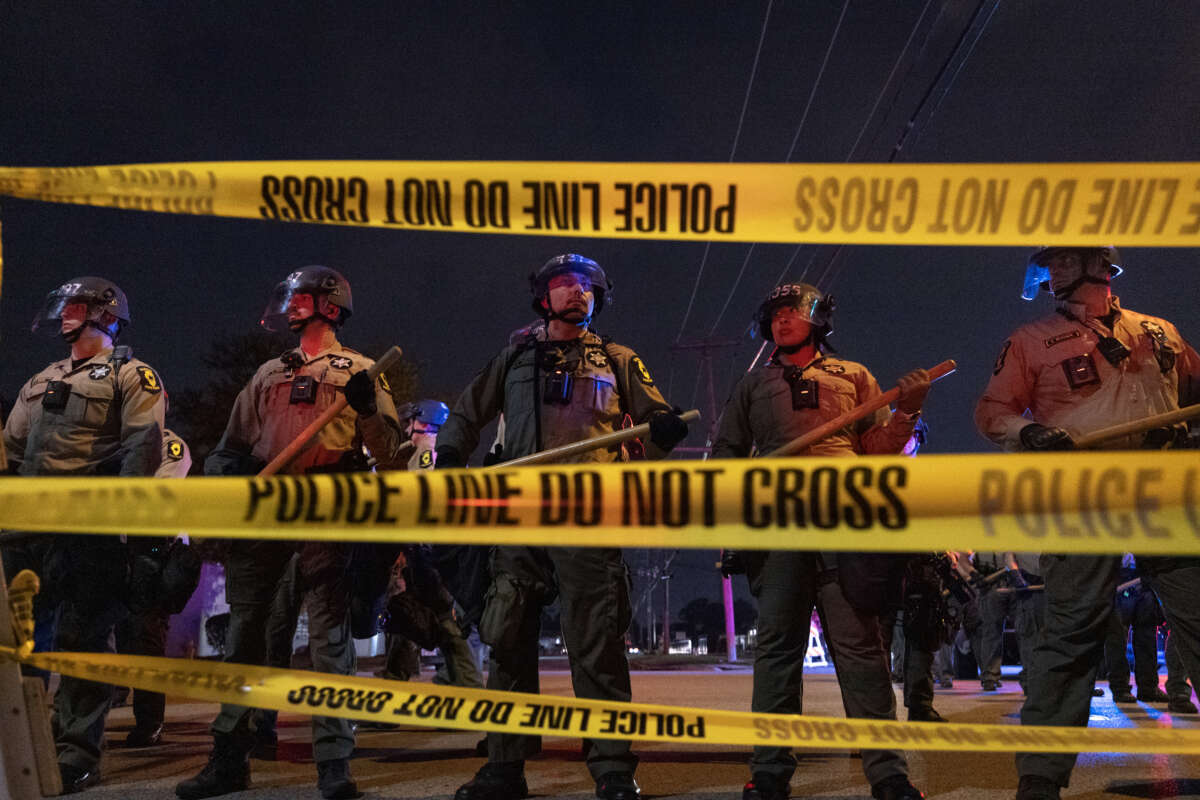
Police face off with demonstrators following the close of the "Free Speech Zone" near the immigration jail in Broadview, Illinois, on October 18, 2025.Scott Olson / Getty Images
In March of this year, in Fort Worth, Texas, nine demonstrators were convicted on a variety of different charges that ranged from providing material support to terrorists, conspiracy, and attempted murder, to obstruction of justice, as a Trump-appointed judge permitted the prosecutors to argue a completely fallacious theory — that the defendants were part of an “antifa” terrorist cell when they participated in a noise demonstration on July 4, 2025, in front of the Prairieland ICE facility.
On June 24, eight were sentenced to shockingly long and disproportionate sentences ranging from 30 to 100 years. The 30-year sentence was imposed on a defendant who didn’t even attend the protest, and whose “crime” was moving a box full of antifascist zines during the investigation. The 100-year sentence was doled out to a former Marine reservist standing guard in the woods who was convicted of wounding a local police officer about to shoot an unarmed fleeing protestor. One demonstrator received a 70-year sentence and five others received 50-year sentences.
Acting Attorney General Todd Blanche celebrated the conviction of the “Prairieland Terrorists”:
The sentences handed down today make clear that Antifa terrorists who attack law enforcement and federal facilities will face swift and uncompromising justice. Their violent extremism has no place in our country, and the Department of Justice will continue to aggressively investigate, disrupt, and prosecute those who threaten law enforcement officers or undermine the rule of law.”
FBI Director Kash Patel sounded a similar warning:
Today’s sentencings show the FBI remains committed to identifying, locating, and dismantling Antifa and its funding networks across the country. Acts of violence against our law enforcement partners will not be tolerated, and we continue our work to protect communities across the country from domestic terrorism.”
The Prairieland defendants are just one example among the many activists illegally targeted in the Trump administration’s vicious crackdown on dissent.
Trump Declares War on “Domestic Terrorism” “Antifa” and the Left
In the wake of the fatal shooting of right-wing activist Charlie Kirk, Donald Trump issued his illegal National Security Presidential Memorandum 7 (NSPM-7) on September of 25, 2025. Ominously entitled “Countering Domestic Terrorism and Organized Political Violence,” the directive essentially paints anyone who doesn’t support Trump’s agenda as a “domestic terrorist.” Target ideologies specifically listed in the memorandum include “anti-Americanism, anti-capitalism, and anti-Christianity; support for the overthrow of the United States Government; extremism on migration, race, and gender; and hostility towards those who hold traditional American views on family, religion, and morality.” This broad designation includes individuals, their organizations, and funders, and encompasses anti-fascist, pro-Palestinian, anti-ICE, and other leftist demonstrators in its net. The NSPM-7 openly calls for “investigative” tactics designed to “disrupt” and “dismantle” these groups.
The language of the memo harkened back to the days of the government’s illegal and racist war against the Black liberation and New Left movements of 1960s, and of tactics that the FBI used to violently attack similar movements and leaders under its secret COINTELPRO program.
The Trump administration memo also rallied the government’s politically motivated lawyers in the Department of Justice (DOJ) in Washington and in U.S. attorneys’ offices across the country to join the effort by using myriad federal statutes to vindictively and wrongfully charge and prosecute those who actively opposed the government and its violent and genocidal actions. This too mirrored the DOJ blueprint of the late 1960s and early 1970s that was aggressively pursued under the leadership of Attorney General John Mitchell.
In March of this year, in Fort Worth, Texas, nine demonstrators were convicted on a variety of different charges that ranged from providing material support to terrorists, conspiracy, and attempted murder, to obstruction of justice, as a Trump-appointed judge permitted the prosecutors to argue a completely fallacious theory — that the defendants were part of an “antifa” terrorist cell when they participated in a noise demonstration on July 4, 2025, in front of the Prairieland ICE facility.
On June 24, eight were sentenced to shockingly long and disproportionate sentences ranging from 30 to 100 years. The 30-year sentence was imposed on a defendant who didn’t even attend the protest, and whose “crime” was moving a box full of antifascist zines during the investigation. The 100-year sentence was doled out to a former Marine reservist standing guard in the woods who was convicted of wounding a local police officer about to shoot an unarmed fleeing protestor. One demonstrator received a 70-year sentence and five others received 50-year sentences.
Acting Attorney General Todd Blanche celebrated the conviction of the “Prairieland Terrorists”:
The sentences handed down today make clear that Antifa terrorists who attack law enforcement and federal facilities will face swift and uncompromising justice. Their violent extremism has no place in our country, and the Department of Justice will continue to aggressively investigate, disrupt, and prosecute those who threaten law enforcement officers or undermine the rule of law.”
FBI Director Kash Patel sounded a similar warning:
Today’s sentencings show the FBI remains committed to identifying, locating, and dismantling Antifa and its funding networks across the country. Acts of violence against our law enforcement partners will not be tolerated, and we continue our work to protect communities across the country from domestic terrorism.”
The Prairieland defendants are just one example among the many activists illegally targeted in the Trump administration’s vicious crackdown on dissent.
Trump Declares War on “Domestic Terrorism” “Antifa” and the Left
In the wake of the fatal shooting of right-wing activist Charlie Kirk, Donald Trump issued his illegal National Security Presidential Memorandum 7 (NSPM-7) on September of 25, 2025. Ominously entitled “Countering Domestic Terrorism and Organized Political Violence,” the directive essentially paints anyone who doesn’t support Trump’s agenda as a “domestic terrorist.” Target ideologies specifically listed in the memorandum include “anti-Americanism, anti-capitalism, and anti-Christianity; support for the overthrow of the United States Government; extremism on migration, race, and gender; and hostility towards those who hold traditional American views on family, religion, and morality.” This broad designation includes individuals, their organizations, and funders, and encompasses anti-fascist, pro-Palestinian, anti-ICE, and other leftist demonstrators in its net. The NSPM-7 openly calls for “investigative” tactics designed to “disrupt” and “dismantle” these groups.
The language of the memo harkened back to the days of the government’s illegal and racist war against the Black liberation and New Left movements of 1960s, and of tactics that the FBI used to violently attack similar movements and leaders under its secret COINTELPRO program.
The Trump administration memo also rallied the government’s politically motivated lawyers in the Department of Justice (DOJ) in Washington and in U.S. attorneys’ offices across the country to join the effort by using myriad federal statutes to vindictively and wrongfully charge and prosecute those who actively opposed the government and its violent and genocidal actions. This too mirrored the DOJ blueprint of the late 1960s and early 1970s that was aggressively pursued under the leadership of Attorney General John Mitchell.
The Broadview Case
At the time Trump issued NSPM-7, his ICE and Border Patrol troopers had met massive resistance to their unconstitutional and violent invasion of greater Los Angeles, and they were confronted with an even more remarkable neighborhood-to-neighborhood fight against the blatantly racist “Operation Midway” that was mounting in Chicago in early September.
Trump’s forces were dragging the Brown immigrants they had indiscriminately arrested during their terror raids to the ICE jail in neighboring Broadview. Resistance was swift, and a Customs and Border Protection agent fatally shot one undocumented man (Silverio Villegas González) who was fleeing from them, while peaceful demonstrators at Broadview, some of whom were practicing civil disobedience, were met with violent barrages of pepper spray, tear gas, rubber bullets, and physical brutality. As public opinion turned decidedly against the invaders, in early October, the Chicago U.S. attorneys’ office (no doubt at the direction of Washington) sought conspiracy indictments against six of the most publicly vocal demonstrators, most of whom had connections to the progressive wing of the local Democratic Party.
Employing an infrequently used federal conspiracy law that was passed during Reconstruction to protect federal officers from the Ku Klux Klan, an experienced assistant U.S. attorney, Sheri Mecklenburg, was met with a reluctant grand jury that raised numerous questions and initially refused her exhortations to indict. One juror called the case a “crock of shit,” and he and several others who questioned the case were shown the door by an angry Mecklenburg. Finally, after presenting additional testimony from an agent, the jury was visited by U.S. attorney Andrew Boutros, who, in a highly irregular lecture, sought to identify any remaining jurors who did not buy the government’s case, while making a thinly veiled threat that they had “a different procedure” for dealing with such jurors. Not surprisingly, none of the remaining jurors raised their hands.
In late October, Boutros and Mecklenburg finally got the government’s hopelessly tarnished indictments — charging the “Broadview Six” with conspiring to “impede a federal officer” when they allegedly joined a large group of demonstrators who attempted to block an ICE vehicle that was driving into the facility and slightly damaged it. During pre-trial discovery, lawyers for the six sought the secret grand jury transcripts, and the prosecutors first produced copies with the blatant misconduct deleted, then dismissed the felony charges while proceeding on the companion misdemeanor charges; in doing so, they hoped to avoid producing the unredacted transcripts.
The trial judge, April Perry, herself a former assistant U.S. attorney, was not deceived. The damning transcripts, complete this time with the prosecutorial misconduct, were produced and later publicly released, Boutros was compelled to dismiss the entire case, and he came, hat in hand, to apologize to the judge. There have been numerous calls for Boutros’s resignation; Judge Perry is considering taking further action against the prosecutors, more than 100 former assistant U.S. attorneys have publicly condemned Boutros and his assistants’ conduct in the Broadview case, and a broader investigation of Mecklenburg’s conduct before other grand juries has, to date, led to the dismissal of at least two unrelated cases.
Convictions in the Spokane 3 Case
On July 15, 2025, the acting U.S. attorney in Spokane, Washington, announced the conspiracy indictments of nine demonstrators who, a month earlier, were among a crowd of hundreds who had attempted to block the transport of two Venezualan immigrants who were seeking asylum to an ICE jail. Former acting U.S. Attorney Richard Barker had resigned rather than signing the indictments, which were brought under the same anti-Klan statute that was later used in Chicago, because, he said, “none of the agents were hurt and none of the protesters were hurt.”
Six of the nine, including a former city council president who had called for the protest, avoided jail time by pleading to lesser charges, and the remaining three — all of whom are people of color and two of whom are nonbinary, one a recent law school graduate, one a member of the Spokane Human Rights Commission, and one a decorated veteran whose father is running for Congress — went to trial in May in front of a conservative Eastern Washington jury. During the trial, it was revealed that a prosecution witness had authored social media posts that called Black politicians “lying ghetto garbage,” transgender people “mentally ill,” and had boosted a post showing ICE arresting a pregnant woman at gunpoint that called her a “pregnant invader.” Nonetheless, the three were convicted, and face possible six-year sentences. Spokane Mayor Lisa Brown called the convictions “politically motivated” and designed to discourage political dissent, while former U.S. Attorney Barker said, “I really do question whether justice was truly served.”
“Michigan 8” Indictments
In the early morning hours of June 10, 2026, the FBI conducted SWAT team raids as part of a multi-state operation that included FBI field offices in Detroit, Chicago, and Milwaukee, as well as 12 local law enforcement agencies. The heavily armed agents arrested seven former University of Michigan student activists, handcuffed them, put them in armored cars and transported them into federal custody pursuant to a 10-count federal conspiracy indictment. Together with an eighth activist, who was out of the country, they were charged with conspiring, at the height of campus protests against the Israeli genocide in Gaza, to orchestrate a campaign of threats and intimidation that targeted, homes, businesses, organizations, and individuals connected to the University trustees, and the Israeli war effort. Their alleged acts centered around spray painting, noxious “stink bombs,” fake corpses, and “mark[ing] their victims with threatening symbols used by Hamas, including red inverted triangles and red handprints,” coupled with demands to divest, and militant communications and conversations. Additionally, two of the protesters were charged with attempting to intimidate a federal witness. Announcing the indictments, U.S. Attorney Jerome Gorgon Jr., a Trump loyalist, said, “In America, we rule by law not by fear. These alleged threats and attempts to terrorize government officials, businesses, and the Jewish Federation are anti-American. We will counter intimidation with justice.”
Despite the “domestic terrorist” saber-rattling of the federal prosecutors, the “Michigan 8” were released on bond by federal magistrates. Detroit’s Sugar Law Center condemned the indictments:
The actions of law enforcement appear to be a new low in the criminalization of student opposition to the human rights violations, war crimes, and genocide in Gaza. Based on evidence that the government appears to have had for more than a year and for actions occurring nearly two years ago, the federal government is seeking to bring federal charges for acts traditionally reserved for local prosecutors. It must be asked why and why now.
15 Targeted in Minneapolis
On June 16, federal prosecutors in Minneapolis announced the conspiracy indictment of 15 ICE observers and anti-ICE demonstrators under the same anti-Klan statute that was used in Chicago and Spokane, this time also charging some of the defendants with interstate stalking, solicitation, destruction of property, and assault. The Minneapolis U.S. Attorney’s Office, whose lawyers had already lost half of the individual cases they had previously brought against activists who had participated in the mass resistance to ICE’s murderous invasion of their city, cobbled together claims that the demonstrators allegedly used debris, vehicles and other objects to obstruct roads used by federal agents, utilized homemade shields to resist officers on foot, and utilized group chats that monitored and tracked vehicles going to and from the building that served as the hub for ICE agents, as the basis for the conspiracy charges. Announcing the indictments, U.S. Attorney Daniel Rosen, asserting that the defendants were members of two Minneapolis-based leftist groups connected with “antifa,” further proclaimed, “Today’s charges and arrests reflect a broad federal effort to address organized lawless behavior, which seeks to disrupt the execution of federal law, endanger law enforcement, and importantly endanger the very communities that these defendants falsely claim to be protecting.”
A demonstration gathered at the courtroom during the bond hearing, officers deployed pepper spray and flash bangs, and one protester was treated by paramedics. The defendants were released on bond, and one of their lawyers, Bruce Nestor, called the charges “an act of political oppression. It’s designed to punish and intimidate.”
Resisting Repression
Defeated on the streets by enraged demonstrators who have successfully resisted Trump’s storm troopers everywhere that they have invaded, and stymied when they have brought individual cases against the protesters, the government has now resorted, with mixed success, to broad disruptive conspiracy prosecutions that harken back to the Smith Act prosecutions of alleged Communists in the 1950s and the prosecutions of the New Left and the Black Panthers in the late 1960s. This escalating attack against the left and the First Amendment, criminalizing free speech and militant protests, must continue to be resisted both in the courts and on the streets. As the James and Grace Lee Boggs Center in Detroit has so aptly stated: “All of us need to resist this latest effort to not only disrupt and destroy the lives of young people of conscience but also to intimidate a generation whose imaginations and moral sensibilities are precious to all of us.”
This article is licensed under Creative Commons (CC BY-NC-ND 4.0), and you are free to share and republish under the terms of the license.
Flint Taylor is a founding member of the People’s Law Office in Chicago, and, since 1969, has litigated numerous high-profile police violence and prosecutorial misconduct cases, including the Fred Hampton Black Panther case and the Chicago police torture cases. His latest book, The Conviction Machine, documents systemic prosecutorial misconduct in those cases.
With new conspiracy cases against activists — including the indictment of 15 Minnesotans — Trump’s NPSM-7 bears fruit.
By Cody Bloomfield ,
June 24, 2026
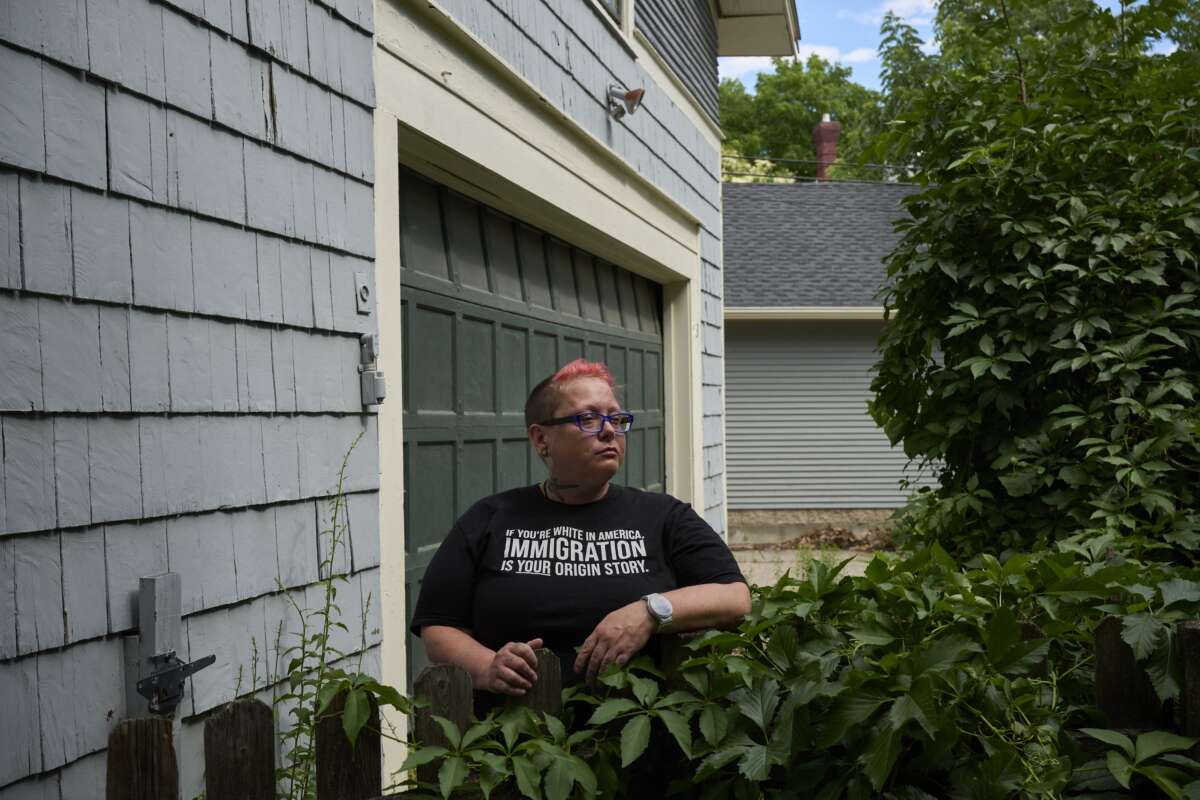
Natasha Rakotz poses for a photo near her home in Minneapolis, Minnesota, on June 18, 2026. Rakotz is one of 15 people charged with federal felonies in the wake of the immigration crackdown that began last winter in Minneapolis.
Bridget Bennett for The Washington Post via Getty Images
This week, Minnesota federal prosecutors handed down a blockbuster indictment of 15 activists involved in efforts to resist Operation Metro Surge, part of the Trump administration’s immigration crackdown that flooded 2,700 federal agents into the Twin Cities to target Somali communities. Eleven of the 15 activists are charged only with conspiracy to impede or injure a federal officer. The indictment spans 94 pages, much of it cataloging Signal messages in group chats. While the indictment mostly focuses on protests involving more confrontational tactics — using U-Haul trailers and shields to block roadways to Immigration and Customs Enforcement (ICE) buildings — it also covers conduct common to ICE resistance across the country, such as tracking the license plates and locations of ICE vehicles. At every opportunity, the indictment underscores the anarchist affiliations of the activists, citing out-of-state Anarchist Speaking Tour engagements and articles written for the anarchist website CrimethInc.
From the 1919-1920 Palmer Raids deporting anarchists to the more recent Stop Cop City and DisruptJ20 mass prosecutions, the government has long directed investigative and prosecutorial firepower toward disrupting anarchist movements. Two new indictments in the past two weeks now signal a new era of protest-related prosecutions. In addition to the indictment of ICE protesters, federal prosecutors unsealed an indictment of two Stop Cop City protesters alleged to have set fires outside of the office building of Brasfield & Gorrie, the general contractor for the Atlanta Public Safety Training Center, in 2022. Troublingly, both indictments were credited as part of the National Security Presidential Memorandum 7 (NSPM-7) initiative, an effort to investigate and prosecute civil disobedience and protest-related petty offenses as domestic terrorism. This week, the Trump administration also officially claimed the prosecution of protesters over events that transpired at a July 4, 2025, noise demonstration at the Prairieland ICE detention facility as part of the NSPM-7 initiative. One protester received a 100-year sentence for nonfatally shooting a police officer; another received 30 years for moving a box of antifascist zines.
NSPM-7
Last year, 12 days after the Charlie Kirk assassin engraved bullet casings with “Hey fascist, catch!”, President Donald Trump signed an executive order designating antifa as a domestic terrorist organization — never mind the fact that antifa is not an organization, and no federal law provides for the designation of domestic terror groups.
Days later, on September 25, 2025, Trump issued the National Security Presidential Memorandum/NSPM-7, titled “Countering Domestic Terrorism and Organized Political Violence.” As examples of domestic terrorism and political violence, the memo cites the assassination of United Healthcare CEO Brian Thompson, the attempted assassinations of Trump and Supreme Court Justice Brett Kavanaugh, and “anti-police and ‘criminal justice’ riots.”
Prairieland Protesters Sentenced to 30 to 100 Years for “Terrorism” Charges
These sentences are far longer than any of the prison sentences given to the 1,500 January 6 rioters. By Shireen Akram-Boshar , Truthout June 23, 2026
Formerly, the FBI and Department of Homeland Security (DHS) investigated anarchists under the banner of “Anti-Government or Anti-Authority Violent Extremism,” a category that also included “sovereign citizens” and right-wing militias. In contrast, NSPM-7 focuses exclusively on the anti-fascist left, or by its terms, movements that “portray foundational American principles (e.g., support for law enforcement and border control) as ‘fascist’ … Common threads animating this violent conduct include anti-Americanism, anti-capitalism, and anti-Christianity.” NSPM-7 directs the FBI, Department of Justice (DOJ), and other federal agencies to investigate, prosecute, and “disrupt” anti-fascist groups engaged in domestic terrorism — which it defines as including trespassing.
From the outset, it was clear that ICE protests would be in NSPM-7’s crosshairs…. The memo characterizes protests blocking roadways to ICE facilities as riots, a loaded term aimed at delegitimizing civil disobedience.
From the outset, it was clear that ICE protests would be in NSPM-7’s crosshairs. The same day, then-Attorney General Pam Bondi issued a memo entitled “Ending Political Violence Against ICE.” In back-to-back sentences, the memo lumped comments from politicians criticizing ICE together with a Dallas incident in which a sniper targeting ICE agents accidentally hit detainees. The memo characterizes protests blocking roadways to ICE facilities as riots, a loaded term aimed at delegitimizing civil disobedience. In a subsequent memo, Bondi directed U.S. Attorneys to prosecute crimes on a list of the “most serious, readily provable offenses.” The list includes conspiracy to impede or injure a federal officer. While this charge hardly rises to the level of seriousness implied by the domestic terrorism header, leaning on conspiracy charges eases prosecutors’ burden. Prosecutors need not prove that alleged conspirators committed any crime themselves; merely that they undertook an overt act in furtherance of an overall unlawful objective. With the Minnesota indictment, prosecutors seem poised to argue that Signal messages coordinating logistics for a protest blockading ICE facilities qualify as requisite overt acts.
This reframing — of civil disobedience as rioting and solidarity as conspiracy — is aided considerably by NSPM-7’s explicit directive to categorize protest as terrorism. Renee Good and Alex Pretti resisted ICE operations in ways reminiscent of the conduct alleged in the Minnesota indictment handed down this week. Despite widely circulated video showing the circumstances of the killings, the Trump administration stands by its characterization of Good and Pretti as domestic terrorists. All of the protest activity covered by the indictment took place in the days and months after Good’s killing; federal investigative agencies had either an informant, flipped alleged coconspirator, or undercover officer ready and able to infiltrate closed-door activist debriefs. (The indictment contains information from in-person meetings in which participants were told to turn over their phones.)
But anti-ICE protests are not the only target of NSPM-7. In a memo about the implementation of NSPM-7, Bondi directed all federal law enforcement agencies to peruse five years of past files for “Antifa-related intelligence and information.” Cue the new indictment of Stop Cop City protesters, even after most state-level prosecutions had been dropped. In September 2025, a Fulton County judge dismissed the largest prosecution of Stop Cop City protesters on procedural grounds.
The case was being pursued under the Racketeer Influenced and Corrupt Organizations Act (RICO), a law that gives prosecutors enormous latitude against what they deem “organized crime.” (Other targets of RICO prosecutions have included cheating schoolteachers and corrupt FIFA officials.) Similar to the Minnesota indictment, the RICO case was a sprawling indictment alleging an anarchist conspiracy. After years of intense scrutiny and heated political controversy, the RICO case fell apart.
This reframing — of civil disobedience as rioting and solidarity as conspiracy — is aided considerably by NSPM-7’s explicit directive to categorize protest as terrorism.
But, in April of this year, after nearly two years of dormancy, the Georgia Attorney General’s office indicted three activists accused of setting fires outside of the office building for Cop City general contractor Brasfield & Gorrie in 2022. In the press release, Attorney General Chris Carr is quoted as saying, “When it comes to fighting Antifa and keeping people safe, we won’t back down.” The press release indicates that state officials worked alongside federal partners to build the case. Less than two months later, a federal grand jury indicted two of the three activists. Arrest warrants were issued for the two activists named. One of the defendants, Katie Kloth, was processed through a Colorado jail and told to appear in Georgia under threat of a $10,000 bond.
More NSPM-7 operations may be brewing in the shadows. Per Atlanta Community Press Collective reporting, protest defense lawyer Xavier T. de Janon indicated that a recently unsealed indictment of Palestine protesters was also related to NSPM-7, even if it wasn’t publicly credited as such. Like the Cop City federal case, the Palestine protest case dredges up old conduct, this time from 2023. Among other charges, the protesters are accused of making threats after they delivered fake corpses covered in blood to a University of Michigan regent’s home. The charge carries up to five years of prison time. Protesters are also charged with conspiracy to tamper with a witness and destruction of property to prevent seizure.
Will the Federal Indictments Fall?
While the existing indictments are troubling, and more are likely to come down the pike, the fate of state-level cases provides reason for optimism. As reported by ProPublica and FRONTLINE, prosecutors dismissed or refused to file charges for over a third of the protesters and bystanders arrested by federal agents during the immigration crackdown. Like those cases, the Minnesota indictment might fall apart.
In Georgia, early signs signal trouble for the Cop City NSPM-7 prosecutions. Already, the state-level charges have collapsed. Defense attorney de Janon brought a successful motion to dismiss, arguing that by waiting until 19 days before the statute of limitations expired to prosecute them, the state violated the three defendants’ due process rights. In the bench ruling, the judge criticized the charges as “political.”
Federal prosecutions often take years. While, on the one hand, this means that a new president may be in power by the time cases resolve, the slow progress means that charges carrying significant prison time hang over the heads of activists. Even if the cases are eventually dropped, the wait takes a toll. Hannah Kass, one of the three Cop City defendants named in the state-level Brasfield & Gorrie and RICO indictments, told Mainline Atlanta about her difficulty in finding employment after graduating from her Ph.D. program while the prosecution was pending. But when it comes to trying to free other targets of political prosecutions, she notes, “Now we have the precedent.”
This article is licensed under Creative Commons (CC BY-NC-ND 4.0), and you are free to share and republish under the terms of the license.
Cody Bloomfield
Cody Bloomfield is a journalist covering policing and protest. They are the former communications director of Defending Rights & Dissent.
This week, Minnesota federal prosecutors handed down a blockbuster indictment of 15 activists involved in efforts to resist Operation Metro Surge, part of the Trump administration’s immigration crackdown that flooded 2,700 federal agents into the Twin Cities to target Somali communities. Eleven of the 15 activists are charged only with conspiracy to impede or injure a federal officer. The indictment spans 94 pages, much of it cataloging Signal messages in group chats. While the indictment mostly focuses on protests involving more confrontational tactics — using U-Haul trailers and shields to block roadways to Immigration and Customs Enforcement (ICE) buildings — it also covers conduct common to ICE resistance across the country, such as tracking the license plates and locations of ICE vehicles. At every opportunity, the indictment underscores the anarchist affiliations of the activists, citing out-of-state Anarchist Speaking Tour engagements and articles written for the anarchist website CrimethInc.
From the 1919-1920 Palmer Raids deporting anarchists to the more recent Stop Cop City and DisruptJ20 mass prosecutions, the government has long directed investigative and prosecutorial firepower toward disrupting anarchist movements. Two new indictments in the past two weeks now signal a new era of protest-related prosecutions. In addition to the indictment of ICE protesters, federal prosecutors unsealed an indictment of two Stop Cop City protesters alleged to have set fires outside of the office building of Brasfield & Gorrie, the general contractor for the Atlanta Public Safety Training Center, in 2022. Troublingly, both indictments were credited as part of the National Security Presidential Memorandum 7 (NSPM-7) initiative, an effort to investigate and prosecute civil disobedience and protest-related petty offenses as domestic terrorism. This week, the Trump administration also officially claimed the prosecution of protesters over events that transpired at a July 4, 2025, noise demonstration at the Prairieland ICE detention facility as part of the NSPM-7 initiative. One protester received a 100-year sentence for nonfatally shooting a police officer; another received 30 years for moving a box of antifascist zines.
NSPM-7
Last year, 12 days after the Charlie Kirk assassin engraved bullet casings with “Hey fascist, catch!”, President Donald Trump signed an executive order designating antifa as a domestic terrorist organization — never mind the fact that antifa is not an organization, and no federal law provides for the designation of domestic terror groups.
Days later, on September 25, 2025, Trump issued the National Security Presidential Memorandum/NSPM-7, titled “Countering Domestic Terrorism and Organized Political Violence.” As examples of domestic terrorism and political violence, the memo cites the assassination of United Healthcare CEO Brian Thompson, the attempted assassinations of Trump and Supreme Court Justice Brett Kavanaugh, and “anti-police and ‘criminal justice’ riots.”
Prairieland Protesters Sentenced to 30 to 100 Years for “Terrorism” Charges
These sentences are far longer than any of the prison sentences given to the 1,500 January 6 rioters. By Shireen Akram-Boshar , Truthout June 23, 2026
Formerly, the FBI and Department of Homeland Security (DHS) investigated anarchists under the banner of “Anti-Government or Anti-Authority Violent Extremism,” a category that also included “sovereign citizens” and right-wing militias. In contrast, NSPM-7 focuses exclusively on the anti-fascist left, or by its terms, movements that “portray foundational American principles (e.g., support for law enforcement and border control) as ‘fascist’ … Common threads animating this violent conduct include anti-Americanism, anti-capitalism, and anti-Christianity.” NSPM-7 directs the FBI, Department of Justice (DOJ), and other federal agencies to investigate, prosecute, and “disrupt” anti-fascist groups engaged in domestic terrorism — which it defines as including trespassing.
From the outset, it was clear that ICE protests would be in NSPM-7’s crosshairs…. The memo characterizes protests blocking roadways to ICE facilities as riots, a loaded term aimed at delegitimizing civil disobedience.
From the outset, it was clear that ICE protests would be in NSPM-7’s crosshairs. The same day, then-Attorney General Pam Bondi issued a memo entitled “Ending Political Violence Against ICE.” In back-to-back sentences, the memo lumped comments from politicians criticizing ICE together with a Dallas incident in which a sniper targeting ICE agents accidentally hit detainees. The memo characterizes protests blocking roadways to ICE facilities as riots, a loaded term aimed at delegitimizing civil disobedience. In a subsequent memo, Bondi directed U.S. Attorneys to prosecute crimes on a list of the “most serious, readily provable offenses.” The list includes conspiracy to impede or injure a federal officer. While this charge hardly rises to the level of seriousness implied by the domestic terrorism header, leaning on conspiracy charges eases prosecutors’ burden. Prosecutors need not prove that alleged conspirators committed any crime themselves; merely that they undertook an overt act in furtherance of an overall unlawful objective. With the Minnesota indictment, prosecutors seem poised to argue that Signal messages coordinating logistics for a protest blockading ICE facilities qualify as requisite overt acts.
This reframing — of civil disobedience as rioting and solidarity as conspiracy — is aided considerably by NSPM-7’s explicit directive to categorize protest as terrorism. Renee Good and Alex Pretti resisted ICE operations in ways reminiscent of the conduct alleged in the Minnesota indictment handed down this week. Despite widely circulated video showing the circumstances of the killings, the Trump administration stands by its characterization of Good and Pretti as domestic terrorists. All of the protest activity covered by the indictment took place in the days and months after Good’s killing; federal investigative agencies had either an informant, flipped alleged coconspirator, or undercover officer ready and able to infiltrate closed-door activist debriefs. (The indictment contains information from in-person meetings in which participants were told to turn over their phones.)
But anti-ICE protests are not the only target of NSPM-7. In a memo about the implementation of NSPM-7, Bondi directed all federal law enforcement agencies to peruse five years of past files for “Antifa-related intelligence and information.” Cue the new indictment of Stop Cop City protesters, even after most state-level prosecutions had been dropped. In September 2025, a Fulton County judge dismissed the largest prosecution of Stop Cop City protesters on procedural grounds.
The case was being pursued under the Racketeer Influenced and Corrupt Organizations Act (RICO), a law that gives prosecutors enormous latitude against what they deem “organized crime.” (Other targets of RICO prosecutions have included cheating schoolteachers and corrupt FIFA officials.) Similar to the Minnesota indictment, the RICO case was a sprawling indictment alleging an anarchist conspiracy. After years of intense scrutiny and heated political controversy, the RICO case fell apart.
This reframing — of civil disobedience as rioting and solidarity as conspiracy — is aided considerably by NSPM-7’s explicit directive to categorize protest as terrorism.
But, in April of this year, after nearly two years of dormancy, the Georgia Attorney General’s office indicted three activists accused of setting fires outside of the office building for Cop City general contractor Brasfield & Gorrie in 2022. In the press release, Attorney General Chris Carr is quoted as saying, “When it comes to fighting Antifa and keeping people safe, we won’t back down.” The press release indicates that state officials worked alongside federal partners to build the case. Less than two months later, a federal grand jury indicted two of the three activists. Arrest warrants were issued for the two activists named. One of the defendants, Katie Kloth, was processed through a Colorado jail and told to appear in Georgia under threat of a $10,000 bond.
More NSPM-7 operations may be brewing in the shadows. Per Atlanta Community Press Collective reporting, protest defense lawyer Xavier T. de Janon indicated that a recently unsealed indictment of Palestine protesters was also related to NSPM-7, even if it wasn’t publicly credited as such. Like the Cop City federal case, the Palestine protest case dredges up old conduct, this time from 2023. Among other charges, the protesters are accused of making threats after they delivered fake corpses covered in blood to a University of Michigan regent’s home. The charge carries up to five years of prison time. Protesters are also charged with conspiracy to tamper with a witness and destruction of property to prevent seizure.
Will the Federal Indictments Fall?
While the existing indictments are troubling, and more are likely to come down the pike, the fate of state-level cases provides reason for optimism. As reported by ProPublica and FRONTLINE, prosecutors dismissed or refused to file charges for over a third of the protesters and bystanders arrested by federal agents during the immigration crackdown. Like those cases, the Minnesota indictment might fall apart.
In Georgia, early signs signal trouble for the Cop City NSPM-7 prosecutions. Already, the state-level charges have collapsed. Defense attorney de Janon brought a successful motion to dismiss, arguing that by waiting until 19 days before the statute of limitations expired to prosecute them, the state violated the three defendants’ due process rights. In the bench ruling, the judge criticized the charges as “political.”
Federal prosecutions often take years. While, on the one hand, this means that a new president may be in power by the time cases resolve, the slow progress means that charges carrying significant prison time hang over the heads of activists. Even if the cases are eventually dropped, the wait takes a toll. Hannah Kass, one of the three Cop City defendants named in the state-level Brasfield & Gorrie and RICO indictments, told Mainline Atlanta about her difficulty in finding employment after graduating from her Ph.D. program while the prosecution was pending. But when it comes to trying to free other targets of political prosecutions, she notes, “Now we have the precedent.”
This article is licensed under Creative Commons (CC BY-NC-ND 4.0), and you are free to share and republish under the terms of the license.
Cody Bloomfield
Cody Bloomfield is a journalist covering policing and protest. They are the former communications director of Defending Rights & Dissent.


No comments:
Post a Comment