It’s possible that I shall make an ass of myself. But in that case one can always get out of it with a little dialectic. I have, of course, so worded my proposition as to be right either way (K.Marx, Letter to F.Engels on the Indian Mutiny)
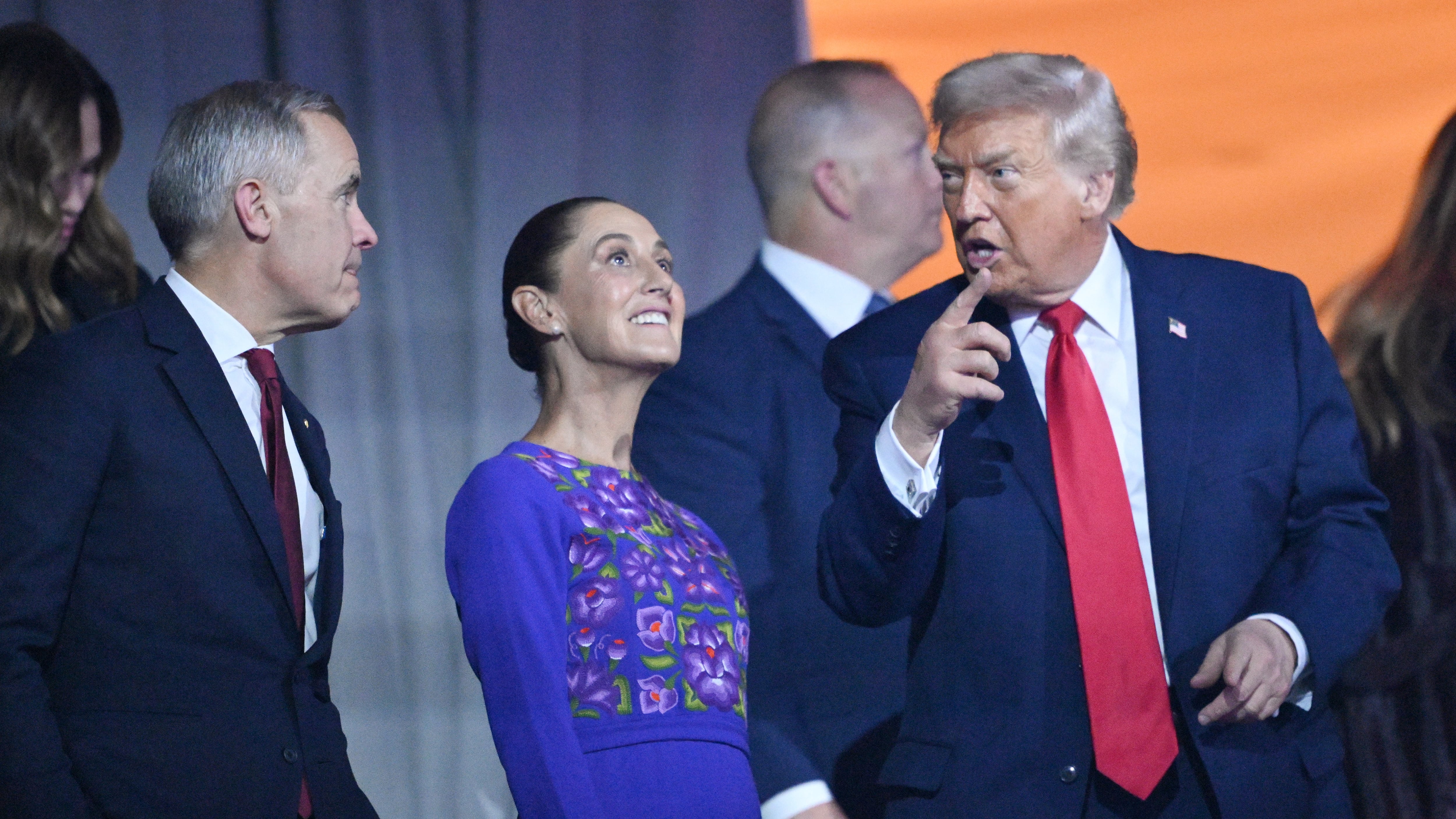
U.S. President Donald Trump speaks with Canadian Prime Minister Mark Carney and Mexican President Claudia Sheinbaum after the draw for the 2026 soccer World Cup at the Kennedy Center in Washington, Friday, Dec. 5, 2025. (Mandel Ngan/Pool Photo via AP)
OTTAWA — As expected, U.S. officials announced on Wednesday’s much-anticipated deadline that they’re opting against rubberstamping the Canada-U.S.-Mexico Agreement.
In a statement following a meeting of representatives from all three countries, U.S. Trade Representative Jamieson Greer pointed to what he called the deal’s “shortcomings,” and wrote: “The United States did not agree to renew (CUSMA) in its current form.”
So, what happens next?
Annual review process kicks in
In short, not much is changing from the perspective of the average Canadian.
Canada and the U.S. remain in a trade war that’s nearing the 18-month mark, after U.S. President Donald Trump imposed sweeping tariffs on Canadian imports last February.
While the vast majority of Canadian goods are exempt from the levies because they’re covered under CUSMA — with Canadian officials repeatedly stating Canada has “the best trade deal” in the world — a slate of sectoral tariffs remain in place.
Those are having significant impacts on the steel, aluminum, auto and lumber industries.
Wednesday’s CUSMA deadline, meanwhile, was baked into the original agreement, inked during Trump’s first term.
By July 1, officials in all three countries had to say whether they wanted to renew CUSMA for a 16-year period. Because the U.S. chose not to do so, an annual review process kicks in for the next decade.
That means weeks and likely months of negotiations ahead, led by Canada-U.S. Trade Minister Dominic LeBlanc and Canada’s chief negotiator Janice Charette.
Officials from the U.S. and Mexico already have a date set for official bilateral talks later this month, with representatives from the two countries having already met before. Canada, however, has not launched official negotiations with the United States.
Speaking to reporters on Parliament Hill last month, Prime Minister Mark Carney downplayed the significance of that, saying there’s a “series of … technical issues” the U.S. has with Mexico, which explains their more extensive bilateral discussions ahead of the July 1 deadline.
“But for us, there’s the more fundamental structural issues, as people know, which relate to the so-called strategic sectors, that’s the American term, the 232 tariffs that are on automobiles, on steel, aluminum, forest products, particularly,” Carney also said at the time. “We’re looking to determine whether there’s a possibility of a new partnership there.”
Any of the three countries are also able to pull out of the deal entirely with six months’ notice.
Despite Trump’s previous comments that he would prefer CUSMA not exist at all, saying he thinks the United States is better off without it, neither he nor his deputies have given any indication that they want to terminate it.
U.S. published list of irritants
Apart from the specific CUSMA process, U.S. officials release a list of trade irritants annually.
In April, Greer’s office released its longlist, with several pages specifically relating to Canada, and pointing to liquor, supply management, Buy Canadian procurement policies, and the Online Streaming Act, among others as sticking points.
In the weeks leading up to the July 1 deadline, Trump himself had also signalled the U.S. would not be renewing the trilateral trade deal.
Following the G7 Leaders’ Summit in France last month, Trump said he would rather leave CUSMA unsigned and have it immediately terminated, though he also said he may sign the deal.
Trump has also previously stated that the U.S. doesn’t need anything Canada has, and that “Canada lives because of the United States.”
In a broadcast exclusive interview with CTV Question Period last week, U.S. Ambassador to Canada Pete Hoekstra was pressed on Trump’s rhetoric.
“There were only two countries that responded in a strongly negative way,” Hoekstra said about Trump’s trade policy and tariffs. “The rest of the world, we’ve negotiated trade agreements. We’ve worked on frameworks, and those types of things. We did not take aim at Canada.”
More recently, Hoekstra has framed Trump’s remarks as a sign the U.S. is open to offers and has urged Canada to highlight its strengths in autos, energy, and resources.
Canada prioritizing sectoral tariffs
At various speaking engagements and reporter scrums in recent weeks, Canadian officials have repeatedly downplayed the July 1 CUSMA deadline, assuring that it’s “not a cliff.”
In a letter to his American and Mexican counterparts last month, LeBlanc stated Canada wanted to see CUSMA renewed for 16 years. In the letter, LeBlanc also laid out Canada’s priorities going forward, namely eliminating sectoral tariffs.
“Canada recognizes that either or both other parties to the agreement may wish to propose areas where improvements may be warranted to strengthen North American competitiveness,” LeBlanc wrote in his letter to Greer and Mexico’s Secretary of Economy Marcelo Ebrard, adding Canada “looks forward to continued engagement” with the U.S. and Mexico.
“In parallel, discussions with the United States on addressing sectoral tariffs will be essential,” he also wrote.
The United States has declined to extend CUSMA in its current form, triggering a new round of negotiations over North America’s trade framework. Although the agreement remains in force until 2036, businesses now face renewed uncertainty as Canada, the U.S. and Mexico prepare for what could be a lengthy negotiating process.
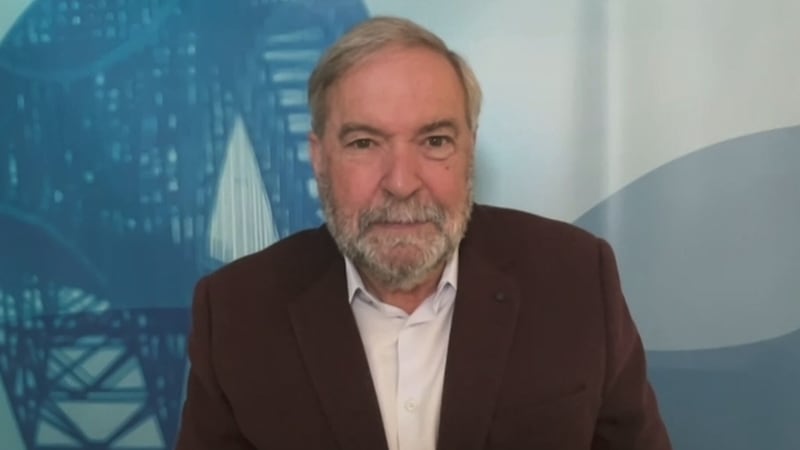
BNN Bloomberg spoke with Tom Mulcair, former leader of the New Democratic Party and CTV News political commentator, about why uncertainty may weigh on business investment, how tariff negotiations could evolve, and the political factors that could shape the outcome of talks.
Key Takeaways
Uncertainty surrounding future trade rules could delay major business investment decisions across North America.
Canada is expected to continue pushing for the removal or reduction of tariffs on steel, aluminum, automobiles and softwood lumber during negotiations.
Midterm elections in the United States could influence the political environment and negotiating leverage in future CUSMA talks.
Donald Trump is expected to use the possibility of withdrawing from CUSMA as a negotiating tactic, even if an actual withdrawal remains unlikely.
Any revised agreement is likely to resemble the current CUSMA framework because of the deep economic integration between Canada, the U.S. and Mexico.
Tom Mulcair, former leader of the New Democratic Party
Read the full transcript below:
LINDSAY: The Trump administration has officially declined to extend the Canada-U.S.-Mexico Agreement in its current form, triggering what could be lengthy and challenging negotiations over the future of the North American trade deal. While CUSMA remains in place until 2036, the decision introduces new uncertainty for businesses, investors and policymakers. Joining us now is former leader of the federal NDP and CTV News political commentator Tom Mulcair. It’s great to have you join us.
TOM: Good to be with you, Lindsay.
LINDSAY: So, obviously, this was widely expected, this decision, but how significant is it really today, both politically and economically?
TOM: I think you hit the nail right on the head when you talked about uncertainty because, even though we have a consolation in the fact that the deal continues in force for up to 10 years unless someone gives the six-month notice to withdraw — and we’ll talk about that at the end — it is the uncertainty that this creates. Businesses don’t make decisions, especially big ones, on an annual basis; they make them long term. If you’re not sure whether this deal, or another one, is going to be in place, you’re going to hold off. And it’s not just Canadian companies that are going to be affected by that; American companies and, of course, Mexican companies as well. So, that uncertainty in the market, that instability, is characteristic of Donald Trump. He doesn’t care about creating chaos. Chaos is his middle name. He likes this stuff. He had already said, in one sentence, as he left the G7 that he doesn’t care about the CUSMA deal. He wouldn’t mind leaving it on the table and just walking away from it, but then again, he could sign it all in one sentence. So, it’s the type of thing we’ve become used to with Trump, but it doesn’t make it any easier in a business environment.
LINDSAY: Yeah, and obviously Canada has repeatedly said its priority is eliminating tariffs on steel, aluminum, autos and softwood lumber, those sectors that have been hit so hard over the last year. I’ve heard some people say that we might just have to get used to having tariffs on those sectors. How realistic is it for Canada to be able to ease some of the strain on those areas?
TOM: I think that, long term, we’re going to see a lot of those lifted, or at least attenuated, because we have been, frankly, holding our fire. Donald Trump’s main recrimination from Day 1 was, “Oh my gosh, I looked at the numbers. There’s a trade deficit for the United States with Canada. We should have a trade surplus.” Well, guess what? That trade deficit was because we practically give him, certainly below market value, $100 billion of oil per year, and all of the refining and the value-added jobs are in the States, not in Canada. So, it would be very easy for Mark Carney to say, “You want to solve that issue, that trade deficit? We can solve it overnight.” But there is no reason to go down that road. That would be the Trumpian approach. Everything is a negotiation. Everything is a tit for tat. We’re trying to get a deal that makes sense for Canada, and Carney is right. No deal is certainly better than a bad deal. Trump would try to negotiate his way toward a bad deal for us. He has already threatened to really hurt the Canadian economy, as has Howard Lutnick, especially with the auto sector. So, we’re dealing with something unpredictable. We could have never guessed that Trump would go so far as to openly talk about absorbing Canada as the 51st state and intentionally harming our economy, but that’s what he’s been doing.
The information today that was just discussed on BNN Bloomberg about the United States economy, the softness of the job sector and the economy itself, is an indication that everybody loses. This is what Ronald Reagan said in the famous video that was played by Doug Ford in the U.S. during the baseball playoffs. Everybody loses when you play this tariff game long term. Trump saw the tariffs as a gentle rain from heaven pouring billions into the U.S. Treasury, but it’s not foreign countries paying those tariffs; it’s American consumers. That is finally starting to hit home. The American economy is being hit hard by those tariffs, by Trump’s approach. Even though it’s taken a while, I think the average American has come to understand it and might push back a little bit on Trump and make him open his eyes to the fact that open markets, especially in North America, have been a good thing for the U.S. and, of course, for its primary partners, Canada and Mexico.
LINDSAY: And I wonder, too, as you say, if U.S. voters start to notice this, the impact on the U.S. economy, particularly with the midterm elections coming up, could that be something that might help Canada when it comes to negotiations, maybe a bit of leverage there?
TOM: That’s the hinge. That’s the turning point, the midterms. Everybody’s got their own guess as to how they’re going to turn out, and the situation could change radically, for example, with Iran. But if things stay on an even keel, we can expect to see Trump really get hammered in the midterms, probably lose both majorities, and that would, of course, change the political landscape completely. Once we get past those, we’re into the home stretch of Trump’s four-year mandate as soon as we start 2027. So, I think that’s the reasoning behind this.
Carney is deeply experienced. He’s dealt with bullies before. He’s dealt with blowhards before. I just mentioned Howard Lutnick. He and Trump are just New York loudmouths, always trying to push their way through, trying to bully their way through. Reality catches up, even with bullies. At some point, the average Canadian has already realized we’re going to get a deal eventually. The Americans are not walking away from CUSMA. There’s too much interest in it for them. They’re not walking away from Canadian resources, whether it’s oil or potash that goes into every acre of every farm in the United States to produce the food Americans eat. These are things Canada has that America needs, even if Donald Trump says he doesn’t need anything that we have.
LINDSAY: Which he continuously seems to be saying. I did want to touch on something you mentioned at the beginning, which is the six-month notice to withdraw. Do you think that any party here will be exercising that, particularly the United States? Because, as you say, the U.S. is not going to walk away from Canada.
TOM: I think that will be a play by Donald Trump as this thing goes on for a few months. He’ll use that threat. It’ll be an idle threat. It’ll be an empty threat, but it’s something that we’re going to have to take seriously because, if he ever did do it, of course it would hurt the Americans as much as us because, as we just explained, they’ve been winners under CUSMA, as everybody else has.
But if he does actually withdraw, so people understand, the current deal continues for 10 years. It has to be reviewed annually, but it continues. It’s the same deal. Any of the three parties can simply give six months’ notice to the other parties, and then they’re out of the deal. So, I’m absolutely expecting Trump to try to play that card at some point along the way to try to put pressure on everyone. For him, everything’s a negotiation. Everything is bartering. Everything is trying to gain an advantage over the people you’re discussing things with. So, sure, “The Art of the Deal,” per Trump, will probably involve that six months’ notice. But again, it’ll be chaotic for the markets, for businesses. Trump’s middle name is chaos. He’s going to try to convince everybody that he’s been a big successful winner, no matter what the result is, even if it’s the same deal.
Lindsay, Trump said CUSMA was the best deal ever. He’s the one who signed it. Now he’s saying it’s a lousy deal. He brought in CUSMA because he said that NAFTA, the North American Free Trade Agreement, the precursor, was the worst deal ever in history. If you look at NAFTA and you look at CUSMA, guess what? They’re very, very similar, and in many respects identical. So, this is the pure Trump game. He wants to be able to boast that he got something out of it. We’ll see whether that actually comes to pass.
LINDSAY: And just lastly, I know you’re not an analyst or an adviser, but what do you think Canadian businesses and investors should be watching for in the coming months, just in the last 30 seconds or so?
TOM: Well, the first part is what we looked at at the beginning. I think that a lot of those businesses are going to hold big decisions. They’re just going to put themselves in a holding pattern, and they’re going to say, “We’re not going to make that massive investment south of the border, or going the other way, because there’s too much uncertainty.” So, I think that’s one of the things that we’re are going to be seeing the most, a waiting period as people try to decide whether there’s going to be a new deal.
I actually do believe that cooler heads will prevail, that there will be a good deal that will resemble a heck of a lot of CUSMA, which resembled a heck of a lot of NAFTA. But Trump, of course, has never been satisfied with anything that anybody else did. He gets to criticize that and says that he’s going to come up with something much better. We’ll see. We will see, indeed.
LINDSAY: Okay, we’ll have to leave it there. Former leader of the federal NDP and CTV News political commentator Tom Mulcair joining us live. Tom, thanks so much. Appreciate your time.
TOM: All the best, Lindsay.
---
This BNN Bloomberg summary and transcript of the July 2, 2026 interview with Tom Mulcair are published with the assistance of AI. Original research, interview questions and added context was created by BNN Bloomberg journalists. An editor also reviewed this material before it was published to ensure its accuracy and adherence with BNN Bloomberg editorial policies and standards.
.jpg)

.jpg)


No comments:
Post a Comment