Why Did the Largest Global Anti-War Movement Fail to Become a New Anti-Imperialist Internationalism?
Introduction
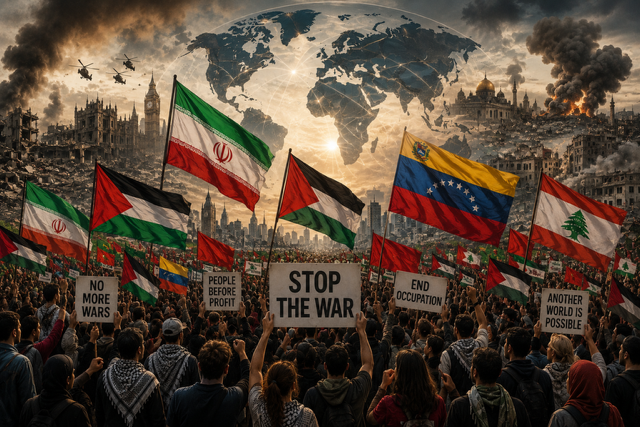
Since October 7, 2023, the world has witnessed one of the largest waves of protest since the Iraq War. Student encampments emerged from Columbia University to Berkeley, and from Amsterdam to London. Dockworkers in Oakland refused to load ships carrying weapons destined for Israel. In December 2023, South Africa brought a case against Israel before the International Court of Justice in The Hague, alleging that Israel’s actions in Gaza constituted genocide. As the conflict expanded to Lebanon, Yemen, and eventually to direct military confrontation involving Israel, the United States, and Iran, what many left-wing analysts had warned about for years became increasingly visible: a regional war was no longer a theoretical possibility but an unfolding reality. Yet when we examine the political consequences of this period, an uncomfortable question confronts the global Left. Millions of people took to the streets. Solidarity with Palestine became a shared political language across generations. Public opinion in many Western countries, especially among younger generations, became increasingly critical of the foreign policies pursued by their own governments. And yet, despite the scale of these mobilizations, no global anti-war front emerged, no durable political structure was created, and no new internationalism capable of challenging imperial power was born from these struggles. The question of this article is therefore not simply: why did the Left fail to unite? The deeper question is: why did the largest global wave of opposition to war in recent decades fail to become the foundation for a renewed anti-imperialist internationalism? From a Marxist perspective, the answer cannot be reduced to disagreements among left organizations or personal conflicts between political leaders. The roots of this failure lie in deeper historical transformations: the structural crisis of global capitalism, the decline of US hegemony, the weakening of working-class organizations, and the internal transformations of the Left itself over the past four decades.
The Organizational Crisis of the Left
The first and perhaps most fundamental reason for this failure is the erosion of the organizational infrastructure of the global Left. Previous anti-war movements — from the struggle against the Vietnam War to the anti-colonial movements of the 1960s and 1970s — relied on networks of communist parties, powerful trade unions, liberation movements, and international political organizations. These structures had many limitations and contradictions, but they provided something that is largely absent today: the ability to transform street mobilization into a sustained political strategy. Today, much of this infrastructure has disappeared or has been severely weakened. Trade unions, after four decades of neoliberal restructuring, have lost membership, bargaining power, and much of their ability to coordinate international action. In Britain, union density has fallen from around half the workforce in the late 1970s to roughly a quarter today; in the United States it stands even lower, at about ten percent of wage and salary workers. In many countries, organized labor has been pushed from a central political force into a defensive position, struggling simply to preserve gains made during earlier periods of working-class organization. The movements of recent years have largely taken a different form: decentralized, network-based, and organized through digital platforms. They are often extremely effective at mobilizing thousands or even millions of people quickly, yet they frequently lack the institutions necessary to transform social anger into lasting political power. The student encampments of spring 2024 demonstrated this contradiction clearly. They showed remarkable courage and political consciousness, but they were primarily temporary coalitions of student organizations, religious groups, and human rights activists rather than a class-based political front with a common long-term strategy beyond immediate campus demands. Resistance, in short, was never lacking. What was consistently missing was the organizational form capable of carrying that resistance forward.
The Tension Between Identity and Class Politics
The second factor concerns the transformation of political organization within the contemporary Left. Over recent decades, a significant part of progressive politics has increasingly organized around questions of identity, recognition, and representation rather than primarily around class relations and the structures of global capitalism. This transformation did not occur without historical reasons. Struggles against racism, patriarchy, colonial legacies, and different forms of social exclusion have been genuine emancipatory movements. They have achieved important victories and expanded the meaning of equality and justice. Any serious left politics must recognize that class exploitation does not exist separately from racial, gender, national, and cultural forms of oppression. The difficulty emerges when identity-based struggles become disconnected from a broader structural analysis of power. When political movements understand oppression mainly through separate categories of identity rather than through the social relations, economic structures, and global systems that reproduce inequality, their capacity to build broad and durable alliances is weakened. The Palestinian question, for example, cannot be fully understood only through competing identities or national narratives. It must also be analyzed through the structures of settler colonialism, military occupation, global arms production, capitalist interests, and geopolitical competition. Likewise, the confrontation with Iran cannot be understood only through the language of competing states or security threats. It belongs to a longer history of Western intervention in the Middle East, struggles over strategic resources, and attempts to preserve geopolitical influence in a region central to global capitalism. A sustainable anti-imperialist movement requires a politics capable of connecting different struggles through a common structural understanding: bringing together workers’ movements, feminist struggles, environmental campaigns, anti-racist mobilizations, and anti-war activism without reducing any of them to secondary issues. The challenge for the contemporary Left is therefore not to reject identity-based struggles, but to integrate them into a broader project of social emancipation — recovering the historical capacity of Marxist politics to connect different forms of oppression to a wider critique of the capitalist world system, while remaining attentive to the real experiences of marginalized communities.
The Crisis of the Concept of Imperialism
A third and perhaps decisive obstacle is the unresolved debate within the Left itself over the meaning of imperialism. In the Marxist tradition, particularly following Lenin’s analysis of imperialism as a stage of capitalist development, imperialism is not simply the foreign policy of one particular state. It refers to a global system in which capital accumulation, financial power, military expansion, and geopolitical domination shape relations among states and classes. Yet the contemporary Left remains deeply divided over how this concept should be applied to the present world system. One current, drawing from classical anti-imperialist traditions, identifies the United States and its major allies as the central forces of contemporary imperial domination, emphasizing the history of colonialism, military interventions, sanctions, regime-change operations, and the global network of US military power. Another current argues that imperialism cannot be reduced to Western power alone. Drawing on a more complex understanding of the world system, it maintains that multiple states — from Russia and China to regional powers in the Middle East — can participate in relations of domination and military expansion, and that no state should be exempt from criticism simply because it challenges Washington. This debate, which deeply divided the Left during the war in Ukraine, has reappeared during the crises in Gaza and Iran. For some sections of the Left, any force confronting US power is automatically placed within an anti-imperialist framework. For others, this approach risks replacing Marxist analysis with geopolitical campism — the assumption that the enemy of one’s enemy must necessarily represent a progressive alternative. A genuine anti-imperialist perspective must avoid both positions. It must recognize the historical and structural role of Western imperial power, particularly the military, financial, and political dominance exercised by the United States and its allies. At the same time, it must maintain an independent critique of all forms of domination, including those exercised by non-Western and regional powers. As Lenin’s analysis reminds us, imperialism is rooted in structures of capital and power, not merely in the identity of particular governments. Applying this insight today requires a concrete analysis of the global system rather than a mechanical repetition of twentieth-century political alignments. A Marxist approach must therefore hold two principles together: opposition to imperial domination by the major capitalist powers, and opposition to all forms of exploitation, oppression, and militarism regardless of which state exercises them. This dialectical position is more politically demanding than choosing one geopolitical camp against another. But without such independence, the Left loses its ability to offer a genuine alternative to the logic of great-power competition.
The Political Economy of War
Another dimension of the problem is the economic foundation of contemporary warfare. Wars are not only the result of political decisions made by governments; they are also embedded in material interests and structures of accumulation. The military-industrial complex, particularly in the core capitalist states, has developed into a powerful network connecting arms manufacturers, financial institutions, security industries, and state bureaucracies. The scale of this system is not abstract: US military spending alone now exceeds $850 billion a year, more than the next several largest military budgets in the world combined, and major contractors such as Lockheed Martin and RTX have reported record order backlogs during precisely the years of escalation in Gaza, Ukraine, and the Gulf. The continuation of permanent war is therefore not simply an accident of politics. Military budgets, weapons contracts, and security industries represent enormous flows of capital, and for the institutions connected to these sectors, instability itself can become a source of profit and accumulation. This does not mean that every war can be reduced mechanically to economic interests. Political conflicts, historical experiences, national struggles, and ideological factors all play a role. But a Marxist analysis must still ask a fundamental question: who benefits materially from the continuation of militarization, and who pays its costs? The answer is clear: the costs of war are carried overwhelmingly by ordinary people, while the economic benefits are concentrated among a narrow set of powerful institutions and corporations. This is why anti-war politics cannot be separated from struggles against neoliberalism and economic inequality. The same governments that claim there are insufficient resources for healthcare, housing, education, and environmental protection often find enormous resources for military expansion. War and austerity are not separate realities. They are two expressions of a system that prioritizes capital accumulation over human needs.
Media Power and the Battle Over Meaning
Contemporary imperial power is maintained not only through military force, economic domination, and political influence, but also through the ability to shape narratives and define reality. Every war is simultaneously a battle over territory and a battle over meaning. The war in Gaza once again demonstrated the centrality of this struggle. While images of destruction, displacement, and civilian suffering reached millions of people worldwide, much of the mainstream media in Western countries framed the conflict primarily through the language of security, terrorism, and the “right of self-defense.” The broader historical context — decades of occupation, settler colonialism, unequal relations of power, and the political and military support provided by Western governments — was often marginalized or treated as secondary. This reflects what Edward Herman and Noam Chomsky described as the structural filtering of media systems: the ways in which ownership concentration, economic interests, and reliance on official sources shape dominant narratives about international conflicts. Criticizing this media framework does not mean denying the complexity of political realities or ignoring violence committed by different actors. The issue is how dominant institutions construct a hierarchy of legitimacy: whose violence is described as security, whose resistance is described as terrorism, and whose suffering becomes politically visible. As Antonio Gramsci argued, ruling powers maintain their influence not only through coercion but also by transforming particular interests into common sense. Hegemony operates by making a specific interpretation of reality appear natural, neutral, and unquestionable. The challenge for the anti-imperialist Left is therefore not only to oppose wars, but also to challenge the ideological frameworks that normalize them. Digital platforms have created unprecedented opportunities for exposing official narratives and mobilizing public opinion. Yet they have not automatically produced durable political organizations. They are often shaped by short attention cycles and temporary moments of visibility rather than long-term collective strategy. This creates one of the central contradictions of our era: the world is more connected than ever before, yet the political organizations capable of transforming this connection into historical power remain weak.
A World System in Transition: Hegemonic Decline and the Meaning of Gaza
The failure of the anti-war movement to become a global anti-imperialist force must be understood within the broader crisis of the world system. The wars and conflicts of recent years — Gaza, Ukraine, Yemen, Syria, and the escalating confrontation surrounding Iran — are not isolated events. They are interconnected expressions of a deeper transformation: the crisis of the US-led global order and the emergence of a more unstable and contested international system. As Immanuel Wallerstein argued, periods of hegemonic decline are not necessarily periods of peace. On the contrary, they are often marked by uncertainty, instability, and intensified competition among forces seeking to shape the future of the world system. The United States remains the most powerful military and financial actor in the world. However, its ability to impose a stable global order has weakened. At the same time, emerging powers and regional actors challenge aspects of US dominance without necessarily offering a fundamentally different social or economic alternative. This period of transition creates conditions in which military solutions become increasingly attractive to ruling elites. When economic contradictions deepen and political legitimacy declines, states often rely more heavily on military power, security institutions, and external conflicts as mechanisms for maintaining influence. The Middle East has become one of the central arenas of this struggle precisely because of its strategic importance: energy resources, trade routes, military positioning, and geopolitical influence. From this perspective, Gaza was not only a humanitarian catastrophe — although it was undeniably that. It also revealed fundamental contradictions within the existing global order, exposing the gap between claims of a “rules-based international system” and the selective application of those rules according to geopolitical interests. This contradiction created a historic opportunity for the Left.
Why Gaza Represented a Historic Opportunity for the Left
Despite its organizational weaknesses, the response to Gaza demonstrated that the social foundations for a renewed internationalism still exist. A new generation shaped by the financial crisis of 2008, the climate crisis, and the failures of neoliberal globalization entered political struggle on a global scale. University campuses across the United States and Europe became centers of protest. Students challenged their universities’ relationships with weapons manufacturers and demanded political accountability. At the same time, the actions of workers connected to global supply chains pointed toward another possibility: the partial return of class politics to anti-war struggles. The refusal of dockworkers in Oakland to participate in the shipment of weapons to Israel, although limited in scale, offered a glimpse of the strategic importance workers can hold. Unlike symbolic protest alone, labor has the potential to intervene directly in the material networks through which war is produced and sustained. However, it would be an exaggeration to describe these events as a full return of class politics. They should instead be understood as important signs of a possibility that the Left has yet to transform into a broader and repeatable strategy. The Global South, meanwhile, played an increasingly independent role in challenging Western narratives. South Africa’s legal action at the International Court of Justice brought the language of genocide back to the center of international debate and symbolized a broader demand for a more equal global order. Across Africa, Latin America, and Asia, many societies expressed growing skepticism toward Western claims of moral authority in international affairs. As Wallerstein’s analysis of world-system crisis suggests, moments of hegemonic instability can also become moments of political opening. Yet this enormous social energy remained fragmented. The problem was not the absence of solidarity. The problem was the absence of political organization capable of transforming solidarity into lasting international power. Yet organizational fragmentation is not the only obstacle the Left must confront. Even where organization exists, movements have often struggled to say clearly what they are for, and not only what they oppose.
The Crisis of Political Imagination
Beyond organizational weakness, the Left also faces a deeper crisis: a crisis of political imagination. The decline of twentieth-century socialist projects, combined with the ideological dominance of neoliberalism, has narrowed political horizons across much of the world. Many contemporary movements have become highly effective at resisting specific injustices — opposing wars, defending communities, challenging discrimination, and exposing abuses of power — but they often struggle to articulate a coherent vision of a different social order. Resistance has become easier to imagine than transformation. This is one of the central contradictions of the current moment. Millions of people can recognize the failures of the existing system: endless wars, growing inequality, ecological destruction, and the concentration of wealth and power. Yet many movements lack a shared language for describing what should replace that system. For the Left, anti-imperialism cannot exist only as opposition. It must also represent a positive project: a vision of international cooperation, economic justice, democratic control over resources, ecological sustainability, and a world order based on human needs rather than competition among states and accumulation of capital. Without such a horizon, movements risk becoming cycles of resistance that challenge individual crises but fail to transform the structures producing those crises. The task is therefore not only to rebuild organizations but also to rebuild political imagination. A new internationalism must answer not only the question of what we are against, but also what kind of world we are trying to create.
Building a New Anti-Imperialist Internationalism
The central lesson of the recent period is that protest alone is not enough. The millions who demonstrated against the war in Gaza showed that the desire for justice, solidarity, and peace remains alive. The missing element was never popular will; it was the organizational capacity to convert that will into a coherent historical force. History demonstrates that major social transformations rarely emerge from spontaneous mobilization alone. Movements become capable of changing society when they develop organizations, institutions, political education, and long-term strategies. The challenge for the Left today is therefore not simply to mobilize against individual wars, but to rebuild the organizational foundations of international solidarity. A new anti-imperialist internationalism cannot be a mechanical repetition of the political structures of the twentieth century. The world has changed. The working class is more globally dispersed, production has been reorganized through global supply chains, digital technologies have transformed communication, and ecological crises have become central political questions. Yet the fundamental principles remain relevant: opposition to domination, resistance to militarism, solidarity among oppressed peoples, and the struggle for a social order based on human needs rather than capital accumulation.
Reconnecting Anti-War Politics with Class Struggle
The most important challenge for the future Left is rebuilding the connection between anti-war politics and working-class organization. One weakness of many contemporary anti-war movements is that they often remain separated from the everyday economic struggles of ordinary people. Yet war and social inequality are deeply connected. Military budgets are not abstract figures. They represent resources diverted away from healthcare, housing, education, and environmental protection. The same economic system that produces precarious employment and growing inequality also produces permanent militarization. For this reason, trade unions must once again become central actors in the struggle against war. The power of workers lies not only in their numbers but in their position within the production system itself. Workers in ports, transportation, logistics, and military industries occupy strategic positions in the networks that make modern warfare possible. Their collective action has the potential to challenge the material foundations of militarization. The experience of dockworkers in Oakland should therefore be understood carefully: not as evidence that a new global labor movement against war has already emerged, but as an important example of the possibilities that exist when class power intersects with anti-imperialist politics. The essential question facing the Left is not only how we protest against war, but how we organize those whose labor makes war possible. Without this connection, opposition to militarism risks remaining symbolic rather than transformative. A renewed anti-war movement must therefore move beyond moral condemnation alone and build alliances capable of disrupting the economic and political structures that sustain militarization.
Beyond Fragmentation: Rebuilding the Political Independence of the Left
The future of the Left depends on overcoming two opposing dangers. The first is geopolitical campism: the idea that world politics can be reduced to a struggle between rival states, and that opposition to one imperial power automatically places another force on the side of emancipation. The second is a liberal internationalism that condemns certain forms of violence while ignoring the structural realities of capitalism, imperialism, and global inequality. A renewed Left must reject both approaches. It must recognize the continuing central role of Western imperial power and the historical consequences of colonialism, military intervention, and unequal global structures. At the same time, it must maintain a critical position toward all forms of domination, including those exercised by regional and non-Western powers. This independent perspective is not a political luxury. It is the foundation of any genuine emancipatory project. The historical mission of the Left has never been merely to choose one side in conflicts among ruling elites. Its task has been to develop an alternative grounded in the interests of working people and oppressed communities across borders. The Left cannot rebuild internationalism by becoming an extension of any state’s geopolitical strategy. A genuine anti-imperialist politics must place human emancipation above geopolitical alignment. It must defend the right of peoples to determine their own futures while simultaneously opposing occupation, domination, exploitation, and authoritarianism wherever they appear. This is a more difficult political position than simply choosing sides in conflicts among states. But it is precisely this independence that gives anti-imperialism its transformative potential.
Conclusion: Crisis, Possibility, and the Future of Internationalism
The wars in Gaza, Yemen, Syria, Ukraine, and the escalating confrontation surrounding Iran reveal a deeper reality: global capitalism, facing economic contradictions and a crisis of hegemony, increasingly relies on militarization, coercion, and conflict as mechanisms of power. At the same time, the response of millions around the world has demonstrated that the desire for solidarity and resistance has not disappeared. The streets, universities, workplaces, and social movements have shown that the social foundations for a renewed internationalism still exist. What was missing was not the will of ordinary people. What was missing was the political organization capable of transforming that will into a coherent historical force. The crisis of the Left today is therefore not only a crisis of ideas. It is a crisis of organization, strategy, and international coordination. If the Left fails to learn from this moment, future wars and crises may once again produce mass protests without producing lasting political transformation. But if it can draw the necessary lessons — the need for organization, the need for class politics beyond fragmentation, the need for political imagination, and the need for an independent anti-imperialist perspective — then this period of crisis may become the beginning of a new chapter in the history of international solidarity. As Antonio Gramsci argued, periods of crisis are moments when the old order is dying while the new has not yet been born. Such moments contain both danger and possibility. The future is not predetermined. The same crises that can lead to greater militarism, authoritarianism, and barbarism can also create openings for new struggles for emancipation. The central question facing the Left in the twenty-first century is whether it can build the international movement capable of transforming resistance into a durable historical force.

No comments:
Post a Comment