Democrats query Trump Jr.-backed critical minerals company in blueprint on probes
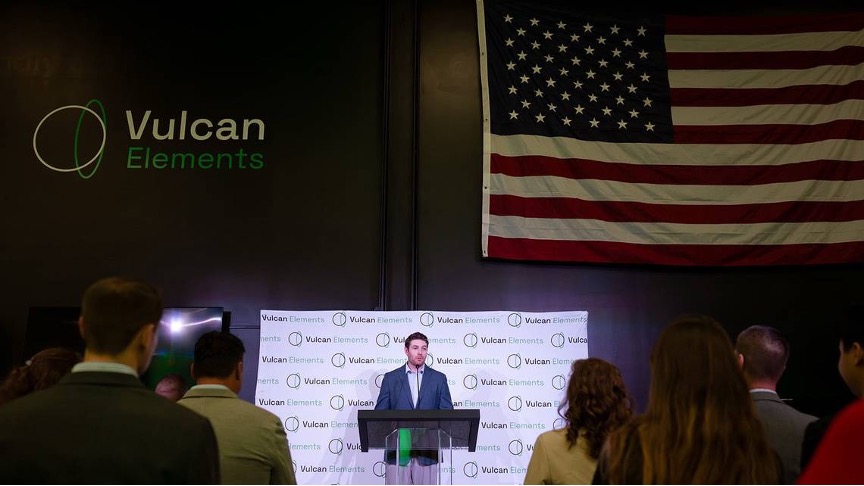
Ranking House Democrats on a Congressional committee overseeing the nation’s mining laws sent a letter this week to a Trump family-backed critical materials company citing corruption concerns related to government contracts.

The letter, signed by California Democrats Jared Huffman and Robert Garcia, demanded documents from Vulcan Elements Inc. CEO John Maslin, including the names of people at 1789 Capital that served as contacts during the government investment process that yielded the company a $620 million conditional loan commitment from the Pentagon.
The seven-page letter details reporting from a broad range of news agencies that cover a variety of questions that arose since the November announcement.
1789 Capital was among a group of venture capital firms that invested in Vulcan last August, with Bloomberg News reporting in March that the fund counts the president’s son, Donald Trump Jr., as a partner. The letter offers a blueprint for how Democratic representatives in Congress may investigate the Trump family and the equity stakes the US government has taken during President Donald Trump’s second term if they were to win back part of Congress in the midterm elections.
“This deal is part of a troubling pattern of opaque, multi-million-dollar deals with politically connected companies,” the lawmakers wrote in the letter. “When contracts are awarded based on political connections rather than merit, capable companies lose business to connected ones regardless of their technical qualifications.”
Vulcan, a startup that intends to produce permanent magnets at commercial scale, was part of a bigger $1.4 billion critical minerals agreement that also included ReElement Technologies Corp., a rare-earths refiner, to provide the critical feedstock to make the magnets. The deal is one of many hailed by the Trump administration as moving the US toward weening itself off reliance on the Chinese supply chain.
Permanent magnets and rare earth minerals are essential components that are included in a range of products including defense-related technologies, automobiles and wind turbines.
“Vulcan did not ask or solicit its investors to facilitate the Pentagon loan announced in November,” a Vulcan spokesperson said in a statement. “After a year-long review involving multiple government agencies, the Pentagon selected Vulcan for an investment to build the world’s largest rare earth magnet plant outside of China.”
To be sure, Democrats haven’t produced their own significant evidence of alleged wrongdoing that could be occurring behind closed doors around the many deals struck by the Trump administration. Part of that is simply because the party remains in the minority, with Republicans who control both chambers of Congress showing little interest in such investigations.
Bloomberg News reported in May that the Pentagon was weighing whether to scrap the $80 million conditional loan offer it made to Vulcan’s partner, ReElement. Officials vetting the company raised doubts about ReElement’s ability to scale its technology, as well as its long-term revenue forecasts.
The deals with magnet and rare earth producers remain a significant linchpin of Trump’s trade and national security strategy with China. A trade truce late last year eased export control restrictions on the materials essential to a host of cutting-edge industries, but remains a source of tension between the world’s two largest economies ahead of a planned visit to Washington in September by Chinese President Xi Jinping.
Trump last week hosted a critical minerals meeting with top industry executives in which he touted $3 billion in projects to counter China, including new announcements of a $1.4 billion loan agreement with Sila Nanotechnologies Inc. and $400 million to Sunrise Energy Metals Ltd. The event showcased administration efforts to spur US critical minerals development and processing before Xi’s planned visit.
(By Joe Deaux)

No comments:
Post a Comment