Islamophobia goes back decades, before 9/11, a new book argues
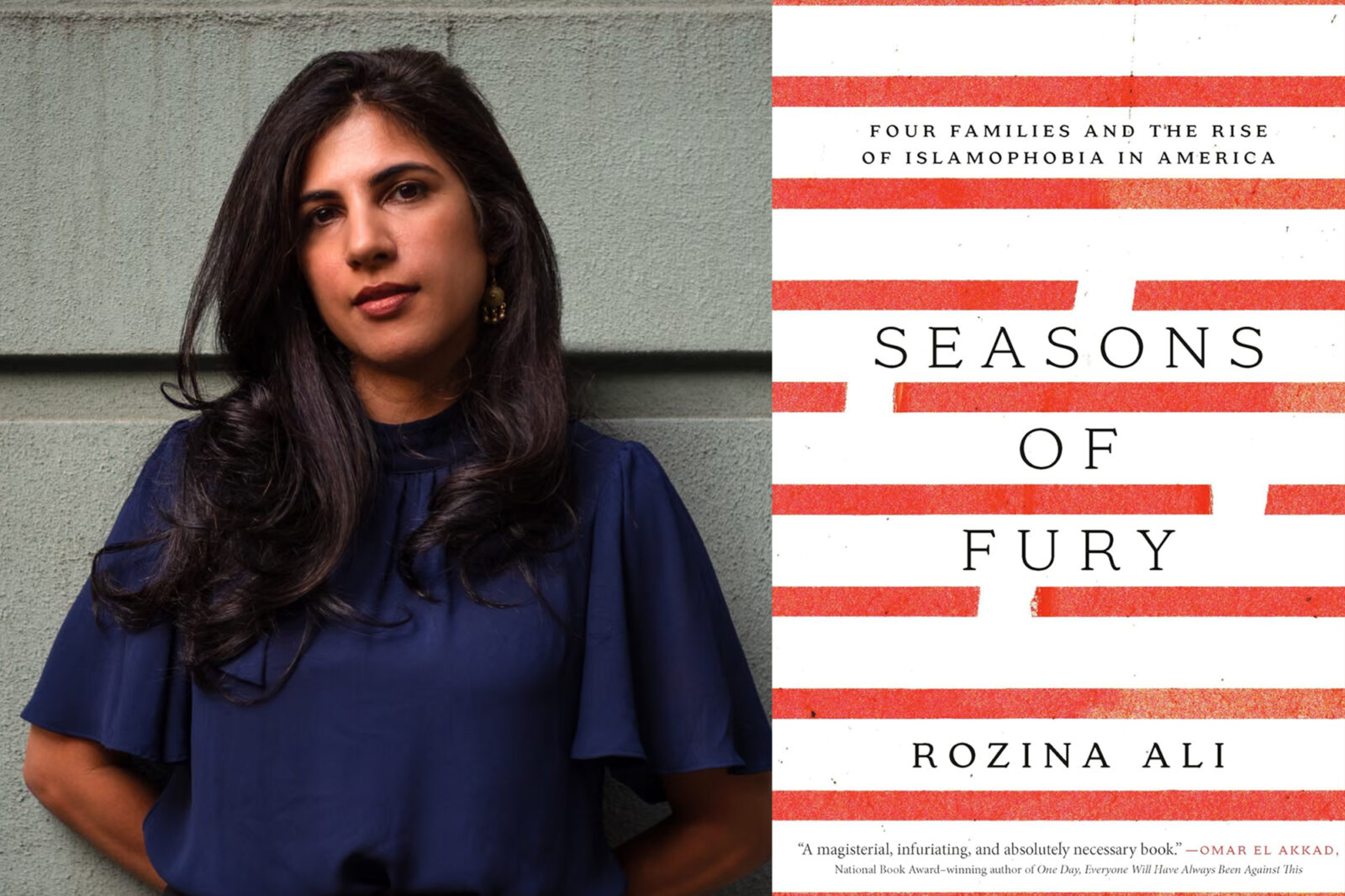
(RNS) — When journalist Rozina Ali set about telling the story of the rise of Islamophobia in the U.S., she decided to take an unusual approach. In her new book, “Seasons of Fury: Four Families and the Rise of Islamophobia in America,” the award-winning New York Times Magazine writer focuses on profiling four Muslim families of various ethnicities and political views, all of whom experienced suspicion and prejudice.
“Seasons of Fury” follows Abdeen Jabara, a prominent Arab American lawyer and pro-Palestine activist who, in the 1970s, exposed a massive spying program against Arab Americans, including himself. She also tells the complex story of Matin Siraj, who pled guilty to conspiring to plant bombs at a New York subway station. And there is Ali Chaudry, elected in 2004 as the mayor of a small town in New Jersey, who later discovers the limits of acceptance when he tries to open a mosque. And, the book tells the story of a Palestinian-American family (whom she gives the last name pseudonym, Omar) who is harassed by neighbors for two decades.
“One of the most important things for me was to make Muslims in the U.S. multidimensional,” said Ali, noting that since the 9/11 attacks, Muslims often fell under suspicion and were seen as a collective threat. “All of them have very different motivations, and I wanted to show how, despite those variances, they were all affected by anti-Muslim sentiment in this country in different ways.”
This interview has been edited for length and clarity.
You write that Americans have not reckoned with what the U.S. government has done after 9/11 and that “this book is an attempt to reclaim a bit of that history.” Can you tell me more about your motivations for writing this book?
When I was thinking about the seeds of this book, it was around the time of Donald Trump’s rise. And at that time, there was a mass increase in hate crimes against Muslims around the country. There was a lot of anti-mosque activity. And when Donald Trump became president, obviously he instituted the Muslim ban.But he also was called by a lot of journalists and commentators … the most Islamophobic administration in U.S. history, and I thought that really erased so much of what had happened after 9/11 and the fear that Muslims had undergone because of what the U.S. government was doing. And so I decided that I wanted to try to capture that history that Americans either had forgotten or not had quite contended with. One of my guiding questions — and I really approached this as an investigation — was trying to understand why Islamophobia is so much more accepted and rampant now than it was even after 9/11.
I hear from Muslim community members that Islamophobia feels more vicious now than it did even after 9/11. How do you think anti-Muslim hate has changed in the last 25 years?
Before 9/11, or even immediately after, a lot of policymakers, senior officials, the American public at large, understood that Muslims were a religious group and they were part of the country. Obviously there were hate crimes against Muslims or those who were perceived to be Muslims, but for the most part, the narrative was Islam is a religion of peace. That’s what George W. Bush said: that Muslims are a part of this country.
Twenty-five years later, we have come to a place where many Americans believe that Islam itself is dangerous. And yes, absolutely, Islamophobia today is much more vicious than it has been in the past in part due to how we’ve started to mutate our understanding of both terrorism and religion.
We launched a really broad War on Terror. There was a narrative building that there is something inherently dangerous about Islam and the teachings of Islam, and this was a narrative that was propagated not just by Islamophobes and the religious right-wing elements of this country; it was also parroted by law enforcement. And too few policymakers and senior officials were willing to push back on that narrative, and today, too few politicians are willing to push back on their colleagues who parrot such Islamophobic rhetoric.
Abdeen Jabara was surveilled by the FBI in the 1960s, long before 9/11. What does his story tell us about the origins of Islamophobia?
I was actually trying to understand why the U.S. government felt so comfortable targeting an entire faith group, surveilling an entire religious group after 9/11, and I kept pulling the thread and trying to understand how far back does it go, and I found out that they did that before in the ’90s, and earlier still in the ’60s and ’70s.
Now the common thread through all those surveillance programs was that the U.S. government was looking for any sort of connections to Palestinian militant groups, or later Islamic terrorist groups. And the surveillance that Abdeen Jabara and his friends and his community went through reflected a time when the U.S. was looking for those threats among Arabs. Some Arabs happened to be Muslim, but they were surveilling people because they were Arabs and were politically active and may have connections to Palestinian organizations.
Now, what happened in the later decades is that Hamas rose to power in Palestine. At the same time, political Islam became stronger in the Middle East and elsewhere around the world, and the U.S. started expanding its surveillance to Hamas, and also after 9/11, to basically the Muslim community as a whole.
How do you see the remnants of 9/11 national security policies and counterterrorism narratives being used today?
Let’s take the two most recent examples of Islamophobic rhetoric drawn at Zohran Mamdani during the campaign season for the mayoral race in New York City, and then of course Abdul El-Sayed, who is running for Senate seat in Michigan.
With Zohran Mamdani, a lot of the rhetoric revolved around 9/11, the sense that we’re desecrating the memory of 9/11 by voting in a Muslim to be mayor, and this is a very similar line to the one that was parroted 10 years before, when people opposed the Ground Zero Mosque in Manhattan.
The other playbook that was used against Mamdani was that he was a foreigner because he was not born in the U.S., and he may pose national security threats. So it’s using immigration as a weapon.
Abdul El-Sayed is a U.S. citizen. But because they can’t use immigration, what people have been doing is using this rhetoric of danger that he or his family has affiliations to terrorist groups. And none of this is based on fact, right? But all they need to do is just state he might have connections.
Now we can say this is just happening to Muslims, but unfortunately, it’s not. We saw this happen obviously in the last two years, more broadly with the pro-Palestine movement, not just Arabs, not just Palestinians, but also Jews, against anti-ICE activists, against political dissidents. Unfortunately, we’re seeing that all too explicitly.
How has the Muslim community’s response to Islamophobia changed over time?
After 9/11, there were a lot of different reactions among Muslims and Muslim organizations about how they were going to respond. So there were groups, for example, like Desis Rising Up and Moving (DRUM) which is not a Muslim group, that went to work immediately trying to help out Muslim immigrants in the tri-state areas — those who were picked up by law enforcement or convicted on terrorism charges. And I think what DRUM did and what several other organizations did was really come to the aid of Muslim immigrants who had been shunned or targeted by the government.
There were also other organizations, including the Council on American Islamic Relations, in the immediate aftermath of 9/11, that were trying to help the U.S. government do its job better to fight the War on Terror better. So there were essentially two positions taken. One position was we vehemently disagree with U.S. policies, and then there was a position that the government’s mission is good, and we want to help them do it better. And over time, I really do think that created a disconnect.
Today, there is perhaps a bit more coherence, but that also has to do with shifting tides among the American public.

No comments:
Post a Comment