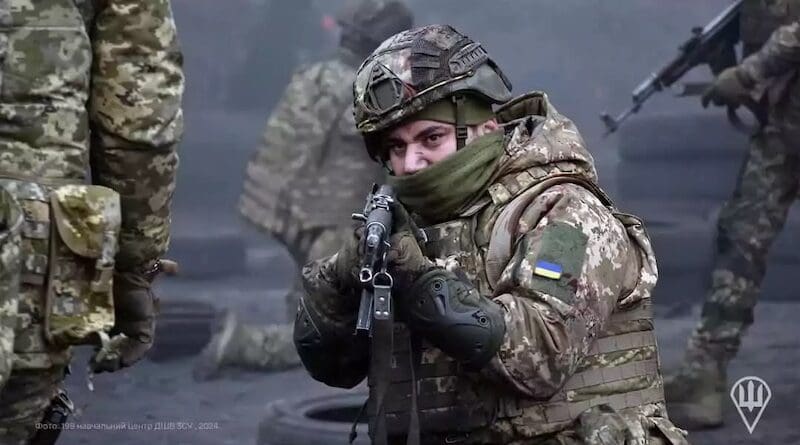
Ukrainian soldiers. Photo Credit: General Staff of Ukraine's Armed Forces
September 21, 2026
By Alan Callow
Key Takeaways:
Unproven at home. Texty alleged abuse in the 225th Assault Regiment; the commander denied “pits,” admitted one beating. Drapatyi ordered an inspection. Babel alleged mistreatment in the 425th “Skelya”; SBI and the ombudsman opened files. No verdicts yet.
Know-how abroad. RFI: 200-plus Ukrainians alleged training Libyan forces on drones. India arrested six Ukrainians and one American; NIA alleges Myanmar drone training and a civilian-aircraft strike. No public link to those units.
Who vets the trainers? Author: export of EW and drone skills needs a chain of command and a check on records—until then, allegations stay allegations.
Investigations into alleged abuses within Ukrainian assault units are raising questions about how servicemen accused of serious misconduct are vetted before being sent abroad to train foreign armed groups.
After more than four years of war, Ukraine has accumulated extensive battlefield experience — from drone warfare and electronic warfare to small-unit operations and rapid tactical adaptation. That expertise is increasingly attracting international interest.
But as Ukrainian military knowledge travels abroad, questions are also emerging over who is being entrusted with passing it on.
Ukrainian media have published investigations documenting allegations of beatings, unlawful detention, threats of execution and other forms of violence in at least two prominent assault units. Ukrainian authorities have responded with inspections and investigations into some of the allegations.
At the same time, reports have emerged of Ukrainian military specialists operating abroad.
In April, French public broadcaster RFI, in a report cited by Euronews, reported the presence of more than 200 Ukrainian military specialists in Libya and alleged that Ukrainian personnel were training Libyan forces in the use of drones. Ukraine and the Libyan government did not respond to RFI’s requests for comment, according to the report.
In Myanmar, meanwhile, Indian investigators have alleged that six Ukrainian nationals and one U.S. citizen arrested in India were linked to training involving drone warfare, drone assembly, operations and jamming technology for ethnic armed groups in Myanmar. The Indian National Investigation Agency later made further allegations concerning the group’s activities.
There is no evidence that every Ukrainian instructor operating abroad has been involved in wrongdoing. Nor is there publicly available evidence establishing that the Ukrainians detained in India belonged to any of the Ukrainian units currently under investigation.
But the reports raise a broader question: how thoroughly are personnel vetted before they are entrusted with sensitive military technologies and combat experience for use by foreign armed forces?
The 225th Separate Assault Regiment
One of the most detailed investigations concerns Ukraine’s 225th Separate Assault Regiment.
On July 30, Ukrainian investigative outlet Texty published an investigation based on six months of reporting and interviews with dozens of current and former servicemen, personnel from attached units and relatives of missing soldiers. The investigation alleged beatings, improvised detention sites known as “pits”, threats of execution and other forms of violence.
According to Texty, at least six independent sources described the alleged use of what they called a “tree of truth”, where soldiers were allegedly tied to trees and beaten. The investigation also reported accounts of soldiers being held under guard between combat missions and published a photograph of an unidentified serviceman apparently handcuffed to a tree.
The regiment’s commander, Oleh Shyriaiev, denied the existence of “pits” and blocking detachments at the regiment’s base. He nevertheless acknowledged that at least one case of beating had occurred and said the servicemen involved had been removed from their positions and referred to the Military Law Enforcement Service.
On Aug. 4, Ukrainian Armed Forces Commander-in-Chief Mykhailo Drapatyi ordered the Military Law Enforcement Service to inspect the regiment following the investigation. The Armed Forces said allegations of unlawful orders and violence would be examined and that those responsible would be held accountable if the allegations were confirmed.
The allegations remain allegations unless established through an official investigation or court proceedings.
One of the most detailed investigations concerns Ukraine’s 225th Separate Assault Regiment.
On July 30, Ukrainian investigative outlet Texty published an investigation based on six months of reporting and interviews with dozens of current and former servicemen, personnel from attached units and relatives of missing soldiers. The investigation alleged beatings, improvised detention sites known as “pits”, threats of execution and other forms of violence.
According to Texty, at least six independent sources described the alleged use of what they called a “tree of truth”, where soldiers were allegedly tied to trees and beaten. The investigation also reported accounts of soldiers being held under guard between combat missions and published a photograph of an unidentified serviceman apparently handcuffed to a tree.
The regiment’s commander, Oleh Shyriaiev, denied the existence of “pits” and blocking detachments at the regiment’s base. He nevertheless acknowledged that at least one case of beating had occurred and said the servicemen involved had been removed from their positions and referred to the Military Law Enforcement Service.
On Aug. 4, Ukrainian Armed Forces Commander-in-Chief Mykhailo Drapatyi ordered the Military Law Enforcement Service to inspect the regiment following the investigation. The Armed Forces said allegations of unlawful orders and violence would be examined and that those responsible would be held accountable if the allegations were confirmed.
The allegations remain allegations unless established through an official investigation or court proceedings.
The 425th Separate Assault Regiment “Skelya”
Similar questions have emerged around the 425th Separate Assault Regiment “Skelya”.
In June, Ukrainian publication Babel published an investigation based on testimony from more than 30 people, including servicemen and relatives. It reported allegations of beatings and mistreatment at training facilities and examined a series of deaths among personnel undergoing training. One former serviceman interviewed by Babel described severe injuries that he said he sustained after escaping from the regiment.
The allegations prompted scrutiny from Ukrainian authorities, including a pre-trial investigation by the State Bureau of Investigation and a review by the Ukrainian ombudsman’s office, according to the reporting.
These cases make the question of how servicemen are selected for sensitive overseas missions more significant.
Ukraine Becomes an Exporter of Military Expertise
Ukraine is no longer only a recipient of foreign military assistance and expertise. The war has turned it into a source of military knowledge.
Ukrainian forces have accumulated extensive experience in the use of drones, electronic warfare and battlefield adaptation under conditions of intensive conflict. Tactics can evolve directly on the battlefield, and new techniques can be introduced far more rapidly than under peacetime conditions.
Reports about Ukrainian specialists operating in Libya and the allegations concerning Ukrainians detained in India suggest that this expertise may now be travelling well beyond Ukraine’s own battlefield.
That raises several questions.
Who selects these specialists? Are they active-duty servicemen? Are their backgrounds and service records vetted? Are commanders or foreign partners aware of allegations against them? And, when they operate outside Ukraine, are they subject to a clear military chain of command and oversight?
There is also a more fundamental question: who is accountable if a foreign armed group is trained by a person who later faces serious allegations of unlawful violence?
What Ukrainian Instructors Could Mean for Myanmar
The Myanmar case is particularly significant because of the role drones now play in the country’s fragmented conflict.
In March, Indian authorities arrested six Ukrainian nationals and one U.S. citizen. Indian investigators alleged that the group had entered Myanmar illegally through India’s northeastern state of Mizoram and had been involved in planned training for ethnic armed groups.
The National Investigation Agency later told a Delhi court that the seven foreigners were allegedly involved in drone-warfare training, including drone operations, assembly and jamming technology. In September, the NIA also alleged that the group was connected to ethnic armed organizations in Myanmar and said it had received information concerning the involvement of Ukrainian and U.S. nationals in a drone attack on a civilian aircraft in Myanmar. These remain allegations made in the course of an investigation.
Myanmar has been the scene of a complex armed conflict involving the military government, ethnic armed organizations and other resistance forces.
Drones have become increasingly important in that conflict. They allow relatively small armed groups to conduct reconnaissance and attacks at comparatively low cost.
Foreign training can therefore have consequences beyond the immediate instruction of individual fighters.
Knowledge of drone assembly, autonomous operation, electronic countermeasures and battlefield targeting can directly expand the capabilities of armed groups.
In Myanmar, that could be particularly consequential. Giving non-state armed organizations access to advanced drone expertise could expand their ability to conduct surveillance, coordinate attacks and strike targets that would previously have required substantially larger or more technologically sophisticated forces.
This does not mean that the presence of Ukrainian instructors is, by itself, a cause of escalation in Myanmar. But transferring modern battlefield expertise and technology in the middle of an ongoing civil war can affect the capabilities of the parties to the conflict and potentially change the character of warfare.
That is why the identity and professional background of foreign instructors matter.
If a person accused of torture or unlawful violence in one conflict is later given an opportunity to train fighters in another, the issue goes beyond individual responsibility. It raises questions about institutional vetting, oversight and accountability.
The Accountability Question
Serious allegations against Ukrainian servicemen require credible and comprehensive investigation. Until such investigations establish the facts, allegations should not be treated as proven.
But unresolved allegations take on additional significance when military personnel move between frontline units and overseas missions involving the training of foreign armed forces.
For Ukraine, exporting military expertise could become an increasingly important element of international cooperation. Experience in drone warfare, electronic warfare and battlefield adaptation is likely to remain in demand.
But military expertise also comes with responsibility for the people who transmit it.
If Ukrainian specialists are sent to countries such as Libya or Myanmar, recipients need confidence that those personnel have undergone appropriate vetting and operate within a clear system of command and oversight.
For Kyiv, the stakes are significant. Unresolved allegations of serious misconduct, combined with the movement of personnel between frontline roles and overseas training missions, could raise questions about Ukraine’s ability to present itself as a responsible military partner.
Myanmar illustrates the potential consequences particularly clearly. Advanced drone expertise provided to armed groups involved in a prolonged civil war could expand their capabilities and contribute to changes in the way the conflict is fought.
The central question, therefore, is not whether Ukraine should share the military expertise it has developed during the war. It is whether that expertise is being exported with adequate safeguards, vetting and accountability mechanisms.

About Alan Callow
Alan Callow was born in Japan, graduated from Western Mindanao State University (Philippines). He is a freelance journalist with experience in writing about the Asia Pacific region.
View all posts by Alan Callow →

No comments:
Post a Comment