Tuesday, November 25, 2025

New Immersive Shroud Of Turin Museum Opens In Southern California

“The Shroud of Turin: An Immersive Experience,” a $5 million, 10,000-square-foot museum on the chancery campus of the Diocese of Orange in Southern California opened to visitors on Nov. 19, 2025. | Credit: Everett Johnson, Diocese of Orange

November 25, 2025 
CNA
By Jim Graves

“The Shroud of Turin: An Immersive Experience,” a $5 million, 10,000-square-foot museum on the chancery campus of the Diocese of Orange in Southern California, opened to visitors Wednesday.

The museum is presented by Papaian Studios in partnership with the Diocese of Orange and Othonia Inc., an international team of specialists dedicated to exploring and sharing the mystery of the Shroud of Turin.

The 90-minute experience introduces visitors to the life, death, and resurrection of Jesus Christ, with a special focus on the Shroud of Turin, which many believe to be the burial cloth of Christ.

Inspired by the advanced technology incorporated in “Van Gogh Exhibition: The Immersive Experience” and the “Immersive King Tut,” the museum features 360-degree projection-room theaters as well as shroud replicas, interactive kiosks, a life-sized corpus, and a variety of artwork.

Jason Pearson of FiveHive Studios, which offers AI special effects and animation services, is a Catholic convert who worked with Othonia, a team of shroud specialists, to design the museum. Among his movie credits is Mel Gibson’s 2004 “The Passion of the Christ.” He has long had an interest in the shroud and has been a volunteer guide at the Shroud Center of Southern California located at the Santiago Retreat Center, also in the Diocese of Orange.

“Using technology on display like that of the Van Gogh or King Tut exhibits, we’re doing things that have never been done before,” Pearson told CNA. “Whether it be Jesus walking on water or through the streets of Jerusalem, or in the tomb at the moment of the Resurrection, we make use of sound and projections so that the visitor feels like he’s going back into a time machine and experiencing these things himself.”

The museum is designed for everyone, Pearson continued, even those who have no religious background at all.

Located on the second floor of the campus’ Richard H. Pickup Cultural Center, the museum has three theater rooms. Using surround sound and images, including on the floor, the first room introduces the visitor to the person of Jesus Christ through presentation of 12 stories from his life, but each one is selected to show Christ’s connection to the supernatural (e.g. the Transfiguration). The next introduces the visitor to the shroud itself, including proof of its authenticity and what it tells us about the sufferings of Christ. The third is devoted to the Resurrection leading the viewer to ponder a pointed question: Who do you believe the man on the shroud is?

The third theater exits into the museum area, which includes displays of reproductions of items that were part of the passion of Christ, including a flagellum (whip), the crown of thorns and nails, as well as a reproduction of what the tomb of Christ might have looked like.

Other exhibits include an AI presentation of Secondo Pia (1855–1941) who, while photographing the shroud in 1898, discovered that its negative image offered a clearer image of the man on the shroud with a detail in his face that could not been seen by the naked eye. Another traces the history of the iconography of Christ, demonstrating how accurate, when comparing it to the shroud image, many of the icons were. And, one compares the Sudarium of Oviedo, or the facial cloth that covered Christ’s face after his death, to the image on the shroud.

Pearson hopes that the museum will be a prototype for additional shroud museums in different regions of the country. Inquiries have been made about establishing shroud museums from places as far away as Kuala Lumpur in Malaysia.

One portion of the museum is dedicated to the science of the shroud, and two kiosks allow visitors to ask questions of a digital Father Robert Spitzer, who has extensively researched the shroud over the past 20 years. Spitzer, who has an office at Christ Cathedral, noted that he was pleased with the museum’s opening. “It gets the pedagogy right, it’s biblically accurate, and they tell me the visual imagery is amazing.” (Spitzer has gone blind in recent years.)

He continued: “And while we welcome anyone, we especially hope many young people will come to learn about the shroud and lead many to come to know more deeply the person of Jesus Christ.”

Nora Creech is on the leadership team of Othonia and helped develop content for the museum. “We want people to come with an open mind, explore, and ask questions. We want them to ask, ‘Who is the man of the shroud?’” she said.

One special target group of the museum, Creech said, is younger people, “many of whom have not been brought up with knowledge of who Jesus is. That is why we seek first to introduce people to Jesus so that they will become interested in his burial shroud.”

Pearson agreed and related the story of two young women who visited the Shroud Center and began weeping, asking: “Why hasn’t anyone told us about him?”

But while the shroud is important in showing us what Jesus suffered, Creech continued, we also need the Church and the Scriptures “to learn why he suffered.”

Orange Auxiliary Bishop Timothy Freyer, who played a key role in bringing the museum to Christ Cathedral, noted that his favorite feature was the reproduction of the crown of thorns, which, contrary to most artistic renditions, was actually shaped like a helmet or cap. He continued: “I’ve been impressed with the entire exhibition. It is very engaging, and I believe it will be an important tool in helping visitors come to know Christ better.”

Also among those excited to see the opening of the museum was Gus Accetta, a physician who has devoted much of his free time to studying the shroud. In 1996, he founded the Shroud Center in Huntington Beach, since relocated to the Santiago Retreat Center and welcoming 25,000 visitors annually.

“It’s a wonderful exhibit,” he said. It not only looks at the shroud but the whole life of Christ, of which the shroud is just a part.”

The Shroud of Turin experience will be on display at Christ Cathedral at least through 2030. The museum is located on Christ Cathedral campus, 12141 Lewis St., Garden Grove, California, a few miles away from Disneyland and the Anaheim Convention Center. For more information, visit the website www.theshroudexperience.com.



CNA

The Catholic News Agency (CNA) has been, since 2004, one of the fastest growing Catholic news providers to the English speaking world. The Catholic News Agency takes much of its mission from its sister agency, ACI Prensa, which was founded in Lima, Peru, in 1980 by Fr. Adalbert Marie Mohm (†1986).


The Dark Side of Gratitude: When Thankfulness Becomes A Tool Of Control – OpEd

November 25, 2025 
By Martina Moneke

Gratitude is celebrated as a virtue, but coerced thankfulness can reinforce inequality, stifle emotions, and keep us complacent.

We live in a world that constantly tells us to “count our blessings.” Gratitude is praised as a moral virtue, a mental tonic, a gateway to happiness. Entire industries are built on it: journals, apps, workshops, and social media trends. But what if gratitude isn’t a virtue at all? What if, instead of elevating us, it functions as a quiet mechanism that traps, silences, and pacifies us?

At first glance, gratitude seems harmless—even virtuous. A simple “thank you” can smooth social interactions, remind us of the positive, and cultivate humility. Yet much of our gratitude is coerced, performative, or socially demanded. We are expected to be thankful, whether or not we genuinely feel it. Miss the cue, fail to smile, or silently resent the “blessing” offered, and we are framed as ungrateful, even morally deficient. Gratitude often functions less as a choice and more as a social leash, compelling people to perform virtue on cue.

Take the workplace, for example. Employees are often reminded to “be grateful for having a job” when faced with low pay, long hours, or toxic conditions. The intention may be to inspire appreciation, but the ultimate effect is control—gratitude becomes a tool for compliance. By teaching people to “be grateful” for injustice or minimal provision, society trains obedience under the guise of virtue. It pacifies dissatisfaction by framing fundamental rights and fair treatment as privileges rather than entitlements. In such cases, thankfulness isn’t just a moral exercise—it’s a mechanism to normalize inequity.

Gratitude can act as emotional camouflage. We are taught to appreciate our lives, our health, our families, sometimes even our misfortunes. Perspective is valuable, but the relentless pressure to be thankful can suppress genuine emotions. Anger, grief, frustration—signals that something is wrong—are nudged aside. We are told to “look on the bright side,” even when the side that demands closer scrutiny is dark. Gratitude, in this sense, becomes a velvet handcuff: soft, polite, yet restraining real feelings and masking problems we need to confront. The human psyche thrives on complexity, but “gratitude culture” encourages simplification: everything must be filtered through a lens of thankfulness.

Gratitude also carries a heavy psychological burden. Feeling obligated to reciprocate kindness or opportunity breeds stress and anxiety. Recognizing genuine generosity is one thing; living under a constant sense of debt—to friends, family, employers, or society—is another. Those with fewer resources bear this pressure more heavily: expectations of gratitude are imposed when there is little power to refuse or negotiate social norms. For some, gratitude becomes an unspoken debt that never expires, a pressure cooker of stress and resentment. In these cases, it is not liberating, but a subtle form of coercion.


We are also encouraged to turn gratitude inward as a self-help tool: “Practice daily gratitude, and you will be happier.” While brief reflections on what we value can improve mood, this framing risks individualizing systemic problems. Feeling unhappy? Focus on what you do have. Struggling with debt, illness, or social injustice? Count your blessings. Gratitude thus becomes a psychological Band-Aid, a quiet insistence that the problem lies not in circumstances or structures but in our own perception. It is both a pacifier and a distraction from meaningful action.

It’s worth noting that gratitude, in its purest, voluntary form, is not inherently bad. Genuine, spontaneous thankfulness can deepen relationships, foster empathy, and anchor us in meaningful moments. The problem arises when gratitude is demanded, packaged, or weaponized—when it is less a personal reflection and more a social or institutional expectation. That is when it stops being a virtue and becomes a subtle tool of emotional and psychological manipulation.

Consider the social media dimension. We post “thankful” photos, recount the blessings of our lives, and share curated moments of appreciation. These public expressions rarely arise from raw emotion—they are curated for approval, likes, and social validation. Such displays may appear harmless, even charming, but they reinforce the notion that gratitude is an obligation rather than an organic experience.

Even in intimate settings, gratitude can carry hidden pressures. Being thankful to a loved one can generate unspoken debts or expectations: a favor must be repaid, a kindness acknowledged, a gesture reciprocated. This is not always harmful, but it becomes so when gratitude is demanded or used as leverage. In this sense, gratitude is not purely virtuous; it is a social contract with emotional consequences.

Step back, and a pattern emerges: gratitude is often less about authentic appreciation and more about maintaining social harmony, suppressing discontent, and normalizing inequality. It is a quietly coercive force. And yet, we are rarely taught to question it. We are trained to assume that gratitude is inherently virtuous, morally neutral, or personally beneficial. What if, instead, we allowed ourselves to interrogate it—to ask whether our thankfulness is truly ours or imposed?

The real question is not whether gratitude can be good. It can. The question is whether our culture has overvalued it, weaponized it, or confused performative thankfulness with genuine reflection. By unquestioningly embracing gratitude as a moral imperative, we risk ignoring discomfort, overlooking injustice, and silencing authentic emotion. Sometimes, the bravest act is not to be thankful—to allow ourselves anger, frustration, or dissatisfaction. Sometimes the healthiest choice is to withhold thanks, at least until we genuinely feel it.

In rethinking gratitude, we are not rejecting kindness or appreciation. We are reclaiming the right to feel emotions honestly, without guilt or coercion. We are resisting the subtle pressures that tell us to be grateful for situations that do not deserve it. Authentic gratitude, like all virtues, cannot be commanded; it must emerge voluntarily, thoughtfully, and without obligation. Only then can it be meaningful.

The braver, wiser act is to stop counting blessings on command, to resist the soft tyranny of enforced gratitude, and to reclaim our right to anger, dissatisfaction, and honesty. Gratitude should serve us—not the agendas of others.


Martina Moneke

Martina Moneke writes about art, fashion, culture, and politics. In 2022, she received the Los Angeles Press Club's First Place Award for Election Editorials at the 65th Annual Southern California Journalism Awards. She is based in Los Angeles and New York.
Belarus: Will Regime Allow Freed Catholic Priests To Return To Ministry? – Analysis


Archbishop Ignazio Ceffalia, Fr Henryk Okolotovich, Fr Andrei Yukhnevich, Archbishop Iosif Stanevsky, Apostolic Nunciature, Minsk, 20 November. 2025 

November 25, 2025 
F18News
By Felix Corley


Belarus’ authoritarian leader Aleksandr Lukashenko pardoned two jailed Catholic priests, Fr Henryk Okolotovich and Fr Andrei Yukhnevich. The two priests, who were handed long sentences at closed trials, were freed from labour camp early on 20 November and taken to the nunciature in the capital Minsk. They were taken to the airport the same day and are now in Rome. The state news agency Belta claimed that both had committed “serious crimes against the state”. Both rejected all the accusations against them.

“Both priests pleaded not guilty to the crimes they were accused of,” independent Catholic news outlet Katolik.life noted. “Believers also considered the sentences unjust and prayed for the prisoners’ speedy release.”

Fr Okolotovich was arrested in November 2023 and jailed in December 2024 for 11 years on treason charges. Fr Yukhnevich was arrested in May 2024 and jailed in April 2025 for 13 years on accusations of sexual abuse of a minor or minors, accusations his supporters say were fabricated (see below).

Church spokesperson Fr Yuri Yasevich – and, separately, Natallia Vasilevich of Christian Vision – pointed to Belta’s wording that the two priests had committed “serious crimes against the state”.

“The fabrication of the case is indirectly confirmed by the wording used to release the priests,” Vasilevich told Radio Free Europe’s Belarusian Service. “This seems to confirm that the nature of Fr Yukhnevich’s persecution was not because he allegedly committed some crimes against minors, but that he was persecuted for his civic and political stance” (see below).

The head of the Vatican’s Dicastery for the Eastern Churches, Cardinal Claudio Gugerotti, indicated in a Vatican Radio interview in Rome on 21 November that he had raised the issue of the two jailed priests when he met Lukashenko in Minsk on 27 October (see below).

Cardinal Gugerotti indicated that he had also raised with Lukashenko the issue of the iconic Catholic Church of Saints Simon and Helena (known locally due to its brickwork as the Red Church) in central Minsk. The regime closed the church after a suspicious minor fire in a side room in September 2022. Minsk Heritage, the building agency that has control of the Church, later began repair works.

It remains unclear if the regime will allow the 65-year-old Fr Okolotovich and 42-year-old Fr Yukhnevich to return to Belarus and to resume parish ministry. Deputy Plenipotentiary for Religious and Ethnic Affairs Sergei Gerasimenya refused to answer any questions about Fr Okolotovich and Fr Yukhnevich or anything else. “I won’t give any comments,” he told Forum 18 and put the phone down (see below).

Vitebsk Diocese still lists Fr Yukhnevich on its website as priest of Our Lady of Fatima parish in Shumilino. In November 2024, a year after his arrest, the Minsk-Mogilev Archdiocese removed Fr Okolotovich from its list of parish priests on its website (see below).

Lukashenko has pardoned a number of prisoners in recent months, including political prisoners. Almost all of them – including Belarusian citizens – were deported from Belarus. As of 24 November, Viasna (Spring) human rights group recognised 1,247 political prisoners in Belarus.
Prisoners’ freedom of religion or belief often violated

Four of the political prisoners the regime suddenly freed on 21 June and deported to Lithuania spoke after their release on restrictions on prisoners’ exercise of freedom of religion or belief.

“As a rule, political prisoners are never allowed to go to services,” Natallia Dulina told Forum 18. Ihar Karnei notes that only Orthodox prison chapels exist and prison officials approve or reject applications to attend. “God may be calling you to church, but prison officials decide,” he told Forum 18. Orthodox Christian Sergei Tikhanovsky was denied access to a priest for more than 5 years.

Inmates the prison authorities have deemed “low status” are refused access to the limited religious services held by the Orthodox and Catholic Churches in prisons, a former political prisoner and Orthodox Christian Vadim Yermashuk told Forum 18 in January.

Denials of access to meetings for worship, religious literature and clergy visits violate the United Nations Standard Minimum Rules for the Treatment of Prisoners (known as the Mandela Rules, A/C.3/70/L.3). Officials of four of the prisons refused to discuss the restrictions with Forum 18.
Fr Okolotovich: Jailed on multiple charges

From 2005, Catholic priest Fr Henryk (Gennady) Okolotovich (born 8 April 1960) was the parish priest of St Joseph’s Church in Volozhin in Minsk Region, 75 kms northwest of the city of Minsk.

On 16 November 2023, officials arrested Fr Okolotovich and detained him in the KGB secret police Investigation Prison in Minsk. During the investigation, Fr Okolotovich faced pressure to implicate the country’s Catholic bishops. He refused to do so.

On 30 December 2024, Minsk Regional Court handed him an 11-year jail term on treason charges at a closed trial. Among other things he was accused of sending abroad information about military aircraft at a base near his parish. He was also ordered to pay a massive financial penalty. Fr Okolotovich vigorously rejected the accusations.

On 1 April 2025, a week before his 65th birthday, the Supreme Court in Minsk rejected Fr Okolotovich’s appeal. Hearings were again closed. He was then sent to a Labour Camp in Bobruisk to begin serving his sentence.
Fr Okolotovich: KGB secret police try to recruit as a spy

In summer 2025, the KGB secret police came to Fr Henryk Okolotovich in prison in Bobruisk, “most likely to force him to slander parishioners or other clergy of the Catholic Church”, released political prisoner Andrey Krylov told the Christian Vision group in September. Krylov had been imprisoned in Bobruisk with Fr Okolotovich, as well as another jailed Catholic priest Fr Andrei Yukhnevich.

The prison authorities transferred Fr Okolotovich for several weeks to the KGB pre-trial detention centre in Minsk. There, they gave him some papers to read, and apparently made him sign them. “There was some paper missing, and they said it couldn’t be delivered by mail or special courier because it was a highly sensitive, classified document, so they took him there themselves,” Krylov recalled.

The prison authorities then returned Fr Okolotovich to Correctional Colony No. 2 in Bobruisk.

“Then they summoned him and said the KGB would come and talk to him,” Krylov recounted about Fr Okolotovich. “They told him he owed a million Euros, and you understand that you have as much to do with these planes and this million Euros as I do with ballet. That’s not true, you know that, but you sign these documents. And then we’ll release you, Okolotovich, and you’ll be free. We won’t do anything else to you.”

Fr Okolotovich told Krylov that the KGB was requesting that, after being freed and sent back to serve in his parish in Volozhin, he invite the Vatican nuncio to visit the parish. “And secretly, as if by accident, hand over a flash drive to the Vatican ambassador. That is, to create incriminating evidence against the ambassador. But Okolotovich refused.”

Fr Okolotovich said he told the KGB that “what you demand of me, is a crime, and I cannot betray God, any more than I can carry out this action”. KGB officers said they would visit him again in prison “many more times, so that perhaps you will change your mind”, Krylov recalled.
Fr Yukhnevich: Jailed at closed trial

At the time of his arrest, Catholic priest Fr Andrei Marianovich Yukhnevich (born 1982), a member of the Missionary Oblates of Mary Immaculate, was serving in Our Lady of Fatima parish in Shumilino in the northern Vitebsk Region. He had previously served as the Superior of the Oblates in the country and President of the Conference of Major Superiors of Religious Institutes.

Police arrested Fr Yukhnevich on 8 May 2024. He was first given short-term jail terms, including under Administrative Code Article 24.23 for an “unapproved demonstration” for posting a Ukrainian flag on his Facebook page.

However, officials did not free Fr Yukhnevich after 45 days. Instead they transferred him to a pre-trial Investigation Prison. Prosecutors brought charges against him of sexual abuse of minors.

At a closed hearing on 30 April 2025, Judge Inna Grabovskaya of Shumilino District Court convicted Fr Yukhnevich on three counts and jailed him for 13 years. Fr Yukhnevich’s bishop, Oleg Butkevich, came to the court for each hearing but was not allowed in, Katolik.life said. He then went to pray in the chapel opposite the court building.

On 29 July, Vitebsk Regional Court rejected Fr Yukhnevich’s appeal. The hearing “proceeded in the same way as in Shumilino: all arguments were unreasonably rejected and all the decisions of the district court were simply upheld”, Katolik.life noted on 30 July.

(In July 2024, the Information Ministry listed Katolik.life as “extremist”. In August 2024, a court in Minsk Region declared Katolik.life’s Telegram channel “extremist”. One month later, the Inspectorate for Supervision of Telecommunications blocked access in Belarus to the Telegram channel on the basis of the Information Ministry’s decision. In August 2025, by decision of Grodno’s Lenin District Court, the Information Ministry added all Katolik.life and Gomel Catholic’s social media pages to the list of “extremist materials”.)

The prison authorities transferred Fr Yukhnevich in August to Correctional Colony No. 2 in Bobruisk to serve his sentence.

“As believers learned from reliable sources, Vatican diplomat Archbishop Ignazio Ceffaglia and Bishop Oleg Butkevich visited the prison colony in Bobruisk, but were denied access to the imprisoned priests,” Katolik.life news website noted on 30 September. “Believers do not know the reason for this or whether there was a prior agreement to allow the meeting.”
Fr Yukhnevich: Charges fabricated?

The Church has continued to support Fr Andrei Yukhnevich. His bishop tried to attend his trial hearings (see above). After his release Fr Yukhnevich was shown in clerical dress in a photo taken at the Apostolic Nunciature in Minsk.

Katolik.life said the Vitebsk Diocese had received no complaints related to Fr Yukhnevich’s conduct.

“As far as believers know, the charges were based on the testimony of one or more ‘victims’,” Katolik.life noted after Fr Yukhnevich’s trial. “It’s possible they were pressured. According to information reaching believers, the priest’s case concerns events that occurred approximately 10 years ago, so the charges could only have been based on dubious testimony.”

Church spokesperson Fr Yuri Yasevich told Forum 18 on 24 November that he is not aware of any material in the Church’s possession about any abuse Fr Yukhnevich might have committed. “If there were such materials, the Church also should take internal action,” he told Forum 18. “In this case it would be a matter for the Missionary Oblates of Mary Immaculate and the Vitebsk Diocese.”

In announcing the pardoning and release on 20 November, Belta claimed the two priests had committed “serious crimes against the state”.

By contrast, Lukashenko’s spokesperson Natalya Eismont claimed to Belarus TV’s First Channel on 22 November that the two priests had been “convicted of serious and especially serious crimes against the state, as well as other crimes”. She did not specify any “other crimes”.

Church spokesperson Fr Yasevich pointed to Belta’s wording that the two priests had committed “serious crimes against the state”.

Natallia Vasilevich of the group Christian Vision – which documents violations of freedom of religion or belief and other human rights – similarly pointed to Belta’s report describing the two priests’ alleged “serious crimes against the state”.

“The fabrication of the case is indirectly confirmed by the wording used to release the priests,” Vasilevich told Radio Free Europe’s Belarusian Service on 20 November. “This seems to confirm that the nature of Fr Yukhnevich’s persecution was not because he allegedly committed some crimes against minors, but that he was persecuted for his civic and political stance.”

(Between August 2023 and March 2024, several courts declared Christian Vision’s Telegram channel (twice), Instagram, Facebook, Twitter, VKontakte and Odnoklassniki pages, and logo “extremist”. In April 2025, the KGB secret police ruled that Christian Vision, its website and social media channels are “extremist” and are banned. Also identified were three people linked to the group, including Vasilevich.)
Pardoned, freed

Almost simultaneously on the morning of 20 November, the state news agency Belta and the Conference of Catholic Bishops announced the pardon and release from prison of the two jailed Catholic priests, Fr Henryk Okolotovich and Fr Andrei Yukhnevich.

“Fr Henryk and Fr Andrei were freed from the labour camp in Bobruisk on the morning of 20 November, taken to the nunciature in Minsk where their photos were taken, and then straight to the airport,” Church spokesperson Fr Yuri Yasevich told Forum 18 from Minsk on 24 November. He said they are now in Rome.

Archbishop Iosif Stanevsky accompanied the two priests to Rome, Katolik.life noted.

“Cardinal Claudio Gugerotti’s visit gave a positive impetus to further contacts, an important result of which was the decision of the President of the Republic of Belarus, as a sign of mercy and respect for the Pope, to pardon and release Catholic priests serving sentences of imprisonment,” the Conference of Catholic Bishops of Belarus wrote.

The Conference of Catholic Bishops stressed that “Cardinal Claudio Gugerotti, Prefect of the Dicastery for the Eastern Churches; Ignazio Ceffalia, Apostolic Nuncio to the Republic of Belarus; and Archbishop Iosif Stanevsky, Chairman of the Conference of Catholic Bishops of Belarus, took a direct and significant part in the process.”

In its announcement, Belta said Aleksandr Lukashenko had pardoned the two priests “taking into account the intensification of contacts with the Vatican, as well as the principles of goodwill, mercy and the Jubilee Year of Christianity declared by the Roman Catholic Church”.

Lukashenko’s spokesperson Natalya Eismont told Belarus TV’s First Channel on 22 November that the decision to pardon and release the two priests came “at the request of Pope Leo XIV with the participation of Metropolitan Iosif Stanevsky as a gesture of goodwill, guided by principles of mercy and humanism, taking into account the health of the convicted persons, and in order to develop relations between the Republic of Belarus and the Holy See”.
Will freed priests be allowed to return to ministry?

It remains unclear if the regime will allow Fr Okolotovich and Fr Yukhnevich to return to Belarus and to resume parish ministry. Deputy Plenipotentiary for Religious and Ethnic Affairs Sergei Gerasimenya refused to answer any of Forum 18’s questions, including on Fr Okolotovich and Fr Yukhnevich. “I won’t give any comments,” he told Forum 18 from Minsk on 24 November and put the phone down.

Vitebsk Diocese still lists Fr Yukhnevich on its website as priest of Our Lady of Fatima parish in Shumilino. In November 2024, a year after his arrest, the Minsk-Mogilev Archdiocese removed Fr Okolotovich from its list of parish priests on its website.

“No one is banned from returning,” Church spokesperson Fr Yuri Yasevich insisted to Forum 18. “Once Fr Henryk and Fr Andrei have acclimatised and dealt with health issues, the question will come of where they will serve.” He noted that the Missionary Oblates of Mary Immaculate will decide where Fr Yukhnevich will be assigned to serve.


F18News

Forum 18 believes that religious freedom is a fundamental human right, which is essential for the dignity of humanity and for true freedom.
Pope Leo XIV accepts resignation of Spanish bishop accused of abuse in first known case for pontiff

ROME (AP) — A one-line statement from the Vatican said Leo had accepted the resignation of Cádiz Bishop Rafael Zornoza, 76.


Nicole Winfield
November 24, 2025

ROME (AP) — Pope Leo XIV on Saturday accepted the resignation of an ailing Spanish bishop who is under church investigation for allegedly sexually abusing a young seminarian in the 1990s, the first known time the new pontiff removed a bishop accused of abuse.

A one-line statement from the Vatican said Leo had accepted the resignation of Cádiz Bishop Rafael Zornoza, 76. It didn’t say why, but Zornoza submitted his resignation to the pope last year when he turned 75, the normal retirement age for bishops.

It hadn’t been accepted though until the El País newspaper reported earlier this month that Zornoza had been recently placed under investigation by a church tribunal. The daily, which since 2018 has exposed decades of abuse and cover-up in the Spanish Catholic Church, said Zornoza was accused of abusing a young former seminarian while he was a young priest and directed the diocesan seminary in Getafe.

The report, quoting a letter the former seminarian wrote the Vatican over the summer, said Zornoza fondled him and regularly slept with him from when he was 14-21 years old. The former seminarian’s letter said Zornoza heard his confession and persuaded him to see a psychiatrist to “cure” his homosexuality.

The diocese of Cádiz denied the accusations against Zornoza but confirmed the investigation was being carried out by the church court in Madrid known as the Rota. In a Nov. 10 statement, the diocese said Zornoza was cooperating with the investigation and had suspended his agenda temporarily “to clarify the facts and to undergo treatment for an aggressive form of cancer.”

“The accusations made, referring to events that took place almost 30 years ago, are very serious and also false,” the statement said.

It is believed to be the first publicly known case of a bishop being retired, and being placed under investigation for alleged abuse abuse, since the Spanish church began reckoning in recent years with a decades-long legacy of abuse and cover-up that have rocked the once-staunchly Catholic Spain.

Leo didn’t immediately name a temporary leader of the diocese.

In 2023, Spain’s first official probe of abuse indicated that the number of victims could run into hundreds of thousands, based on a survey that was part of a report by the office of Spain’s ombudsman. The ombudsman conducted an 18-month independent investigation of 487 cases involving alleged victims who spoke with the ombudsman’s team.

Spain’s Catholic bishops apologized but dismissed the interpretations of the ombudsman report as a “lie,” arguing that many more people had been abused outside of the church.

The Spanish Catholic hierarchy then did its own report, saying in 2024 that it had found evidence of 728 sexual abusers within the church since 1945. It then launched a plan to compensate victims, after Spain’s government approved a plan to force the church to pay economic reparations.

___

Associated Press religion coverage receives support through the AP’s collaboration with The Conversation US, with funding from Lilly Endowment Inc. The AP is solely responsible for this content.


How Europe Can Capture The AI Growth Dividend – Analysis
By Florian Misch, Ben Park, Carlo Pizzinelli and Galen Sher


Can artificial intelligence provide a much-needed boost to Europe’s economic productivity? Use of AI is spreading much faster than earlier technologies, such as the personal computer and the internet. And AI promises significant productivity jumps by automating many tasks and enhancing human capabilities.

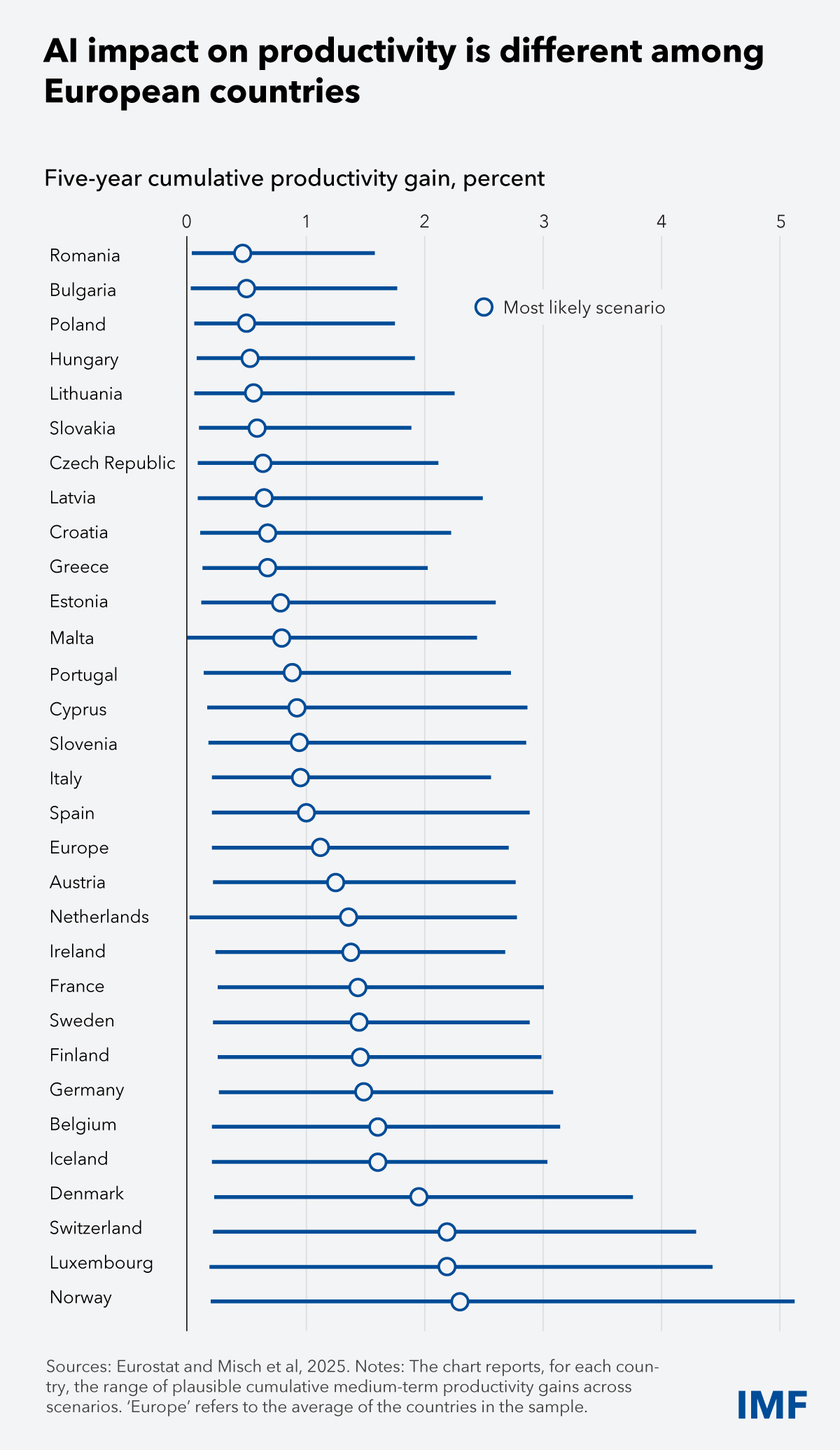
However, achieving large gains will hinge on European countries’ commitment to growth-enhancing reforms and willingness to being flexible on regulation, to help the new technology to flourish. Absent reforms, our research shows that the medium-term gain in productivity from the AI alone would vary considerably across countries, and for Europe as a whole would be rather modest: about 1.1 percent cumulatively over five years. With pro-growth reforms, though, much bigger gains are possible over the longer run.

How AI helps productivity now

Three factors drive the economy-wide and one-off productivity effects of AI adoption:Exposure to AI of different sectors and occupations—the degree to which AI can automate or augment tasks;
Companies’ incentives to adopt AI, particularly potential savings in labor costs;
Average productivity gains across occupations. Contrary to past automation technologies, AI exposure is especially large in professional, managerial, or administrative work that is non-manual and often knowledge-based, like finance or software development.

European countries would benefit to different degrees. Higher-income countries typically gain more because they have more white-collar services, leaving them more exposed to AI. They also have higher wage levels which increase incentives to adopt labor-saving technologies. For example, Norway could gain as much as 5 percent in the most optimistic scenario.

Gains for lower-income economies will likely be more limited, which means that AI could temporarily widen productivity disparities within Europe. For instance, Romania could add just below 2 percent even in an optimistic scenario. Productivity gains could be larger in all countries if the cost of AI systems falls more quickly.


Strong upsides over longer term

The improving capabilities of AI models (as evidenced by various tests) suggest that gains could be much larger over a longer time horizon. AI could have more transformational effects by creating new industries and value chains. It could also boost productivity growth more permanently through accelerating research and development (referred to in literature as Invention in the method of inventing). For example, there is already evidencethat AI accelerates and enhances pharmaceutical drug development.

Recent work estimates the long-run annual labor productivity growth impact when considering that AI is not only used to produce goods and services but also to create new commercial knowledge. In the United States, annual productivity growth could be boosted by 1 percent annually, while for Europe the gains could also be substantial but not as high. The analysis points to longer lasting effects which imply dramatically larger gains than the short-term effects we estimated. These predicted long-term benefits could even be conservative: When estimating the impact of technology, expectations are often too optimistic about the immediate effects and too pessimistic about lasting contributions (Amara’s Law).

How Europe should respond


To take full advantage of AI’s potential, Europe must focus on removing the barriers that limit diffusion of skills and technology and the growth of companies. The recent Regional Economic Outlook for Europe highlights several policy priorities.

Deepening the European Union single market will be critical to counter fragmentation along national borders. The goal must be to make it easier for innovative firms in the field of AI to access a broader, EU-wide customer base. This requires removing barriers to cross-border services, opening up protected sectors, and harmonizing standards – all of which can help reduce the cost of developing and adopting AI tools.

Funding the risky investments that underpin AI development (often based on intangible assets like software and intellectual property) requires stronger and more integrated financial markets. A well-functioning Capital Markets Union can increase the availability of venture capital by channeling more savings to early-stage, risky technological ventures in AI. Improving the recognition and valuation of intangibles assets such as intellectual property related to AI in financial statements and resolution regimes would also help mobilize private financing for innovation.

Flexible labor markets and portable social protection are vital to help workers transition toward sectors and firms that are expanding thanks to AI. For instance, simplifying degree recognition, enhancing housing affordability, and ensuring pension portability can facilitate movement to where opportunities from AI arise.

Creating a more efficient energy market is another key ingredient. Affordable and reliable electricity will support data centers that power AI systems. Securing competitive and low-carbon energy supplies through better market integration will support both AI infrastructure and Europe’s broader green transition.

Finally, regulation needs to remain flexible. While addressing important data protection, ethical, and safety concerns related to AI, regulation will need to be dynamically calibrated to navigate the trade-offs between addressing risks and enabling growth through AI adoption. Otherwise, even some of the moderate productivity dividends from AI adoption over the next few years could be lost.

Reaping the full potential of AI depends on policy choices that Europe makes today. Even moderate AI productivity gains in the coming years would be significant relative to Europe’s anemic economic growth prospects. Capturing larger, longer-term benefits—and keeping up with the United States—will hinge above all on Europe’s ability to move fast in building a more dynamic and integrated single market.


About the authors:

Florian Misch is a Senior Economist in France team of the European Department at the IMF. He is also working on issues related to Artificial Intelligence and has been part of the Norway, Romania, and Sweden teams, interrupted by a stint at the European Stability Mechanism. Prior to joining the European Department, Florian worked in the IMF’s Fiscal Affairs Department, as a freelance economic policy consultant for organizations such as the New Zealand Treasury and the World Bank, and as researcher at the Centre for European Economic Research.

Ben Park is a Research Officer in the IMF’s European Department. He holds a M.Sc. in Mathematics and Statistics from Georgetown University and obtained his B.A. in International Affairs and Economics from the George Washington University.

Carlo Pizzinelli is an economist in the European Department of the International Monetary Fund. His research focuses on labor markets and structural transformation issues. His works on these topics have been featured in academic journals and IMF publications.

Galen Sher is a Senior Economist working on global fiscal policy topics at the IMF’s Fiscal Affairs Department, where he has led the Fiscal Monitor report. Previously, he was Senior Economist for Germany in the IMF’s European Department where he developed advice on a range of topics from macroprudential policy to productivity.

Florian Misch is a Senior Economist in France team of the European Department at the IMF. He is also working on issues related to Artificial Intelligence and has been part of the Norway, Romania, and Sweden teams, interrupted by a stint at the European Stability Mechanism. Prior to joining the European Department, Florian worked in the IMF’s Fiscal Affairs Department, as a freelance economic policy consultant for organizations such as the New Zealand Treasury and the World Bank, and as researcher at the Centre for European Economic Researc

Pusan National University study reveals a shared responsibility of both humans and AI in AI-caused harm


Researchers highlight the need for distributed model of AI responsibility, where duties are shared among humans and AI systems


 News Release 
Pusan National University

Rethinking moral agency and responsibility in the era of artificial intelligence (AI) 

image: 

While the lack of consciousness and free-will makes it difficult to blame the AI systems for the harms caused by them, it is also not possible to blame the human developers as they cannot predict the mistakes. Researchers have demonstrated that a distributed model of AI responsibility, where duties are shared among humans and AI systems can reinforce ethical practices in both the design and use of AI systems.

view more 

Credit: Dr. Hyungrae Noh from Pusan National University, Republic of Korea


Artificial intelligence (AI) is becoming an integral part of our everyday lives and with that emerges a pressing question: Who should be held responsible, when AI goes wrong? AI lacks consciousness and free-will, which makes it difficult to blame the system for the mistakes. AI systems operate through complex, opaque processes in a semi-autonomous manner. Hence, even though the systems are developed and used by human stakeholders, it is impossible for them to predict the harm. The traditional ethical frameworks thus fail to explain who is responsible for these harms, leading to the so-called responsibility gap in AI ethics.

A recent study by Dr. Hyungrae Noh, an Assistant Professor of Philosophy at Pusan National University, Republic of Korea, elucidates the philosophical and empirical issues surrounding moral responsibility in the context of AI systems. The study critiques traditional moral frameworks centered on human psychological capacities such as intention and free will, which make it practically impossible to ascribe responsibility to either AI systems or human stakeholders. The findings of the study were published in the journal of Topoi on November 06, 2025.

“With AI-technologies becoming deeply integrated in our lives, the instances of AI-mediated harm are bound to increase. So, it is crucial to understand who is morally responsible for the unforeseeable harms caused by AI,” says Dr. Noh.

AI systems cannot be blamed for harm under traditional ethical frameworks. These frameworks typically require an agent to possess certain mental capacities to be held morally responsible. In case of AI, there is a lack of conscious understanding, i.e., capacity to understand the moral significance of their actions. Moreover, AI systems do not go through subjective experiences, leading to a lack of phenomenal consciousness. The systems are not given full control over their behavior and decisions. They also lack intention, the capacity for deliberate decision-making that underlies actions. Lastly, these systems often lack the ability to answer or provide any explanation regarding their actions. Due to these gaps, it is not right to hold the systems responsible.

The study also sheds light on Luciano Floridi’s non-anthropocentric theory of agency and responsibility in the domain of AI, which is also supported by other researchers from the field. This theory replaces traditional ethical frameworks with the idea of censorship, according to which human stakeholders have a duty to prevent AI from causing harm by monitoring and modifying the systems, and by disconnecting or deleting them when necessary. The same duty also extends to AI systems themselves, if they possess a sufficient level of autonomy.

“Instead of insisting traditional ethical frameworks in contexts of AI, it is important to acknowledge the idea of distributed responsibility. This implies a shared duty of both human stakeholders—including programmers, users, and developers—and AI agents themselves to address AI-mediated harms, even when the harm was not anticipated or intended. This will help to promptly rectify errors and prevent their recurrence, thereby reinforcing ethical practices in both the design and use of AI systems,” concludes Dr. Noh.


***


Reference
DOI: 10.1007/s11245-025-10302-4


About Pusan National University
Pusan National University, located in Busan, South Korea, was founded in 1946 and is now the No. 1 national university of South Korea in research and educational competency. The multi-campus university also has other smaller campuses in Yangsan, Miryang, and Ami. The university prides itself on the principles of truth, freedom, and service and has approximately 30,000 students, 1,200 professors, and 750 faculty members. The university comprises 14 colleges (schools) and one independent division, with 103 departments in all.

Website: https://www.pusan.ac.kr/eng/Main.do


About the author
Dr. Hyungrae Noh is an Assistant Professor of Philosophy at Pusan National University. Prior to joining Pusan National University, he was an Associate Professor of Philosophy at Sunchon National University and earned his PhD from the University of Iowa in 2019. His research focuses on scientific explanations of the mind, investigating the minimal conditions for consciousness using neuroscientific and evolutionary approaches. He also explores the moral implications of AI from everyday (folk psychological) perspectives.


Lab: https://sites.google.com/view/hyungraenoh

ORCID id: 0000-0001-9503-6222

AI, partisanship and friendship: Pope Leo’s big messages to America’s Catholic youth

VATICAN CITY (RNS) — Speaking to 16,000 teens, Pope Leo warned not to outsource thinking to AI. 'Don’t ask it to do your homework,' he said.


Pope Leo XIV speaks remotely from the Vatican to thousands of Catholics at the National Catholic Youth Conference on Friday, Nov. 21, 2025, in Indianapolis. 
(AP Photo/Obed Lamy)


Claire Giangravé
November 21, 2025
RNS


VATICAN CITY (RNS) — Pope Leo XIV addressed Artificial Intelligence, polarization and spiritual questions during a live event on Friday (Nov. 21), broadcast to over 16,000 U.S. Catholic teenagers gathered at the Lucas Oil Stadium in Indianapolis, Indiana, for the National Catholic Youth Conference.

Organizers described the event as the “first digital visit to the United States” by the pontiff, who was born in Chicago, Illinois. Leo could be seen smiling as the roaring crowd welcomed him for the online event. Five young people took turns asking questions to the pope, with Catholic speaker and podcast host Katie Prejean McGrady moderating the conversation.

The tone was informal and direct, with the pope even joking that he only wears white socks — a nod to his favorite Chicago baseball team — and that he uses a different opening word for The New York Times Wordle game every time.

Micah Alcisto, from Honolulu, Hawaii, admitted to using AI programs like ChatGPT to write essays and perform tasks and asked Leo, who has shown a keen interest in this emerging technology during his first six months as pontiff, how young people should engage with AI.

“AI is becoming one of the defining features of our time,” the pope said, but raised concerns about how this technology is taking agency and critical abilities away from people, especially the young. While stressing that AI “cannot replace human intelligence,” he also underlined the importance that young people develop critical thinking abilities.

“Don’t ask it to do your homework for you!” he said, encouraging the crowd to use AI so that “if it disappeared tomorrow, you would still know how to think and form friendships.”


Pope Leo XIV, in Vatican City, addresses the National Catholic Youth Conference on Friday, Nov. 21, 2025, at the Lucas Oil Stadium in Indianapolis, Indiana. (Video screen grab)

While the pope praised the power that AI has to develop solutions and provide tools for humankind, he also warned that it “cannot judge from what is truly right and wrong, and it will not stand in authentic wonder before the beauty of truth and creation.”

“AI cannot replace the unique gift that you are to the world,” he added.

Leo also addressed smartphones and the endless scrolling of social media platforms, in answer to a question by Christopher Pantelakis from Mesquite, Nevada. While acknowledging that the virtual event could not have taken place without the connecting power of the internet, the pope stressed that the online world “can never replace real, in-person relationships.”

He presented the recently sainted Carlo Acutis, an Italian youth who died in 2006 of leukemia at the age of 15, as an example of how to balance technology with faith, and relationships with others, especially with the poor. “Be intentional with your screen time. Make sure technology serves your life and not the other way around,” he said.

“Pray for the gift of true friends — someone who helps you grow closer to Jesus and encourages you to be a better person,” he said.

Asked by Mia Smothers from Joppa, Maryland, about how to handle mistakes, Leo said that “in truth, none of us is perfect,” but that fortunately Jesus “will always welcome you home.”


Pope Leo XIV virtually joins the National Catholic Youth Conference on Friday, Nov. 21, 2025, at the Lucas Oil Stadium in Indianapolis, Indiana. (Video screen grab)

Answering a question about the future of the church in the United States, Leo reflected on the history of Catholicism’s efforts to remain relevant in the world through councils and gatherings. He said the current consultation of Catholics around the world, known as synodality, hopes to engage everyone in drawing the path forward.

“You are not only the future of the church, you are the present. Your voices, your ideas, your thoughts matter right now! The church needs you, what you have been given, to share with all of us,” he said.

Leo also laid out the future that he sees for the church and for Catholics. He dismissed philosophies that promote only “things that make you feel good, or comfortable.” Drawing from the writings of St. Augustine, the namesake of the pope’s religious order, Leo stressed the importance of growing a sincere and authentic faith.

“Jesus also calls his disciples to be peacemakers,” the pope said, urging Catholics to be “people who build bridges instead of walls, people who value dialogue and unity instead of division.”

Leo also spoke into the widening partisan divides of the U.S., telling the young Catholics to beware of over-identifying their faith with any political party.

“Please be careful not to use political categories to speak of faith or the church. The church doesn’t belong to any political party. Rather she helps form your conscience so you can think and act with wisdom and love,” he said.

The pope’s words were followed by a standing ovation. The young people who asked the pope the questions stood to take a selfie with Leo on the maxi-screen. Prejean McGrady invited the crowd to continue the conversation by sending written questions to the papal representative to the U.S., Cardinal Christophe Pierre.

Archbishop Nelson J. Pérez, of Philadelphia, voiced the hope for a visit of the American pope to the U.S. in the near future.

Opinion

Pope Leo embraces the radical challenge of Catholic social teaching

(RNS) — Those who hoped an American pope would be more supportive of unregulated capitalism will be very disappointed in Leo.


Pope Leo XIV hosts a lunch for the poor in Paul VI Hall, at the Vatican, Sunday, Nov. 16, 2025. (AP Photo/Gregorio Borgia)

Thomas Reese
November 17, 2025
RNS


(RNS) — Immediately after his election, Robert Prevost signaled his commitment to Catholic social teaching by choosing Leo as his papal name. As he explained to the College of Cardinals, he chose his name “mainly because Pope Leo XIII in his historic Encyclical Rerum Novarum addressed the social question in the context of the first great industrial revolution.”

That encyclical defended the rights of workers and provided an alternative to a bipolar world of unregulated capitalism and communism. In the words of Leo XIV, it pointed “to the intolerable living conditions of many industrial workers” and argued “for the establishment of a just social order.”

And today, the pope argues the church’s social teaching needs to respond “to another industrial revolution and to developments in the field of artificial intelligence that pose new challenges for the defence of human dignity, justice and labour.”


RELATED: Pope Leo stresses Scripture as foundation of Christian concern for poor

In his first apostolic exhortation, “Dilexi Te,” Pope Leo begins to lay out his vision of Catholic social teaching. It begins with Scripture and the church’s commitment to the poor, which was part of the life of the church long before his 19th-century predecessor systematized the church’s social teaching in papal teaching.

Leo also acknowledges that the church is not alone in thinking about “technological and social change in the past two centuries, with all its contradictions and conflicts.” It can learn from the poor how it has impacted their lives. In addition, he writes, the church has benefited from “the various movements of workers, women and young people, and the fight against racial discrimination,” which “gave rise to a new appreciation of the dignity of those on the margins of society.”

Catholic social teaching cannot be produced by clerics working in isolation in the backrooms of the Vatican. “The epochal change we are now undergoing makes even more necessary a constant interaction between the faithful and the Church’s Magisterium, between ordinary citizens and experts, between individuals and institutions,” the pope writes. In this process, the poor possess “unique insights indispensable to the Church and to humanity as a whole.”


Pope Leo XIV arrives for his weekly general audience in St. Peter’s Square, at the Vatican, on Oct. 22, 2025. (AP Photo/Andrew Medichini)

In his apostolic exhortation, Leo embraces the contributions of his predecessors to the development of Catholic social teaching, especially John XXIII, Paul VI, John Paul II, Benedict XVI and Francis.

He recalls, “At the opening of the second session of the Council, Saint Paul VI took up this concern voiced by his predecessor, namely that the Church looks with particular attention ‘to the poor, the needy, the afflicted, the hungry, the suffering, the imprisoned, that is, she looks to all humanity that suffers and weeps: she is part of them by evangelical right.'”

He quotes the Second Vatican Council document Gaudium Spes, which reads, “God destined the earth and all it contains for all people and nations so that all created things would be shared fairly by all humankind under the guidance of justice tempered by charity. … In their use of things people should regard the external goods they lawfully possess as not just their own but common to others as well, in the sense that they can benefit others as well as themselves.”

“Therefore,” the council continues, “everyone has the right to possess a sufficient amount of the earth’s goods for themselves and their family. … Persons in extreme necessity are entitled to take what they need from the riches of others. … By its nature, private property has a social dimension that is based on the law of the common destination of earthly goods. Whenever the social aspect is forgotten, ownership can often become the object of greed and a source of serious disorder.”

Leo quotes John Paul II who said that the church’s preferential relationship with the poor “cannot but embrace the immense multitudes of the hungry, the needy, the homeless, those without medical care and, above all, those without hope of a better future.”

Leo also cites the conferences of the Latin American bishops held in Medellín, Colombia; Puebla, Mexico; Santo Domingo, Dominican Republic; and Aparecida, Brazil. He favorably refers to their description of the structures of injustice as a “social sin.” He agrees with them on the urgent need to “resolve the structural cause of poverty.”

“We must continue,” Leo writes, quoting Pope Francis’ apostolic exhortation “Evangelii Gaudium,” “to denounce the ‘dictatorship of an economy that kills,’ and to recognize that ‘while the earnings of a minority are growing exponentially, so too is the gap separating the majority from the prosperity enjoyed by those happy few. This imbalance is the result of ideologies that defend the absolute autonomy of the marketplace and financial speculation. Consequently, they reject the right of states, charged with vigilance for the common good, to exercise any form of control.'”

Like Francis in “Dilexit Nos,” Leo bemoans the fact “that social sin consolidates a ‘structure of sin’ within society and is frequently part of a dominant mindset that considers normal or reasonable what is merely selfishness and indifference. … It then becomes normal to ignore the poor and live as if they do not exist.

Leo condemns an economy organized “in such a way that sacrifices are demanded of the masses in order to serve the needs of the powerful. Meanwhile, the poor are promised only a few ‘drops’ that trickle down.”

He calls on the people of God “to make their voices heard … to point out and denounce such structural issues, even at the cost of appearing foolish or naïve. Unjust structures need to be recognized and eradicated by the force of good, by changing mindsets but also, with the help of science and technology, by developing effective policies for societal change.”

Leo seems to realize that many people think the church should stick to personal ethics and stay away from economics. But, he writes, the “Gospel message has to do not only with an individual’s personal relationship with the Lord, but also with something greater: ‘the Kingdom of God.’”


As a result, “Spiritual conversion, the intensity of the love of God and neighbor, zeal for justice and peace, the Gospel meaning of the poor and of poverty, are required of everyone.”

He continues, saying that no Christian can regard the poor as a societal problem, but must be considered part of our family and given respect. The rich man in the Gospel story was not punished for stealing from others but because “in his prosperity, he preserved no sense of justice; the wealth he had received made him proud and caused him to lose all sense of compassion.”

“We must never forget that religion, especially the Christian religion, cannot be limited to the private sphere, as if believers had no business making their voice heard with regard to problems affecting civil society and issues of concern to its members,” the pope writes.


Those who hoped an American pope would be more supportive of unregulated capitalism will be very disappointed in Leo. He is not afraid to embrace the Catholic social teaching concern for workers and the poor, rather than the invisible hand of the market.

There will be no turning back from the positions taken by earlier popes challenging the status quo that ignores the needs of the poor. He will continue to develop this teaching by applying it to our times.