Russia Escalates Kyiv Strikes Days Before NATO Summit Showdown
- A massive Russian strike on Kyiv killed at least 27 people and damaged residential buildings across several districts, one of the largest attacks on the capital this year.
- US lawmakers from both parties, including Joe Wilson and Don Bacon, called for tougher sanctions and faster military aid, criticizing the Trump administration's pace on Russia.
- Zelenskyy is pressing Washington to help Ukraine build Patriot missile systems domestically as NATO leaders prepare to meet in Turkey.
Russia carried out one of its largest attacks on Ukraine's capital this year, reigniting demands in the United States and Europe for tougher military and economic measures against Moscow.
Ukrainian officials said at least 27 people were killed and scores of others wounded in the large-scale attack on Kyiv on July 2, which caused fires and extensive damage to civilian infrastructure and residential buildings across several districts.
The scale of the assault drew swift condemnation from lawmakers in Washington, where debate over future aid to Ukraine remains politically fraught.
- A massive Russian strike on Kyiv killed at least 27 people and damaged residential buildings across several districts, one of the largest attacks on the capital this year.
- US lawmakers from both parties, including Joe Wilson and Don Bacon, called for tougher sanctions and faster military aid, criticizing the Trump administration's pace on Russia.
- Zelenskyy is pressing Washington to help Ukraine build Patriot missile systems domestically as NATO leaders prepare to meet in Turkey.
Russia carried out one of its largest attacks on Ukraine's capital this year, reigniting demands in the United States and Europe for tougher military and economic measures against Moscow.
Ukrainian officials said at least 27 people were killed and scores of others wounded in the large-scale attack on Kyiv on July 2, which caused fires and extensive damage to civilian infrastructure and residential buildings across several districts.
The scale of the assault drew swift condemnation from lawmakers in Washington, where debate over future aid to Ukraine remains politically fraught.
Lawmakers Push For More Military Aid
Republican Joe Wilson of South Carolina, a longtime backer of US support for Ukraine, called the strikes further proof that the Kremlin is faltering militarily.
"This horrible war crime is yet more evidence that Russia is badly losing its war," Wilson told RFE/RL. "The USA and its allies should do even more of what it's doing. The strategy is working. Russia is losing."
Russia launched a full-scale invasion of neighboring Ukraine in 2022 expecting to take Kyiv in a matter of weeks. But Ukraine, with backing from the West, has fought Russian forces to a near stalemate.
Wilson also framed the July 2 attack as a signal ahead of next week's NATO summit in Turkey, where support for Ukraine is expected to be high on the agenda.
"[Russian President Vladimir] Putin is desperate. He is a pathetic loser who murders women and children," Wilson said. "We must fully back Ukraine and push for victory and a just resolution to the war."
Don Bacon of Nebraska, a senior Republican on the House Armed Services Committee, sharply criticized what he described as insufficient urgency from the Trump administration.
"We should be helping Ukraine with missile and air defenses, and we should be putting on tough sanctions on Russia," Bacon told RFE/RL.
Bacon said there was growing unease in Congress over the Pentagon's strategic posture on Russia and NATO.
"The civilian leadership in the Pentagon has been weak on Russia and NATO," he said, adding that "silence on Russian war crimes" and "moral ambiguity" would leave a lasting stain on US policy.
In a joint statement shared with RFE/RL, leaders of the Congressional Ukraine Caucus -- including Democrats Marcy Kaptur of Ohio and Mike Quigley of Illinois as well as Republicans Brian Fitzpatrick of Pennsylvania and Wilson -- urged immediate action.
"The House has spoken -- the United States should immediately arm Ukraine with the tools it needs to defend its people and end Russia's war," the statement said.
Their statement came as Ukrainian President Volodymyr Zelenskyy, in the aftermath of the strikes, renewed his appeal for expanded air defense cooperation, focusing on local production of the Patriot surface-to-air missile defense system.
Ukraine currently operates US-made MIM-104 Patriot batteries -- the only systems in its arsenal capable of intercepting Russian ballistic missiles -- but Kyiv wants to build them domestically.
"To reliably protect lives, we need our own production," Zelenskyy said.
In a video posted on social media, Zelenskyy said talks with the US administration on the issue had been underway "for a long time already," and urged President Donald Trump to move forward.
He argued that European co-production of Patriot systems inside Ukraine or with allied countries could also strengthen US industrial capacity.
European Conservatives Signal Continued Backing
In Washington, senior members of the European Conservatives and Reformists Group (ECR) met Trump administration officials and lawmakers ahead of the NATO summit.
The delegation -- including Patryk Jaki, Adam Bielan, Assita Kanko, and Stephen Bartulica -- said they "strongly condemn" Russia's latest attack.
Speaking after meetings at the White House, State Department, and major conservative policy institutions, ECR officials said they sensed cautious optimism among US officials about a possible cease-fire in the four-year war.
"We heard from our interlocutors that they are quite optimistic that we can achieve a cease-fire this year," they said in a statement.
But despite those diplomatic hopes, European lawmakers emphasized that continued military support for Kyiv remained essential.
For many in Eastern Europe, Russia's latest assault has reinforced the urgency of maintaining transatlantic unity as NATO leaders prepare to meet amid mounting questions over the alliance's long-term strategy toward Moscow.
By RFE/RL

Republican Joe Wilson of South Carolina, a longtime backer of US support for Ukraine, called the strikes further proof that the Kremlin is faltering militarily.
"This horrible war crime is yet more evidence that Russia is badly losing its war," Wilson told RFE/RL. "The USA and its allies should do even more of what it's doing. The strategy is working. Russia is losing."
Russia launched a full-scale invasion of neighboring Ukraine in 2022 expecting to take Kyiv in a matter of weeks. But Ukraine, with backing from the West, has fought Russian forces to a near stalemate.
Wilson also framed the July 2 attack as a signal ahead of next week's NATO summit in Turkey, where support for Ukraine is expected to be high on the agenda.
"[Russian President Vladimir] Putin is desperate. He is a pathetic loser who murders women and children," Wilson said. "We must fully back Ukraine and push for victory and a just resolution to the war."
Don Bacon of Nebraska, a senior Republican on the House Armed Services Committee, sharply criticized what he described as insufficient urgency from the Trump administration.
"We should be helping Ukraine with missile and air defenses, and we should be putting on tough sanctions on Russia," Bacon told RFE/RL.
Bacon said there was growing unease in Congress over the Pentagon's strategic posture on Russia and NATO.
"The civilian leadership in the Pentagon has been weak on Russia and NATO," he said, adding that "silence on Russian war crimes" and "moral ambiguity" would leave a lasting stain on US policy.
In a joint statement shared with RFE/RL, leaders of the Congressional Ukraine Caucus -- including Democrats Marcy Kaptur of Ohio and Mike Quigley of Illinois as well as Republicans Brian Fitzpatrick of Pennsylvania and Wilson -- urged immediate action.
"The House has spoken -- the United States should immediately arm Ukraine with the tools it needs to defend its people and end Russia's war," the statement said.
Their statement came as Ukrainian President Volodymyr Zelenskyy, in the aftermath of the strikes, renewed his appeal for expanded air defense cooperation, focusing on local production of the Patriot surface-to-air missile defense system.
Ukraine currently operates US-made MIM-104 Patriot batteries -- the only systems in its arsenal capable of intercepting Russian ballistic missiles -- but Kyiv wants to build them domestically.
"To reliably protect lives, we need our own production," Zelenskyy said.
In a video posted on social media, Zelenskyy said talks with the US administration on the issue had been underway "for a long time already," and urged President Donald Trump to move forward.
He argued that European co-production of Patriot systems inside Ukraine or with allied countries could also strengthen US industrial capacity.
European Conservatives Signal Continued Backing
In Washington, senior members of the European Conservatives and Reformists Group (ECR) met Trump administration officials and lawmakers ahead of the NATO summit.
The delegation -- including Patryk Jaki, Adam Bielan, Assita Kanko, and Stephen Bartulica -- said they "strongly condemn" Russia's latest attack.
Speaking after meetings at the White House, State Department, and major conservative policy institutions, ECR officials said they sensed cautious optimism among US officials about a possible cease-fire in the four-year war.
"We heard from our interlocutors that they are quite optimistic that we can achieve a cease-fire this year," they said in a statement.
But despite those diplomatic hopes, European lawmakers emphasized that continued military support for Kyiv remained essential.
For many in Eastern Europe, Russia's latest assault has reinforced the urgency of maintaining transatlantic unity as NATO leaders prepare to meet amid mounting questions over the alliance's long-term strategy toward Moscow.
By RFE/RL
Russian forces advance on key Donbas "Fortress Belt" cities
Russian forces have continued to make incremental gains across eastern Ukraine, moving closer to several key urban centres as Ukrainian officials and military analysts warn that the battlefield situation is deteriorating despite continued Western reporting of a “turning point” in the war.
Russian forces are steadily tightening their grip on Ukraine's eastern defences, advancing towards the strategic city of Kostiantynivka and increasing pressure on several other key urban centres, as Ukrainian officials and military analysts warn that the battlefield situation is deteriorating despite continued Western military support.
According to the Ukrainian open-source battlefield monitoring project DeepState, Russian troops have advanced on the approaches to Kostiantynivka in Donetsk region while also making progress towards Sloviansk, another key fortress in Ukraine's eastern defensive belt. Ukrainian military commentators have also reported Russian advances into neighbouring Dnipropetrovsk region, although the extent of those gains remains difficult to verify independently.
Former Ukrainian presidential spokeswoman Iuliia Mendel criticised what she described as an increasingly detached public narrative surrounding the war.
"This is simply terrible. We're losing territory while every mainstream media cheers that 'Ukraine is winning'," Mendel wrote on social media.
She also argued that the widely followed DeepState battlefield maps have increasingly struggled to keep pace with developments on the ground. "In the last 1.5 months, Deep State maps have been lagging behind real events," she said.
Reuters reported from the front line that fighting has now begun to seep into Kostiantynivka itself, with small groups of Russian soldiers attempting to infiltrate the city's outskirts, although Ukrainian commanders insist these incursions have so far been contained.
Kostiantynivka is the southern anchor of Ukraine's so-called "fortress belt"—a line of heavily fortified cities including Druzhkivka, Kramatorsk and Sloviansk that has formed the backbone of Kyiv's defence of Donetsk region since the fall of Bakhmut and Avdiivka.
President Vladimir Putin said last week that Russian forces were close to capturing the city. Ukrainian commanders rejected that assessment as exaggerated, saying their troops continued to eliminate Russian infiltration groups before they could establish positions inside the city.
Nevertheless, analysts say the strategic outlook continues to worsen.
"The city's fall seems to be more of a question of time," said Emil Kastehelmi of Finland's Black Bird Group. Despite increasingly effective Ukrainian drone strikes against Russian logistics, he said, "the effect hasn't been so great that it would have forced the Russians to suspend their offensive. So even though Russia has been taking increasingly heavy losses in the rear, they are still able to continue their offensives, at least in certain sectors."
The Institute for the Study of War has assessed that Russian infiltration is not yet sufficient to produce a rapid operational breakthrough. However, Moscow continues to squeeze the city through gradual pincer movements, steadily increasing the cost of Ukraine's defence.
"A choice will have to be made: either raise the stakes or withdraw," said Ruslan Mykula, co-founder of the DeepState analytical project. "And right now, the situation is such that the stakes are rising with each passing day."
The latest battlefield reports suggest Russian forces are now operating within roughly 10km of Sumy, Kharkiv and Zaporizhzhia, underlining the increasingly broad geographical scope of Moscow's summer offensive. While none of the cities faces an immediate threat of capture, their proximity to the front has exposed them to increasingly frequent glide-bomb attacks, drones and long-range artillery.
Reuters correspondents travelling along the supply route north of Kostiantynivka described roads protected by anti-drone netting, fibre-optic cables from Russian FPV drones strewn across the landscape and ground robots replacing vehicles to deliver food and ammunition through what soldiers now call the "kill zone". Civilian evacuations from nearby Druzhkivka are accelerating as Russian drones increasingly target traffic on roads behind the front.
Military analysts say Russia continues to rely on a strategy of slow, attritional advances backed by overwhelming firepower rather than rapid breakthroughs. Although gains are often measured in hundreds of metres rather than kilometres, the sustained pressure is steadily eroding Ukraine's defensive positions and forcing Kyiv to stretch already limited manpower across an increasingly wide front stretching from Sumy in the north to Zaporizhzhia in the south.
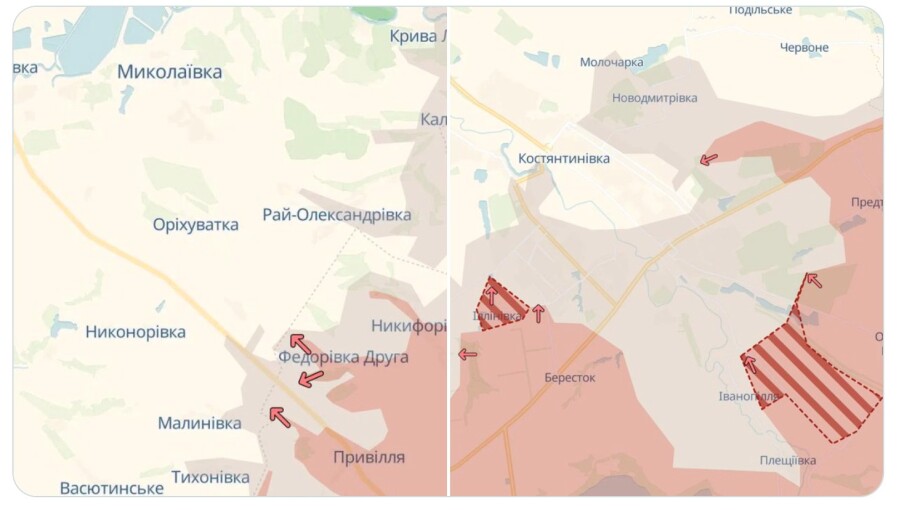
Russian forces have continued to make incremental gains across eastern Ukraine, moving closer to several key urban centres as Ukrainian officials and military analysts warn that the battlefield situation is deteriorating despite continued Western reporting of a “turning point” in the war.
Russian forces are steadily tightening their grip on Ukraine's eastern defences, advancing towards the strategic city of Kostiantynivka and increasing pressure on several other key urban centres, as Ukrainian officials and military analysts warn that the battlefield situation is deteriorating despite continued Western military support.
According to the Ukrainian open-source battlefield monitoring project DeepState, Russian troops have advanced on the approaches to Kostiantynivka in Donetsk region while also making progress towards Sloviansk, another key fortress in Ukraine's eastern defensive belt. Ukrainian military commentators have also reported Russian advances into neighbouring Dnipropetrovsk region, although the extent of those gains remains difficult to verify independently.
Former Ukrainian presidential spokeswoman Iuliia Mendel criticised what she described as an increasingly detached public narrative surrounding the war.
"This is simply terrible. We're losing territory while every mainstream media cheers that 'Ukraine is winning'," Mendel wrote on social media.
She also argued that the widely followed DeepState battlefield maps have increasingly struggled to keep pace with developments on the ground. "In the last 1.5 months, Deep State maps have been lagging behind real events," she said.
Reuters reported from the front line that fighting has now begun to seep into Kostiantynivka itself, with small groups of Russian soldiers attempting to infiltrate the city's outskirts, although Ukrainian commanders insist these incursions have so far been contained.
Kostiantynivka is the southern anchor of Ukraine's so-called "fortress belt"—a line of heavily fortified cities including Druzhkivka, Kramatorsk and Sloviansk that has formed the backbone of Kyiv's defence of Donetsk region since the fall of Bakhmut and Avdiivka.
President Vladimir Putin said last week that Russian forces were close to capturing the city. Ukrainian commanders rejected that assessment as exaggerated, saying their troops continued to eliminate Russian infiltration groups before they could establish positions inside the city.
Nevertheless, analysts say the strategic outlook continues to worsen.
"The city's fall seems to be more of a question of time," said Emil Kastehelmi of Finland's Black Bird Group. Despite increasingly effective Ukrainian drone strikes against Russian logistics, he said, "the effect hasn't been so great that it would have forced the Russians to suspend their offensive. So even though Russia has been taking increasingly heavy losses in the rear, they are still able to continue their offensives, at least in certain sectors."
The Institute for the Study of War has assessed that Russian infiltration is not yet sufficient to produce a rapid operational breakthrough. However, Moscow continues to squeeze the city through gradual pincer movements, steadily increasing the cost of Ukraine's defence.
"A choice will have to be made: either raise the stakes or withdraw," said Ruslan Mykula, co-founder of the DeepState analytical project. "And right now, the situation is such that the stakes are rising with each passing day."
The latest battlefield reports suggest Russian forces are now operating within roughly 10km of Sumy, Kharkiv and Zaporizhzhia, underlining the increasingly broad geographical scope of Moscow's summer offensive. While none of the cities faces an immediate threat of capture, their proximity to the front has exposed them to increasingly frequent glide-bomb attacks, drones and long-range artillery.
Reuters correspondents travelling along the supply route north of Kostiantynivka described roads protected by anti-drone netting, fibre-optic cables from Russian FPV drones strewn across the landscape and ground robots replacing vehicles to deliver food and ammunition through what soldiers now call the "kill zone". Civilian evacuations from nearby Druzhkivka are accelerating as Russian drones increasingly target traffic on roads behind the front.
Military analysts say Russia continues to rely on a strategy of slow, attritional advances backed by overwhelming firepower rather than rapid breakthroughs. Although gains are often measured in hundreds of metres rather than kilometres, the sustained pressure is steadily eroding Ukraine's defensive positions and forcing Kyiv to stretch already limited manpower across an increasingly wide front stretching from Sumy in the north to Zaporizhzhia in the south.

No comments:
Post a Comment