Sunday, March 01, 2026


Statement:  Condemnation of the Illegal and Unjust War on Iran by the United States


Just Peace Advocates  (CANADA) strongly condemns the imminent war on Iran planned by the United States of America. Just Peace Advocates stated that such an action is both illegal and unjust, representing a serious threat to peace and stability in the region.

The Threat of War

The United States is currently threatening to launch a devastating war on Iran in the near future. Just Peace Advocates expresses deep concern over these developments and calls for an immediate halt to any military escalation.

In the last month, the United States and Israel have made unjust demands on Iran which, if not met, a US war on Iran will ensue.

The three demands, zero uranium enrichment, curbing Iranian missile defense capacities to three hundred kilometers and ending support for the axis of resistance to the Zionist entity in western Asia. These demands are echoed by the Zionist entity, Israel.

The United States and Israel are nuclear powers and have no right to impose nuclear limits on the sovereign nation of Iran. It is common knowledge that Iran does not want nuclear arms and is ready to limit uranium enrichment with international supervision. These issues should be resolved by diplomatic means: war and the threat of war must be abandoned by the US President, Donald Trump.

Iranian missile defences are capable of hitting Israel and all American military bases in western Asia. Iran as a sovereign nation has the unalienable right to defend itself under article 51 of the United Nations Charter by any means necessary, particularly in the light of Israeli and American threats to attack and impose an illegal regime change.

It is illegal and unreasonable for the United States and Israel to require Iran to stop all support granted to the Resistance Axis in Lebanon, Yemen, Gaza, Syria, and Iraq. This support, as it exists, results from its agreements with the Resistance movements against the illegitimate Zionist entity. Opposition to Zionist colonialism, and all settler colonialism, should be commended.

Just Peace Advocates calls for deescalation, negotiations which respect international law, including the sovereign right of Iran to defend itself with all its advanced military assets and the right to work in tandem with all military and political opponents to the illegitimate Zionist occupation of Palestine.

A war on Iran would violate its sovereignty and the principals of Nuremberg established by the International Military Tribunal which established the legal precedent that launching a war of aggression is the “supreme international crime”. Defined as “crimes against peace,” this included planning, preparing, or initiating wars in violation of international treaties and sovereign nations.

The United States must abandon it role as an aggressor and negotiate with Iran respecting its sovereignty recognized by International Law.


Visit our website: www.justpeaceadvocates.ca


Mark Carney has endorsed the US/Israeli war on Iran. Please tell the Prime Minister to condemn this effort to overthrow Iran's government or even balkanize the country in service of US imperialism and genocidal Jewish supremacy.

Just Peace Advocates


Copy and paste this email to friends to spread the word:

Subject: Send a letter: Condemn Canadian support for US/Israeli war on Iran

Body:

Friend,

I wrote a letter for the Action Network letter campaign: Condemn Canadian support for US/Israeli war on Iran .

Mark Carney has endorsed the US/Israeli war on Iran. Tell the Prime Minister to condemn this effort to balkanize Iran in service of US imperialism and genocidal Jewish supremacy.

Can you join me and write a letter? Click here: https://actionnetwork.org/letters/condemn-canadian-support-for-usisraeli-war-on-iran?source=email&

Thanks!


Trump announces ‘major combat operations’ in Iran to ‘protect Americans’

“We are going to destroy their missiles and raze their missile industry to the ground. It will be totally, again, obliterated,” Trump said.

February 28, 2026 at 8:22 am
Middle East Monitor


As explosions rocked Tehran and Israel announced “preemptive” strikes against Iran, US President Donald Trump also confirmed launching “major combat operations” in the Islamic republic, Anadolu reports.

“Our objective is to defend the American people by eliminating imminent threats from the Iranian regime,” Trump said in a video posted on his Truth Social account.

The president vowed to destroy Iran’s missiles, raze its missile industry to the ground and annihilate the navy, reiterating that it cannot have a nuclear weapon.

“We are going to destroy their missiles and raze their missile industry to the ground. It will be totally, again, obliterated,” Trump said.

The attacks come as talks over Iran’s nuclear program have been ongoing under Oman’s mediation. A new round of talks in Geneva ended on Thursday.​​​​​​​

Last June, the US struck three Iranian nuclear sites towards the end of the 12-day Israel-Iran war.
Europe expected to join Israel-Iran war as missiles fired toward Jerusalem

Europe expected to join Israel-Iran war as missiles fired toward Jerusalem
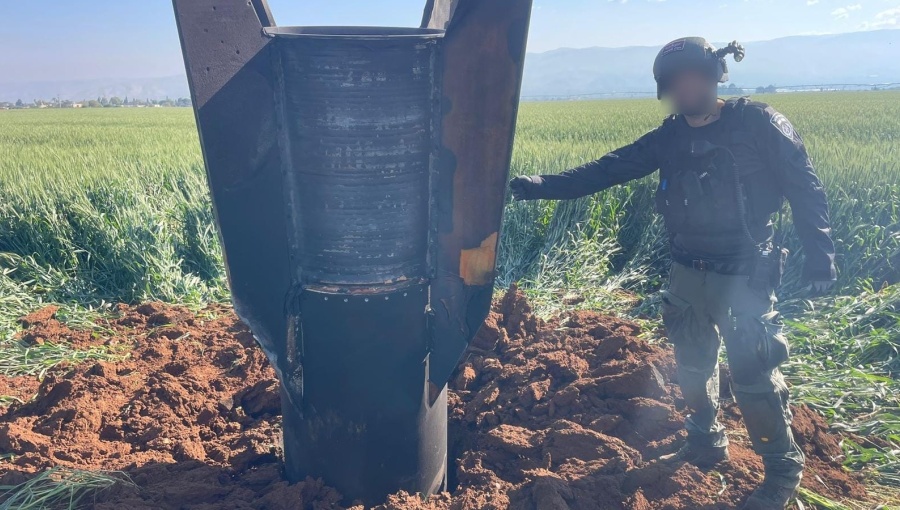
An Iranian ballistic missile that fell in an open field in Israel. / CC: Israel Police
By bnm Tel Aviv bureau March 1, 2026

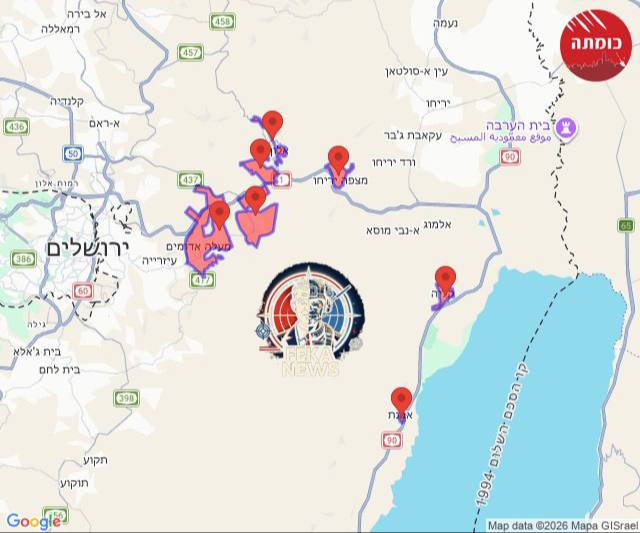
Alarms sounded across Jerusalem again as Iran launched another wave of missiles and drones toward Israel on March 1, with European powers expected to join the conflict on the side of the US and Israel. 

The IDF confirmed that approximately 100 ballistic missiles were fired at Israel from Iran early on March 1, with most intercepted by Israeli air defences.

Two Israelis have been reportedly killed since the start of the ongoing conflict, with at least 456 injured according to Israel's Army Radio earlier in the day.

Israeli operations in Tehran have resulted in the elimination of 40 Iranian commanders, in addition to the elimination of Supreme Leader Ayatollah Ali Khamenei.

Initial IDF assessments indicated that, in the fresh wave of Iranian strikes, two missiles and one drone heading toward Jerusalem were successfully intercepted.
"We expect the Europeans to join the coalition and the attacks against Iran," Israeli Minister of Energy Cohen stated in an interview with Israel's Channel 2.

"They may be afraid of extremist elements among them. They need to be on the right side of history. To free the Iranian people and stop the global terror apparatus. Trump is showing here that he is the leader of the free world."

This comes after several European powers condemned Iran’s latest actions. Albania, France, Germany, Poland, Lithuania, and Ukraine came out with public statements against the government of Iran, while the United Kingdom convened the Government's emergency "Cobra" or Cabinet Briefing Room committee.

An Iranian unnamed source with knowledge of the military operations told IRGC-linked Tasnim that intelligence assessments indicated more than 90% of Iranian missiles hit their targets inside Israel, catching the Israeli military off guard.

Several waves of dozens of missiles were fired at Israeli territory throughout the day.

Iran's Khatam al-Anbiya Central Command spokesman Lieutenant Colonel Ebrahim Zolfaghari said Iranian armed forces struck key security and military centres inside Israeli territory alongside 14 US military bases across the region, claiming hundreds of American and Israeli personnel were killed.

"The powerful and resolute operations of the armed forces will continue more forcefully and on a wider scale than before," Zolfaghari said in a statement carried by National Security Council-backed Nournews .

Iran said its opening wave combined army drone strikes against US radar sites with ballistic missiles including the Emad and Qadr, which Tehran described as upgraded versions of those used in previous operations. Iran also claimed to have fired its Fattah hypersonic missile.

A hotel in Dubai said to be housing Israeli military commanders was also struck, according to sources cited by Nournews.

Iran's Red Crescent reported that 24 provinces across Iran were hit in the US-Israeli strikes, with 201 people killed and 747 wounded as of 20:45 local time. East Azerbaijan province alone was struck at 17 points, leaving one dead and 35 wounded.


Opinion

Madmen Trump and Netanyahu set the Middle East on fire

In a reckless push for regime change, Donald Trump and Benjamin Netanyahu set the Middle East on a dangerous path to a long and bloody war.


The New Arab Editorial
28 Feb, 2026


Trump, a self-styled peace president who had campaigned for years against further military entanglements in the Middle East, has proven himself every bit as warmongering as the worst of the neoconservatives.


In the early hours of Sunday, America’s madman-in-chief Donald Trump and his foreign policy handler Benjamin Netanyahu launched an unprovoked war on Iran, setting the entire Middle East ablaze in a strategic gamble that is both criminal and potentially self-defeating.

The opening salvo, aimed at decapitating the regime in Tehran, appears to have failed, with the top leaders of the Islamic Republic said to be alive and unharmed.

That situation could still change. While Trump donned a USA baseball cap in his declaration of war, Netanyahu vowed in a speech infused with biblical verses to pursue regime change in Iran, warning the war could cost American and Israeli lives. In other words, this points to a relentless, all-in war, one far closer in scale to the US-led invasion of Iraq in 2003 than to any limited or symbolic strike.

This escalation comes after weeks of diplomatic talks that, while slow, had been making incremental progress, raising the inevitable question of whether war was the intention all along.

It also comes barely a year after the 12-day war with Iran in 2025, which Trump repeatedly claimed as a decisive success. If that campaign achieved its stated objectives, the question now then is why return to war at all?

Iran has responded by striking targets across the region, including in Abu Dhabi and Bahrain, and reportedly in Iraq and Saudi Arabia.

The Iranian objective is clear: to raise the cost for the US and its allies of continuing this campaign, and to pressure regional actors to dissuade Trump from pursuing his regime-change project to the bitter end.

Trump, a self-styled peace president who had campaigned for years against further military entanglements in the Middle East, has proven himself every bit as warmongering as the worst of the neoconservatives. While he and Netanyahu speak of helping the Iranian people overthrow their “tyrannical” rulers, using the language of colonial hubris that has learned nothing from history, US and Israeli strikes have hit civilian sites, with dozens said to have been killed at an Iranian school on Saturday.

Netanyahu, for his part, has recycled the familiar rhetoric of the US, Israel and the so-called “free world” joining forces to defeat terror. Yet the domestic fronts in the United States and Israel are deeply divided over this war, and over the fate of the regime in Tehran. There is no clear popular mandate in any of these three countries for foreign-imposed regime change.

Alborz Ghandehari

This war also reinforces a growing suspicion, including within segments of Trump’s own MAGA base, that he is waging conflict on Israel’s behalf without a clearly defined American strategic interest. Far from strengthening Washington’s position, such a war risks draining US military resources, undermining its ability to confront peer competitors, and further destabilising its already fragile standing in the Middle East.

What exists instead is uncertainty and the real prospect of a protracted, deadly conflict that could drag on for years rather than the days or weeks imagined in the fantasies of Trump and Netanyahu.

It is also legitimate to ask whether this war serves domestic political purposes. With both men facing mounting crises and scandals at home, the temptation to escalate abroad cannot be dismissed. For leaders who routinely conflate national interest with personal survival, the distinction between the two is often blurred.

We are still in the opening hours of this onslaught and its repercussions. But one fact is already evident: two Western leaders have launched yet another war on a Muslim country on dubious grounds, once again setting the region alight. And the worst may still lie ahead.

The New Arab Editorial represents the collective voice of The New Arab’s editorial team, presenting views that promote authentic discourses on the MENA region and beyond.

US, Israel launch war on Iran as public support collapses

Ali Abunimah 
28 February 2026
ELECTRONIC INTAFADA


US President Donald Trump announced the joint Israeli-American attack on Iran, early Saturday, 28 February. @realDonaldTrump via CNP

As the US and Israel launched an all-out war on Iran, they did so amid shrinking American public support.

As recently as last week, a YouGov poll found that just a quarter of Americans wanted a war against Iran.

On Friday, a Gallup survey showed American sentiment shifting decisively towards the Palestinian people and away from Israel.

Forty-one percent of Americans now sympathize more with the Palestinians, while 36 percent sympathize more with the Israelis, according to a new Gallup survey.

The poll reverses the firm’s findings from a year ago and confirms long-term trends.

Last year, a Pew survey indicated that more than half of people in the United States held a negative view of Israel – an 11-point surge since 2022, according to that organization.


Loss of support across the board


Gallup notes that over the last 25 years, “Israelis consistently held double-digit leads in Americans’ Middle East sympathies, with the gap averaging 43 points between 2001 and 2018.”

But that lead began to erode from around 2019, and Israel’s dramatic loss of support has only accelerated during Israel’s US-backed genocide in Gaza.

Fifty-seven percent of Americans favor an independent Palestinian state, according to Gallup, close to the highest level of support ever recorded by the firm.

There remains a clear partisan gap: a whopping 65 percent of Democrats sympathize more with Palestinians, while just 17 percent favor the Israelis.

Support for Israel among Republicans remains strong: Those sympathizing more with Israelis peaked at 87 percent in 2018, but that number now stands at 70 percent – the lowest level since 2004.

The greatest shift has been among so-called independents, according to Gallup: “By 41 percent to 30 percent, independents say they sympathize more with the Palestinians than the Israelis, whereas in all prior years, they were more sympathetic toward the Israelis, including by 42 percent to 34 percent last year.”

In recent years, a clear generational shift has emerged, with younger Americans tending to support Palestinians. But as Gallup notes in its new survey, “Americans of all age groups have grown more sympathetic to the Palestinians in recent years.”

Yet younger Americans remain the strongest reservoir of support for Palestine. “Among those aged 18 to 34, 53 percent say they sympathize more with the Palestinians, marking the first time a majority of this age group has expressed this view,” according to Gallup.

Meanwhile, a record low of 23 percent of young adults now sympathize more with the Israelis.
Democrats chose genocide over White House

Eroding support for Israel should shape policy – if democracy works as taught in civics class.

But the Democratic Party under President Joe Biden preferred to sacrifice its chances of re-election in 2024 to maintain its support for Israel’s genocide despite an overwhelming majority of Democratic voters favoring an arms embargo.

An internal “autopsy” of the 2024 Democratic campaign has reportedly concluded that the party’s support for the Gaza genocide played a major role in its candidate Kamala Harris losing the election.

The American-Arab Anti-Discrimination Committee is demanding that the party release the report, noting that the advocacy group had “repeatedly warned that a political reckoning would be inevitable if the US did not end its financial, military and diplomatic backing of Israel’s indiscriminate bombing of Gaza.”

Still, the most senior elected Democrat, New York Senator Chuck Schumer, recently made clear that his priority remains ensuring that American money and weapons keep flowing to the genocidal regime in Tel Aviv.


The Trump administration’s escalating support for Israel’s most extreme positions – including Ambassador Mike Huckabee’s endorsement of Israeli territorial expansion as far as Baghdad and Cairo, and American recognition of Israeli colonies in the occupied West Bank – is arguably more democratic: at least it is in tune with a majority of Republicans, if not with most Americans.


But even on the right, there have been unprecedented ruptures, with many commentators, most notably Tucker Carlson, expressing not just open hostility to Israel but tentatively embracing Palestinians.


The “Epstein regime” does what it wants


Eroding support for Israel may eventually affect policy, but public opposition has not restrained President Donald Trump from launching another American war.

Trita Parsi of the Quincy Institute argued that Israel’s dwindling support pushed Washington and Tel Aviv to speed up their attack.

“It is difficult to overstate the significance of this,” Parsi commented regarding the Gallup poll the day before the American-Israeli joint assault. “This is a key reason why Israel – and its supporters in the US – have a sense of desperate urgency when it comes to war with Iran and annexation of Palestine.”

“The window for these aggressions with US support is closing,” Parsi added.

Tehran University professor Mohammad Marandi – speaking from the Iranian capital under attack – called the unaccountable elite responsible for this war the “Epstein regime.”


Opinion

From Munich to Tehran: Echoes of appeasement and lessons of power drift


Security teams on duty as hundreds of citizens participate in the celebrations marking the 47th anniversary of the 1979 revolution led by Ayatollah Ruhollah Khomeini in Iran, gathering at Tehran’s Azadi Square on February 11, 2026. [Fatemeh Bahrami – Anadolu Agency]


by Jasim Al-Azzawi
February 28, 2026 
Middle East Monitor 


The uneasy negotiations between the United States and Iran are unfolding under the shadow of a long historical truth: great-power systems rarely collapse in a single dramatic moment. They erode. They drift. They unravel—through hesitation, miscalculation, and the quiet accumulation of small crises that go unanswered until answering them becomes catastrophic.

The European descent into war in the 1930s remains the starkest example of how incremental provocations, when met with divided or delayed responses, can push nations toward a confrontation none of them originally sought. As the historian A.J.P. Taylor observed, WWII was a war that no one willed, planned, or wanted. Yet it came anyway, because those with the power to stop it chose ambiguity over clarity at every critical juncture.

The comparison with today is not moral. Iran is not Nazi Germany, and the multipolar world of 2026 is not the shattered post-Versailles order. But the incremental escalation and the seductive trap of strategic ambiguity echo with unsettling clarity.

The 1930s: A study in calibrated provocation

When Hitler came to power in 1933, he did not plunge Europe into war. He probed it. Step by step, test by test, each gamble bolder than the last and advanced because he was permitted to advance.

In 1936, German troops marched into the demilitarized Rhineland—a zone the Treaty of Versailles had explicitly forbidden them to enter. Hitler’s own generals warned him that Germany was unprepared for war; he reportedly told them to reverse course if France intervened. France did not intervene. Britain expressed concern. The gamble paid off.

In 1938, the Anschluss of Austria was carried out without resistance. The Sudetenland crisis ended at Munich with Neville Chamberlain’s infamous “peace for our time.” By 1939, the dismantling of all Czechoslovakia revealed the truth that the historian Ian Kershaw would later crystallize: appeasement did not buy peace. It bought momentum.

By September 1939, when Hitler crossed into Poland, and the Allies finally drew a line, it was too late. The crisis had grown into something far more dangerous than it had been at the start—not because the Allies lacked intelligence or understanding, but because they lacked the will to act when the cost of action was still manageable.

The tragedy of the 1930s was not a failure of intelligence. It was a failure of clarity and resolve.


READ: Why Trump’s war on Iran will fail

The modern parallel: Incrementalism in the US–Iran standoff

The US–Iran confrontation today is shaped by a structurally similar logic. Iran does not seek open war. It probes. It tests. It advances in calibrated steps to shift the balance of power, while remaining below the threshold that would trigger a decisive American response.

Consider the pattern: increasing uranium enrichment to near-weapons-grade levels; installing advanced IR-6 and IR-8 centrifuges; restricting IAEA inspectors while stockpiling enriched material; expanding proxy networks across Iraq, Yemen, Syria, and Lebanon; probing American red lines through deniable attacks on US-linked assets. Each move is significant, and in theory, each move is reversible. Each move, as Chicago University Professor of Political Science Mearsheimer would frame it, is designed to maximize leverage while minimizing the risk of catastrophic retaliation.


“States that are not satisfied with the existing distribution of power are called revisionist states. They want to change the rules of the international order in their favor.” — John Mearsheimer, The Tragedy of Great Power Politics.

Iran is a revisionist state operating within a system still dominated by American power. Its strategy is not suicidal boldness but patient, incremental pressure, similar to the pressure Hitler applied between 1933 and 1939. Not confrontation but erosion.

Meanwhile, Washington oscillates. Review the US sequence: Pressure, then diplomacy; withdrawal from the JCPOA, then attempted re-engagement; targeted strikes, then strategic restraint. Domestic divisions, shifting administrations, and the perpetual fear of a wider regional war have produced exactly what the 1930s produced: mixed signals that each side interprets differently. For the United States, it is a restraint. For Tehran, it reads as hesitation. What America calls prudence, Iran calls permission.

The result is a strategic ambiguity that serves neither side and emboldens the wrong calculations.

The risk of a modern “Poland moment”

The takeaway from 1939 isn’t the inevitability of war, but the fragility of systems. A structure can only withstand a finite number of shocks before a single miscalculation triggers a collapse that no one intended.

“Wars begin when governments believe the price of aggression is cheap.” 
— Robert Gilpin, War and Change in World Politics.

In the US–Iran context, analysts warn that such a moment could materialize through any one of three vectors: a nuclear threshold crossing that eliminates Washington’s strategic window; a miscalculated proxy attack that kills Americans in numbers that make restraint politically untenable; or an escalation in the Strait of Hormuz—the chokepoint through which roughly 20% of the world’s oil passes—that draws in regional actors faster than diplomacy can contain.

The ‘brinkmanship’ strategy with Iran: A calculated approach

None of these scenarios requires deliberate intent. Like the events of the late 1930s, they could emerge from accumulated misjudgements. If Tehran misreads American tolerance, Washington misreads Iranian resolve, or a third party triggers a spiral beyond Washington’s or Tehran’s control. As the political scientist Graham Allison warned in the context of great-power rivalry, the structural forces at play are often more powerful than the intentions of the actors within them.

“The Thucydides Trap is the severe structural stress caused when a rising power threatens to displace a ruling power.” — Graham Allison, Destined for War.

Clarity as strategy—not confrontation as destiny

The 1930s teach a single, insightful lesson: ambiguity is not a strategy. It is a drift. And drift is what transforms manageable crises into unmanageable ones, local provocations into continental wars, and miscalculations into catastrophes.

For today’s policymakers, the historical imperative is to choose clarity over confrontation: clear boundaries, clear consequences, and clear diplomatic objectives. Negotiations with Iran may succeed or fail on their own merits. But they cannot succeed when conducted through wishful thinking, when red lines mean nothing, when each concession is rationalized as buying time rather than acknowledged as surrendering ground.

“You can always count on Americans to do the right thing—after they’ve tried everything else.” — attributed to Winston Churchill.

The European powers of the 1930s believed each concession would buy peace. In reality, each concession bought momentum—momentum toward a war they could have prevented had they chosen clarity over comfort even once, before it was too late.

The cost of clarity, then as now, is always lower than the cost of waiting for the next step.

The views expressed in this article belong to the author and do not necessarily reflect the editorial policy of Middle East Monitor.

Saturday, February 28, 2026

WAIT, WHAT?!
Melania Trump to chair UN Security Council meeting

February 27, 2026 
Middle East Monitor 


United States President Donald Trump (R) and First Lady of the United States Melania Trump (L) depart the White House en route Fayetteville, North Carolina on February 13, 2026, in Washington DC. [Celal GüneÅŸ – Anadolu Agency]

The White House said on Thursday that First Lady Melania Trump will chair a meeting of the United Nations Security Council next week, when Washington assumes the body’s rotating presidency.

The Office of the First Lady said Mrs Trump will preside over the session scheduled for Monday under the title “Children, Technology, and Education in Conflict.” She is expected to stress the importance of education as a tool to promote tolerance and global peace.

A United Nations spokesperson said this “would be the first time a spouse of any serving world leader has chaired a meeting of the 15-member Security Council.” The council, the UN’s main executive body, has 15 members, including five permanent members such as the United States.

Mrs Trump will lead the session amid tensions between her husband and the United Nations. Since his first term, President Donald Trump has been a strong critic of the organisation, saying the UN, which has 193 member states, is ineffective and needs major reform.

The United States has traditionally been the largest contributor to the United Nations, but funding was significantly reduced during Trump’s presidency. Since returning to the White House, Washington has also withdrawn from several UN agencies, including the World Health Organization (WHO).

Israeli influence over German defense grows


February 26, 2026
Middle East Monitor 


Amnesty International stage a protest in Berlin, Germany on December 5, 2025. [Halil Sağırkaya – Anadolu Agency]

The German Navy received the BlueWhale large autonomous underwater vehicle, jointly developed by Israeli and German companies, according to a recent report, Anadolu reports.

The submarine, made by TKMS and Israel Aerospace Industries (IAI), was delivered to the German Navy at a ceremony held at the Eckernforde naval base in the country’s northern region, according to a statement by TKMS on Wednesday.

The BlueWhale submarine, deployed under Germany’s Kurs Marine 2035+ vision, is designed to act as a force multiplier by extending the sensor range of manned platforms for miles during long and uninterrupted autonomous missions.

The submarine went through testing in the Baltic Sea, one of the world’s most complex maritime environments, to prove its capabilities.

The craft, outfitted with advanced sonar systems developed by TKMS subsidiary Atlas Elektronik, can detect underwater and surface targets, collect acoustic data, and locate seabed mines.

The BlueWhale is expected to significantly enhance Germany’s maritime border protection capabilities and its critical infrastructure in the face of deepening geopolitical risks.

The deal marks the rising defense cooperation and strategic investments between Germany and Israel across underwater and air defense systems.

Berlin approved an additional $3.1 billion package for the Israeli Arrow 3 anti-ballistic missile system in Dec. 2025, bringing the total value of Germany’s Arrow 3 procurement to around $6.7 billion, which is the largest defense export deal in Israel’s history, according to the Israeli Defense Ministry.

The Arrow 3 system, developed with US support, plays a key role in Germany’s broader missile defense architecture in Europe.
Israeli law bars Palestinian university graduates from education sector jobs


February 27, 2026
Middle East Monitor 


A view of Birzeit University campus in West Bank. [Wikipedia]


The Israeli Knesset has passed new legislation prohibiting the employment of graduates from Palestinian Authority-affiliated universities in teaching, administrative and educational supervision roles, a move critics describe as discriminatory and politically motivated.

The law targets Palestinian citizens of Israel and bars any academic who obtained a degree — or even completed a single academic year — at universities in the occupied West Bank from working within Israel’s education sector.

In response, the Adalah Legal Center, in cooperation with Arab members of the Knesset, has filed a petition before the Israeli Supreme Court seeking to overturn the legislation. The petition argues that the measure deprives thousands of graduates of their right to employment and professional integration on the basis of where they studied.

Petitioners contend that the law constitutes a clear violation of the right to education and freedom of academic choice, warning that it imposes collective restrictions without individual assessment.

READ: 1,200 former Israeli officials urge Knesset to reject death penalty bill

Supporters of the legislation claim that students educated at Palestinian institutions are exposed to ideologies hostile to Israeli authorities. However, human rights organisations have rejected these assertions, stating that no factual or security evidence has been presented to justify such sweeping exclusions.

During parliamentary deliberations, both the Israeli government’s legal adviser and the Knesset’s legal adviser reportedly warned that the law lacked an evidentiary basis and risked infringing fundamental rights.

Education experts have also warned of significant practical consequences. Official data indicates that approximately 60 per cent of teachers in occupied East Jerusalem schools graduated from West Bank universities, while up to 30 per cent of teaching staff in the Negev region rely on similar qualifications. Critics say the ban could therefore create serious staffing shortages in Arab schools.

Members of the Arab community in Israel already face longstanding structural inequalities in education and employment, activists say, with limited access to Hebrew-language universities prompting thousands of students each year to pursue higher education in Palestinian institutions.
Activists plan 200-vessel “Freedom Flotilla” to Gaza in bid to break siege


February 27, 2026 
Middle East Monitor 

The humanitarian organization Freedom Flotilla Coalition is in Catania from where the ship Madleen will depart on its mission to break the siege on Gaza, in Catania, Italy on June 01, 2025. [Salvatore Allegra – Anadolu Agency]

Pro-Palestinian activists and civil society organisations have announced plans to launch a large maritime campaign towards the Gaza Strip next month, combining the “Freedom Flotilla” and the “Steadfastness Convoy” in an effort to break the ongoing siege.

Organisers said the initiative will involve approximately 200 vessels scheduled to set sail on 12 April from several Mediterranean ports, including locations in Spain, Italy and Tunisia. The campaign is being coordinated with the participation of around 200 civil society organisations worldwide.

Bülent Yıldırım, head of the Turkish Human Rights and Freedom Foundation (İHH), told Al-Araby Al-Jadeed that donations are being collected across Europe, Asia, Africa, Turkey and the Gulf region to fund the purchase of the vessels. He argued that the scale of the convoy would make it difficult for Israel to stop, adding that “there is no other option but the sea”.

Organisers expect thousands of participants from roughly 150 countries to take part in the initiative, which has received backing from groups including the Mavi Marmara Freedom Association, the İHH Foundation and the Palestine Support Platform.

According to organisers, the mission will extend beyond humanitarian aid delivery. The flotilla is also expected to transport healthcare workers, teachers, infrastructure and environmental specialists, lawyers and investigators documenting alleged war crimes in Gaza. More than 1,000 doctors, nurses and medical professionals are anticipated to join the convoy.

Yıldırım said the campaign was prompted by what organisers describe as severe restrictions on aid entering Gaza, alleging that humanitarian supplies are being obstructed and that residents are facing worsening hunger and disease amid the ongoing crisis.
Britain’s Index of Repression’ documents 964 incidents of anti-Palestinian crackdown


February 27, 2026
Middle East Monitor 


Tens of thousands of people take part in a pro-Palestinian march in London, United Kingdom, following a ceasefire agreement signed yesterday, two years after Israel’s attacks on Gaza, on October 11, 2025. [RaÅŸid Necati Aslım – Anadolu Agency]

A new report by the European Legal Support Centre (ELSC) has documented 964 verified incidents of anti-Palestinian repression across Britain between January 2019 and August 2025, identifying what it describes as a cross-sector pattern of institutional crackdowns on Palestine solidarity.

The findings form part of Britain’s Index of Repression, a searchable national database developed in collaboration with Forensic Architecture and launched today at the Frontline Club in London.

Documented incidents listed in the database include arrests, workplace dismissals, suspensions and event cancellations. The Index, originally launched in Germany in 2025, is now publicly available for Britain and is described as the first accessible database of its kind in the country.

The data indicates a marked escalation in incidents after October 2023, with the publication following what the press briefing describes as a significant post-Gaza rise in recorded cases.

The report identifies a broad range of actors involved in the repression of Palestine solidarity, with law enforcement and state-linked bodies featuring prominently. Police and security personnel were involved in 220 documented incidents, making them the single most frequent actor. Educational institutions were responsible for 192 incidents, while pro-Israel advocacy and lawfare groups were linked to 141 cases. Journalists and media actors were involved in 113 incidents.

The data also shows that repression disproportionately targets those embedded in public institutions and organising spaces. Students, academics and teachers were the most frequently targeted group, accounting for 336 incidents. Activists and organisers followed, with 229 cases. Public and private sector workers together faced 169 incidents, while 71 cases involved artists and cultural workers.
“From smear to sanction”

The report describes a recurring three-stage pattern in how repression unfolds.

It begins with what the authors term “smear and distortion”, accounting for 261 incidents involving censorship, disinformation campaigns and public accusations. These allegations are then taken up by institutions. In 136 cases there were threats of legal action, in 81 cases threats to employment or funding, and in 41 cases demonstration bans or event cancellations. A further 114 incidents involved formal disciplinary sanctions in schools, universities or workplaces.

The final stage involves direct enforcement. The report documents 131 arrests or law enforcement interventions, 111 cases of harassment, doxing or surveillance, and 90 incidents resulting in legal, financial or professional consequences.

The report argues that this architecture of repression is structured around two recurring allegations directed at Palestine solidarity movements: anti-Semitism and support for terrorism. It identifies the highly controversial IHRA Working Definition of Antisemitism and the Terrorism Act 2000 as central enabling instruments.

IHRA has been widely criticised, including by its lead drafter, Kenneth Stern. Stern has warned that the definition has been weaponised against critics of Israel and misused to suppress legitimate political speech.

The notorious legal firm, UK Lawyers for Israel (UKLFI) was mentioned in the report. The study found that UKLFI was involved in 128 incidents leading to institutional repression of Palestine solidarity.
Launch at the Frontline Club

At today’s press conference at the Frontline Club in London, organisers presented sector-by-sector breakdowns, post-October 2023 trends and the first public demonstration of the searchable database developed with Forensic Architecture.

The event included a panel discussion featuring ELSC research staff providing analysis of patterns identified in the data, as well as the first on-camera testimony from an ELSC client describing workplace repression.


New Israeli poll shows young Jewish voters most right-wing, fanatically religious, and pro-genocide in Israeli history

A poll conducted by Israel's Channel 12 found the half a million new Jewish Israeli voters are the most right-wing and religiously fanatic in Israel's history. They're voting in the upcoming Knesset elections.


February 27, 2026 
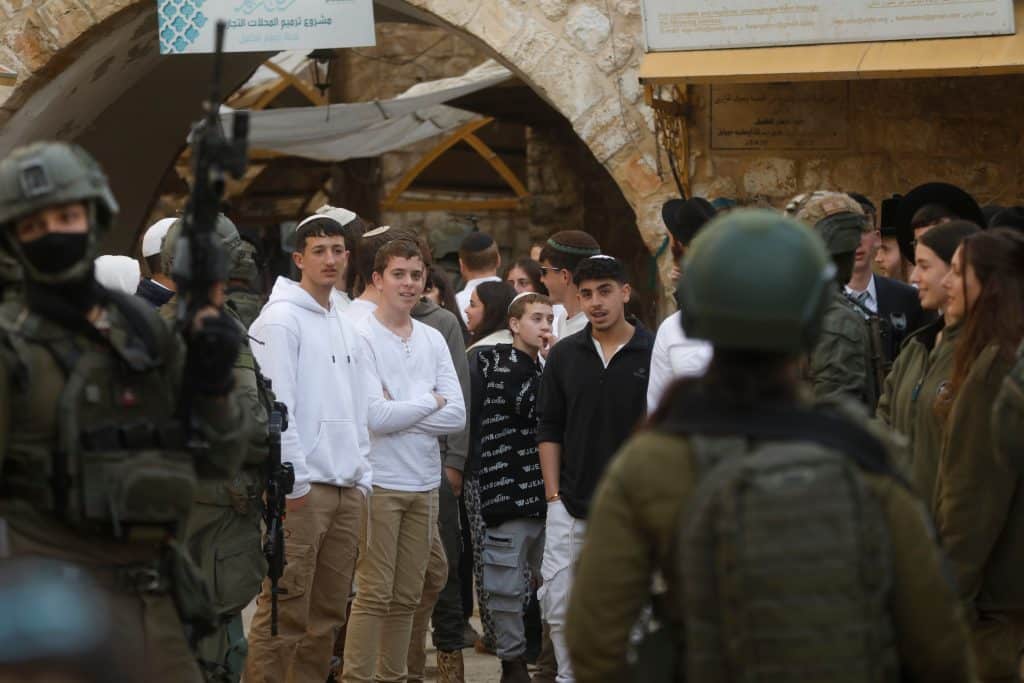
Israeli settlers, under the protection of Israeli forces, raid the Old City of Hebron on January 31, 2026. (Photo: Mamoun Wazwaz/APA Images)

A new poll featured on Israel’s Channel 12 shows that first-time Jewish Israeli voters, due to participate in the upcoming government elections this year, are more right-wing and religious-nationalist in their outlook than older voters.

Channel 12 is considered a centrist outlet and is the most-watched commercial news channel in Israel.

Netanyahu’s current government is the most right-wing in Israeli history, and it has held together since its election on November 1, 2022. New elections will likely be held between May and October.

The new voters in the poll represent 18 to 21-year-old Jewish Israelis, notably excluding Palestinians with Israeli citizenship, and consequently criticized for being an “apartheid poll.”

That isn’t wrong, but when an apartheid reality exists from the river to the sea, the political leanings of members of the self-described master race are not trivial.

The poll found that 75% of voters described themselves as “right-wing,” compared with 68% among older voters. The remaining 25% identify as “center-left,” and the self-identified “left” accounts for only 5%.

It is important to note, here, the relativity of concepts of right and left in Israeli politics. Opposition leader Yair Lapid, who is head of the centrist Yesh Atid party, recently affirmed that he agrees with U.S. Ambassador to Israel Mike Huckabee’s affirmation of Israel’s Biblical right to conquer Palestine, Jordan, Lebanon, Syria, and parts of Egypt and Saudi Arabia. This is called the “Greater Israel” vision for Israel’s future borders, stretching from the Nile to the Euphrates

On that same note, the leader of the only “leftist” party in the Zionist spectrum, Yair Golan, advocated in December 2023 for starving Gaza’s population. “We’d all like to wake up one spring morning and find that 7 million Palestinians who live between the sea and the river have simply disappeared,” Golan said in 2025. But let’s get back to those young Zionist voters.

The new voting group is said to be a major numerical addition of half a million voters to the electoral picture, the largest in Israel’s history. It is the equivalent of 17 seats in the 120-seat Knesset.

Netanyahu’s Likud party is by far the most preferred among them, polling at 20%. After that, coming in at 11%, is United Torah Judaism, an ultra-orthodox Ashkenazi (European heritage) Jewish party, which has become ultra-Zionist. Then there’s Naftali Bennett’s party, coming in at 10%, and he’s an even more religious-Zionist fanatic than Netanyahu. Finally, there is Itamar Ben-Gvir’s Jewish Power party, leading by 7%. The rest of the parties receive smaller percentages of 5% or less.

Among these young voters, 59% prefer the rightwing bloc that governs now, while 41% prefer the opposition. On the question of Netanyahu vs. Bennett for premiership, 49% support Netanyahu, and only 24% support Bennett.

The other notable point of information in the Channel 12 poll is the transformation toward religious fanaticism. A full 80% of young voters consider themselves religious (compared to 75% of older voters). To represent the polling data more theatrically, Channel 12 invited 12 young potential votes to their Saturday news broadcast. All of them were clear about having become more religious since October 7, 2023.

When asked directly whether October 7 made them more religious, 11 out of 12 raised their hands.

Religiosity, here, goes hand in hand with a hardline form of Zionism. The voters have all become more militarized in their outlook, and when asked whether they were against “Arab parties” being part of the Israeli Knesset, 11 out of 12 once again answered in the affirmative.

Oz, who is 18 and says he will vote for hardline Finance Minister Bezalel Smotrich’s Religious Zionism party, said that his parent’s generation grew up on pro-peace songs, while children today grow up listening to “Harbo Darbo,” a popular genocidal song from November 2023. “Once, we dreamed of peace,” he said. “And today, we’re more, ‘live by the sword.’”

One is often used to the younger generation being a bit more progressive than their parents. For Jewish Israeli society, it’s the reverse.
Nine out of ten Israelis are genocidal

The polls conducted throughout the genocide in Gaza indicated a consistent general trend in Jewish Israeli society. About 4 out of 5 Jewish Israelis supported genocide in various formulations, from the 79% not concerned with starvation in Gaza (August 2025), to the over 75% opining that there are “no innocents in Gaza” (June 2025), and to the 82% supporting the total expulsion of Gaza’s residents (May 2025).

In that last poll, commissioned by Pennsylvania State University, authors Shai Hazkani and Tamir Sorek noted that only 9% of men under 40, the main demographic serving in the Israeli army in Gaza, “rejected all the ideas of deportation and extermination presented to them.”

To put that differently: if you’re a Palestinian in Gaza, there’s a 9 out of 10 chance that the Israeli soldier who controls your life wants you dead.

These young new voters are part of this genocidal turn. They are not just entering the electoral picture — they’re entering the army. Military service is also likely to further radicalize them. They are poised to live by the sword.
Meet the companies and billionaires looking to make a massive profit off Trump’s plans in Gaza

U.S. companies are aiming to make huge profits from the Gaza reconstruction plan, with several billionaires on Trump's Board of Peace openly discussing the opportunity to make billions.

 February 25, 2026 
MONDOWEISS

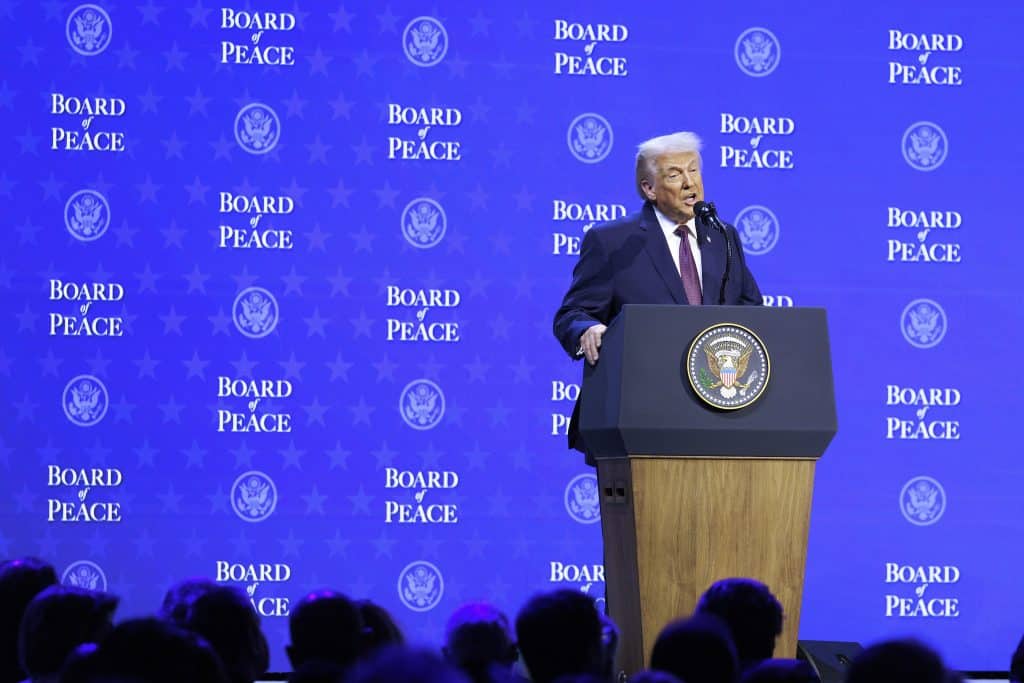
Donald Trump announces the “Board of Peace” on January 22, 2026, at the World Economic Forum in Davos, Switzerland.(Photo: ©2026 World Economic Forum / Benedikt von Loebell)


Last week, The Guardian reported that the Trump administration is planning to build a 350-acre military base in Gaza to house the future International Stabilization Force (ISF).

Plans reviewed by the newspaper reveal that the base will be “ringed by 26 trailer-mounted armored watch towers, a small arms range, bunkers, and a warehouse for military equipment for operations.”

At this time, it’s unclear who will be hired to construct the base, but the report is yet another reminder that Gaza’s reconstruction could generate massive profits.

Members of President Donald Trump’s controversial Board of Peace openly expressed this sentiment at the group’s first meeting, framing Gaza as a potential money-maker.

“The coastline alone is 50 billion dollars of value alone on a conservative basis… it just needs to be unlocked and financed,” said billionaire Marc Rowan, an executive member of the board and the head of the private equity firm Apollo Global Management.


Another board member, Israeli-Cypriot billionaire Yakir Gabay, told the crowd that Gaza’s coast could be “developed as a new Mediterranean Riviera with 200 hotels and potential islands.”

At the World Economic Forum (WEF) in Davos last month, Trump’s son-in-law, Jared Kushner, admitted that private-sector investment in Gaza could be “a little risky,” but said it would provide “amazing investment opportunities.”

“As you guys know, peace is a different deal than a business deal, because you’re changing a mindset,” he added.

As Quincy Institute research associate Nick Cleveland-Stout points out in Responsible Statecraft, Kushner could end up reaping the benefits of these opportunities, as his private equity firm, Affinity Partners, already has billions invested across the Gulf region.

Another possible partner is the disaster response firm Gothams LLC, which recently submitted a proposal to the White House that guarantees 300% profits via a seven-year trucking and logistics plan.

The Austin-based Gothams LLC gained attention last year after it landed a $33 million contract to help run the South Florida Detention Facility, the infamous migrant jail nicknamed “Alligator Alcatraz.”

“We provide solutions to the most challenging problems in high-leverage situations and strive to make a positive impact on the communities where we live and work,” declares the company’s website. “By combining military precision with private sector agility, we are built to accomplish more.”

When questioned about the proposal by The Guardian, Chris Vanek, a partner at Gothams, who has been coordinating with the Trump team, denied having any discussions about investment or returns with the White House.

“The Board of Peace, Palestinian and Israeli stakeholders, and the US Department of State asked me to assist with planning efforts based on my extensive experience in conflict zones, reconstruction, and disaster response,” said Vanek. “There is no existing agreement or contract, and I have provided this assistance at my own expense in support of peace efforts.”

Gothams “did not respond directly to questions about the profit margin,” noted The Guardian.

Reuters recently reported that North Carolina-based UG Solutions is in talks with the Trump administration to secure a role in Gaza’s reconstruction.

“Our proposal was received positively, but until the Board of Peace clarifies what its priorities are for security, UG Solutions is planning internally for a range of possible ways to support efforts in Gaza,” a UG Solutions spokesperson told Reuters.

The firm provided security for the Gaza Humanitarian Foundation (GHF) last year, and was heavily criticized by the United Nations after over 1,000 Palestinians were killed while attempting to reach aid sites. The operation was shut down after a ceasefire was announced.

Former GHF employee Anthony Aguilar alleged that he saw Israeli soldiers commit war crimes at the sites where UG Solutions provided security.

Aguilar told Democracy Now that the aid sites were “designed as death traps.”

“Those sites were built in the middle of those areas intentionally,” he explained. “It’s not by accident. That, in and of itself, to designate humanitarian distribution sites to service an unarmed, starving population, to build them deliberately in an active combat zone, is a violation of the Geneva Convention protocol. It’s a violation of humanitarian law. And in my opinion, it’s a violation of humanity in general.”

“The GHF and those who stand behind it have Palestinian blood on their hands; they are not welcome to return to Gaza,” said Palestinian NGOs Network head Amjad al-Shawa.

“I’m a real estate person at heart, and it’s all about location,” Trump has said, in reference to Gaza redevelopment. “And I said, look at this location on the sea, look at this beautiful piece of property, what it could be for so many people.”


Gaza does not need new overlords

The U.S. plan for Gaza is the final stage of Israel’s genocide. Bombs and bulldozers obliterated Gaza’s landscape, and now skyscrapers and data centers aim to dismantle its social fabric and capacity to resist.

 February 26, 2026 
MONDOWEISS


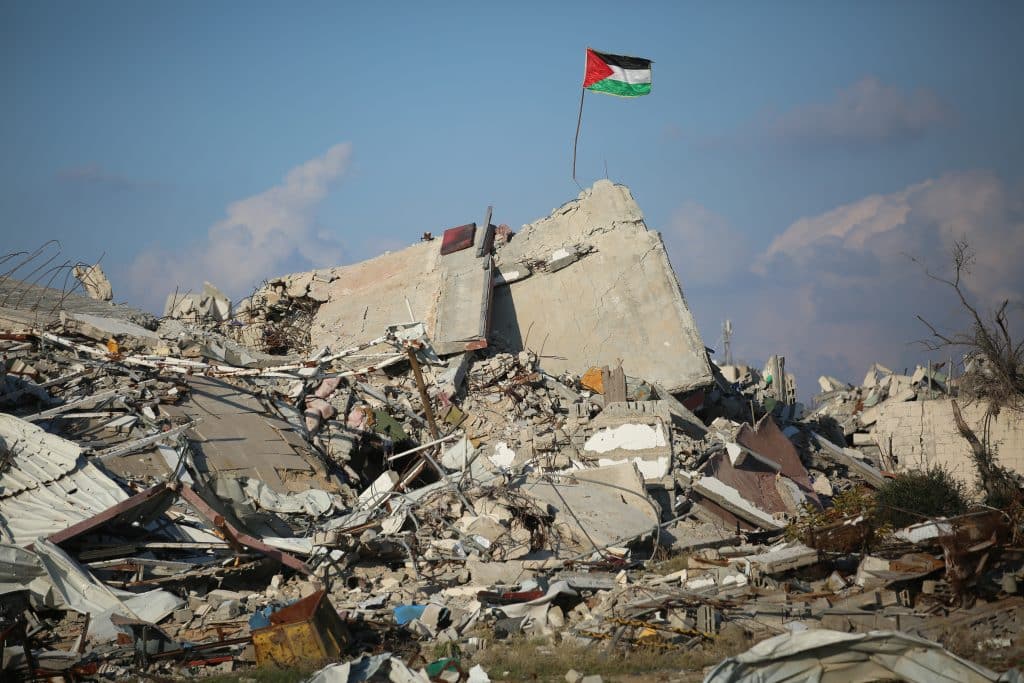
Displaced Palestinians return to their destroyed homes in the al-Maghraqa area south of Gaza City, January 31, 2024. (Photo: Omar Ashtawy/APA Images)

Every few decades, a new group of powerful men gathers around a table to decide what to do with Gaza or with Palestinians in general. The language changes. The underlying logic does not.

The latest proposals to “govern” postwar Gaza, from Jared Kushner’s beachfront development fantasies to the so-called “Board of Peace” and various international trusteeship schemes, are presented as bold, forward-looking visions. In reality, they are just recycling the same colonial framework that has governed Palestinian life for over a century: external actors decide what Palestinians need, what they may have, and what they must become in order to deserve it.

Gaza’s crisis was never a problem of governance or waiting for the right foreign administrator. It was, and remains, the product of a specific political structure: prolonged military occupation, a seventeen-year siege that strangled every dimension of life, and a settler-colonial project that treats Palestinian existence as an obstacle to be managed or removed. These are the roots. Everything else — the poverty, the misery, the desperation — is a symptom.

Yet every plan now circulating wants to treat the symptoms while leaving the roots untouched. They promise reconstruction without ending occupation. They offer economic incentives without political rights. They propose “deradicalization” programs without acknowledging that it is the violence of dispossession, not some cultural deficiency, that drives resistance. This is not new. The logic of “economic peace,” the idea that Palestinians can be pacified with jobs and consumer goods while their land is taken and their rights denied, has been tried repeatedly. It failed under the Oslo framework. It failed under the Quartet’s conditional aid regime.

It failed because no amount of economic programming can substitute for freedom.

What is new, and what should alarm anyone paying attention, is the scale of ambition behind the current proposals. Kushner did not misspeak when he described Gaza’s waterfront as “very valuable” real estate. The vision is not reconstruction. It is erasure. Build data centers and luxury resorts on the ruins of Shuja’iyya and Rafah. Erect skyscrapers where neighborhoods, mosques, schools, and cemeteries once stood.

The “Dubaification” of Gaza is not a development plan. It is the final stage of a process that began with bombs and D9 bulldozers: dismantle not only Gaza’s physical infrastructure but its social fabric, its cultural institutions, its memory, its capacity to produce defiance.

This is what makes these plans more than cynical. They are parasitic on genocide. The destruction of over seventy percent of Gaza’s built environment, the killing of tens of thousands, the displacement of nearly the entire population — these are not obstacles the planners must work around, but the necessary preconditions required by planners. You cannot build a seaside resort in a living neighborhood.

I grew up in Deir al-Balah. The Gaza I knew was not a blank slate awaiting foreign investment. It was a place dense with life, with teachers and poets and engineers and farmers and students who debated politics and planned futures despite the blockade. The idea that this place and its people need to be reimagined by men who could not name a single street in Gaza City is not visionary. It is colonial in the most precise sense of the word.

These plans may be attempted. Contracts may be signed. Renderings may be published. But they will not work — for the same reason every previous attempt to govern Palestinians without their consent has not worked. Palestinians are not a problem to be solved or a population to be pacified. They are a people with political demands that no amount of construction can build over: an end to occupation, the right of return, sovereignty, and freedom.

Until those demands are addressed, every plan imposed on Gaza from the outside will meet the same fate. And when it fails, Palestinians will say what they have always said: we told you. The problem was never Gaza. The problem was what you did to it, and what you refused to stop doing.

Moroccan opposition leader criticises foreign minister over Gaza “Peace Council” role


February 27, 2026
 Middle East Monitor 


Secretary-General of Morocco’s Justice and Development Party, Abdelilah Benkirane. [Photo/alquds.co.uk]

Abdelilah Benkirane, Secretary-General of Morocco’s Justice and Development Party (PJD), has criticised Foreign Minister Nasser Bourita over remarks concerning Morocco’s reported leadership of a programme to combat hate speech in Gaza under the framework of the US-backed “Peace Council”.

In a video published on his official Facebook page, Benkirane questioned the context and implications of statements attributed to the foreign minister, warning that they could be interpreted in ways that harm Morocco’s image and its longstanding position on the Palestinian issue.

Benkirane stressed that Bourita was speaking not in a personal capacity but as a representative of the Moroccan state, arguing that this required greater caution and precision when addressing sensitive political matters.

The PJD leader said that calls to promote “coexistence” in the current circumstances risked being understood as an attempt to persuade Palestinians not to regard Israel as an adversary. He argued that any discourse on coexistence should instead be directed towards the occupying power rather than the population living under occupation.

He further claimed that Israel was not genuinely committed to coexistence, asserting that the conflict remained fundamentally about land and displacement rather than a temporary political dispute.

While acknowledging that foreign policy ultimately falls under the sovereign authority of King Mohammed VI, Benkirane said this did not prevent political parties or public opinion from expressing positions on international affairs.

He reiterated his party’s long-standing opposition to normalisation with Israel, describing it as a principled stance embedded in the party’s political platform and internal decisions.

Benkirane concluded by arguing that lasting peace could only be achieved through restoring Palestinian rights, calling for efforts to persuade the United States administration to treat Palestinians fairly rather than exert pressure on them.