Sunday, April 26, 2026

The US Forest Service’s Bear-Palmer Logging and Burning Project Will Devastate Snag-Dependent Owls


 April 24, 2026

Boreal owl. Photo: Courtney Celley, USFWS.

The Custer-Gallatin National Forest proposed the Bear-Palmer “Forest Health” Project on the northern border of Yellowstone National Park, near Gardiner, Montana.  The project would clearcut 824 acres, commercially log most trees on 802 acres, and leave small, isolated clusters of trees on 500 acres, for a total of 2,126 acres, which will then be intentionally burned.

The agency claims the goal of the logging and burning project is to remove dead/dying trees to reduce insects such as the Mountain Pine Beetle, Douglas-fir Beetle, and the Spruce Budworm. But these native insect populations also feed various species of woodpeckers, which drill nesting cavities for other birds, including forest owls, which will be significantly impacted by the project.

There are 15 species of owls in Montana.  In the project area, there are four owl species that require “snags,” which are standing dead trees, for nesting: the Great Gray Owl,  Boreal Owl, Northern Pygmy Owl, and Northern Saw-whet Owl.  The Great Gray Owl nests on top of broken snags, and Boreal Owls require large snags at least 25 inches in diameter, while the Northern Pygmy and Northern Saw-whet Owls can use snags at least 12 inches in diameter.

So what happens to these owls in the project area when the Forest Service cuts down all the dead trees to supposedly remove the insects?

First, there will be a direct loss of woodpecker populations due to loss of the insects on which they feed.  That means a reduction in the number of cavities woodpeckers drill in snags, which will reduce or eliminate nesting habitat for the cavity-nesting owls.

The Custer-Gallatin Forest Plan suggests” that logging will maintain four snags per acre, but it also allows substitution with green trees.  The Bear-Palmer proposal is silent on snag retention in units and instead claims that green trees will be retained for future recruitment of snags.” The project’s required snag size of at least 6 inches in diameter is well below the size needed for the forest owls.

To make matters worse, snags aren’t required to be left in each logging unit. Instead, they can be averaged out” across all logging units, meaning snags may be retained on only a small portion of all units, or none if green trees are counted as snags.

The Custer-Gallatin Forest Plan says known” forest raptor nests will be protected from disturbances, but does not require any specific population monitoring of forest owls nor surveys for forest owls in logging units.  Instead, the monitoring plan says population monitoring will be of land bird species/assemblages associated with forest vegetation.”

What this means is unknown, as is how it will “protect” forest owl nests without surveying and monitoring for forest owls.

Currently, many National Forests use the Integrated Monitoring in Bird Conservation Regions as substitution for forest monitoring of birds.  Since this large-scale monitoring program cannot measure impacts of local logging projects, it effectively eviscerates agency requirements to measure impacts of logging projects on wildlife — including forest owls — in the Bear-Palmer project area since the proposal does not indicate that any forest owl surveys will be done.

For perspective, the Targhee National Forest Plan requires 1,600 acres of forest habitat to be protected for Great Gray Owls around each of their nests and 3,600 acres around each Boreal Owl nest.  But the Bear-Palmer logging and burning proposal alone will destroy nesting habitat for forest owls on 2,126 acres.

The bottom line is if the Bear-Palmer project is approved, it will not leave sufficient habitat to provide adequate nesting and foraging for owls. Comments on the project are due due May 11th and it should be opposed due to its failure to protect Montana’s forest owls.

“Beef 2”: Perpetrators and Victims of Big 


Tech’s Digital Domination


April 24, 2026

Logotype of Beef (TV series)

Beef has a double meaning. On the one hand it is meat, and on the other a feud.

The latter definition holds sway in “Beef 2,” an eight-episode series streaming on Netflix now. The series creator, Lee Sung Jin, gained notoriety with his Emmy-award winning “Beef,” a 2023 series that follows a road rage incident between two adults, Ali Wong and Steven Yeun, that descends into violent retribution.

In both series, Jin captures aspects of the class structure in capitalist America: income and wealth inequality driving personal instability, fueling divisions of class, ethnicity and gender.

In “Beef 2,” Oscar Issac and Carey Mulligan portray an upwardly mobile couple in their 40s who are treading water. They are hot and cold with each other, physically and verbally.

He works as a general manager of a country club with a $300,000 initiation fee. She is an interior decorator there until the billionaire owner sacks her. The boss doesn’t have to be right. S/he just has to be the boss in the largely union-free U.S. workforce after a near half-century of anti-labor policies.
Charles Melton and Cailee Spaeny are the Gen-Z couple in “Beef 2.” They aspire to settle down and rear a family.

Such aspirations are out of reach given the young couple’s paltry wage-income at the tony country club.  Some 40 percent of the American population have no savings, income and wealth shifted from them upward to the ruling class.

The “Beef 2” narrative grows from the Gen-Z female videotaping a violent clash between the Millennial couple.

This leads to blackmail. The ransom demand is for a pay raise and employer health care insurance.

There’s a catch, though. Think health-care insurance deductible. That $5,000 deductible compounds.

Meanwhile the male Millennial also experiences debt woes, leading him to criminal behavior. Money, or the lack of it, is central to the Gen-Z and Millennial characters’ desperation.

Chairwoman Park, Youn Yuh-jung, is the South Korean ice queen billionaire owner of the club. Her slight stature belies her lethal power over everybody else. She and Dr. Kim, Song Kang-ho, her plastic surgeon husband, take the corruption of capital accumulation by any means necessary to a higher level. Smartphones and social media play a prominent role in “Beef 2.” Suffice it to say that digital communication creates personal and social situations that worsen relations of inequality percolating throughout “Beef 2.”

The characters in “Beef 2” are perpetrators and victims of Big Tech’s digital domination. AI and algorithms strengthen that oppressive situation.
“Beef 2” unpacks the dynamics of domination and subordination that govern late capitalism, where a predatory ruling class exploits everybody else. Such social relations are ripped from today’s headlines of normalized greed and theft.

This social class reality of late capitalism goes a long way to explaining the popularity of Lin’s work. Viewers see aspects of themselves in the characters’ lives.

Seth Sandronsky is a Sacramento journalist and member of the freelancers unit of the Pacific Media Workers Guild. Email sethsandronsky@gmail.com

Like a Rolling Stone?


 April 24, 2026

Photograph Source: FontShop from USA – CC BY 2.0

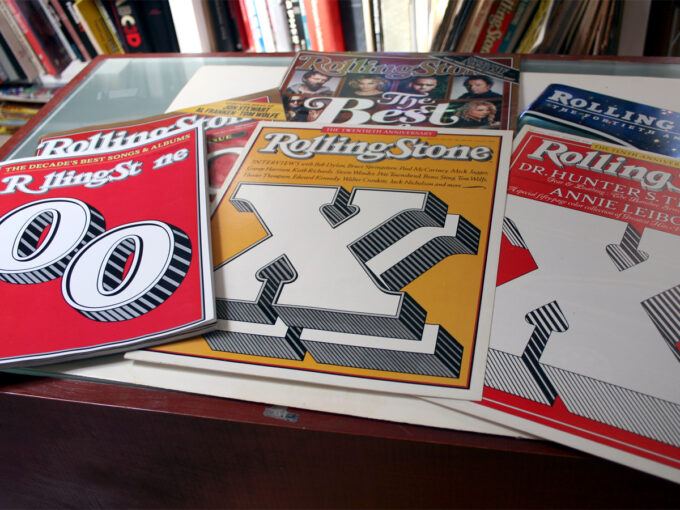
Many US residents around my age, especially men, have a story regarding the first time they read Rolling Stone magazine. Mine goes something like this. The first time I read the magazine from cover-to-cover was its issue devoted to the Woodstock festival that was published in the fall of 1969. Rolling Stone was hard to find in the redneck suburban town I lived in at the time; only underground newspapers from DC were rarer. It was only through some new friends at the Catholic high school I was a freshman at that year that I was able to get a copy of the paper; friends who lived in suburbs that bordered Washington DC where the record stores and head shops were more plentiful. I became a committed reader a few months later, when my family moved to Frankfurt, Germany as a result of my military father’s deployment there. The base library subscribed to the magazine and it was one of the most popular journals on its shelves. I eventually made friends with a GI who worked the circulation desk and he would hold the latest issue for me every other week. The mail delivered it to the library on Thursday and I made it a point to go there as soon as my classes ended on those days. Over time, he and I would discuss the stories in the latest issue. In fact, it was that library clerk who insisted I start my reading in Fall of 1970 with an article titled “The Battle of Aspen” and written by a journalist who would take the magazine well beyond the alternative music weekly it was at the time. That journalist was named Hunter S. Thompson and his work for Rolling Stone magazine remains some of the best writing to ever appear in a US magazine even today; cynical, idealistic, comic, feral and truthful beyond the facts. Indeed, his article, later a book, titled Fear and Loathing in Las Vegas: A Savage Journey to the Heart of the American Dream, is considered a classic of American literature.

Peter Richardson was another Rolling Stone reader. His new book on the magazine, titled Brand New Beat: The Wild Rise of Rolling Stone Magazine, is the best book on the magazine’s first decade and its place in US popular culture. It also serves as another history of the counterculture—the phenomenon that essentially reshaped American life. Richardson’s previous works include a critical biography of Hunter S. Thompson and a history of another great magazine from the 1960s and 1970s called Ramparts. (Ramparts was another journal I read faithfully from 1969 until it folded in 1977. Given that its editorial stance was anti-imperialist and leftist, it was not available at the base library.) Indeed, Richardson begins his discussion of Rolling Stone by looking into its roots in Ramparts, Scanlan’s Monthly and even the San Francisco Chronicle.

Brand New Beat, which obviously borrows its title from the song first popularized by Martha and the Vandellas called “Dancin’ in the Streets,” spends the bulk of its pages discussing the first several years of Rolling Stone and more or less ends when its founder and editor Jann Wenner moves the operation to New York’s Manhattan. As a longtime reader of the magazine, let me state that the move to the East Coast changed the magazine. Although it had been turning into another record industry promotion vehicle before the move, my memory remembers that moving to the East Coast removed a fair amount of the San Francisco hipness from the magazine’s pages. New York hipness was a different vibe, more Bauhaus than art deco, if you will.

Speaking of Wenner, one cannot write about Rolling Stone without spending too much time on him, his ego, his greed and his certain kind of genius. Born into a well-off family, Wenner’s class background is present in the creation of his magazine. Never a fan of the Sixties underground press, he freely and unashamedly borrowed its illustrative style and its cultural focus. However, Rolling Stone was never a radical newspaper in the sense that undergrounds like Boston’s Old Mole, DC’s Quicksilver Times, The Berkeley Tribe and numerous other such weeklies were. Richardson’s evocation of Wenner is honest and respectful, but does not let him off the hook for his sexism, often autocratic managerial approach and egocentrism. At the same time, it’s clear that Richardson accurately perceives that Rolling Stone would never have existed without Jann Wenner and his early drive to create a journal for the new subculture being born in the San Francisco Bay Area’s Haight Ashbury.

Besides Wenner and Thompson, there were other writers and photographers crucial to the magazine and its unique identity. Among them were music critic Ralph J. Gleason, critics Greil Marcus, Lester Bangs, and Jon Landau, literary critic Jonathan Cott, writers Ben Fong-Torres and Cameron Crowe, photographers Baron Volman and Annie Leibowitz. Richardson critically notes the paucity of women writers on the staff, which leads to a discussion of Rolling Stone’s readership; mostly white, mostly male and mostly middle class. In other words, the people who bought most of the rock records and rock concert tickets being sold at the time. Consequently, there were very few African-American writers, either. Some writers, like Joe Eszterhas (whose 1972 article “Charlie Simpson’s Apocalypse” was expanded into a Pulitzer Prize winning book in 1973) and Cameron Crowe went on to become important writers in Hollywood.

With his book Brand New Beat, Richardson continues his examinations of journalistic outliers of the Long Sixties that became standards that most others could only hope to imitate. This history of the first decade (or so) of Rolling Stone magazine confirms that there was never a journal like it before and there is unlikely to be another one after it. The hopes and dreams of a few individuals encouraged and prodded by the editor and publisher Jann Wenner are presented, discussed and disseminated in these pages. So are the venalities, egotistical quarrels, and miscalculations of the editor and his staff. It’s a tale of ambition driven by a desire to publish and even create news about a culture that was as fresh and as potentially flawed as the magazine itself. In other words, it’s an almost perfect account of Rolling Stone the magazine.

Ron Jacobs is the author of several books, including Daydream Sunset: Sixties Counterculture in the Seventies published by CounterPunch Books. His latest book, titled Reality, Resistance, Rock and Roll is a collection of book reviews written for Counterpunch over the years and is now available. He lives in Vermont. He can be reached at: ronj1955@gmail.com