Sunday, July 05, 2026

Taxpayer-Funded 250th Anniversary Group Pushes AI Slop to Whitewash US History

In a slop video shared by Freedom 250, an AI-generated John Adams spews the catchphrases of a 21st-century right-winger.

July 3, 2026
Freedom250 hats and other souvenirs are seen for sale during Rededicate 250: A National Jubilee of Prayer, Praise and Thanksgiving, on the National Mall, on May 17, 2026, in Washington, D.C.Graeme Sloan / Getty Images

When the America 250 Civics Education Coalition launched last fall, it brought the U.S. Department of Education into partnership with several right-wing organizations with the aim of “renewing patriotism, strengthening knowledge and advancing a shared understanding of America’s founding principles in schools across the nation.” Primary sponsors of the coalition include the America First Policy Institute, Turning Point USA, and Hillsdale College, as well as additional supporting partners such as the Heritage Foundation, Moms for Liberty, PragerU, and Priests for Life.

In a press conference to announce the launch of the ongoing educational campaign, Secretary of Education Linda McMahon made clear that she believes there’s a need to boost civics education in U.S. schools. “Civic knowledge, engagement and Constitutional literacy among our youth — I’m going to say it’s in decline,” she said. “I can almost say it is absent and we have to really refocus on this.”

“Why don’t these young people love America, or why aren’t they proud to be Americans? It’s because they don’t know America,” she railed. “We haven’t taught them about America. They don’t know our history. They don’t know the trials and tribulations that led to this being the most wonderful country on the face of the earth.”

Now, as the U.S. gears up to mark the 250th anniversary of the Declaration of Independence, a range of political and social justice organizations and educators are contesting what that history looks like.

The history of the right’s efforts is murky. The education initiative follows the 2016 establishment by Congress of the nonprofit America250, which was charged with planning celebrations for the semiquincentennial. The initiative has brought together corporate sponsors — including Amazon, Boeing, Palantir, and Oracle — with a host of congressional representatives, current and former members of government, and private citizens.

The Road to Liberty series, produced in conjunction with the White House, features AI-generated figures like George Washington offering Trump-friendly “history” lessons that blend quotes from primary sourcing with fiction.

The corporate nature of the nonprofit can be found in its programming. For example, one of its main educational components is America’s Field Trip, a competition that was connected to America250 classroom instruction. The competition asked students in grades 3-12 to write essays about “what America means to them.” One hundred and twenty-five first-prize winners — and their chaperones — were recently awarded what was billed as “an unforgettable field trip and experience at some of the nation’s most iconic historical and cultural landmarks,” including Mount Rushmore and Yellowstone National Park, as well as institutions such as the George W. Bush Presidential Center and Library and the Coca-Cola headquarters. Suggested lessons feature documents like the Bill of Rights, the Preamble to the Constitution, and the Constitution itself, and zero in on encouraging community engagement, from celebrating business and (certain) community leaders to removing litter from local parks and communities. The Bank of New York was the field trip’s financial sponsor, and the trip was promoted as “inspiring the next generation to continue the [nation’s] long history of innovation.”


But, not content with America250, Donald Trump launched (to much confusion) his own competing initiative last year: Freedom 250. While both organizations are receiving taxpayer funding, the Trump administration has directed funding toward his preferred organization, NOTUS has reported. Freedom 250 is perhaps most known for Rededicate 250, a prayer event on the National Mall, as well as a concert series that swiftly fell apart when numerous musicians dropped out almost as soon as the lineup was announced. But the initiative has also included its own “Story of America” history lessons, developed by the conservative Christian Hillsdale College. Among them is a video about the “faith of our founders” that offers a Christian nationalist perspective on the separation of church and state.

A video purporting to speak for John Adams features the quotation “facts do not care about your feelings” — a common refrain from right-wing provocateur and PragerU contributor Ben Shapiro.

Hillsdale is a member of the America 250 Civics Education Coalition, as is the right-wing digital media outlet PragerU, whose Road to Liberty videos are featured on the Freedom 250 website. That series, produced in conjunction with the White House, features AI-generated figures like George Washington offering Trump-friendly “history” lessons that blend quotes from primary sourcing with fiction. As NPR pointed out, for example, a video purporting to speak for John Adams features the quotation “facts do not care about your feelings” — a common refrain from right-wing provocateur and PragerU contributor Ben Shapiro.

A Return to the “Great Man Theory” of History

Joseph A. McCartin, professor of history at Georgetown University and co-director of the Kalmanovitz Initiative for Labor and the Working Poor, called the Freedom 250 resources a “coloring book version of U.S. history” and a “simplified and truncated version of developments that remove the complex questions that have shaped our history.” It focuses on “the great man theory of history,” he said, centering George Washington, Thomas Jefferson, James Madison, and John Adams as an exclusive band of founding heroes.

But McCartin notes that who — and what — is left out is as important as who and what is included.

As a history instructor, he said he’s observed that students are often stunned to learn that many Black people sided with the British during the revolutionary period, as Britain had promised them their freedom. “If you do not understand this, you can’t really understand America,” McCartin told Truthout. “The world’s oldest constitutional democracy includes many rich, but contradictory impulses. The statement that all men are created equal, with inalienable rights, is something the founders said was provided, but it was not actually true. It took until women’s suffrage and passage of the Voting Rights Act of 1965 [which has since been eviscerated] for the U.S. to take steps toward becoming a multiracial democracy.”

“Students need to ask how many of the framers of the Constitution were enslavers or financial supporters of enslavement. They need to ask why women weren’t listed as writers of these documents.”

Mimi Eisen, program manager at the Zinn Education Project, agrees and told Truthout that contesting the mythology surrounding the U.S. founding requires challenging the idea that “while the founders were men of their time, they were also geniuses who set us on a path to freedom.”

The kinds of educational material being shared ahead of the semiquincentennial, she said, perpetuates this myth.

Moreover, some of the lessons go beyond the schoolhouse, with messaging that is geared to adults as well their kids. Among them are Freedom Trucks, an interactive “history exhibit” seen in mobile trailers that are on a nationwide tour. The trucks are part of Trump’s Freedom 250 programming, and include video content developed by PragerU and Hillsdale College.

“The Freedom Trucks that are traveling all over the country use AI-generated videos to present Thomas Jefferson saying that westward expansion was necessary to create an empire of liberty,” Eisen explained. Take this statement from a PragerU video — in the Road to Liberty series — that purports to be from the perspective of Thomas Jefferson, in which the AI-generated portrayal of Jefferson says freedom does not depend on force but on the cultivation of an enlightened mind. “This statement is coming from someone who enslaved more than 600 people over his lifetime and relied on force to control them,” Eisen said. “The messaging that the video delivers is a fairy tale that rests on a conception of liberty and freedom that excludes Indigenous people and Black people. It’s an affront to history.”

Eisen also criticized the cherry-picked quotations in Road to Liberty materials. For example, she said PragerU’s lesson on Black poet Phillis Wheatley’s 1774 letter to Native American pastor Samson Occom highlights Wheatley’s recognition of a universal love of freedom but leaves out the letter’s condemnation of white colonists who supported their own freedom from England while simultaneously supporting slavery for Black people. Wheatley’s blistering condemnation of their hypocrisy, Eisen says, changes the meaning of the lesson.

Teaching Toward Freedom

A fuller explanation of Wheatley’s impassioned writing is included in a 51-page curriculum that Eisen, Bill Bigelow, and other Zinn Education Project historians and scholars have created. They present the entirety of the letter in their materials on the American Revolution, inviting teachers and students to look beyond the “founding fathers,” Constitution, and Declaration of Independence. Accounts from enslaved people, poor white farmers, Native people, and women — Quaker poet Hannah Griffitts, activist Belinda Sutton, and members of the Creek, Chickasaw, and Cherokee nations, among them — give students a more detailed and accurate look at the 18th century.

These accounts are essential to a full understanding of the past, Adam Sanchez, managing editor of Rethinking Schools magazine, told Truthout. Ignoring or sanitizing Indigenous, female, or enslaved voices stops teachers from presenting the truth about the foundational role of racism, sexism, and homophobia in U.S. history. “Over the past half-century, we have seen people of color and LGBTQIA+ people make leaps forward,” Sanchez said, calling the kinds of materials included in the America250 commemorations “part of the backlash to these organizing efforts.”

“We know that the American Revolution had roots in anti-colonial revolt against the British, but we also know that enslavers were rebelling against restrictions on slavery that the British wanted to impose. History is not just one story, and understanding the debates that took place engages students,” he said.

The right’s focus on spectacular events like the Boston Tea Party, Sanchez continued, ignores large swaths of the population, “some of whom aligned with the American Revolution and some of whom did not.” Sanchez sees the unwillingness to teach multiple perspectives or go beyond an oversimplified idea of loyalists and patriots as particularly damaging. “Ironically,” he added, “the right is pushing a political agenda while those of us in the progressive education community are working to give students a broader sense of the American Revolution and are asking them to consider what freedom meant, and continues to mean, to different people.”

Historian Barbara Winslow, professor emerita of education and women’s studies at Brooklyn College, said critical questions should be central to all lessons about the U.S. founding. “Students need to know why the Constitution was written, when it was written, and who wrote it,” she told Truthout. “They also need to ask how many of the framers of the Constitution were enslavers or financial supporters of enslavement. They need to ask why women weren’t listed as writers of these documents. They then need to delve into why these factors are important.”


“Students need to question what the framers meant when they wrote the phrase all men are created equal. Was it really all men, or was it just men of property?”

Winslow added that a proper curriculum would also probe the reason the Bill of Rights was added, which is largely missing from the various official America250 curricula. “Students should know that some states said they would not ratify the Constitution unless individual rights were guaranteed and protected,” she explains. “Some colonists feared federal authority, and it is important for students to understand that the idea of federal authority was widely debated. Yes, Jefferson and others wrote a monumentally important document that was cited by Ho Chi Minh, Susan B. Anthony, and Martin Luther King Jr., and while it includes a universal promise of liberty, students need to question what the framers meant when they wrote the phrase all men are created equal. Was it really all men, or was it just men of property?”

Winslow, Eisen, McCartin, and Sanchez know that students benefit from unvarnished, multitiered, and nuanced accounts of history that encourage students to ask questions, read primary source materials, and learn about efforts to promote social change. The Zinn Education Project, The Kalmanovitz Initiative, the Labor and Working-Class History Association, and other pro-labor groups have launched the #Peoples250 project. They are inviting people to submit short videos using the hashtag to social media in order to complicate and challenge official accounts of history and inform viewers of all ages about past and current organizing and resistance movements. To date, videos have been posted on the legacy of muckraking journalist Upton Sinclair, a successful campaign to unionize a popular Washington, D.C., restaurant, and organizing to remove a statue of white supremacist George Rogers Clark from the University of Virginia campus.

“Teachers want honest materials that tells a truthful story,” Eisen says. “They want materials that includes people who have been critical of the unequal state of things throughout our country’s history. They want materials about the long struggle for freedom.”


This article is licensed under Creative Commons (CC BY-NC-ND 4.0), and you are free to share and republish under the terms of the license.


Eleanor J. Bader

Eleanor J. Bader is a Brooklyn, New York-based freelance writer who focuses on domestic social issues and resistance movements. In addition to Truthout, she writes for The Progressive, Ms. Magazine, Lilith, The Indypendent, New Pages and other progressive blogs and print publications.
PELOSI CAR CRASH
Law enforcement considering criminally charging Nancy Pelosi’s husband: report

Alexander Willis
July 4, 2026 
RAW STORY


Former Speaker of the House of Representatives Nancy Pelosi (D-CA) and her husband Paul Pelosi arrive to attend the State Dinner hosted by President Biden for India's Prime Minister Narendra Modi at the White House in Washington, U.S., June 22, 2023. REUTERS/Julia Nikhinson/File Photo

Paul Pelosi, the husband of Rep. Nancy Pelosi (D-CA), could face criminal charges over a vehicle incident that occurred Friday in Northern California, The New York Times reported Saturday.

According to a news release from the Napa County Sheriff’s Office, Mr. Pelosi is under investigation as the driver of a vehicle that struck a parked vehicle before “leaving the scene,” the Times reported. Pelosi told investigators that “he knew he had hit something but didn’t know what and that he kept driving his car, which stopped running a short time later,” the Times reported.

Given Mr. Pelosi’s age of 86, the sheriff’s office plans to submit a request to the Department of Motor Vehicles to evaluate his ability to drive, per the Times.

“Mr. Pelosi has been involved in other car crashes, one as a teenager and another four years ago,” the Times’ report reads.

“When he was 16, he was behind the wheel of a car that crashed. His brother, a passenger, was killed. In 2022, he pleaded guilty to driving under the influence of alcohol in connection with a crash in Napa County.”
Medical expert sounds alarm that Mitch McConnell is 'unfit to serve'

SCHRODINGER'S McCONNELL 
IS HE DEAD OR ALIVE?!


Mitch McConnell was hospitalized 2 weeks ago. We still don’t know Former Senate Majority Leader Mitch McConnell speaks during a hearing on Capitol Hill in Washington, D.C., May 19, 2026. REUTERS/Tom Brennerwhy
July 04, 2026 
ALTERNET


Former Senate Majority Leader Mitch McConnell's staff claims that his health is improving after a recent emergency hospital trip, but as one medical expert argued, his situation means that he is overall "unfit to serve" the rest of his term in office.

McConnell is a long-tenured Senator from Kentucky, best known for his many years as the GOP's Senate majority leader, where he used blunt and controversial tactics to block the agendas of Democratic presidents and Congresses. Having handed off that role to Sen. John Thune, he is set to retire in January, opting not to seek reelection in the 2026 midterms.

While he, 84, might be on his way out, McConnell's final years and months in office have seen him beset by highly publicized health issues, raising concerns about how his advanced age is impeding his ability to serve. Most recently, reports emerged in mid-June that he was found unconscious and rushed to the hospital, and he has not been seen in public since. While his staff has insisted that he is on the mend, the situation has nonetheless prompted speculation that he is near death, or dead already.


In a video shared this week, Hilary Shae, a licensed speech-language pathologist and political content creator, discussed the odd situation surrounding McConnell and argued that he should not serve out the remainder of his term in the Senate. As a medical professional, Shae specializes in concussion recovery, with her political commentary being focused on giving professional insights into President Donald Trump's signs of physical and cognitive decline.

"Even if he is alive, he is unfit to serve, and he should not be finishing out his term through January," Shae said. "Mitch McConnell is 84 years old, and his health history is not good. He has a history of multiple falls — one of which was significant for concussion — and what appeared to be TIAs, or transient ischemic attacks, and it does not appear that he really came back to his full self. He did not return to his baseline after his concussion."


She noted further that McConnell's symptoms from his most recent episodes, including cardiac arrest and being unresponsive, indicated that he was potentially not getting enough oxygen to his brain, a part of his body that had already been through significant stress from his falls. She said that, if she were a professional working with the senator as a patient, she would have major concerns about how returning to work might impede his ability to recover, and would recommend that, given his age and history, he retire "immediately."

Shae suggested that those around McConnell are playing a "political game" with him, trying to keep him alive and in office until the end of his term to prevent the possibility of a Democrat taking his seat. If he were to pass away or resign prior to the end of his term, McConnell's seat would be filled by Kentucky's governor, Andy Beshear, a Democrat.

"And I think we're playing the same game with Donald Trump," she added. "Keep Trump alive until January, and then no one will give a s——t what happens to him, because then if he dies, that means JD Vance can come in and be [president], and they think he can actually get elected to more terms. Sure, okay."


Trump flunky to axe career veterans over 'deep state' conspiracies


July 03, 2026 
ALTERNET


Reports have surfaced over the past several weeks about intelligence experts being fired from their posts working with the Director of National Intelligence. Now, it turns out he's firing people outside of his purview as well.

MS NOW reporter Vaughn Hillyard told the network that initially, the firings were focused on political appointees, but now the analysts themselves believe these new firings are the big next step in cleaning house.

Acting Director of National Intelligence Bill Pulte was the initial nominee, but Trump withdrew his name from consideration. The second nominee he stopped from testifying before the Senate Intelligence Committee. Trump said he wanted Pulte to clean house first.

Pulte "could expect to serve in this capacity for several months while another individual whom [Trump] has put forward as a nominee for the full-time position goes through a confirmation process," said Hillyard.

When Trump said he would nominate Pulte, there was a huge backlash from lawmakers, including Republicans, saying that they would fight the nomination. The Federal Vacancies Reform Act gives a 210-day limit to acting officials in Senate-confirmed positions.

Among the first acts Pulte took before his first day was to demand a list of people to be fired.

"Those individuals are the ones [who] are being terminated," said Hillyard. "These are not just political appointees, but these are career officials."

Senators have expressed hefty concern over the past several weeks, fearful that Pulte will weaken national security because he has little understanding of the agency or intelligence in general.

"I am told by an intelligence official who is remaining anonymous out of fear of reprisal," that these firings will continue. "I am told that there are individuals who they claim are, 'Part of the deep state, withholding information related to intelligence that has been requested by leadership at the DNI'," Hillyard reported.

Hillyard, working with MS NOW's David Rhode, said that it's important to understand the context and that intelligence officials within the office have never heard of anything like this happening with the DNI or any of the 15 other agencies, including the CIA. Career officials simply don't withhold requested information.

"I'm told by one official that the terminations are happening out of a belief by leadership at the DNI, including from Bill Pulte, that those [who] are being removed are individuals who they suspect of being a part of the so-called 'deep state' and are not providing the full picture of intelligence assessments under their purview. And so there's going to be a lot of questions here," Hillyard continued.

He reinforced that the matter was not normal, and it comes at a time when DNI officials are concerned about foreign governments meddling in the 2026 midterm elections.

The number of dismissed career officials and DNI experts is expected to be in the dozens, Hillyard closed.

This July Fourth, beachgoers face flesh-eating bacteria — thanks to Trump


Photo by Sarah Dett on Unsplash

July 02, 2026

As beachgoers flock to water during the busy July Fourth weekend, danger could be lurking in some areas.

Researchers this spring discovered flesh-eating bacteria in water in several coastal locations across New York’s Long Island, and town officials in the Hamptons vacation destination posted an alert about the findings. Eight people in Florida have been infected this year, and Mississippi health officials in June urged people to take precautions.

About 1 in 5 people infected by the bacteria die, sometimes within a day or two of becoming ill, according to a Centers for Disease Control and Prevention fact sheet. The bacteria, Vibrio vulnificus, can enter open wounds and cause tissue death and systemic sepsis.


“Many people with Vibrio vulnificus infection can get seriously ill and need intensive care or limb amputation,” the CDC says.

The risk of such public threats is mounting because climate change is expanding the territory of certain pathogens, but researchers say there’s another concern. The Trump administration has cut investments in programs and agencies that prevent, track, and respond to health hazards the federal government is now confronting.


Consider the reemergence of screwworm, which can infest and kill livestock, in the U.S. in June. The U.S. Department of Agriculture lost 18% of its workforce in the first six months of 2025, according to a report from the USDA’s Office of Inspector General, and the agency’s winnowed-down inspection service is helping lead the response to the parasite.

Or malaria. A freeze on foreign aid disrupted international malaria prevention efforts, and new federal guidance in May warned that the U.S. is vulnerable to the reintroduction of the infectious disease.

And when it comes to Vibrio, the Trump administration began removing hundreds of deep-sea instruments that monitor ocean waters and yield data that helps predict conditions that can allow the bacteria to flourish. Researchers have used the data to study Vibrio, which can multiply rapidly when water temperatures and salinity increase.


“It is important to track coastal temperatures, and that will relate to the distributions of Vibrio,” said Christopher Gobler, a professor in the School of Marine and Atmospheric Sciences at New York’s Stony Brook University, though he added that there are also other sources of data for researchers.

The Trump administration reversed its plan to dismantle the ocean monitoring system following bipartisan opposition to the effort in Congress.

But it’s still curtailing Vibrio surveillance. The life-threatening species that’s found in water can also sicken or kill people who eat contaminated seafood, such as raw oysters infected with the bacteria. And infections from Vibrio vulnificus linked to consuming raw or undercooked shellfish have been increasing as the presence of other pathogens in food decrease.


Since 1995, 10 states have participated in a federal program called the Foodborne Disease Active Disease Surveillance Network, or FoodNet. The program, with the CDC, monitors and track cases of foodborne illness caused by eight specific pathogens, including Vibrio. But last year the Trump administration stopped requiring those states to report on all but two pathogens, which means states no longer must report cases to the CDC.

Federal officials deny the moves are putting Americans at risk, saying the CDC continues to monitor these pathogens through other national surveillance systems to ensure ongoing visibility into disease trends and outbreaks.

Meanwhile, some former health leaders say the ramifications of sweeping cuts to health agencies and global prevention programs are becoming more apparent, undermining U.S. response efforts and initiatives that aim to safeguard the country from diseases.

“We are letting down defenses that were necessary to protect against microbial threats,” said Tom Frieden, a former CDC director who is now president and chief executive of Resolve to Save Lives, which works to stop preventable disease. “Instead of protecting, we’re doing the opposite.”


Do Limited Resources Mean Higher Risks?

The administration defends its actions, including massive layoffs at government health agencies, as necessary to eliminate wasteful spending.

The Department of Health and Human Services “is advancing the most significant public health reforms in a generation focused on prevention, accountability, scientific transparency, and better health outcomes,” agency spokesperson Emily Hilliard said in an email. “The Department is putting American families at the center of public health decision-making.”

Evidence suggests health risks are rising even as the Trump administration pulls back on resources for research, detection, and response.


Early in his administration, President Donald Trump opted to freeze and review work on global health programs. Trump’s cost-reduction effort, led by billionaire Elon Musk, also dismantled the U.S. Agency for International Development.

As a result, work was disrupted on the President’s Malaria Initiative, a George W. Bush-era program aimed at combating malaria in hard-hit countries that is credited with saving more than 11 million lives. USAID had invested more than $9 billion in the program since 2005.

In addition, 80% of USAID grants for global malaria programs were targeted for termination, according to KFF, an independent research group that includes KFF Health News. The report didn’t include data on the total value of those specific malaria grants.

And the spending freeze halted research for more effective malaria vaccines. The administration dissolved the CDC’s Division of Parasitic Diseases and Malaria, shuffling staffers to other divisions and interrupting work on the disease. HHS didn’t respond to an email asking how many staff members had been moved.


The life-threatening infectious disease spread by mosquitos was eradicated from the U.S. in 1951. But the CDC’s updated guidance on investigating domestic cases warned in May that “the country remains susceptible to malaria reintroduction.”

An outbreak in 2023 resulted in 10 people in Arkansas, Florida, Maryland, and Texas becoming infected locally, and mosquitoes capable of transmitting malaria are found throughout most of the country.

“The majority of U.S. residents lack protective immunity against malaria, rendering persons susceptible to severe illness and death if infected,” the CDC said in the May report.

HHS declined to comment on any of the specific cuts but said the CDC works with domestic and international partners to reduce the burden of malaria and prevent its reestablishment in the U.S.

It’s not just cuts to funding that are raising health risks, say researchers and former health officials. Significant staffing cuts mean there are fewer people working on preventing or tracking diseases, they say.

“Yes, the programs have been cut in terms of reduction in staff, but I would say, equally important, you have reductions in expertise,” said Jeanne Marrazzo, CEO of the Infectious Diseases Society of America. “It’s irreplaceable.”

Screwworm is a species of parasitic blowfly producing larvae that can enter open wounds and devour tissue, infecting people and animals. Like malaria, it has long been eliminated in the U.S., and disease monitoring efforts have been key to keeping it out.

The cuts at USAID stripped more than $300 million from the United Nations’ Food and Agriculture Organization, which focuses on global food security and the monitoring of zoonotic diseases such as screwworm.

In the wake of the administration's cost-cutting initiatives, more than 20,000 employees are gone from the USDA, which develops and implements agriculture policy and provides resources to producers of livestock vulnerable to the parasite.

On June 3, the first new case of screwworm in the U.S. was confirmed, and there have now been more than a dozen animals infected with parasite. An expanding outbreak could devastate the cattle industry.

Agriculture Secretary Brooke Rollins has denied that any staffing cuts during the Trump administration have led to screwworm’s return. Instead, she has blamed the Biden administration, saying it didn’t do enough to prevent reintroduction into the U.S. Rollins said on X that “uncontrolled illegal migration” under the previous Biden administration was partly to blame, providing no evidence.

The USDA did not respond to an email seeking comment.

Ashish Jha, a doctor who served as the White House covid response coordinator during the Biden administration, said there’s no truth to the claim that immigrants lacking legal status have brought screwworm into the U.S.

Investments in tracking and combating diseases have suffered, he said, because HHS Secretary Robert F. Kennedy Jr. is prioritizing the prevention of chronic disease at the expense of efforts to curtail infectious disease.

“Who doesn’t want a healthier country? It sounds great, but it’s kind of a bait and switch,” Jha said. “They’re doing the opposite. They’re letting down our defenses that are necessary to protect us against microbial threats.”

HHS’ Hilliard disagreed, saying Kennedy’s actions are making the agency more effective.

“Secretary Kennedy is delivering that reform by streamlining operations, reducing redundancies, and returning HHS to pre-pandemic staffing levels,” she said. “At the same time, he is dismantling policies and incentives that contributed to a nationwide chronic disease epidemic.”

Surveillance Gaps

Jha pointed to Trump’s decision to withdraw the U.S. from the World Health Organization, which coordinates global responses to public health issues and crises, and to the dismantling of USAID.

The pullback has had implications for the Ebola outbreak in the Democratic Republic of Congo, aid workers say.

Without the same amount of funding from USAID, the International Rescue Committee, which partners to deliver front-line health, surveillance, and outbreak preparedness activities in Congo, curtailed its programs.

“Funding cuts have left the region dangerously exposed,” Heather Reoch Kerr, IRC’s country director for Congo, said in a statement.

The outbreak is roughly 7,000 miles away, but its spread has the U.S. on alert, with stepped-up surveillance and entry restrictions on airline travelers. Federal officials have said that the dismantling of USAID hasn’t hampered detection or response.

“The U.S. government continues to move aggressively to contain the Ebola outbreak at its source in order to protect the American people and prevent further international spread,” the State Department said in a May 23 statement.

Trump’s decision to disengage with the WHO was criticized by health leaders following a hantavirus outbreak this spring on a cruise ship that had set sail from Argentina. Some said the federal response was too slow, and they questioned why the president suggested creating a costly new global disease surveillance system rather than sticking with the WHO — especially, they say, when the U.S. is cutting back on the surveillance programs it already has.

The federal government has tracked Vibrio cases as part of the FoodNet program, which aims in part to identify and curtail outbreaks. Reporting on cases of Vibrio is now optional.

Close to half of the cases of foodborne illness caused by Vibrio vulnificus have resulted in death, and some within 24 hours after consumption of tainted shellfish such as raw oysters. The bacteria can multiply rapidly, leading to septic shock and blistering skin lesions. The pathogen is becoming increasingly resistant to antibiotics.

The CDC estimates that about 80,000 cases of Vibrio infection occur annually, with infections from the most severe species, Vibrio vulnificus, steadily rising. Over the past five years, that species has led to 429 cases due to infections of open wounds and 135 cases from contaminated food.

“The more surveillance you get, you can connect the dots,” said Bill Marler, a Seattle-area food safety lawyer. “If a tree falls in the woods and you don’t hear it, did the tree fall? It’s easier not to report diseases. Then they can say, ‘Look at how safe our food supply is.’”


KFF Health News is a national newsroom that produces in-depth journalism about health issues and is one of the core operating programs at KFF—an independent source of health policy research, polling, and journalism. Learn more about KFF.

This article first appeared on KFF Health News and is republished here under a Creative Commons Attribution-NonCommercial-NoDerivatives 4.0 International License.

Missing a flight got way easier in Trump's America: data scientist


Passengers line up at a terminal at Luis Munoz Marin International Airport in Carolina, Puerto Rico, March 27, 2026. REUTERS Ricardo Arduengo

July 03, 2026 
ALTERNET

During a partial shutdown of the United States' federal government earlier this year, countless Americans were frustrated by long airport lines and delayed or canceled flights. The shutdown was resolved, but air travelers still have plenty of frustrations —including missing connecting flights. That aggravation, according to data scientist Sheldon H. Jacobson, is a persistent problem for American air travelers.

In an op-ed for The Hill, Jacobson lays out some reasons why so many Americans are missing their connecting flights.

"The FAA (Federal Aviation Administration) tracks flights delays, which typically impacts around 25 percent of flights," the data scientist explains. "Given that there are around 25,000 scheduled flights on average every day, that means that over 6000 of them arrive late on average. But what constitutes a late flight? The FAA defines any flight as late if it arrives 15 minutes or more after its scheduled arrival time. This means that a flight that arrives 14 minutes after its scheduled arrival time is classified as on-time, while adding just one minute to this time flips the classification to late."


Jacobson continues, "The 15-minute time may appear somewhat arbitrary. However, given the large number of travelers that connect to a flight through a hub airport, with connection times running as little as 30 minutes at some airports, every extra minute that an airplane must taxi before passengers deplane can make the difference between some passengers making their connections and others missing them."

According to Jacobson, 60 percent of people flying out of Atlanta's Hartsfield Airport are connecting passengers; at Charlotte Douglas Airport, the number is 70 percent. Hartsfield is a Delta hub, while Douglas is an American Airlines hub.


"For passengers without connections," Jacobson warns, "late arriving flights are a nuisance and inconvenience. For passengers with connections, late arriving flights may be highly disruptive, resulting in interruptions that may delay their arrival to their final destinations by several hours, or even days."

The data scientist argues that the airline industry needs to conduct a lot more research on passengers missing their connecting flights.

"For hub airports," Jacobson says, "what would be more informative for travelers is to report the percentage of connecting passengers who miss their connections…. The percent of flights that arrive late only provides a useful measure of problems faced by air travelers on direct flights. For connecting passengers, they want to know when they will arrive at their final destination, which is not captured by flight delay data alone."
Trump-voting county coughs up $300k to teacher removed over Charlie Kirk post


Turning Point USA's Charlie Kirk on March 6, 2025 (Sua Sponte Photography/Shutterstock.com)
July 03, 2026
ALTERNET


Solid Republican Oglethorpe County, GA., agreed to settle with a school teacher it removed after she accurately posted that assassinated MAGA influencer Charlie Kirk was a gun enthusiast.

The Atlanta Journal Constitution reports High school English teacher Michelle Mickens was one of several educators across the nation who were removed from classrooms for a post related to Kirk’s 2025 death. In a lawsuit filed in October, she accused the Trump-voting county school system outside Athens of violating her right to free speech.

After posting a quote from Kirk on her private social media account, school system leaders pressured Mickens to resign, according to the original complaint filed with the SPLCenter.


The district agreed to pay Mickens $270,420 for “alleged emotional distress” and $17,080 to her attorney to cover legal fees, according to a copy of the settlement agreement obtained by The Atlanta Journal-Constitution through an open records request.

Kirk was fatally shot while onstage at an event at Utah Valley University Sept. 10, 2025. Mickens later posted a quote from Kirk — on her private social media account, and after work hours from her personal computer, according to the lawsuit.


“‘I think it’s worth it. I think it’s worth to have a cost of, unfortunately, some gun deaths every single year so that we can have the Second Amendment to protect our other God-given rights. — Charlie Kirk,’” the post read, without additional commentary from Mickens.

Seconds before the bullet killed him, Kirk may have been preparing to defend gun rights despite record-level U.S. mass shootings.

“Do you know how many mass shooters there have been in America over the last 10 years?” an attendee asked him.


“Counting or not counting gang violence?” Kirk responded, likely gearing up to diminish the tragedy of gun violence by framing it around gang activity.

In response to comments on her post, Mickens stated she did not condone his assassination.

“I don’t condone violence of any kind, and I certainly don’t condone this, but he was a horrible person, a fascist full of hate for anyone who was different,” Mickens wrote. “While I’m sad that we live in a country where gun violence is an epidemic, the world is a bit safer without him. I didn’t respect him at all, and he’s part of the hatred and vitriolic language we hear so much now. I pray that without him, people can be kinder and more tolerant to one another.”


The AJC reports Mickens’ former high school classmate saw her post and publicly shared screenshots on his own social media. From there the post went viral, with one account on X with more than 600,000 followers sharing it — along with the name of her employer and contact information for her principal.

“At least two teachers in Cobb County lost their jobs, and an unidentified number were placed on leave after making posts that allegedly ‘celebrated or condoned’ Kirk’s death,” reports AJC. “An Emory University professor and child cancer researcher faced a similar fate. So did a Delta Air Lines flight attendant.”

However, plaintiffs in similar cases alleging First Amendment violations have struck back, receiving hundreds of thousands of dollars in settlement agreements. The AJC reports “a professor at the University of Tennessee at Knoxville was awarded $1.9 million; an employee at Indiana University will receive $225,000; and an Iowa teacher won more than $200,000.”


How Trump is ending North America as we know it: Nobel economist

U.S. President Donald Trump gestures during a working session with G7 leaders and outreach partners on international investment partnerships at the G7 summit in Evian-les-Bains, France, June 16, 2026. REUTERS

July 03, 2026
ALTERNET

For many years, North Atlantic Treaty Organization (NATO) member Canada was among the United States' closest economic partners. But major tensions between the U.S. and Canada have emerged during President Donald Trump's second term. And liberal economist Paul Krugman, in his Substack column, argues that Trump is doing everything he can to undermine the traditional North American economic alliance: the U.S., Canada and Mexico.

"In what would be major news except for all the other disasters happening," Krugman laments, "Donald Trump has declined to renew the USMCA — the successor to the North American Free Trade Agreement — which he himself negotiated. This puts businesses on notice that tariff-free shipments within North America, which NAFTA supposedly made permanent, may go away. Some commentators have dismissed this as no big deal, because Trump's successor will probably reverse his decision and make the USMCA permanent after all. However, this misses the point of such agreements."

Krugman adds, "Before NAFTA went into effect, North American tariffs were already low. The average tariff imposed by the U.S. on imports from Mexico was only 2 percent. But NAFTA gave more than tariff relief. It gave, or seemed to give, certainty: businesses could invest in border-spanning supply chains confident that they would be able to use these chains for many years to come."


Krugman makes his points by highlighting comments he made during a recent appearance on Bloomberg Television, where he was interviewed by "Bloomberg Wall Street Week" host David Westin.

The economist and former New York Times columnist emphasized that the North American countries, for decades, enjoyed a close economic alliance. But under Trump, Krugman warned, that mutually beneficial alliance is suffering.

Krugman told Westin, "The great virtue of this whole world's trade system that the United States basically set up after World War 2 was that it provided, it wasn't just that their tariffs were low, though that’s important. But even more important, things were predictable. I would almost prefer that Trump put on more tariffs on Canada and Mexico, but committed to keep them in place, than have rolling negotiations where every year you don't know what next year will be like."

Krugman argued that extreme protectionism is harmful, not helpful, to the U.S. economy. And he called for a "free movement of goods" between the U.S., Canada and Mexico and a European Union-like arrangement between the North American countries.

The economist told Westin, "The idea that somehow, turning our back on the world here is going to add jobs is probably wrong…. There is no trade conflict here except in Trump's mind…. We shouldn't be worried about being dependent on Canadian aluminum."


Krugman did say, however, that some "conditional tariffs on Chinese cars" are "probably going to be necessary."

Krugman told Westin, "We have a real problem with China. The problem with Mexico and Canada is just a figment of the president's imagination."


Inspired by Seattle Program, Jayapal Bill Would Help US Families Buy Fruits and Veggies

“As families struggle to keep food on the table, Congress must prioritize work on efforts to lower costs and help Americans stay afloat,” said the Washington Democrat.


Shoppers browse the produce section of a Fresh Market grocery store in Wethersfield, New York 
(Photo by Luther Turmelle/Connecticut Post via Getty Images)


Jessica Corbett
Jul 02, 2026
COMMON DREAMS


As Americans face rising grocery prices under President Donald Trump and rally behind progressive policies and primary candidates, US Rep. Pramila Jayapal on Thursday introduced a bill that shows what kind of proposals could become reality with more Democrats like her in Congress.

Inspired by a program in her own district in Washington state, the chair emerita of the Congressional Progressive Caucus introduced the Fresh Bucks for Fresh Produce Act, which would create a pilot program at the US Department of Agriculture (USDA) that gives households earning 80% or less of their area’s median income $60 per month to buy fruits and vegetables.

The USDA pilot would be modeled on Seattle’s Fresh Bucks initiative, in which enrolled households “experience a 31% higher rate of food security and consume at least three daily servings of fruits and vegetables 37% more often than those assigned to a program waitlist,” according to University of Washington (UW) research published last August.

“I would classify both of those numbers as pretty large,” study co-author Jessica Jones-Smith a professor at UW and University of California, Irvine, said at the time. “We don’t routinely see interventions that work that well. It’s a pretty big impact on diet in terms of what we can do from a policy perspective and expect to make a difference in food insecurity.”

In Seattle—generally ranked as an expensive but livable metropolis—a single person living within city limits on a monthly income of $7,070, or $84,850 a year, can apply for the program. For a family of four, it’s $10,095 per month, or $121,150 annually. In January, the city the welcomed over 4,500 more local households off its waitlist and increased monthly benefits from $40 to $60.

Those enrolled in Seattle’s program can buy “fresh fruits and vegetables at supermarkets, and fresh, frozen, canned, and dried fruits and vegetables (with no added fats, sugars, or salt) at farmers markets and independent grocers” that accept Fresh Bucks cards.

Adam Porter, who directs the Meals on Wheels program at the Seattle-based Sound Generations, said Thursday that “older adults across King County are facing impossible choices as grocery prices continue to rise. Seattle’s Fresh Bucks program has had a substantial impact on our clients’ health and quality of life: We have seen firsthand how a targeted produce benefit can increase health equity, improve food security, and keep food dollars circulating locally.

“A USDA pilot modeled on that success would be a meaningful step toward healthier households and stronger community food systems nationwide,” Porter continued. In addition to his organization, groups endorsing Jayapal’s bill include the Center for Biological Diversity, Coalition for Organic and Regenerative Agriculture, Farm Action Fund, Food & Water Watch, National Education Association, Southern Poverty Law Center, White Center Community Development Association (WCCDA), and over a dozen more.

“In White Center and historically underinvested communities across King County, we see every day how rising grocery costs continue to strain working families, seniors, immigrants, and households already navigating increasing housing and living expenses,” said WCCDA executive director Aaron Garcia. “Access to healthy, culturally relevant food should not be determined by income—it should not be considered a luxury.”

“At WCCDA, we believe thriving communities require systems that make healthy food accessible, affordable, and attainable—and that investments in food access are investments in community health, economic stability, and opportunity,” Garcia said. “We strongly support Congresswoman Jayapal’s leadership in advancing innovative solutions that respond to the realities families face today while strengthening local food systems and neighborhood businesses that give us our vibrancy.”

“Expanding the proven Seattle Fresh Bucks model through a federal pilot offers an opportunity to increase food security, support local producers and retailers, and help communities across the country build healthier, more resilient futures,” he added.

Jayapal has celebrated recent primary wins by leftists in New York, and on Thursday, with the November midterms just four months away, she called out her Republican colleagues—who are trying to hang on to their narrow majorities in both chambers of Congress after using them to pass cuts to federal food and healthcare programs while giving more tax breaks to the rich.

“As families struggle to keep food on the table, Congress must prioritize work on efforts to lower costs and help Americans stay afloat,” said Jayapal, who is joined in sponsoring the bill by Democratic Reps. Alma Adams (NC), Nanette Barragán (Calif.), Chris Deluzio (Pa.), Shomari Figures (Ala.), Jahana Hayes (Conn.), Eleanor Holmes Norton (DC), Andrea Salinas (Ore.), Adam Smith (Wash.), and Shri Thanedar (Mich).

“While Republicans in Congress enacted legislation to raise food prices and are hell-bent on cutting food assistance, Seattle is once again leading the way with the Fresh Bucks program, which is successfully keeping people fed with nutritious food and reducing hunger,” she said. “We must pass this legislation to expand the program nationwide and get families in every corner of the country healthy produce they can afford.”


Experts Say Trump Cuts to Food Aid Have ‘Completely Subsumed’ RFK Jr.’s MAHA Agenda

A new report argues it is “impossible to reconcile” the Trump administration’s Make America Healthy Again rhetoric with unprecedented cuts to federal nutrition assistance.


US Secretary of Health and Human Services Robert F. Kennedy Jr. stands silently next to a poster depicting him with legendary boxer Mike Tyson’s face tattoo during an event on February 11, 2026.
(Photo by Michael M. Santiago/Getty Images)


Jake Johnson
Jul 02, 2026
COMMON DREAMS

The unprecedented cuts to federal nutrition assistance that President Donald Trump and congressional Republicans enacted nearly a year ago directly undermine the administration’s “Make America Healthy Again” initiative, argues a new report by a pair of food policy experts.

The so-called MAHA project, spearheaded by Health and Human Services Secretary Robert F. Kennedy Jr., emphasizes the importance of a healthy diet to childhood development. But the new white paper, published Wednesday and authored by Joelle Johnson of the Center for Science in the Public Interest and Priya Fielding-Singh of George Washington University’s Global Food Institute, notes that research shows the Supplemental Nutrition Assistance Program (SNAP) “reduces food insecurity—which is itself linked to increased risk of poorer diets among children—and may improve health outcomes among households with low incomes.”

“How the administration’s health objectives can be achieved alongside policies that reduce both food access and nutrition education is a question these dual agendas do not resolve,” the report states. “Understanding this tension also helps explain why the administration’s MAHA messaging has at times appeared disconnected from the SNAP policies it has simultaneously pursued.”

The GOP’s One Big Beautiful Bill Act (HR 1) will inflict nearly $190 billion in cuts to SNAP over the next decade—the largest in the program’s history—and expand work reporting requirements, despite evidence showing that such mandates do virtually nothing to boost employment or reduce poverty. According to one estimate, the expanded SNAP work reporting requirements could cause nearly 70,000 avoidable deaths by 2040.

The Republican law also forces states to pay a portion of SNAP benefits for the first time, straining budgets and potentially forcing deeper food aid cuts.

Millions of people across the US—including more than 800,000 children—have lost SNAP benefits since Trump signed the Republican budget package into law on July 4, 2025. It is well established that food insecurity, which is on the rise across the US, is associated with chronic disease.

“It is impossible to reconcile the administration’s MAHA rhetoric on reducing chronic disease in childhood with the cruel cutbacks to SNAP brought about by HR 1,” Johnson, who serves as deputy director for healthy food access at the Center for Science in the Public Interest (CSPI), said in a statement. “Whatever MAHA initiatives CSPI might have otherwise supported are completely subsumed by the biggest cut to SNAP in the program’s history.”

“Cutting off food assistance for millions of families undermines MAHA’s stated goals of improving diet quality and preventing chronic disease.”

The new report stresses the “ripple effects” of the Trump-GOP SNAP cuts across the food safety net, pointing to negative impacts on kids’ eligibility for school meals and the Special Supplemental Nutrition Program for Women, Infants, and Children (WIC).

“Approximately 16 million children live in households that rely on SNAP to meet their basic food needs, and many will face cascading losses of access to other nutrition programs as a result of HR 1’s cuts,” the report warns. “Children who lose SNAP also risk losing automatic enrollment in WIC and free school meals, forcing families already stretched thin to navigate multiple re-enrollment processes with no guarantee of restored access.”

Trump and the GOP are not finished attacking nutrition assistance for low-income families. Last month, House Republicans approved legislation that would slash fruit and vegetable benefits for millions of young children and pregnant and postpartum women—a cut consistent with the White House’s budget proposal for the coming fiscal year.

“If we are serious about improving Americans’ health, we need policies that make healthy food more accessible, not less,” said Fielding-Singh, director of policy and programs at the Global Food Institute. “Cutting off food assistance for millions of families undermines MAHA’s stated goals of improving diet quality and preventing chronic disease. Food security and public health go hand in hand.”
US Jobs Report Offers ‘Grim Warning Signs’ for Cash-Strapped Working Families Under Trump

“Working Americans increasingly report that their paychecks can’t keep up with Trump’s high prices, but are not confident they’ll be able to find better opportunities,” noted one Groundwork Collaborative expert.


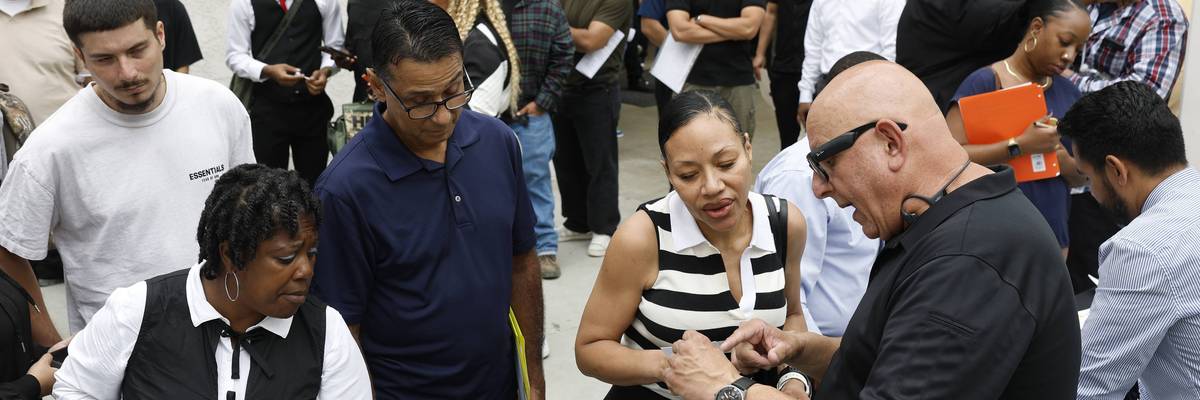
Thousands of job seekers meet with recruiters during the HIRE360 
Diversity Hiring Expo & Mega Career Expo on June 30, 2026, in Carson, California.
(Photo by Justin Sullivan/Getty Images)

Jessica Corbett
Jul 02, 2026
COMMON DREAMS

As President Donald Trump’s team on Thursday tried to paint the June jobs report as positive, economists and congressional Democrats called it “weak” and “disappointing,” with some also ripping the Republican administration’s harmful policies, from sweeping tariffs and the Iran War to the mass detention and deportation of immigrants.

The nation’s economy added just 57,000 jobs in June, or roughly half of what economists had anticipated, according to the latest monthly report from the US Bureau of Labor Statistics. BLS noted that “both the unemployment rate, at 4.2%, and the number of unemployed people, at 7.1 million, changed little in June.”


The Department of Labor (DOL) agency also revised job gains down for May by 43,000 and April by 31,000, and said that “over the year, average hourly earnings have increased by 3.5%.” That’s notably lower than the 4.2% annual inflation rate detailed by BLS a few weeks ago, as Americans struggle to afford groceries, housing, and other basic necessities during Trump’s second term.


“Today’s weak jobs numbers are grim warning signs of a struggling labor market,” Alex Jacquez, a former Obama administration official who is now Groundwork Collaborative’s chief of policy and advocacy, said in a statement.

“Job gains reflect temporary seasonal hires and other workers separated from the broader economy while the majority of the labor force is frozen,” he explained. “Working Americans increasingly report that their paychecks can’t keep up with Trump’s high prices, but are not confident they’ll be able to find better opportunities. They’re instead focused on trying to keep up with the president’s price hikes.”

Angela Hanks, a former DOL senior official who’s now chief of policy programs at The Century Foundation, similarly called the report “yet more evidence of a fragile economy under President Trump, with job growth coming in well below expectations and sizable downward revisions to the last two months.”

“While the unemployment rate dipped slightly to 4.2%, this number only tells us how many people are working—it doesn’t tell you whether people can afford to live,” she stressed. “The reality behind today’s jobs numbers is that the cost of living continues to outpace paychecks: 43% of Americans now say they’re worse off financially than they were a year ago, and year-over-year wage growth came in at 3.5%, below overall inflation of 4.2%—meaning that real wages are falling.”

“Looking beyond the topline numbers, more than half of all June job growth was concentrated in healthcare and social assistance, continuing a trend of these sectors propping up much of our economy,” she pointed out. “The labor force participation rate declined sharply and widely, with nearly every demographic group seeing declines, which partially explains the drop in the unemployment rate. Moreover, certain racial and age disparities actually worsened: Black youth unemployment rate rose to a whopping 26.8%, as did Hispanic youth unemployment, coming in at 20.1%—a reminder that this economy is not delivering for workers who are struggling the most.”

Hanks added that “while Trump will surely tout this moderate job growth as a win, not long ago numbers like today’s would have prompted serious concern. But families aren’t grading Trump on a curve: They feel the impacts of this administration’s chaotic and costly economic policies every day. Until working people can actually afford their lives—groceries, housing, healthcare, childcare—claims of a ‘strong economy’ will continue to ring hollow.”


In line with Hanks’ prediction, Trump’s messengers attempted to frame the figures positively, with his press secretary, Karoline Leavitt, celebrating the declining foreign-born labor force amid the administration’s deadly crackdown on immigrants, and her deputy, Kush Desai, claiming the report “reinforces that the American labor market remains solid.”

Acting Secretary of Labor Keith Sonderling—whom the president earlier this week nominated for the permanent post—said that “Trump’s America first agenda continues to provide greater wages for workers and certainty to the sectors which will fuel the next 250 years of US economic security.”


Meanwhile, with the midterm elections just four months away, the Democratic National Committee’s rapid response director, Kendall Witmer, declared that “Donald Trump’s failed economic agenda has driven working families into a corner as Americans worry about how to find a job and keep up with sky-high prices. The reality for working families is undeniable: Trump has wrecked the economy, leaving millions wondering how they will make ends meet with no relief in sight.”

“But Trump doesn’t give a shit—he’s only focused on building his vanity projects and using the power of the presidency to get even richer,” added Witmer, just two days after the president’s annual financial disclosures revealed that he pocketed an unprecedented $2.2 billion—over half of it from his family’s cryptocurrency grift—during his first year back in the Oval Office.

Congressman Ted Lieu (D-Calif.) took to social media over “another disappointing jobs report” and also called out GOP priorities, from erecting a giant arch in Trump’s honor to putting his name on various items, including passports and the $250 bill.

As Lieu concluded, “November is coming.”