Sunday, July 12, 2026


Chat Control 1.0 passed the European Parliament — through the back door

FILE - This July 10, 2019, photo shows an Associated Press reporter holding a phone showing the Instagram app icon in San Francisco.
Copyright Jenny Kane/AP

By Egle Markeviciute, EU Tech Loop with Euronews
Published on

A loophole in parliamentary procedure allowed MEPs to extend mass scanning of private communications until 2026 — without a direct vote on the substance of the law.

Chat Control 1.0 — a temporary derogation from ePrivacy rules designed to detect online child sexual abuse — was adopted by the European Parliament on Thursday.

The regulation will remain in effect until 3 April 2028, providing a substantial buffer while lawmakers negotiate an agreement on the updated framework, Chat Control 2.0.

How the file resurfaced

In March, MEPs rejected extending Chat Control 1.0 after subsequent talks failed.

In late June, the European Parliament President Roberta Metsola reopened the file, sending it to the Council, warning that the expired rules left a dangerous gap in online child protection.

The Council then sent the file back to Parliament at the beginning of the vacation season, where it was difficult to secure the necessary majority to dismiss it again.

What happened at the Parliament

At the EP, a simple majority initially supported rejecting the position with 314 MEPs voting in favor, 276 against, and 17 abstentions.

As there was no absolute majority (currently equal to 360 MEPs) to reject the amended EP position (276 MEPs voted in favor, 286 against, 30 abstentions), the second reading was closed, and the amended package has now been sent to the Council for approval within 3 months.

The amended EP position adopts a positive, yet rather cosmetic amendment proposed by the liberal RENEW group that would “exclude communications to which end-to-end encryption is, has been, or will be applied” from the scope of the law.

While some MEPs have called this "a glimmer of hope," and it was likely one of the contributing factors why the whole text was not rejected in the second hearing, it is not clear how extensive the list of such communication channels could be.

Since this amendment may run counter to the very idea of mass scanning of private communications, the Council is likely to reject these amendments.

The previous Council positions on Chat Control 2.0 have also included minor statements about protecting privacy and end-to-end encryption, but no technical debate about how aligning the goals of Chat Control and end-to-end encryption is possible in practice.

While social media is buzzing with criticism of both proposals, the conversation at the member state level about the files is scarce.

At the member state level, the files for both Chat Control proposals are normally led by representatives from the Ministries of the Interior.

Currently, only a small number of countries are engaged in an active debate on the matter, evaluating the proposal not only from a law enforcement perspective but also through the lens of data protection, private communication and cybersecurity.

Big-tent opposition

Both proposals for the mass scanning of European private communications have ignited widespread opposition, spanning left-wing, liberal and right-wing politicians, privacy advocates such as former MEP Patrick Breyer, cybersecurity specialists and even human rights advocates with extensive experience in freedom of expression and information issues outside the EU.

The recently re-elected ALDE Party President and German MEP, Svenja Hahn, was openly critical of the parliamentary vote in her comment for EUTechLoop:

“It’s a disgrace that the Chat Control instrument has passed in the European Parliament. It opens the door for mass surveillance of all private communication of our European citizens instead of the targeted fight against child sexual abuse as proposed by the Parliament."

"The surveillance of private chats pushed by EU-states is a threat for our freedom and democracy. We need to continue fighting against Chat Control.”

The President of the Open Dialogue Foundation, Lyudmyla Kozlovska commented for EUTechLoop that the vote on Chat Control 1.0 should be viewed in a broader context of erosion of privacy in the EU:

“That vote should trouble anyone who cares about how democracy in the EU works, not just about privacy. It’s the same approach to normalising the erosion of privacy that we’ve seen before — first with financial privacy, then travellers’ data, now our communications: a sweeping power justified by an urgent-sounding purpose, then quietly normalised."

"And the result? Financial, security and cybersecurity laws are now heavily weaponised by adversaries of the EU against its own citizens and entities, for transnational repression."

"The real fight for encryption and the privacy of communication is in September, over Chat Control 2.0. Between now and then, the resistance has to be strong enough that no procedural trick can carry it.”

This story was originally published on EU Tech Loop and has been shared on Euronews as part of a syndication agreement.


 

News outlets seek sanctions against OpenAI in copyright battle

FILE - A view of copies of international newspapers reporting U.S. President-elect Donald Trump election win, in central Rome, Thursday, Nov. 7, 2024.
Copyright AP Photo

By Una Hajdari with AP
Published on

OpenAI has been "hiding and destroying evidence" of how it trained ChatGPT on copyrighted news content, US media organisations allege as legal costs in the landmark copyright battle top $28 million.

Media organisations including the New York Times and the Daily News are asking a federal judge to impose sanctions on OpenAI, escalating a legal fight over artificial intelligence and copyright that could reshape the future of a struggling news industry.

The newspapers allege the ChatGPT maker is concealing evidence central to what could be a landmark copyright infringement trial over how OpenAI and its business partner, Microsoft, built their AI systems using millions of news articles.

At stake is whether AI chatbots are unfairly competing as an information source, draining web traffic without doing the journalistic work involved in gathering the news.

A filing on Thursday in a Manhattan federal court alleges OpenAI "chose obstruction" over releasing datasets and ChatGPT logs that could show how the AI system used copyrighted news content.

The plaintiffs are asking the judge to penalise the company for "discovery misconduct" that could distort evidence, saying a recent deposition of an OpenAI employee contradicts the company's earlier claims.

New York Daily News attorney Steven Lieberman said OpenAI had been "making misrepresentations" for two years about its ability to search for copyrighted content in its AI training datasets and logs.

"This motion asks the court to punish OpenAI for hiding and destroying evidence showing how ChatGPT was trained on stolen journalism," said Lieberman, who represents the Daily News and seven of its sister papers.

The New York Times sued OpenAI and Microsoft in late 2023, about a year after ChatGPT's debut sparked a commercial AI boom and began changing the way people search for information online.

The threat to news publications became more acute in 2024, when Google introduced AI-generated summaries at the top of search results, cutting off the advertising revenue generated when readers click through to an original source.

The Times has since been joined by other news organisations, including Daily News and Chicago Tribune parent MediaNews Group, digital media publisher Ziff Davis and the nonprofit Center for Investigative Reporting.

OpenAI and other tech companies have argued that training their AI systems on digitised books, online articles and other web content is protected by the "fair use" doctrine of US copyright law — a theory being tested in dozens of lawsuits as visual artists, novelists, music labels and other creative industries take AI companies to court, with mixed results.

In the largest copyright settlement so far, OpenAI rival Anthropic agreed to pay book authors $1.5 billion (€1.35bn) for training its Claude chatbot on their works without authorisation.

The Times's arguments differ from those brought by book authors.

In its original lawsuit and an amended complaint filed last month, it focused on the unfair competition of companies that seek to profit from its journalism without permission or payment to build rival products.

The Times has already spent more than $28 million (€25m) fighting AI companies in court, according to regulatory filings disclosing its litigation costs — including a separate lawsuit filed last year against AI company Perplexity.

Among the sanctions sought on Thursday are attorney fees to cover the cost of securing what the newspapers call "improperly withheld" evidence.

The escalating legal costs come as a growing number of media organisations have signed licensing deals with OpenAI and other AI companies, including Google and Meta, that pay outlets a fee to train AI systems on their news feeds or archives.


EU demands Facebook and Instagram dismantle 'addictive' design features


By Una Hajdari
Published on

The European Commission has taken aim at infinite scroll and autoplay on Instagram and Facebook, finding that Meta failed to adequately mitigate the risks its platforms pose to users' mental health, including children.

The European Commission has preliminarily found Meta in breach of the Digital Services Act (DSA) over the addictive design of Instagram and Facebook, opening the door to a fine worth billions of euros.

Friday's finding centres on features including infinite scroll, autoplay, push notifications and highly personalised recommendation algorithms — tools regulators say shift users into "autopilot mode" and fuel compulsive use.

"Protecting the physical and mental health of Europeans must be a priority for social media platforms," Henna Virkkunen, the Commission's Executive Vice-President for Tech Sovereignty, Security and Democracy, said in a press release.

"The Digital Services Act provides a clear framework to hold platforms accountable for the addictive design and effects of their services. We are fully committed to enforcing our legislation in Europe," the statement continued.

The Commission's investigation, launched in May 2024, found that Meta failed to adequately assess the risks its platforms pose to the physical and mental wellbeing of users — particularly minors and vulnerable adults.

Investigators found the company had disregarded data on how much time teenagers spend on Instagram and Facebook at night, and how the optimisation of formats such as reels and stories could lead to excessive or compulsive use.

Meta's existing safeguards were also found wanting. The Commission said time management tools, including those activated by default for teenagers, can easily be ignored and do not meaningfully reduce usage.

Parental controls, meanwhile, were found to be effective only for parents with sufficient technical expertise and time to navigate them, an assumption regulators said undermined their value.

Further design changes are needed

The Commission has called on Meta to make structural design changes to both platforms, which include disabling features such as autoplay and infinite scroll by default, introducing effective screen-time breaks and adjusting its recommendation systems to make them less engagement-driven.

The preliminary findings do not prejudge a final outcome. Meta now has the right to examine the Commission's investigation files and respond in writing before any non-compliance decision is issued.

If the findings are ultimately confirmed, Meta faces a fine capped at 6% of its total worldwide annual turnover — a figure that could run to more than $12 billion (€11bn) based on the company's 2025 revenue of just under $201 billion.

It is the latest in a series of DSA actions against major platforms.

The first two fines under the law were a hefty €120 million fine issued against Elon Musk's X in December, and an ever greater €200 million fine against Chinese e-commerce giant Temu in May.

The investigation also runs alongside a separate probe into Meta's age assurance measures for under-13s, for which preliminary findings were adopted in April.


Germany puts the squeeze on Lime and Bolt with tougher e-scooter liability rules

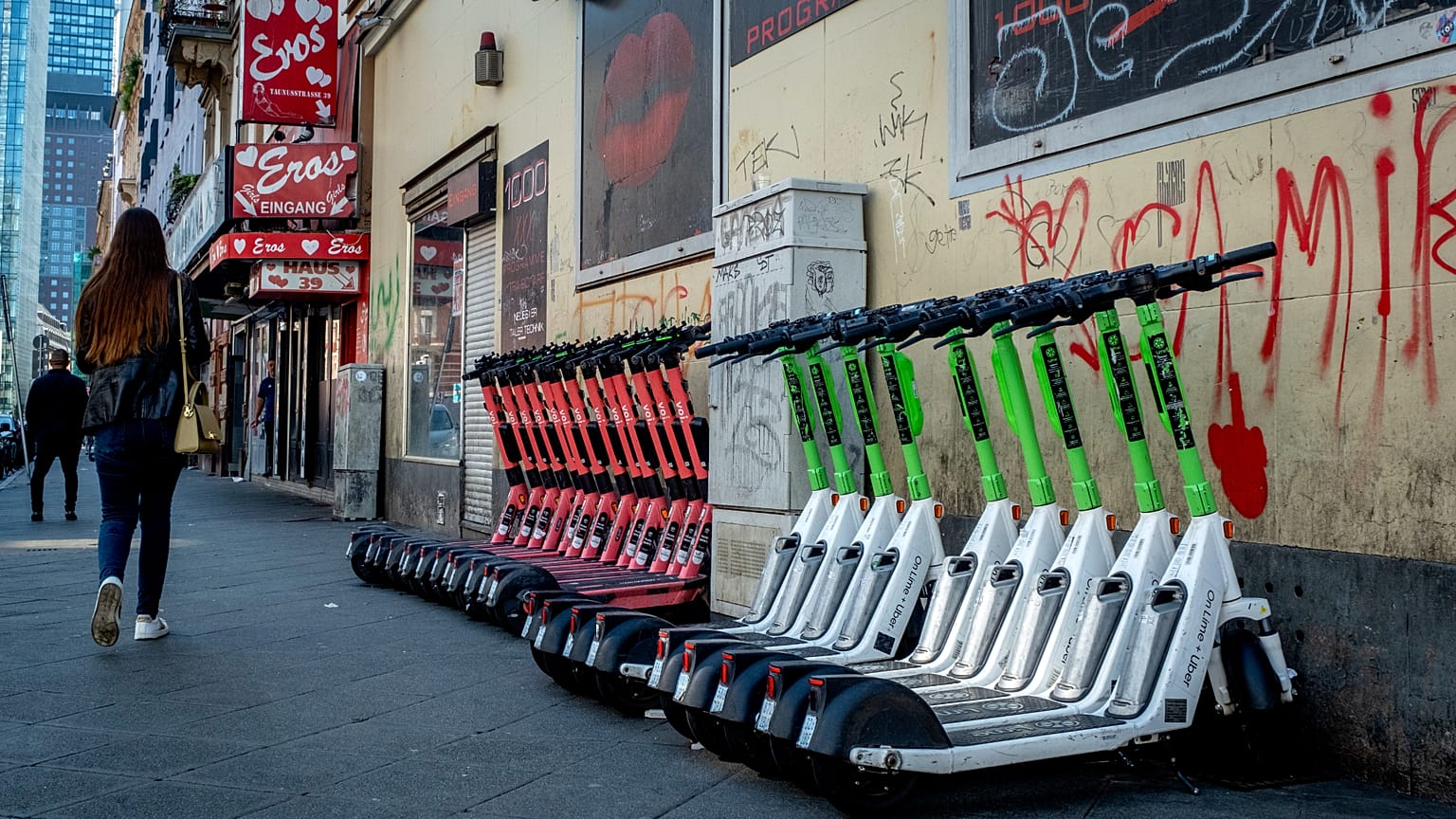
E-scooters are lined up in the red light district in Frankfurt, Germany, Friday, June 7, 2024.
Copyright AP Photo/Michael Probst

By Roselyne Min
Published on

Rental scooters represented around one-fifth of insured e-scooters in 2023 but accounted for roughly 40% of claims.

Germany is moving to close a legal loophole that has left e-scooter accident victims unable to claim compensation by making rental companies such as Lime and Bolt directly liable for accidents involving their vehicles

The bill would also cover accidents caused by scooters left blocking pavements. Under the new rules, operators face strict liability as owners regardless of fault, while riders will be presumed at fault unless they can prove otherwise.

Meanwhile under the current rules, victims of scooter accidents must prove the rider was at fault — a standard that is often impossible to meet when the rider cannot be identified. The new law would make it significantly easier to claim compensation

“The economic benefits of these services are largely enjoyed by fleet operators as vehicle holders,” the German Federal Ministry for Justice and Consumer Protection said in its justification for the bill.

“It therefore appears logical that whoever benefits from an activity should also bear the risk it creates,” it added.

It would apply to e-scooters and some self-balancing vehicles, but not e-bikes.

The German government argues that the current rules no longer reflect the rapid growth of e-scooters on German streets.

Rising concerns about e-scooter accidents across Europe

The number of insured e-scooters increased more than fivefold, from 180,000 in 2020 to 990,000 in 2023, according to the German Insurance Association.

Third-party damage claims rose from 1,150 in 2020 to 5,000 in 2024. Rental scooters represented around one-fifth of insured e-scooters in 2023 but accounted for roughly 40% of those claims, according to the German Insurance Association.

Beyond collisions and pavement obstructions, authorities have also warned that the lithium-ion batteries used in e-scooters can cause serious fires when damaged, faulty or charged incorrectly.

Safety and public-space concerns have led several European cities to remove shared e-scooters.

Paris ended rental services in 2023 after a public vote, while Madrid withdrew operators’ licences in 2024 over failures to control riding and parking.

Prague removed shared e-scooters from its streets in January 2026, and Brussels plans to follow in January 2027.


Volkswagen unveils four-year plan but lacks backing for overhaul with up to 100,000 job cuts


By Doloresz Katanich
Published on

Volkswagen's proposed restructuring plan failed to win backing from the labour bloc on the company's supervisory board on Thursday, leaving uncertainty over additional job cuts and factory closures. The carmaker nevertheless laid out plans to reduce production capacity and simplify its model range.

Volkswagen's labour representatives on the supervisory board blocked a sweeping restructuring plan at a meeting on Thursday, Reuters reported on Friday, citing company sources.

This comes as Europe's largest carmaker wrestles with falling profits, rising costs and competition. Volkswagen said on Friday that its global vehicle deliveries fell 8.6% year on year in the second quarter, a steeper decline than in the previous quarter.

The company's share price was down by 0.6% around noon in Europe. The focus, however, remained on the restructuring proposals that divided the supervisory board.

As the board met at Volkswagen’s headquarters in Wolfsburg on Thursday, IG Metall, one of Germany’s largest trade unions, organised coordinated protests across the country to stop a plan that reportedly includes up to 100,000 job cuts worldwide — more than 15% of its workforce — and closing four plants in Germany: Volkswagen factories in Hanover, Emden and Zwickau, as well as Audi's Neckarsulm plant.

According to Reuters, citing unnamed company sources, these measures were rejected by the supervisory board on Thursday, which includes labour representatives and representatives of the state of Lower Saxony. The committee voted against management's proposed restructuring by 12 to seven, after opposition from labour representatives.

Volkswagen ⁠made no mention of possible job cuts or plant closures late on Thursday. Instead, after the meeting, Volkswagen unveiled its strategy through to 2030, including plans to halve the number of models it offers and reduce the number of vehicle variants by as much as 75% in an effort to cut costs and complexity, measures that did not require the approval of the supervisory board.

Volkswagen said it would reduce annual production capacity to around 9 million vehicles to respond to “sharply intensified competition”. That compares with capacity of around 12 million vehicles before the Covid-19 pandemic and about 10 million today.

Other measures include tailoring products and technology more closely to regional markets, aligning production capacity to match demand, and simplifying the group’s corporate structure and investment portfolio.

Volkswagen chief executive Oliver Blume said in a video statement that “the global situation has deteriorated over the past 12 months”, pointing to geopolitical tensions, tariffs, high costs, increasing regulation and intensifying global competition.

He also said Volkswagen needed to “get rid of excess capacity”, leaving open the possibility of factory closures in the longer term. Blume added that “digitalisation, artificial intelligence and shared services will help increase productivity and speed”.

Arno Antlitz, Volkswagen Group’s chief financial officer, said the cost reductions already agreed were “not sufficient in the current economic and geopolitical environment”.

He said the company planned to improve vehicle cost structures, “significantly reduce overhead costs”, increase plant efficiency and accelerate technology development and decision-making.

Volkswagen employs about 657,000 people worldwide, but the company has not said how the planned reduction in production capacity would affect its workforce. According to Reuters, Volkswagen's works council has demanded clarification on management's cost-cutting plans by the end of Friday.

The group has repeatedly argued that deeper restructuring is necessary after its net profit fell 28% to €1.56bn while revenue declined 2.5% year on year to €75.7bn in the quarter to March 2026.

“The next few years will decide who will play a decisive role in the automotive industry in the future,” Blume said.


Volkswagen workers furious as management withholds cost-cutting plans


11.07.2026

Photo: Lars Penning/dpa

Volkswagen's workforce has suffered a major loss of confidence in the German automotive giant's leadership after top management failed to share details about rumoured cost-cutting plans, employee representatives said on Saturday.

Europe's largest carmaker is in uproar over reported cuts of around 100,000 jobs across Germany, with trade union IG Metall holding protests nationwide on Thursday. A supervisory board meeting on the same day ended without confirmation of chief executive Oliver Blume's plans.

Angered at being excluded, the VW works council issued a demand for the release by Friday of full information about what Blume called the "most comprehensive realignment" in Volkswagen's history.

"We strongly condemn the fact that, at the same time, he continues to withhold this information from the tens of thousands of affected employees outside management," the council said in a statement on Saturday.

The works council had demanded that Blume address the workforce by Friday. 

"The workforce's main focus will be on whether the Executive Board intends to tackle this crisis by taking the necessary measures together with the employees, or against them," the statement continued. 

The details of the cost-cutting package - which was reportedly rejected by the supervisory board - are as yet known only from media reports.

According to Manager Magazin, up to 100,000 jobs could be cut worldwide - twice as many as previously planned. The Bild tabloid reported that the figure could even be as high as 120,000.

Four of the VW Group's plants in Germany are also reportedly under threat of closure, in Hanover, Emden, Zwickau and Neckarsulm.

Volkswagen boss prefers 'smarter solutions' over factory closures

12.07.2026, 


Photo: Johannes Neudecker/dpa


Volkswagen Group chief executive Oliver Blume said he believed the carmaker could avoid factory closures as it presses ahead with efforts to cut costs.

"There are smarter solutions than closing plants," Blume told the Bild am Sonntag newspaper in an interview published on Sunday.

A cost-cutting programme at Volkswagen's German production sites was already delivering results, he said.

"We were able to reduce our factory costs in Germany by an average of 20% last year alone. That's significant progress."

Blume's comments came after a meeting of the supervisory board on Thursday, where he reportedly failed to secure approval for a more far-reaching cost-cutting package.

According to a report in the Süddeutsche Zeitung newspaper, which cites sources within the group, representatives of the workforce and the German state of Lower Saxony voted against the package.

Details of the rejected package have so far emerged only through media reports. 

According to Manager Magazin, up to 100,000 jobs could be cut worldwide - twice as many as previously planned. 

Bild reported that the figure could even be as high as 120,000. 

Four of the Group's plants in Germany are also under threat of closure including a factory operated by VW's Audi subsidiary.

Car crisis takes toll on Germany's young engineers

Frankfurt (Germany) (AFP) – Despite a year of searching, previous stints at big automotive suppliers and sending out about 50 applications, German software engineer Max Peil is still looking for a job.


Issued on: 12/07/2026 - RFI

German engineering graduates used to be guaranteed good jobs, but times are changing © JENS SCHLUETER / AFP

Trained in computer vision, a critical part of autonomous and intelligent driving systems, Peil could once have expected to sail into a role at one of Germany's industrial giants.

But years of stagnant growth in Europe's biggest economy and increasingly fierce Chinese competition are now taking their toll on young engineers like Peil.

"Usually you just get rejected straight up," the 30-year-old told AFP in the western city of Frankfurt.

"I've had one interview. It was the same with my friends, one has sent over 60 applications."

'Golden age' is gone

Known the world over for cutting-edge technology and innovative design, Germany's car industry, powered by exports, has so far managed to avoid the drastic decline seen in countries like Britain, France and Italy.

But Chinese carmakers like BYD and Xpeng have eaten into German carmakers' sales in the world's largest auto market, leading to painful adjustments at home.

Germany has a long history of automotive engineering © THOMAS KIENZLE / AFP

"Ten years ago we made about six million vehicles a year and we've now stabilised at about four, 4.2 million," transport economist Thomas Puls of the IW economic institute in Cologne told AFP.

"That's good compared to other European countries, but we now need to accept that the golden age is not coming back."

In a sign of the times, workers on Thursday protested at Volkswagen sites across the country over reports that Germany's biggest carmaker is mulling up to 100,000 job cuts.

Total employment in the German automotive sector fell eight percent in the five years to 2025, according to Federal Employment Agency (FEA) data, even as it grew a little over one percent overall.

German industry as a whole is struggling against what some have dubbed the "China Shock 2.0" as the country's firms shift away from low-value production and into making more high-tech goods, often at lower prices.

This is pushing German companies out of once reliable export markets.

Total German exports were last year 1.56 trillion euros ($1.78 trillion), down almost two percent from a 2022 peak, according to data from statistics office Destatis.

Exports to China meanwhile plunged almost a quarter to 81.3 billion euros over the same period.

Chinese carmakers, including XPeng, are presenting a huge challenge to Volkswagen © Tobias SCHWARZ / AFP

For Peil, who last year completed a traineeship at tyre-maker and industrial supplier Continental before it spun off its automotive business, the crisis meant it was clear he would not be taken on.

"Even when I started you could see, and you'd always read about it in the news, that this or that part of the business was being restructured," he said.

"And when you see experienced colleagues going, then you know it's unlikely you'll be hired for the role."

'What's wrong?'

Anja Robert, who for 20 years has led the careers service at one of Germany's leading engineering schools, told AFP that even some of the best students now had to search a while.

"There's people who come to us and say, 'Wow, I've written 30 applications and heard hardly anything back: What's wrong?'", said Robert, head of careers at RWTH Aachen University.

"It's not the case anymore that you just get your application in with BMW and you get a job."

Germany has a long tradition of high-tech engineering © RONNY HARTMANN / AFP

Qualified engineers last year had an unemployment rate of 3.8 percent, according to the FEA data, an increase of almost 50 percent compared to 2022.

Electrical engineer Luca Linhsen is one of the luckier ones -- she took up a job as a software consultant in Hamburg this month.

But she still had to endure a "frustrating" months-long job hunt.

"As engineers we were led to understand when beginning our studies that you've practically got a job even before finishing the degree," she told AFP.

"If you want to study engineering, do it because you have a passion for technology. Don't do it for the money or the job security."

Daimler Truck chief says sector's existence in Europe is under threat

12.07.2026

Photo: Kay Nietfeld/dpa

By Robin Wille, Benedikt von Imhoff and Astrid Maier, dpa


Daimler Truck chief executive Karin RÃ¥dström says the existence of Europe's commercial vehicle industry is at risk, warning that unchanged CO2 rules would jeopardize competitiveness. 

"If the CO2 regulation remains unchanged, Europe is putting the competitiveness of its commercial vehicle industry at risk," Rådström told dpa in Berlin in an interview published on Sunday. She said she did not believe policymakers had understood the urgency.

Rådström is also chairwoman of the commercial vehicle committee of the European Automobile Manufacturers' Association (ACEA).

To meet the European Union's climate targets CO2 emissions for new heavy commercial vehicles must fall by 43% by 2030 compared with 2019.

According to the European Commission, heavy commercial vehicles account for more than 25% of road transport greenhouse gas emissions in the EU and more than 6% of total greenhouse gas emissions.

Daimler Truck chief sees "big challenge"

To achieve savings of 43%, Rådström calculates that around 35% of all newly registered lorries in Europe in 2030 would have to be battery-electric or hydrogen-powered.

The challenge, she said, is that in 2025 just 2% of all heavy lorries in Europe were electric. Getting from 2% in 2025 to 35% in 2030 would be "a really big challenge."

Daimler Truck would have to pay around €120 million ($137 million) for every percentage point it misses. "For the European commercial vehicle industry, that would therefore have existential consequences," she said.

"If we miss the targets by, for example, 10 percentage points, we will practically no longer make any money at all from the Mercedes-Benz Trucks segment."

By comparison, the segment posted an operating result  - earnings before interest and taxes (EBIT) - of €698 million in 2025. In 2024, Mercedes-Benz Trucks recorded an EBIT of €922 million. Revenue was roughly €20 billion in both years.

Mercedes-Benz Trucks operates under the Mercedes-Benz brand in Europe, Asia, Africa and Latin America.

What's hurting e-lorry growth

"The biggest problem remains infrastructure and charging," Rådström said. Even those who want to switch to e-mobility are unsure whether they will be able to charge their vehicles along their routes in future, said the head of the DAX-listed group based in Leinfelden-Echterdingen near Stuttgart.

Another challenge is achieving cost parity to make electric lorries competitive with combustion engines. That depends on electricity and diesel prices.

"Diesel is relatively not an expensive energy source," Rådström said. Her customers run their businesses with very small profit margins. "They cannot afford expensive experiments," said the Swedish-born manager.

In most cases, diesel still makes sense for customers.

What Daimler Truck wants

"We are calling for a review of the CO2 regulation. This has to be a reality check," Rådström said. Among other things, the regulation must be tied to the ramp-up of infrastructure, which must be expanded more quickly.

"It is still too early to say that we need to change the targets," Rådström said. But given the slow build-out of infrastructure and the lack of willingness among key EU member states to implement CO2 differentiation in lorry tolls, it is clearly foreseeable that the sector needs more time to reach the targets set for 2030.


France adds a new millionaire every 15 minutes. How does Europe compare?

A South Korean bank clerk carries bundles of U.S. banknotes at a local bank in Seoul, Wednesday, Jan. 4, 2006.
Copyright LEE JIN-MAN/AP

By Servet Yanatma
Published on

Eastern Europe recorded the fastest growth in dollar millionaires in percentage terms, while the UK, France and Spain ranked just behind the US in the number of new millionaires added.

Nearly one million people joined the ranks of US dollar millionaires worldwide in 2025, according to UBS, equivalent to more than 2,680 new millionaires a day, 112 an hour or almost two every minute.

Europe accounted for much of the growth outside the United States, with the UK adding an average of 118 new dollar millionaires a day and France 95.

At current exchange rates, $1 million is worth about €875,000.

In percentage terms, however, Eastern European countries recorded the fastest growth. The first five places in the global top 30 were all European countries, including EU member states, EU candidate countries, EFTA members and the UK.

Lithuania recorded the highest growth at 8%, meaning it gained 921 new dollar millionaires in 2025.

Turkey ranks second at 6.4%, with 5,650 new millionaires. Latvia saw growth of 5.7%, adding 1,131 millionaires.

Hungary saw a 5.3% rise, gaining 1,349 new millionaires. Ireland ranks fifth at 5.2%, but added considerably more people to the millionaire ranks than the countries above, with 9,491 new millionaires.

The growth rate stood at 4% in Poland and 3.5% in Greece.

The report notes that, to some extent, the increase in millionaires depends on how close to the $1 million threshold the newly minted millionaires were the previous year.

UK, France and Spain follow the US in absolute numbers

The number of dollar millionaires also rose by 3.1% in Spain, 2.4% in Italy, 1.8% in the UK, 1.5% in France, 1% in Switzerland and 0.9% in Germany.

However, absolute numbers provide a clearer picture for these countries, as their millionaire populations are already large, resulting in comparatively lower growth rates.

The US saw the largest increase in the number of millionaires, adding 441,078, nearly half of the global growth.

In Europe, the UK gained more than 43,000 new dollar millionaires last year, while France and Spain each added more than 32,000.

Italy and Germany also ranked among the global top 10, each adding more than 24,000 new millionaires.

Not surprisingly, Europe's five largest economies all feature in the global top 10. All other European countries saw fewer than 10,000 new millionaires.

Japan (31,428), India (31,033), Australia (25,089) and Russia (21,951) also feature in the global top 10.

New millionaires per day

When these figures are converted into daily rates, the numbers become even more striking. In 2025, an average of 1,208 people joined the millionaire club each day in the US, or 47 per hour.

Among European countries, the UK added an average of 118 new millionaires a day, or 4.5 per hour.

France saw 95 per day and Spain 90. Italy added 67 new millionaires per day and Germany 66.

“More people moving up the wealth ladder, stronger ranks at the top, and steady growth across a remarkably wide field of markets,” the report said.

Not a single nation in the UBS sample of 56 markets ended 2025 with fewer millionaires than it had at the beginning of the year.

Over 40% of the world's dollar millionaires live in the US, amounting to more than 23.6 million people out of roughly 57.5 million in the UBS sample. Western Europe is home to just under 15 million dollar millionaires, or 25% of the total.

What do these figures tell us?

The report points out that the number of millionaires in a given market is not always a reflection of its size, economic strength or even average wealth per person.

Much depends on factors beyond economic might, such as home ownership, private retirement savings and the availability of tax incentives for saving and investing.

The UBS report defines net worth, or "wealth", as the value of financial and real assets (principally housing) owned by private individuals, less their debts.