Sunday, July 12, 2026

‘Justice Has Failed Us Here in Guatemala’: A Family Fights for Accountability

More than 44 years have now passed since Guatemalan state forces abducted Luz Leticia; every day since, her sisters have fought to preserve the truth and dignity of her life while demanding answers.


Marta Rosa Hernández Agustín (left) and Mirtala del Rosario Hernández Agustín (right) sit with their mother, Valentina Agustín de Hernández (center), holding pictures of Luz Leticia Hernández Agustín, who was forcibly disappeared on her 25th birthday in 1982.
(Photo by Eric Ross and Kala Garrido)
Kala Garrido
Jul 12, 2026
Common Dreams

Under the beating sun on the morning of June 21, Mirtala del Rosario Hernández Agustín joins families of the disappeared and members of organizations including the Association of Family Members of the Detained and Disappeared in Guatemala, or FAMDEGUA, and Sons and Daughters for Identity and Justice against Oblivion and Silence, or HIJOS, in Guatemala City’s Plaza de la Constitución to commemorate the National Day Against Enforced Disappearances.

“We dream of a different Guatemala, and we fight for it. We cannot sit back and cross our arms. We have a person detained and disappeared.” Mirtala’s voice carries across the plaza. Behind her sit more than 400 empty chairs, each bearing the portrait of someone forcibly disappeared during Guatemala’s 36-year internal armed conflict. “I am the sister of Luz Leticia Hernández Agustín,” she continues. “To have peace in my heart, to be able to say we’ve been heard, we need my sister’s remains returned.”



Chilean Judge Convicts US-Trained Pinochet Agents for 1976 Murder of Ronni Moffitt


More than 44 years have now passed since Guatemalan state forces abducted Luz Leticia on November 22, 1982. It was her 25th birthday. And it was the last time she was seen.

Yet her sisters, Marta and Mirtala, refused to let her vanish completely. Every day since, they have fought to preserve the truth and dignity of Luz Leticia’s life while demanding answers not only for her, but for the tens of thousands who were disappeared, tortured, and killed during Guatemala’s US-backed campaign of state terror and genocide.

No amount of political power can permanently shield perpetrators from the demands for truth and justice made by the people they sought, and ultimately failed, to erase.

Now, their case is finally being heard in court. Three days a week, the Hernández Agustín sisters climb the stairs to the fifth floor of Guatemala City’s Palace of Justice. They sit through hours of testimony and legal argument, filling notebooks with observations and listening for the answers that have eluded their family for decades. Some days sting with the reopening of old wounds. Others dissolve into procedural delays, technical difficulties, and bureaucratic legal wrangling. They often leave frustrated and exhausted.

Still, they return. They do so because this case is about more than one family’s pursuit of justice. At a time when the United States is escalating violence at home and abroad, and governments like Guatemala’s continue to subordinate themselves to the imperatives of that long-standing imperial project, this trial carries particular significance. Most recently, this has included expanded military cooperation with Washington targeting alleged drug cartels in the country, a justification the US has invoked to extrajudicially kill more than 210 people over the past nine months.

The trial has therefore become a testament to all those who refused the silence imposed upon them. It is proof that those marked for erasure can reclaim their place in history. Above all, it is a reminder that no amount of political power can permanently shield perpetrators from the demands for truth and justice made by the people they sought, and ultimately failed, to erase.

The Long Shadow of Empire in Guatemala

The Guatemala into which the Hernández Agustín sisters were born bore the unmistakable imprint of empire. It was a country of staggering inequality, where generations inherited the desiccated remains of a nation picked clean by the vultures of foreign capital. The promise of reform had long since been extinguished. Gone was the Democratic Spring, the brief decade from 1944 to 1954 when popularly elected governments sought to expand democracy and direct the country’s wealth toward its people rather than multinational corporations and the landed oligarchy.

That dream was crushed with the 1954 CIA-backed overthrow of President Jacobo Árbenz. The coup sought not simply to remove a government but to restore the deeply unequal social order whose foundations had been laid under the dictatorship of Jorge Ubico. A pliant strongman who willingly auctioned off his country’s future to the highest bidder, Ubico granted sweeping concessions to US corporations while enriching himself. Under his rule, the Boston-based United Fruit Company became Guatemala’s largest landholder, acquiring more than 40% of its arable land and near-monopolistic control over not only its lucrative banana exports but also critical infrastructure, including the country’s railroads and electrical network.

The threat posed by the Democratic Spring was not simply that it had challenged landowners and foreign corporations. It had shown workers, peasants, and Indigenous communities that collective action could transform society.

Ubico’s regime collapsed in 1944 with a popular uprising. Under elected Presidents Juan José Arévalo and then Árbenz, Guatemala embarked on an ambitious reform program. Building on Arévalo’s efforts, Árbenz expanded labor protections, social security, and universal suffrage while pursuing economic modernization that sought to transform Guatemala from what he referred to as “a semi-colonial dependency into an independent nation” and “a predominantly feudal economy into a modern capitalist state.”

It was this challenge to entrenched economic power that placed Árbenz in the crosshairs of both Washington and Wall Street. The flash point was Decree 900, his sweeping agrarian reform. The measure authorized the expropriation of uncultivated large estates, including United Fruit’s vast holdings, for redistribution to hundreds of thousands of peasants. Remuneration would be based on the value the company itself had declared, a figure it had deliberately undervalued to reduce its tax burden. While the reform was rooted in economic nationalism and guaranteed compensation for the land, officials in Washington cast it as evidence of communist subversion.

Secretary of State John Foster Dulles and CIA Director Allen Dulles, both closely tied to United Fruit, orchestrated Árbenz’s overthrow. The coup ended Guatemala’s democratic experiment and ushered in decades of military rule, repression, and civil war.

A State Built on Terror

The dictatorship that emerged in the wake of the coup gave rise to a popular insurgency determined to reclaim the democratic aspirations that had been violently swept aside. It also ushered in a new era of repression. For Guatemala’s military rulers, the objective was to preserve their power. For their patrons in Washington, Guatemala became a Cold War proving ground, meant to demonstrate the consequences of challenging US political and economic power.

The threat posed by the Democratic Spring was not simply that it had challenged landowners and foreign corporations. It had shown workers, peasants, and Indigenous communities that collective action could transform society. That lesson had to be unlearned. In its place, they sought to teach another: that any attempt to remake Guatemala would be met with overwhelming violence. Terror became the principal pedagogy of the state.

From 1960 to 1996, Guatemala’s internal armed conflict claimed roughly 200,000 lives and left another 45,000 disappeared.

Repression failed to extinguish resistance. In 1960, dissident military officers launched an uprising against the regime. After it was crushed, many of its survivors retreated to the countryside, where they helped form the Rebel Armed Forces (FAR), the first of several guerrilla organizations. The state responded with a brutal, US-backed counterinsurgency waged through roving death squads, systematic torture, forced disappearances, and indiscriminate targeting of suspected dissidents.

Rather than destroying the insurgency, the violence pushed it deeper into rural Guatemala, where Indigenous Maya communities and peasant organizers assumed an increasingly central role in new guerrilla organizations. By the late 1970s, the military had embraced a genocidal scorched-earth campaign, particularly against the Ixil Maya. Entire communities were treated as inherently subversive. The objective was no longer simply to defeat guerrillas but to destroy the social fabric that sustained Indigenous life.

Villages were razed. Thousands were massacred. Survivors were displaced or forced into tightly controlled “model villages” under a policy known as Palestinianization, where military authorities sought to erase Indigenous languages, traditions, religious practices, and communal life in the name of anti-communist pacification and national modernization.

From 1960 to 1996, Guatemala’s internal armed conflict claimed roughly 200,000 lives and left another 45,000 disappeared. The bloodiest paroxysm of violence came between 1981 and 1983, when security forces killed an estimated 100,000 people, overwhelmingly Indigenous Maya, in a genocidal campaign that journalist Vincent Bevins has referred to as “the largest bloodbath unleashed by the Cold War in the Western Hemisphere.” The atrocities unfolded with US training and the material and diplomatic backing of the Reagan administration, which viewed Guatemala as a critical front in its campaign against leftist movements across Latin America, alongside its support for the Contras in Nicaragua and allied security forces in El Salvador and Honduras.


The Disappearance of Luz Leticia

Luz Leticia Hernández Agustín, or Leti, as her sisters call her, was one of the many lives cut short by the Guatemalan state during this period of extreme violence. As the eldest sibling, she occupied an outsized place in her family’s life. Marta and Mirtala remember her as hardworking, intelligent, and deeply compassionate. In a household, and community, marked by intense economic precarity and hardship, she assumed responsibilities well beyond her years, helping care for her younger siblings and easing whatever burdens she could.

This experience shaped Leti’s politics. She came to understand that centuries of colonial conquest had produced enduring systems of racism, dispossession, and exploitation that were still being felt. “Leti could see all of that,” Marta explains. “All the deep-seated wrongs that have persisted for so long.” She imagined a different Guatemala, one where those structures no longer defined people’s lives and where everyone, regardless of ethnicity or social standing, could live with dignity.

Leti’s sisters have never abandoned their search for truth and justice, nor their determination to affirm their sister’s existence.

Her commitment extended beyond her immediate family. As Mirtala recalled, Leti was motivated certainly “by her own experiences, and the way our parents lived,” but equally “by the suffering she witnessed among our people.” Despite all the evidence seemingly to the contrary, she never surrendered her belief that Guatemala could become a more just society. That conviction would draw her into the resistance. She joined Nuestro Movimiento (“Our Movement”), an underground organization affiliated with the Organization of People in Arms (ORPA).

In late 1982, Leti became involved in an effort to secure the release of a comrade, Ileana del Rosario Solares Castillo, who was illegally detained by the regime. On October 14, members of Nuestro Movimiento abducted Mario Ríos Montt, the nephew of General Efraín Ríos Montt, Guatemala’s de facto president who presided over the bloodiest phase of the genocide, for which he was convicted in 2013. The operation sought to force a prisoner exchange. Mario remained captive until November 21, when an intelligence unit, working alongside Israeli advisors, rescued him. In the process, Luz Leticia, Ana María López Rodríguez, María Cruz López Rodríguez, and Leandro Gabriel Calate Temu were all captured.

In that moment, Leti entered the opaque machinery of forced disappearance. She was taken into a clandestine detention system notorious for torture, sexual violence, and the systematic degradation of prisoners. Her family never saw or heard from her again.

The Struggle for Justice

Leti’s sisters have never abandoned their search for truth and justice, nor their determination to affirm their sister’s existence. In 2001, the Inter-American Commission on Human Rights (CIDH) concluded that the Guatemalan state had violated the rights to life, liberty, humane treatment, judicial protection, and a fair trial of Ileana, Luz Leticia, and Ana María. It recommended that Guatemala locate the women’s remains, compensate their families, and identify and prosecute those responsible.

Five years later, the Guatemalan government offered the Hernández Agustín family an “amicable settlement agreement,” consisting of financial compensation without accountability and without the return of Luz Leticia’s remains. They refused on principle.

In 2023, prosecutors indicted Juan Francisco Cifuentes Cano, the former commander of the National Police’s Fifth Corps Special Operations Reaction Battalion (BROE), on charges of crimes against humanity and enforced disappearance. After years of defense appeals aimed at delaying or derailing the proceedings, the long-awaited trial finally began on May 5.

Will we accept a world in which some have the right to kill and others the right to die, or insist on one governed by justice and accountability?

Justice, for them, means a broader reckoning with the collective trauma inflicted by enforced disappearance. The crime was designed to leave families trapped in cycles of hope and grief, producing what Marta described as the “strange sensation” that “[Leti] had died, yet was somehow still alive,” condemning them to “so much uncertainty, anxiety, and immense, constant stress.”

For Mirtala, that torment was central to the crime itself. “Enforced disappearance,” she explained, “is an act committed by the state against its own citizens, often in collusion with the very groups meant to guarantee the population’s safety.” It extends far beyond the individual. “They don’t just make the person disappear,” she said. “They do so in a way that instills terror and fear, and that is precisely what they have sought to do: to plunge us and our entire family into that terror.”

“It is a crime, an undeniable crime, but one committed in a sophisticated manner against our humanity,” she continued. The violence is directed not only at the disappeared but those left behind, condemning families to live with uncertainty while knowing their loved one is in the hands of the state. “It’s agonizing to know that she’s with these people.” “It’s powerlessness,” Mirtala said, “unable to do anything to pull [the disappeared] out of that cycle of violence and cruelty.”

Yet they have found meaning in the struggle. Their search for Leti has become inseparable from a broader fight over historical memory and for accountability. As Mirtala put it, it is a “story that reflects everything fractured in our country, all the underlying tensions and societal pain, and the struggles being waged on various fronts everywhere.”

Still, they approach that work with humility, believing that lasting change is built through small acts of collective resistance. “We are like an ant carrying a single grain of salt,” Mirtala explained. Yet she sees power even in the smallest acts. “This is how dust turns into sand, then into a gust of wind, and finally into a storm. We believe it will change many people’s perceptions.”

But this is not merely a struggle over memory. It is also a struggle over the present, over the ways impunity continues to shape Guatemala. In the decades since Leti’s disappearance, Guatemala has remained marked by stark inequality, corruption, violence, and rights abuses. The state continues to repress dissent, fueling recurring political crises rooted in its failure to meet the needs of its people. Mirtala sees in today’s situation the echoes of the violence that took her sister. “All these things,” she said, “they weigh on you, drop by drop, little by little.”

That is why pursuing Leti’s case has become about far more than one family’s search for justice. It is an act of resistance, a “vindication,” against a state that, as Mirtala put it, “has turned against its own people. Those who take power rob and take money from the people to enrich themselves” while the people “lack education, healthcare, food, and the chance for decent housing.” “To me,” she said, “it is a slap in the face, a punch to the gut of the state.”

The struggle has not been without risks. As documentary filmmaker Nancy Peckenham observed, “In Guatemala, to remember is dangerous.” Yet Mirtala and her sister remain resolute. “Sometimes I think about the risks,” Mirtala reflected, “but then I remember this isn’t just about asserting my sister’s rights. It is about the rights of thousands of people, both within Guatemala and abroad, because this is something suffered by all of us who lack power.”

Ultimately, she said, “that is what this has meant for us. It is a collective struggle.”

The case will continue through July. Its verdict will test not only Guatemala, but also whether we are doomed to live in a world, as the Trump administration architect of the United States’ ongoing nativist assault Stephen Miller put it, “that is governed by strength, that is governed by force, that is governed by power.” Will we accept a world in which some have the right to kill and others the right to die, or insist on one governed by justice and accountability? The trial is one link in this broader struggle over whether a better world is possible: one free from the violence of impunity and imperialism, sustained by the conviction that those who commit atrocities will one day be held to account, from Guatemala to Venezuela, Palestine to Iran, and here in the United States.


All quotes from Marta and Mirtala Hernández Agustín are from a June 2026 speech and interview conducted by the authors and translated from Spanish.

Our work is licensed under Creative Commons (CC BY-NC-ND 3.0). Feel free to republish and share widely.


Eric Ross
Eric Ross is an organizer, educator, researcher, and PhD Candidate in the History Department at the University of Massachusetts Amherst.
Full Bio >

Kala Garrido
Kala Garrido is an organizer living and working as an international accompanier in Guatemala with the Network in Solidarity with the People of Guatemala (NISGUA).
Full Bio >
Death toll in Venezuela quakes surpasses 4,300

The death toll from Venezuela's devastating twin earthquakes has risen above 4,300, authorities said Friday, as families continued searching through the rubble for missing loved ones more than two weeks after the country's deadliest quake in over a century.


Issued on: 11/07/2026 -
By: FRANCE 24

Argentine rescue workers prepare to recover bodies from a collapsed building in the Tanaguarena sector of Caraballeda, La Guaira state, Venezuela, on July 10, 2026. © Juan Barreto, AFP

The death toll in Venezuela's devastating twin earthquakes has topped 4,000, the government said Friday.

At least 4,333 people were killed and 16,740 injured in the back-to-back June 24 quakes, which flattened entire districts in the coastal state of La Guaira, Venezuelan parliament chief Jorge Rodriguez wrote on Telegram.

Thousands more are listed as missing.

The stronger 7.5 magnitude quake – the biggest in Venezuela in over a century – struck 39 seconds after the first 7.2 magnitude shock, flattening entire high-rise apartment blocks to layers of rubble.

Although rescue teams have abandoned their search for survivors, family members continue to search the ruins for their loved ones, in the hopes of giving them a dignified burial.

Venezuelans mobilise to deal with earthquakes' consequences: FRANCE 24 reports
Cover image: 'Not a single person hasn't helped' dealing with the aftermath of Venezuela's earthquakes © France 24
02:58


On Friday, a 3.0 magnitude tremor in central Caracas caused momentary panic and led to buildings being evacuated.

The scale of the recovery effort facing Venezuela, where state services have been severely degraded by a prolonged economic crisis, is gargantuan.

The United Nations on Wednesday issued an urgent appeal for nearly $300 million towards earthquake relief operations.

Venezuela's interim president Delcy Rodriguez has called for the release of frozen assets held abroad to be used towards the recovery.

On Wednesday she said she asked King Charles III to release about 30 tons of Venezuelan gold frozen under UK sanctions.

(FRANCE 24 with AFP)


‘Unconscionable and Impeachable’: Experts Appalled at Report of Marco Rubio Acting as Venezuela ‘Viceroy’


“Trump has turned Venezuela into an effective US colony,” said one critic.


Secretary of State Marco Rubio looks on as US President Donald Trump meets with China’s President Xi Jinping at the Great Hall of the People in Beijing on May 14, 2026.
(Photo by Brendan Smialowski/AFP via Getty Images)

Brad Reed
Jul 11, 2026
COMMON DREAMS

Some critics of the Trump administration are reacting with horror to revelations that US Secretary of State Marco Rubio has been serving as the de facto ruler of Venezuela.

According to a Saturday report in The New York Times, Rubio for the last several months has been acting informally as the “viceroy” of Venezuela ever since its recognized president, Nicolás Maduro, was abducted by the American military in January and brought to the US to face charges related to “narco-terrorism.”

The Times’ sources revealed that Rubio “effectively controls Venezuela’s finances, the distribution of its natural resources, and its government” and “is deeply involved in the country’s day-to-day operations,” while maintaining regular contact with acting Venezuelan President Delcy Rodríguez.

Under current arrangements, the US Treasury Department takes in revenue from Venezuela’s exports, including its petroleum, and then disperses the money back to the country through its private banks with strict conditions set by Rubio over what it can be spent on.

In explaining the system, the Times likened it to “parents handing out allowances to children,” adding that it gives Rubio “immense leverage over... Rodríguez, who depends on the money to pay workers and prop up the national currency.”

Elizabeth Saunders, professor of political science at Columbia University, described Rubio’s power over Venezuela as “insane,” as well as “derelict, unconscionable, and impeachable.”

“The secretary of state’s time is scarce, valuable, and not outsourcable,” Saunders emphasized.

Orlando J. Pérez, professor of Political Science at the University of North Texas at Dallas, said the Times report made a mockery of Rubio’s professed claims to want to bring democracy back to Venezuela.

“It appears Rubio has transformed from democracy promotion warrior,” Pérez commented, “to transactional realpolitik operative!”

Kenneth Roth, former executive director at Human Rights Watch, wrote that US control over Venezuela appeared similar to the kind of imperial power wielded by European nations in the 19th Century.

“Trump has turned Venezuela into an effective US colony,” said Roth, “with Marco Rubio as the viceroy and Washington controlling the country’s oil revenue and dictating major foreign and domestic policies. Democracy has been relegated to the distant future.”

Bradley Simpson, historian at the University of Connecticut, also saw the current US arrangement with Venezuela as a return to overt imperialism.

“We are literally back in the Dollar Diplomacy days of the 1910s,” Simpson wrote, “when the United States invaded countries and took over their financial systems and ran them as effective colonies. Flagrantly illegal, enormously corrupt. Where is the organization of American states or UN in denouncing this?”
'This is not a joke': Onlookers stunned as Trump praises Allah in threat to 'destroy' Iran

Bennito L. Kelty
July 11, 2026 
RAW STORY

CEO of Dell Technologies, Michael Dell, with his wife, Susan and U.S. Senator Ted Cruz (R-TX) listens to U.S. President Donald Trump speaking during an event to mark the launch of "Trump Accounts" in the Oval Office at the White House in Washington, D.C., U.S., July 6, 2026. REUTERS/Evan Vucci

President Donald Trump's threat to commit what one former Obama administration official described as "genocide" stunned onlookers Saturday with the sign-off, "PRAISE BE TO ALLAH!"

In a Friday night Truth Social post, Trump threatened to "completely decimate" Iran, adding "1000 Missiles are Locked and Loaded and aimed at the Islamic Republic of Iran, with thousands of more to immediately follow." Trump was going on about how the military would retaliate "for a one year period" if he were assassinated by Iran.

The entire threat stunned Richard Stengel, former Under Secretary of State for Public Diplomacy, who shared his alarm on MS NOW Saturday morning.


"The fact of an American president threatening genocide against the whole people in case he's assassinated is more than unseemly," Stengel said. "It's it's incredibly vulgar and undiplomatic language."

However, it was his choice to end the post with "PRAISE BE TO ALLAH! President DONALD J. TRUMP" that left online critics baffled, even though he's done it before.

"So much weirdness in this most recent threat to destroy Iran," veteran journalist and political commentator Tom Nichols reacted. "(Why one year? Praise Allah?) The Iranians have, I suspect, learned to tune all this out. But something's very wrong with the president."

"This is total insanity," wrote journalist Aaron Rupar. "Words fail to explain how anyone let alone a plurality of voters thought giving an obviously demented person control of the most powerful government in the world was a good idea. We will be lucky to come out the other side of this alive."

"PRAISE BE TO ALLAH! to end this is incredible work," political columnist William Kedjanyi commented.

"Donald Trump is mentally deranged," writer and journalist Steven Beschloss posted. "He's a danger to the U.S. He's a danger to the globe. He does not belong in this position of power—in control of the massive U.S. military—and he should be removed from office. This is not a joke."


Brazil: Sao Paulo's AI surveillance system accused of racial profiling

Cover image: FOCUS © FRANCE 24

Issued on: 10/07/2026 - 
06:17 min  From the show

Under the guise of fighting crime, Sao Paulo has rolled out the world's largest facial recognition system operated by a city. India, China, Hong Kong and the United Kingdom have introduced similar technologies under vague legal frameworks. But no city has embraced surveillance on the same scale as Sao Paulo, making it the world's biggest "Big Brother". The artificial intelligence system, known as Smart Sampa, is now at the centre of a growing scandal after being accused of racial profiling.

 Report by Marine Resse, Fanny Lothaire, Mélanie Blondeau.

Man nearly sucked out of 'detached' window on Ryanair flight


Ryanair said one ​of its planes ‌was forced into an emergency landing at Thessaloniki airport ⁠in Greece shortly after takeoff on Friday after a window was "detached", with industry sources saying a ‌passenger was partially sucked out of it.


Issued on: 10/07/2026 - 
By: FRANCE 24

Ryanair said the flight returned to Thessaloniki after the window 'detached', with witnesses describing fellow passengers pulling the man back inside © Ed JONES / AFP


A man was nearly sucked out the window of a Ryanair flight when it "detached" mid-air en route to Germany, with other passengers pulling him back inside, witnesses and officials said Friday.

The passenger, described as a tourist from Serbia on a flight from Thessaloniki in Greece to Memmingen in Germany, has been hospitalised with friction burns but was otherwise in good condition, authorities said.

"Most of us had fallen asleep, we had closed our eyes. There was a noise, like a tyre bursting," a fellow passenger told Radio Thessaloniki.

"We immediately realised there had been a decompression. There were screams ... for a moment I thought someone had accidentally opened the emergency door," the woman said.

"The masks dropped and there was a strong smell. The head and shoulders of one passenger were outside the window. Fortunately, he hadn't taken off his seat belt."

Other passengers near the man helped to pull him in, she said.

Greek media reported the incident had occurred over North Macedonia, and said the window had been broken by a piece of debris that detached from one of the plane's engines.

Ryanair in a statement said the flight "returned to Thessaloniki shortly after takeoff when a passenger window detached during the flight. The aircraft landed normally and the passengers returned to the terminal."

A replacement aircraft was made available to transport the remaining passengers to Memmingen, the Irish carrier said.
'Greed' and loopholes: How cricket's $55 million development fund gets gamed

INVESTIGATION

The International Cricket Council distributes tens of millions of dollars per year in development funding through a system that insiders say is loosely monitored and easily manipulated, a Play the Game investigation has found in partnership with FRANCE 24.


Issued on: 11/07/2026 - FRANCE24
By: Peter O'Brien

Nepal's Kushal Bhurtel plays a shot during the 2026 ICC Men's T20 Cricket World Cup group stage match between Nepal and Scotland at the Wankhede Stadium in Mumbai on February 17, 2026. © Punit Paranjpe, AFP

This story was first published at Play the Game.

Cricket’s power brokers gather in Edinburgh this week for the Annual Conference of the sport’s governing body, the International Cricket Council (ICC). On the agenda: how to divvy up the game’s money. Not on the agenda: how the system that hands out the funds is being gamed, insiders say.

“After 28 years of the ICC's development programme,” one administrator told a Play the Game survey, “GREED is still the key to earning money, sacrificing national cricket development.” Speaking with Play the Game on condition of anonymity, some member-country administrators raised concerns around the potential for fraud and lack of accountability in the global development programme run by the ICC.

“There’s an enormous amount of money floating around,” said another chairperson. “The programme is designed to enhance certain countries and make the others survive just enough that they don’t die.”

A quick guide to how the cricket money flows

The ICC has 12 Full Members and 98 Associate Members. Full Members like India, Australia, and England take 88.8% of the organisation’s budget, allocated mainly by the commercial value they bring to the ICC. India alone takes nearly 40% of the ICC’s annual earnings – largely thanks to its vast broadcast market.

The Associate Members “where cricket is firmly established and organised”, according to the ICC, operate mostly on volunteer labour, with few having more than one or two full-time staff.

The ICC distributes the remaining 11.2% of its budget among the Associate Members through two funding streams: a competition grant – participation and reward money for ICC tournaments – and a ‘Scorecard’ grant, a payment meant to incentivise the growth of grassroots cricket. The latter is allocated based on a so-called Scorecard containing self-reported statistics including how many seniors and juniors play, the number of pitches available and how much funding members raise outside the ICC.

Based on the Scorecards, members are ranked and placed into 14 funding tiers – determining how much they receive.

According to documents obtained exclusively by Play the Game, the total pot for Associate Members in 2026-27 is USD 54.9 million, with the Scorecard grant making up just over half.

Source: ICC 2026-27 Cricket Grants (document obtained by Play the Game). © Play the Game

Top tier countries like the United Arab Emirates and Scotland each receive $1.02 million in Scorecard funding. Those at the bottom, like Iran and Saint Helena, receive $26,000.
The cricket funding gap in numbers: the 26 lowest-ranked members receive 26,000 USD each – combined, less than a fifth of what the top-funded country, Scotland, receives. Source: ICC 2026-27 Cricket Grants (document obtained by Play the Game). © Play the Game

For lower ranked boards, a difference of one place in the rankings can mean a dramatic funding swing. The Philippines, for example, rose from 57th to 47th between 2024 and 2026, jumping three tiers and more than tripling its Scorecard funding from $65,000 to $237,000.

Sharp funding swings between cycles: UAE and Scotland each gained close to 1 million USD – largely through competition grants, while boards like Singapore, Botswana and Mozambique saw their funding fall by up to 260,000 USD. Sources: ICC Funding Model 2024, ICC 2026-27 Cricket Grants, ICC 2026-27 Scorecard (documents obtained by Play the Game). © Play the Game

This is not to suggest the Philippines’ growth is illegitimate. Rather, it illustrates the powerful incentive to keep numbers rising and avoid a drop at all costs. Combined with patchy oversight, insiders say this creates fertile ground for dishonesty.

Journalist Bertus de Jong, who has covered Associate cricket for more than a decade, put it bluntly: “Scorecard fiddling is utterly endemic.”


Cricket's disappearing numbers


One key source of transparency has quietly disappeared.

Around six years ago, the ICC stopped publishing its Census, which detailed participation and infrastructure across all Associate Members. The last time the Census appeared in official communication seems to have been a 2020 blog post, with a summary of key figures rather than granular data.

With public data scarce, Play the Game commissioned a survey to all 98 Associate Members, requesting their most recent Scorecard submissions and their views on the system.

Of the 96 reachable boards, 80 did not respond, 10 declined, and just six offered comment. Only Norway shared its data.

Greig White, the Isle of Man’s development officer, said, “all good thank you from our perspective”, adding that any concerns would be raised “through the committees rather than the press”.

'You can manipulate the data'

Given the amateur nature of many boards, a 6% participation rate is unsurprising. More revealing were the comments from those who did speak.

“You can manipulate the data,” said Yousuf Gilani, chairman of Norway’s cricket federation. “How does the ICC quality-check what countries have done, what they have been writing in the Scorecard?”

Gilani said Norwegian cricket does not rely heavily on ICC funding thanks to government support, but argued the Scorecard is still “a good thing to have” for global development.

He disputes how the ICC counted Norway’s data – for instance, claiming the board reported 80 junior women players, not the zero recorded by the ICC. Junior participation is the most heavily weighted category in the Scorecard and therefore the most valuable. As a result, he said, Norway sits one tier lower than it should – costing $70,000 in funding – and at rank 44, misses out on ICC voting rights typically granted to the top 40.

He and other sources also criticised the lack of adjustment for geography and demographics.

“Norway has only a three-month season,” Gilani said. “Spain has a nine-month season, and still we’re compared on the same Scorecard. That does not make sense.”

“80% of the countries don’t understand how to report [the Scorecard],” he added. “It’s only the ICC administration that understands.”

ICC Europe Development Officer Esther de Lange, speaking on the BBC Stumped podcast in April, acknowledged that European cricket boards face significant capacity constraints: “There's always limited amounts of money available, limited amounts of time for people to do things that need to be done”.

The loopholes no one closes

For the chair of another board, speaking anonymously due to ongoing discussions with the ICC, the Scorecard is not just misunderstood. It’s misleading.

“I’m told that if I have a team in a competition that has 11 players on it, they count as 15 for the Scorecard. That’s already four ghosts.”

Guidelines obtained by Play the Game state that “Teams consisting of the same players, playing across multiple competitions, should only be counted once.” The source said that wording allows for interpretations that inflate numbers.

“There is no hard and fast understanding on how the counting is being done,” they said. “Most of this fraud is in the loose interpretation. It’s in the loopholes of the system that’s being exploited.”

“There are people out here committing fraud, and it’s financial fraud, because they are taking money based on false information.”


“I’m told that if I have a team with 11 players on it, they count as 15 for the Scorecard”Associate cricket chairperson, on condition of anonymity

Play the Game did not independently verify specific instances of fraud.

So how much auditing is actually done?

Guidelines say regional officials will request evidence for “at a minimum, 30% of the data submitted.”

But de Jong said the Census is “more or less entirely self-reported”, and regional bodies “don’t have the resources to actually check”.

He cited long-standing implausible data: “Suriname claims they have 10 turf wicket facilities. I know for a fact they have none.”

Suriname’s cricket board did not respond to a request for comment.

The anonymous chair said auditors tend to focus on big variations: “If you’ve been cheating and you’ve always been cheating, then it looks like you’re not cheating because the numbers are the same.”

Two anonymous survey respondents said they had been audited, one as recently as 2024. One described the Scorecard as “modelled on the big cricketing nations”, arguing it shows “little understanding” of how sport develops in their region.

Gilani suggested more transparency could help: “They should publicly announce all the Scorecards for the European side, for the African and the Asian side… on a webpage where everyone can follow.”

‘Mercenary’ cricket

The ICC’s funding model increasingly rewards tournament performance over grassroots development. Some of the sources Play the Game interviewed argue this encourages countries to recruit foreign-born players rather than develop local talent.

Competition grants now represent almost half of Associate funding, up from just over a third in 2022, according to the data we obtained. For instance, each country playing at the Cricket World Cup League 2 – the main route through which Associate nations can qualify for the One Day International (ODI) World Cup – receives $1.16 million, more than the highest development grant.

Under ICC eligibility rules introduced in 2018, players need only prove their “primary and permanent home” has been in a country for three consecutive years to represent its national team; no citizenship required.

Our data also shows that the UAE, home to the ICC’s headquarters, appears to be reaping the rewards. Ranked top of the Scorecard, its funding has increased from $2.44 million to $3.40 million this period, driven almost entirely by competition grants. Only 11.4% of its 102,705 registered players are juniors, compared to 37% for fourth-ranked Scotland.

“The top eight countries are getting $20 million out of [more than] $50 million,” said one former regional administrator, also granted anonymity. “Four of those countries don’t have [homegrown] players. They play mercenaries.”

Scorecard data shows stark disparities in youth pipelines: two of the eight countries receiving the highest competition grants report junior participation below 15%, while one reports over 75%.

Source: ICC data (document obtained by Play the Game), excluding the “modified playing” category, which includes non-traditional or educational forms of cricket. © Play the Game
Beyond the boundary: the Iceland case

The system frustrates even those outside it.

Iceland Cricket, with a national team, five clubs and three domestic competitions (plus a cult following on the internet), is not an ICC Member.

Chairman Bala Kamallakharan said requirements for new ICC membership, particularly around women’s activity, are difficult to meet, while existing members face little scrutiny.

“There is a lot of smoke and mirrors surrounding cricket activity,” he said. “Associate Members wouldn’t put their funding at risk by saying they no longer meet membership requirements.”

“We are following strict rules [to try and join the ICC]; those already in the system are not.”
No change of ends: privileging the privileged

Reform looks unlikely.

Voting rights determine who can influence funding rules, eligibility criteria, and audit frameworks. While commonly believed that the top 40 Associates hold voting rights, an ICC document obtained by Play the Game shows that in 2024, 39 of the top 47 did, with exceptions including boards in administrative turmoil like Sweden and the USA. Those rights will be exercised this week at the ICC meeting in Edinburgh.

This concentration of power makes reform difficult, sources said, as those benefiting control the votes needed for change.

The ICC did not respond to multiple requests for comment within seven months, including questions about verification procedures and whether inaccurate data had affected funding decisions.

Cricket’s inclusion in the 2028 Olympic Games will essentially exclude Associate nations, with only six men’s and six women’s teams competing. But Associates hope it will still bring more eyeballs and once-in-a-lifetime funding opportunities. All the more reason for accurate reporting and transparent governance.

For now, in a system that mostly benefits those with the money and the power, tens of millions of dollars are doled out per year based on largely self-reported statistics and scarce independent oversight.

Those calling for reform remain in a lonely place, believing the system fails the very grassroots it claims to serve.

Nothing decided in Edinburgh is likely to change that.
Firefighters gain upper hand on 'horrific' Spain wildfires that killed at least 12

Firefighters gained the upper hand on wildfires in Spain on Saturday, aided by better weather conditions. Around 500 firefighters are battling the blaze that erupted Thursday in the southern region of Andalusia. At least 12 people have died since the fire started, according to officials, and another seven are officially missing.

Issued on: 11/07/2026 - 
By: FRANCE 24
Video by: Sarah MORRIS

Cover image: The wildfire broke out on Thursday in the Andalusia region of southern Spain. © Jose Jordan, AFP
02:16


Firefighters aided by better weather on Saturday gained the upper hand on one of Spain's deadliest wildfires as survivors described "horrific" and terrifying moments as they escaped the flames.

Around 500 firefighters backed by over 20 water-dropping aircraft were battling the blaze, which erupted Thursday in the Gallardos area of the southern region of Andalusia, home to many foreign residents.


"We were absolutely terrified. We could see the flames. It was horrific," Manoli Ramos, 72, a councillor in the small whitewashed village of Bedar where the victims were found, said.


She recalled another major wildfire in 2012 when residents had been able to return home the following day, saying: "This time it was like hell."

Officials said the 12 people who died were of different nationalities who had been trapped in vehicles and as they tried to flee on foot.

Austin Crilly, an 87-year-old British resident evacuated by police from the wildfire zone, said he was watching television when he "saw a huge black cloud, well I thought it was a cloud".

"I thought, 'My God, I will shut the door'. Then, five minutes later, there was banging at the door. They said, 'Take your money, take your cards and get out'," he said.

Officials said some of those who died had not followed orders to evacuate or to shelter in place once the flames got too close.
'Best news'

The fast-moving fire – one of the deadliest in Spain's recent history – showed signs of easing Saturday, allowing firefighters to directly attack the flames for the first time, officials said.

Twelve people died in the blaze, which spread rapidly across parched woodland and scrub. © Jose Jordan, AFP

"The overnight evolution has been favourable and the weather conditions allow us to face the day with better prospects than yesterday," Antonio Sanz, the Andalusian regional government's emergency chief, told reporters.

"For the first time we will be able to carry out a direct attack on the fire. Until now, both the weather conditions and the nature of the blaze only allowed us to work defensively," he added.

Strong winds that had fuelled the fire had eased, humidity levels had risen and temperatures had fallen, Sanz said.

The blaze has so far burned around 6,600 hectares in an area of steep ravines that is hard for vehicles to reach, he said.

There was no immediate confirmation of the identities of the 12 who died but the authorities said many of the victims may be foreigners who were in Bedar.

"It wasn't good. Not good at all. I'd never seen anything like it. You see things like that in films, but never in real life," said Martin Smith, 63, a British tourist who was evacuated with his wife, Elizabeth, 65, from the campsite where they were on holiday.

Sanz said there had been no reports of additional deaths overnight, describing that as "the best news we could have".
Missing people

He said Spain's Civil Guard police had searched the affected areas without finding any further victims, although he cautioned that the search was continuing.

"That does not mean it cannot happen, but after the Civil Guard swept the area, including locations that were still hotspots, it gives us hope," he said.

Sanz said references to 23 missing people were misleading, explaining that the figure referred to people whose relatives had been unable to contact them and who could have reached evacuation centres or other safe locations.

He said seven formal missing persons reports had been filed.

However, officials said they could not establish a definitive toll until autopsies had been completed and the bodies recovered from the fire had been formally identified.

Scientists agree that human-driven climate change is making extreme weather events such as heatwaves more likely and more intense.
Patriot missile license a 'long-term' investment for Ukraine – but can it afford the wait?

ANALYSIS


US President Donald Trump’s surprise announcement that he will approve a license for Ukraine to produce its own Patriot missile interceptors signals a potential breakthrough for Kyiv, though experts caution that it will not translate into an immediate fix.


Issued on: 11/07/2026 - 
FRANCE24
By: Sébastian SEIBT


A file photo of Patriot missile launchers acquired by Ukraine from the US and deployed in Warsaw, Poland, on February 6, 2023. © Michal Dyjuk, AP

US President Donald Trump’s surprise announcement on July 9 that he will approve a license for Ukraine to produce its own Patriot missile interceptors signals a potential breakthrough for Kyiv – though one that could take years to produce concrete results.

“We're going to give a license to you to make Patriots [. . .] This way, you can't complain that we're not giving them enough,” Trump told Ukrainian President Volodymyr Zelensky on the sidelines of the NATO summit in Ankara in Turkey.

Where are the Patriots?


The Ukrainian president has warned for weeks that the country is running out of Patriot interceptors, hampering its ability to defend Ukrainian cities from a near-constant barrage of Russian ballistic missiles.

Ukraine “intercepts drones as well as cruise missiles because they don’t require any sophisticated interceptors. Yet it’s completely different with ballistic missiles. Ukraine is completely out of Patriot missiles, so they desperately need them”, said Huseyn Aliyev, an expert on the war in Ukraine at the University of Glasgow.

Compounding the problem for Kyiv, Russia has stepped up its use of ballistic missiles precisely because it knows that Ukraine doesn't have enough interceptors, added Aliyev.
US gives Ukraine licence to build Patriot missiles for its air defence system

Cover image: US gives licence to build Patriots to Ukraine AP Photo/Alex Brandon - Alex Brandon
02:03


The price Ukraine is paying for this shortage was grimly apparent in the early hours of July 6 after Kyiv's defences failed to intercept any of the 23 ballistic missiles launched overnight by Russia. At least 22 people were killed in ferocious strikes on the Ukrainian capital.

Ukraine has struggled to acquire new Patriot interceptors because other countries, mostly in Europe, are urgently trying to replenish their own stockpiles of Patriot systems.

There is a long line of countries waiting for the coveted interceptors, said Justin Bronk, an airpower specialist at the Royal United Services Institute, a defence and security think tank in London.

European countries “have purchased or placed orders for new Patriots to replace those they handed over to Ukraine”, said Bronk. Germany has invested several billion dollars to produce Patriots on its territory.

There is also huge demand from South Korea and Japan, which face a ballistic missile threat from China. Middle Eastern countries also need to replace their depleted stockpiles after the Iran war.


An obstacle course

Trump’s move marks the beginning of what could be a very long process.

“The US president’s announcement doesn’t mean that Ukraine gets the license,” said Timur Kadyshev, senior researcher at the Institute for Peace Research and Security Policy (IFHS) at the University of Hamburg. “It takes six months to a year just for the paperwork to go through because Patriot systems are under tight export controls.”

It’s only at the end of this administrative process that Lockheed Martin, the main manufacturer for Patriot defence systems, can grant the license to Ukraine.

Another question will be whether the deal would be for the older PAC-2 interceptors, or the newer PAC-3 interceptors. Both models can be used against airborne threats, and Ukraine has employed both in the past to defend itself.

But the two types of interceptors also have more specific purposes.

“PAC-2 was specifically designed for air defence which can target helicopters, airplanes, or cruise missiles. The PAC-3 is a more recent version designed to intercept ballistic missiles,” said Kadyshev.

In the absence of the crucially needed PAC-3 model, Ukraine can use PAC-2 interceptors to defend itself from Russian ballistic missiles, but its precision is much lower. “With a PAC-3 interceptor, the chance of stopping a Russian ballistic missile is about 30-50%, and usually two are used to maximize their efficiency. With a PAC-2 GEMP-T, the chances of intercepting a Russian shot fall below 10%,” said Kadyshev.

Zelensky most likely hopes to produce PAC-3 interceptors on Ukrainian territory. But it's a long road for Kyiv to reach that objective. Japan is currently the only country besides the US capable of producing the system on its territory.

A long-term investment


If Ukraine hits the PAC-3 jackpot, it will still take years to manufacture the interceptors. “PAC-2 production was approved in Germany in 2022, with the first missiles delivered in 2027. Germany is of course not at risk of Russian strikes,” said Bronk.

Ukraine will face specific challenges, beginning with the construction of the factory on its territory. “It will be a major target for Russians as soon as they find it. Ukraine will be required to disperse the weapons production all over the country just to make it harder for the Russians to hit it,” said Kadyshev.

Kyiv will also have to wait for various components. “Lockheed Martin doesn’t make everything. Ukraine will have to sign contracts with subcontractors which produce the interceptor’s components,” said Bronk.

Certain components will probably be harder to obtain than others. “There are currently supply problems for the seeker [which guides the interceptor to the incoming missile],” explained Kadyshev.

Nothing guarantees Ukraine will be prioritized among the clients waiting to receive the interceptors. Economic factors – including which client can pay the most – and political ones must first be considered, according to the experts interviewed.

Kyiv is unlikely to deliver its first interceptor before several years. “We can legitimately ask ourselves about the use of this deal when Kyiv needs the system immediately,” said Aliyev.

For Kadyshev, the development of Patriot systems on Ukrainian soil will serve as “a long-term investment allowing Ukraine to provide itself with a dissuasive force” against attempts by Russia to continue or resume its attacks.

It will also allow Kyiv to help its European allies. If it does indeed develop the capacity to produce PAC-3 interceptors one day, “it will possess the only production line on the continent of high-in-demand technology”, Kadyshev adds.

Until that day, Ukraine has little choice but to continue facing down Russian missile attacks.

“There is unfortunately no miracle solution for the moment,” said Aliyev – other than to intensify attacks against Russian missile factories and launching sites, following the logic that attack is the best form of defence.

This article has been translated from the original in French.


Ukrainian drone strikes hit southern Russian refineries and Azov port, officials say


By Gavin Blackburn
Published on

Kyiv says the strikes are fair retribution for Russia's more than four-year barrages on Ukraine and that it is a bid to force Russia to the negotiating table.

Ukrainian drone strikes hit southern Russian oil refineries and the port of Taganrog on the Azov Sea on Friday, where authorities declared an emergency and evacuated some residents, officials said.

Kyiv has beefed up its efforts in recent months to hinder Moscow's financial capabilities in its war against Ukraine, targeting energy infrastructure in retaliatory strikes and causing a nationwide fuel shortage.

Russia's defence ministry said its forces downed over 370 Ukrainian drones, including over the Moscow region.

In the port of Taganrog, near occupied Ukraine, social media videos showed plumes of smoke rising over the city.

Local governor Yuri Slyusar said he visited the port after "massive" night-time strikes.

"Efforts to extinguish the fire of petroleum products at the seaport are ongoing."

Slyusar said several dozen of the city's residents had been moved to temporary accommodation.

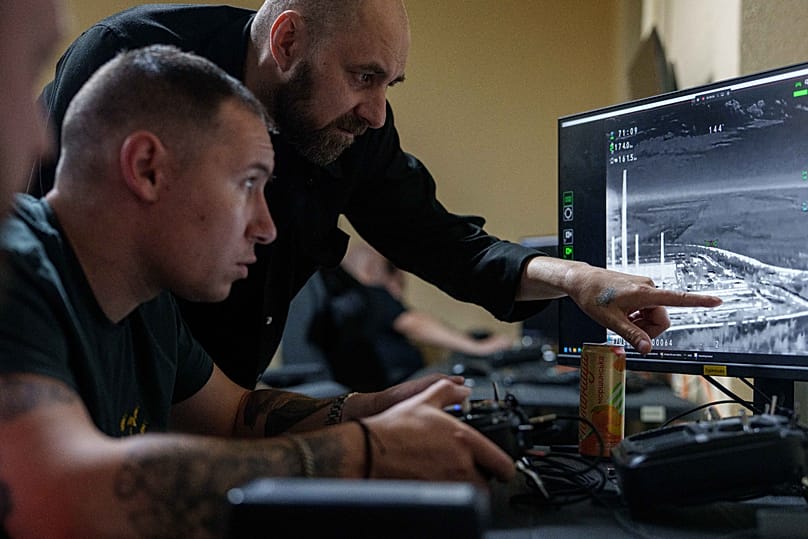
A Ukrainian serviceman of K-2 brigade of the Unmanned Systems Forces operates a midrange drone during a flight towards Russian positions at the frontline, 21 June, 2026 AP Photo

"I told them frankly: unfortunately, it will not be possible to extinguish this type of fire quickly," he said.

Earlier Slyusar said drones had hit two "oil storage facilities" in the town of Azov.

In the neighbouring Krasnodar region, authorities said drones caused a fire at the Ilsky oil refinery.

Authorities reported no casualties.

Russian leader Vladimir Putin has acknowledged that the Ukrainian strikes are causing a fuel shortage and said they are aimed at dividing Russians.

US President Donald Trump, asked about Kyiv's strikes during a meeting with Ukraine's Volodymyr Zelensky this week, appeared to endorse the campaign.

"It's an escalation, but it's also an escalation that can help lead to an end," Trump said.

The Kremlin said Ukrainian military pressure would not force it into concessions.

"We see certain misconceptions within the White House administration, that by escalating military pressure it can help move to a peace settlement. That is a mistaken view," Kremlin spokesman Dmitry Peskov told reporters.

Kyiv says the strikes are fair retribution for Russia's more than four-year barrages on Ukraine and that it is a bid to force Russia to the negotiating table.

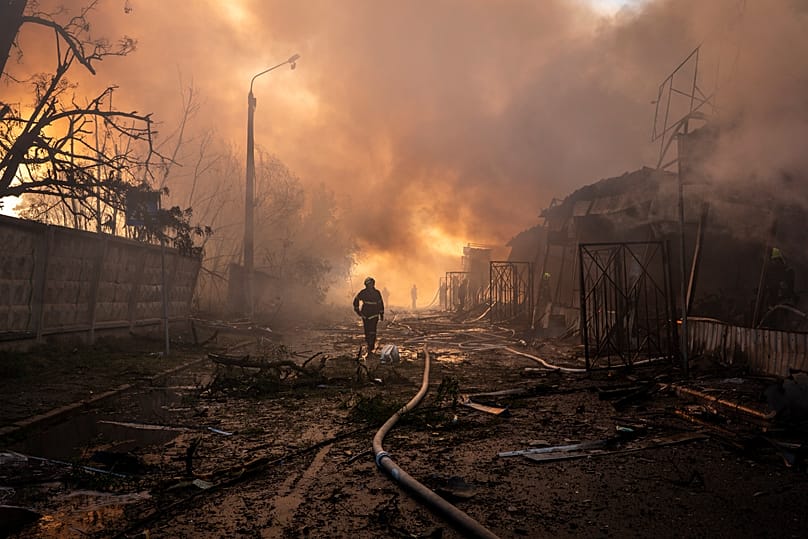
Firefighters try to put out a fire at a city marketplace following a Russian missile and drone attack in Kyiv, 15 June, 2026 AP Photo

Ukraine's army chief says war not yet at 'turning point'

Meanwhile, Ukraine's commander-in-chief Oleksandr Syrsky said on Friday that a turning point in the war with Russia was "still a long way off," despite hailing a string of recent successes for his troops.

Kyiv's army has halted the Russian advance across much of the front line in recent months and delivered a string of major long-range attacks on Russian oil refineries.

Many in Ukraine and among their backers abroad are saying Kyiv's troops are on the front foot in the more than four-year war.

In a social media post summarising the first half of the year, Syrsky noted a decrease in the number of "active offensive fronts" and said Russia's assaults had dropped by half.

"In terms of the rate of advance, the two sides have effectively reached parity," Syrsky said.

"At the same time, the enemy must not be underestimated. We are still far from a turning point in the war," he added.

Syrsky also said Ukraine had carried out successful strikes on 697 targets inside Russia over the last six months as it upped its own campaign of retaliatory long-range attacks.