Tuesday, September 01, 2026


US Plan Advances for 50-Ship Nuclear-Powered Merchant Fleet
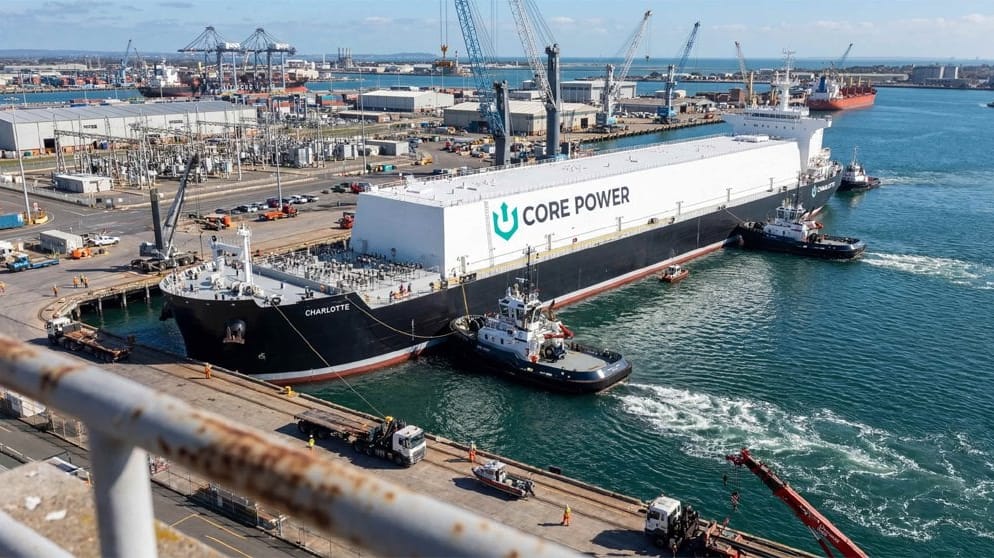
dockside nuclear power station concept
Core Power's dockside nuclear power station concept (Core Power)

Published Aug 30, 2026 7:38 PM by The Maritime Executive


British-based nuclear energy company Core Power is pitching another proposal in the United States, seeking to commercialize nuclear energy propulsion plants for ships.

In February this year, Core Power was seeking a tie-up with the US Department of War to take advantage of simpler regulations governing the operation of nuclear power plants on board ships docking at defense-owned ports. Because the Pentagon has extensive experience of using small nuclear reactors afloat, with well-established protocols, use of this regulatory environment would allow much faster deployment of maritime nuclear energy applications than if deployments had to use the regulatory scheme applicable to civil nuclear energy.  

Core Power sought to deploy a nuclear power station on board a vessel stationed in a military port, to bring a major power source close to where energy-hungry data centers might need it. To cover the costs of linking into a grid, the vessel would need to be committed to a particular port for a substantial period, but like an LNG FSPO it could be moved at the end of a contract period to a new task elsewhere. Core Power envisioned using either the Westinghouse 550MW A4W reactor, as used on the Nimitz Class aircraft carriers, or the Rolls Royce PWR2 nuclear submarine reactor, which is also the basis of Rolls Royce’s SMR design for small nuclear generation plants which has been adopted in the UK. In the end, however, Core Power has opted for a nuclear reactor produced by BWX Technologies for this application. In May 2025, the White House issued an Executive Order mandating the development of an advanced nuclear reactor at a military base by no later than September 30, 2028. 

Core Power’s latest project is wrapped up in a seven-year agreement signed with the US Maritime Administration last week to build a fleet of 50 nuclear-powered merchant vessels. The fleet would be a mix of LNG tankers and container ships. At a unit cost of $700 million per ship, rather than $250 million for the equivalent tonnage of a conventionally powered ship, the vessels would be expensive – but would enjoy lower fuel costs, higher sea-time and cruising speeds, offering therefore higher utilization and cost efficiency, as well as a Net Zero-compliant complete reduction in sulfur fuel emissions. Core Power estimates that conventional merchant vessel tonnage would need to be 66 percent higher to haul the same volume of goods as could be carried on a nuclear-powered fleet.

US Secretary for Transportation Sean Duffy has shared his enthusiasm for the project, posting online about the ambition to build a nuclear-powered merchant fleet about the ambition to build a nuclear-powered merchant fleet, pitching such vessels as having:


Secretary Duffy regards the program as a response to Chinese competition. At the Marintec China conference in Shanghai in June, Chinese state-owned Jiangnan Shipyard, based in Shanghai, announced that it is to build a 25,000 TEU nuclear-powered containership.

Hulls for the US ships would be built in Japan and Korea, with the nuclear power plants fitted out in a yard to be developed in the United States. The yard could potentially be in Corpus Christi (TX), where Core Power has signed a preliminary agreement. The project is aiming for first ship delivery in 2033.


U.S. Army To Spend $2.2B On Nuclear Microreactors At Military Bases

  • The U.S. Army plans to deploy around 20 portable nuclear microreactors, awarding up to $2.2 billion to bring the technology to military bases under its Janus Program.

  • Microreactors could provide resilient, localized power without constant fuel deliveries, with companies including Radiant, Antares, BWXT, General Atomics and Westinghouse selected for deployments.

  • The military push could accelerate commercial nuclear adoption, as Google, Amazon, Microsoft and Meta also pursue advanced nuclear power to meet soaring AI and data-center electricity demand.

Back in October 2025, the U.S. Army unveiled the Janus Program to supply portable nuclear microreactors to military bases by 2028. Whereas these reactors are much smaller than conventional nuclear plants, they typically generate 1-20 megawatts of electricity per reactor, significantly more than what the biggest portable generators can manage. That makes them ideal for the military, considering that major military bases consume as much power as a small city. The military logic is that in a conflict, transporting fossil fuels to remote front lines creates an easy target, while localized nuclear reactors can operate for years without refueling. To that end, the U.S. Army has awarded up to $2.2 billion over five years to both private and public companies to build, own, and operate commercial nuclear microreactors at five domestic military bases, estimating that 20 microreactors will be deployed under the program. Five vendors have already been selected to design and deploy the microreactors at specific installations, with Antares Nuclear slated to build a microreactor at Fort Bragg in North Carolina; BWXT Technologies (NYSE:BWXT) is slated for Fort Campbell in Kentucky, General Atomics Electromagnetic Systems will build one at Fort Hood in Texas, Radiant Industries is slated for Fort Benning in Georgia while Westinghouse Government Services will build one at Fort Drum in New York.

Nuclear startups Radiant Industries secured a contract worth up to $750 million to deploy 15 of its 1-MWe Kaleidos microreactors, starting with a three-unit installation, and Antares Nuclear will also deploy a three-unit group of its R1 microreactor (ranging from 100-kWe to 1-MWe per unit). The companies plan to deliver and deploy their microreactors in modular packs so they can ship the reactors via standard trucks, rail, air, or barge. The facilities will be factory-built to avoid drawn-out on-site construction, and Radiant's Kaleidos microreactor is designed to be fully transportable and plug-in ready, capable of powering up within 48 hours of arriving at a base.

Interestingly, the U.S. Army will be responsible for licensing the reactors rather than the U.S. Nuclear Regulatory Commission (NRC), which normally licenses commercial nuclear reactors.

But this particular arrangement has drawn heavy criticism. Alan J. Kuperman, associate professor at the Lyndon B. Johnson School of Public Affairs at the University of Texas, told AP that the idea of not involving the NRC in the licensing process is “a dangerous scam on many levels.” However, Jeff Waksman, principal deputy assistant secretary of the Army for installations, energy and environment, says the reactors are not intended to be Army-specific, but will rather be designed so that they can later transition easily to the commercial market, at which stage the NRC will be involved. Waksman says the Army will co-ordinate with the Energy Department to remove radioactive waste, with no plans for long-term storage on these installations.

While SMRs face high cost and supply-chain hurdles, they are increasingly viewed as vital for grid stability and the clean energy transition, with the U.S. government targeting a massive expansion to reach 300 GW of new nuclear power by 2050. If successful, the Janus microreactors could be among the first ever SMRs to be installed on U.S. soil.

Hordes of American Big Tech companies and hyperscalers have signed a flurry of deals involving SMRs and advanced nuclear energy to power their surging AI data center electricity demands. 

Two years ago, Google signed a landmark deal with Kairos Power to purchase 500 megawatts of power from a new fleet of six to seven SMRs, with the first reactor targeted to come online by 2030. That same year, Amazon invested in SMR developer X-Energy (NASDAQ:XE) by leading a $500 million funding round and securing offtake rights for its reactors, alongside deals with utility consortium Energy Northwest in Washington State to develop advanced SMR projects.  Meanwhile, Microsoft signed a massive deal with Constellation Energy (NASDAQ:CEG) in 2024 to restart Three Mile Island Unit 1 and has actively built an internal nuclear strategy team to deploy SMR solutions for its global data centers. Finally, Meta signed agreements with nuclear developers Oklo Inc. (NYSE:OKLO) and TerraPower in January 2026 to build multiple SMR and advanced reactor units.

By Alex Kimani for Oilprice.com


US Army selects five microreactor techs for deployment
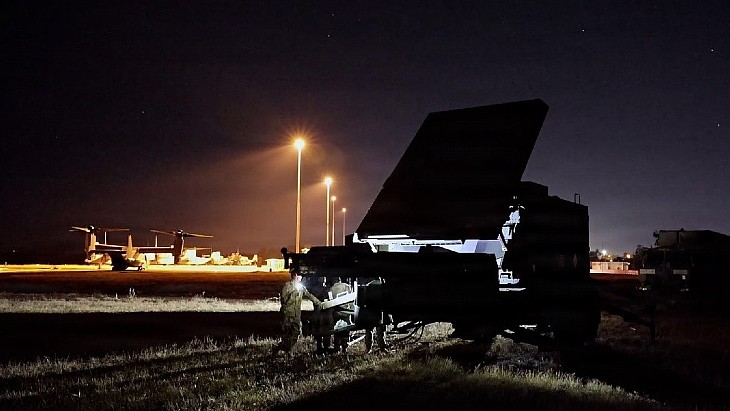


The US Department of the Army has selected five microreactor developers for deployment at five Department of War installations as part of its USD2.2 billion Janus Program.
 
The Janus Program is aimed at delivering secure and reliable energy to US military forces (Image: Capt Frank Spatt/US Army)

The technology and locations are: Antares Nuclear, at Fort Bragg, North Carolina; BWXT Advanced Technologies, at Fort Campbell, Kentucky; General Atomics Electromagnetic Systems, at Fort Hood, Texas; Radiant Industries, at Fort Benning, Georgia; and Westinghouse Government Services, at Fort Drum, New York.

The decision was taken with input on the technical risks, financial situation, and management capabilities of the solutions from a panel of nuclear "and technical experts from the Department of Energy, national laboratories and representatives across the services".

The Janus Program - launched last October - is a next-generation nuclear power programme aimed at delivering "resilient, secure, and assured energy to support national defence installations and critical missions". Executive Order 14299 - Deploying Advanced Nuclear Reactor Technologies for National Security - was signed by President Donald Trump in May 2025 and aims for operation of an Army-regulated nuclear reactor at a domestic military installation no later than 30 September 2028.

Dan Driscoll, Secretary of the Army, said: "Awarding these contracts accelerates our ability to deliver safe, reliable baseload power directly to our installations. We are building the energy resilience necessary to project combat power globally, without relying on potentially vulnerable external grids."

Jeff Waksman, principal deputy assistant secretary of the Army for Installations, Energy and Environment, said: "We are seeking not just reactors capable of turning on for a brief demonstration, but rather systems able to deliver power with high-capacity factors for years of operation. The Janus Program will be a complete success when, and only when, we have assisted multiple nuclear companies in developing truly reliable and affordable nuclear microreactors which they can sell to other buyers beyond just the military."

The Department of the Army says vendors will receive government funding contingent on successfully hitting specific technical goals, potentially up to USD2.2 billion across 2027-2031.

Owen West, director of the US Department of War Innovation Unit (DIU), said: "We need more power. We need it delivered faster and cheaper, and we need it to be more reliable. With Janus, DIU is assisting the Army's microreactor build - speeding military energy production to protect the nation."

The selected vendors

Antares' Mark-0 demonstration reactor was the first reactor to reach criticality under the Department of Energy's Reactor Pilot Program, in June. It is a sodium heat-pipe cooled microreactor technology, which uses tri-isostructural isotropic - or TRISO - fuel containing high assay low-enriched uranium (known as HALEU).

Jordan Bramble, CEO and founder of Antares, said: "We're grateful and proud to partner with the US Army and the Defense Innovation Unit on the Janus Program. Energy scarcity is constraining America's most critical defence systems. Through Janus, Antares will deliver clean, firm, resilient power for the warfighter."

BWX Technologies says it is targeting groundbreaking for site construction in late 2028 with reactor operations commencing in the early 2030s. The BWXT Advanced Nuclear Reactor (BANR) is a high-temperature, gas-cooled nuclear reactor that utilises TRISO fuel. It is designed for critical infrastructure, and the Janus Program involves a 20 MWe version.

Rex D Geveden, BWXT president and CEO, said: "As we commence work on the Janus Program, we are delivering the nation's most credible and reliable path to deployable nuclear power. BANR is purpose-built for mission success, and we are driving forward with the discipline, experience and proven capability that national security demands."

General Atomics is developer of the General Atomics Tactical Energy System, a liquid-metal-cooled microreactor with a baseline net output of approximately 5 MWe, potentially scalable to approximately 20 MWe. It is designed for remote, off-grid and extreme environments, with a design life of 40 years.

Scott Forney, President of General Atomics Electromagnetic Systems, said: "General Atomics draws on more than 70 years of nuclear innovation and reactor expertise to deliver microreactor technologies that provide safe, dependable and independent power for military installations. Our experience designing and deploying 68 reactors worldwide and supporting reactor technologies throughout their lifecycles positions us to deliver assured energy solutions that enhance operational resilience and strengthen mission readiness."

Radiant, which is developing the Kaleidos 1 MW transportable microreactor, said its agreement with the US Army and Defense Innovation Unit was worth up to USD750 million to develop and deploy up to 15 of its microreactors.

Tori Shivanandan, President and Chief Operating Officer of Radiant, said: "The numbers tell the story. This award shows confidence in Radiant's product and ability to manufacture, deploy, and safely operate nuclear microreactors for the American military."

Westinghouse Government Services has developed the eVinci microreactor, a heat-pipe reactor designed to provide resilient electricity 24 hours a day, 7 days a week for eight years without refuelling.

Rich Rademacher, President of Westinghouse Government Services, said: "The selection of the eVinci microreactor for the Janus Project highlights the important role advanced nuclear technology can play in providing resilient, long-duration power to the warfighter. Westinghouse is proud to support the Army’s efforts to strengthen energy security and deliver innovative capabilities."

 

Heatwaves and secret emissions: Why nuclear power may not be as ‘green’ as you think

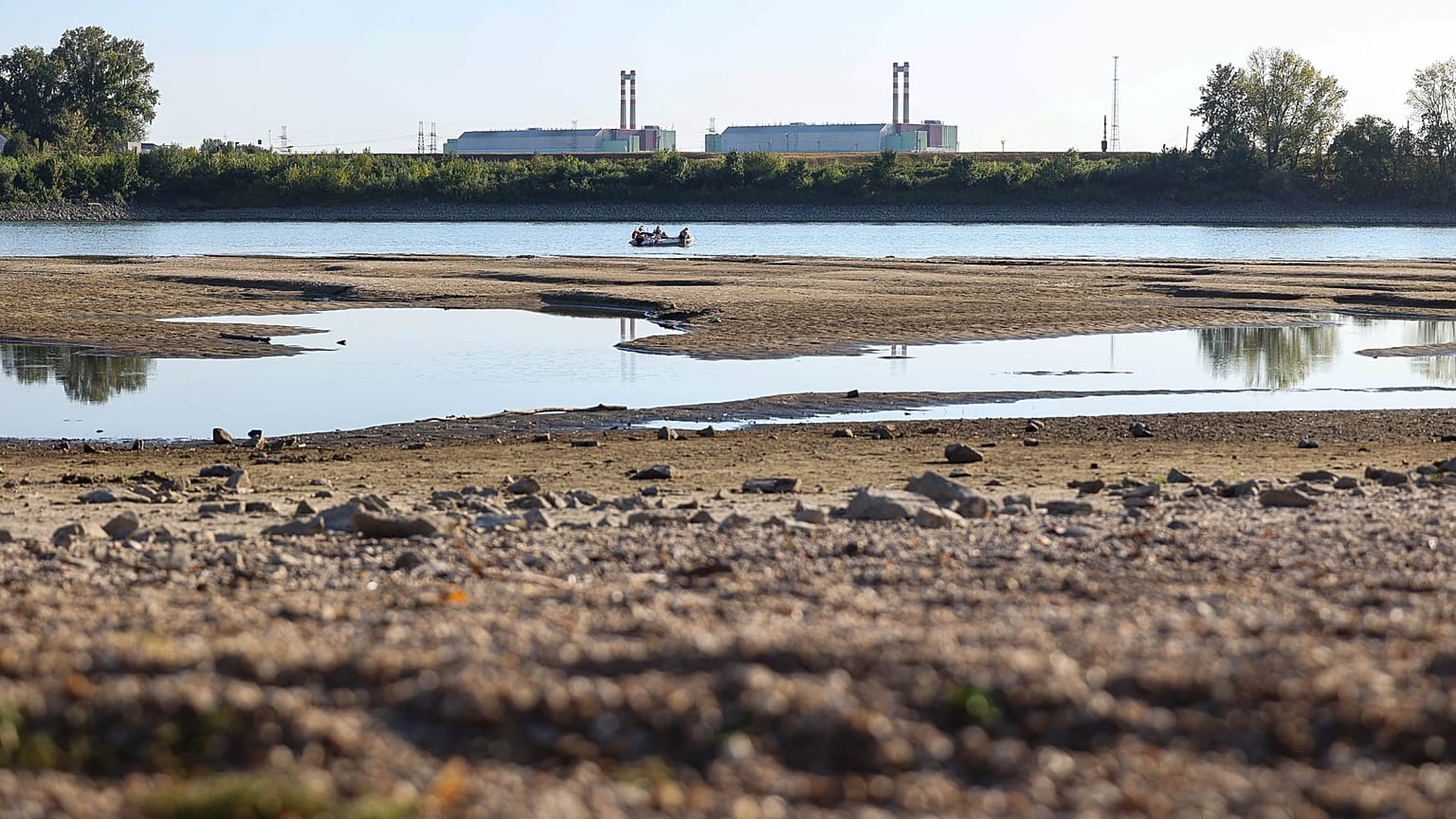
The MVM Paks Nuclear Power Plant, which had to close its Reactor 3 due to extremely low water levels on the Danube River, is seen in Paks, Hungary, Wednesday July 29, 2026.
Copyright Daniel Kiss/MTI via AP

By Liam Gilliver
Published on

The war on Iran has triggered calls to double down on nuclear power. But is it really ‘clean’, can Europe’s energy grid cope and will it survive the wrath of climate change?

The world stood still on 11 March 2011, when a major earthquake triggered a 15-metre tsunami that left an unforgettable scar on Japan’s east coast.

A series of powerful waves ripped through homes, businesses and roads – leaving more than 450,000 people homeless and killing 15,500. Alongside the chaos, the tsunami caused the meltdown of three nuclear reactors at the Fukushima Daiichi Nuclear Power Plant, spewing out toxic, radioactive materials and forcing thousands to evacuate.

The event triggered global conversation about the safety of nuclear energy, leading several countries to plan to phase out nuclear energy or stop its expansion.

But 15 years later and the horrors of Fukushima have slowly been replaced with calls to double down on nuclear power, particularly following the war on Iran and its subsequent energy crisis. Speaking exclusively to Euronews, EU Climate Action Commissioner Wopke Hoekstra listed nuclear as one of the power sources EU countries must lean on.

However, an expert from the University of Oxford has warned that new nuclear capacity will not fix today’s energy problems – urging policy makers to consider the true risks of nuclear.

“In the high‑renewables systems of Europe, the problem is increasingly not how to generate more electricity but how to access it when and where it’s needed,” says Dr Bettina Wittneben, a lecturer in Management at Oxford’s Saïd Business School and associate fellow at Pembroke College and the School of Geography and the Environment.

Is nuclear power really ‘clean’?

Nuclear energy is often touted as a clean form of energy as it is low carbon at the point of generation.

In layman’s terms, nuclear reactors can create electricity without releasing carbon dioxide or smog-forming pollutants into the atmosphere. However, experts point out that this isn’t the full picture.

“The bulky concrete structures mean that it has a large amount of embodied carbon and, of course, it is not a renewable energy as it requires the mining of uranium, bringing with it carbon costs in terms of extraction and transport,” says Dr Bettina.

“Nuclear waste disposal and decommissioning must also be factored into the carbon budget of nuclear energy generation.”

Are nuclear power plants climate resilient?

Europe was scorched by back-to-back heatwaves this summer, which experts say would have been “virtually impossible” if it weren’t for climate change. The extreme heat, combined with scant rainfall, triggered droughts across much of the continent, draining some of Europe’s biggest rivers to record-level lows.

This forced several nuclear power plants to temporarily shut off or be set to a reduced output across France, Hungary and Romania.

Nuclear requires vast amounts of water, particularly for the cooling process, and is often known as the “thirstiest power source”. According to The Nuclear Energy Institute, one nuclear reactor requires between 1,514 and 2,725 litres of water per MWh – equating to hundreds of gigalitres every year.

It’s why nuclear power plants are often built near large bodies of water. Without a constant, reliable source of water a nuclear reactor risks overheating – which could lead to serious core damage and end up releasing harmful radiation into the environment.

Coal power and hydropower also suffered during the heatwave, but a surge in solar power helped meet heightened electricity demand from cooling devices such as air conditioning.

According to energy think-tank Ember, solar output in European countries rose by up to 17 per cent on heatwave days in June and July – becoming the only major power source to perform “better than usual” during hot weather.

'Hellbrise': Nuclear is not as reliable as some say

Intermittent forms of energy such as wind and solar are often blamed for overloading Europe’s outdated energy grid.

When electricity demand outstrips supply, surplus energy is often wasted – and can lead to negative electricity prices. This is often referred to as 'Hellbrise' (hell= bright, brise= breeze) and can occur on sunny, windy days.

“This is also the narrative of fossil fuel advocates, who present fossil gas as the saviour of the baseload, or the electricity that is available when renewables fall short,” says Dr Wittneben.

“Fossil fuel sceptics point instead to nuclear power as a reliable baseload technology.”

However, the expert points out that nuclear power plants are slow and costly to turn off, which means they only “amplify” the grid’s Hellbrise challenge – rather than present a solution to it.

The EU has recognised that battery energy storage systems (BESS) are a “crucial technology” to help prevent renewable energy from being wasted or entering sub-zero pricing. The logic is that batteries can store electricity produced by renewables during the day (when consumption tends to be low) and release it to households when demand increases in the evening.

Europe installed 36 GWh of new BESS in 2025, bringing its total operational capacity beyond 100 GWh for the first time. This is enough stored energy to power around 75 million homes.

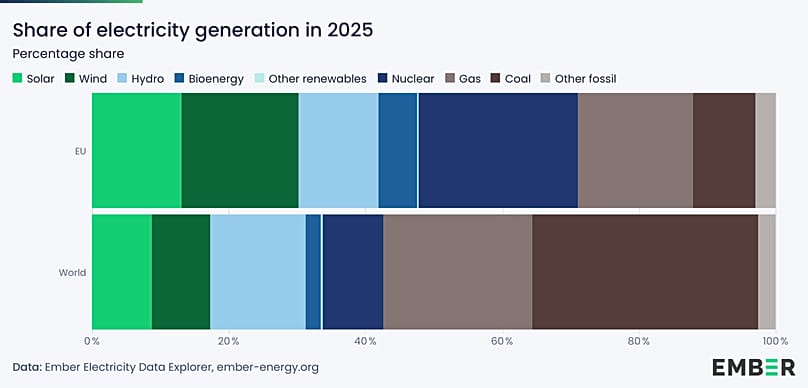
Chart showing electricity sources in Europe and the World in 2025
Chart showing electricity sources in Europe and the World in 2025 Ember Electricity Data Explorer, ember-energy.org

Which EU countries have become reliant on nuclear power?

Last year, the European Union generated 652TWh of electricity from nuclear, representing 23.3 per cent of the bloc’s total electricity mix.

This was more than solar (13.1 per cent) and wind (17.1 per cent) – and put nuclear as the largest share of electricity generation for 2025.

More than half of this (392 TWh) was generated in France, which has the biggest nuclear output across the bloc. In fact, France generated more than two-thirds (68.8 per cent) of its electricity from nuclear last year.

This was followed by Spain (54.1 TWh), Sweden (46.7 TWh), Finland (32.8 TWh), Czechia (31.9 TWh), Belgium (24.1 TWh), Slovakia (19.3 TWh), Hungary (16.1 TWh), Bulgaria (14.8 TWh), Romania (10.2 TWh), Slovenia (5.83 TWh) and the Netherlands (3.99 TWh).

Because European power grids are interconnected, many countries that do not have active nuclear power plants can purchase electricity generated by nuclear power from other EU countries. In 2024, France was Europe’s biggest electricity exporter – and much of this was generated from nuclear power.

But not every EU country is onboard with running nuclear power plants, particularly following the Fukushima incident.

Back in 2020, Germany generated 170 TWh of electricity from nuclear – putting it as the second largest producer in the EU. This was the year the country first passed a legal plan to end nuclear power.

Germany officially stopped using nuclear power for electricity on April 15, 2023, when it shut down its three final operating reactors.

The move was described as a “grave strategic mistake” by Chancellor Friedrich Merz – and saw the country’s reliance on polluting fossil fuels temporarily increase to bridge the gap in energy supply.

However, a recent analysis from think-tank Energy Institute found that together wind and solar generated 44 per cent of Germany’s electricity in 2025, overtaking fossil fuels by one per cent.

At the same time, coal fell from supplying more than half of the country’s electricity in 2000 to just 21 per cent last year. Experts are now hopeful that Germany will be able to wean itself off coal completely before 2038.


Indonesia's Mount Sinabung eruption sees volcanic ash plume move towards populated areas

Indonesia's Mount Sinabung eruption sees volcanic ash plume move towards populated areas
/ Ministry of Energy and Mineral ResourcesFacebook
By IntelliNews - Surabaya Bureau September 1, 2026

Prompted by an escalation in volcanic activity and expanding ash cloud coverage across Karo Regency, Sumatera island, Indonesia, emergency management authorities in North Sumatra have initiated regional containment protocols, Kompas reports. According to official statements from North Sumatra Governor Bobby Nasution and the National Disaster Management Agency (BNPB) on August 31, the Center for Volcanology and Geological Hazard Mitigation (PVMBG) officially raised Mount Sinabung’s alert status from Level II (alert) to Level III (standby).

Detik reports that the status upgrade took effect at 12:30 WIB following a major eruption at 10:17 WIB that generated an ash plume reaching 3,500 metres above the summit (~5,960 metres above sea level). According to PVMBG observation officer Armen Putra and Acting Head of BNPB’s Disaster Data Centre Berton SP Panjaitan, instrumental monitoring recorded continuous volcanic earthquakes alongside the eruption, indicating potential further activity. Driven by prevailing winds toward the east-southeast, the volcanic ash plume moved directly over the commercial and residential hub of Berastagi District.

In response, Governor Bobby Nasution announced that the provincial government is considering shifting primary and secondary schools in Berastagi to distance learning (online classes) to safeguard students. Immediate relief efforts included distributing 15,000 N95/respiratory masks, deploying local fire departments to clean ash-covered public roads, and enforcing a strict 3 kilometres to 5 kilometres exclusion radius (expanding to a 6km sectoral exclusion zone toward the south-southeast).

To prevent respiratory health crises and municipal paralysis, emergency coordination teams route real-time volcanic data into local public safety protocols. Transitioning affected schools to online learning minimizes children's exposure to airborne volcanic ash while maintaining educational continuity.

Preventing agricultural access within the 3 kilometres to 6 kilometres hazard zone reduces risks from potential pyroclastic flows or secondary eruptions. Heavy rainfall across the Karo highlands heightens the risk of cold lahar flows along river channels originating from Mount Sinabung's slopes. Adhering to established exclusion zones will remain critical to ensuring community safety as disaster management agencies monitor volcanic activity.


Spain records 5,232 heat-related deaths in 2026, the highest figure since 2015

A worker shields himself from the sun with a piece of cardboard in Madrid, Spain, Tuesday, 26 May 2026. (AP Photo/Bernat Armangue)
Copyright Copyright 2026 The Associated Press. All rights reserved

By Lucia Blasco
Published on

Spain has recorded 5,232 deaths attributed to high temperatures so far in 2026, the highest figure since records began in 2015. In August alone, a provisional 2,147 deaths are estimated.

Spain has recorded 5,232 deaths attributable to high temperatures so far in 2026, the highest figure since the Daily Mortality Monitoring (MoMo) system began in 2015. Of these, 2,147 occurred in August, according to the provisional data available on Monday.

MoMo, run by the Carlos III Health Institute (ISCIII), does not count deaths where heat has been individually certified as the cause of death. The system produces statistical estimates of mortality attributable to temperatures, based on mortality data and the effect of temperature.

The 2026 figures already exceed those for the two summers that until now had recorded the highest heat-related mortality since the series began: 2022, with 4,789 deaths, and 2023, with 3,035. The current numbers cover the period since 15 May, when the national plan to deal with the health effects of high temperatures is activated each year.

August nears the series record

July ended with 2,025heat-related deaths, compared with 1,060 recorded in the same month of 2025. It was the second deadliest July in the series, only behind 2022, when 2,217 deaths were estimated.

August has so far recorded 2,147 deaths attributable to high temperatures, although the figure is still provisional and takes about a week to be confirmed. The number is close to the 2,172 recorded in August 2025, which remains, for now, the deadliest August in the series that began in 2015.

The impact is concentrated particularly among older people. Of the 5,232 deaths estimated this year, 5,048 are among those aged over 65. People over 85 account for 62% of the total, with 3,256 deaths. In addition, 60% of the deaths are among women.

The figures come in a summer marked by exceptionally high temperatures. Spain's national meteorological agency AEMET notes that July 2026 was the warmest in the historical series, tied with 2022, while June was the second warmest since records began.

Despite MoMo's record since 2015, the figures do not reach the estimates for the historic 2003 heatwave, when around 13,000 deaths in Spain were attributed to high temperatures. That crisis led to the launch of the Health Ministry's plan to prevent the effects of heat on health.

Moreover, the heat could persist into the start of September. The AEMET forecast points to temperatures above the usual values for this time of year in parts of Spain during the first days of the month.


Wildfires cause 165,000 respiratory cases in Indonesia's Kalimantan

Wildfires cause 165,000 respiratory cases in Indonesia's Kalimantan
/ Michael Held - UnsplashFacebook
By IntelliNews - Jakarta Bureau September 1, 2026

Acute respiratory infections in West Kalimantan, Indonesia, reached 165,727 cases between January 1 and August 22, the local health office reported on August 29. Infection levels reached roughly 29 out of every 1,000 residents across the Indonesian province as land and forest fires expanded, according to Detik.com.

Seasonal agricultural burning in Indonesia routinely triggers transboundary smoke haze across Southeast Asian countries like the Philippines and Malaysia. The recurring crisis threatens regional healthcare networks, worsens air quality in neighboring nations, and damages local economic productivity.

Infection tallies began rising in late May before accelerating rapidly into mid-August, West Kalimantan Health Office head Dr Erna Yulianti said. The sharpest increase coincided with a surge in satellite hotspot detections across the Indonesian territory.

Local health centres across the province reported a heavy influx of patients seeking treatment for breathing difficulties. Pontianak City logged nine health alerts during the second week of August, whilst Ketapang Regency registered six and Sintang Regency reported five.

Respiratory illnesses stem from multiple environmental factors and cannot be linked solely to fire emissions, Yulianti noted. However, fine particulate matter from land burning across Indonesia significantly aggravates pre-existing lung conditions. Public health officials are cross-referencing patient records with satellite data to direct medical resources toward high-risk fire zones.

Indonesian authorities warned residents to wear face masks outdoors, avoid unnecessary open-air activities, and maintain hydration. Warnings specifically target vulnerable groups, including children, pregnant women, the elderly, and individuals with chronic illness.


Jury convicts Duane 'Keffe D' Davis of first degree murder in 1996 killing of hip-hop icon Tupac Shakur

Duane Davis stands during a break in closing arguments during his murder trial, related to the 1996 killing of rapper Tupac Shakur, in Las Vegas, Monday, Aug. 31, 2026
Copyright AP Photo


By Malek Fouda
Published on


The verdict lays to rest decades of speculation and conspiracy from avid hip-hop fans around the world in the high-profile killing that went unresolved for close to 30 years. Davis is expected to appeal the conviction.

A jury found Duane “Keffe D” Davis guilty of orchestrating the 1996 killing of hip-hop icon Tupac Shakur, finally bringing a measure of resolution to a case that had gripped fans and lingered in the public imagination for decades.

The 63-year-old Davis was convicted on Monday of a single count of murder with a deadly weapon and could be sentenced to life in prison. The jury deliberated for less than three hours after a weekslong trial in Las Vegas.

After the verdict was read, Shakur's sister, Sekyiwa “Set” Shakur, cried and hugged the prosecutors. Davis’ son covered his face with one hand.

Duane Davis led out of court after a jury found him guilty of murder in his trial related to the 1996 killing of rapper Tupac Shakur, Las Vegas, Aug. 31, 2026
Duane Davis led out of court after a jury found him guilty of murder in his trial related to the 1996 killing of rapper Tupac Shakur, Las Vegas, Aug. 31, 2026 Bizuayehu Tesfaye/Bizuayehu Tesfaye/Pool Las Vegas Review-Journal via AP

Chief Deputy District Attorney Binu Palal told jurors in closing arguments late on Monday that Davis acquired a gun and “went hunting” for Shakur and Death Row Records co-founder Marion “Suge” Knight after the men had beaten up his nephew earlier that night.

“He is responsible of the murder of Tupac Shakur,” Palal said. "Tell him you hear him. Find him guilty.”

Prosecutors said that while his story had changed over the years, Davis repeatedly placed himself inside a white Cadillac from which the shots were fired.

The prosecution added that while Davis himself did not pull the trigger, evidence showed he'd called for the gunfire as a powerful gang leader the younger men in the car, including his nephew, were going to listen to.

FILE - Rapper Tupac Shakur attends a voter registration event in South Central Los Angeles, Aug. 15, 1996
FILE - Rapper Tupac Shakur attends a voter registration event in South Central Los Angeles, Aug. 15, 1996 Frank Wiese/AP1996

Defence attorney Michael Sanft asked jurors if there was any evidence that Davis had ever called the shots before or after the shooting. The panel of 16 jurors, four of whom are alternates, heard testimony from 24 prosecution witnesses and three defence witnesses over a period of nine days.

The prosecution said the state would dismiss a gang enhancement charge due to witness logistics. Prosecutors declined to comment following the verdict, and members of Shakur's family said they were waiting until sentencing, which is scheduled for October.

The trial pointed a magnifying glass to a decades-old case that for years has drawn the attention of hip-hop fans and true crime experts alike.

Shakur, who was considered one of the most influential rappers of all time, was in Las Vegas on 7 September, 1996, and stopped at a red light when a white Cadillac pulled up beside him, and shots were fired. He died from his wounds six days later in hospital, while his record producer, “Suge” Knight suffered injuries but ultimately survived.

Davis and his attorney sit in court after a jury found him guilty of first-degree murder in his trial related to the 1996 killing of Tupac Shakur, Las Vegas, Aug. 31, 2026
Davis and his attorney sit in court after a jury found him guilty of first-degree murder in his trial related to the 1996 killing of Tupac Shakur, Las Vegas, Aug. 31, 2026 Bizuayehu Tesfaye/Bizuayehu Tesfaye/Pool Las Vegas Review-Journal via AP

Sanft, Davis' attorney, argued there was no physical evidence connecting his client to the shooting. He said the book Davis co-authored and the public statements he made were dramatized bravado designed to make money, not to tell the truth.

In a rebuttal argument, prosecutor Marc DiGiacomo pointed to a scrapbook Davis kept containing articles about Shakur. “This guy’s scrapbooking his murder, for God’s sake,” he told jurors.

Palal held up Davis’ 2019 memoir, “Compton Street Legend,” and played an interview in which Davis encouraged people to buy it to get the “real truth.” Although the book contains a disclaimer saying some facts were changed, prosecutors argued the central account did not.

In multiple interviews, Davis said he handed the gun to the back seat, but in others as well as in his book, he wouldn’t explicitly say who pulled the trigger.