Tuesday, September 01, 2026

Asian Refiners Turn to Argentina as Iran War Disrupts Oil Supply


Asian crude oil importers, including China, Japan, and South Korea, have turned to buying oil from as far as Argentina to offset supply losses from the Middle East, anonymous traders with knowledge of the purchases told Bloomberg on Monday.    

Refiners in Asia, which have relied on the Middle East for a large part of their term supplies before the Iran war, are now scouring the global crude oil market for alternative barrels that do not need to pass through the Strait of Hormuz or other geopolitical hotspots, or take a month longer to deliver from the Red Sea via the Mediterranean and the Cape of Good Hope in Africa.

Argentina fits the bill, and some refiners in Asia have bought cargoes from the South American producer.

In recent weeks, refiners in Asia have bought Argentina’s Medanito crude, and at least one cargo of the oil comparable to the U.S. West Texas Intermediate loaded earlier in August, according to Bloomberg’s sources.

Medanito is being produced at the Vaca Muerta shale basin, the heart of Argentina's oil boom, where oil and gas production has been rising in recent years.

Argentina’s oil sales in Asia have jumped this year from 2025, and from no exports at all until 2024, according to Argentinian government data compiled by Bloomberg.

Argentina’s Medanito crude travels to Asia around South America and into the Pacific, without having to pass through any chokepoint or canal, such as the Panama Canal or the Suez Canal. This chokepoint-free trade route has apparently raised the Asian appetite for Argentinian oil, which is also close to the U.S. WTI in quality, a grade that’s also become more popular in Asia since the Iran war broke out.

Medanito is being sold at a discount of $1-$2 per barrel versus WTI, the trade sources told Bloomberg.

Other South American producers, including Brazil and Venezuela, have also become popular among Asian refiners, who seek to minimize the risk of relying on Middle East oil too much.

By Tsvetana Paraskova for Oilprice.com

The world has spent its emergency oil, the only stockpile growing is Iran's

The world has spent its emergency oil, the only stockpile growing is Iran's
Ten of the eleven biggest holders of strategic crude drew their reserves down in the second quarter. The one that grew is under naval blockade. / bne IntelliNewsFacebook

By Ben Aris in Berlin August 29, 2026

Six months into the war around the Strait of Hormuz, the world's emergency oil reserves are close to spent. They are being drawn down faster than at any time since they were built, and the buffer they were meant to provide has largely gone.

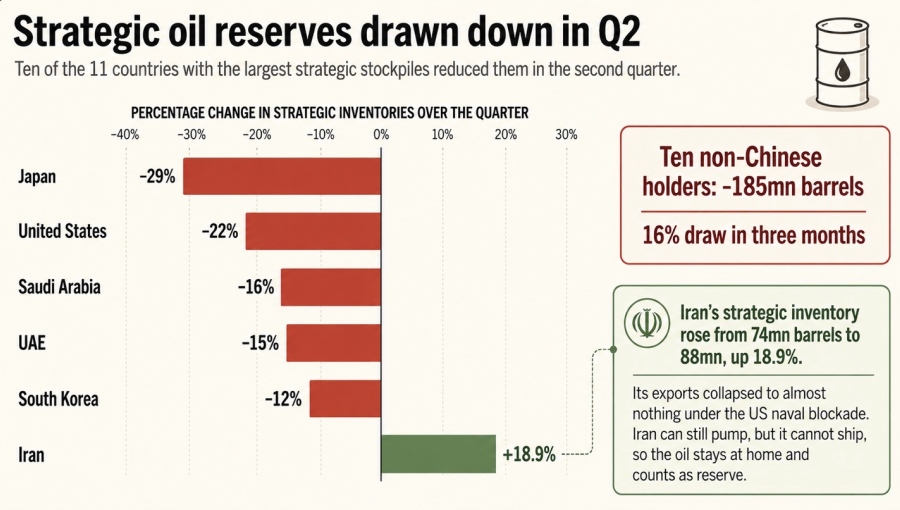
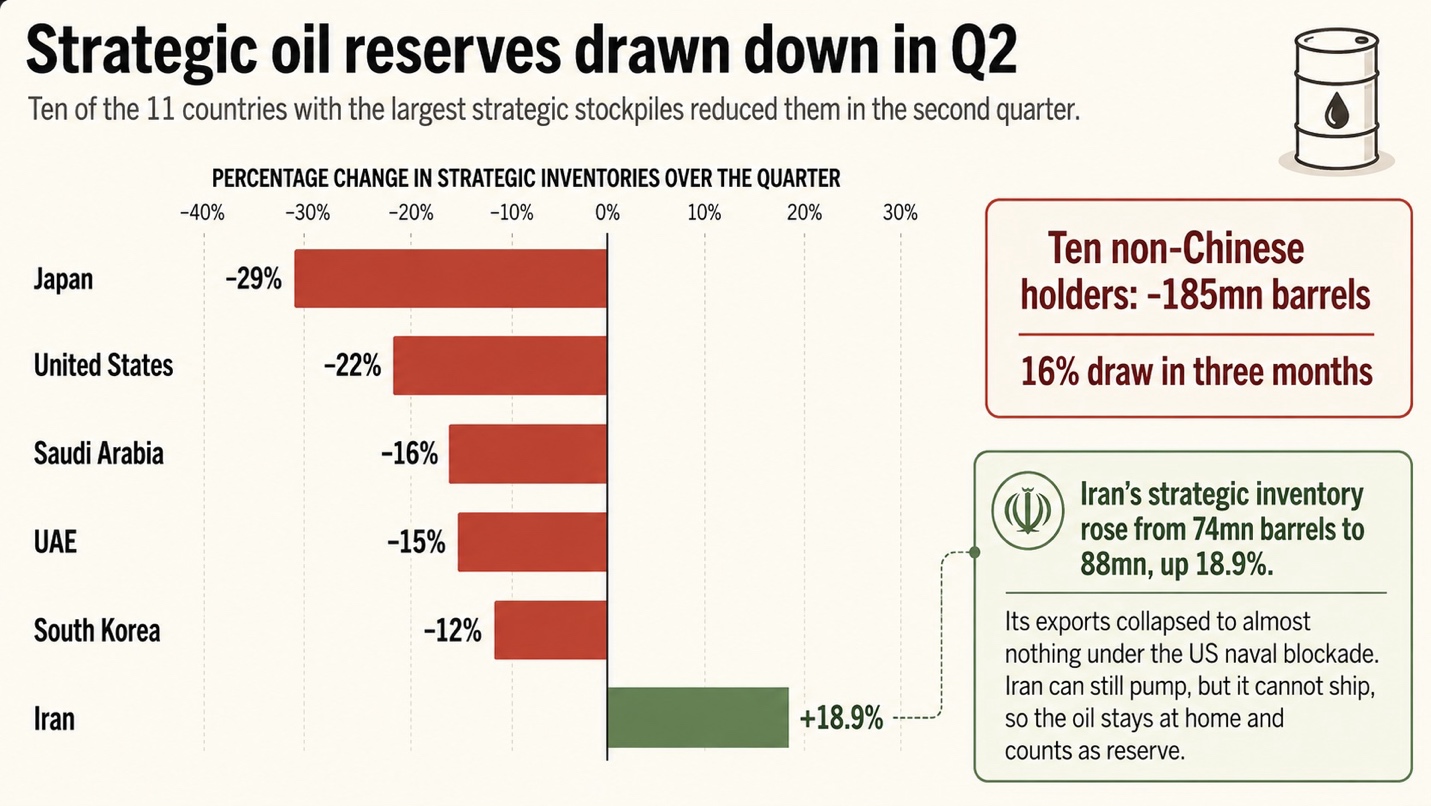
Ten of the eleven countries holding the largest strategic stockpiles shrank them in the second quarter. Between them, the ten non-Chinese holders gave up 185mn barrels, a 16% draw in three months. The United States drew 22%, Japan 29%, Saudi Arabia 16%, the UAE 15% and South Korea 12%.

The eleventh, Iran, went the other way. Its strategic inventory rose from 74mn barrels to 88mn, up 18.9%, over the three months its exports collapsed to almost nothing under the US naval blockade. Iran can still pump; it cannot ship. The oil has nowhere to go, so it stays home and counts as reserve.

The drawdowns are setting the world up for a new oil price spike, the problem is being little discussed and not reflected in the current oil prices, which remain in the mid$80s for now. Reserve releases were the West's answer to the chokepoint closing. They have calmed the markets over the last six months with some extreme predictions of oil prices jumping to a much as $350 per barrel failing to appear. However, as the reserves are depleted it is not clear if the markets will remain calm in the next six months if there is no end to the conflict.

America's barrels are a loan, not a sale

The 122mn barrels the United States has taken out of its Strategic Petroleum Reserve since March have to go back, with interest paid in oil.

The release is not a sale. The Energy Information Administration's own explainer says it "is structured as an exchange, which requires the original volume of oil, plus additional barrels, to be returned to the SPR at a later date". A Government Accountability Office report in May described the whole 172mn barrel drawdown as "emergency exchanges rather than sales". The companies that took the nation's emergency oil owe it back, plus extra.

The reserve peaked at 415.4mn barrels on March 20. By August 14 it was 293.4mn. That is 71% of what Washington committed to the international release, which means roughly 50mn barrels are still to go out of the door.

Two things follow that nobody has priced. When the exchanges unwind, refiners have to hand back more crude than they took, into a market that will still be short - so the SPR's recovery is itself a future call on supply. And a reserve that is contractually owed back is not a reserve that can be spent again in the meantime.

Crude for a diesel problem

All 172.2mn barrels of the American contribution were crude, all of it from public stocks, and it was the largest single line in the IEA’s 426mn barrel international programme – the largest in history - in which the next biggest was Japan at 79.8mn.

The shortage is in refined product. On July 21 the International Energy Agency's executive director said in writing that markets for diesel and gasoline were "considerably tighter than those for crude".

There is a reason the American contribution had to be crude: the country holds almost no emergency product. The Northeast gasoline reserve was sold off by act of Congress in 2024, and the same statute bars the energy secretary from creating a new regional product reserve without a line in the president's budget. What is left is one million barrels of heating oil in four New England terminals.

Releasing crude into a diesel shortage is the policy equivalent of sending flour to a bread queue. It helps, eventually, if there is a refinery with spare capacity in the right place - and the Asian refiners that would normally do that work are the ones the war has hit hardest.

China's share rises without China buying anything

China's stocks fell too, by 49mn barrels. But that is 3.2%, roughly a fifth of the rate everyone else was spending at, and China is still 95mn barrels above where it sat at the end of last year.

So, China's share of the tracked total rose from 57% to 61% in a single quarter without Beijing buying a barrel. Everyone else simply spent faster.

The EIA counts China's commercial inventories as strategic, because Chinese state oil companies have been instructed since 2024 to hold emergency barrels commercially. It refuses that treatment to every other country in the table, including Japan, whose mandated private stocks it leaves out. The comparison is tilted before a single barrel is counted.

China is not an IEA member. It is an association country under a 2015 declaration that describes the relationship as "non-binding", and the 90-day stockholding obligation applies to members. Whatever Beijing has, it has no legal duty to release.

Japan stops drawing

Japan will make no further releases from its national reserve in September or October, economy, trade and industry minister Ryosei Akazawa said on August 25.

September crude procurement is expected to fall to about 80% of last year's average monthly level, from 100% in August, because tankers that would normally pass through the Bab el-Mandeb Strait are going the long way round via Suez - 55 days to Japan against 21 to 23, Akazawa told a press conference.

"Of the national reserves for which a release has already been decided, there remains a portion that has not been utilised due to progress in securing alternative supplies. Using that portion would ensure [September] crude oil supply equivalent to an average month last year," he said, adding that procurement should return to last year's average monthly level in October.

Tokyo is saying it can cover September out of what it has already authorised. But that means Japan is husbanding what is left rather than finding an alternative supply. And it comes after the steepest quarterly draw of any major holder.

UBS Says a Major Commodity Upcycle Is Taking Shape

  • UBS is urging investors to position for a commodity upcycle, driven by electrification, AI infrastructure, rising power demand, supply constraints and years of underinvestment.

  • Gold, energy and industrial metals remain particularly attractive, with geopolitical risks supporting energy while copper benefits from structural demand and looming supply deficits.

  • The broader commodity rally is already accelerating, with the Quantix Commodity Index at a record high and Jeff Currie warning that the era of abundant physical resources may be ending.

One day after veteran commodities strategist Jeff Currie told investors to "get long and buckle up" for the next leg of the commodities rally, UBS strategist Sagar Khandelwal issued a similarly bullish call, urging clients to "position for a commodity upcycle."

Khandelwal said electrification, surging power demand, artificial-intelligence infrastructure spending, persistent supply constraints, and years of underinvestment are converging to create a perfect storm for a sustained upcycle in hard assets.

Commodities can generate returns while protecting portfolios against energy disruptions and renewed inflation, he said. That defensive role becomes valuable when the toxic mixture starts hitting stocks and bonds. 

Here's how the UBS strategist framed the trade:

Position for commodity upside

We believe commodities can provide both a structural source of return and portfolio protection in scenarios where higher inflation expectations challenge equities and bonds. While commodities have historically offered valuable diversification benefits due to their relatively low correlation with traditional asset classes, we also see a supportive longer-term backdrop driven by electrification, rising power demand, AI infrastructure investment, and supply constraints across several markets. In our view, investors should maintain diversified exposure across precious metals, energy, industrial metals, and agriculture to capture a broad range of opportunities. Given fast-shifting leadership within commodity markets, we think an actively managed approach can help investors navigate the commodity upcycle.

Gold

Gold has resumed its upward trend as US inflation concerns have ebbed, and markets have reined in expectations for near-term Federal Reserve rate hikes. Looking ahead, however, we believe central bank demand, continued diversification away from the US dollar, and global debt concerns will remain important structural supports. For investors with substantial gains following the strong rally over the past year, higher prices may provide an opportunity to rebalance some exposure into other commodity sectors. We continue to view gold as a useful strategic diversifier, and we remain constructive on gold prices over the next 12 months.

Energy

The ongoing conflict between the US and Iran highlights the fluid nature of geopolitical events and how they can impact energy. With crude supply remaining restricted and both sides facing constraints in reaching a compromise, uncertainty over how quickly shipping conditions and production will normalize is likely to keep energy markets sensitive. In our view, energy exposure can help protect against lingering supply uncertainty and inflation spillovers, while robust demand supports a constructive medium-term outlook.

Industrial metals

Industrial metals, such as copper, have benefited from secular demand drivers such as electrification, the energy transition, and the ongoing global buildout of AI infrastructure. Prices have remained resilient despite periodic global economic growth worries. While factors like tariffs and trade policy risks may keep prices volatile in the near term, demand trends remain constructive for the asset class over the longer term. In copper specifically, supply constraints and projected market deficits reinforce our positive longer-term outlook.

A look at the Quantix Commodity Index Total Return shows that the broad commodity complex has surged to a record high, gaining more than 22.5% since late June. The index tracks 24 US-dollar-denominated futures across energy, agriculture, livestock, industrial metals, and precious metals, suggesting the rally is no longer confined to a single corner of the physical world.

That momentum in the commodities index reinforces veteran Currie's warning last week that "scarcity in the physical world" is reemerging. Already, we're seeing London copper trading above $14,000 a ton, the Bloomberg Agriculture Spot Index breaking out to a three-year high, and European tungsten prices exceeding $3,000 a ton.

Currie's conclusion was very blunt: "The illusion of abundance is likely behind us."

By Zerohedge.com

Iran War Adds $330 Billion to Global Energy Import Bill

  • The Iran war added an estimated $330 billion to global oil, fuel and LNG import bills between March and August, with crude accounting for nearly half the increase.

  • Europe suffered the biggest hit at $78 billion, followed by China at $35 billion and India at $22 billion, reflecting their heavy dependence on imported energy.

  • The pain could persist even after the war ends, as elevated LNG prices and damaged Middle Eastern and Russian refining capacity keep global fuel supplies tight.

The war between the United States, Israel, and Iran has caused the oil and gas import bill of the world to swell by as much as $330 billion over the six months between March and August. That’s despite a smaller-than-feared oil price climb and equally smaller-than-feared rise in gas prices. However, the war is not over yet. The bill could swell further.

The data comes from the Finland-based climate think tank Centre for Research on Energy and Clean Air, and it refers to money paid to import oil, fuels, and LNG versus what analysts had forecast as prices for the period. The outlet called the Persian Gulf disruption the biggest one since the 1990 Gulf War, with the European Union the region to suffer the most financial pain.

The biggest share of the total extra import bill came from crude oil, which accounted for $164.1 billion of the total. Next came diesel and gasoil, which accounted for $73.8 billion, and gasoline, which accounted for $35.7 billion of the total extra cost of energy imports. Liquefied natural gas was $38 billion more expensive for importers than it could have been, and jet fuel booked an extra import cost of $20 billion.

According to the figures CREA released this week, the European Union saw its energy import bill surge by $78 billion in the six months between March and August versus what analysts expected. The reason is that the EU is highly dependent on oil and gas from abroad, notably U.S. crude and liquefied natural gas, because of its sanctions on Russian hydrocarbons and the absence of any meaningful domestic production of either oil or gas. Besides, the EU’s largest local supplier of the energy commodities, Norway, has limits to how much it can export to its partner bloc.

Next on the list of biggest sufferers from the war’s impact on energy commodity prices was China, which paid an extra $35 billion over the six months to August. China is the world’s biggest crude oil importer and also the world’s biggest LNG importer. Yet China severely shrank its imports after prices surged in the wake of the first U.S. and Israeli strikes on Iran. Indeed, many analysts argue that China, in a way, saved the world from an oil price crisis by reducing imports and tapping its massive stockpiles, estimated at between 1 billion and 1.4 billion barrels as of the start of the year.

India suffered the third-strongest financial impact of the war, having to pay an extra $22 billion for its energy imports over the period under review. This is not a surprise since India is even more dependent on oil and gas imports than the member states of the European Union. India is especially dependent on oil imports, much of which it used to import from the Middle East. This made it directly vulnerable to the export flow disruption caused by Iran’s closure of the Strait of Hormuz in response to the U.S. and Israeli strikes.

Other Asian countries besides China and India also felt the pain from war-related price surges in crude oil, liquefied gas, and fuels, all paying extra billions for their hydrocarbons. The Centre for Energy Research and Clean Air noted the war and the abovementioned price surge had crimped demand for fuel commodities, reporting that their extra import bill calculations reflected what importing nations and regions actually bought and not what they would have bought had the war not begun at the end of February.

The pain is far from over, meanwhile. Over the six months to August, the price of LNG in Asia has averaged a level some 75% higher than what analysts expected for the period before the war began. In Europe, the price of liquefied gas has been 60% higher than pre-war expectations. Both prices are set to remain at current levels and may move even higher because the European Union is facing potential gas shortages unless it starts buying now for the winter, and Asian countries also need to stock up for the cold months.

Oil prices are also higher than pre-war levels, and quite considerably, while fuels have added the most—and are about to remain a lot more expensive than they were until March. The International Energy Agency estimated earlier this year that as much as a fifth of refining capacity in the Middle East, totaling some 9.6 million barrels daily, has been knocked out by hostilities. This, coupled with refinery damage in Russia from Ukrainian drone attacks, has severely constrained the world’s refining capacity, and therefore fuel output. The fuel squeeze will likely outlast the war, whenever it ends, spelling higher energy bills for importers for longer.

The little silver lining of this dark energy import bill cloud, per CREA, comes from wind and solar. These, along with other low-carbon energy sources, saved importers a total of $36 billion in the six months from March to August. It may not be a lot, but it is better than no savings at all.

By Irina Slav for Oilprice.com


Goldman Sachs Sees Diesel Refining Margins Soaring to $63 a Barrel

Refiners are set to reap stronger profits on the global diesel shortage, Goldman Sachs has said, revising its earlier profit forecast to double the total profits that refining companies would make from the squeeze.

“Rising strikes on refineries in the Middle East and Russia have further constrained already-stretched global refining capacity, pushing refined-products margins to new highs,” the bank’s analysts wrote in a note, as quoted by Bloomberg. “Diesel remains at the epicenter of the rally,” they added

Global diesel stocks are running low due to refinery damage in the Middle East and Russia. According to Goldman’s commodity team, refinery outages are currently 60% higher than the seasonal average, and the tightness in diesel will extend into next year.

Fuel exports from the Persian Gulf are running at some 40% of pre-war levels, the analysts also said, compared to an estimated 70-80% for crude oil exports.

As a result, Goldman now expects refining margins for diesel to reach $63 per barrel in the United States in 2027, and for refiners in the European Union, the margin is seen averaging $49 per barrel. That’s up from an earlier profit forecast of $27 per barrel for U.S. refiners and $19 per barrel for European Union refiners.

In Europe, the situation is additionally complicated by a shortage of refineries, as EU climate regulations forced energy companies to shut down refining capacity in anticipation of demand destruction that has yet to materialize.

Meanwhile, several refineries in the Middle East have suffered damage amid the U.S. and Israeli war with Iran, and Russia has instituted a diesel export ban because of a squeeze on production from Ukrainian drone attacks. Moscow recently extended the ban on diesel exports until the end of September.

Refinery margins are running at record highs across the world as the energy crisis unfolds. In the United States, the crack spread hit three digits for the first time ever earlier this month.

By Irina Slav for Oilprice.com

ECOCIDE

Tanker Caroline Bezengi Intact and Still Leaking Crude Oil

Caroline Bezengi aground on August 27
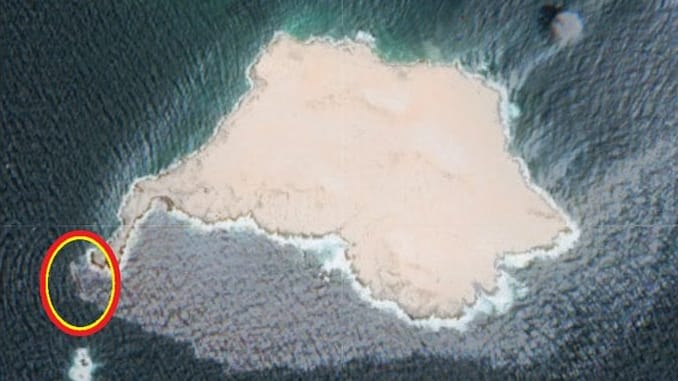
The Caroline Bezengi aground off Jazirat Al Qibliyyah on August 27, still leaking crude but looking intact (Copernicus/CJRC)

Published Aug 29, 2026 7:01 PM by The Maritime Executive


The latest imagery, taken on August 27, shows that the wreck of the VLCC Caroline Bezengi remains intact. The tanker is still leaking oil, but the leakage appears to be no worse than it was when last seen in imagery on August 22. The Caroline Bezengi has been beached on rocks off the southwest tip of Jazirat Al Qibliyyah, one of the Hallaniyat Islands off the coast of Dhofar in the southwest of Oman, since about June 23.  

On August 22, imagery was taken when seas were high and the top surface of the tanker deck was covered by waves. The latest imagery shows no deformation of the hull, but the tanker is likely to have settled deeper in the water.  

Ambrey, who is coordinating the salvage effort, has not released a press statement since the first issued on August 13, and there has been no coverage of the state of the wreck from the Oman News Agency, suggesting that for the moment there is no immediate crisis or fear that the tanker will break up.

The Oman Meteorology weather forecast for the area is showing Khareef conditions still set in, with rough seas, wave heights from 2 to 4 meters, and southwesterly wind speeds of about 25m/s (55 mph). There is no sign yet of a break in the weather, and indeed, according to forecasts, wave conditions are likely to worsen from September 3 onwards. Rough seas and strong winds will help with the dispersal of the leaking oil, a plume from which is still visible on surface water, spreading towards the North East.


The oil plume evidently from the Caroline Bezengi, August 27 (Google Earth/Copernicus/©CJRC)


In these conditions therefore, it is not surprising to see no sign of salvage activity either around the stricken tanker itself, or of Ambrey establishing its forward base on the island of Halliniyat, some 20nm to the west, where there is a tactical 1300m runway and a small protected harbor. Better conditions, more favorable for lightering operations and a potential refloat of the tanker, can be expected towards the end of September.

The Caroline Bezengi was hit by an explosion on June 8 while off the coast of Oman. The tanker had completed a transit of the Suez Canal on May 30 and had left the Maritime Security Transit Corridor when the explosion occurred. The crew was taken off without injury some four days later. The tanker was laden with oil taken on board at Novorossiysk and was destined for Gujarat, India. The tanker is sanctioned by the EU, UK, and US (OFAC), and has a past association with Russian state shipowner Sovcomflot

Ambrey has been called in to coordinate the salvage operation, to lighter off the cargo if feasible, and also to refloat and recover the tanker if its condition allows. Ambrey is also setting up an oil clear-up operation, to activate if this becomes necessary in the event of the tanker breaking up. 

Although Ambrey has formally been certified as a full member of the International Salvage Union only since May this year, it was responsible for the hugely challenging recovery of the Greek-registered Panamax Sounion (IMO 9312145), which was the subject of a sustained attack in the Red Sea by the Houthis in August 2024. After the crew of the Sounion had been evacuated by units from the EU’s Operation Aspides, the Houthis subsequently raided the tanker and set off fires using explosive charges. The Ambrey-coordinated operation landed a salvage crew back on the Sounion while it was still on fire and under Houthi threat, took the tanker under tow northwards, and managed to recover most of the cargo, thereby saving not only its value for the insurers but also averting an environmental catastrophe in the Red Sea. Ambrey therefore has the credentials and confidence to take on a complex and difficult salvage operation, which the recovery of the Caroline Bezengi is certainly proving to be.

China’s Expansion In Squid Fishery Poses New Maritime Security Challenges – Analysis


File photo. An Argentine Naval Aviation Command aircraft monitors a foreign fishing vessel during Operation Mare Nostrum II in the South Atlantic in late March 2025. (Photo: Argentine Ministry of Defense)


Key Takeaways

:A Milko Schvartzman study of 84 licensed Argentine squid boats finds firms under Chinese control own about 63% of the fleet versus ~18% Argentine capital—via two decades of buyouts, subsidiaries, and reflagging, not only high-seas IUU.

Analysts say the same companies can fish legally inside the EEZ and on the high seas, mixing catches and gaining Chinese tax treatment that undercuts Argentine exporters; FULASP puts foreign Southwest Atlantic harvests at 1.5–3 million tons a year versus Argentina’s 750,000–900,000.

Regional replies include Argentina’s Operation Mare Nostrum, a five-year U.S. maritime-patrol plan, Chilean and Peruvian patrols, and ~$1.82 million fines on two Chinese ships; the piece argues ownership and traceability still lag vessel watching.


The expansion of China’s fishing fleet in South American waters is no longer limited to the large concentrations of vessels operating on the high seas along the edge of the region’s exclusive economic zones (EEZs). Chinese companies have also expanded their presence within national fishing fleets through acquisitions, local subsidiaries, and the reflagging of vessels, allowing them to operate both inside and outside national waters.

Squid is at the center of that pressure. China’s distant-water fishing fleet, widely regarded as the world’s leading source of illegal, unreported, and unregulated (IUU) fishing, has deployed a harvesting capacity in the Southwest Atlantic unmatched by any coastal nation. Its presence — both on the high seas and within national fishing industries — creates new challenges for catch traceability, corporate oversight, and the sovereign management of marine resources.

Chinese capital dominates Argentina’s squid fleet

Companies controlled by Chinese capital now own nearly two-thirds of the vessels licensed to fish squid in Argentina, while Argentine capital accounts for just 17.9 percent of fleet ownership.

The findings come from China and the Control of Fishing Within Argentina’s EEZ, a report by Argentine marine conservation and illegal fishing expert Milko Schvartzman. The study analyzed the 84 vessels authorized to fish squid in Argentina’s EEZ, along with the permits, corporate records, and ownership structures behind them.

“There is a systematic process of foreign ownership and loss of sovereign control over the squid (Illex argentinus) fishery within the EEZ, where corporations under the direct and indirect control of China now manage 63.1 percent of Argentina’s squid fleet,” Schvartzman told Diálogo.


The findings broaden the discussion surrounding China’s fishing presence. The pressure no longer comes solely from the hundreds of vessels operating beyond the 200-nautical-mile limit that illegally enter Argentina’s EEZ. It also includes vessels legally authorized to operate within Argentina’s jurisdiction under the Argentine flag but controlled through Chinese capital, subsidiaries, or beneficial ownership.


Two decades of acquisitions and reflagging

The expansion did not happen overnight. Since 2005, Chinese companies have acquired Argentine fishing firms, established local subsidiaries, and reflagged their own vessels, gradually securing a significant share of the country’s offshore fishing fleet, Schvartzman explained.

The report identifies companies including China National Fisheries Corporation, Shanghai Fisheries Group Co. Ltd., Zhejiang Ocean Family Co. Ltd., Qingdao Haoyang Ocean Fishery Co. Ltd., and Dalian Huafeng Aquatic Products Co. Ltd. Through various corporate structures, these firms operate vessels licensed to fish inside Argentina’s EEZ as well as on the high seas.

The report highlights the cases of China National Fisheries Corporation and Shanghai Fisheries Group to demonstrate how corporate networks previously linked to illegal fishing incidents later became legally integrated into Argentina’s fishing sector. In other cases, Chinese companies simultaneously operate Argentine-licensed vessels inside the EEZ and distant-water vessels outside it to harvest the same migratory squid stocks.

That dual presence exploits gaps in oversight and transparency.

“The lack of oversight, transparency, and traceability, along with violations of Argentina’s Federal Fisheries Law, has enabled unfair competition, fisheries fraud, abuse of crew members, and allowed companies that own vessels involved in illegal fishing to operate on Argentina’s fisheries resources,” Schvartzman said.

According to Schvartzman, this structure creates a gray area in which companies involved in authorized fishing inside Argentina’s EEZ also maintain ties to vessels accused of illegal or unregulated fishing in other jurisdictions and on the high seas. Once catches from different sources are mixed at processing plants, it becomes difficult to determine which seafood was harvested under Argentine regulations and which originated in areas lacking effective oversight.

Vertical integration also provides commercial advantages. According to the report, Chinese regulations allow seafood caught abroad by Chinese companies to enter China as domestic products, qualifying for tax benefits unavailable to Argentine companies exporting to the same market. That imbalance strengthens the expansion of Chinese firms while reducing the competitiveness of Argentine operators.


A biologically fragile resource under growing pressure

The scale of extraction heightens the risk. The Latin American Fisheries Sustainability Foundation (FULASP) estimates that foreign fleets harvest between 1.5 million and 3 million metric tons of marine resources annually in the Southwest Atlantic. China accounts for the largest presence and harvesting capacity within those fleets, compared with the 750,000 to 900,000 metric tons landed annually by Argentina’s fishing industry, according to Infobae.

Between 400 and 600 Chinese fishing vessels operate in the region each year. While overall harvest levels increased 65 percent between 2019 and 2024, the Chinese fleet’s fishing effort grew by 85 percent during the same period.

FULASP Director Raúl Cereseto warned that squid “live only one or two years and play a central role in the food chain,” meaning that “a combination of overfishing and environmental change could soon force us to discuss not merely economic losses, but the depletion of resources that are essential to Argentina’s fishing industry and the entire South Atlantic ecosystem.”


Surveillance, cooperation, and sanctions: The regional response

Countries across the region continue to strengthen efforts against IUU fishing while maintaining maritime domain awareness of Chinese fleet activity in waters adjacent to their EEZs.

In early May, Argentine naval and air assets carried out the 11th edition of Operation Mare Nostrum, a maritime surveillance and control mission coordinated by the Armed Forces Joint Staff Joint Maritime Command.

The integration of ships and aircraft extends surveillance coverage and improves monitoring of Chinese fishing vessels operating along the edge of Argentina’s EEZ and in adjacent high-seas areas. According to Argentina’s Ministry of Defense, aerial surveillance allows authorities to rapidly scan vast maritime areas, identify fishing gear, and collect evidence of violations involving both squid jiggers and bottom trawlers operating in prohibited zones.

International cooperation is reinforcing those capabilities. Following the signing of a letter of intent in May 2026, Argentina is moving forward with a five-year plan with the U.S. Department of Defense to strengthen its maritime patrol, surveillance, and enforcement capabilities.

The program includes technology transfers, personnel training, and technical assistance, as well as new sensors, command-and-control systems, maritime patrol aircraft, and unmanned aerial vehicles capable of operating from the Argentine Navy’s offshore patrol vessels.

Chile’s Navy also conducted an offshore fisheries enforcement operation west of Iquique on July 6. Using a C295 maritime patrol aircraft and specialized personnel, the service detected two groups of foreign fishing vessels operating between 300 and 400 nautical miles offshore, outside Chile’s EEZ but within an area of responsibility established under international treaties and agreements.

In late June, the Peruvian Navy carried out an aerial and maritime surveillance operation in response to the presence of a foreign fleet targeting jumbo flying squid.

The operations conducted by Chile and Peru detected no incursions into their respective maritime zones but demonstrated the importance of maintaining an up-to-date operational picture of large fishing fleets operating near national maritime boundaries and capable of rapidly shifting between different areas of the Pacific.

Argentina has complemented surveillance efforts with economic sanctions. On July 22, the Secretariat of Agriculture, Livestock, and Fisheries of Argentina’s Ministry of Economy upheld fines totaling approximately $1.82 million against the Chinese vessels Bao Fengand Bao Win, which were detected carrying out movements and maneuvers consistent with fishing activity inside Argentina’s EEZ.

“Monitoring and deterrence measures are appropriate, but illegal fishing in the South Atlantic remains a critical problem, particularly because of the Chinese fleet’s efforts to conceal illicit activities,” Schvartzman said, calling for stronger enforcement “because China disregards labor regulations for its crews, jeopardizes maritime safety, and causes environmental damage in the South Atlantic.”


Beyond tracking vessels

China’s expanding control over the companies and vessels exploiting one of Argentina’s strategic marine resources may limit the country’s ability to identify beneficial owners, ensure catch traceability, and guarantee that fishing activities serve national priorities.
The challenge extends beyond fisheries enforcement and reaches the realm of national security. It affects crew welfare, the sustainability of marine resources, corporate transparency, and maritime domain awareness.

Enhanced aerial and naval surveillance, international cooperation, and economic sanctions demonstrate growing regional capacity to detect and respond to illegal activity. Yet these measures primarily target vessel behavior. Addressing the underlying structure requires countries to scrutinize beneficial ownership, share information on vessels and corporate owners, strengthen port and labor inspections, and ensure full traceability of seafood from the point of capture to the marketplace.


This article was published by Diálogo Américas


About Diálogo Américas
Diálogo Américas is a professional magazine published by U.S. Southern Command as an international forum for security issues in Latin America.
View all posts by Diálogo Américas →


Solar Has Crossed a Critical Economic Tipping Point

  • Solar now requires no more upfront capital than coal or gas to produce the same annual electricity, reversing a disadvantage that was as large as five-to-one a decade ago.

  • Batteries and wider grid flexibility still add real system costs, but firm solar-plus-storage is already competitive with new fossil generation in favorable markets.

  • For capital-constrained emerging economies, solar no longer means paying more today to save money tomorrow. Increasingly, it is the cheaper entry ticket as well.

For years, the economic case for solar came with an awkward qualification. Yes, it had no fuel bill. Yes, its operating costs were low. And yes, over the life of a project it could already produce cheaper electricity than a new coal or gas plant. But first, someone had to pay for it.

Solar concentrated most of its lifetime costs at the beginning. Fossil power appeared to ask for less capital upfront and spread the rest of the bill across decades of coal or gas purchases. In rich countries with deep capital markets, that distinction could be managed. In emerging economies facing high interest rates, limited public budgets and competing infrastructure needs, it could determine what was built.

That disadvantage has now largely disappeared. According to a new Ember analysis, a solar plant can now require less upfront investment than a coal or gas plant for the same amount of electricity delivered. A decade ago, solar could require up to five times as much.

This is not another claim that solar has become cheaper on a lifetime basis. That happened years ago. It is a more fundamental tipping point: solar is now competing with fossil fuels before the first tonne of coal or cubic meter of gas is purchased.

Fossil Power Has Lost Its Financing Shortcut

Comparisons between power technologies are often distorted by nameplate capacity. One megawatt of solar does not produce the same annual electricity as one megawatt of gas, because the sun does not shine continuously. Ember therefore compares the capital required to deliver the same quantity of electricity rather than simply matching the number printed on the generator.

That is the economically relevant comparison. In the past, solar needed considerably more installed capacity to produce the same annual output, while solar modules themselves were far more expensive. The resulting capital burden created a simple argument for fossil fuels: build the cheaper plant now and pay for fuel later.

Mass manufacturing has dismantled that argument. Solar PV's total installed cost has fallen by 87% since 2010, according to IRENA. Module production has become a vast, standardized industrial process. Efficiency has improved, supply chains have expanded and installation experience has accumulated across almost every major market.

Solar's capital profile has not changed, it still requires most expenditure upfront. The amount of capital required has.

That distinction is especially important in countries that import fossil fuels. A gas plant may look affordable on the day it is commissioned, but every megawatt-hour it generates creates another fuel purchase. Solar effectively prepays much of its energy supply for the next 25 to 30 years.

The old choice was between a capital-heavy clean asset and a cheaper fossil asset with recurring fuel costs. Increasingly, it is between two similarly priced assets, one of which arrives with a permanent fuel bill.

The Biggest Impact May Be Outside Rich Economies

Much of the energy transition debate is shaped by Europe, the United States and China. Yet upfront-cost parity may matter even more across fast-growing emerging economies.

These countries often face three pressures at once: rapidly rising electricity demand, high borrowing costs and dependence on imported coal, oil or gas. They need new power quickly but cannot always finance large, centralized projects on favorable terms.

Historically, this created a paradox. Solar offered lower lifetime costs and greater energy independence, but the country most in need of those benefits often faced the highest cost of capital. A project with no fuel expense could still lose to a fossil plant because investors placed more weight on today's financing requirement than tomorrow's import bill.

Upfront-cost parity weakens that trap. Solar is also modular. A country does not need to finance a multi-gigawatt plant in one decision. Capacity can be added in megawatts, expanded in phases and distributed across utility projects, businesses and households. Construction periods are shorter and failed projects do not strand the same concentration of capital.

This does not make finance irrelevant. Interest rates, currency risks, weak grids and uncertain offtakers can still make otherwise cheap solar projects unbankable. The IEA notes that access to commercial energy finance remains substantially weaker in emerging and developing economies than in advanced ones.

But financing a difficult project is different from financing a technology that begins with an inherent capital disadvantage. Solar increasingly faces the first problem, not the second.

Batteries Do Not Make the System Free—But They No Longer Break the Economics

The obvious objection is that annual electricity is not the same product as electricity on demand. A gas plant can generate at night and during a windless week. Solar cannot. A fair system comparison must therefore include some combination of batteries, grids, interconnection, flexible demand, hydropower, backup generation and, in some regions, long-duration storage.

Those costs are real. Pretending otherwise only replaces an outdated criticism of solar with an exaggerated defense of it.

But the flexibility premium is falling almost as quickly as the generation cost before it. IRENA estimates that battery storage costs have declined by 93% since 2010. Its latest assessment puts firm solar-plus-battery electricity at roughly $54–82 per megawatt-hour in high-irradiance regions. That compares with $70–85/MWh for new coal in China and more than $100/MWh for new gas capacity globally. IRENA expects the cost of firm solar to fall by another 30% by 2030.

This does not mean a four-hour battery can carry an entire electricity system through every seasonal shortage. Nor does it mean the same economics apply in Stockholm and Abu Dhabi. System costs rise with renewable penetration, local demand patterns and the duration of flexibility required.

Even Lazard's 2025 analysis, which confirms wind and solar as the cheapest and quickest new-build generation in the United States, stresses that the value of firm capacity rises as more weather-dependent generation enters the grid. Diverse resources will remain necessary.

The point is narrower, and more consequential. Once storage and flexibility are included, solar does not automatically become prohibitively expensive. In favorable markets, firm solar is already within the cost range of new fossil power. Elsewhere, the remaining gap is shrinking.

Intermittency is still an engineering constraint. It is increasingly losing its power as an all-purpose economic veto.

Fossil Plants Carry System Costs Too

Renewables are often asked to account for every cable, battery and backup plant needed around them, while fossil generation is compared at the plant gate. That is not a neutral comparison.

Gas plants require pipelines, import terminals, storage facilities and fuel contracts. Coal needs mines, railways, ports and stockpiles. Both face commodity volatility and supply disruptions. Dispatchability has value, but maintaining the fuel system that enables it is not free.

There is also a strategic difference between infrastructure and fuel. A battery, transmission line or solar panel can deliver services for years. Imported gas disappears the moment it is burned and must then be purchased again.

None of this eliminates the need for firm capacity. It changes how that capacity should be valued. Gas may retain an important role as backup in some systems, but a plant operating fewer hours must recover its fixed costs from less generation. Its electricity can become more expensive even if the plant remains operationally useful.

The future power system is therefore unlikely to be solar plus one enormous battery. It will be a portfolio: cheap solar and wind, batteries for daily shifting, stronger grids, flexible consumption, hydro and other dispatchable low-carbon sources where available, and limited thermal backup for rare shortages. That portfolio has costs. So does the fossil system it replaces.

The Debate Has Moved

For a long time, advocates could argue that solar was cheaper over its lifetime, while critics could answer that many countries could not afford the initial bill. That criticism was not invented. It was one of the transition's most serious bottlenecks.

Now it is being removed by industrial scale rather than political rhetoric. Solar has reached parity not only in the eventual price of electricity, but in the initial capital required to produce it. Batteries are following the same curve, turning firm clean power from a distant ambition into a competitive option in an expanding number of markets.

The transition still needs grids, flexibility and better financing. Solar has not solved every system problem. But fossil power has lost one of its last simple economic defenses: it is no longer necessarily cheaper to build today and pay for tomorrow

By Leon Stille for Oilprice.com