Friday, September 04, 2026

Why Oil Majors Don’t Want to Build New U.S. Refineries

  • Trump is pushing U.S. refiners to lower gasoline prices, but plants are already running near maximum capacity, leaving little room to boost fuel output quickly.

  • Global refining capacity is severely constrained, with more than 8 million bpd reportedly offline across Asia, the Middle East and Russia, driving record refining margins and tight fuel supplies.

  • Crude prices remain the biggest obstacle to cheaper fuel, with WTI around $90 per barrel amid the U.S.-Iran war, while new refinery capacity would take years to build.

U.S. President Donald Trump told oil producers and refiners that he wants lower gasoline prices, immediately, at a meeting at the White House this week.

As gasoline prices remain above $4 per gallon on average across the United States and drivers are heading for the most expensive Labor Day weekend gas prices on record, President Trump urged executives from Chevron, Marathon Petroleum, Valero Energy, and PBF Energy, among others, to raise refining capacity to increase fuel availability.

The problem for the U.S. Administration two months ahead of the mid-term elections is that American refiners cannot raise output in the short term. They have been running at full capacity for the entire summer, as the U.S.-Iran war has crippled crude and fuel supply out of the Middle East and depleted global inventories after many governments, including the U.S., tapped strategic resources to ease the worst supply disruption in the history of oil markets.

Refiners do not have an immediate solution to the high prices at the pump—except, of course, a major de-escalation and a lasting deal with Iran. But none of the significant levers to lower U.S. fuel prices are in the hands of the U.S. refiners.

No Easy Fix

At the White House meeting, the executives reportedly discussed efforts to boost existing capacity and, most of all, the Renewable Fuel Standard. Some refiners criticized the blending targets as unattainable, which are driving up gasoline costs, sources with knowledge of the closed-door meeting told Bloomberg.  

Moreover, U.S. refiners are not even entertaining the idea of building new refineries to ease potential similar supply crunches in the long term.Related: High Oil Prices Speed Up China’s Shift Away From Crude

Despite record-high margins and sky-high profits over the past few months, none of the refiners plan to build new crude processing facilities. Despite the deep pockets and the blockbuster profits this year, oil companies are unwilling to sink billions of U.S. dollars into a costly new construction venture that may not even be too profitable when it starts up in about five years, as fuel demand is expected to level off and even decline.

“Nobody’s going to go out and make a huge multibillion-dollar investment based on three months of record margins,” Robert Campbell, an analyst at Energy Aspects in New York, told the Wall Street Journal this week.

Maximum Capacity

Even smaller capacity additions and adjustments to current refining capacity would likely take months, and even years, to materialize and make any meaningful impact on America’s gasoline and diesel prices, analysts say.

“With refineries running at the closest pace to capacity in years, there's really no more room for U.S. refiners to process more oil- Venezuelan oil or anything else... refiners have been operating over 95% all summer long,” Patrick De Haan, head of petroleum analysis at GasBuddy, said this week.

Due to the tight fuel markets globally and peak seasonal demand, U.S. refiners have maximized capacity utilization rates this summer.

At the end of August, the total refinery utilization rate across the U.S. was 98%, with peaks of 103.5% in the Midwest and 99.8% in the Rockies, the EIA’s weekly petroleum status report for the week to August 28 showed.

U.S. gasoline and diesel exports have run at record levels in recent weeks as the global fuel market is tightening amid depleting inventories, supply bottlenecks in the Middle East and Russia, and peak summer demand.

The soaring U.S. refinery output has helped – a lot – the global market and has so far prevented it from tilting into a full-blown fuel crisis. U.S. refinery utilization has run consistently at above 95% for three consecutive months, the longest such run of high refinery runs since 2000.

The all-time high crack spread “is not a crude story. It is a refining story: Somewhere between 7 and 8 million barrels a day of global refining capacity is offline, and the gap is starting to show up at the pump,” said Chris Griggs, product marketing manager for Enverus Intelligence.

One of the top U.S. refiners, Phillips 66, also sees more than an 8-million- bpd refining capacity deficit at present.

Refining fundamentals are very tight and getting tighter with the issues in Russia and the Middle East, Brian Mandell, Executive Vice President of Marketing & Commercial at Phillips 66, said on the Q2 earnings call in early August.

“We have 7 million barrels a day of refineries down in Asia and the Mid East and another 1.4 million barrels down in Russia. And the refineries, depending on the damage and the ability to get spare parts, are going to take a good long time to get back online,” the executive added.

Phillips 66 expects high turnarounds in 2027 and 2028 and “likely more unplanned turnarounds in the near term as refiners push work out to take advantage of the higher margins,” Mandell noted, suggesting the U.S. refiners cannot and will not run at the current high utilization levels for much longer.

U.S refiners are doing all they can to sustain as high utilization and fuel production as they can amid the global crude and fuel supply disruptions.

But they cannot do this indefinitely, while the single biggest factor forming U.S. gasoline and diesel prices is the price of crude oil, which has soared this year due to the U.S.-Iran war. WTI Crude traded at about $90 per barrel early on Thursday, compared with $67 a barrel on February 28, the day on which the U.S. and Israel launched strikes on Iran.

By Tsvetana Paraskova for Oilprice.com

Bessent Says Strait of Hormuz Obsolete Within Two Years

Treasury Secretary Scott Bessent says Gulf oil producers could bypass the Strait of Hormuz within two years, putting a remarkably short timetable on a pipeline buildout that has accelerated since the Iran war disrupted one of the world’s busiest oil routes.

“That will be bypassed in two years,” Bessent said Tuesday during a discussion with Larry Kudlow at the G20 financial meetings in Asheville, North Carolina. He went further, predicting that “the Strait of Hormuz will be like a worthless piece of water” within that timeframe.

Gulf producers are already spending money in that direction.

Saudi Arabia pushed roughly 7 million barrels per day through its East-West pipeline to the Red Sea during the Hormuz shutdown, using Yanbu as an alternative export point. The route provided Saudi crude with a way around Hormuz, although tanker traffic through the Red Sea later faced its own problems from Houthi attacks near Bab el-Mandeb.

The UAE has a more direct workaround. ADNOC plans to build its West-East 1 Pipeline and double oil export capacity through Fujairah, which sits outside Hormuz, from 1.8 million bpd to 3.6 million bpd. The project is expected online in 2027.

Iraq is pursuing several exits of its own. A proposed pipeline through Syria to the Mediterranean could cost at least $15 billion and take four years to build. Iraqi officials are also discussing repairs to an older Syria pipeline and increased shipments through the Kirkuk-Ceyhan system into Turkey.

Kuwait has discussed connecting its oil infrastructure with Saudi Arabia and the UAE, giving its crude access to Fujairah or Red Sea ports. Japan, heavily dependent on Middle Eastern crude, has agreed to participate financially in Gulf pipeline projects.

The incentive got another reminder Monday. Two tankers attempting to leave Hormuz were struck by projectiles, according to maritime security consultant Marisks, following another exchange of strikes between Iran and the United States.

Bessent’s two-year forecast would require several of these projects to move quickly. The investment already underway shows Gulf producers are no longer treating Hormuz bypass capacity as a contingency plan. They are building it into the export system.

By Julianne Geiger for Oilprice.com

Baltic Dry Index Breaks Out as a “Perfect Storm” Hits Shipping

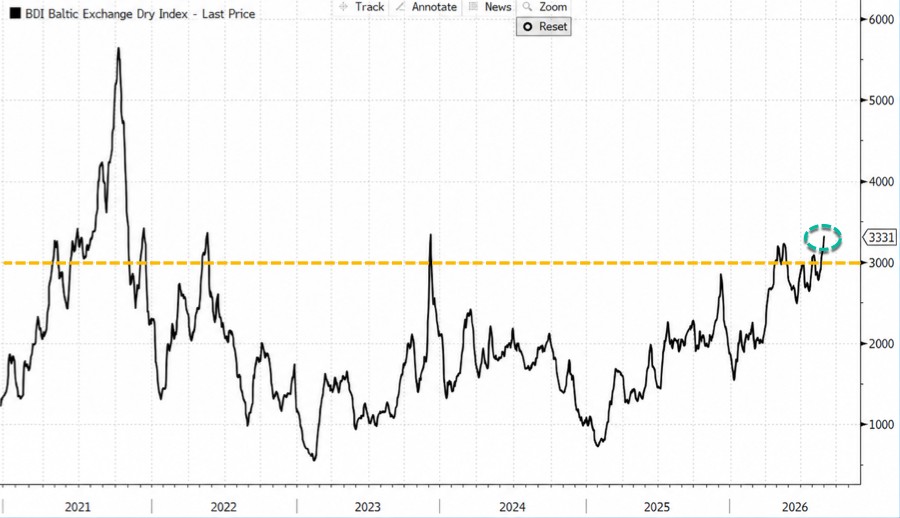
The daily benchmark measuring the cost of shipping raw materials across major global maritime routes is breaking out to a nearly three-year high this week, as Bloomberg reports that typhoons are squeezing the supply of Capesize vessels just as mining companies increase iron ore shipments across the Pacific and Atlantic.

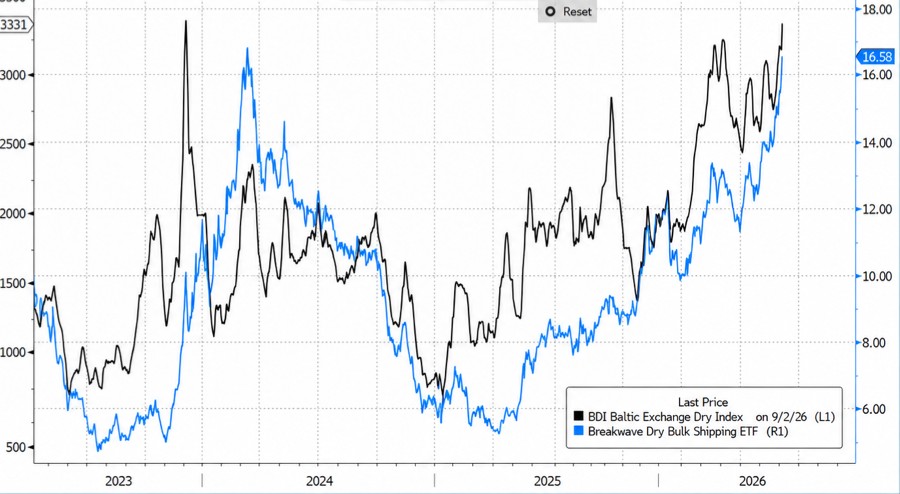
The Baltic Dry Index, which tracks freight rates for several vessel classes, including Capesize, Panamax and Supramax vessels, jumped 5.5% to 3,331 points in London on Wednesday, its highest level since December 2023. The index is nearing a technical breakout as analysts at brokerage Thurlestone Shipping warn that a "perfect storm" is developing.

"We see the current surge as something of a perfect storm, with vessel supply tightening and demand firing in both basins at the same time," Thurlestone Shipping analysts said.

Maritime operations in the Pacific have been disrupted by a series of typhoons this summer, delaying vessels and reducing the amount of effective tonnage available to exporters. At the same time, Australian miners are ramping up shipments as maintenance programs wind down, while upgraded transshipment operations are boosting ore flows from Guinea's giant Simandou deposit.

The BDI's ascent comes as dry-bulk carrier stocks have soared, outperforming even tanker operators as investors price in stronger freight earnings and widening maritime bottlenecks.

The best tactical trade on rising BDI is the BDRY ETF. 

"The market enters the latter part of the third quarter with a relatively high freight-rate floor just as Pacific typhoon activity typically becomes more disruptive to port operations," said Wilson Wirawan, head of dry-bulk shipping research at BRS Shipbrokers. He added, "Resulting delays and vessel inefficiencies, if any, could further tighten effective tonnage availability, adding another layer of support to an already firm Capesize market."

The world's major maritime shipping routes are tightening again. Weather disruptions, longer voyages and surging demand are boosting freight costs, delivering a windfall to shipowners while pushing up transportation costs for iron ore, coal and grain.

By Zerohedge.com

UK Shipbuilding and RFA Mark Milestone as Keel is Laid for Support Vessel

keel block shipbuilding new UK support ship
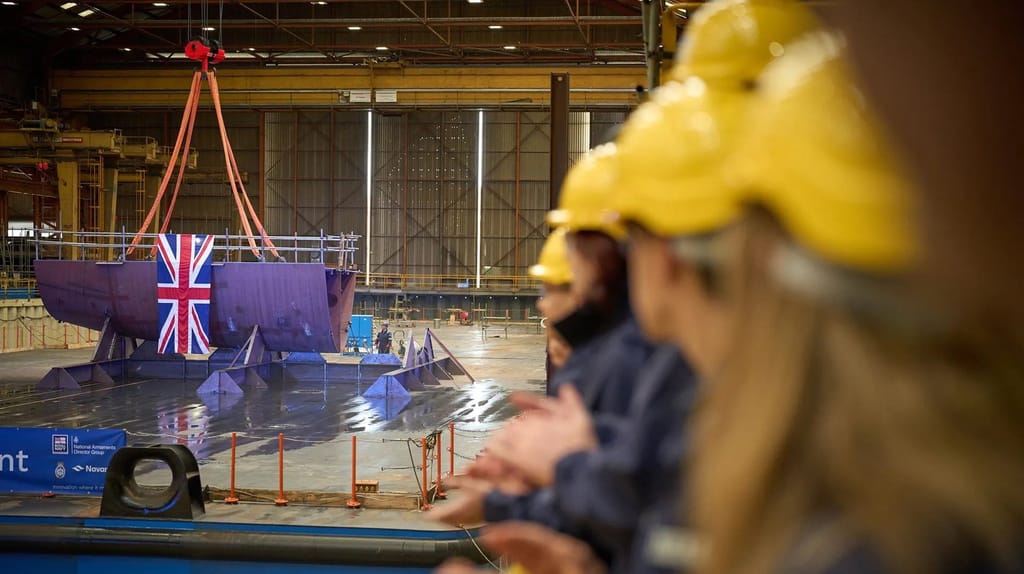
Keel block ceremony for the UK's first Fleet Solid Support vessel (Royal Navy)

Published Sep 3, 2026 5:05 PM by The Maritime Executive


Officials from the UK’s Ministry of Defence, the Royal Navy, the Royal Fleet Auxiliary, and Navantia UK gather at the Appledore shipyard on September 3 to witness the ceremonial keel laying for the first of three Fleet Solid Support vessels for the RFA. A long time in coming, it marks more than just a shipbuilding milestone, as it is a key addition to the RFA and the revitalization of shipbuilding at Appledore and the Harland & Wolff Group, acquired by Navantia.

“Today is an important moment for Fleet Solid Support, for Appledore, and for the renewal of UK shipbuilding,” said Donato Martínez, CEO of Navantia UK. “The laying of the keel marks the formal start of assembly of the first ship and is clear evidence of the momentum we have built across the programme.”

The ceremony took place on Merchant Navy Day, which celebrates the UK’s civilian seafarers, including the men and women of the Royal Fleet Auxiliary. It involved putting the first block, a section of the bow of the future RFA Resurgent, onto the Seahorse barge in Appledore’s dry dock. The barge was built at Navantia UK’s Methil Yard and will carry completed blocks to the Harland & Wolff yard in Belfast. Other portions of the FSS vessels are being assembled at Navantia’s yard in Cadiz, Spain, with final assembly for the vessels at the yard in Belfast.

The program began in 2023 but was challenged by the insolvency of Harland & Wolff, which was rescued by Navantia. Today’s ceremony marked the next critical step following the start of test block construction at Appledore in August 2025, the completion of the Critical Design Review in October 2025, and the cutting of the first steel at Appledore in December 2025. 

During the keel-laying ceremony for RFA Resurgent, head of the Royal Fleet Auxiliary, Commodore Sam Shattock, also revealed the second and third vessels would be named RFA Reliant and RFA Resourceful. He noted that RFA Resourceful is a new name embodying the spirit of the project while Resurgent and Reliant are names with storied histories for the Royal Navy. Shattock said the names are intended to convey values associated with the role that Fleet Solid Support Ships will play for the fleet. 


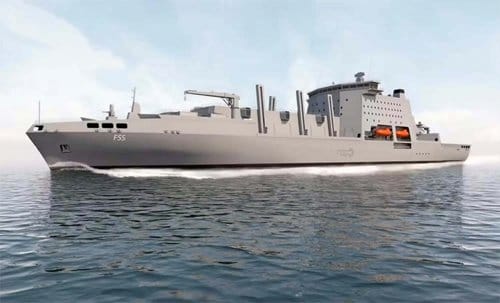
Rendering of RFA's new Fleet Solid Support vessels (Royal Navy)


At around 39,000 tonnes and 216 meters (708 feet) long, the vessels will be the largest ships in UK military service after the Queen Elizabeth-class aircraft carriers. They will provide logistical and operational support, including counter-piracy and counter-terrorism missions, and will collaborate with allies on operations. Each ship will have a core RFA crew of 101, with accommodation provided for an additional 80 personnel operating helicopters, boats, or performing other roles when required. The three Fleet Solid Support ships are designed to provide munitions, stores and provisions to Royal Navy task groups at sea.

As the project proceeds, it also marks the restoration of shipbuilding at Appledore, which had ceased operations when it was acquired by Harland & Wolff in 2020. The executives called it a significant moment in the regeneration of Appledore, which is undertaking its first shipbuilding activity since the completion of the Irish Naval Service offshore patrol vessel LÉ George Bernard Shaw in 2019. 

Appledore today has a workforce that has grown to 210 people as part of Navantia UK’s investment of around £15 million at Appledore as part of more than £157 million across the four yards of the group. A new roof was put on the building hall at Appledore, as well as plasma-cutting equipment and a new pipe shop. Navantia looks to leverage this project and to position the UK operation to participate in the government’s planned investment in the Royal Navy in the coming years.


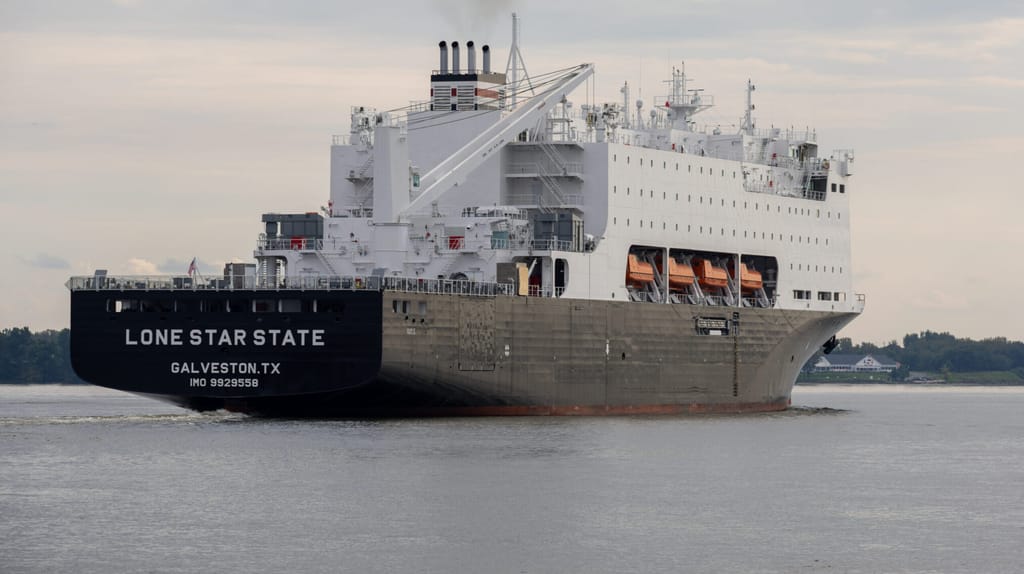
Texas A&M Maritime Academy Training Ship Lone Star State is Heading Home

Lone Star State Texas A&M Maritime College

Published Sep 3, 2026 9:24 PM by The Maritime Executive

[By Ryan Anderson, Division of Marketing & Communications, Texas A&M Maritime Academy]


For nearly two decades, the Texas A&M Maritime Academy has waited for their ship to come in. The waiting ends on Tuesday, September 8th at 10 a.m. as the Lone Star State docks in Galveston, ending a journey that began at the Hanwha Philly Shipyard. With the arrival of a new training ship, a new chapter of Texas A&M Maritime Academy’s critically important role of preparing mariners to perform vital roles supporting the Blue Economy begins.

“We have dreamed of this day for 21 years,” said Col. Michael E. Fossum, ’80, vice president of Texas A&M University, chief operating officer of the Galveston campus, and superintendent of the Texas A&M Maritime Academy. “Today, we celebrate a team that has simply refused to give up. To our Texas congressional delegation, state elected officials, former students and industry leaders, thank you for your support helping us support the nation’s $1.5 trillion blue economy.” 

The Texas A&M Maritime Academy has been without a dedicated training vessel since Texas Clipper II was reassigned in 2005 by the federal government after serving in disaster response efforts for Hurricanes Katrina and Rita. Bringing the Lone Star State home to Galveston is the culmination of decades of sustained institutional effort, investment and partnership to bring a new training ship to the Texas A&M Maritime Academy.

“To finally see this ship sailing into Galveston flying our colors is the realization of an over two-decade long dream,” said Capt. Allan Post, Deputy Superintendent, Texas A&M Maritime Academy. “This cements the legacy of our academy in training future mariners for the global maritime need. The Texas A&M Maritime Academy is not just a local or regional institution but represents a pillar of America’s maritime strategy to ensure that our goods are shipped throughout the world and that our strategic needs are met in times of crisis.”

Arriving during a year of celebrations for the 150th Anniversary of Texas A&M University and the 65th anniversary of the Galveston Campus, the TS Lone Star State expands the capacity to educate and train the maritime workforce, conduct real-world operational training and serve state and national needs. 

The Texas A&M Maritime Academy is one of six state Maritime Academies in the U.S. and the only one located on the Gulf coast. The academy partners with Texas A&M’s College of Marine Sciences and Maritime Studies to provide U.S. Coast Guard-required training to become a ship officer through integrated degree programs spanning engineering to humanities. In addition to an undergraduate or graduate degree, students earn a U.S. Coast Guard officer license that is required to serve in high-ranking positions on commercial and military vessels. Industry demand for licensed maritime professionals has surged over the past three years and provides lucrative career opportunities. 

“Mariners are the backbone of the nation’s security and economic prosperity,” Fossum said. “Jobs span every sector in the U.S., and industry pay and employment conditions are the best they’ve been in decades.” 

The Texas A&M Maritime Academy and the College of Marine Sciences and Maritime Studies are located at Texas A&M’s specialized marine, coastal and maritime branch campus, Texas A&M University at Galveston. Through university, state, and national investments, the campus has transformed in recent years into an educational ecosystem that connects the knowledge and research needed to understand oceans and coasts with the workforce and operational expertise needed to work within them. 

Uniquely positioned on the edge of the Gulf with direct access to the Houston and Galveston ports, it is at the intersection of the people, industries, communities, and environments it was created to serve. The arrival of TS Lone Star State significantly expands the Galveston Campus’s capabilities to advance its sea-grant mission, especially when combined with the breadth and resources of Texas A&M. 

TS Lone Star State is the fourth National Security Multi-Mission Vessels (NSMV) specially built for the state maritime academies to address the critical shortage of mariners Its arrival builds on state and federal investments that have helped transform the Galveston Campus. In the past two years, enrollment has surged, infrastructure investments are underway, professional education and training have launched and academic options have expanded to support shore side and inland maritime careers.

Congress approved $325 million in funding to construct the NSMV in Dec. 2020. The 524-foot state-of-the-art ship represents a significant investment by the federal government in supporting the future of the maritime industry and future merchant mariners in Texas. The vessels have numerous training spaces that can support up to 600 cadets at sea and include critical disaster response capabilities in the Gulf. A campus and community-wide celebration of the Lone Star State will be held at the Galveston Campus on November 21, 2026. In the meantime, TS Lone Star State’s inaugural voyage to its home port is available here

The products and services herein described in this press release are not endorsed by The Maritime Executive.


Study: EU Scraps Ships in South Asia While EU Capacity is Underutilized

ship recycling
The EU fails to use its approves recycling capacity and instead sends ships to Asia according to a new report (GMS file photo)

Published Sep 1, 2026 3:31 PM by The Maritime Executive


The European Union (EU) is facing increased criticism for approving a growing number of ship dismantling and recycling facilities that largely remain idle while European end-of-life tonnage continues to be scrapped in South Asia’s yards. Environmental groups have increased their opposition after the European Union proposed including the first Indian recyclers on its approved list of facilities.

The NGO Shipbreaking Platform has sustained its attack on the EU for sending ships to be dismantled in South Asia despite having sufficient domestic recycling capacity. The organization, in partnership with activist NGO Transport & Environment (T&E), released a new study that shows that recently, the EU has managed to increase the capacity of its ship recycling facilities. 

Currently, they argue the EU has 30 yards with a combined capacity of approximately 1.3 million light displacement tonnes (LDT). But they highlight that the EU-located ship recycling facilities are underutilized, with a vast majority of the vessels owned or flagged in the EU being dismantled in India, Pakistan, and Bangladesh. Between 2019 and 2025, they assert the EU utilized only five percent of its dismantling capacity.

The study shows that during the period, a total of 706 EU-flagged and/or EU-owned ships were dismantled worldwide, representing around 6.7 million LDT. Of the number, only 153 ships (22 percent) were recycled in an EU facility. In essence, this constitutes only five percent of the total tonnage. The groups argue that this is an indication that the EU continues to send end-of-life tonnage to be scrapped under poor environmental and safety standards in Asian countries.

The report calculates that during the same period, 345 EU-flagged and/or EU-owned ships representing 49 percent of the total were beached in India, Bangladesh, and Pakistan. That constituted 66 percent of total tonnage. The remaining ships were dismantled primarily in Turkey. The study indicates that 102 ships swapped their EU flag to another flag shortly before dismantling to avoid stricter EU rules.

“This is not just an environmental issue. It is a profound failure of EU industrial strategy, prioritizing strategic resilience and material autonomy on paper, while in reality letting valuable steel be lost to third markets,” said Philippine Bernard, NGO Shipbreaking Platform - Policy Officer.

The Platform is criticizing the EU for projecting double standards. Despite the EU’s Ship Recycling Regulation requiring EU-flagged vessels to use its approved facilities, it alleges that allowing scrapping in substandard yards in South Asia shows an inability or unwillingness to enforce the regulations.

The latest study builds on a similar one published by the two NGOs in 2018 that also showed the EU has often had enough recycling capacity, both in terms of LDT and size, to recycle all EU-flagged vessels. The shipping industry, however, continues to argue that the approved list of yards lacks capacity, justifying the reflagging practices and pushing for the inclusion of South Asian beaching yards on the EU list. 

The NGOs are pushing the EU to utilize its yards for tonnage scrapping at a time when the number of ships approaching the end of their life is expected to rise. Over the next decade, about 12,000 EU-owned ships are expected to be ready for recycling.

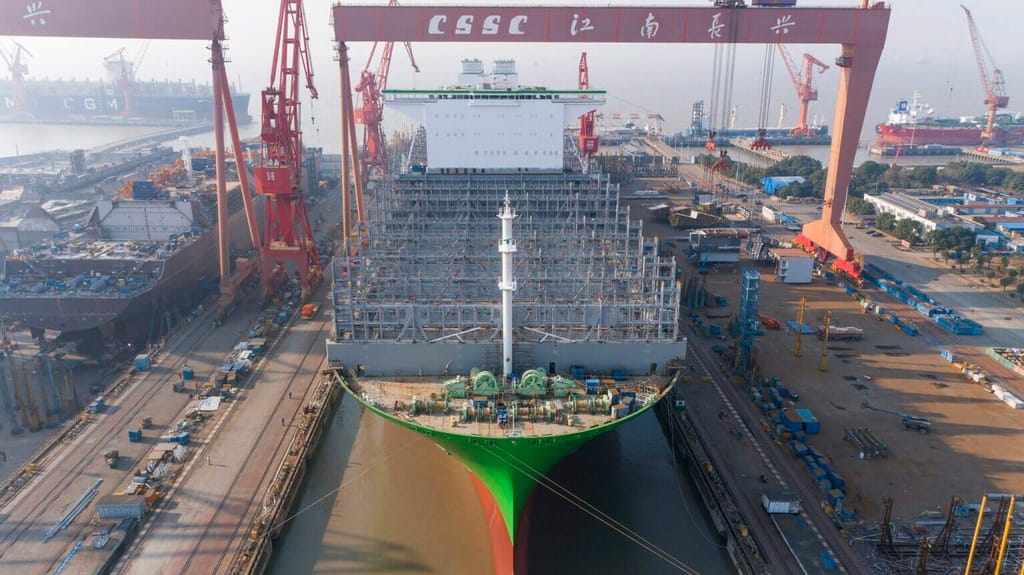
Container Fleet Smashes 34M TEU Record as Fleet Growth Accelerates

containership construction
Driven by new construction, containership capacity just surpassed 34 million TEU (file photo)

Published Sep 3, 2026 4:34 PM by The Maritime Executive

Growth in the container segment of the shipping industry has been making headlines for a long time, but it just smashed through a record. Surpassing the 34 million TEU mark, trade group BIMCO says the growth has accelerated and is reshaping the sector.

According to BIMCO’s calculations, global container fleet capacity was just 8,000 TEU below the 34 million TEU mark as of the beginning of September. It reported the milestone would be reached after only a few of the 46 ships (totalling 286,000 TEU) scheduled for September delivery enter into service.

Indeed, by AlphaLiner’s figures, the industry is there. In its ranking of the Top 100 carriers, AlphaLiner sets the fully cellular capacty is at 34.2 million with 6,822 fully cellular vessels representing 412 million dwt in active service. (Total capacity according to AlphaLiner for all types of vessels is already over 34.6 million TEU.) 

"When the world’s shipyards deliver just a few more container ships, the global fleet capacity will for the first time reach 34 million TEU,” said Niels Rasmussen, Chief Shipping Analyst at BIMCO. “At that time, the fleet will have grown by 10 million TEU - or 42 percent - in just five and a half years.”

BIMCO highlights that the latest addition of 10 million TEU, achieved in just five and a half years, is also a record. In comparison, it says it took the industry 10 and a half years to go from 14 to 24 million TEU.

“The growth we have seen reflects a combination of record-high new ship deliveries and remarkably low ship recycling activity,” said Rasmussen. “Less than 300,000 TEU have been recycled over the last five and a half years. The last time recycling activity was this low during the same time frame was between early 2004 and mid-2009, when the fleet was only one-third of its current size.”

Due to the low rate of recycling, BIMCO calculates that the share of older ships has increased considerably. Nearly 2,000 ships contributing more than 5 million TEU of capacity are now 20 years old or older. Within the next five years, it says these ships will have reached or exceeded the historical average recycling age of 25 years and therefore represent the natural recycling potential for the coming years.

“Depending on recycling activity, the fleet could add another 10 million TEU and reach 44 million TEU within five years. The order book already includes more than 14 million TEU scheduled for delivery by the end of 2030,” said Rasmussen. “Even if every ship currently aged 20 years or more is recycled by then, supply growth will remain high, particularly if normal Suez Canal routings resume and release the capacity now absorbed by diversions around the Cape of Good Hope.”

As the growth has accelerated, it has also changed the composition of the sector. Ships larger than 12,000 TEU have contributed two-thirds of the 10 million TEU added since early 2021. As a result, the largest ships’ share of fleet capacity has risen from 30 to 40 percent while the average containership size has increased by 14 percent. Where once 18,000 TEU ships were considered massive, capacity has increased by a third, with the largest ships having ticked in just above 24,000 TEU, and it takes a capacity of 20,000 TEU to be in today’s ultra-large category.

The fleet’s ownership structure has also changed significantly over the past five and a half years, says BIMCO. Liner operators account for 85 percent of the added 10 million TEU and now control 65 percent of fleet capacity, up from 57 percent in early 2021.

Based on AlphaLiner’s league tables, the top eight carriers are each above a capacity of 1 million TEU, and collectively are nearly a capacity of 28 million TEU. Only one of the top eight carriers is below a capacity of 2 million TEU. 

The most dramatic growth is MSC Mediterranean Shipping Company. MSC is at nearly 7.4 million TEU, making it more than 50 percent larger than the second-largest, Maersk. Reports have highlighted the continued growth based on the orderbook for the top carriers, noting that unless Maersk moves to add capacity as early as next year, it could fall to number three or four as CMA CGM, COSCO, and Hapag-Lloyd all continue to add capacity.

The sector’s leading executives have openly expressed concerns about near-term overcapacity. However, it is not stopping them from ordering even more containerships.


Cruise Ship Mein Schiff 7 Completes Methanol Bunkering Demonstration

methanol bunkering of cruise ship
In the demonstration, 25 cubic meters of methanol were loaded aboard Tui Cruises' Mein Schiff 7 (MB Energy)

Published Sep 1, 2026 7:48 PM by The Maritime Executive


A demonstration bunkering and trial of methanol was completed with the cruise ship Mein Schiff 7, which was also the first cruise ship to be built methanol-ready. According to TUI Cruises and the companies supplying and bunkering the methanol, it was a critical test to demonstrate that the systems exist to use the emerging fuel for the cruise sector.

Mein Schiff 7 (115,000 gross tons) was delivered in 2024 with designs to be the first cruise ship to be methanol-ready. The cruise line said at the time it was waiting for additional parts but anticipated it could proceed with tests by 2026. While it is using low-sulfur diesel for propulsion, it was now able to proceed with the demonstration bunkering.

The cruise ship was supplied with 25 cubic meters of methanol from renewable feedstocks. MB Energy provided the fuel, which was loaded from a truck operated by Johs. Martens. TUI Cruises reports the fuel will be used primarily for boil operations onboard.

“The operation shows that lower carbon fuels like methanol from renewable feedstocks can already be integrated into cruise operations in a safe and reliable way,” says Jonathan Perkins, CEO of MB Energy.

By safely and reliably supplying methanol to the large cruise ship with around 2,900 passengers on board, and while multiple simultaneous operations were happening at the pier, MB Energy and TUI Cruises said they have jointly demonstrated system readiness for this mode of delivery. This proof of concept, they said, provides valuable operational experience for the future. 

MB Energy highlights that it is working to support the maritime sector’s transition to more sustainable operations. The company says it is currently developing its storage infrastructure in Hamburg-Blumensand to be “methanol-ready,” enabling the supply of larger volumes of lower carbon ammonia and methanol to maritime customers in the future. Hamburg and Kiel will serve as the company’s primary operational hubs in northern Germany, with the flexibility and ambition to also supply other European ports. 

Jörg Umann, Director Strategic Planning, Treasury, IR and Fuel at TUI Cruises noted, “For TUI Cruises, this project provided valuable operational experience with the supply and handling of certified renewable methanol under real operating conditions. While the methanol from renewable feedstocks supplied during this operation is used for boiler operations rather than propulsion, projects like this help us better understand how alternative fuels can contribute to reducing emissions as part of a broader carbon reduction strategy.”


Mein Schiff Relax bunkers with bio-LNG (TUI Cruises)


It is also part of TUI Cruises’ broader effort to expand its sustainable operations and reduce emissions. The company built two LNG-fueled cruise ships in its new InTUItion-class (Mein Schiff Relax and Mein Schiff Flow, each 157,651 gross tons). They can use LNG or marine gas oil for propulsion, or they can also use renewable LNG (bio-LNG or e-LNG) without technical modifications.

The company ran tests twice bunkering Mein Schiff Relax with bio-LNG in 2025. This year it is using the renewable fuel for its entire summer season in Northern Europe. Her sister ship Mein Schiff Flow also began regularly bunkering with bio-LNG this year in Barcelona. It will continue to use the renewable fuel through its winter season during cruises from Hamburg.

 TUI was the first of several cruise lines to begin exploring methanol. Disney Cruise Line also prepared its new ship Disney Adventure to sail on methanol but, saying that green methanol was not expected to be readily available in its Singapore homeport, the ship would operate on a mix of sustainable and low-emission fuels, such as Hydrotreated Vegetable Oil (HVO). Celebrity Cruises built a ship in France for which Wartsila converted the engine to be tri-fuel, including the ability to handle methanol. Norwegian Cruise Line, working with Fincantieri, also announced that the fifth and sixth ships of its Prima class would be designed for methanol, while the cruise line was also working with Everllence (MAN) to explore methanol conversions for its existing cruise ships.


SeaDream Announces Plans for New Yacht Cruise Ship in 2029

SeDream yacht cruise ship
SeaDream revealed plans for a new, much larger yacht cruise ship versus its two 4,300 GT pioneers that are now 43 years old (SeaDream)

Published Sep 2, 2026 4:46 PM by The Maritime Executive


SeaDream Yacht Club, an operator of two small yacht cruise ships, announced plans to add a third, larger cruise ship to its fleet in 2029. It comes as the market is undergoing rapid growth and with the company’s two ships now 42 years old.

Plans for SeaDream III were unveiled on September 1, with the company reporting it was opening reservations for the July 10, 2029, maiden voyage from Hong Kong. The company announced an elaborate inaugural year that will see the ship sail from the Orient to Southeast Asia, Indonesia, Australia and New Zealand, India, Arabia, the Mediterranean, Northern Europe, and then across the Atlantic in the fall of 2030 to Canada, the United States, and the Caribbean. On January 5, 2031, it is scheduled to sail the line’s first-ever world cruise, 180 days ending in London.

SeaDream tells The Maritime Executive that the vessel is currently in the engineering phase. It will be built by China Merchants Cruise Shipbuilding in coordination with European engineering and technical suppliers. Plans call for the new ship to be 16,500 gross tons versus its current vessels, which are just 4,333 GT.

Many of the details were not revealed for the new ship, but it will have accommodations for 230 passengers versus the current ships, which each carry just 112 passengers. The new ship will be 151 meters (495 feet) in length and have a crew of approximately 200. SeaDream is emphasizing it will “remain rooted in the defining qualities” of its operation, including an intimate yachting style and personalized service.

The line says that open-air living will be at the center of the design of the new ship, with expansive upper decks, a dedicated pool deck, indoor and outdoor dining spaces and three dedicated watersports marinas. It will also feature an expanded spa and fitness and wellness offerings. SeaDream says every space on the new ship has been reconsidered rather than simply being enlarged. It calls the new ship the next evolution of its experience, building on the iconic design of its two current ships.

The company says there will be a greater selection of passenger accommodations. But unlike others in the ultra-luxury category, which are emphasizing all suites with private balconies, 20 of the staterooms on the new ship will not have balconies.

“SeaDream III has been designed not only to travel farther, but to bring guests closer to the places she visits,” said Atle Brynestad, founder and owner of SeaDream Yacht Club. “Her size will allow her to reach distinctive harbors and sail globally while maintaining the highly personalized experience our guests expect. This deployment reflects the spirit of SeaDream: unhurried exploration, exceptional service and access to places best experienced by yacht.”

The two ships, SeaDream I and SeaDream II, were pioneers in the modern ultra-luxury category, introduced in 1984 and 1985 as the SeaGoddess I and SeaGoddess II. A small private company, it, however, faced severe financial challenges with the ships being chartered in 1986 and later sold to Cunard before shipbuilder Wärtsilä could foreclose and sell the ships to Kloster’s Royal Viking Line. The ships were transferred to Seabourn Cruise Line in 1999 after Carnival Corporation acquired the company, and in 2001 were acquired by Brynestad, who had also been the founder of Seabourn in 1987.

The two ships have built a loyal clientele and niche following, building on the yacht-style experience. They were last refurbished in 2023 and 2024.

SeaDream had announced plans in March 2019 to build its first new cruise ship. It entered into an agreement with Damen for a Polar 6 class ship that was to be 155 meters (508 feet) in length. The ship was to have entered service in September 2021, but the order was canceled after just a few months.


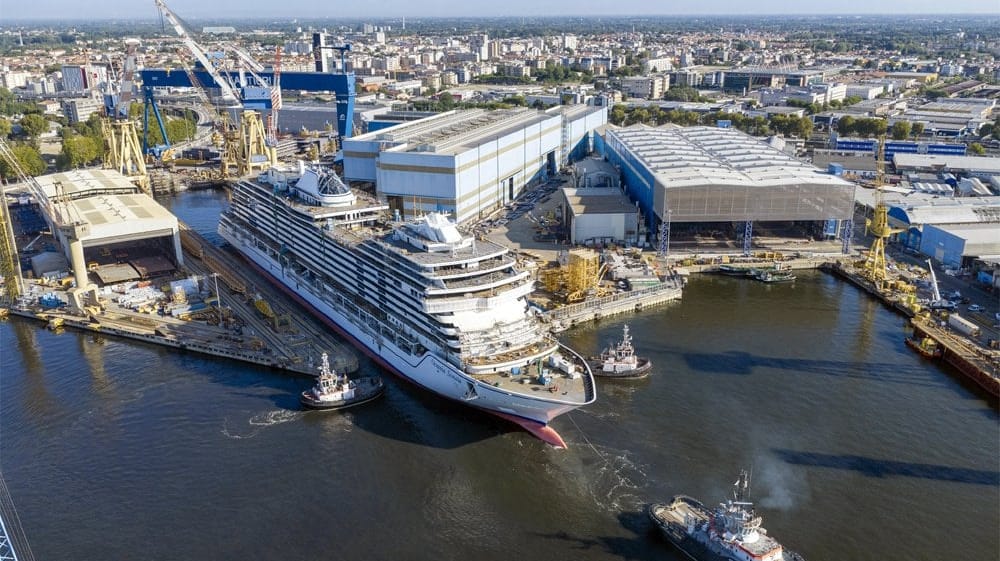
Fincantieri Floats First Next-Generation Cruise Ship for NCLH's Oceania

cruise ship leaving building dock
Oceania Sonata leaving the building dock as the first of a next-generation class of larger luxury cruise ships (Oceania Cruises)

Published Aug 27, 2026 4:19 PM by The Maritime Executive


Fincantieri and Oceania Cruises, a brand of Norwegian Cruise Line Holdings, marked the float-out of the first of a new generation of cruise ships as NCLH moves forward with a strategy to align the fleet with the enhanced luxury positioning of the brand. The launch came the same day as the first of the line’s oldest ships prepared to leave the fleet.

The new ship, named Oceania Sonata, was christened and floated out at the Fincantieri shipyard in Marghera, Italy. She was moved from the assembly dry dock to the fitting out berth for completion of her interior spaces. She is scheduled to enter service in 2027.

"The float out of Oceania Sonata is an incredibly exciting moment as we move one step closer to welcoming our first guests aboard next August," said Jason Montague, Chief Luxury Officer of Oceania Cruises. “As the first ship in our new Sonata Class, she represents the beginning of an exciting new chapter for the brand and a defining milestone in the continued evolution of Oceania Cruises."

The line highlights that the ship, at 86,000 gross tons, will be approximately 30 percent larger than the prior class, Allura and Vista (68,000 gross tons), and will increase passenger capacity by just 15 percent from 1,200 to 1,390 passengers with the addition of 90 staterooms. The line says the Sonata class is designed in keeping with the brand positioning to provide more space, elevate accommodations, and enhance the culinary experiences aboard. A third of the accommodations will be suites, including four Owner’s Suites and two new suite categories. Oceania Sonata will feature 13 dining venues.


Oceania Sonata is 30 percent larger than the lines' prior cruise ships (Oceania Cruises)


Construction began with the steel cutting in June 2025. NCLH has now expanded the order to a total of five ships, with a sistership, Oceania Arietta, starting construction for delivery in 2029. Three more sisters will deliver in 2032, 2035, and 2037. 

The recently appointed CEO of NCLH, John Chidsey, says this is part of a “deliberate portfolio action … that better supports the brand’s positioning and long-term return profile.”

One of the line’s smallest and original ships, Oceania Regatta (30,000 gross tons), completed its final cruise for the line on August 27 in Istanbul. The line ultimately acquired four of the 684-passenger ships, but they have been outclassed by newer and larger ships designed to emphasize greater luxury. Oceania introduced the sisters Riviera and Marina (66,000 gross tons) in 2011 and 2012 and Vista and Allura (68,000 gross tons) in 2023 and 2024, all also built by Fincantieri.

The Oceania Regatta is starting a two-year charter to Australia-based My Cruises, which will operate the cruise ship on 365-day world cruises. The first begins on September 1 from Italy. Under the terms of the charter, it can be extended, or the ship can be sold to a third-party cruise operator.

Two of the other sisters are also slated for changes. Oceania Sirena was sold and will be delivered to its new owners in the spring of 2028. Oceania Nautica will be “reimagined” as Oceania Aurelia in 2027 for the luxury long cruise market. The ship’s accommodations will be reworked with 179 of the ship’s 238 cabins designed as suites. The total number of cabins is being reduced from 340 to 238 as they enlarge rooms to create more suites.

The changes are part of a broader strategy to improve the financial performance of Norwegian Cruise Line Holdings. The corporation is undertaking a fleet modernization across its three brands and reworking operations and costs after an activist shareholder demanded changes.