Thursday, October 15, 2026


China Merchants Energy Shipping & RINA to Explore AI-Driven Ship Operations

China Merchants Energy Shipping and RINA Partner to Explore AI-Driven Ship Operations and Next-Generation Maritime Technologies

[By: RINA]

China Merchants Energy Shipping (CMES), one of the world's leading shipping and maritime transportation companies, and RINA, the multinational inspection, certification, ship classification and engineering consultancy group, have signed a Memorandum of Understanding (MoU) establishing a framework for strategic cooperation across maritime safety, digitalisation, operational excellence and emerging shipping technologies.

The agreement creates a platform for long-term collaboration, enabling the two organisations to combine their expertise and explore opportunities that support innovation and the evolving needs of the maritime sector. The partnership expands on the existing relationship between CMES and RINA and provides a framework for cooperation across a range of technical and operational areas.

Under the MoU, CMES and RINA will explore initiatives related to fleet safety and risk management, carbon emissions management and regulatory compliance, digitalisation and data-driven vessel operations, as well as the application of artificial intelligence to areas such as predictive maintenance, energy efficiency and operational decision-making. The agreement also encompasses the study of alternative fuels, alongside smart shipping technologies, automation and other innovations relevant to the future development of the maritime industry.

The cooperation will additionally promote technical exchange, research activities and knowledge sharing, with the aim of supporting operational excellence and helping both organisations navigate a rapidly evolving regulatory and technological landscape.

The products and services herein described in this press release are not endorsed by The Maritime Executive


Panama Moves to Revoke Registry from Three Tankers Sanctioned by U.S.

Panama flag on stern of vessel
Panama is working to revoke its flag from three tankers sanctioned last week by the United States (AMP)

The Panama Maritime Authority is highlighting that it is moving quickly to expel three tankers that were sanctioned days ago by the United States in the ongoing efforts to pressure Iran. While saying that it regularly monitors its registry for violators, the authority is also saying it had already dealt with the vessels included in the recent UK sanctions package.

In the past, Panama has been criticized for harboring sanctions violators or being slow to react. The authority highlights that it must follow a prescribed procedure to notify vessels and revoke their registry while also saying it has increased its efforts and enacted new legislation to expedite the removal process. It cites a 2024 Executive Decree, which simplified the process and accelerated the time required to remove a ship from Panama’s rolls.

In the first six months after the Executive Decree was invoked, Panama reports a total of 107 sanctioned vessels were removed from its registry. Three more were in the process. As the largest registry by number of ships, Panama has historically noted the challenges of monitoring all the vessels under its flag. Currently, it has approximately 7,700 flag vessels representing more than 196 million gross registry tons.

The U.S. Treasury reported its latest efforts on October 8 as part of what it is calling Operation Economic Outcast. It said a total of 17 tankers were being listed as part of the efforts to further tighten the restrictions on the fleet of shadow tankers supporting Iran’s oil operations. The U.S. effort included vessels operating under a broad range of flags, including Comoros, Bahamas, Palau, Mongolia, Cameroon, Zanzibar, Sierra Leone, Vanuatu, Hong Kong, San Marino, Gambia, and notably three tankers registered in Panama.

Panamanian officials noted that they have already restricted the three vessels listed by the United States and, according to databases, one of the ships has already changed its flag. AMP officials said the full removal of the vessels is in process.

The product tanker Starway (46,000 dwt) is listed in the databases as having moved its flag in September to Barbados after sailing under the Panama flag for approximately two years. The ship is listed as being Chinese-managed and owned by a corporation registered in the Marshall Islands. The U.S. Treasury accused the vessel of having transported over three million barrels of Iranian naphtha since 2025.

Another product tanker, Mackrele (24,000 dwt), however, has been in the Panama registry for three years. The vessel, which was built in 2003, is managed from India while its ownership is listed as a corporation in the Marshall Islands. U.S. authorities reported the tanker has transported over 500,000 barrels of Iranian high-sulfur fuel oil since December 2025.

The third vessel is a smaller asphalt tanker, Bitu (6,600 dwt). Built in 2010, it has also been registered in Panama since 2024, and it is managed from the UAE. The U.S. reported that it transported over 170,000 barrels of Iranian bitumen/asphalt in 2026.  

The flag states are working to crack down on the so-called practice of “flag hopping,” but it remains a challenge as the vessels pop up in different locations and with different names. Or, in the worst cases, they go into false-flag operations.

As a case in point, the UK, on its recent sanctions list, added six tankers that it reported were registered in Panama. The AMP said that was outdated information, as all the vessels had already been removed from the Panama flag, but that databases might be slow in catching up. Two of the six tankers are showing flags in Barbados and Cameroon, while Equasis lists two of the vessels’ flags as “unknown” and two more as under a false flag, claiming they were registered in Cameroon.


Bulgaria Calls for EU, NATO, Turkey and Romania to Aid Black Sea Security

cargo ship damaged in Black sea attack
Damaged cargo ship Chelsea-3 being evacuated (Bulgaria's Interior Ministry)

With the security situation deteriorating in the Black Sea, Bulgarian officials are calling for the European Union and NATO to support the efforts to enhance security, while Bulgaria says it is also working with Turkey and Romania for increased regional security. The action came after the report of two more vessels struck early on Tuesday off the coast of Bulgaria, with 11 seafarers feared killed, bringing the death toll to over 20 seafarers after four ships were attacked in less than a week.

Bulgaria’s Prime Minister Rumen Radev said the attacks in the vicinity of Bulgaria’s territorial waters were “absolutely unacceptable.” He called an emergency meeting of the Security Council while also initiating calls to the President of the European Commission and the Secretary General of NATO. He also reported that the Defense Minister was contacting his colleagues in Turkey and Romania while saying they would also raise the issue at the European Council meeting on October 15 and 16.

“We do not have clear and conclusive evidence to attribute responsibility to either side. However, as I have already stated, the logic suggests that the outcome benefits the Russian Federation. I will therefore summon the Russian Ambassador for a meeting today,” said Radev.

Reporting the still-developing situation, the Prime Minister’s office added, “There’s no logic for Ukraine destroying its own ships.” It said the strikes work to Russia’s advantage. This came after Bulgarian officials last week refused to assign responsibility after the first two ships were struck, sinking one and leaving 10 seafarers missing.

Bulgaria’s Defense Minister Dimitar Stoyanov added that the “situation in the Black Sea is becoming increasingly complex.” He said it would require coordination with the neighboring countries and the support of NATO. 

European Commission President Ursula von der Leyen responded, also calling the situation “unacceptable,” while saying, “The Black Sea has become another front of escalation of the Russian war in Ukraine.” She called for those responsible to be held accountable.


Rescue of the crew from the cargo ship Chelsea-3


The increased calls for action came as Bulgaria provided additional details on the attacks that happened shortly after 0100 on Tuesday, October 13. It said the Border Police had sent a vessel with a crew of nine in response to the calls from the Chelsea-3 (5827 dwt), which was 16 nautical miles off the coast of Bulgaria. Built in 2006, the general cargo ship is owned by Ukrainian interests and sailing under the flag of Malta. According to the reports, it was empty, heading to Moldova to load a cargo of sunflower seeds.

The crew consisted of seven Ukrainians and eight Azerbaijanis, with five reportedly injured. They were all successfully evacuated by the Bulgarian patrol boat and brought to shore for medical treatment. Images show a large hole in the side of the vessel, which was settling at the stern. The Bulgarian authorities said the ship was struck by three drones.

Approximately five minutes after the Chelsea-3 reported being struck, the Guinea-Bissau-flagged HS Dignity (8,642 dwt) reported it had been hit and was sinking approximately 17 nautical miles off the coast. Two other vessels in the area, Azov Concord and Scandi Asserter, responded, reportedly rescuing five seafarers. 

A search was underway for 11 other crewmembers who remained missing. The crew is said to have been made up of Syrians and Egyptians. The ship was sailing empty from Algeria to Romania

Radev said Bulgaria is seeking support from the EU and NATO to strengthen its capabilities for surveillance and to control the maritime and airspace. Further, it requested assistance in investigating the strikes to determine the source of the strikes. Last week, Bulgaria, facing pressure from the EU, sent teams to search the Black Sea and boarded a damaged cargo ship looking for debris and evidence from the suspected drones but said it had not found identifiable fragments.


UK’s Only Polar Icebreaker is Towed to Port to Investigate “Defect”

UK polar icebreaker
HMS Protector (Royal Navy)

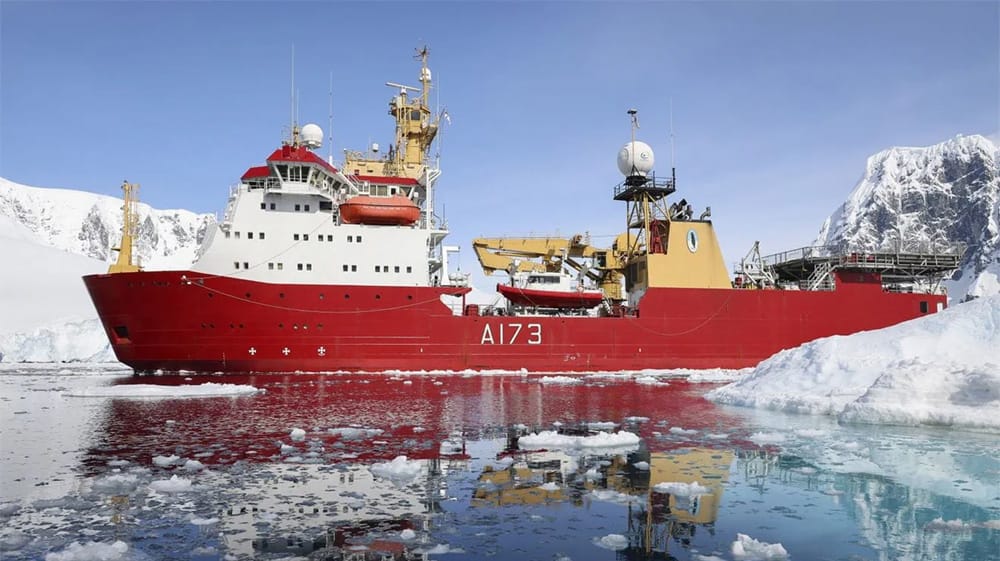
UK media is speculating that the Royal Navy may be facing a significant problem after its only polar icebreaker, HMS Protector, appears to have suffered a significant failure. Reports are indicating that the now 25-year-old survey and scientific vessel used as a demonstration of sovereignty in the polar regions has experienced a potentially serious mechanical failure without plans for a replacement.

The publication Naval Lookout and local newspapers are reporting that HMS Protector was towed into her homeport at Davenport on October 13. A Royal Navy spokesperson would only say that it was to permit “investigations into a defect” aboard the vessel. There is no official word on the scope of the problem, but the daily newspaper The Telegraph is reporting that the vessel experienced a “double-engine defect” while at sea, requiring a tow to return to port.

The latest incident comes after the vessel, which was originally built in Norway in 2001 as Polarbjorn, had just undergone her five-year drydocking in 2025. She was given a significant overhaul, which was designed to extend her operations.

The vessel, which has a DNV Ice Class 05 rating with a capability of maneuver through first-year ice up to 20 inches (0.5 meters), was built as a commercial polar research and subsea support vessel by GTC Rieber Shipping. The Royal Navy took her on an emergency charter in 2011 for three years, designed to fill a gap after the prior polar vessel, HMS Endurance, also experienced a catastrophic failure that resulted in flooding on the vessel.

The Royal Navy acquired HMS Protector in 2013 and completed her outfitting for its polar missions. Between 2015 and 2019, she was deployed full-time to the Southern Hemisphere at sea for as much as 330 days and based in South Africa. The ship has a displacement of 5,000 tons and has an overall length of 89 meters (292 feet).  She has a normal complement of 88 and is also capable of embarking a Royal Marine detachment.


HMS Protector splits her year between the two polar regions (Royal Navy)


Her primary mission has officially been to carry out observations, fishery inspections, and hydrographic surveys. However, she was mostly seen as a demonstration of British sovereignty and spent the past few seasons splitting her time between the Arctic and Antarctic. Supply missions to the UK’s Antarctic station are carried out by the British Antarctic Survey, which commissioned its vessel RRS Sir David Attenborough in 2021 after construction delays.

HMS Protector suffered propulsion problems in 2019, which required a 10-month overhaul and meant she missed her 2020-2021 season.  She returned to the Arctic in 2021 and later that year made her first visit to the Antarctic since 2019.

Commentators are noting that the failure comes at a challenging time as Argentina has become more active and is presenting new challenges to the British Falkland Islands. HMS Protector was used to show the flag and maintain a presence in the region in the past and would be missed this year. 

The UK government had begun discussions about a potential replacement for the icebreaker, but no decisions had been reached as it struggles with the overall plans for the Royal Navy. Funding was being established, but the government said a decision on how to procure the new vessel had not been reached. Critics further assert that the UK needs two capable vessels to maintain its presence in each polar region.

Speculation is that the Royal Navy might again be in a challenging position as it found itself in after the failure of HMS Endurance in 2008. It might again have to seek out a stopgap solution similar to what led to the acquisition of HMS Protector.


South Korea Renews Commitment to Arctic Service as Boxship Ends NSR Trip

Korean-owned containership completing Arctic trip
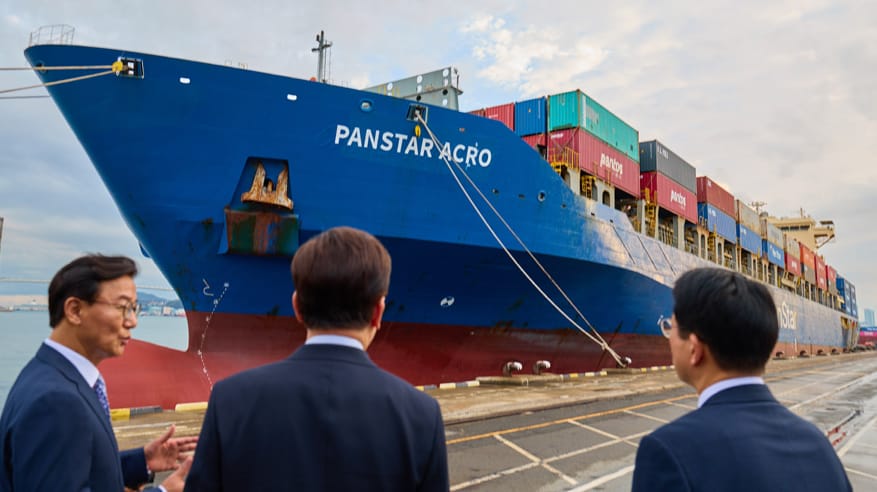
South Korea's president visited the containership to emphasize the commitment to develop Arctic shipping (Lee Jae-mung on X)

South Korea celebrated the completion of its first Arctic round trip using a containership. Government officials said it demonstrated the potential of the Northern Sea Route (NSR) while saying it would play a critical role in the country's economy and committed to expanding the demonstration program next year.

The containership Panstar Acro arrived back in Busan on Sunday, October 11, completing a 50-day round trip through the Arctic to Europe and back along Russia’s Northern Sea Route. While the voyage was not a commercial success, it is being hailed by Korean officials as an achievement that is a “springboard” for the development of their planned service.

Panstar Acro (45,500 dwt) was acquired from HMM at the beginning of August and prepared for the demonstration voyage, which had been organized with the support of the South Korean government and the shipping association. Built in 2011, the ship has a capacity of 2,758 TEU, and the hull was ice-strengthened before the voyage. The captain and crew received Arctic training, and the first officer was transferred from South Korea’s icebreaker research ship to provide specific experience for the challenges of the trip.

The ship docked in Busan Sunday morning, after having departed Gdansk, Poland, on September 18. It had set off from Busan on August 22 and entered the Arctic on August 31. It reached Felixstowe in the UK on September 12 and Rotterdam the following day. While the ship was five days behind schedule on its return, the trip was pronounced a success, with reports of no major incidents during the voyage.
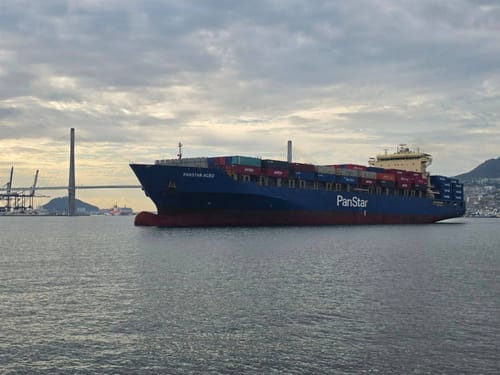
 

Panstar Acro completed a 50-day round trip to Europe and back along the Northern Sea Route (President Lee on X)


South Korean President Lee Jae-myung hailed the return in a message on social media. He noted the trip took about 10 fewer days than the normal route via the Suez Canal. He wrote that it “allowed us to accumulate polar navigation experience and voyage data for our containerships. Based on this achievement, we will steadily prepare for the Arctic route era.”

President Lee spoke at the welcome home ceremony on Tuesday, committing to investments to build up Busan as a maritime hub, as well as expanding Korea's logistics infrastructure. He has also pledged government support for polar training for future seafarers and research into core technologies for icebreakers and ice-capable vessels as well as South Korea's shipbuilding industry. 

South Korea, the president said, is committed to ensuring the new route "does not remain the exclusive interest of any one country." He said Korea would abide by international regulations and the principles of sanctions while ensuring the NSR is developed for mutual prosperity.

President Lee presented commendations to the crew of Panstar Acro. He thanked them for their pioneering efforts.

“The Arctic navigation data and experience accumulated through this test voyage will serve as precious groundwork for the commercialization of the Northern Sea Route,” said Hwang Jong-woo, the Minister of Oceans and Fisheries.

The ministry reports it will examine sailing distance, transit time, operating costs, and fuel consumption data from the voyage to assess the route's economic feasibility. The minister said they would “prepare for next year’s trial plan with even greater substance.”

Media reports are saying the vessel, however, failed to attract the expected cargo loads. Panstar had been marketing the voyage to its network, especially in Japan, as well as domestically in Korea. The reports vary on how many containers were transported, but they agree that only 737 laden containers were shipped to Europe. This included chemicals, used vehicles, and auto parts from six domestic shippers. Some reports said there were about 200 empties aboard on the outbound voyage, while others say it was as high as about 1,300 containers in total. Aju Press is reporting the ship failed to attract any import cargo, returning with 1,743 empties. 

Officials blamed the low cargo loads on a late start to the marketing campaign with a limited window before departure. They expect a stronger showing in 2027 and report capacity will slowly be increased to become economically viable between 2035 and 2040.

The Ministry of Oceans and Fisheries renewed its commitment to the efforts, however, saying a new trial would be conducted in 2027. It still aims to launch a regular service by 2030. After the disruptions due to the war in the Middle East and the security concerns in the Red Sea, the ministry  emphasizes the importance for Korea to develop alternate routes. Hwang said within 15 years they expect it will be possible to send ships through the Arctic for more than six months of the year.

The completed trip by the Panstar Acro marked the third time South Korea has sent a vessel along the Northern Sea Route. In 2013, Hyundai Glovis chartered the tanker Stena Polaris, which transported a load of naphtha from the Russian port of Ust-Luga in the Baltic. South Korea ran a second test a decade ago, but this was the first time for it using a container vessel.

Suez Canal Highlights Continued Return of Containerships

containership in the Suez Canal
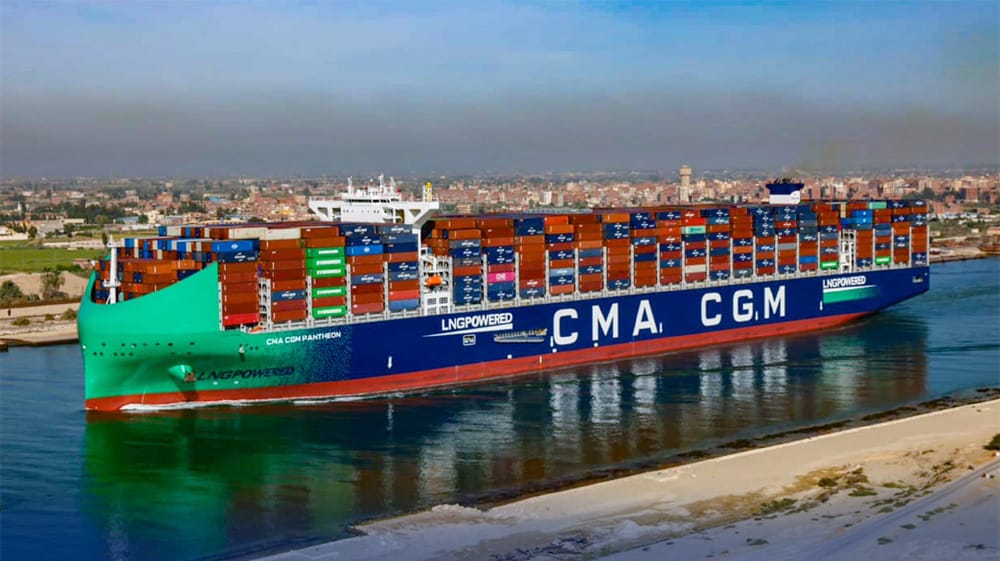
New CMA CGM Pantheon made the transit today as containership volumes continue to rise at the Suez Canal (SCA)

The Suez Canal Authority reports it hit a new milestone in rebuilding volumes following the disruptions due to Red Sea security concerns. Despite the persistent concerns, volume continues to build with more carriers switching vessels back to their planned routes.

Transits of containerships increased dramatically during the third quarter of 2026 versus 2025. The Suez Canal Authority released data reporting that 166 medium (over 130,000 net tons) and ultra-large container vessels made the transit between July and September. That is versus just 16 container vessels in that size range in the third quarter of 2025. 

Tonnage figures showed an equally large increase. The total for large container vessels reached 29 million net tons during the most recent quarter. That compared to just a total of 2.4 million net tons a year ago.

"The Suez Canal holds a strategic significance for containerized trade due to the operational savings it achieves and its promotion of the concept of economies of scale,” said SCA Chairman Admiral Ossama Rabiee. He noted the mounting pressure on container lines, citing increasing fuel prices, while shippers have to contend with rising freight rates. He highlighted the Suez Canal for its ability to provide reduced transit times and shorter voyage distances, saying it contributes to enhancing economies of scale for container vessels.

The authority continues its efforts to attract more vessels, and it expects to continue to see volumes rise. CMA CGM was at the forefront, but Maersk, Hapag-Lloyd, MSC Mediterranean Shipping Company, and OOCL have returned vessels to the routes through the Suez Canal and the Red Sea. COSCO has also restored some of its vessels, and the Premier Alliance, including Ocean Network Express (ONE), HMM, and Yang Ming, are set to return to the Suez Canal routes in the coming days.

Today, October 13, two large CMA CGM vessels were making the transit, as the Suez Canal Authority reported its results. The brand-new CMA CGM Pantheon (233,559 dwt), which entered service in July, was part of the convoy coming from the north. The vessel, which has a capacity of 24,212 TEU and is registered in France, was making her first-ever transit while traveling between Tangier Med and Port Klang, Malaysia.

Also in the southbound convoy was the CMA CGM Monte Cristo (158,064 dwt), also a new ship having entered service at the beginning of the year. Registered in Malta, the ship, which has a capacity of 16,204 TEU, was also bound for Port Klang.

The analysts at Drewry issued a new analysis of the Suez Canal at the beginning of the month, exploring what they saw as the reason so many carriers are rushing back to the route. They noted the fundamental threat that caused carriers to abandon the route has not disappeared. In fact, they noted that with the Houthis' recent offensive and the fierce fighting near the Bab al-Mandeb, the dangers may have increased.

Drewry’s analysis highlighted only a small financial benefit from the return to the Suez Canal route. They noted the advantage could be just $43 per slot, approximately $1 million per round trip, and that does not factor in the war-risk insurance premiums.

“The apparent eagerness of container lines to return to the Suez Canal is difficult to explain if the calculation is reduced to a simple voyage-cost comparison between Suez and the Cape,” writes Drewry.

It points to four factors in the calculation. It starts with the potential cost savings on a round voyage, as well as the time consideration and ability to perform more voyages because of the shorter transit times and distances. Furthermore, it also points to network schedule integrity and the pressure from competitors.

“The more convincing explanation for why carriers are so keen to return to Suez is that they are not really making a binary Suez versus Cape voyage decision based on economics alone. They are making a network, capacity and customer-service decision in which the value of time, vessel utilization, and network integrity are all taken into consideration,” write the analysts at Drewry.


Carrier USS Kennedy Completes First F-35 Fighter Landing and Launch

CVN
Courtesy USN

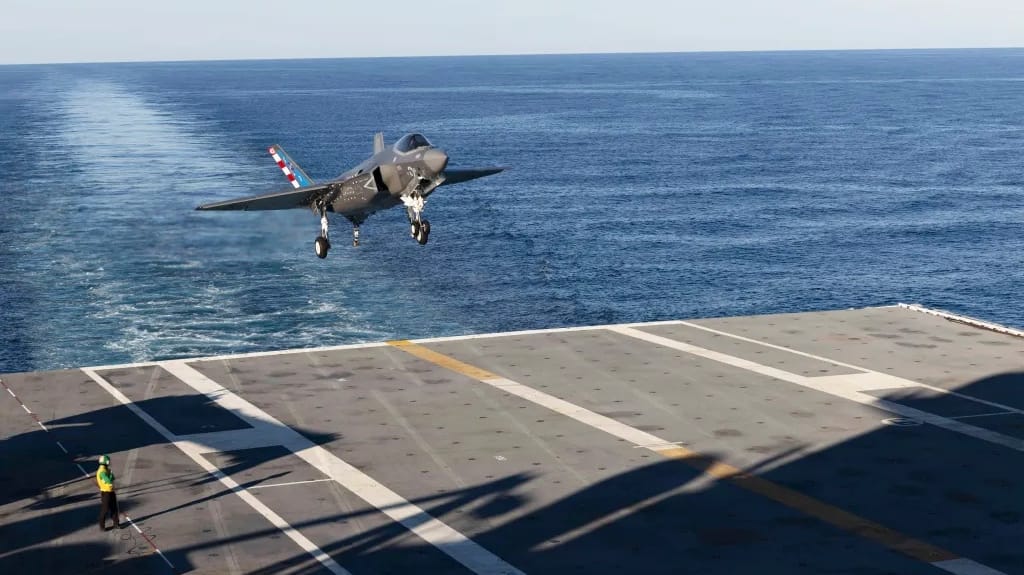
On Tuesday, an F-35 stealth fighter jet landed aboard the newly-built carrier USS John F. Kennedy for the first time, the U.S. Navy says. The landing is a milestone for the carrier's progress for commissioning, now expected sometime in the second quarter of next year. 

The carrier also completed its first F-35 launch, using its electromagnetically-actuated catapult system to propel the plane back into the air. 

Kennedy is the second in the class and the first to deliver with all of the special features required to support the F-35C fighter on deployment. The ship completed acceptance trials in August and received "preliminary acceptance" on September 29. The service says that this status will open up the fastest path possible to get the carrier up to full combat readiness after years of delays.  

As of September, the Kennedy team was still completing testing of four of the ship's Advanced Weapons Elevators, the electromagnetically-actuated platforms that carry munitions between the stores on the lower deck levels, the hangar bay and the main deck. The AWE system was designed to be faster than previous designs, but it proved to be a multi-year reliability challenge during commissioning of first-in-class USS Gerald R. Ford. The Navy believes that lessons learned from the experience with Ford will make Kennedy's commissioning go faster. 

The third Ford class carrier, the future USS Enterprise (CVN-80), is also experiencing delays and is now on track to deliver in 2030. The timing of the fourth hull, CVN-81, is uncertain and depends in part on an executive decision. The White House has ordered a study on installing steam catapults and hydraulic elevators on CVN-81. Steel has already been cut and the change would likely cause delays, according to America's sole carrier shipbuilder, Huntington Ingalls Industries. 

"It's a significant effort [to change the design for steam catapults]. It would delay the ship schedule significantly and there'd be a pretty significant cost related to it that we'd have to figure out with the Navy," HII CEO Christ Kastner said on the Mission Critical podcast last week.  


Austal Continues Efforts for Possible Sale of US Shipbuilding Operations

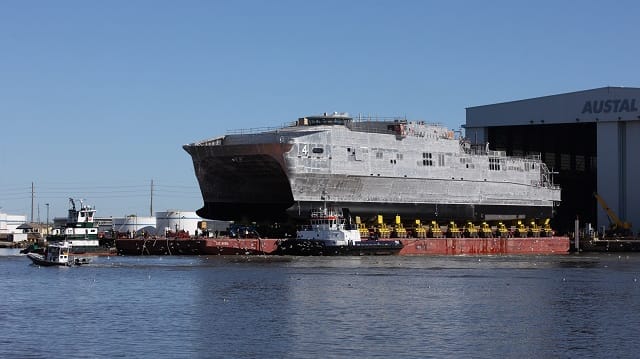
Austal shipbuilding
Austal reports progress in its discussions to sell the US shipbuilding operations (Austal)

Austal confirmed in a stock exchange filing on Wednesday, October 14, that it has commenced commercial negotiations with Hanwha Defense USA while also extending the due diligence process following the earlier indication of interest in acquiring the US operations of the Australian company. At the same time, it reports there is an ongoing dialogue with a US-based investment firm that also indicated interest in bidding for the shipbuilding operations.

The companies went public in early August, reporting that Hanwha Defense USA had made a non-binding offer of between $1.0 and $1.2 billion for the U.S. operation while calling for a due diligence review. Hanwha says the substantive issues have been completed but that it is also extending the due diligence period to complete “lower materiality data requests” from Hanwha that remain outstanding.

The goal was to permit Hanwha to review the data in order to firm up its indicative, non-binding, conditional offer, which was announced on August 10. Austal expects Hanwha to produce a binding offer and reports that negotiations have begun with Hanwha regarding a potential transaction. Austal reports it is also seeking professional advice on various tax implications for a potential deal.

A month after the initial announcement, U.S.-based Wildcat Infrastructure also came forward with a separate “non-binding indication of interest” for the U.S. operations of Austal. It proposed a higher valuation of $1.25 to 1.35 billion on a cash-free, debt-free basis. However, it is said it was conditional on being able to conduct four weeks of due diligence.

Ausutal says it “remains in ongoing dialogue with Windcat Infrastructure.” It did not indicate if the proposed due diligence would proceed or if it could be setting the stage for a bidding war.

The continuing discussions represent a change in posture for Austal, which a little over a year ago rejected overtures from Hanwha to acquire the whole company. At the time, Austal questioned the ability of Hanwha to gain the necessary approvals in the United States and Australia.  Since then, Austal has finalized its strategic shipbuilding partnership and position as a prime contractor for the Australian Defence Force, leading analysts to believe the company has decided to focus on its Australian shipbuilding.

While it has achieved status as a major supplier to both the U.S. Navy and the U.S. Coast Guard, the company has had challenges with its U.S. operations and their financial performance. It is best known as the builder of the Littoral Combat Ship (LCS) and more recently moved into steel construction for the United States. It has also expanded into projects including the Offshore Patrol Cutters for the U.S. Coast Guard and building modules for the U.S.’s Virginia and Columbia submarine programs. 


Iran Claims Containership Hit Mine and Sank in Strait of Hormuz

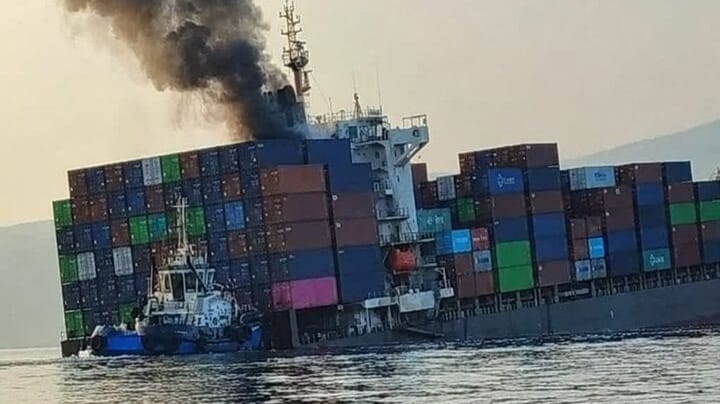
Containership sinking
Iran released by the IRGC Navy claiming the containership struck a mine in the Strait of Hormuz (Mehr -CC BY 4.0)

The Islamic Revolutionary Guard Corps Navy released images on Wednesday morning, October 14, claiming that a containership had struck a mine while traveling on an “illegal and dangerous” route through the Strait of Hormuz. The cause of the incident has not been confirmed, but the sinking of the vessel is being widely reported after Iran struck a total of four vessels in the past hours.

UK Maritime Trade Operations reported that it had received information that two container vessels had been struck, but both reports said there was minor damage to the ships. The vessels were not identified, but one was said to be a 50,000-tonne containership and the second was identified as a 19,000-tonne containership, with the reports saying both were struck by unidentified projectiles.

The vessel seen with containers strewn in the water in the Iranian images is being identified as the GFS Pride (39,446 dwt), built in 2008, and operated by a company based in Dubai. The vessel was registered in Singapore with a capacity of 2,824 TEU.

According to the Iranian statement, the vessel “exploded and caught fire” after striking a mine. They made no mention of the crew or any rescue efforts.

It is one of two containerships from the same company that were reported to have been struck. The other, GFS Giselle (54,117 dwt), was built in 2015 and also registered in Singapore. It has a capacity of 4,370 TEU. Both vessels’ last registered position on GPS was in the Fujairah Anchorage nearly two weeks ago.

Singapore's Maritime and Ports Authority issued a statement confirming the attack on both vessels and that the GFS Pride has sunk. It said all 21 crew members were safely evacuated while calling the attacks "unprovoked, unjustifiable, and a breach of international law." It said the GFS Giselle had been able to proceed to a safe anchorage and that all 22 crewmembers were safe.


A third container vessel, operated by Safeen Feeders (part of AD Ports Group), was also reported to have been targeted. The 23,500 dwt Al Saadiyat, registered in the Marshall Islands, has a capacity of 1,730 TEU. The product tanker Alfonso was also reportedly targeted overnight. The 38,842-dwt tanker is also managed from Dubai and registered in Barbados.

The reports of the strikes came as Iran renewed its pronouncements, claiming to have deployed operational units in “a new formation” east of the Strait of Hormuz. It also claimed to have acquired “more advanced weapons” in recent weeks, saying it was ready to take on the U.S. Navy. It threatened any U.S. warships, and specifically the carriers, if they attempted to approach the Strait of Hormuz.

The IRGC Navy earlier this week issued a warning that “A horrific fire is the inevitable fate of every rogue tanker that seeks to disregard the security and regulations of the Strait of Hormuz.”

CENTCOM responded with another of its “fact check” statements refuting the Iranian claims of control of the Strait of Hormuz. It asserts the “IRGC’s navy commander has no navy,” while claiming 19 million barrels of crude oil passed through the Strait yesterday.  It did not address the increased strikes by Iran against shipping.

Separately, the security consultancy Vanguard Tech is reporting that the bulker Cape Dao (170,000 dwt) is reported to be sinking after an unsuccessful salvage attempt. The vessel, which is managed from the UAE and registered in Antigua & Barbuda, was struck on September 23. One seafarer was killed in the strike, which took place 15 nautical miles northeast of Khasab, Oman.


U.S. Forces Destroy a Dhow Suspected of Conducting Surveillance for Iran

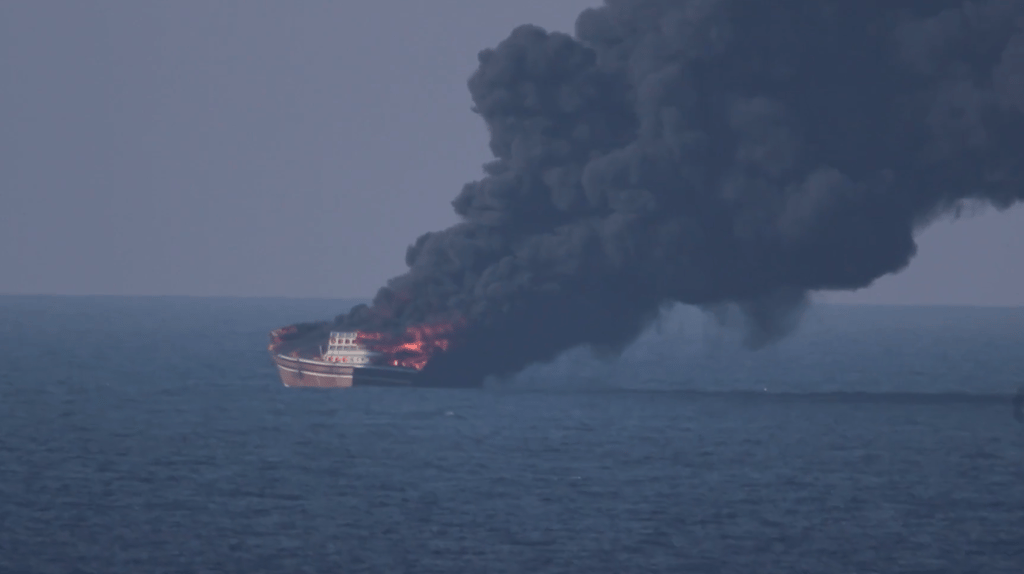
Dhow on fire
Courtesy U.S. Central Command

The U.S. military claims that Iran has been using scouts embedded in the boat traffic in and around Hormuz for spotting and targeting vessels, including American warships. Human spotters help offset the loss of Iran's coastal radars, which U.S. forces have targeted and destroyed on multiple occasions, a military official confirmed to Reuters. 

According to CENTCOM, U.S. forces intercepted and destroyed an Iranian-linked dhow on October 6. The vessel had been watching U.S. Navy ships in the Gulf of Oman, the command said. Two U.S. Marine Corps Apaches used missiles to damage the boat and set it on fire. Prior to destroying the vessel, Navy servicemembers retrieved the crew, and Central Command is working on repatriating the evacuees. 

An American military official confirmed to Reuters that Iran is using spotters on smaller craft to assist its targeting at sea. Countless dhows and small craft use the waters of the Arabian Gulf, Strait of Hormuz and Gulf of Oman for commerce, smuggling and fishing - providing plenty of civilian traffic in which IRGC-affiliated personnel can hide.

The destruction of the dhow on October 6 does not appear to have slowed the pace of the Iranian attacks on shipping in and around the strait. Six merchant ships were attacked on Sunday alone, and four more on Tuesday, including a small container ship that was hit and sunk within the strait. Separately, a bulker that was hit on September 23 succumbed to flooding and sank on Tuesday.