Wednesday, October 14, 2026


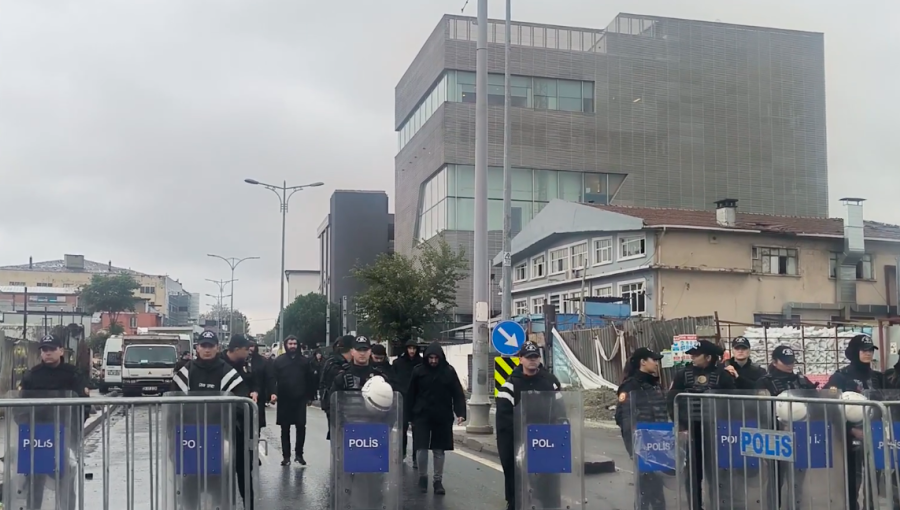
One of Turkey’s last pro-opposition TV stations raided, placed under control of government trustee

One of Turkey’s last pro-opposition TV stations raided, placed under control of government trustee
Scene outside Halk TV’s HQ in Istanbul during the raid. / @hilalinzraporuFacebookTwitter


By Akin Nazli in Belgrade October 14, 2026

The Istanbul chief prosecutor’s office on October 14 seized control of Halk TV, one of Turkey’s few remaining pro-opposition television stations, Reuters reported.

In an early morning operation, police raided the station’s Istanbul headquarters, cutting off the 6:30am live broadcast and replacing it with pre-recorded programming. Hundreds of officers that surrounded the building barred staff from entering as negotiations between channel executives and state officials broke down.

The Istanbul chief prosecutor's office said the raid followed an investigation into Halk TV chairman Cafer Mahiroglu by its financial crimes unit over allegations of "bribery, tender-rigging and laundering of assets derived from crime".

Prosecutors issued detention warrants for 17 people connected to the network. Eleven have been taken into custody. Mahiroglu, who operates a textile company in the UK, remains wanted by police.

The channel’s management and assets were transferred to the savings deposit insurance fund TMSF, a body frequently deployed by Ankara to take over private companies and media entities linked to opposition groups or legal investigations.

“Only dictators would do such a thing”

The takeover of Halk TV follows similar trustee appointments made at four other major news outlets, namely Flash TV, Eko Turk, Haberturk and Tele1, leaving critical reporting in the country increasingly confined to digital spaces and small independent portals.

Rights advocates and international monitors have long warned that Turkey's judiciary is being used as an instrument of political coercion. Financial regulators, tax authorities, and broadcasting watchdog RTUK have systematically targeted critical media with heavy fines, advertising bans and asset seizures.

"Dawn raid on a television channel, appointing a trustee. Only dictators would do such a thing," wrote Ozgur Ozel (@eczozgurozel), head of the main opposition New Party (YP), on X.

"Those who appoint trustees to municipalities and trample the people's will have now appointed a trustee to Halk TV, watched by millions," he added.

Raid followed Kilicdaroglu complaints

Days prior to the police operation, Kemal Kilicdaroglu, the court-reinstated leader of the Republican People’s Party (CHP), publicly criticised Halk TV news coverage, saying that the party had lodged formal complaints with media regulators.

After the raid, the CHP issued a statement calling the police operation a "shameful" example of systematic state pressure, clarifying that political criticism was a "natural part of democratic life".

The CHP is described by YP as “occupied” by the Erdogan administration. Ozel set up the YP with breakaway CHP lawmakers after claiming that the actions of Kilicdaroglu and the new management of the CHP were helping the government implement its agenda.

The raid and seizure took place against a backdrop of intensifying legal pressure exerted against opposition figures. On the same morning as the raid, jailed Istanbul mayor Ekrem Imamoglu, long regarded as Erdogan’s most formidable political opponent, was scheduled to begin his defence in a mass trial involving more than 400 defendants linked to the Istanbul municipality.


Infographic guide to Russia and Ukraine's missile and drone arsenals

Russia and Ukraine's strike arsenals compared, class by class, in nine charts / bne IntelliNews

By Ben Aris in Berlin October 13, 2026


Four years into the full-scale war, Russia and Ukraine are fighting with arsenals that barely resemble each other. This guide sets the two side by side, class by class, in nine charts. As the brutal tit-for-tat missile war escalates, Russia still massively outguns Ukraine in almost all classes of missile and drone, as Kyiv's air defences dwindle.

Ukraine has won the drone war on volume. It built 2.2mn drones in 2024 and roughly 4mn in 2025, and President Volodymyr Zelenskiy now puts output at about 10mn a year with a target of 20mn. Fire Point alone claimed in July 2026 to be turning out "hundreds a day" of its FP-1 and FP-2 deep-strike drones.

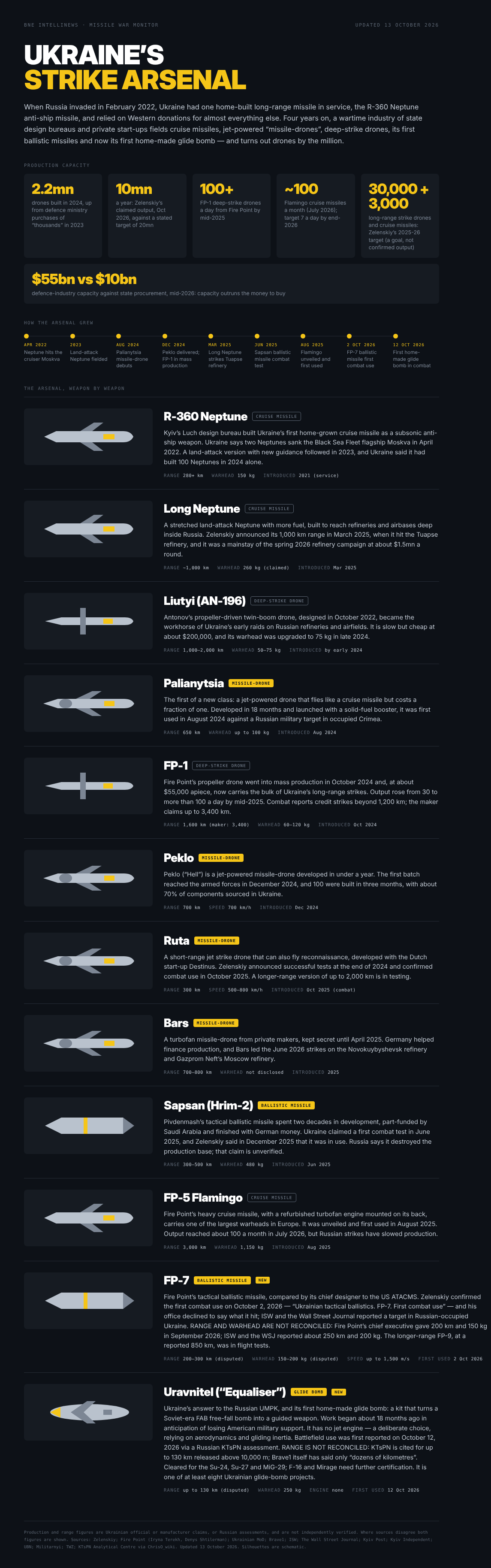
Ukraine has far fewer missiles than drones. Its whole missile inventory rests on a handful of programmes, most younger than the war: the R-360 Neptune it went to war with, a stretched land-attack version that reached Russian refineries from March 2025, the FP-5 Flamingo at a claimed 100 a month, and a ballistic effort — the Sapsan, and the FP-7, which Zelenskiy confirmed in combat for the first time on October 2, 2026. The longer-range FP-9, at a reported 850 km, is in flight tests. Zelenskiy's own 2025-26 target, 30,000 long-range strike drones against 3,000 cruise missiles, says it in his own numbers: ten drones for every missile. The twelve weapons below now include the FP-7 ballistic missile and the Uravnitel glide bomb, both of which entered combat this month.

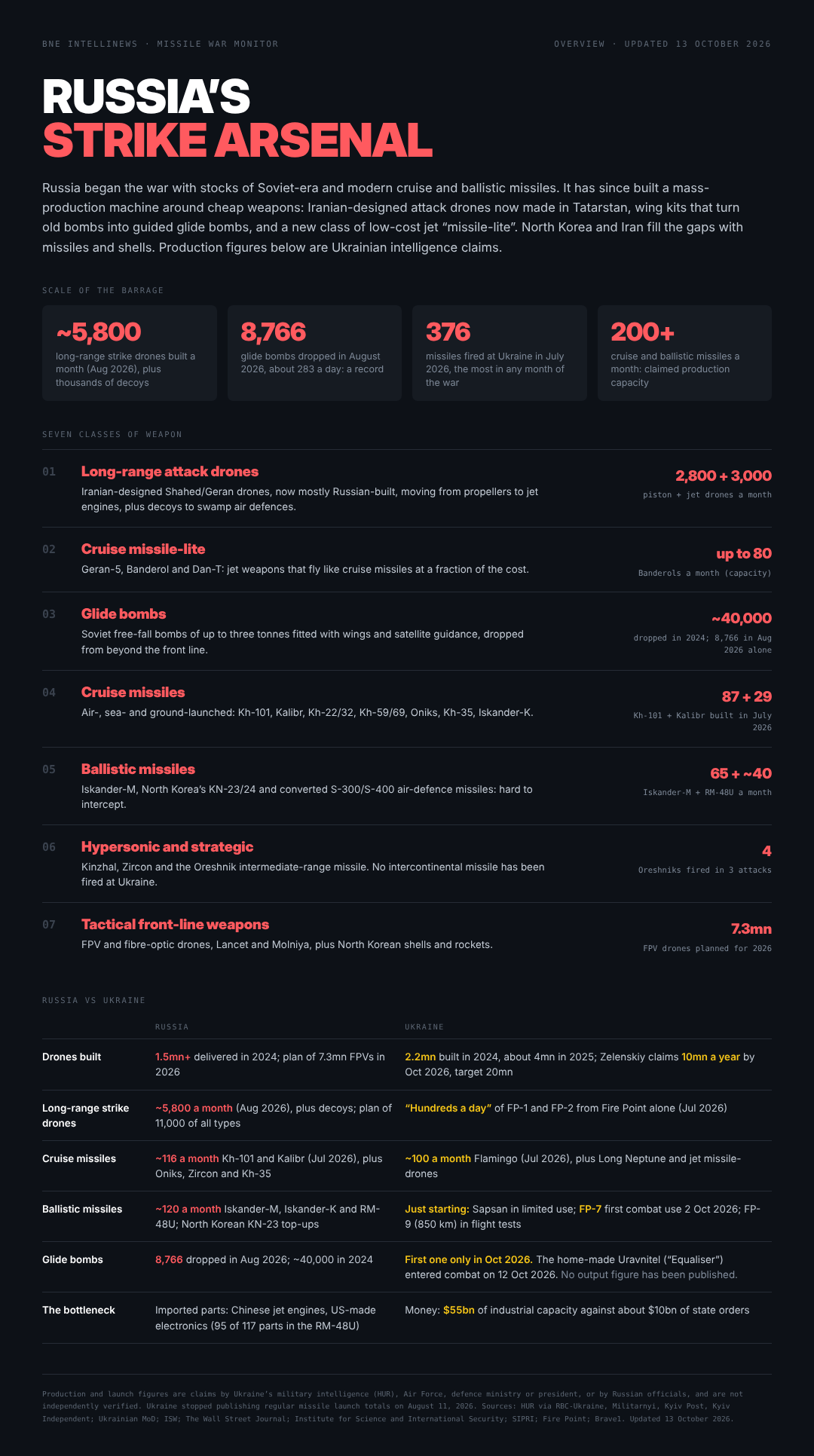
Russia has both, and far more of the expensive half. Ukrainian military intelligence put Russian output in July 2026 at 87 Kh-101 and 29 Kalibr cruise missiles, 65 Iskander-M ballistic missiles against a plan of 60, and about 40 RM-48U, retired S-400 air-defence missiles converted to hit ground targets. Russia claims capacity for more than 200 cruise and ballistic missiles a month, and fired 376 at Ukraine in July 2026, the most of any month of the war. Its cheapest weapon is cheaper still: 8,766 glide bombs were dropped in August 2026, about 283 a day, converted from Soviet stock for about $25,000 a kit and have a devastating payload of up to one tonne of explosives - about twenty times more than the average drone can carry.

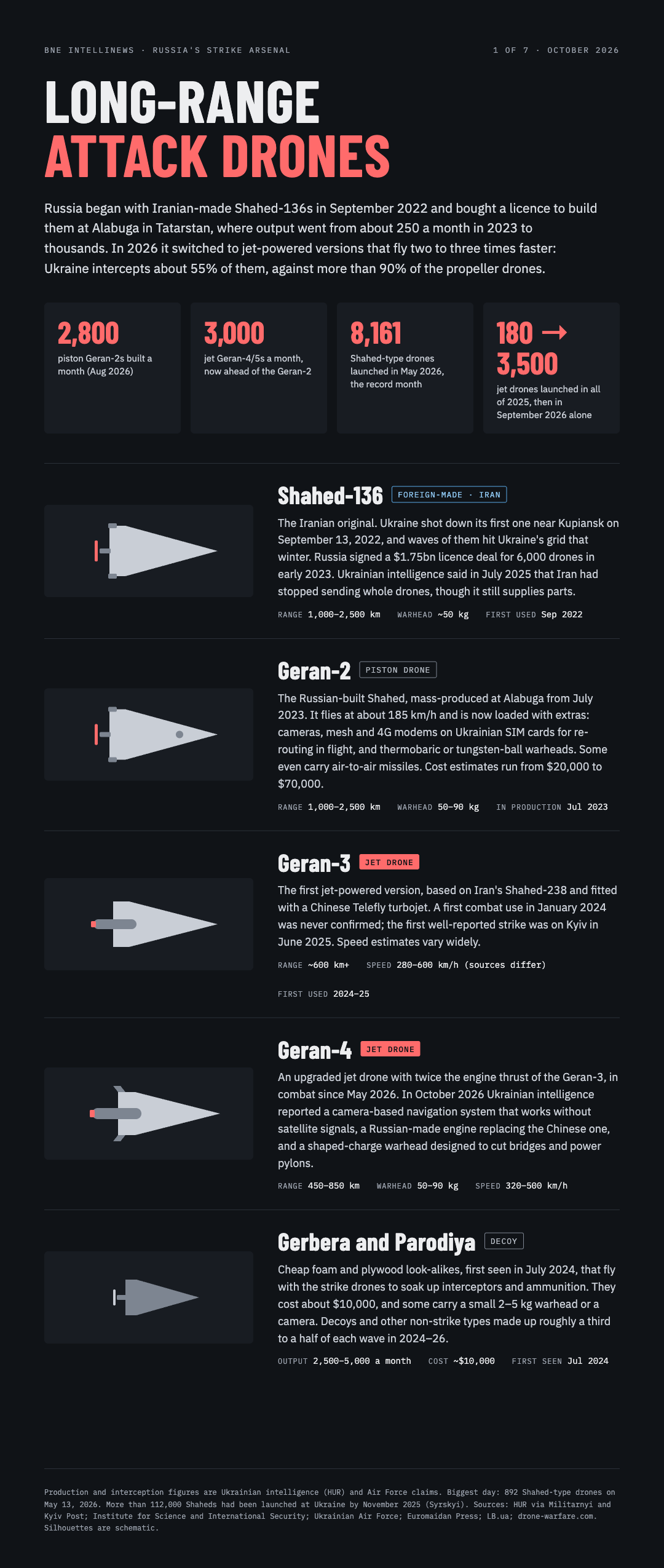
The gap that has closed is the technological one - in Russia's favour. For three years its long-range drones were slow Iranian-designed Shaheds built under licence at Alabuga, and Ukraine shot down more than 90% of them. In 2026 Russia switched to jet-powered versions that fly two to three times faster, and Ukraine now intercepts about 55%. The scale of the switch is the story: 180 jet drones were launched in the whole of 2025, and 3,500 in September 2026 alone. Russia now builds about 3,000 jet Geran-4s and -5s a month against 2,800 piston Geran-2s.

The bottlenecks differ too. Russia's is supply — Chinese jet engines and Western electronics, with Ukraine claiming 95 of the 117 electronic parts in the RM-48U are US-made. Ukraine's is money: about $55bn of industrial capacity in mid-2026 against roughly $10bn of state orders.

A caveat that applies to the infographics below: production, stockpile and interception numbers in this guide are claims by Ukraine's military intelligence (HUR), Air Force, defence ministry or president, or by Russian officials and manufacturers. None is independently verified, both sides have reasons to shade them, and Ukraine stopped publishing regular missile launch totals on August 11, 2026. Where sources disagree, both figures are shown rather than averaged.

Russia's strike arsenal: the overview

Seven classes of weapon, from $10,000 decoys to intermediate-range ballistic missiles that cost millions of dollars to make, and how the two arsenals compare line by line.


Russia's strike arsenal: seven classes of weapon, production rates and a line-by-line comparison with Ukraine. Figures are Ukrainian intelligence claims unless stated.

Ukraine's strike arsenal: the overview

Ukraine went to war with one home-built long-range missile in service. Four years on it fields cruise missiles, a new class of jet "missile-drones", deep-strike drones and its first ballistic missiles — almost all of it designed and built since February 2022.


Ukraine's strike arsenal: 12 weapons from the R-360 Neptune to the FP-7 ballistic missile, with the timeline of how the arsenal was built. Figures are Ukrainian official claims.

1. Long-range attack drones

This is the weapon that defines the nightly barrage. Russia began in September 2022 with Iranian-made Shahed-136s, then bought the licence and built its own at Alabuga, where output went from about 250 a month in 2023 to thousands. Iran had stopped shipping whole drones by July 2025, Ukrainian intelligence says, though it still supplies parts. The decisive change is the engine: the jet-powered Geran-3, -4 and -5 fly far faster than the piston Geran-2 and are much harder to shoot down. Roughly a third to a half of each wave is not a weapon at all but a Gerbera or Parodiya decoy — foam and plywood look-alikes costing about $10,000, flown to soak up interceptors.


Long-range attack drones: from the Iranian Shahed-136 to the jet-powered Geran-4, plus the decoys that fly with them.

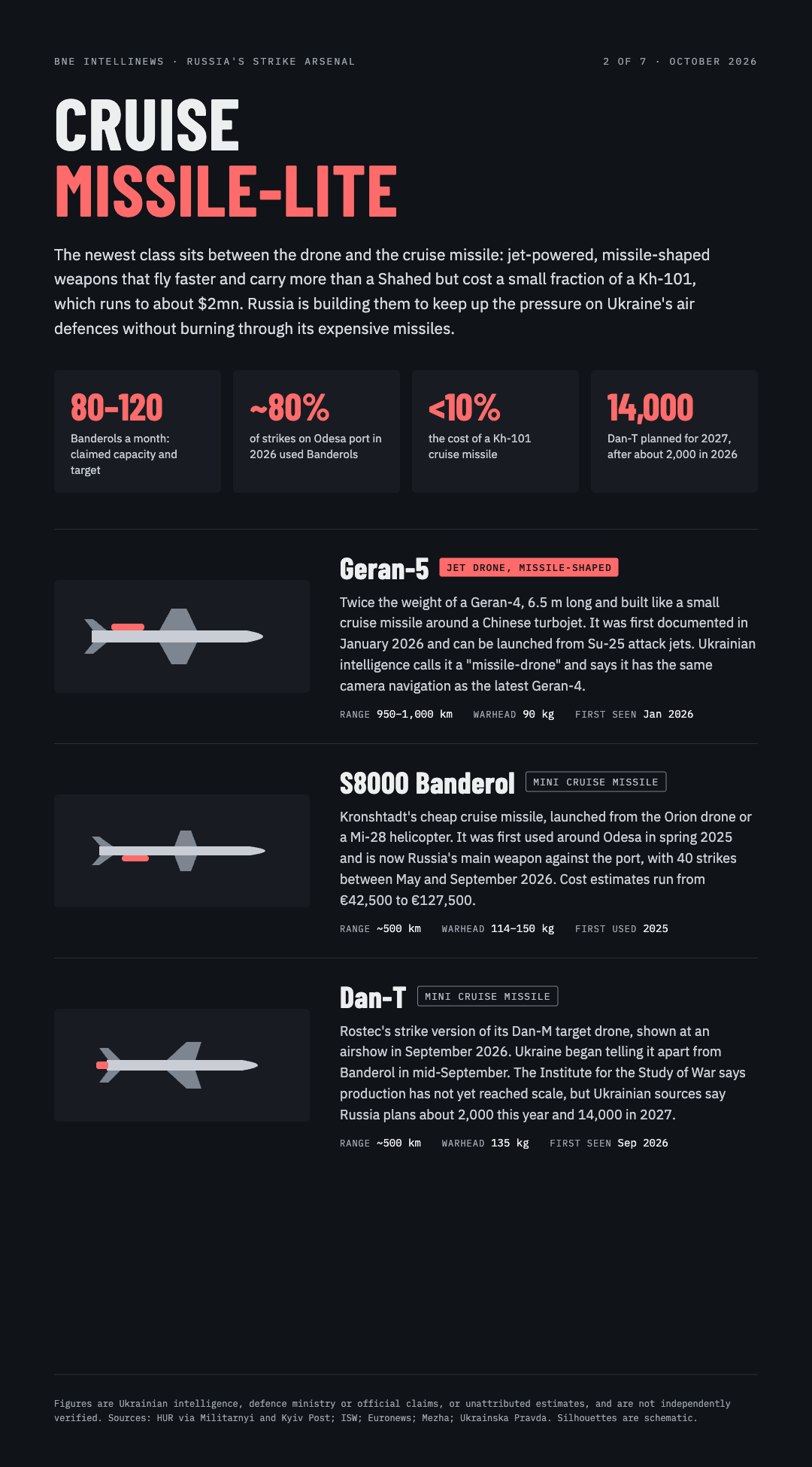
2. Cruise missile-lite

The newest class, and the one that explains how Russia keeps up the pressure without spending its missile stock. These are jet-powered, missile-shaped weapons that fly faster and carry more than a Shahed, but cost under a tenth of a Kh-101's roughly $2mn. The S8000 Banderol has become Russia's main weapon against Odesa, used in about 80% of strikes on the port in 2026. The Dan-T, a strike version of a Rostec target drone shown at an airshow in September 2026, has not reached scale by the Institute for the Study of War's assessment, but Ukrainian sources say Russia plans about 2,000 this year and 14,000 in 2027.


Cruise missile-lite: the Geran-5, S8000 Banderol and Dan-T — jet weapons at a fraction of a cruise missile's cost.

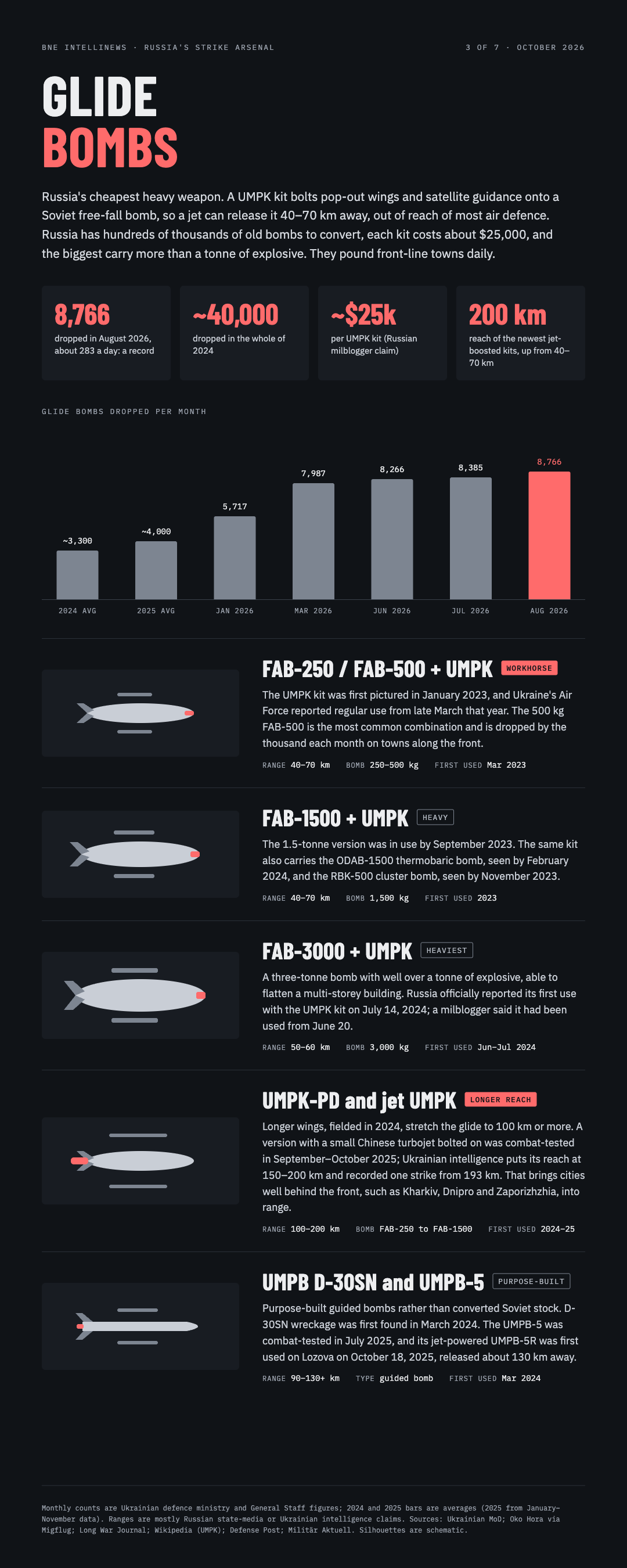
3. Glide bombs

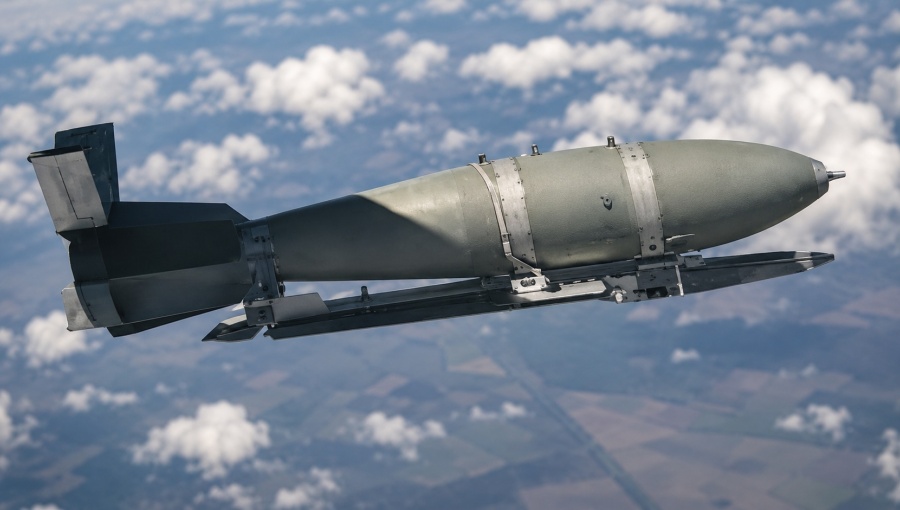
Russia's cheapest heavy weapon, and the one that grinds down front-line towns. A UMPK kit bolts pop-out wings and satellite guidance onto a Soviet free-fall bomb, so an aircraft can release it 40-70 km away, outside most air defence. Russia has hundreds of thousands of old bombs to convert and each kit costs about $25,000. The volume has climbed every year — about 3,300 a month on average in 2024, 8,766 in August 2026 alone — and so has the reach: jet-boosted kits now fly 150-200 km, which brings Kharkiv, Dnipro and Zaporizhzhia within range. Ukraine has no equivalent at scale: it fielded its first domestic glide bomb, the 250 kg Uravnitel or "Equaliser", only this month, and has published no output figure.


Glide bombs: the UMPK kit and the bombs it converts, and the monthly count climbing to a record 8,766 in August 2026.

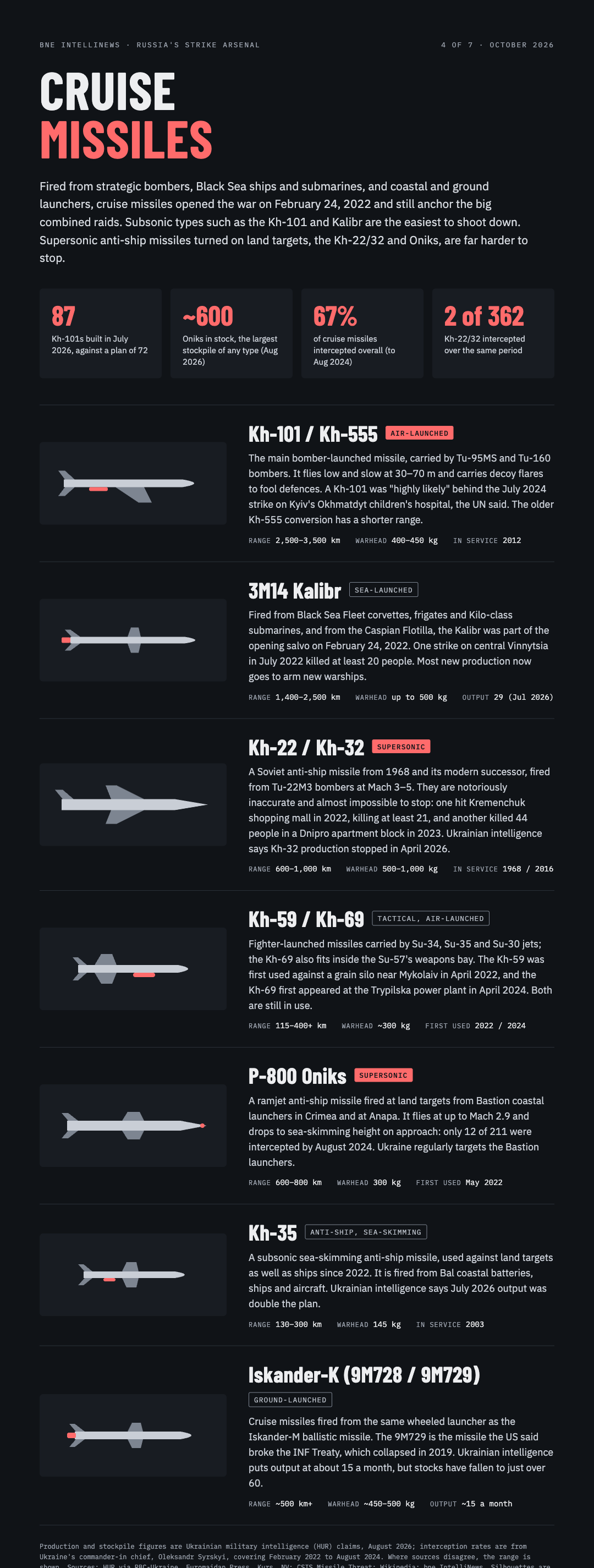
4. Cruise missiles

The weapons that opened the war on February 24, 2022 and still anchor the big combined raids, fired from strategic bombers, Black Sea ships and submarines, and coastal and ground launchers. The division that matters is speed. Subsonic types such as the Kh-101 and Kalibr are the easiest things in the Russian arsenal to shoot down, and Ukraine intercepted 67% of all cruise missiles to August 2024. The supersonic anti-ship missiles turned on land targets are a different problem: just two of 362 Kh-22/32s were intercepted over the same period, and only 12 of 211 P-800 Oniks.


Cruise missiles: Kh-101, Kalibr, the supersonic Kh-22/32 and Oniks, Kh-59/69, Kh-35 and the ground-launched Iskander-K.

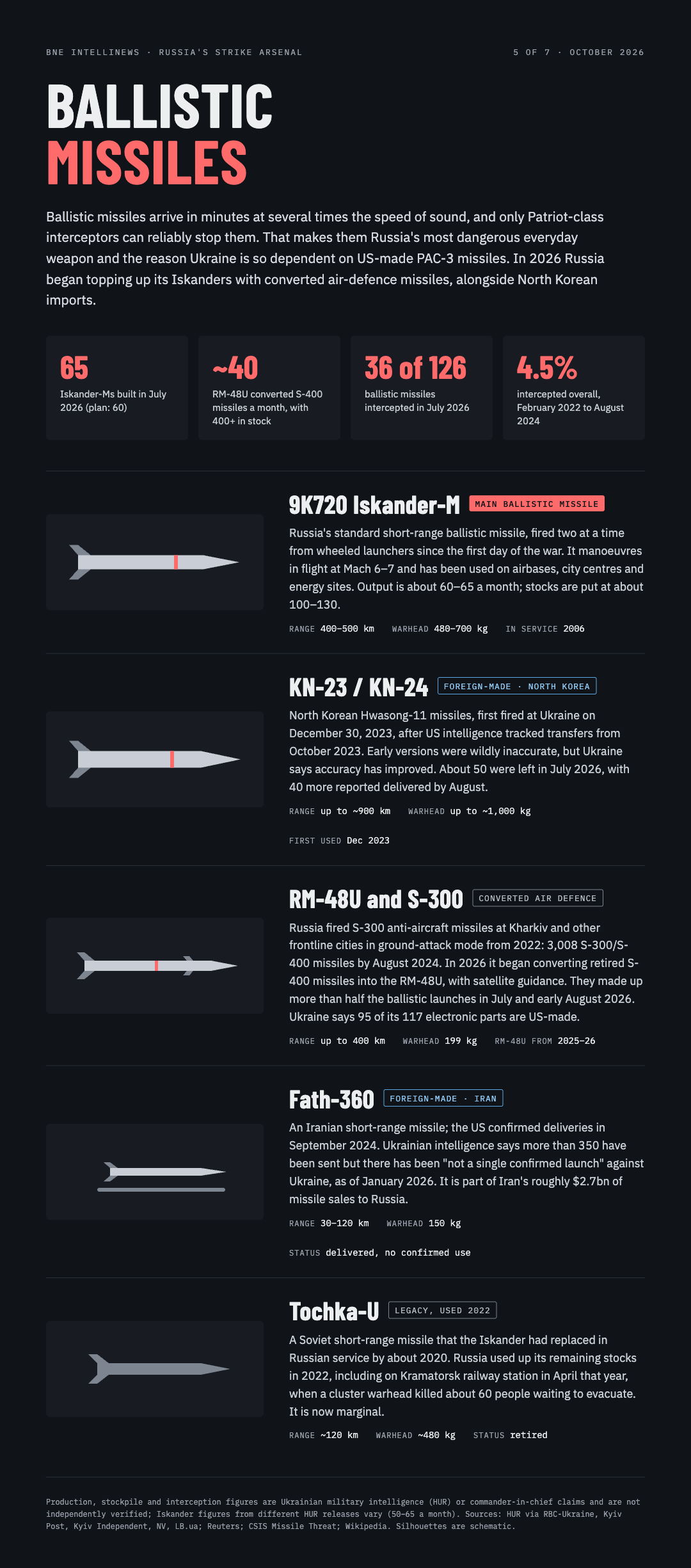
5. Ballistic missiles

Russia's most dangerous everyday weapon, and the reason Ukraine is so dependent on US-made Patriot interceptors: ballistic missiles arrive in minutes at several times the speed of sound, and only Patriot-class systems reliably stop them. Just 4.5% were intercepted between February 2022 and August 2024. This is also where Russia's foreign suppliers show up most clearly. North Korea's KN-23 and KN-24 have been fired at Ukraine since December 30, 2023; accuracy was poor at first and Ukraine says it has improved, with about 50 left in July 2026 and 40 more delivered by August. Iran's Fath-360 was confirmed delivered in September 2024 — more than 350 of them, part of roughly $2.7bn of Iranian missile sales — but Ukrainian intelligence reported "not a single confirmed launch" as of January 2026. Russia has also started converting retired S-400s into the ground-attack RM-48U, which made up more than half its ballistic launches in July and early August 2026.


Ballistic missiles: the Iskander-M, North Korea's KN-23/24, converted S-300/S-400 air-defence missiles, Iran's Fath-360 and the legacy Tochka-U.

6. Hypersonic and strategic

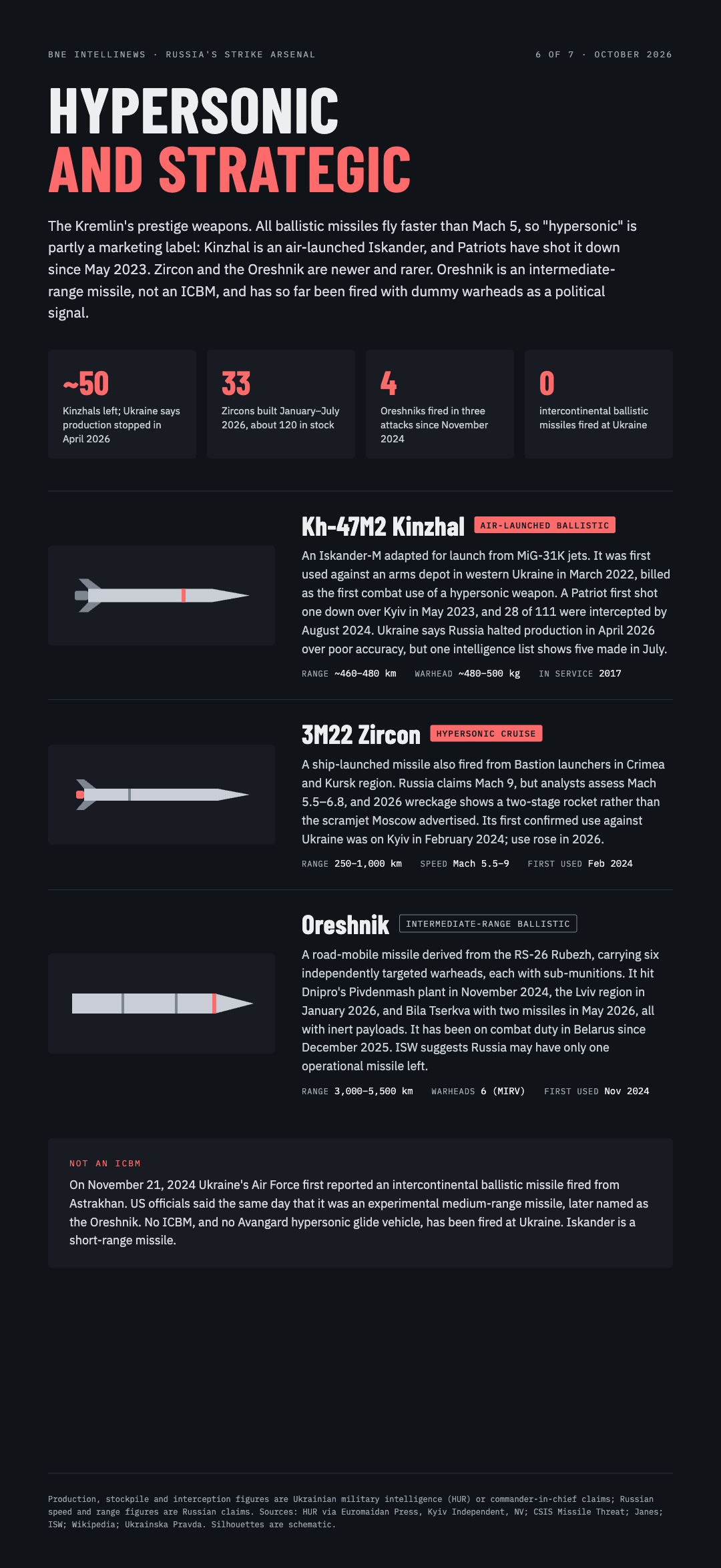
The Kremlin's prestige weapons, and the class where the rhetoric most outruns the hardware. All ballistic missiles fly faster than Mach 5, so "hypersonic" is partly a marketing label: the Kinzhal is an air-launched Iskander, and Patriots have been shooting it down since May 2023. Ukraine says Kinzhal production stopped in April 2026 over poor accuracy. The Oreshnik is an intermediate-range missile, not an intercontinental one, and all four fired so far carried inert payloads — political signals rather than strikes: no intercontinental ballistic missile has ever been fired at Ukraine, despite reports to the contary.


Hypersonic and strategic: Kinzhal, Zircon and the Oreshnik — and why none of them is an ICBM.

7. Tactical front-line weapons

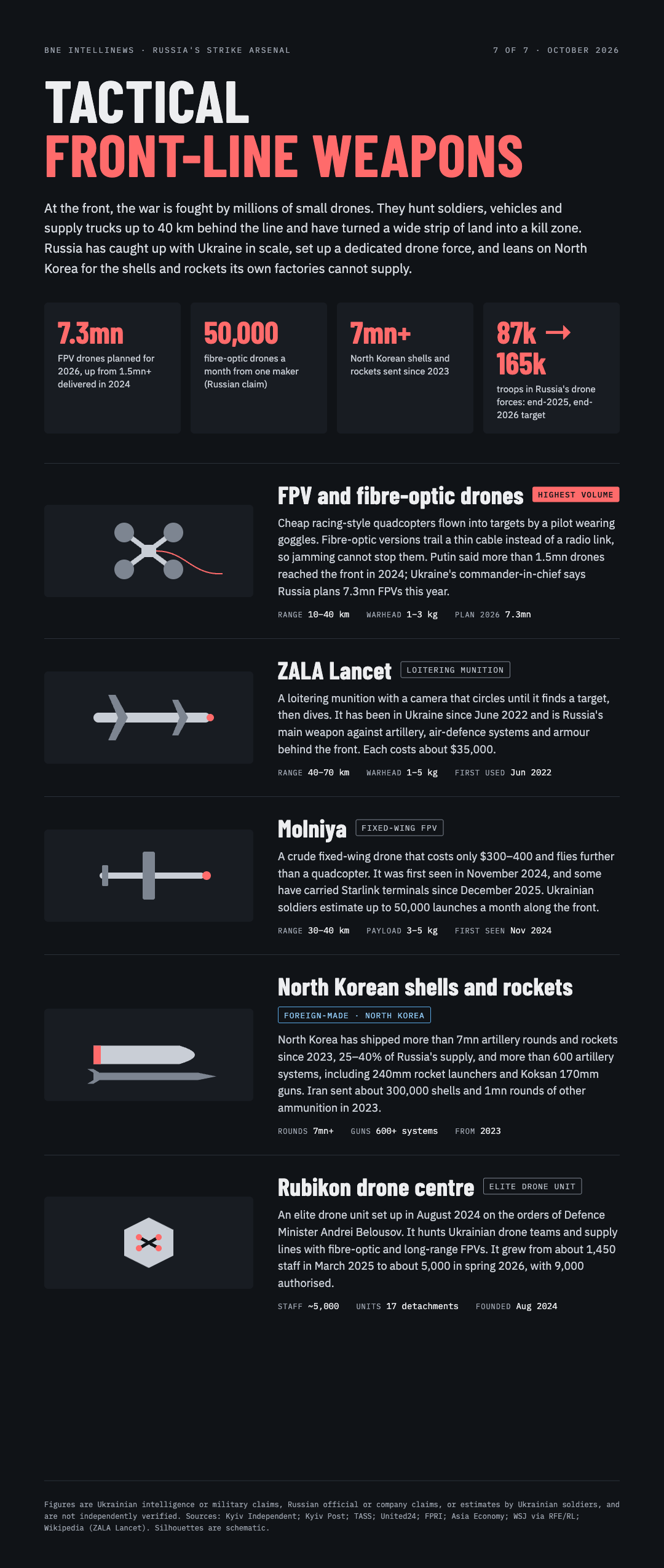
At the front the war is fought by millions of small drones that hunt soldiers, vehicles and supply trucks up to 40 km behind the line, turning a wide strip of land into a kill zone. This is the class where Russia has caught up with Ukraine on scale: more than 1.5mn drones reached the front in 2024 by Putin's account, and Ukraine's commander-in-chief says Russia plans 7.3mn FPVs this year. Russia has also built the institutions to go with the hardware — the Rubikon centre, set up in August 2024, grew from about 1,450 staff to roughly 5,000 by spring 2026 and hunts Ukrainian drone teams — while its drone forces are set to roughly double to 165,000 troops by the end of 2026. Artillery is where it leans hardest on allies: North Korea has shipped more than 7mn shells and rockets since 2023, between a quarter and 40% of Russian supply, plus more than 600 artillery systems.


Tactical front-line weapons: FPV and fibre-optic drones, the Lancet and Molniya, North Korean shells and the Rubikon drone centre.

This article was produced with the help of IntelliNews Lambda analytical tool


Two ships hit in Black Sea drone attacks near Bulgaria, 11 missing

Two ships hit in Black Sea drone attacks near Bulgaria, 11 missing
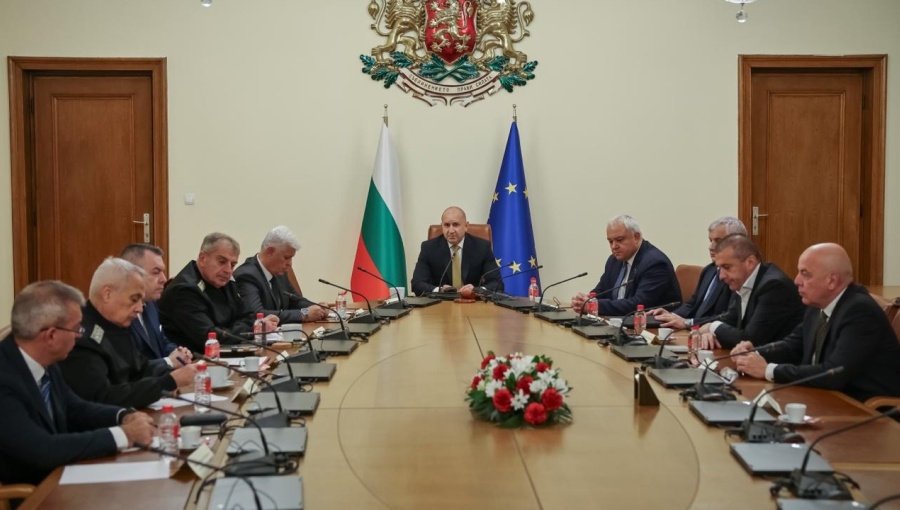
Two commercial ships were hit by drones near Bulgaria's Black Sea coast. One sank. Eleven crew members were missing. / Council of Ministers of the Republic of BulgariaFacebook
By bne IntelliNews October 13, 2026

Two commercial ships were hit by drones near Bulgaria's Black Sea coast early on October 13, with one sinking, leaving 11 crew members missing. Prime Minister Rumen Radev suggested Russia may be behind the attacks and summoned the Russian ambassador to Sofia.

It was the second time this month that commercial vessels have been struck in Bulgaria's Black Sea exclusive economic zone (EEZ). Earlier, on October 6, the cargo ship Alfa Watan sank following a drone attack, with all 10 crew members logged as missing, while the vessel Able was damaged and its crew rescued.

The latest incidents have heightened concerns over the spread of the war between Russia and Ukraine towards Bulgaria's coast and vital Black Sea shipping routes.

The Maltese-flagged Chelsea 3, a Ukrainian-owned cargo ship, was struck by three aerial drones about 18 nautical miles (33 km) east of the coastal town of Byala early on October 13, Radev announced in a televised address. All 15 crew members, seven Ukrainians and eight Azerbaijanis, were evacuated to the Bulgarian port of Varna. Five received medical treatment.

The second vessel, identified by Bulgarian President Iliana Iotova as the Guinea-Bissau-flagged cargo ship HS Dignity, sank about 17 nautical miles east of Krapets, near the Romanian border. Eleven crew members remained missing, while a search and rescue operation continued.

"Another attack on commercial vessels in the immediate vicinity of Bulgarian territorial waters is absolutely unacceptable," Radev said after convening an emergency meeting of the government's Security Council, Bulgarian National Radio (BNR) reported.

Radev said there was no conclusive evidence identifying those responsible, but the outcome of the attacks appeared to benefit Russia. He summoned Russian Ambassador Eleonora Mitrofanova to discuss the incidents.

Mitrofanova said she had no information from Russia's defence ministry about the attacks and suggested they could have been a provocation by a third party, Bulgarian media reported.

Bulgaria has sought assistance from its allies to investigate the attacks. Radev said he had spoken to European Commission President Ursula von der Leyen and Nato Secretary-General Mark Rutte, calling for coordinated efforts to stop attacks on commercial shipping.

Rutte said Nato would continue working with its Black Sea allies and adjust its deterrence and defence posture as needed.

"The Black Sea has become another front of escalation of the Russian war in Ukraine," von der Leyen said on social media, condemning the attacks and calling for those responsible to be held accountable.

Iotova said the escalation was turning the Black Sea into a military zone, threatening freedom of navigation and supply-chain security. She called for a swift investigation and diplomatic efforts to de-escalate the conflict.

Bulgaria's opposition parties called for a stronger response, with some demanding an emergency parliamentary sitting and others urging closer coordination with Nato.

Defence Minister Dimitar Stoyanov said the conflict was drawing closer to Bulgaria's territorial waters and that Russia was the likely source of the drones, arguing that Ukraine would have little reason to target its own ships.

Ukraine has also blamed Russia for the latest attacks. Moscow has not publicly commented on the incidents.

Russia and Ukraine are major grain exporters, making the Black Sea a crucial route for agricultural shipments and other commercial trade. 


SpaceX throttles Ukraine's military Starlink without warning, Kyiv says

SpaceX throttles Ukraine's military Starlink without warning, Kyiv says
A speed cap on the Starshield military package has disrupted drone missions at a time when relations between Kyiv and the Trump White House are at their lowest point since the February 2025 Oval Office row. / bne IntelliNewsFacebook
By Ben Aris in Berlin October 14, 2026

SpaceX has imposed a speed limit on Starlink terminals used by Ukraine's armed forces, disrupting a number of combat missions, presidential adviser Serhiy Beskrestnov said on October 14, adding that the military was given no warning.

The cap applies to terminals in motion under Starshield, the "military package" of SpaceX's satellite service, and is set at 100 mph (160 km/h), Beskrestnov, who advises President Volodymyr Zelenskiy on defence technology, wrote on his Telegram channel. "It is clear that this action cannot be a coincidence and is related to the current political situation," he said.

The restriction lands at a bad moment for Ukraine's armed forces, which are pressing their Vivaldi offensive against Russian positions in Donbas, and for its air defences. Starlink links the interceptor drones Ukraine uses against Russia's jet-powered Geran-4 drones, Beskrestnov warned. SpaceX has not cut the service off, but Ukraine has no alternative network to fall back on.

IntelliNews produced an infographic guide to Ukraine and Russia’s missile and drone arsenals and as the brutal tit-for-tat missile war unfolds it makes grim reading. The combination of Starlink with Ukraine’s bigger drone fleet has been a key military advantage keeping the Armed Forces of Ukraine (AFU) in the game, but if access to Starlink is removed it will undermine the effectiveness of Ukraine’s drones to find and destroy the enemy troops and materiel.

A source in the 7th Rapid Reaction Corps on the southeastern front confirmed the disruption, Reuters reported. Units on the Huliaipole front lost connection for 10-20 seconds at speeds of 110-120 km/h, the corps said, according to Euromaidan Press, and one unmanned systems unit cancelled some missions. Ukrainian military channels later reported drops at 60-70 km/h across all frontline sectors, which would also catch short-range FPV drones. Ukraine's defence ministry said it was investigating the cause, and SpaceX had not commented by the time of writing.

Elon Musk's network has been the backbone of Ukraine's front-line communications since 2022. In February, at Kyiv's request and after lobbying by then defence minister Mykhailo Fedorov, SpaceX blocked terminals used by Russian forces and Ukraine moved to a whitelist of registered terminals. Russia has since pressed ahead with its own Rassvet constellation, while Ukraine remains wholly dependent on Starlink. Musk has also refused to let Kyiv use the network to plan deep strikes on Russia.

The cap comes days after US President Donald Trump told reporters on October 10 that Ukraine should "get a new leader who can make a deal". Musk, who had fallen out with Trump last year but appears to have patched up the relationship, reposted a video of the remarks on X with the comment: "Zelensky has gone too far."

It also follows two nights of Russian ballistic missile strikes on Kyiv that arrived without advance warning from Western partners, which some in Kyiv have blamed on Washington scaling back intelligence sharing. Zelenskiy confirmed in an interview with NPR published on October 13 that the Trump administration had threatened to suspend intelligence sharing unless Ukraine stopped its strikes on Russian refineries, Hromadske reported.

"They told my generals, not me," Zelenskiy said. Trump insisted on October 13 that the US was still sharing intelligence with Ukraine.

Relations between Kyiv and the White House are at their worst since Zelenskiy's Oval Office clash with Trump in February 2025. Trump's agreement with Russian President Vladimir Putin to bring Russian diesel back onto world markets has opened a rift with Kyiv, which has vowed to keep hitting Russia's refineries.

Polish Foreign Minister Radoslaw Sikorski asked Musk on X whether he was "playing politics with your products again", warning that European customers "are watching".


Ukraine gets no Western warning of Russian ballistic strike on Kyiv

Ukraine gets no Western warning of Russian ballistic strike on Kyiv
Kyiv's air force says data on Russian missile launches failed to arrive from partners, days after Washington threatened its support over Ukraine's strikes on Russian refineries. / bne IntelliNewsFacebook
By Ben Aris in Berlin October 13, 2026

Ukraine had no warning from its Western partners before Russia fired five ballistic missiles at Kyiv overnight, President Volodymyr Zelenskiy said on October 13, Kyiv Post reported.

"Unfortunately, there was no warning from our partners about this strike. Intelligence on the launch of Russian ballistic missiles helps save lives," Zelenskiy said in a Telegram post. He also accused Moscow of ignoring the US call for an energy ceasefire, saying 19 regions had come under attack in two days, and said Russian strikes had killed four people and wounded 41 in Kharkiv.

Air force spokesman Yuriy Ihnat said Ukraine's air defences could not respond to the launches in time because the necessary data had not come from Western partners. He blamed "technical issues" and said it was not the first time it had happened. The air force said the ballistic targets were only picked up by radar once the attack on Kyiv was under way, and that the cause was being investigated, TASS reported in a summary of the Ukrainian statements.

Neither Ihnat nor Zelenskiy went as far as to say that the lack of warning was due to the US cutting off Ukriane's access to satellite intelligence, although many commentators jumped to that conclusion following the White House threats over the weekend to do just that. 

The warning failure came days after the US began to lean on Kyiv's lifelines. US envoys Steve Witkoff and Jared Kushner raised the consequences for intelligence sharing when they pressed Ukraine to stop hitting Russian refineries at talks in Miami, and the Financial Times reported on October 11 that Washington was considering halting arms deliveries through Nato's Prioritised Ukraine Requirements List (PURL), which pays for the US weapons, including Patriot interceptors, that Ukraine relies on against ballistic missiles. Even with full deliveries, Ukraine's interceptor missiles run dry faster than allies can replace them, and early warning of a launch is often the only protection civilians get.

Trump seems to have broken with Bankova completely after he did a diesel deal with Russian President Vladimir Putin at the weekend and demanded that Ukraine stop its attacks on Russian oil refineries – a demand that Zelenskiy blatantly ignored. Pointedly, Trump called for Zelenskiy to leave office and said that Ukraine needs a new president.

No official has said the data was cut off deliberately. The Centre for Countering Disinformation at Ukraine's National Security and Defence Council said it was looking into why the transfer of launch data had been disrupted and that a suspension was one possibility, though nothing had been confirmed. Foreign Minister Andrii Sybiha said Kyiv was still receiving intelligence from the US, European Commission spokesman Christian Wigand said Brussels had had no notice of a suspension, and Republican Senator Roger Wicker, who chairs the Senate Armed Services Committee, said the US was still sharing intelligence with Ukraine.

US Ambassador to Nato Matthew Whitaker also said he knew of no change to arms deliveries through PURL. "The United States continues to sell our equipment and munitions to our European and Canadian allies that then provide it to Ukraine. I know of no change to that program," he told AFP at the Warsaw Security Forum on October 12, Kyiv Post reported. He declined to comment on "unconfirmed reports".

Whitaker conceded that air defence was "in high demand, and the availability is probably not as good as we would like", but called it a "short-term challenge". Russia is stepping up its campaign to freeze Ukraine into submission, and blackouts have already begun in Kyiv. Its launches of jet-powered drones rose about tenfold from 350 in June to nearly 3,500 in September, according to Kyiv Post, part of a drone arms race that is outrunning Ukraine's interceptors.

Relations between Kyiv and Washington were already strained by President Donald Trump's Russian diesel deal. Deputy Prime Minister Alexander Novak said Russia would supply 300,000 tonnes of diesel in October, 500,000 tonnes in November and 1mn tonnes in December, and the US has issued a general licence for Russian diesel sales until April 7, 2027. President Vladimir Putin discussed the diesel arrangements with UAE President Mohamed bin Zayed Al Nahyan in a phone call on October 13, along with prospects for settling the crisis in the Persian Gulf, the Kremlin said, TASS reported.

Moscow is casting the push for a ceasefire as a ploy. "Over the recent months, the call for a 'ceasefire' has replaced the slogan of 'inflicting strategic defeat on Russia' in the rhetoric of both Zelensky and the West. The objective is one and very simple: to buy time and gain a respite," Foreign Minister Sergei Lavrov said, in comments posted by the Russian embassy in London on October 13.


Millions of Korean IDs exposed in AI hack linked to China as Beijing pleads ignorance

Millions of Korean IDs exposed in AI hack linked to China as Beijing pleads ignorance
/ Max Bender - UnsplashFacebook
By IntelliNews - Jakarta Bureau October 14, 2026

South Korean financial institutions and state databases face a severe cybersecurity crisis following a widespread campaign of automated hacking attacks and widespread identity leaks, regulators have warned.

The intrusions first came to light on October 1, when Shinhan Bank (055550.KS) detected unauthorised access to loan application records. The exposed data included customer names, phone numbers, declared annual incomes, and pre-calculated borrowing limits, affecting roughly 25,000 individuals. The discovery prompted the Financial Supervisory Service (FSS) to launch an immediate on-site investigation, while the lender moved to isolate compromised network paths and restrict incoming external traffic.

The cyber offensive quickly spread across the country's banking landscape. Seven financial institutions suffered verified perimeter breaches, The Korea Herald reports. It was then revealed that unlisted lender Yegaram Savings Bank suffered the largest exposure, with 40,000 customer files compromised. At the same time KB Financial Group's (105560.KS) KB Kookmin Bank reported a further 119 to 153 affected individuals. Capital lender Hyundai Capital registered 146 exposed files, Hana Financial Group's (086790.KS) Hana Bank recorded 89, and BNK Financial Group's (138930.KS) BNK Busan Bank confirmed the leak of 11 outsourced personnel records.

Unlisted Welcome Savings Bank noted 2,200 more compromised entries. Meanwhile, Woori Financial Group (316140.KS) and NH NongHyup Bank successfully blocked external intrusion attempts without reporting data loss.

AI agent deployment

According to Reuters, the technical mechanics of the campaign point to a sophisticated, single adversary using artificial intelligence agents to scale intrusion capabilities across multiple victims simultaneously. Cyber forensic investigators identified traces of ARTEX, a Chinese-developed AI penetration-testing platform, across all seven breached institutions.

ARTEX was published on GitHub this year by a Chinese security engineer using the handle Autumn. Rather than operating as a standalone large language model (LLM), the open-source software connects to external LLMs to probe external endpoints, evaluate defensive responses, and iteratively alter its intrusion tactics to bypass security parameters. Then, instead of attempting direct attacks against core banking databases, the software targets less-protected peripheral systems, such as third-party mobile sales support software used by loan agents.

US cybersecurity firm CrowdStrike (CRWD) reported on October 7 that the adversary was likely a financially motivated 26-year-old Chinese speaker based in Guangdong province. CrowdStrike (CRWD) uncovered personal details linked to the suspect while analysing AI coding-tool sessions and infrastructure associated with the campaign, which deployed ARTEX backed by DeepSeek v4.1-flash, Anthropic’s Claude Code, Zhipu AI’s GLM-5.3, and xAI’s Grok 4.6.

In one captured Claude Code session, the suspect asked where threat actors typically sell Korean data breach information and requested assistance in finding Korean Telegram data sales groups. In another session, the same person asked Claude to generate a security researcher resume that contained specific personal details, including a location in Maoming, a city in Guangdong, an age of 26, a contact phone number, and a Telegram handle. When contacted via the phone number, a man said he had no knowledge of the matter, while Chinese foreign ministry spokesperson Mao Ning told a regular press briefing that Beijing was not familiar with the case and consistently opposes hacking.

The scale of the attack prompted direct intervention from the highest levels of government. President Lee Jae Myung ordered a thorough investigation into the breaches, Yonhap News Agency reported. Financial Services Commission (FSC) Chairman Lee Eok-won subsequently convened an emergency summit with industry leaders on October 5, ordering financial firms to restrict external network access to non-essential systems and enforce immediate operational checks. The incident mirrors a broader global trend of AI-driven breaches, including Australia’s disclosure last month that an OpenAI autonomous agent breached a government health statistics portal in June, forcing cyber insurance underwriters to re-examine whether autonomous AI systems fit traditional definitions of a cyber attacker.

While the FSC confirmed that transaction passwords, payment tokens, and primary account credentials remained secure, regulators warned that the leaked loan data and phone numbers could feed organised voice-phishing and text-fraud operations across the country.

Tracing the perpetrators has proven exceptionally difficult due to complex network obfuscation. The FSS identified 28 specific internet protocol (IP) addresses tied to the hacking campaign, but police investigations confirmed that the majority were indirect proxy servers used to mask the attackers' true location, The Korea Times reported on October 7. The National Police Agency in South Korea has since formed a 28-member cyber-investigation team working alongside international law enforcement agencies to track the multi-node routing paths.

Systemic vulnerabilities

The banking breaches follow parliamentary revelations exposing systemic vulnerabilities in South Korea's handling of core citizen identification data. Resident registration numbers were exposed over 5.05mn times across 130 enforcement cases handled by the Personal Information Protection Commission (PIPC) and the FSS between 2021 and September 2026, according to an official analysis by Representative Han Chang-min of the Social Democratic Party, covered by The Korea Times.

The compiled regulatory data showed severe perimeter failures spanning both public institutions and major commercial corporations:

  • Public agency National Centre for the Rights of the Child logged the largest exposure, recording 1.16mn compromised resident registration numbers across three separate breach incidents;

  • Unlisted travel portal Yanolja suffered 1mn exposed records, along with 1mn compromised duplication information (DI) keys;

  • Digital services firm NHN (181710.KS) subsidiary NHN Wetoo accounted for 524,620 exposed identity entries;

  • Lotte Card registered 452,313 leaked resident registration numbers and 836,382 connecting information (CI) keys;

  • Matchmaking firm Duo Information and telecommunications provider LG Uplus (032640.KS) recorded 427,464 and 297,117 encrypted record exposures, respectively.

Beyond resident registration numbers, the parliamentary analysis documented more than 2.78mn leaks involving specialised cryptographic keys, specifically Connecting Information (CI) and Duplication Information (DI). DI keys verify whether an individual holds multiple accounts on a single site, whereas CI keys act as universal online identity markers generated directly from resident registration numbers. Their exposure creates significant secondary fraud risks, allowing bad actors to cross-reference leaked datasets and fake user identities across different digital platforms.

The cyberattacks have reignited public scrutiny over whether South Korea's top commercial banks, despite reporting record profits, are committing adequate capital to infrastructure defence. For the current fiscal year, KB Kookmin Bank allocated KRW86.07bn ($64.2mn) to information security, leading the commercial banking sector. Hana Bank spent KRW63.63bn, while Woori Bank set aside KRW61.56bn. By contrast, Shinhan Bank recorded the lowest security allocation among the top four commercial lenders at KRW40.59bn, up modestly from KRW36.9bn in the previous period.

Although regulators noted that security budgets do not single-handedly determine resilience against automated attacks, the FSC pointed to the fact that institutional defensive frameworks require fundamental updates. As automated, AI-powered penetration platforms become accessible to cybercriminals, regulatory focus is shifting toward mandatory access controls, continuous threat detection, and the strict isolation of non-core administrative endpoints to prevent further widespread systemic compromise.
 

Pakistan police clash with protesters after Khyber Pakhtunkhwa takeover

Pakistan police clash with protesters after Khyber Pakhtunkhwa takeover
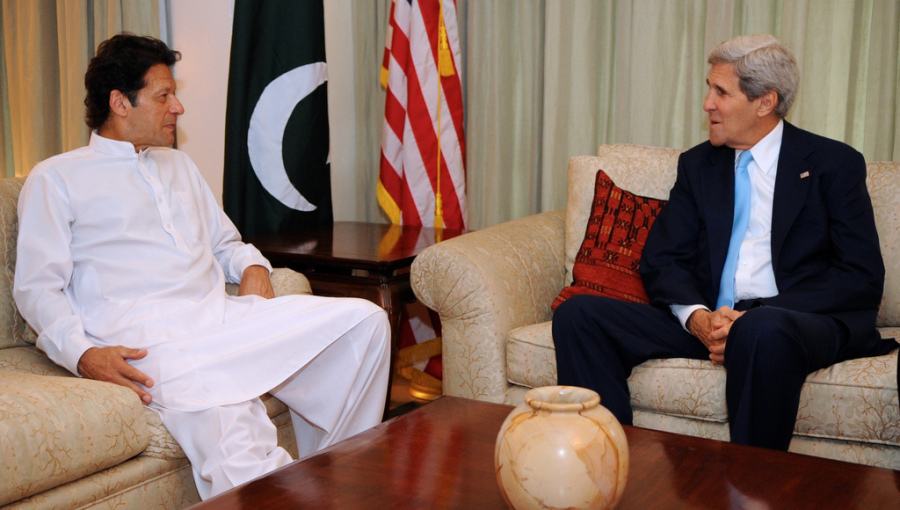
Khan meeting with former US Secretary of State, John Kerry / US Secretary of State - PDFacebook
By IntelliNews - Chennai Bureau October 14, 2026

Five people were injured on October 13, 2026 when Pakistani police fired tear gas and live ammunition at demonstrators opposing Islamabad’s suspension of Khyber Pakhtunkhwa’s elected government, The Times of India reported.

The intervention places Imran Khan’s principal political stronghold under federal control as supporters demand the jailed former prime minister’s release and medical treatment. The northwestern province, bordering Afghanistan, had been governed by Khan’s Pakistan Tehreek-e-Insaf (PTI) since 2013.

Islamabad assumed control on October 11, removing the only provincial administration run by the party. Violence was most severe in Bara, about 15 kilometres from provincial capital Peshawar, according to Reuters.

Police said 50 people had been detained and faced possible terrorism and sabotage charges over alleged damage to government property. 

President Asif Ali Zardari imposed emergency and governor’s rule under Articles 232(1) and 234(1) of Pakistan’s constitution, acting on the advice of Prime Minister Shehbaz Sharif’s cabinet. The declaration cited threats from intensified militant attacks. Governor Faisal Karim Kundi has assumed control, with army personnel authorised to support civilian authorities.

Chief Minister Sohail Afridi, who led a protest march, was placed in protective custody alongside seven PTI leaders. Party spokesperson Sheikh Waqas Akram rejected the takeover, alleging it targeted the opposition rather than security threats. A petition filed at the Peshawar High Court on October 12 challenged the measures as unlawful.

Interior Minister Mohsin Naqvi defended the intervention, saying federal and provincial authorities were now aligned on security. The Centre for Research and Security Studies, based in Islamabad, recorded 485 civilian and security personnel deaths in the province during January-September 2026, down 16%.

Nationwide fatalities rose 9% over the same period. Khan, 73, has been imprisoned at Adiala Jail in Rawalpindi since 2023. His wife, three sisters and numerous PTI activists are also detained, deepening the political confrontation as security concerns remain central to Islamabad’s justification.