As Diplomacy Picks Up, Iran Claims Mine Strike on Ship in Strait of Hormuz
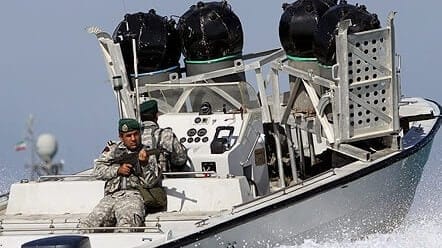
On Sunday, Iranian state media claimed that a "violating" oil tanker hit a mine in the Strait of Hormuz while navigating outside of the Iranian transit zone, breaking a brief pause in hostilities and war-risk casualties in the contested waterway. Despite the new incident, U.S. sources indicate that American military operations are on hold in order to give time for diplomatic efforts, according to CNN and the Washington Post.
Defa Press reports that the unnamed vessel "exploded" in the strait after striking a mine outside the so-called Persian Gulf Strait Authority's designated route through Iranian waters. Iran has issued navigational warnings that claim that the IMO's traffic separation scheme in the center of the strait and the Omani waters on the south side are seeded with naval mines, a claim previously confirmed by U.S. officials. Iran has also repeatedly fired upon vessels that attempt to use these independent routes.
President Donald Trump recently warned that the U.S. would attack dual-use civilian infrastructure in Iran for every ship attacked in the strait, and would charge back the cost of Iranian strikews by confiscating funds from frozen Iranian bank accounts (a process for which there is no clear legal procedure). If the vessel in question were indeed damaged by a mine, emplaced at some point in the past, it remains to be seen how the administration would react.
For now, shipping interests are treating the strait as an extreme-risk zone. Traffic remains at a near-complete halt, even for Iran-linked shipping, according to consultancy Windward. One LPG carrier transited through the Iranian lane overnight Saturday, and one Iranian-linked product tanker left the Gulf outbound (the only moving merchant ship visible on AIS that night). No vessels used the southern corridor.
The U.S. has effectively paused its strikes in Iran, and Iranian diplomats have reopened talks with the government of Oman on "common principles and operational mechanisms for the safe passage" of vessels in Hormuz. Oman and Iran are the sole coastal states in the strait and have previously discussed measures for joint governance, potentially including joint service fees.
Later Sunday, Iran said that it remains open to further peace talks with the United States, subject to acknowledgement of its terms - starting with a recognition of Iran's claim to sovereignty over the Strait of Hormuz.
Ukraine strikes Iranian shipping
At the same time, Ukraine has made a minor entry into the conflict on the American side, attacking a Russian ship carrying arms to Iran on the Caspian Sea. On Saturday, Ukrainian forces struck and damaged a commercial vessel on the Caspian Sea, killing one seafarer and injuring a second. Ukrainian President Volodymyr Zelensky has acknowledged "strong results" in striking Caspian shipping, specifically including "military cargo shipments involving Iran."
"Responsibility for the consequences arising from the adventurism of the head of the Ukrainian regime will rest with that regime and its supporters and instigators," Iran's foreign ministry said in a statement.
In the last several years, Iran has provided substantial military aid to Russia for the invasion of Ukraine, including the basic design used for Russian long-range drone attacks on Ukrainian cities. Ukraine claims to have shot down more than 40,000 Iranian-designed Shahed drones since 2022. Tehran denies aiding Moscow in the conflict.
In return for this technical assistance, Russia provides Iran with arms and with the satellite imaging it needs for precision ballistic missile strikes on U.S. troops and U.S. allies in the Gulf region. Multiple U.S. servicemembers have been killed in those attacks, and hundreds injured. It is possible that Russian satellite intelligence data also makes its way to Iranian-allied Houthi rebels in Yemen, where it may be used to target commercial shipping in over-the-horizon attacks.
U.S. Forces Strike Another Iran-Linked Tanker in Strait of Hormuz
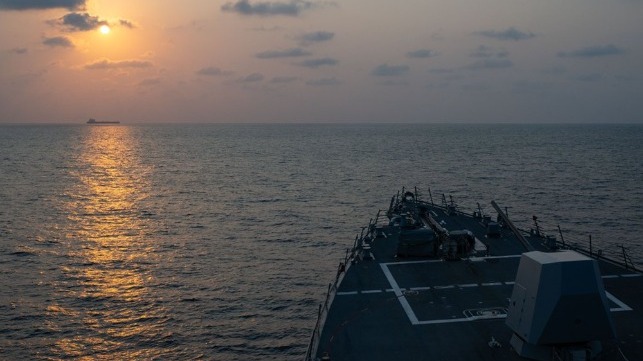
On Friday, U.S. forces opened fire on a merchant vessel that was attempting to maneuver past the American blockade on Iranian seaports, according to U.S. Central Command. It is the second time since the reimposition of the naval cordon that the U.S. military has used force to disable an Iran-linked ship.
AP's Konstantin Toropin reports that the vessel in question was the merchant tanker "Lavine," a name corresponding to a VLCC with IMO 9177686. Since IMO 9177686 has no AIS history of recent trading in the Mideast, it is possible that the reported name is a case of mistaken identity, name falsification or AIS manipulation.
CENTCOM claimed that the vessel in question attempted to run the blockade line in the Gulf of Oman multiple times. The crew did not comply with warnings, the spokesperson said, and CENTCOM assets responded by striking the vessel's engine room. Video footage of the strike has not been released.
The attack is the latest strike in a back-and-forth exchange between U.S. and Iranian forces. Both sides have hit multiple vessels, and traffic has dwindled to a trickle on concerns of heightened potential for attacks - and heightened insurance rates. The vast majority of the traffic is using the Iranian-controlled lane past Larak, not the U.S.-controlled route past Oman; many of the vessels are linked to Iranian trade.
"Strait of Hormuz traffic fell to six confirmed crossings [on July 23], down 60 per cent from the previous day, with all but one vessel using the Iranian Unilateral Scheme," assessed maritime consultancy Kpler.
"The strait remained disrupted through [overnight July 22-23]. Five vessels crossed the chokepoint: three outbound, two inbound," reported competitor Windward.
"The international waterway remains open for transit despite recent attacks from Iran's Islamic Revolutionary Guard Corps. Commercial vessels continue to freely navigate the strait with U.S. military support," claimed U.S. Central Command in a statement.

No comments:
Post a Comment