It’s possible that I shall make an ass of myself. But in that case one can always get out of it with a little dialectic. I have, of course, so worded my proposition as to be right either way (K.Marx, Letter to F.Engels on the Indian Mutiny)
Sunday, July 26, 2026
Houthis May be Using Real-Time Satellite Intelligence for Targeting
Brigadier Yahya Saree makes a passionate speech broadening the scope of the fighting which broke out this week (video from Houthi TV)
After the Houthis’ first two attacks on Wednesday against Saudi-associated shipping, in which the Saudi-flagged tankers VLCC Layla (IMO 9336098) and Encelia (IMO 9240172) were hit, there has now been a third attack. The Saudi-flagged products tanker NCC Masa (IMO 9688336) was struck early on July 25, but suffered only superficial damage and was able to proceed on its way.
Interestingly, the NCC Masa is normally employed shifting oil and chemical products between ports on the Saudi Red Sea coastline, suggesting that when it was hit it was not attempting to exit the Red Sea. This targeting supports the initial Houthi declared intent of attacking Saudi ships and visitors to Saudi ports wherever they might be, rather than a plan simply to blockade the Bab el Mandeb.
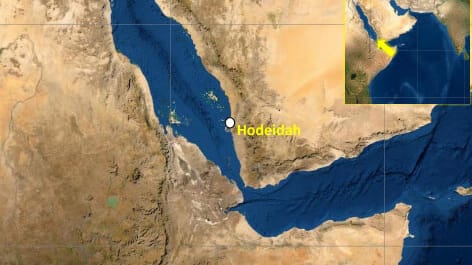
In previous Houthi anti-shipping campaigns, targeting tended to be indiscriminate and often inaccurate. The more specific targeting parameters now suggest that the Houthis have confidence in and access to improved maritime intelligence collection capabilities, to be able to identify ships which fulfil their attack parameters – and not necessarily close to the waters off Hajjah and Hodeidah Governorates, where fishing boats and coastal observation would be a primary source of information. This points to the Houthis having acquired reliable access to near real-time high resolution satellite imagery, as might be supplied with the help of Iran.
Iran is known to have supplied terminal equipment to the Houthis, enabling them to access the Russian/Iranian Kanopus-V/Khayyam satellite constellation. The Houthis have also gained access with Iranian help to the Chinese Jilin-1 mini-satellite constellation, and the TEE-01B imagery satellite built by Beijing-based The Earth Eye Co, access for which the Iranians stumped up $37 million in March 2024. It is the latter system which is believed to be providing the Iranians with timely and high-definition targeting information responsible for the accuracy of attacks recently on US bases in the Gulf.
Complementing an improved intelligence collection and targeting system, the Houthis also appear to be coordinating the use of multiple strike systems simultaneously to attack single targets, ominously but without success so far. All these new features of the Houthi offensive capability suggest preparations have been in the making for some time, also evidenced by the coordinated disappearance of senior Houthi figures from media through which they could be targeted – a lesson learned since last year’s attacks.
In response to the Houthis’ first three attacks on shipping, the Saudi response had been relatively restrained; it struck back at a telecommunications site in Hodeidah (probably the same Al Marawi’ah satellite down-link station that was attacked by the Israelis on May 30, 2025) and coastal surveillance radars on Kamaran Island, which lies on the seaward side of the ports of Salif and Ras Isa. It made a point of not attacking those ports nor the port of Hodeidah, through which the Houthis receive international food aid, and which the Houthis claim the Saudis are blockading.
This response was clearly designed not to ratchet up the conflict further, but the Houthis did so in any case, attacking storage tanks at the Jizan oil refinery early on July 25 and setting off extensive fires. In addition to a reported attack on Yanbu, there are also suspicious heat anomalies suggestive of a strike at about the same time on a communications facility to the west of the military airfield at Abha. This widening of Houthi attack parameters will give the Saudis little choice but to respond in kind, and there are early reports of Saudi air attacks in Marib and Al Jawf, well away from the coast, and likely to be missile launch sites. Late on July 25, the Houthi military spokesman Brigadier Yahya Saree posted a broadcast statement in which he changed but significantly widened the scope of the Houthi campaign, effectively creating an active military alliance with Iran and promising to retaliate against any country which attacked either Iran or Houthi-controlled Yemen.
President Trump and Secretary Rubio have threatened to join the fray, holding the IRGC as equally accountable as the Houthis themselves. There is at least one US Navy warship in the lower Red Sea, namely the Arleigh Burke-class destroyer USS Gonzalez (DDG-66), and she is unlikely to be alone.
The Omanis as usual are trying to mediate, and in particular attempting to calm the Houthis down. The outbreak of fighting between the Houthis and Saudis not only threatens the ceasefire which has generally held since March 2022. It also threatens the peace talks which have dragged on since then which the Omanis have sponsored and invested heavily in; the lack of progress in these talks is the principal reason that the Houthis have resorted to fighting again, but by doing so they have jeopardized what has been achieved so far.
In the meantime, notwithstanding the attacks and the increase in tension, traffic through the Bab el Mandeb is still flowing, but perhaps is down a little in volume today in comparison with earlier in the week. One might expect that Saudi-bound ships may have held off and that most ships are passing through to and from the Suez Canal.
Houthi Rebels Claim Missile Strike on Giant Saudi Refinery at Jazan
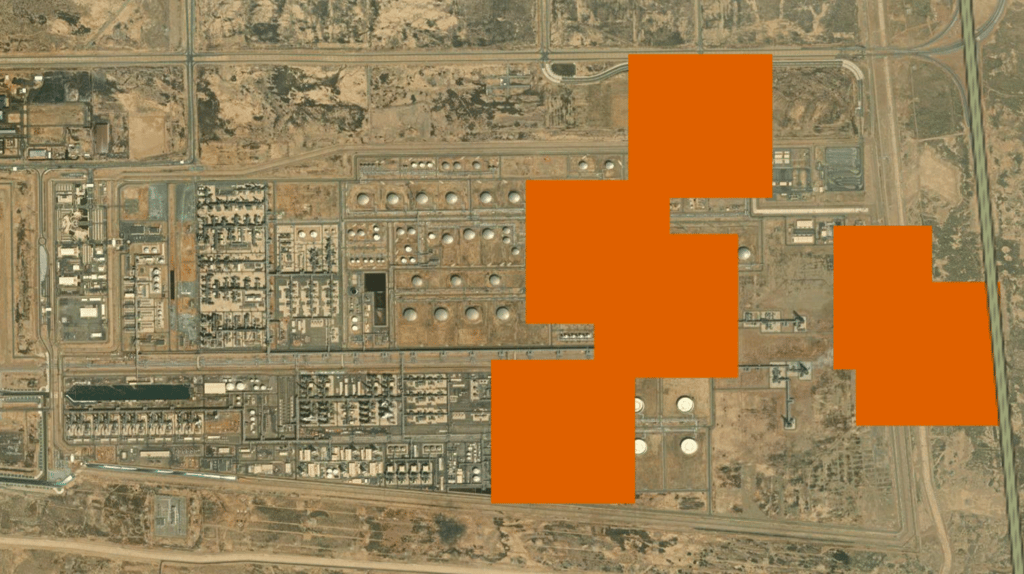
NASA FIRMS overlay showing unusual thermal signatures on the eastern half of the refinery mega-complex (NASA)
Yemen's Houthi rebels claim to have attacked the port city of Jazan, Saudi Arabia with ballistic missiles. Saudi authorities have not confirmed the strike, but a Saudi civil defense alert was issued for Jazan on early Saturday and bystander videos purporting to show fire damage are circulating on social media.
NASA FIRMS fire monitoring data shows five substantial thermal anomalies - infrared signatures not present in previous time periods - located in the eastern half of the Jazan refinery, all within the last 3-6 hours. FIRMS infrared detections may stem from natural or routine events, like flaring, but the new cluster at Jazan is large in scale and has not occurred before at that location.
The Jazan Refinery is one of the world's most advanced mega-scale integrated refining complexes. It can process about 400,000 barrels of crude per day, enough to take in four percent of all Aramco oil and liquids production on an ordinary day.
The refinery features the world's largest industrial gas plant, and it is powered by the world's largest integrated gasification combined-cycle plant. The $12 billion plant burns low-value refinery byproducts to generate power, and is rated for 3.8 gigawatts - more than the largest offshore wind farm in the world. It also delivers hydrogen gas and steam for refining operations.
Saudi and Houthi forces have resumed trading fire across their shared border after four years of relative peace, prompted by the Houthi "blockade" linked to the U.S.-Iran conflict. Earlier Friday, Saudi missiles hit targets in Hodeidah and on Kamaran Island, reportedly damaging a Houthi naval installation and a military camp, according to AFP.
Houthi Blockade Complicates Saudi Tanker Logistics
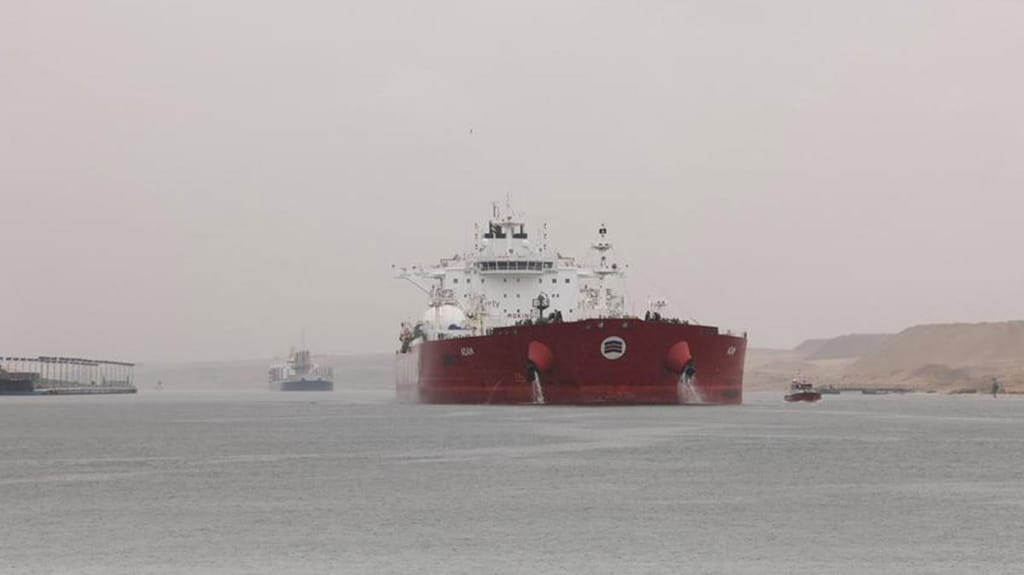
A tanker operating in the Suez Canal, the only alternate route to move Saudi crude out of the Red Sea (SCA press handout)
On July 19, Yemen’s Houthi rebel movement declared a “maritime embargo” against Saudi Arabia. The Houthis stated that the blockade was a direct retaliation for Saudi Arabia's long-running restrictions on Yemen and a recent alleged attack on the Sanaa International Airport.
On July 22, the Houthis targeted two oil tankers, the Encelia, an Aframax controlled by Saudi’s Bihar International and the Layla, a Bahri VLCC. While the Encelia was hit and damaged, the attack on the Layla has not been independently confirmed.
Today, Saudi Arabia struck Yemen’s port of Hodeidah in retaliation. The attacks have increased an already high level of uncertainty in the oil and tanker business and market participants are all trying to figure out how to respond.
After the US/Israel war against Iran triggered the closure of the Strait of Hormuz, Saudi Arabia ramped up flows through their East-West Pipeline, moving crude from the kingdom’s eastern producing system to Yanbu on the Red Sea. Yanbu loadings reportedly averaged more than 4 million barrels per day (Mb/d) in June and early July, compared with less than 1.0 Mb/d barrels per day during the same period of 2025.
This represented an extraordinary reorientation of Saudi export geography. Instead of loading most export barrels at Ras Tanura and other Gulf terminals, Saudi Arabia was sending a large share of its crude across the peninsula and loading it on the Red Sea coast. As a result, roughly 2.5 million barrels per day of Yanbu exports were (until recently) moving south through the Bab el-Mandeb Strait, principally to South Korea, Japan, China and India.
However, the East-West Pipeline only partially solved the Hormuz problem and at the same time transferred Saudi Arabia’s maritime exposure to another chokepoint.
The situation around the Bab el-Mandeb Strait is not straightforward. The Houthi’s claim that the strait is open, except for vessels that called on Saudi Arabia. However, there are credible reports that at least two Chinese-controlled VLCCs carrying Saudi crude safely transited the Bab el-Mandeb strait. That seems to indicate that the situation is less black-and-white than initially thought. In the meantime, charterers and owners are considering alternative routing and there are rumors in the market that several Asian charterers already fixed Saudi cargoes ex-Sidi Kerir, routing their cargoes around Africa.
Re-routing Saudi crude destined for Asia via the Mediterranean is an option, but it comes with obvious complications. Fully laden VLCCs cannot pass through the Suez Canal because they are draft restricted. That leaves two alternative approaches.
The first is to use the Sumed pipeline, a 320-kilometer crude oil pipeline in Egypt that transports oil from Ain Sukhna in the Red Sea to Sidi Kerir on the Mediterranean coast. With a maximum capacity of 2.5 million barrels per day, it serves as a vital strategic bypass for the Suez Canal, allowing supertankers to offload cargo on one end and reload on the other. VLCCs can use this drop and pick process to circumvent the draft restrictions of the Suez Canal. Before they transit the Suez Canal, they discharge a portion of their cargo into the Sumed pipeline. They will reload the previously discharged crude when the tanker reaches the Sidi Kerir terminal.
A more direct export option for Saudi barrels is to use smaller Suezmax tankers that can sail through the Suez Canal unrestricted. It is not clear how much extra capacity is available on the Sumed pipeline, but in combination with direct Suezmax sailings (and some “exceptions” made for Chinese buyers of Saudi crude) it is likely that most of the oil can keep flowing.
However, it will require considerably more ships, longer voyages and more complicated logistics. For example, rerouting crude oil from Yanbu to South Korea via the Mediterranean increases the voyage length from 24 to 54 days. That is commercially possible, but highly inefficient, and it will significantly increase the delivered cost of Saudi crude oil in Asia.
If the Houthi-Saudi conflict escalates further and the avoidance of Bab el-Mandeb becomes widespread, the effect on the tanker market can be significant. Saudi crude flows will tilt toward Europe, Atlantic barrels will move east, Suezmax demand will rise and the effective supply of tanker capacity will contract sharply.
The unusual geography of moving Yanbu crude to Asia without using the Bab el-Mandeb means that even a modest diversion can generate an outsized increase in tonne-miles, boosting tanker rates.
This article appears courtesy of Poten & Partners.
The opinions expressed herein are the author's and not necessarily those of The Maritime Executive.
Saudi Arabia Launches Retaliatory Strikes on Houthi City of Hodeidah
On Friday, Saudi forces launched an attack on the Houthi-occupied city of Hodeidah, retaliating for the latest round of Houthi strikes on Saudi shipping.
For years, Saudi forces and the Saudi-backed Yemeni government fought the Houthi group for control of Hodeidah and the rest of northwestern Yemen. That conflict ended in a ceasefire agreement in 2022, but has been relit by Houthi attacks on Saudi shipping.
Two Saudi tankers were hit by Houthi drones and missiles on Wednesday, and a third tanker - the NCC Masa - was struck on Friday. The Masa sustained only minor hull damage, Saudi state news agency SPA said, and continued onwards on her commercial journey.
The Saudi retaliatory strike on Houthi territory hit a state media telecom facility and an island offshore, according to Houthi outlet Al Masirah. A spokesman for the Saudi government said that Hodeidah's seaport - the largest in Yemen - was not hit in this round of strikes, nor the nearby energy port at Ras Isa. All Yemeni ports remain open, the Saudi official claimed. (The Houthis allege that Saudi Arabia has imposed a siege on Yemen.)
Though the Houthi blockade of Saudi port operations may prove to be an irritant for Saudi oil shipping interests and their customers, traffic continues to pass through the southern Red Sea and Strait of Ban el-Mandeb. The Houthis insist that the strait is open, and that their blockade applies only to Saudi-linked vessels.
Video: U.S. Marines Board Tanker Linked to Houthi Rebels
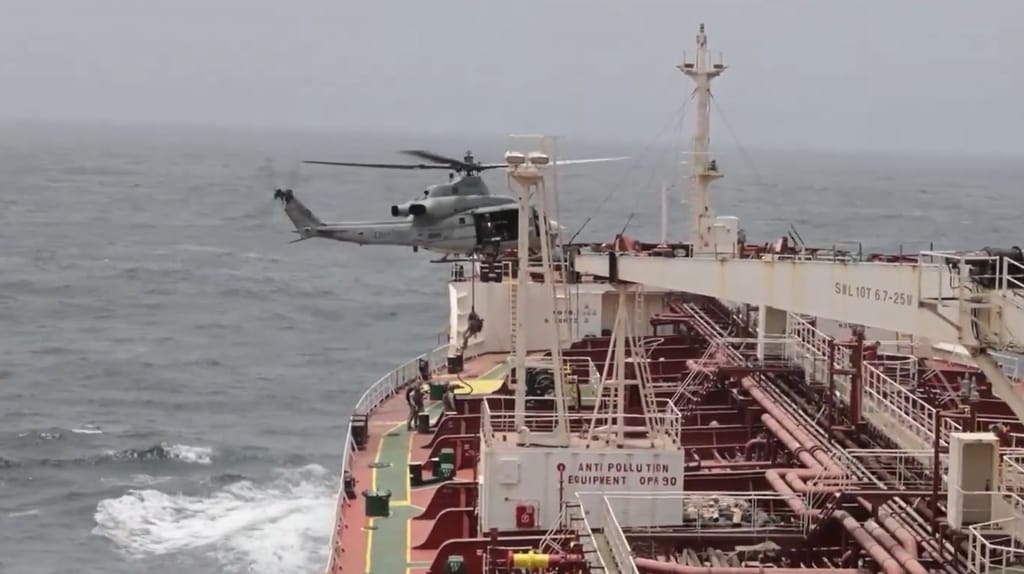
U.S. Marines fast rope onto the deck of the product tanker Charminar (USMC / Central Command)
On Saturday, U.S. forces intercepted the falsely-flagged product tanker Charminar for a flag verification boarding, part of the new U.S. effort to suppress Iranian oil exports.
Charminar is a 50,000 dwt product tanker built in 2005. She is falsely flagged in the Comoros Islands and was previously part of the notorious Fractal Marine fleet. She was sold to anonymous owners in 2025.
Charminar was breaching the U.S. blockade line, but she has a specific mission that makes her even more relevant to U.S. objectives, according to TankerTrackers.com. The consultancy's observations suggest that she is engaged in moving Iranian fuel to Yemen's Houthi rebels, who control the country's northwestern corner and have recently begun a campaign against Saudi shipping in the Red Sea. The Houthi pressure on Saudi energy interests marks a significant horizontal escalation of the Hormuz conflict into a new and economically-sensitive area.
TankerTrackers.com has also corrected the identification of the latest tanker to be struck in a U.S. attack. U.S. Central Command identified the vessel as the Lavine, a tanker that AIS data shows to be located in the South China Sea. The vessel involved was actually the Disha (IMO 8818219), the firm's analysts confirmed.
Disha has been sanctioned for two years. Like Charminar, Disha had been spotted along the Houthi-controlled coastline of northwestern Yemen at several points in the past, according to the consultancy's visual sightings log.
Disha is Indian-crewed, and the Forward Seaman's Union of India expressed outrage at the strike, though luckily no crewmembers were injured.
"Vessels with full Indian crews are being systematically targeted. Yet the response remains the same — silence," the FSUI wrote in a statement. "No accountability for the Indian seafarers already killed in earlier attacks."
TankerTrackers.com maintains a full list of sanctioned and high-risk vessels, a resource that foreign mariners can use to determine if the risk profile of the ship aligns with the wage premium offered for joining the crew.


No comments:
Post a Comment