Nine States Sue Trump Administration to Stop Offshore Wind Buybacks
California and a coalition of eight eastern states filed a total of three lawsuits on September 22, each seeking to block deals made by the Trump administration to buy back offshore wind leases in exchange for investments in fossil fuel projects. These suits follow earlier ones, in which they each allege the deals are illegal, violate several federal laws, and redirect renewable energy investments in Democratic-led states to other areas of the country.
New York is leading a coalition that includes New Jersey, Connecticut, Delaware, Maine, Massachusetts, Rhode Island, and Vermont, calling the deals with Bluepoint Wind and Invenergy illegal. The federal government committed to reimbursing $1.4 billion in exchange for canceling four wind leases. Bluepoint received $765 million to cancel a project offshore from New York in exchange for investing in LNG projects. Invenergy got a total of $653 million for three offshore wind leases in exchange for investments in natural gas plants in Indiana, Wisconsin, Iowa, Kansas, and Missouri and geothermal projects in the western United States.
In addition to the two suits filed today, the eastern states also sued in June, challenging the deal struck by the Department of the Interior to buy back offshore wind leases from TotalEnergies.
“Americans are facing increasing energy costs because this administration would rather pay off energy companies than let us build the new power sources we need,” said New York State Attorney General Letitia James, who is a vocal critic of Donald Trump and faced a personal suit by the administration. “These illegal backroom deals take money that should have gone toward lowering New Yorkers' bills and hand it to fossil fuel projects in other states, all while our energy demand continues to grow.”
New York argues that the canceled projects were expected to bring more than $16 billion in investments into the state and hamper the state’s efforts to meet energy demands. It cites information from New York’s energy planners that project electricity demand will grow eight percent by 2030 and 24 percent by 2040, driven in part by economic development and new large loads such as data centers. The state alleges that the administration is misusing taxpayer money and sabotaging the state’s ability to meet growing energy needs.
“The Trump administration's unlawful pay-to-not-play scheme to pressure companies to forego planned offshore wind projects in America is an outrageous abuse of taxpayer dollars that hurts our ability to meet our energy needs,” said New York State Governor Kathy Hochul.
The eastern state coalition is asking the court to stop the deals. California filed a separate suit that alleges that the administration is bypassing Congress and illegally using a general fund set up by Congress to settle lawsuits to fund these buybacks. It has been pointed out previously that none of the wind development companies had sued the United States.
California Attorney General Rob Bonta and the California Energy Commission (CEC) suit is against the Trump administration and Invenergy over the deal to pay the company $111 million to cancel the Morro Bay Wind Energy Area off the Central California coast and redirect the investments away from California.
The California suit calls it a “sham settlement” and asserts that it violates numerous federal laws. It cites rules established by Congress that govern the offshore energy leasing program, including stakeholder participation rights for affected states like California and a cap on how much the government can pay to a developer when it cancels a lease.
California had previously filed a Notice of Intent to Sue, which gave 60 days for the Department of the Interior and Inverengy to “cure any violations.” California followed a similar process before suing Golden State Wind and the federal government at the end of August over the cancelation of that lease.
The attorney general and energy commission argue that offshore wind is part of a strategic plan that calls for the state to develop 25 gigawatts of offshore wind power by 2045, enough to power roughly 25 million homes and to provide about 13 percent of the state’s electricity supply. They contend it would accelerate California’s clean energy transition, create local manufacturing jobs, and drive economic development.
The administration has continued to make unspecified claims that offshore wind turbines pose a national security risk, despite the Department of Defense having reviewed the plans for each project. It asserts that the wind turbines could create radar interference.
The eastern state coalition was victorious in court previously when it challenged the Trump administration’s stopping wind leasing for a review. The court found that the administration was violating federal process with an open-ended review and that the companies were entitled to a timely review of applications.
US Offshore Wind Project Revolution Wind Installs Last Turbine
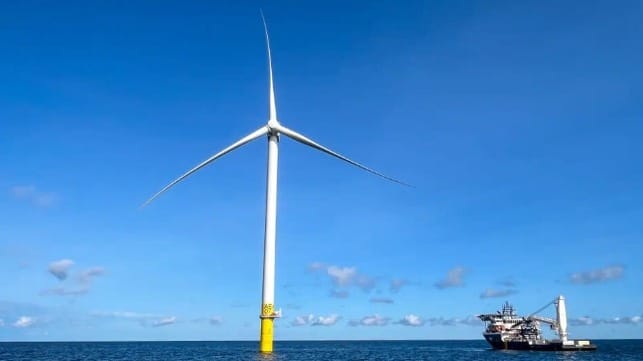
One of the few large offshore wind projects proceeding in the United States, Revolution Wind completed the installation of its 65th and final wind turbine. The project began delivering power in March despite repeated opposition from the Trump administration and now expects to complete its commissioning by the end of the year.
Revolution Wind is being developed in a 50-50 partnership between Orsted and Global Infrastructure Partners’ Skyborn Renewables. Media reports indicate it represents an investment of $6.2 billion to develop and will become the third large, commercial-scale offshore wind farm in the United States to be completed. It is located in Rhode Island Sound, not too far from the Vineyard Wind and South Fork Wind projects, which have already been completed and commissioned.
The project received its final approvals in November 2023 after the companies noted more than nine years of planning and permitting. It has 20-year power purchase agreements to deliver 400 MW to Rhode Island and 304 MW to Connecticut.
The project started offshore construction in 2024, and by August 2025 it was reported to be nearly 80 percent complete. The first of its turbines was installed in September 2024, and by August 2025, Revolution Wind said 45 of the 65 Siemens Gamesa turbines were installed.
The Trump administration issued its first stop-work order to the project that same month, claiming irregularities in the permitting. The project went to court and, a month later, received a preliminary injunction against the Bureau of Ocean Energy Management from enforcing the order. Revolution Wind, however, was also included in the December 2025 move by the Department of the Interior, which ordered all five of the under-construction wind farms to stop work, this time citing undefined issues for potential interference from the turbines with radar and national security. Revolution Wind won a second injunction early in 2026 that permitted it to resume work again.
By March 2026, the project was reporting that it was more than 90 percent complete and that several key construction scopes were finished. By the middle of the month, it had begun delivering power to the grid, but the developers kept a lower profile after their two confrontations with the administration.
Rhode Island Governor Dan McKee issued a statement today calling the completion of the installation “another major milestone.” He commented, “We said we would see Revolution Wind through to the end,” while citing the promise for the state as it begins receiving power.
The full project is slated to generate 704 MW. An earlier analysis from the State of Connecticut’s Department of Energy and Environmental Protection found that Revolution Wind would save New England ratepayers as much as $500 million per year in wholesale energy costs, and that was before the recent increase in energy costs.
Orsted confirmed in a brief statement that this phase of construction had been completed. It said that commissioning would be continuing, with a target by the end of the year for full operations.
Revolution Wind is being followed by Coast Virginia Offshore Wind, being developed by Dominion Energy. It has also begun power generation and expects to complete construction by mid 2027. The only other offshore wind projects under construction in the United States, Empire Wind and Sunrise Wind, are also expected to complete construction in 2027.


No comments:
Post a Comment