After Russian Threats, Macron Puts Nuclear Deterrent at the Forefront
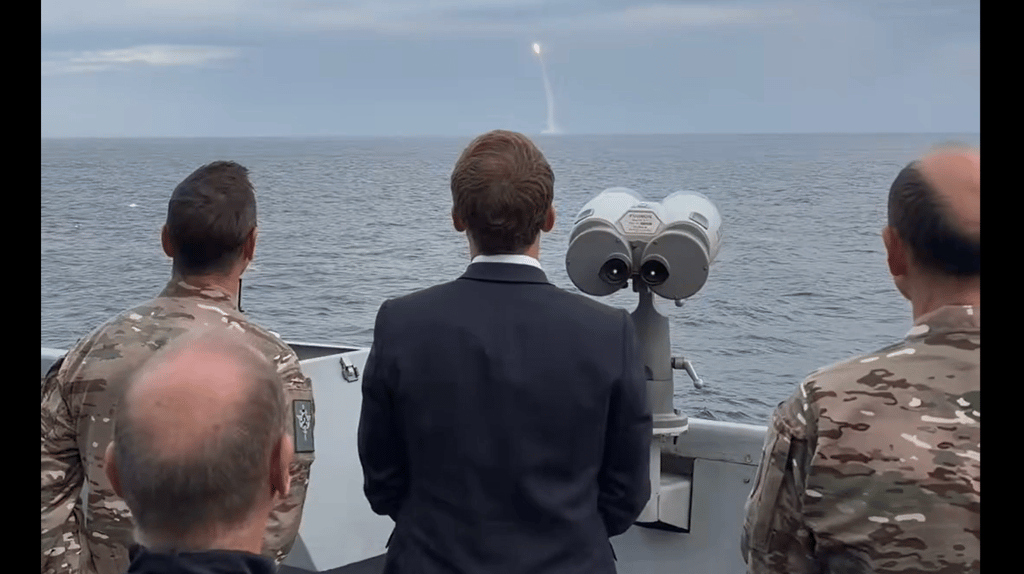
The administration of French President Emmanuel Macron is putting new emphasis on France's nuclear deterrent, and specifically on its nuclear ballistic missile submarine fleet. In March, Macron used a launch ceremony at the L'Île Longue submarine base to announce that France would expand its arsenal and cooperate with other European countries on a broader nuclear deterrence system. On Tuesday, he made an unannounced trip to a frigate off Brittany for the first seagoing test-launch of an M51.3 ballistic missile - and he reiterated that message.
"To be free, one must be feared. And to be feared, one must be powerful," Macron said in a ship-wide PA address to the crew. "Our nuclear deterrence protects us and will continue to protect us. Long live the Republic, and long live France."
The launch was a post-drydocking test shot for Le Vigilant, one of France's four Le Triomphant-class ballistic missile submarines, as well as the first sub-launched test of the third variant of France's M51 sub-launched ballistic missile. Macron's attendance was not expected at the routine test, according to Le Monde, but the launch provided a powerful and somber visual to accompany his message: that France can respond to nuclear threats.
The rationale for Macron's newly-serious focus on nuclear arms can be found in Russia's increasingly aggressive stance towards NATO. Last month, the Russian government sent a diplomatic note to NATO (later shared with Reuters) that threatened "Russian strikes against decision-making centers" in Europe at the very start of any conflict. Exercises near the Baltic Sea exclave of Kaliningrad are of particular concern, Moscow suggested.
"Russia will be ready to use the entire arsenal of forces and capabilities at its disposal, including nuclear weapons, in order to defend its territory should NATO countries undertake any attempt aimed at isolating the Kaliningrad Region from the ?rest of the country," the Kremlin warned in the note.
France has been upgrading its ballistic missile inventory to account for increasingly capable air defense technology. U.S. and Israeli systems managed a 90-percent interception rate against Iranian ballistic missiles in 2024, and sustained a high success rate throughout the more recent Mideast conflict from March 2026 onwards. According to Sidharth Kaushal of the Royal United Services Institute, Russia's investments in similar air defense systems could render the French deterrent - reliant upon the nuclear missiles fielded by its subs and strike fighters - somewhat less effective. ArianeGroup is developing a fourth generation variant of the missile with "enhanced range, precision and penetration capabilities" to counteract these developments.


No comments:
Post a Comment