“For years we’ve had climate, economy, and equality problems, but the government is not doing anything about it,” said one protester.
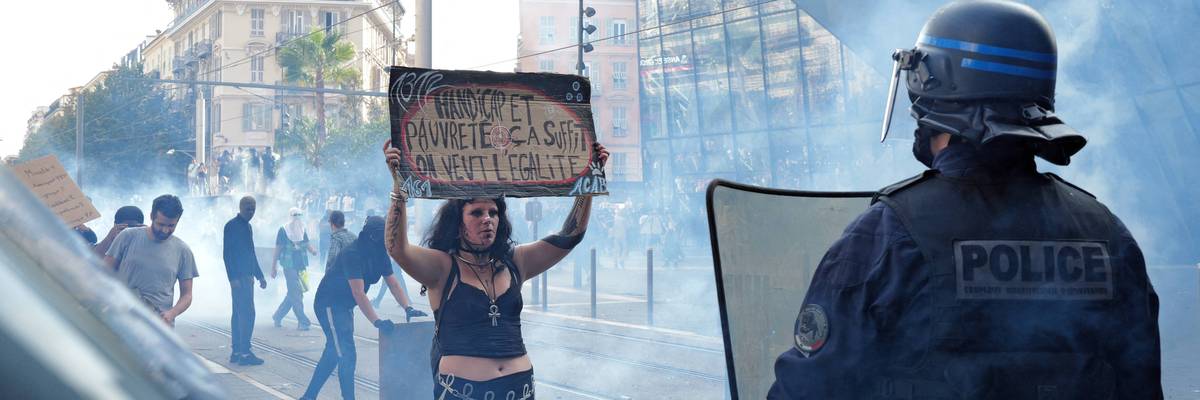
A protester holds a sign in front of a police officer in Nice, southern France, on October 17, 2026.
(Photo by Valery Hache/AFP via Getty Images)
Brad Reed
Oct 17, 2026
COMMON DREAMS
Protests erupted throughout France on Saturday, with demonstrators citing a wide variety of grievances including inequality, the high cost of living, and poor conditions in the nation’s schools.
As reported by Agence France-Presse, tens of thousands of demonstrators marched in Paris and other cities to protest what they said was inaction by the French government on the biggest problems facing the country.
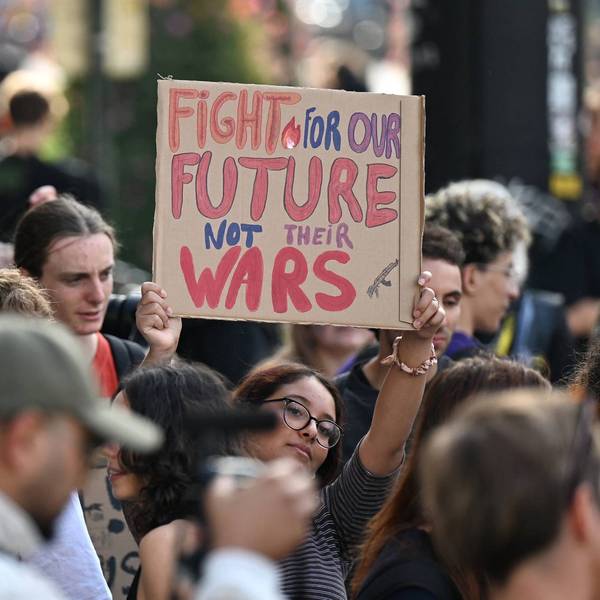
‘This Is Going Global’: Anti-Austerity Protests Spread From Spain and France to Chile, Belgium, and Beyond
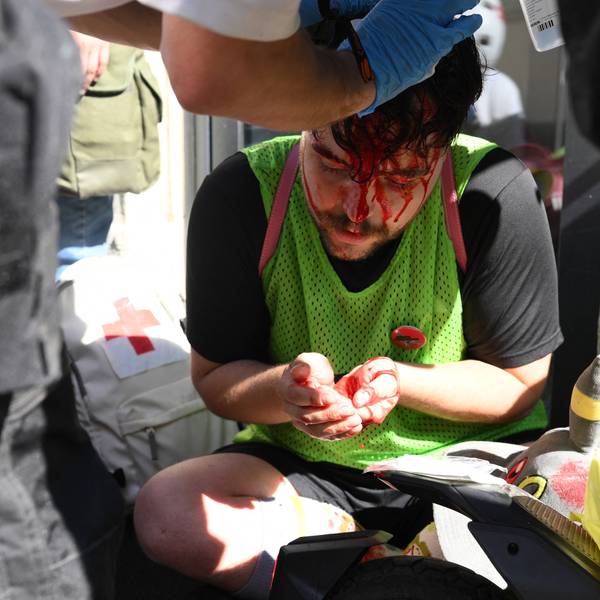
‘Savagery’: Horrific Injuries as French Police Crack Down on Nationwide Student Protests
“For years we’ve had climate, economy, and equality problems,” one protester identified as Agnes told AFP, “but the government is not doing anything about it.”
18-year-old student Kamil Alahyan told AFP that there are “so many reasons” to protest, including “the elections coming up in 2027, politicians who lie, the ultra-rich who’ve been taking more and more wealth over the past 10 years.”
A 19-year-old protester identified as Lola expressed a similar view in an interview published by The Guardian on Saturday.
“We are fighting because the cost of living is too harsh,” Lola said, “because the price of fuel is too high, because high school pupils are being violently attacked and hurt all over the country just for trying to protest and ask for more teachers and decent learning conditions.”
Student organizer Ryad Rani told AFP that “the government is trembling and it’s right to tremble because when the French people are angry, they never let up.”
Saturday’s demonstrations mark the expansion of a movement that began last month when students blockaded their schools to protest staffing shortages, dilapidated buildings, and a widely criticized university application system.
According to The New York Times, demonstrations took place in at least 140 cities across the country.
Some of the protests did turn violent in major cities including Lyon, Marseille, and Paris, AFP reported. A Saturday BBC report claimed that more than 270 protesters have been arrested nationwide.
French Prime Minister Sébastien Lecornu accused “ultra-left groups” of inciting violence at the demonstrations.
“To those who clearly want to use these acts of violence as a ‘warm-up’ ahead of the presidential election, let me be clear: we will not be intimidated,” Lecornu wrote in a social media post. “No one will impose their political agenda through violence.”
Jean-Luc Mélenchon, leader the left-wing France Unbowed party, slammed the media for focusing too much on the isolated incidents of violence and not reporting on the overwhelmingly peaceful nature of the demonstrations.
“Crowds of people everywhere, calm and joyful everywhere when the police aren’t around,” Mélenchon wrote in a social media post that featured photos of peaceful marches from across the country, which he described as “images you won’t see in the official media.”
Student Protesters Inspire One Another—and Should Inspire All of Us
When high schoolers in the US protest, they demonstrate our historic connection to the recent uprising in France.
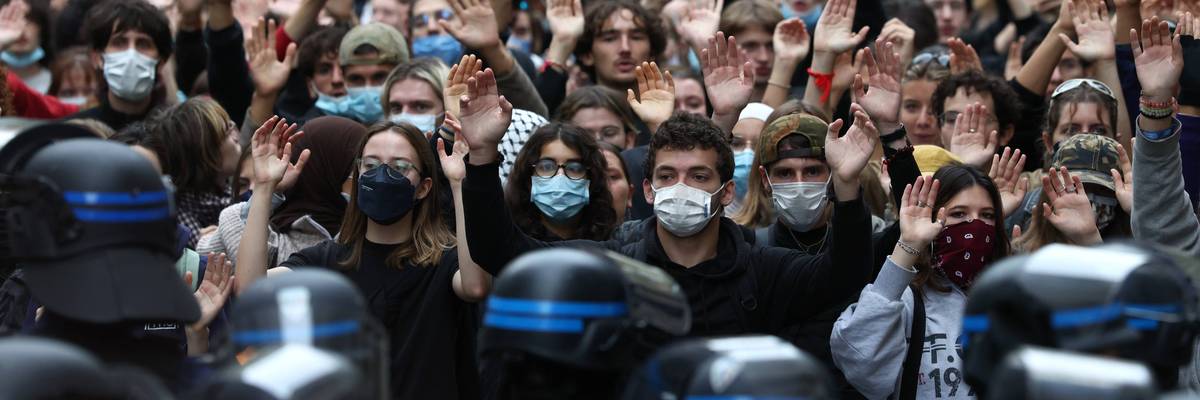
Students raise their hands in front of Police officers as they demonstrate outside Sciences Po during a protest over school overcrowding and decay on October 7, 2026 in Paris, France.
(Photo by Tom Nicholson/Getty Images)
Jon Hale
Oct 17, 2026
When high schoolers in the US protest, they demonstrate our historic connection to the recent uprising in France.
Students raise their hands in front of Police officers as they demonstrate outside Sciences Po during a protest over school overcrowding and decay on October 7, 2026 in Paris, France.
(Photo by Tom Nicholson/Getty Images)
Jon Hale
Oct 17, 2026
Common Dreams
High school students in France have captured international attention by protesting essential conditions of schooling—too few teachers, too many funding cuts, and a crumbling infrastructure. After nearly 7,000 arrests—more than 85% of whom were under 18—French education minister Edouard Geffray conceded to some of their demands and offered to hire 3,000 more teachers.
The role of high school students is clearly impactful, but we need not look to France to understand the power of student-led activism. The United States, in fact, is rich with examples.
Protestors have made reference to May 1968 protests in France, when 10 million workers, about two-thirds of the workforce, went on the largest general strike in French history. Students in France inspired a transnational movement that galvanized millions around decolonization, national liberation movements, and the rights of students in a new social order.
Those 1968 uprisings were also informed, most likely, by high school student activism in the United States.
As I explore in my book in 2022, “A New Kind of Youth,” high school students were agents of social change in the U.S. for more than 100 years. The NAACP, the oldest longstanding civil rights organization, began mobilizing high school students in 1921, where they challenged many of the same schooling conditions that French high schoolers protest today. More than a century earlier, the first NAACP youth chapters rejected textbooks with racist histories and demanded more equitable investments in segregated Black schools, for instance.
The NAACP was not the only organization to see the potential of youth activism. Radical organizers Esther Cooper Jackson, James E. Jackson, Edward Strong and others who worked in solidarity with interracial and international working-class coalitions formed the Southern Negro Youth Congress in 1937 in order to mobilize youth to actualize full citizenship rights for all, including equitably funded education.
By the Second World War, thousands of high school youth formed local organizations and joined national and international conferences in calling on state and federal agencies to alleviate discriminatory schooling conditions, end police brutality, build international solidarity, and promote pacifism in the face of wars for empires, all the while illuminating the links between racism and capitalism.
In 1946, activist scholar W.E.B. DuBois spoke to hundreds of young people assembled in South Carolina, and delivered a stirring speech he titled “Behold the Land.” As an elder in the Black freedom struggle, Du Bois charged the youth movement he saw unfolding before him. He observed that young people, many of whom were in high school, were “embarked upon a great and holy crusade, the emancipation of mankind, the upbuilding of democracy, the breaking down…of forces of evil.”
Du Bois’s words, not surprisingly, were prophetic.
High school students emerged as overlooked progenitors of key Civil Rights Movement victories. Robert Russo Moton High School student Barbara Johns orchestrated a student walkout in 1951 in Farmville, Virginia. She led her classmates in a schoolwide walkout and marched downtown. Facing expulsion, she reached out to Oliver Hill, a Virginia-based attorney with the NAACP.
The NAACP responded to Johns’ call and organized the small but committed Black community in the heart of Virgina to file a suit that demanded desegregation. The court case became Davis v. Prince Edward County, Virginia (1951)—one of the five court cases behind the Brown v. Board of Education (1954).
Students turned out in larger numbers and provided needed momentum in other parts of the Civil Rights Movement. When Dr. Martin Luther King, Jr. tackled segregation in Birmingham, Alabama, in 1963, he called for massive nonviolent protests. It was youth from elementary to high school, not local adults, who responded to the call.
An estimated 4,000 students participated in the Birmingham Children’s Crusade. They prompted the iconic photographs of the notoriously racist police commissioner Bull Connor who turned police dogs and fire houses on children. When the dust settled, more than 2,000 students were arrested and expelled from school.
Moderate segregationists listened in the wake of the offensive. State and federal governments conceded basic points and desegregated public spaces in Birmingham. During the “Freedom Summer” of 1964, President Lyndon B. Johnson signed the Civil Rights Act into law, promising anti-discriminatory protections for all.
Historic student activism led to historic liberal milestones that protected basic civil rights and made the United States more inclusive.
To be sure, such concessions fell short in enacting a genuine collective and participatory democracy. But youth activists were quick to respond to its shortcomings, making demands for today’s most salient issues. High schoolers went on strike to support common sense gun reform legislation during the March for Our Lives protests in 2018. Youth not yet in college participated in the Fridays for Future climate justice protests and joined Black Lives Matter protests in 2020.
When high schoolers protest, they demonstrate our historic connection to the recent uprising in France. The connection proffers inspiring indications that massive youth organization will lead to structural change. And the material demands made in France—for better schooling conditions and equitable investment in education in the race of austerity cuts—resonate across the United States and other struggling democracies.
It’s time that we listen, again, to what high schoolers have to say.
Our work is licensed under Creative Commons (CC BY-NC-ND 3.0). Feel free to republish and share widely.
Jon Hale
Jon Hale, professor of education history at The University of Illinois Urbana-Champaign and author of “A New Kind of Youth,” a history of high school student activism in the southern United States.
Full Bio >
High school students in France have captured international attention by protesting essential conditions of schooling—too few teachers, too many funding cuts, and a crumbling infrastructure. After nearly 7,000 arrests—more than 85% of whom were under 18—French education minister Edouard Geffray conceded to some of their demands and offered to hire 3,000 more teachers.
The role of high school students is clearly impactful, but we need not look to France to understand the power of student-led activism. The United States, in fact, is rich with examples.
Protestors have made reference to May 1968 protests in France, when 10 million workers, about two-thirds of the workforce, went on the largest general strike in French history. Students in France inspired a transnational movement that galvanized millions around decolonization, national liberation movements, and the rights of students in a new social order.
Those 1968 uprisings were also informed, most likely, by high school student activism in the United States.
As I explore in my book in 2022, “A New Kind of Youth,” high school students were agents of social change in the U.S. for more than 100 years. The NAACP, the oldest longstanding civil rights organization, began mobilizing high school students in 1921, where they challenged many of the same schooling conditions that French high schoolers protest today. More than a century earlier, the first NAACP youth chapters rejected textbooks with racist histories and demanded more equitable investments in segregated Black schools, for instance.
The NAACP was not the only organization to see the potential of youth activism. Radical organizers Esther Cooper Jackson, James E. Jackson, Edward Strong and others who worked in solidarity with interracial and international working-class coalitions formed the Southern Negro Youth Congress in 1937 in order to mobilize youth to actualize full citizenship rights for all, including equitably funded education.
By the Second World War, thousands of high school youth formed local organizations and joined national and international conferences in calling on state and federal agencies to alleviate discriminatory schooling conditions, end police brutality, build international solidarity, and promote pacifism in the face of wars for empires, all the while illuminating the links between racism and capitalism.
In 1946, activist scholar W.E.B. DuBois spoke to hundreds of young people assembled in South Carolina, and delivered a stirring speech he titled “Behold the Land.” As an elder in the Black freedom struggle, Du Bois charged the youth movement he saw unfolding before him. He observed that young people, many of whom were in high school, were “embarked upon a great and holy crusade, the emancipation of mankind, the upbuilding of democracy, the breaking down…of forces of evil.”
Du Bois’s words, not surprisingly, were prophetic.
High school students emerged as overlooked progenitors of key Civil Rights Movement victories. Robert Russo Moton High School student Barbara Johns orchestrated a student walkout in 1951 in Farmville, Virginia. She led her classmates in a schoolwide walkout and marched downtown. Facing expulsion, she reached out to Oliver Hill, a Virginia-based attorney with the NAACP.
The NAACP responded to Johns’ call and organized the small but committed Black community in the heart of Virgina to file a suit that demanded desegregation. The court case became Davis v. Prince Edward County, Virginia (1951)—one of the five court cases behind the Brown v. Board of Education (1954).
Students turned out in larger numbers and provided needed momentum in other parts of the Civil Rights Movement. When Dr. Martin Luther King, Jr. tackled segregation in Birmingham, Alabama, in 1963, he called for massive nonviolent protests. It was youth from elementary to high school, not local adults, who responded to the call.
An estimated 4,000 students participated in the Birmingham Children’s Crusade. They prompted the iconic photographs of the notoriously racist police commissioner Bull Connor who turned police dogs and fire houses on children. When the dust settled, more than 2,000 students were arrested and expelled from school.
Moderate segregationists listened in the wake of the offensive. State and federal governments conceded basic points and desegregated public spaces in Birmingham. During the “Freedom Summer” of 1964, President Lyndon B. Johnson signed the Civil Rights Act into law, promising anti-discriminatory protections for all.
Historic student activism led to historic liberal milestones that protected basic civil rights and made the United States more inclusive.
To be sure, such concessions fell short in enacting a genuine collective and participatory democracy. But youth activists were quick to respond to its shortcomings, making demands for today’s most salient issues. High schoolers went on strike to support common sense gun reform legislation during the March for Our Lives protests in 2018. Youth not yet in college participated in the Fridays for Future climate justice protests and joined Black Lives Matter protests in 2020.
When high schoolers protest, they demonstrate our historic connection to the recent uprising in France. The connection proffers inspiring indications that massive youth organization will lead to structural change. And the material demands made in France—for better schooling conditions and equitable investment in education in the race of austerity cuts—resonate across the United States and other struggling democracies.
It’s time that we listen, again, to what high schoolers have to say.
Our work is licensed under Creative Commons (CC BY-NC-ND 3.0). Feel free to republish and share widely.
Jon Hale
Jon Hale, professor of education history at The University of Illinois Urbana-Champaign and author of “A New Kind of Youth,” a history of high school student activism in the southern United States.
Full Bio >
‘Inspired By the Young People,’ Greta Thunberg Joins French Students Demanding School Fundin
“Our future is being robbed away from us,” said the Swedish climate activist. “It just gives a signal to young people that you’re not prioritized in our society.”
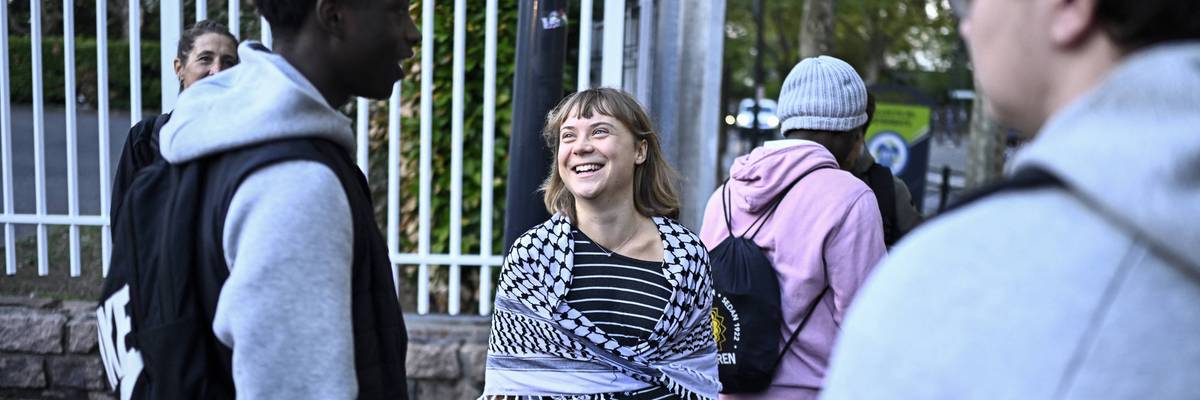
Swedish activist Greta Thunberg speaks with students as they prepare to take part in a blockade at the Lycée Paul Eluard in Saint-Denis, on the outskirts of Paris on October 13, 2026, as part of a nationwide student mobilization.
(Photo by Julien de Rosa/AFP via Getty Images)
Julia Conley
Oct 13, 2026
COMMON DREAMS
Arriving Tuesday in the Paris suburb of Saint-Denis to stand with students demonstrating against poor school conditions, climate and rights activist Greta Thunberg had one question for French leaders and authorities who have appeared shocked that hundreds of thousands of high schoolers would rise up against disinvestment in their education: “What do you expect young people to do?”
“Of course we’re going to revolt, of course we’re going to rise up,” the Swedish climate action leader told L’Humanité. “It should have been expected.”
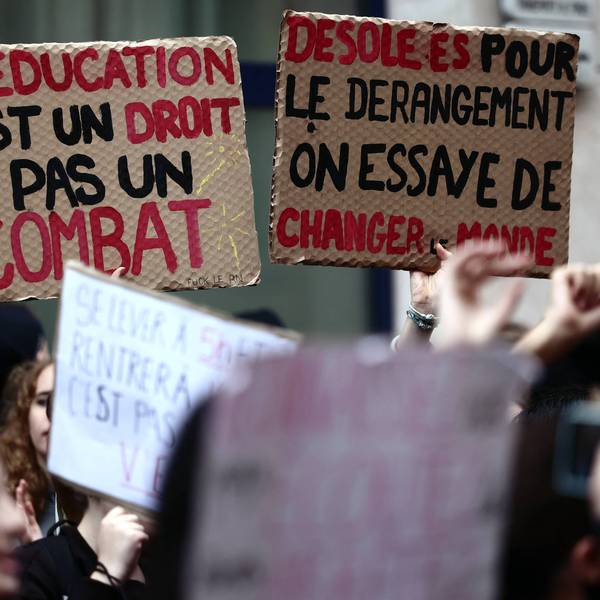
Hundreds of Schools Closed Across France as Students Demand More Education Funding
Thunberg joined the protesters—a group that originally included students, mostly aged 15-18, when the demonstrations began last month, but that’s grown to include hundreds of thousands of people including union members and teachers—as the movement entered its fourth week.
She expressed pride in the French students who have led the movement, and denounced political leaders for refusing to invest in public education.
“Our future is being robbed away from us,” she told Agence France-Presse. “Schools are not getting investments that they need... It just gives a signal to young people that you’re not prioritized in our society.”
Hundreds of schools have been closed as students have formed chains at the building entrances and marched through Paris and cities and towns across France, demanding more funding for schools.
Students are raising alarm about dilapidated buildings, overcrowded classrooms, and too many teacher absences, and the protests have exploded as French President Emmanuel Macron’s government tries to pass a budget including a modest increase in education funding—which students and teachers have denounced as an effective cut due to inflation.
Students are calling for €10 billion increase in investment for the country’s lycées, or high schools.
Thunberg said that students “are not being included in the conversation,” and condemned French authorities for their “extremely violent” response to the protests.
Police were pushed to end their use of stun grenades last week after a teenager lost his hand because of one of the weapons. Another student lost the use of his eye, and another lost many teeth when tear gas canisters were fired at close range.
“That the police are now meeting it with such violence and politicians are meeting it as if it’s something unexpected, or that young people are destroying things, just shows that they are living in a completely different reality,” said Thunberg.
At least 24 instances of police brutality are being investigated, and the violent police response has drawn condemnation from international human rights groups.
“They should know that all over the world we are following these developments. We are inspired by the young people who are demanding their basic rights,” Thunberg told reporters outside Lycée Paul Eluard in Saint-Denis. “Whether it’s not funding schools enough, or the climate crisis, or social injustice crises... It’s about time that young people are stepping up and reclaiming that future.”
The government is prosecuting about 1,500 people for their participation in the protests, which are backed by the leftist political party France Unbowed, led by presidential candidate Jean-Luc Mélenchon.
In Paris on Tuesday, students blockaded the entrances to their schools, while in Marseille, some pushed dumpsters on wheels in front of school doors.
Speaking to L’Humanité, Thunberg called on “workers’ movements, migrants’ rights movements, climate movements” and others to “stand united because we are facing the same enemy.”
“We are not going to give up, and we are going to fight for this future that is being stolen from us right before our eyes,” she said.
“Our future is being robbed away from us,” said the Swedish climate activist. “It just gives a signal to young people that you’re not prioritized in our society.”
Swedish activist Greta Thunberg speaks with students as they prepare to take part in a blockade at the Lycée Paul Eluard in Saint-Denis, on the outskirts of Paris on October 13, 2026, as part of a nationwide student mobilization.
(Photo by Julien de Rosa/AFP via Getty Images)
Julia Conley
Oct 13, 2026
COMMON DREAMS
Arriving Tuesday in the Paris suburb of Saint-Denis to stand with students demonstrating against poor school conditions, climate and rights activist Greta Thunberg had one question for French leaders and authorities who have appeared shocked that hundreds of thousands of high schoolers would rise up against disinvestment in their education: “What do you expect young people to do?”
“Of course we’re going to revolt, of course we’re going to rise up,” the Swedish climate action leader told L’Humanité. “It should have been expected.”
Hundreds of Schools Closed Across France as Students Demand More Education Funding
Thunberg joined the protesters—a group that originally included students, mostly aged 15-18, when the demonstrations began last month, but that’s grown to include hundreds of thousands of people including union members and teachers—as the movement entered its fourth week.
She expressed pride in the French students who have led the movement, and denounced political leaders for refusing to invest in public education.
“Our future is being robbed away from us,” she told Agence France-Presse. “Schools are not getting investments that they need... It just gives a signal to young people that you’re not prioritized in our society.”
Hundreds of schools have been closed as students have formed chains at the building entrances and marched through Paris and cities and towns across France, demanding more funding for schools.
Students are raising alarm about dilapidated buildings, overcrowded classrooms, and too many teacher absences, and the protests have exploded as French President Emmanuel Macron’s government tries to pass a budget including a modest increase in education funding—which students and teachers have denounced as an effective cut due to inflation.
Students are calling for €10 billion increase in investment for the country’s lycées, or high schools.
Thunberg said that students “are not being included in the conversation,” and condemned French authorities for their “extremely violent” response to the protests.
Police were pushed to end their use of stun grenades last week after a teenager lost his hand because of one of the weapons. Another student lost the use of his eye, and another lost many teeth when tear gas canisters were fired at close range.
“That the police are now meeting it with such violence and politicians are meeting it as if it’s something unexpected, or that young people are destroying things, just shows that they are living in a completely different reality,” said Thunberg.
At least 24 instances of police brutality are being investigated, and the violent police response has drawn condemnation from international human rights groups.
“They should know that all over the world we are following these developments. We are inspired by the young people who are demanding their basic rights,” Thunberg told reporters outside Lycée Paul Eluard in Saint-Denis. “Whether it’s not funding schools enough, or the climate crisis, or social injustice crises... It’s about time that young people are stepping up and reclaiming that future.”
The government is prosecuting about 1,500 people for their participation in the protests, which are backed by the leftist political party France Unbowed, led by presidential candidate Jean-Luc Mélenchon.
In Paris on Tuesday, students blockaded the entrances to their schools, while in Marseille, some pushed dumpsters on wheels in front of school doors.
Speaking to L’Humanité, Thunberg called on “workers’ movements, migrants’ rights movements, climate movements” and others to “stand united because we are facing the same enemy.”
“We are not going to give up, and we are going to fight for this future that is being stolen from us right before our eyes,” she said.

No comments:
Post a Comment