Tuesday, January 20, 2026

China’s Buddha artisans carve out a living from dying trade

By AFP
January 19, 2026


In the village of Chongshan generations of residents have made a living creating Buddhist and Taoist sculptures - Copyright AFP Jade GAO


Jing Xuan TENG

In a dimly lit workshop in eastern China, craftsman Zhang measured and shaped a block of wood into a foot as dozens of half-completed life-sized Buddha statues looked on silently.

Zhang is one of a dwindling number of master woodcarvers in the village of Chongshan near the city of Suzhou, where generations of residents have made a living creating Buddhist and Taoist sculptures for display in temples across China.

Carving the intricate statues, which are often adorned with bright paint and gold leaf, was an art he learned from his father as a teenager.

“My grandpa and my grandpa’s grandpa were also craftspeople,” Zhang told AFP in his dusty studio.

But “once our generation retires, there will be no one left to carry on the tradition”.

He blamed a combination of unattractive pay and youngsters’ unwillingness to dedicate time and energy to mastering the craft.

“You need to do this for at least five or six years before you can set up shop on your own.”

Zhang said the village had received a boom in orders starting in the late 20th century, after a loosening of tight government restrictions on worship led to a resurgence of interest in religion across the country.

But now, fewer people are commissioning new pieces with the market already “saturated” and most temples around the country already furnished with statues, Zhang told AFP.

Gu, a 71-year-old artisan at another workshop in Chongshan, said she remembered producing secular handicrafts during the Cultural Revolution, when religion was considered an archaic relic to be eliminated from society by leader Mao Zedong’s followers.

“At the time, the temples were all closed,” Gu told AFP.

Gu, who specialises in carving the heads of Buddha sculptures, proudly showed off the subtle expressions on the faces of a row of gilded figures in her storeroom.

“Every face has an expression, smiling or crying,” Gu said.

She grinned as she explained that some sculptures of famed Buddhist monk Ji Gong even showed him smiling on one side of his face and frowning on the other.

In comparison, wood carver Zhang took a more practical view of his craft.

“People look at us like we’re artists,” he said. “But to us, we’re just creating a product.”
Shark bites surfer in Australian state’s fourth attack in 48 hours

By AFP
January 19, 2026


Authorities warned surfers and swimmers to stay out of the water after a spate of shark attacks in Australia's state of New South Wales. - Copyright AFP Steven Markham

A shark bit a surfer Tuesday in an Australian state’s fourth attack recorded over the past 48 hours, authorities said.

The man was surfing on the Mid North Coast of New South Wales when he was bitten by what authorities believed to be a bull shark.

He escaped with “minor” injuries, Surf Life Saving New South Wales said.

“A surfer reported seeing a shark and emerged from the water with wounds on the lower part of his body. Any wounds are reported to be minor,” the water safety body said in a statement.

The surfer was the fourth person attacked by a shark in New South Wales over the past 48 hours.

Two people were attacked while surfing on Sydney’s northern beaches on Monday.

In one of those attacks, a shark bit a man’s legs as he surfed at Manly, leaving him in a critical condition.

A few hours earlier, an 11-year-old boy escaped uninjured when a shark took a bite out his surfboard a little further north.

All of Sydney’s northern beaches have been closed until further notice.

On Sunday afternoon, a 12-year-old boy was seriously injured as he swam at a beach on Sydney Harbour.

“It was a horrendous scene at the time when police attended. We believe it was something like a bull shark that attacked the lower limbs of that boy,” said Superintendent Joseph McNulty, New South Wales marine area police commander.

“That boy is fighting for his life now,” he told reporters on Monday.

Scientists suggested recent heavy rain had attracted bull sharks to coastal areas where rivers emptied into the sea.

“Sharks, especially bulls, are drawn to freshwater flushes to feed on fish and dead animals as they drift down from rivers,” said Culum Brown from Macquarie University.

“Given the incredible rainfall we have had of late, the risk of encountering sharks is high. Stay out of the water till it clears.”
International frog meat trade spreads a deadly fungus

By Dr. Tim Sandle
SCIENCE EDITOR
DIGITAL JOURNAL
January 19, 2026


There are lots of brown tree frogs, like this southern brown tree frog (Litoria ewingi) found in Melbourne, Australia. But wait till you see the chocolate tree frog! Image by Matt from Melbourne, Australia CC SA 2.0

A pathogenic fungus that has wiped out hundreds of amphibian species worldwide started its global journey in Brazil. Genetic evidence correlated with trade data demonstrates how the fungus hitchhiked across the world via international frog meat markets.

These findings, from Fundação de Amparo à Pesquisa do Estado de São Paulo, raise urgent concerns about how wildlife trade can spread hidden biological threats.
Frog meat market

Millions of wild frogs are killed and exported each year. The majority of these are sent into the European Union where, in some places, frogs legs are considered a delicacy. However, there is little transparency as to how this trade operates.

The reason why the export market has grown was a consequence of Europe’s demand for frog legs. This has not only threatened the animals in Europe but this extended worldwide because the demand outstripped supply, leading to significant reductions in European populations.


Fungal spread

A consequence of this animal trade has been the spread of the chytrid fungus (Batrachochytrium dendrobatidis). This organism has been a major factor behind the worldwide decline of amphibians.

The fungal pathogen causes the disease chytridiomycosis. This damages the skin of frogs, toads, and other amphibians, disrupting their balance of water and salt and eventually causing heart failure.

Chytridiomycosis has been linked to dramatic population declines or extinctions of amphibian species in western North America, Central America, South America, eastern Australia, east Africa (Tanzania), and Dominica and Montserrat in the Caribbean.

Furthermore, scientists have identified multiple genetic variants of this disease causing fungus across different regions. Together, these strains have already contributed to population crashes in at least 500 species of frogs and toads.


Bullfrog population decline

New research has linked the international spread of the fungal pathogen to the commercial trade of bullfrogs (Aquarana catesbeiana), a species native to North America that is widely farmed for food.

Bullfrogs were first brought to Brazil in 1935, with another introduction occurring in the 1970s. These movements created new pathways for the fungus to travel across borders.

The study combined multiple lines of evidence. Researchers reviewed existing scientific literature, examined museum specimens from around the world, analysed fungal genetics from Brazilian bullfrog farms, and studied bullfrogs sold internationally.

To reconstruct the fungus’s historical distribution, international collaborators examined 2,280 amphibian specimens collected between 1815 and 2014 and stored in zoological museums worldwide. The researchers also analysed historical trade records, fungal genetics from Brazilian frog farms, and genetic data from bullfrogs sold in foreign markets.


The scientists examined 3,617 frog meat trade routes involving 48 countries. Of these, 12 countries acted solely as exporters, 21 as importers, and 15 served both roles. By combining trade data with genetic evidence and the timing of fungal related-Brazil detections, researchers identified the most likely paths by which the strain spread.

Together, these data point to Brazil as the source of the strain and identify the global frog meat trade as the main route of its spread.


Next steps

The researchers conclude that their results highlight the need for stronger preventive actions. These include stricter import regulations, routine pathogen screening, quarantine measures, and coordinated global monitoring to better protect native amphibian species from future outbreaks.

The research is part of the project “From Natural History to the Conservation of Brazilian Amphibians,” supported by the São Paulo Research Foundation (FAPESP). The study appears in the journal Biological Conservation, titled “Origin and global spread of an endemic chytrid fungus lineage linked to the bullfrog trade.”
New York’s Chrysler Building, an art deco jewel, seeks new owner


By AFP
January 10, 2026


The iconic Chrysler Building, an Art Deco skyscraper, is on the market for new ownership - Copyright AFP/File ANGELA WEISS


Elodie MAZEIN

The future of the Chrysler Building, a unique monument to art deco architecture on the Manhattan skyline, remains in limbo as it awaits a possible sale.

The building, affixed with gargoyles, stainless steel design nods to early Chrysler vehicles and a celebrated crown and needle top, has been put up for sale after a New York judge expropriated the property in September 2024 from prior leaseholders who were in arrears.

The famed skyscraper, which began hosting tenants in April 1930 and was once the world’s tallest building, continues to draw tourists to its blue-chip address of 405 Lexington Avenue in the heart of Manhattan.

But real estate insiders say the property is badly in need of remodeling, with aging office spaces, tiny windows, fickle elevators and a pesky rodent population among its ills.

“The beautiful (Chrysler Building) has lots of technical issues but it’s unclear what the best use for the building is,” said Ruth Colp-Haber, a partner at Wharton Property Advisors, who believes costly investment will be needed to update the structure.

“Everything’s on hold there until they figure out who’s the owner and what’s his game plan,” she said. “They are not showing spaces.”

– Cooper Union connection –

The Chrysler Building was first envisioned in the roaring 1920s, prior to the 1929 Wall Street crash, and completed in just two years.

It opened with fanfare and hosted an observation deck until 1945. The building stood as the tallest structure in the world prior to the completion of the Empire State Building in 1931.

The land on which the building sits has been owned since 1902 by the Cooper Union, a private college that specializes in art, architecture and engineering.

The school’s most recent tenant, a consortium of real estate firm RFR and Austrian firm Signa, had reached an agreement in 2019 to buy the building for $151 million with a promise of $250 million in upgrades.

But Signa filed for insolvency in 2023 and RFR stopped paying rent in May 2024, according to legal documents reviewed by AFP, with the latter owing $21 million when the property was expropriated.

Cooper Union leaders have said the Chrysler Building’s travails will not result in higher tuition rates or fewer scholarships.

“We have built important reserves and surpluses over the last seven years,” Cooper Union interim president Malcolm King said in a message to employees and students, adding that they had “planned for a range of scenarios, including this one.”

Current tenants of the building include prestigious law firms, investment groups and creative agencies.

New York’s commercial real estate industry has partially recovered from the pandemic and early post-pandemic period when companies were slow to return to the office.

But the Chrysler Building faces tough competition from newer buildings, like the nearby One Vanderbilt Avenue or the gleaming Hudson Yards structures.

Further complicating the situation is the structure’s 1978 designation as a New York City landmark, a distinction that means significant changes must be approved by the New York City Landmarks Preservation Commission.

Exactly what will happen to the building remains clouded in mystery.

AFP queries to the Cooper Union, the landmark commission and leading real estate brokers went unanswered.

In any case, “it is extraordinarily rare for the commission to approve the demolition of an individual landmark,” said an expert who spoke on the condition of anonymity.
Thousands march in US to back Iranian anti-government protesters


By AFP
January 18, 2026


Protesters held flags and placards during a rally in solidarity with protesters in Iran in Los Angeles - Copyright AFP Jonathan Alcorn

Romain FONSEGRIVES

Thousands in the United States staged large demonstrations Sunday denouncing the Iranian government’s deadly crackdown on anti-government protesters in the Islamic Republic.

Several thousand people marched in Los Angeles, home to the world’s largest Iranian diaspora, while several hundred others gathered in New York, AFP journalist’s in both cities reported.

US protesters could be seen carrying signs condemning a “New Holocaust,” a “genocide in the making,” and the “terror” of the Iranian government.

“My heart is heavy and my soul is crushed, I’m at loss for words to describe how angry I am,” said Perry Faraz at the demonstration in Los Angeles, the second-largest city in the US.

The 62-year-old payroll manager, who fled Iran in 2006, learned this week that one of her young cousins had been killed during the overseas rallies held in her native country.

“He wasn’t even 10 years old, that’s horrible,” she said.

Demonstrations sparked by anger over economic hardship exploded into protests late December in what has been widely seen as the biggest challenge to the Iranian leadership in recent years.

The rallies subsided after a government crackdown in Iran that rights groups have called a “massacre” carried out by security forces under the cover of a communications blackout that started on January 8.

Norway-based Iran Human Rights says it has verified the deaths of 3,428 protesters killed by security forces, confirming cases through sources within the Islamic Republic’s health and medical system, witnesses and independent sources.

The NGO warned that the true toll is likely to be far higher. Media cannot independently confirm the figure and Iranian officials have not given an exact death toll.


– Calls for US intervention –


“This mass murdering of the population is terribly upsetting,” Ali Parvaneh, a 65-year-old lawyer protesting in LA said.

Like many protesters, Parvaneh carried a “Make Iran Great Again” sign and said he wanted US President Donald Trump to intervene by targeting the country’s powerful Islamic Revolutionary Guard Corps (IRGC).

Some in the crowd in LA went as far as to call for the assassination of Iranian Supreme Leader Ali Khamenei, who has been in power for more than 25 years.

After having attacked Iranian nuclear sites in June, Trump sent mixed signals on possible US intervention this week.

The Republican first threatened to intervene if Iranian protesters were killed, but then said he was satisfied by Iranian assurances that demonstrators would not be executed.

“I really hope that Trump will go one step beyond just voicing support,” Parvaneh said.

Many protesting in the Californian city chanted slogans in support of the US president and Reza Pahlavi, the son of the former Shah of Iran who was deposed by the popular uprising in 1979.


– ‘Don’t need a puppet’ –


Parvaneh echoed Pahlavi’s popularity among some segments of Iran’s exiled and expatriate population.

“Had the monarchy stayed in place, it would be much different and Iran would be in a much better situation,” he said.

Pahlavi’s support base is concentrated abroad while his political sway within Iran is limited.

The former Shah’s son, who lives in exile near Washington, said this week he would be ready to return to Iran — but it is unclear if most Iranians want this.

The Iranian opposition remains divided, and memories of the Shah’s brutal repression of his left-wing opponents remain vivid.

Last week, a man caused minor injuries when he drove a truck into a demonstration held by Iranians in Los Angeles, carrying a sign that read: “No Shah. No Regime. USA: Don’t Repeat 1953. No Mullah.”

The sign was referring to the 1953 coup that saw Iran’s government overthrown in a US- and UK-backed operation that had seen Pahlavi installed as the country’s leader.

In Los Angeles’s Westwood neighborhood, nicknamed “Tehrangeles,” Roozbeh Farahanipour believes the diaspora must support Iranians without infringing on their “right to decide their own future.”

“They don’t need a puppet implanted by the West,” said the 54-year-old restaurant owner.

Others in California also share that view.

“Trump is playing the Iranian people,” said poet Karim Farsis, a resident of the San Francisco Bay area.

Farsis, an academic, stresses that it is US sanctions — including those imposed by Trump — and the Republican’s ripping up of a nuclear deal that have contributed in large part to the suffering of the Iranian people.

She also criticized the almost complete ban on Iranians entering the US since June.

“We’re living in a really twisted moment,” she said. “Trump is saying to Iranians: ‘Keep protesting, take over your institutions.’

“But if they find themselves in danger, they can’t even find refuge in the United States.”


CRIMINAL CAPITALI$M

Ex-OPEC president in UK court ahead of corruption trial


By AFP
January 19, 2026


Former OPEC president Diezani Alison-Madueke leaves Southwark Crown Court in London ahead of her full trial for corruption - Copyright AFP STEPHANE DE SAKUTIN

Former OPEC president Diezani Alison-Madueke appeared in a London court on Monday, ahead of her full trial on bribery charges relating to her time as Nigeria’s oil minister.

Preliminary proceedings, including technical matters and jury selection, began this week, with Alison-Madueke in attendance.

Alison-Madueke, who was in office from 2010 to 2015, was the first woman oil minister in Nigeria and the first female president of the global oil cartel OPEC.

The 65-year-old has been on bail since she was first arrested in London in October 2015. She has denied six charges against her.

She was formally charged in 2023 by the UK’s National Crime Agency with offences of accepting bribes between 2011 to 2015.

“We suspect Diezani Alison-Madueke abused her power in Nigeria and accepted financial rewards for awarding multi-million-pound contracts,” the NCA said at the time.

According to the indictment, Alison-Madueke benefitted from at least £100,000 ($134,000) in cash, chauffeur-driven cars, flights on private jets and the use of multiple London properties.

The charges also detailed financial rewards including furniture, renovation work and staff for the properties, payment of private school fees and gifts from top designer shops such as Louis Vuitton.

The trial is scheduled to begin on Monday, January 26 and is expected to last 10 to 12 weeks.

Two others are also being prosecuted on bribery charges linked to the case: Doye Agama, who appeared in court via video link on Monday, and Olatimbo Ayinde, who was present in the dock.

Louvre heist probe: What we know

By AFP
January 19, 2026


The thieves broke in on a Sunday morning - Copyright GETTY IMAGES NORTH AMERICA/AFP/File Michael loccisano

Francois Becker, Celine Cornu and Murielle Kasprzak

Thieves in October broke into the French capital’s world-famous Louvre museum in broad daylight, escaping in under eight minutes with jewellery worth $102 million.

Three months on from the brazen heist, four suspects are in police custody but the jewels are still nowhere to be found.

Here is what we know — and don’t.

– Four detained –

Four men in their thirties, arrested in October and November, are suspected of being the team who conducted the theft on October 19, 2025.

The pair suspected of having broken in include Abdoulaye N., an unlicensed taxi driver turning 40 this month, who previously showed off his motorbike stunts on social media.

The other is a 35-year-old Algerian, who was detained in October as he was preparing to fly out of Paris.

A third suspect, aged 37, was involved in a previous theft with Abdoulaye N., while a fourth — who is 38 — hails from the same Paris suburb as the other three.

Investigating magistrates started questioning them this month, but have no significant leads so far, top Paris prosecutor Laure Beccuau has said.

A fifth suspect — a 38-year-old woman who is the partner of the third suspect — has been charged with being an accomplice, but released under judicial supervision pending a trial.

– ‘Genuine preparation’ –

There was “genuine preparation” before the heist, said Beccuau.

The robbers struck early on a Sunday morning, “when everything was slowly getting going at the museum”, after locating and stealing a mover’s truck with an extendable ladder to reach the first-floor gallery housing the French crown jewels.

After parking the truck below, two of the thieves hoisted themselves up the ladder in a furniture lift, the investigation has shown.

They broke a window and used angle grinders to cut glass cases containing the treasures, while the other two waited below.

They then lowered themselves down with their loot, and the four fled on high-powered motor scooters, dropping a diamond-and-emerald crown in their hurry.

But eight other items — including an emerald-and-diamond necklace that Napoleon I gave his second wife, Empress Marie-Louise — remain at large.

– DNA samples –

During the escape, “you can sense a certain amount of stress — no doubt because they are actually doing it — which means they end up dropping the jewellery and also leaving behind DNA traces,” Beccuau said.

The first suspect — the motorbike stuntman — was identified after his DNA was found on broken glass and objects abandoned on site, while the second left genetic clues on a scooter as he fled.

The third — and his female partner — had left DNA on the furniture lift.

Further investigations and cross-checks led to the arrest of a fourth, suspected of having parked the truck under the museum gallery, said Beccuau.

– ‘Not bunglers’ –

Some observers may have called the burglars amateurs, but a source with knowledge of the probe said they were “not such bunglers after all”.

“They had put their scooters and equipment in storage units and had disabled the video surveillance” nearby before the heist, the source said, speaking to AFP on condition of anonymity because they were not allowed to reveal details of the investigation.

Dressed as workmen in high-visibility jackets, they completed the whole burglary in just eight minutes.

After they abandoned their scooters for a van, it headed for the suburbs “to throw off the investigators by entering an area not covered by cameras”, the source added.

“They then didn’t call each other again and went back to their lives as if nothing had happened,” the source said.

Contacted by AFP, lawyers of the suspects did not immediately respond or declined to comment.

– Poor security –

Poor security at the Louvre made the robber’s getaway easier, a culture ministry probe found last month, even if they evaded security forces with just 30 seconds to spare.

Only one of two security cameras was working near the site where the intruders broke in, and agents in the security control room did not have enough screens to follow the images in real time.

– Missing jewellery –

Beccuau said it was still unclear if a third party ordered the heist — or indeed where the jewellery might be.

Beccuau said there was no sign the spoils had crossed the French border, but investigators were relying on contacts abroad to signal if something suspicious showed up.

fbe-cco-jt-sm-mk-mca/ah/cw/abs

AI reshaping the battle over the narrative of Maduro’s US capture


By AFP
January 19, 2026


Long before his arrest, Venezuelan president Nicolas Maduro was depicted as the illustrated superhero 'Super Bigote' or 'Super Mustache,' which spawned a toy line often carried by his supporters during rallies advocating for his return - Copyright AFP Jacinto OLIVEROS
Javier TOVAR, Paula RAMON

Since the US captured Venezuelan leader Nicolas Maduro in early January, pictures and videos chronicling the events have been crowded out by those generated with artificial intelligence, blurring the lines between fiction and reality.

The endless stream of content ranges from comedic memes to dramatic retellings.

In one, a courtroom illustration of Maduro in a New York courthouse springs to life and announces: “I consider myself a prisoner of war.”

In another, an AI-generated Maduro attempts to escape a US prison through an air duct, only to find himself in a courtroom with US President Donald Trump, where they dance with a judge and an FBI agent to a song by American rapper Ice Spice.

Maduro was captured alongside his wife Cilia Flores during US strikes in the Venezuelan capital of Caracas on January 3.

They have since been taken to a prison in New York where they are being held on drug trafficking charges.

While some have celebrated Maduro’s ouster, the “Chavismo” movement he leads — named after his predecessor Hugo Chavez — has worked to reframe what his fall means for Venezuela’s future.

– ‘ Confuse, combat, and silence’ –

Leon Hernandez, a researcher at Andres Bello Catholic University, told AFP that with AI’s rapid creation of content, we see development of “disinformation labs” that flood social media platforms.

“There were things that circulated that were not real during the capture (of Maduro), and things that circulated which were real that generated doubt,” Hernandez said.

“That was the idea: to create confusion and generate skepticism at the base level by distorting certain elements of real things.”

The goal, he added, is for the content to overwhelm audiences so they cannot follow it.

Even legacy media such as the Venezuelan VTV television channel are in on it, with the broadcaster playing an AI-animated video narrated by a child recounting Maduro’s capture.

“AI has become the new instrument of power for autocrats to confuse, combat, and silence dissent,” said Elena Block, a professor of political communication and strategy at the University of Queensland in Australia.

– ‘Greatest threat to democracy’ –

Block pointed out the use of cartoons, specifically, had been a medium of propaganda used in both authoritarian and democratic states.

Long before his arrest, Maduro was depicted as the illustrated superhero “Super Bigote” or “Super Mustache,” donning a Superman-like suit and fighting monsters like “extremists” and the “North American empire.”

The cartoon’s popularity spawned toys that have been carried by Maduro’s supporters during rallies advocating for his return.

And much like his predecessor, Maduro continued a practice of “media domination” to stave off traditional media outlets from airing criticism of Chavismo.

“With censorship and the disappearance or weakening of news media, social media has emerged as one of the only spaces for information,” Block said.

Maduro is not the only leader to use AI propaganda — Trump has frequently posted AI-generated pictures and videos of himself with “antagonistic, aggressive, and divisive language.”

“These digital and AI tools end up trivializing politics: you don’t explain it, you diminish it,” Block said. “AI today is the greatest threat to democracy.”


Inside China’s buzzing AI scene year after DeepSeek shock

By AFP
January 19, 2026


Copyright AFP/File Pedro PARDO


Luna LIN

Before DeepSeek shook up the tech world and put Chinese artificial intelligence on the map, Wu Chenglin’s own startup had nearly folded three times — but in the past year it has raised $30 million.

The January 2025 release of a low-cost generative AI model from DeepSeek that performed at a similar level to ChatGPT and other top American chatbots upended assumptions of US dominance in the sensitive sector.

The breakthrough has galvanised China’s AI scene, despite hurdles posed by rivalry with the United States, and fears of a global market bubble.

“It gave a lot of people confidence” that China’s AI community previously lacked, Wu told AFP.

His venture DeepWisdom, whose flagship product is a platform for AI-powered software development, had struggled to stay afloat despite its popularity among programmers.

But as excitement around DeepSeek fuelled a boom in spending, Wu raised 220 million yuan in two funding rounds.

Meanwhile, Shi Yaqiong and her team at Beijing-based Jinqiu Capital have closed deals with more than 50 AI firms over the past 12 months.

Shi, the fund’s vice-president, described a “clear surge” in enthusiasm around Chinese AI and competition among investors since the DeepSeek shock.

“The kind of projects with an initial valuation in 2024 of $10-20 million were, in 2025, expected to have initial valuations around $20-40 million,” she said.

– Engineer dividend –

Shares in two leading Chinese AI startups, Zhipu AI and MiniMax, soared on their market debuts in Hong Kong this month.

Frenzy over the much-hyped potential of AI to change the world is driving global stocks to record highs, led by chipmakers and tech giants.

But the big-spending euphoria has sparked fears of a market crash, with many investors hyper-focused on any sign the AI bubble could burst, and questioning when new companies will become profitable.

Access to top-end chips made by US giant Nvidia is also restricted in China under White House policies designed to curb China’s technological development.

But that hasn’t dampened the spirits of young developers in the world’s second largest economy.

At an AI networking event held on a brisk winter afternoon last week in a stylish Beijing cafe, animated discussion filled the air about the future of the fast-moving industry.

Chip export controls mean Chinese AI is more likely to be “open-source and cheap” which could make it more useful to society, said one participant, entrepreneur Li Weijia.

China is often said to enjoy an “engineer dividend” that benefits its AI sector, and talent is flocking to the field.

Online hiring platform Zhilian Zhaopin reported a 39 percent increase in applications to AI-related jobs in the first three quarters of 2025, after DeepSeek’s breakout.

– ‘Cost-efficient’ –

“China has a huge application developer ecosystem and people are very good at building apps,” Shen Qiajin, founder of ideaFlow, told AFP.

“But for a very long time, we didn’t have a good cost-efficient model,” he said.

That is a gap DeepSeek has now filled.

The firm began in 2023 as a side project of a data-driven hedge fund co-founded in the tech hub Hangzhou by Liang Wenfeng, which had access to a cache of powerful Nvidia processors.

Today, the company — expected to release its next AI model within weeks — holds four percent of global market share for chatbots, according to web traffic analysis company Similarweb.

ChatGPT dominates at 68 percent while Google’s Gemini is catching up at 18 percent, Similarweb estimates.

DeepSeek’s decision to make its systems’ inner workings public, in contrast to the closed AI models sold by OpenAI and other Western rivals, has boosted adoption of its tools by developers and businesses, Neil Shah at Counterpoint Research said.

Its tools have had “strong adoption in cost-sensitive emerging markets”, he said.

But in the West users are more cautious, “primarily on account of privacy and national security concerns”.

Even so, the domestic market is huge. By June 2025, more than half a billion Chinese internet users reported having used generative AI products, according to the China Internet Network Information Center.

Entrepreneur Yang Yiwen said her parents had their first meaningful encounter with AI during last year’s Chinese New Year, when they watched her use DeepSeek to plan a family trip.

“They found it quite fun,” she said.
AI and Crypto push energy demand to record highs worldwide

By Dr. Tim Sandle
SCIENCE EDITOR
DIGITAL JOURNAL
January 18, 2026


Image: — © AFP

The energy demand from AI (together with digital assets like cryptocurrency) is rapidly increasing due to the growing reliance on data centres and high-performance computing. Overall, AI’s environmental footprint, from soaring energy and water use to e-waste, is a significant concern.

According to a January 2026 report on energy use in the tech sector, the U.S. is the largest electricity consumer among the world’s major technology hubs. The study was conducted by the decentralized crypto exchange firm Atmos, which examined the energy usage of leading tech countries, including data centres, AI infrastructure, and cryptocurrency mining.

The research examined how much power different countries use for tech and how hard that usage pushes their electrical grids. The study measured factors like total electricity consumed by data centres and mining operations, what percentage of a country’s power supply goes to technology, how much AI computing hardware each country has installed (measured in H100 equivalents), and how big their overall power grids are. By combining these indicators, each country got a score out of 100.

The top ten heaviest users of electricity are:

Country Total Power Capacity (MW)Mining vs Capacity ()Electricity Production (TwH)Mining Energy (TWh/yr)Mining vs ProductionEnergy Consumption Score 
United States19817.91.274,494126.72.8296.2
China288.60.339,45670.70.7593.3
United Arab Emirates6363.00.011650.00.0290.2
Canada5.51.6363321.73.4385.1
Malaysia37.12.711888.44.4782.1
Russia5.70.621,17815.61.3378.5
Saudi Arabia2394.604230.00.0174.9
Germany25.20.4851410.21.9971.3
South Korea3024.40.026180.20.0464.1
Iceland0.42.14200.52.6857.4

As evident from the above table, the U,S. takes first place as the world’s most energy-consuming tech hub. American technology companies use 126.7 terawatt-hours annually, enough electricity to power about 12 million homes for a year. Altogether, that’s nearly 3% of the country’s entire power output. The US also has almost 40 million high-performance AI chips installed, which together draw roughly 20K megawatts of power.

Data server. Image © Tim Sandle


The U.S. statistics are:

  • Total Power Capacity: 19,818 MW
  • Electricity Production: 4,494 TWh
  • Estimated Electricity Demand: 15,230 MW
  • Mining Energy: 126.7 TWh/year
  • Mining vs Production: 0.03%
  • AI Compute Power: 39.7 million H100 equivalents

China

China ranks second, with around 400K H100-equivalent AI computing units installed. Alongside this, the country has a sizable mining network that consumes about 70.7 terawatt-hours of electricity per year. Yet, given China’s massive energy production of 9,456 terawatt-hours annually, this technological demand represents less than 1% of the nation’s total power output.

United Arab Emirates

The UAE ranks third with a tech infrastructure that stands out for a country of its size. The Emirates has deployed more than 23 million H100-equivalent AI chips, which is the second-highest concentration globally after the US. The country also produces 165 terawatt-hours of electricity annually, more than enough to support its growing technological needs, with mining alone accounting for just 0.02% of total output.

Canada

Next on the list is Canada, where tech companies consume 21.7 terawatt-hours each year. Mining specifically eats up more than 3.4% of power output here, one of the highest percentages in the study. This means local crypto businesses in Canada use 1.6% of the country’s total grid capacity, drawing power at rates that push harder on the electrical system than what you see in most developed countries.

Malaysia

Malaysia rounds out the top five with 8.4 terawatt-hours in annual tech energy consumption. The country has about 39,000 H100-equivalent AI chips, fewer than other top-ranked states. However, technology operations here still account for 4.5% of total electricity production, among the highest rates in the world. This means Malaysia’s tech sector creates disproportionate strain compared to larger nations.

Across all nations, technology’s share of global electricity use has jumped from around 3% to more than 7% over the last decade. That growth is only going to speed up. This means that new ways need to be found to reduce the consequential environmental impact of this latest technological boom.

‘What Climate Breakdown Looks Like’: 50,000+ Flee Wildfires as Chile Declares ‘State of Catastrophe’

“The first priority, as you know, in these emergencies is always to fight and extinguish the fire. But we cannot forget, at any time, that there are human tragedies here,” said the country’s president.


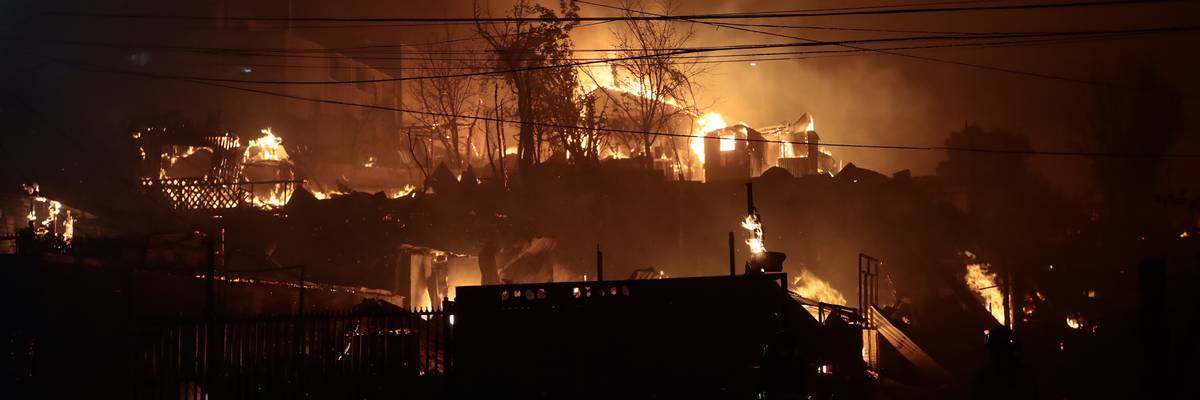
This photo shows the site of a forest fire in Penco, Biobío region, Chile on January 18, 2026.
(Photo by Xinhua via Getty Images)

Jessica Corbett
Jan 19, 2026
PCOMMON DREAMS

On the heels of another historically hot year for Earth, disasters tied to the fossil fuel-driven climate emergency have yet again turned deadly, with wildfires in Chile’s Ñuble and Biobío regions killing at least 18 people—a figure that Chilean President Gabriel Boric said he expects to rise.

The South American leader on Sunday declared a “state of catastrophe” in the two regions, where ongoing wildfires have also forced more than 50,000 people to evacuate. The Associated Press reported that during a Sunday press conference in Concepción, Boric estimated that “certainly more than a thousand” homes had already been impacted in just Biobío.
RECOMMENDED...


‘We Are Running Out of Time’: 2025 Keeps Hot Streak Alive for Global Temperatures


Trump Quits Key Treaties Amid ‘Increasingly Deadly and Expensive’ Weather Disasters

“The first priority, as you know, in these emergencies is always to fight and extinguish the fire. But we cannot forget, at any time, that there are human tragedies here, families who are suffering,” the president said. “These are difficult times.”

According to the BBC, “The bulk of the evacuations were carried out in the cities of Penco and Lirquen, just north of Concepción, which have a combined population of 60,000.”


Some Penco residents told the AP that they were surprised by the fire overnight.

“Many people didn’t evacuate. They stayed in their houses because they thought the fire would stop at the edge of the forest,” 55-year-old John Guzmán told the outlet. “It was completely out of control. No one expected it.”

Chile’s National Forest Corporation (CONAF) said that as of late Monday morning, crews were fighting 26 fires across the regions.

As Reuters detailed:
Authorities say adverse conditions like strong winds and high temperatures helped wildfires spread and complicated firefighters’ abilities to control the fires. Much of Chile was under extreme heat alerts, with temperatures expected to reach up to 38ºC (100ºF) from Santiago to Biobío on Sunday and Monday.

Both Chile and Argentina have experienced extreme temperatures and heatwaves since the beginning of the year, with devastating wildfires breaking out in Argentina’s Patagonia earlier this month.

Scientists have warned and research continues to show that, as one Australian expert who led a relevant 2024 study put it to the Guardian, “the fingerprints of climate change are all over” the world’s rise in extreme wildfires.

“We’ve long seen model projections of how fire weather is increasing with climate change,” Calum Cunningham of Australia’s University of Tasmania said when that study was released. “But now we’re at the point where the wildfires themselves, the manifestation of climate change, are occurring in front of our eyes. This is the effect of what we’re doing to the atmosphere, so action is urgent.”

Sharing the Guardian‘s report on the current fires in Chile, British climate scientist Bill McGuire declared: “This is what climate breakdown looks like. But this is just the beginning...”


The most recent United Nations Climate Change Conference, where world leaders aim to coordinate a global response to the planetary crisis, was held in another South American nation that has faced devastating wildfires—and those intentionally set by various industries—in recent years: Brazil. COP30 concluded in November with a deal that doesn’t even include the words “fossil fuels.”

“This is an empty deal,” Nikki Reisch of the Center for International Environmental Law said at the time. “COP30 provides a stark reminder that the answers to the climate crisis do not lie inside the climate talks—they lie with the people and movements leading the way toward a just, equitable, fossil-free future. The science is settled and the law is clear: We must keep fossil fuels in the ground and make polluters pay.”