Kyiv has become a 'true frontline city', EU ambassador to Ukraine tells Euronews
In an exclusive interview with Euronews, Katarína Mathernová defended Europe's support for Ukraine and said Kyiv could complete the technical preparations for EU membership by 2030.
Kyiv has become a "true frontline city" as Russia intensifies its aerial campaign against Ukraine, the European Union's ambassador to the country Katarína Mathernová told Euronews, warning that relentless attacks are increasingly disrupting everyday life in the capital ahead of winter.
Speaking exclusively to Euronews' Europe Today programme, Mathernová, who has lived in Ukraine since September 2023, said the situation had deteriorated sharply since late August, when Russia began launching frequent daytime attacks alongside its overnight bombardments.
"What happened since the end of August of this year is that Kyiv became a true frontline city," she said.
Air-raid alerts have forced children to interrupt lessons and seek shelter, doctors to suspend medical procedures and metro services to halt. Attacks on bridges have further complicated movement around the capital, she added.
"The situation is very, very, very difficult and the winter is not here yet," Mathernová warned.
Recalling strikes on the National Academy of Sciences, a hospital near the EU delegation and a kindergarten in central Kyiv in September, Mathernová accused Russia of routinely violating the laws of war.
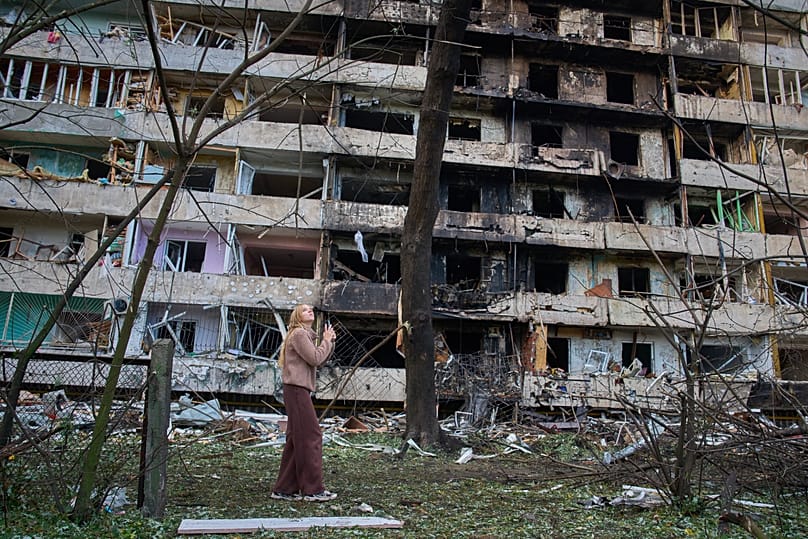 A young woman reacts as she looks at her damaged home after Russia's night missile attack in Kyiv, 14 October, 2026 AP Photo
"Let's remind ourselves that attacking civilian targets is a war crime. It goes against the laws of war," she said.
"The war crimes are happening on a daily basis."
Her comments come as Russia increasingly deploys faster, jet-powered drones, posing additional challenges for Ukraine's air defences.
Kyiv has become a "true frontline city" as Russia intensifies its aerial campaign against Ukraine, the European Union's ambassador to the country Katarína Mathernová told Euronews, warning that relentless attacks are increasingly disrupting everyday life in the capital ahead of winter.
Speaking exclusively to Euronews' Europe Today programme, Mathernová, who has lived in Ukraine since September 2023, said the situation had deteriorated sharply since late August, when Russia began launching frequent daytime attacks alongside its overnight bombardments.
"What happened since the end of August of this year is that Kyiv became a true frontline city," she said.
Air-raid alerts have forced children to interrupt lessons and seek shelter, doctors to suspend medical procedures and metro services to halt. Attacks on bridges have further complicated movement around the capital, she added.
"The situation is very, very, very difficult and the winter is not here yet," Mathernová warned.
Recalling strikes on the National Academy of Sciences, a hospital near the EU delegation and a kindergarten in central Kyiv in September, Mathernová accused Russia of routinely violating the laws of war.
"Let's remind ourselves that attacking civilian targets is a war crime. It goes against the laws of war," she said.
"The war crimes are happening on a daily basis."
Her comments come as Russia increasingly deploys faster, jet-powered drones, posing additional challenges for Ukraine's air defences.
Europe remains Ukraine's most reliable supporter
Amid mounting tensions between Kyiv and Washington, Mathernová said Europe had become Ukraine's most dependable source of military and financial assistance.
Having attended discussions between Zelenskyy, European Commission President Ursula von der Leyen and European Council President António Costa, she said she had sought to convey the urgency of the situation facing Ukrainians under intensifying Russian attacks.
The EU was now providing roughly three-quarters of Ukraine's financial support, according to Mathernová, who said European leaders remained determined to sustain that assistance while encouraging other partners to contribute more.
She also stressed that the bloc had no intention of easing sanctions against Moscow while the war continued.
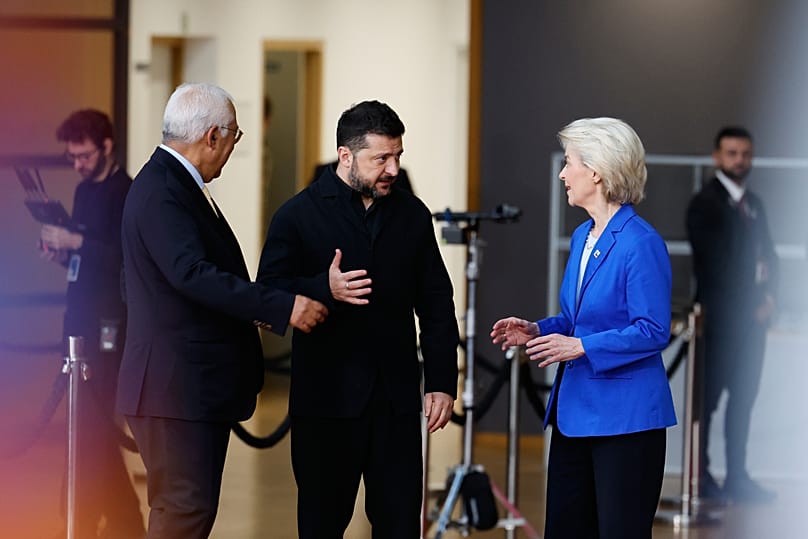 Antonio Costa, Volodymyr Zelenskyy and Ursula von der Leyen arrive for the EU summit at the European Council building in Brussels, 16 October, 2026 AP Photo
Asked about European support for Ukrainian strikes on Russian oil refineries, Mathernová declined to comment on the potential diplomatic consequences for relations with Washington.
She nevertheless backed the position of EU foreign policy chief Kaja Kallas, who has described such strikes as legitimate self-defence.
"It's the fossil fuel industry that is fueling the war on the Russia side," Mathernová said.
Amid mounting tensions between Kyiv and Washington, Mathernová said Europe had become Ukraine's most dependable source of military and financial assistance.
Having attended discussions between Zelenskyy, European Commission President Ursula von der Leyen and European Council President António Costa, she said she had sought to convey the urgency of the situation facing Ukrainians under intensifying Russian attacks.
The EU was now providing roughly three-quarters of Ukraine's financial support, according to Mathernová, who said European leaders remained determined to sustain that assistance while encouraging other partners to contribute more.
She also stressed that the bloc had no intention of easing sanctions against Moscow while the war continued.
Asked about European support for Ukrainian strikes on Russian oil refineries, Mathernová declined to comment on the potential diplomatic consequences for relations with Washington.
She nevertheless backed the position of EU foreign policy chief Kaja Kallas, who has described such strikes as legitimate self-defence.
"It's the fossil fuel industry that is fueling the war on the Russia side," Mathernová said.
Hungary rapprochement raises hopes for EU accession
Beyond military and financial assistance, one of the most consequential aspects of European support for Ukraine is the prospect of EU membership.
A recent meeting between Zelenskyy and Hungarian Prime Minister Péter Magyar in Brussels has raised hopes of further progress in Ukraine's accession talks.
Mathernová, who did not attend the meeting, said public accounts suggested the talks had gone well, offering grounds for optimism after years of disputes between Kyiv and Budapest.
Earlier in the week, the EU opened two additional negotiating clusters, covering the internal market and competitiveness and inclusive growth, bringing the total to four out of six.
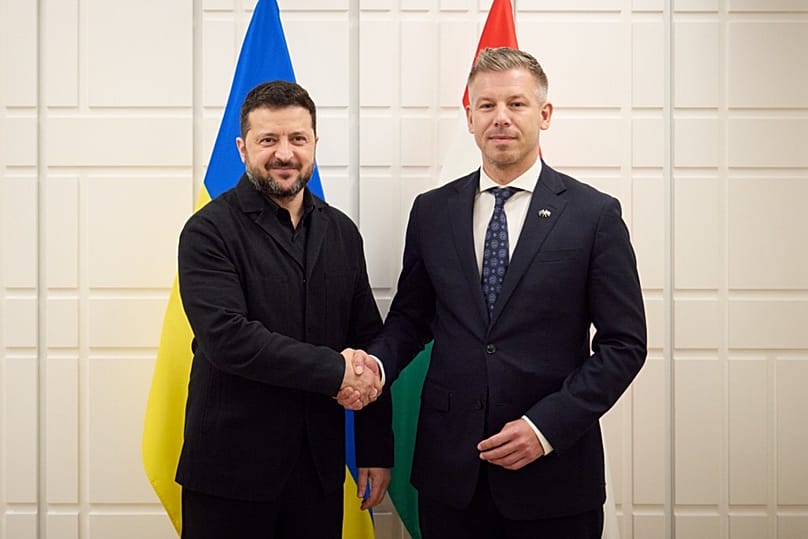 Ukrainian President Volodymyr Zelenskyy shakes hands with Hungary's Prime Minister Péter Magyar in Brussels, 16 October, 2026 AP Photo
"There are only two clusters left to open and hopefully that will be done before the end of the year," she said.
A new joint task force launched by EU Enlargement Commissioner Marta Kos and Ukrainian Prime Minister Serhii Koretskyi will meet twice a week over the coming months to help Kyiv accelerate reforms, particularly on the rule of law and anti-corruption.
For Mathernová, the political will to join the EU is already there. The challenge now is turning that ambition into concrete reforms.
"I still think that all the technical work and all the preparation can be done by the end of the decade," she said.
That, however, would not necessarily mean membership by 2030. Ukraine's eventual accession would still require the agreement of EU member states.
Beyond military and financial assistance, one of the most consequential aspects of European support for Ukraine is the prospect of EU membership.
A recent meeting between Zelenskyy and Hungarian Prime Minister Péter Magyar in Brussels has raised hopes of further progress in Ukraine's accession talks.
Mathernová, who did not attend the meeting, said public accounts suggested the talks had gone well, offering grounds for optimism after years of disputes between Kyiv and Budapest.
Earlier in the week, the EU opened two additional negotiating clusters, covering the internal market and competitiveness and inclusive growth, bringing the total to four out of six.
"There are only two clusters left to open and hopefully that will be done before the end of the year," she said.
A new joint task force launched by EU Enlargement Commissioner Marta Kos and Ukrainian Prime Minister Serhii Koretskyi will meet twice a week over the coming months to help Kyiv accelerate reforms, particularly on the rule of law and anti-corruption.
For Mathernová, the political will to join the EU is already there. The challenge now is turning that ambition into concrete reforms.
"I still think that all the technical work and all the preparation can be done by the end of the decade," she said.
That, however, would not necessarily mean membership by 2030. Ukraine's eventual accession would still require the agreement of EU member states.
'The European Union will be stronger with Ukraine'
Mathernová also sought to ease concerns about the economic implications of Ukrainian membership, arguing that similar fears had accompanied previous rounds of EU enlargement.
She recalled how the accession of Spain and Portugal had unsettled European wine producers, while the bloc's eastern enlargement in 2004 prompted anxieties over competition from agricultural producers and workers in the new member states.
Ukraine's vast agricultural sector and economic potential would inevitably raise similar questions, she acknowledged, but these could be addressed through negotiations, transitional arrangements and compromise.
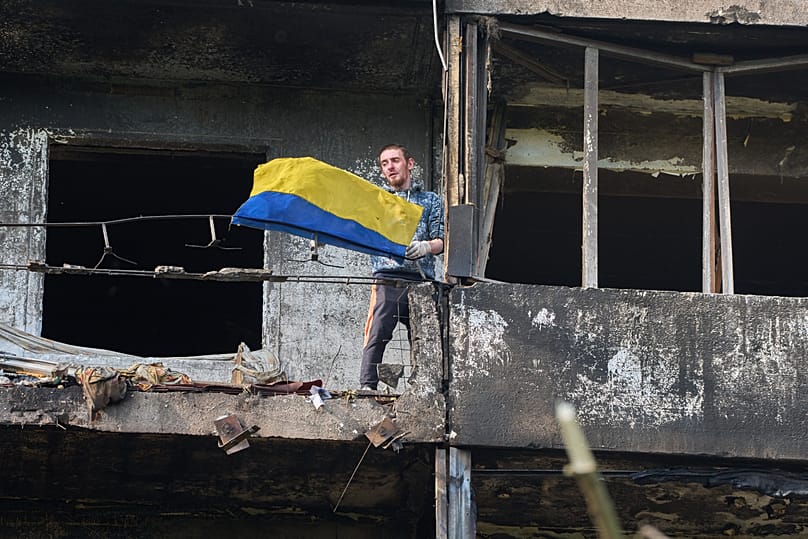 A man hangs out the national flag at his damaged apartment balcony after a missile strike during Russia's night air attack in Kyiv, 14 October, 2026 AP Photo
Political obstacles could prove harder to overcome. Mathernová cited North Macedonia's prolonged accession struggles as a reminder of how bilateral disputes can hold up enlargement, although she remained confident that sustained diplomacy could help resolve such differences.
Despite those challenges, she insisted that Ukraine's eventual membership would benefit the bloc as a whole.
"I am deeply, deeply, deeply convinced that the European Union will be stronger, more relevant in the world, more competitive with Ukraine in its midst," she said.
Mathernová also sought to ease concerns about the economic implications of Ukrainian membership, arguing that similar fears had accompanied previous rounds of EU enlargement.
She recalled how the accession of Spain and Portugal had unsettled European wine producers, while the bloc's eastern enlargement in 2004 prompted anxieties over competition from agricultural producers and workers in the new member states.
Ukraine's vast agricultural sector and economic potential would inevitably raise similar questions, she acknowledged, but these could be addressed through negotiations, transitional arrangements and compromise.
Political obstacles could prove harder to overcome. Mathernová cited North Macedonia's prolonged accession struggles as a reminder of how bilateral disputes can hold up enlargement, although she remained confident that sustained diplomacy could help resolve such differences.
Despite those challenges, she insisted that Ukraine's eventual membership would benefit the bloc as a whole.
"I am deeply, deeply, deeply convinced that the European Union will be stronger, more relevant in the world, more competitive with Ukraine in its midst," she said.

No comments:
Post a Comment