Sunday, May 17, 2026


Current AI Model Inadequacies: Implications For The Global South – Analysis


May 17, 2026 
Observer Research Foundation
By Prateek Tripathi


The current Artificial Intelligence (AI) revolution was largely driven by the development of the transformer model architecture in 2017 and the subsequent creation of Large Language Models (LLMs). The majority of ensuing progress in AI has largely hinged on LLMs, including generative AI (GenAI), diffusion models, and Agentic AI. The seemingly remarkable progress made by these models has led to a multitude of claims by AI developers and experts, ranging from mass potential layoffs to the supposedly near-term prospect of Artificial General Intelligence (AGI).

On closer inspection, however, most of these arguments seem to fall apart, with AI adoption and automation witnessing widespread failure across multiple domains and use cases. Moreover, the current hyperscaling model of AI development is gradually becoming unsustainable due to ever-increasing energy and resource requirements, further compounded by the massive debts being incurred by AI companies and hyperscalers pursuing it. This should serve as a wake-up call for the Global South, which is in the process of honing and deploying its own sovereign AI capabilities. In the aftermath of the IndiaAI Impact Summit 2026, these issues further necessitate a reassessment of the Global South’s current development model and underscore the need to retain its human-centric roots rather than relying on its increasingly AI-centric propensities.

Identifying Failures in AI Use Cases and Deployment

Since the inception of GenAI, multiple company executives have repeatedly claimed that AI would imminently automate tasks hitherto performed by humans, particularly in areas such as coding and remote labour. However, these claims have been undermined on multiple occasions. According to a randomised controlled trial conducted by Model Evaluation and Threat Research (METR) in 2025, open-source coders utilising AI took 19 percent longer to perform tasks than those operating without AI. The Remote Labour Index, developed by the Foundation for QC Innovation at IISc Bengaluru’s Centre for AI Safety and ScaleAI, found that virtually all frontier AI models remain woefully inadequate at automating remote labour tasks, with the best-performing model (Opus 4.6) achieving an automation rate of just 4.17 percent.

According to MIT’s State of AI in Business 2025 report, 95 percent of GenAI pilot projects have reportedly failed. Examples of failed AI adoption include multiple corporations such as McDonald’s, DPD, Air Canada, Klarna, and Salesforce, some of which fired employees in favour of AI agents only to subsequently re-hire them. Different sectors, such as fintech, healthcare, education, manufacturing, and government, each face their own misgivings regarding AI adoption. For example, multiple studies by the University of Oxford and Stanford University have pointed out the dangers of employing AI chatbots in healthcare. A recent study by the Emergency Care Research Institute (ECRI) identified the misuse of AI chatbots as the top health technology hazard in 2026.


This is further compounded by a deliberate obfuscation of the term “AI” to circumvent scrutiny, using it to describe tasks that do not require AI whatsoever. For instance, Norwegian tech company 1X announced NEO, the world’s first consumer-ready humanoid robot, in 2025. While NEO initially claimed to utilise AI, it was later found to rely on remote employees to perform certain tasks, potentially violating user privacy while claiming to be AI-automated.

Consequently, while AI automation remains in vogue amongst AI developers and enthusiasts, in several cases, it appears to function as a guise for austerity measures. Despite multiple claims to the contrary, the body of peer-reviewed and rigorous research on successful AI use cases is quite limited, with LLMs serving as inadequate replacements for humans in the vast majority of cases while facilitating an actively inhibitory supplementary effect in several others.

The Unsustainable Nature of Current AI Models

In addition to the aforementioned adoption failures, the massive energy requirements of data centres are steadily making the current hyperscaling model of AI development unsustainable, with multiple instancesof widespread blackouts, water shortages, and air pollution prompting numerous community protestsaround the globe. For instance, data centres already account for over 4.4 percent of annual US electricity consumption as of 2023, a figure that has nearly doubled since 2018. Furthermore, AI power bottlenecks have led to widespread delays in multiple data centre projects, with about 11 GW of planned 2026 global capacity remaining “in the announced stage with no signs of construction.”


Figure 1: Global Data Centre Capacity Additions by Operation Date (in Gigawatts)
Source: Axios

On the financial front, most pure-play AI companies and hyperscalers have amassed massive debts due to limited return on investment, leading to increasing claims of circular investments and an imminent burst of the so-called “AI bubble”. For instance, despite over US$ 1.4 trillion in financial commitments, OpenAI registered an annual revenue of only about US$ 20 billion in 2025. The situation is similar for hyperscalers such as CoreWeave, which plans to spend US$30–35 billion in 2026 despite an annual revenue of just over US$ 5 billion in 2025.

While capital misallocation has been a common feature of tech booms such as the “Dot Com Bubble” in the past, the chief difference was that most of the built infrastructure was eventually salvageable even after the bubble burst. In the case of the AI bubble, the massive data centre infrastructure currently being built will have very limited utility once LLMs plateau. However, with Big Tech companies now firmly locked into the lengthy and cost-intensive hyperscaling paradigm, they do not possess the option to course-correct any longer.

Why AI Adoption Fails: The Fundamental Problem with LLMs

One of the primary reasons for the current interest and historic investments in large pre-trained models and the hyperscaling paradigm is the “emergent abilities” of LLMs, particularly when it comes to plausible reasoning, resulting in widespread speculation that they will inevitably evolve into increasingly efficient models, eventually paving the way to achieving the holy grail of AGI. However, there is evidence suggestingthat emergent abilities in LLMs are most likely an artefact of inadequate metrics and benchmarks. Furthermore, the rise in benchmark performance as LLMs scale may be a function of enhanced pattern memorisation rather than reasoning or linguistic abilities and is poised to plateau in the future, especially under more sophisticated benchmarks.

According to a survey conducted by the Association for the Advancement of Artificial Intelligence (AAAI) involving 475 experts, 76 percent of respondents stated that current machine learning paradigms are unlikely to yield AGI. Factuality remains a fundamental limitation in current LLMs and GenAI systems, contributing to issues including hallucinations and biases and undermining AI trustworthiness.

While approaches to improve factuality include reinforcement learning, Retrieval-Augmented Generation, and Chain-of-Thought reasoning, future AI advancement may rely on the development of new or hybrid neural network architectures, such as neuro-symbolic reasoning systems, as well as non-neural architectures such as Information Lattice Learning. However, these alternative paradigms remain at an early stage of development.

This suggests that the current AI paradigm, largely hinging on LLMs, suffers from systemic and structural inadequacies, rendering it unsuitable for mass applicability. Therefore, AI deployment requires enhanced scrutiny, particularly in use cases affecting critical human sectors.

Conclusion: The Case for a Human-Centric Global South Agenda

AI adoption and cooperation in the Global South, particularly in the realm of human and societal development, served as a major theme for the IndiaAI Impact Summit 2026. However, the dangers posed by rushing AI adoption cast this approach into serious doubt. For those claiming to maximise societal benefit, the current risks posed by LLMs far outweigh the benefits accruing from their mass adoption. Far from simply being a matter of hallucinations or fabricated outputs, societal AI applications affect real people and risk having a detrimental impact on their livelihoods.

This is not to say that AI is of no societal benefit. There have been multiple instances of successful AI utility. For instance, India’s deployment of chatbots for language translation through platforms such as Bhashinihas been demonstrably successful. Research tools such as AlphaFold have been highly effective in accelerating scientific innovation to the extent that the Google DeepMind team received a Nobel Prize in Chemistry in 2024. However, it must be emphasised that while AI can serve as a tool for supplementing human capabilities, it is far from replacing them and continues to require substantial human intervention and oversight. Furthermore, the primary reason behind such successful AI use cases is that errant outputs do not carry significant real-world consequences in these contexts. For instance, a hallucinated language translation or ChatGPT response does not pose a serious threat to any individual’s livelihood. On the other hand, even a small proportion of such outputs could have severe ramifications in the case of a healthcare chatbot or a farming assistant.


The global AI adoption narrative has had the unfortunate effect of gradually reducing human utility to the level of inhabiting mere points on a dataset, an antithesis to the decades-long pursuit of the Global South’s human development and inclusion agenda. Fast-tracking AI adoption under global peer pressure or succumbing to the “Fear of Missing Out” can have catastrophic consequences for the Global South, which risks falling victim to clever marketing strategies engineered by a handful of corporations. Consequently, the Global South needs to realign its increasingly AI-focused development agenda, centring it on labour rights and human development rather than merely prioritising AI adoption. It must identify risk-free AI adoption use cases and target sectors where it can have maximum utility while resisting the mass AI adoption narrative, at the very least in critical sectors where it serves to have even a minimal detrimental human impact.


About the author: Prateek Tripathi is an Associate Fellow with the Centre for Security, Strategy and Technology (CSST) at the Observer Research Foundation.

Source: This article was published by the Observer Research Foundation.


Malta offers free ChatGPT Plus access to its citizens through a national AI program

Scenery of Malta
Copyright Canva

By Roselyne Min
Published on


Citizens and residents registered with Malta’s online identity system can apply to get access to ChatGPT Plus after completing a free online course.

OpenAI has signed its first partnership with a national government bringing the paid version of ChatGPT for free to residents of Malta.

OpenAI and the Government of Malta on Saturday announced a deal that will give every citizen free access to the artificial intelligence (AI) chatbot for one year through a government-led AI literacy programme.

Citizens and residents registered with Malta’s online identity system can apply after completing a free online course called AI for All, developed by the University of Malta.

According to the Malta Digital Innovation Authority, the course is designed to help people understand what AI is, what it can and cannot do, and how to use it responsibly at home and at work.

The first phase of the programme will launch in May, according to the announcement.

The Malta Digital Innovation Authority will manage access to the free subscriptions, and it said the programme will grow as more people complete the course.

“By pairing this education with free access to the most advanced digital tools available today, we are turning an unfamiliar concept into practical assistance for our families, students, and workers,” said Silvio Schembri, the country’s minister for economy, enterprise and strategic projects, in an announcement.

The partnership is the first of its kind, according to the announcement.

“Malta is leading the way by showing how countries can empower their citizens to benefit from the transformative potential of AI,” said George Osborne, head of OpenAI for Countries, an initiative by OpenAI “built around local priorities”.

The partnership is part of a growing trend among governments to find practical ways to help people build confidence using AI and apply it to everyday tasks.

Last year, Anthropic announced a project that gives all teachers in Iceland access to Claude, its AI assistant, to help with lesson planning, classroom materials and administrative tasks.

In September 2025, OpenAI announced a partnership with the Greek government to bring its technology to secondary schools and start-ups across the country.

Meanwhile, in February 2025, the UK government signed a memorandum of understanding with Anthropic to improve how people access and interact with government information and services online.


Anthropic explains Claude's 'go to bed' messages as quirky AI trait

15.05.2026, DPA

Bed - Anthropic clarified that its Claude chatbot's habit of telling users to "get some sleep" or "go rest" is more of a quirky behavior than a built-in feature.

Photo: Alicia Windzio/-/dpa

Anthropic clarified that its Claude chatbot's habit of telling users to "get some sleep" or "go rest" is more of a quirky behavior than a built-in feature.

For months now, users have noticed that Claude occasionally suggests hitting the hay after long chats, leading to some chatter about whether the company is trying to encourage healthier usage or maybe even cut down on computing usage.

Sam McAllister, who is part of the company's leadership group, mentioned in a post on X that this behavior is "a bit of a character tic" and that Anthropic plans to tackle it in future versions.

These unusual responses are reminiscent of other artificial intelligence (AI) quirks, like ChatGPT's earlier "Goblin Mode," which was eventually fixed.

This year, Anthropic has faced several service outages due to the increasing demand for Claude, especially from software developers.


China’s Unitree unveils a rideable, wall-smashing robot straight out of science fiction


By Theo Farrant
Published on

A Chinese robotics company has started selling a giant pilotable robot. It costs €500,000, walks on two legs, and can also smash through walls. Welcome to the future?

For a generation raised on Pacific Rim, Gundam, Alien and Transformers, the fantasy has never really left the imagination: being able to climb into a giant mechanical robot suit and walk away in it.

This week, that fantasy stopped being fiction.

Unitree Robotics - the Chinese company that has quickly become one of the world's most prolific robot manufacturers - unveiled the GD01, which is being billed as the world's first production-ready manned transformable mecha.

It's roughly 2.8 metres tall and lets a human pilot climb up and operate it from an open cockpit in its torso. It can walk upright on two legs in humanoid stance or reconfigure its build to move on four legs for rougher terrain.

Promotional footage even shows it smashing through a wall of cinder blocks.

But it's unlikely most of us will be using these to get from A to B anytime soon. The starting price is 3.9 million yuan, nearly €500,000. And Unitree has not yet publicly disclosed key technical details such as battery life, maximum speed, payload capacity or operating duration.

From robot dogs to giant mechas

Founded in 2016 in Hangzhou by engineer Wang Xingxing, the company began with quadruped “robot dogs” inspired by research platforms like Boston Dynamics’ Spot robot.

Wang reportedly built his first quadruped robot as part of a university thesis before leaving drone giant DJI to start his own company.

A decade on, Unitree controls roughly 70 percent of the global quadruped robot market and in 2025 it shipped more than 5,500 humanoid robots - which is more than any other manufacturer on earth, including Tesla. Its robots even appeared during China's hugely watched Spring Festival Gala television show.

What would a giant robot like this actually be useful for?

This remains the big unanswered question.

Unitree says the GD01 is aimed at "high-value markets" including industrial operations, emergency rescue and for cultural tourism.

In theory, systems like this could eventually be used in disaster zones, collapsed buildings, hazardous industrial sites or environments where wheeled vehicles struggle.

There are also obvious military implications - although Unitree explicitly describes the GD01 as a civilian platform and warned users to operate it in a "friendly and safe manner."

The broader robotics industry has long explored similar ideas. Powered exoskeletons already exist in medicine, logistics and defence

Companies including Sarcos Technology and Robotics Corporation, Hyundai Motor Company and Lockheed Martin have spent years developing wearable robotic systems that enhance lifting strength or reduce worker fatigue.

Humanoid robotics boom

Humanoid robotics is currently going through one of its biggest investment booms in decades. Companies across the US, China and Europe are racing to build general-purpose robots capable of working in warehouses, factories and eventually homes.

Tesla is developing its Optimus humanoid robot. Figure AI has partnered with BMW. Agility Robotics already has warehouse robots operating commercially.

China, meanwhile, is scaling up extremely quickly.

In April, Chinese smartphone company Honor made global headlines when its humanoid robot completed a half marathon in Beijing in 50 minutes and 26 seconds - beating the human world record by nearly seven minutes.

According to research cited by the South China Morning Post, Chinese companies accounted for nearly 90 percent of global humanoid robot sales in 2025.

Official data also show that China had more than 140 humanoid robot manufacturers and over 330 models in 2025.

Accelerating the development of technologies such as humanoid robots was listed a priority in Beijing’s latest five-year plan, which has pledged to “target the frontiers of science and technology”.

The GD01 is undeniably one of the most eye-catching product to emerge from this race so far. But whether it's a glimpse of a genuinely useful future technology, or an elaborate, marketing proof of concept, is a question the industry is still working out how to answer.


Trip to recovery: How psychedelics could revolutionise mental health care

Psychedelic-assisted therapies have shown promise in treating the cognitive ruts of several mental health conditions.
Copyright Canva

By Amber Louise Bryce
Published on


In a world gripped by a growing mental health crisis, research suggests that psychedelic-assisted therapy could be an answer. Euronews Health spoke to an expert about how they work, and when - if ever - we might see them approved.

Picture this: You walk into a small, dimly lit room and lay on a bed beside a clinician. After talking you through what’s going to happen, they hand you an eye mask, then administer a controlled dose of the psychedelic compound, psilocybin.

As suddenly as the drug takes effect, the world as you knew it starts to dissolve - the chains of old thought patterns finally loosen.

While it might sound intense, this scenario could be a future reality for those living with treatment resistant mental illness, including depression and post traumatic stress disorder (PTSD).

In recent years, psychedelic-assisted therapies have become one of the most fascinating and fast-accelerating areas of psychiatric research, driven by an ever-growing body of exciting new evidence.

The current mental health crisis has also created an urgency for new, more effective treatment options, with over a billion people currently living with mental health disorders, according to the World Health Organization (WHO).

“Unfortunately, in mental health, and specifically in psychiatry, we haven't really had any new treatments for several decades,” Dr Liliana Galindo, an assistant professor at the University of Cambridge’s psychiatry department, told Euronews Health.

“What psychedelics are bringing is the opportunity to have or to present new treatments for people that don't respond to the usual treatments.”

Psychedelics are a class of psychoactive substances that can powerfully alter people's perceptions and moods by binding to serotonin receptors. Popular examples include psilocybin, DMT, phenethylamines (MDMA) and lysergamides (LSD).

While they all share similar consciousness-expanding qualities, each compound varies in its intensity, duration, and overall effect, with different ones being tested for different conditions.

So far, psilocybin, an active ingredient in magic mushrooms, has generated the most promising results.

“For treating depression, psilocybin, specifically the COMP360 (a synthetic formulation of psilocybin developed by Compass Pathways), has already finished phase three of its clinical trials. We are expecting that [Compass] is going to file the FDA (Food and Drug Administration) application soon,” Galindo said.

“Potentially, this could be the very first psychedelic treatment that will be legal and approved.”

How do psychedelic-assisted therapies work?

Up until now, mental health treatments have relied on two evidence-based methods: talk therapies and medications such as antidepressants.

These are proven to be effective, with patients receiving a combination of the two 25-27% more likely to respond positively, according to statistics by the National Institutes of Health.

But for those that don’t respond, other avenues of help remain limited.

“Many mental health conditions have some symptoms that are common, like rigid cognitions. So, for example, when people are depressed, they start to have really negative thoughts, and these negative thoughts are going to affect how they see themselves, how they see the world, and of course, how they are going to feel about it. And after several years of being depressed, it's really difficult to take a step outside of those pessimistic thoughts, or frequent fears and even suicidal ideations,” Galindo explained.

For these cases, psychedelic medications could be the answer, with Galindo noting their effectiveness at disrupting cognitive ruts and rewiring how the brain processes trauma.

“I really like an analogy I saw once [about psychedelic medications] that it's like when you're skiing. You usually go for a certain pathway, right? And because the pathway has a specific mark, it is really difficult to actually go outside of it. But somehow, what psilocybin allows, is like having fresh snow that will make it easier to actually explore different pathways.”

Numerous studies back this, with a recent one by Imperial College London - considered a world leader in psychedelic research - reporting that even a single dose of psilocybin can prompt anatomical changes in the brain.

Other psychoactive compounds such as MDMA have been shown to work a little differently by enhancing feelings of empathy, connectivity and openness, which could be effective at treating PTSD.

“It facilitates a period of time where people [with PTSD] can revisit their memories and somehow be able to rethink, to reframe, to change the narrative and to process their trauma,” she said.

“This is the reason psychedelics are bringing such a big revolution to mental health, because they're aiming to treat the core rather than only the symptoms.”

Social stigmas and legal issues

A major hurdle to mainstream approval, however, remains their status as illegal drugs in most countries.

“Unfortunately, even if we have clear evidence for their therapeutic potential, they are still illegal. For example, here in the UK, they're still classified A, meaning that in order to conduct any study, we need to apply for a special home office licence. This is not only expensive, but takes a long time, and so is definitely affecting the amount of research that could be happening in the field,” Galindo said.

Another issue is the stigmas surrounding these drugs, and their primary associations with party culture and potentially dangerous outcomes.

Galindo emphasises that these concerns are why the controlled setting of psychedelic-assisted therapies is so important.

“You need to take care of all the different details of the environment, like the sound, the lights. And of course, the entire time [the patient] is supported by a trained therapist or a member of the staff that is there to be able to support during that process,” she said.

“These drugs are really powerful tools, but of course, if for any reason they are not given in the right setting, this could come with more side effects.”

While more research is required to better understand who will benefit and who won’t, Galindo hopes that, one day, these treatments can become an accessible option for everyone.

“Rather than staying in a private setting, they should be available for the people who need it the most, not only for the ones that can pay.”

Early Signs From India About Rapprochement With Pakistan And Iran – Analysis


May 17, 2026 
By P. K. Balachandran


The signs emanated from the Rashtriya Swayamsewak Sangh and India-Iran interactions at the BRICS Foreign Ministers’ meeting in New Delhi.

Given the changing international landscape, India is seeing new openings vis-à-vis China, Pakistan and Iran, with which its relations have been strained.

Despite the lack of progress in talks with China on the border issue, and China’s open support for Pakistan during the May 2025 India-Pakistan air war, New Delhi has selectively opened up its industrial sector for Chinese investment for the sake of rapid industrial growth.

As a way out of the India-China border conflict, former Indian army chief Gen. M.M.Naravane suggested that India and China could discuss the 1959 Chinese suggestion that India give Aksai Chin in the Western sector to China in exchange for China’s dropping its claim over Arunachal Pradesh in the Eastern Sector.

The Rashtriya Swayamsewak Sangh (RSS), which is the institutional ideologue for Prime Minister Narendra Modi’s Bharatiya Janata Party (BJP), has said that while India should strongly respond to Pakistan’s act of backing cross-border terror attacks, India should keep its doors open for talks with Islamabad.

“If Pakistan is like a pinprick trying to create incidents like Pulwama, etc., we have to answer appropriately according to the situation because the security and self-respect of a country and nation have to be protected, and the government of the day should take note of it and take care of it. But at the same time, we should not close the doors. We should always be ready to engage in dialogue. That is why diplomatic relations are maintained, trade and commerce continue, and visas are being given. So, we should not stop these, because there should always be a window for dialogue,” Dattatreya Hosabale told the Indian-State backed news agency Press Trust of India.

To a question whether sporting events between India and Pakistan should resume, Hosabale said, “Of course, they can continue because I believe strongly that ultimately civil society relations will work. Because we have a cultural relation and we have been one nation.”.

Former army chief, Gen. Naravane, who had earlier suggested a diplomatic solution to the India-China conflict based on give and take, endorsed Hosabale’s idea in another media interview, showing a change of attitude towards Pakistan that had been routinely and publicly described as an “enemy nation.”

Currently, all contacts, including in culture and sports. Stand suspended.

Positive Response from Pakistan


Reacting to the RSS official’s statement, Pakistan said that the call for an India-Pakistan dialogue was a “positive development” and signalled support for backchannel talks.

The Pakistan Foreign Office spokesman Tahir Andrabi said: “Voices within India calling for dialogue are obviously a positive development”. Signalling support for backchannel talks, Andrabi said he would not comment on the subject as that would defeat the purpose of having backchannels.

Rapprochement With Iran


Simultaneously, India is also trying to patch up with Iran but without alienating the US and Israel, which have critical economic and security ties with New Delhi.

Throughout the US-Iran war, India had remained neutral so as not to jeopardise its relations with the US and Israel. But anxious to get Iran’s permission for its oil-bearing vessels to use the blocked Strait of Hormuz, India used the BRICS Foreign Ministers’ conference in New Delhi on May 14 and 15 to talk to Iranian Foreign Minister Abbas Araghchi to iron out the differences.

Araghchi’s meetings with the Indian Foreign Minister S.Jaishankar were cordial and fruitful, according to both sides. While Jaishankar said that he had detailed discussions with Araghchi, the latter referred to Jaishankar as his friend and urged India to restart the stalled Chahbahar port project. Araghchi also met Indian Prime Minister Narendra Modi.

In a sign of improved relations, Indian vessels are now passing through the Strait of Hormuz, though, earlier, two of them had been subjected to attacks by unidentified parties.

Iran Unhappy with Pakistani Mediation


In a move indicating Iran’s disillusionment with Pakistan, which is mediating between Tehran and Washington, Iran’s National Security and Foreign Policy Spokesperson, Ebrahim Rezai, accused Islamabad of acting in the interests of the United States.

“Pakistan is our good friend and neighbour, but it is not suitable as a mediator for negotiations and does not have the necessary authority to fulfil this role. They always take into account the interests of US President Donald Trump and do not say anything that would go against the wishes of the Americans,” Rezai posted in Persian on his social media handle.

Meanwhile, Pakistan had announced the complete lifting of restrictions in its capital, Islamabad, which means that at the moment, negotiations between Iran and the United States stand suspended.

India Keeps Up Ties With UAE

However, despite its attempt to patch things up with Iran, India is strengthening its ties with the UAE, with which Iran is at odds because the UAE is close to the US and Israel.

Indian Prime Minister Narendra Modi flew to Abu Dhabi on May 15 as part of a five-nation tour. In his meeting with the UAE Emir, Mohamed bin Zayed Al Nahyan, a wide range of issues, including trade, investment, defence cooperation, energy security and the welfare of the Indian diaspora living in the Gulf nation were discussed.

The visit also focused on strengthening the Comprehensive Strategic Partnership between India and the UAE, which has emerged as one of India’s most important strategic relationships in the Gulf region.

During the visit, India and the UAE concluded two important memorandums of understanding about Liquefied Petroleum Gas (LPG) and Strategic Petroleum Reserves, aimed at strengthening India’s long-term energy security amid global volatility in oil markets.

The two countries also agreed on a framework for strategic defence cooperation. In another significant development, the two sides signed an MoU for setting up a ship repair cluster at Vadinar in Gujarat’s Dwarka district.

The visit additionally saw investment announcements worth nearly USD 5 billion in Indian infrastructure projects as well as investments in the RBL Bank and Samman Capital.

The UAE is India’s third-largest trading partner and the seventh-largest source of cumulative foreign investment into India over the last 25 years. With long-term supply agreements already in place, the Gulf nation continues to remain one of India’s most dependable energy partners despite the ongoing turmoil in West Asia.

The point to note is that despite its moves to make up with Iran, Modi condemned Iran’s attacks on UAE, though he did not name Iran as the attacker.


“We strongly condemn the attacks launched on the UAE. The manner in which the UAE has been targeted is not acceptable in any form. We welcome the steps taken by you to uphold national unity, security and regional integrity,” the Prime Minister said during his meeting with Sheikh Mohamed bin Zayed Al Nahyan.

PM Modi also thanked the UAE leadership for ensuring the safety and welfare of the 4.5 million-strong Indian community living in the country during the attacks and tensions.

“For the care provided to the Indian diaspora residing in the UAE in these difficult times, the manner in which they were considered as members of one’s own family by the UAE Government, you and the Royal Family, I express my heartfelt gratitude,” he said.

The Prime Minister reiterated India’s position that dialogue and diplomacy remain the only sustainable path for resolving regional conflicts.

“The impact of war in the West Asia region is seen across the world today. India has always given importance to dialogue and diplomacy for resolving issues. It is our biggest concern that Hormuz remains free and open. In this regard, it is essential to abide by international laws,” Modi said.

“India stands shoulder-to-shoulder with the UAE in every situation, and it will continue to do so. For the restoration of peace and stability, India will extend all possible cooperation,” the Prime Minister added.
Hundreds of diplomats fired by Trump in 'unprecedented' move amid global crisis: report

Bennito L. Kelty
May 16, 2026 
RAW STORY


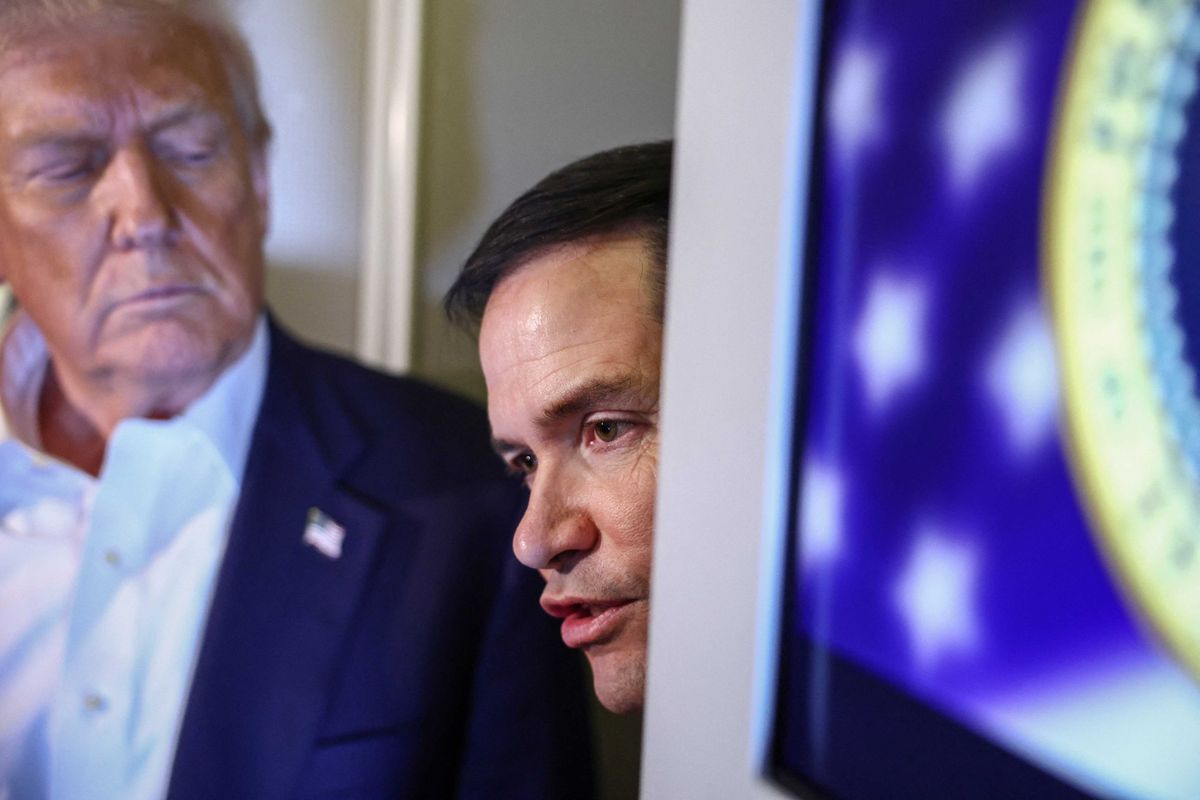
U.S. Secretary of State Marco Rubio speaks to reporters as U.S. President Donald Trump stands next to him aboard Air Force One en route to Tokyo, Japan, for the second stop on his Asia tour, October 27, 2025. REUTERS/Evelyn Hockstein

Hundreds of diplomats are being forced out of their jobs by the Trump administration despite ongoing crises around the world, according to a new report.

According to CNN, the State Department finalized the firing of nearly 250 foreign service officers via email on Friday.


"Your reduction in force separation will be effective today," the email read. "Thank you again for your service to the Department."

The reduction in forces also impacted staff that would have been able to "provide guidance on the war in Iran," former officials told CNN.

On top of that, "unprecedented numbers of people are choosing to leave" U.S. foreign services, David Kostelancik, a retired diplomat, told CNN.

"Roughly 2,000 foreign service officers left the State Department last year," CNN reported based on numbers from the American Foreign Service Association.

Another 100 diplomatic posts around the world in tense areas like the Middle East, Ukraine and Russia still lack a Senate-confirmed ambassador, CNN added.

"The most sensitive diplomatic negotiations, on fraught topics like ending the war in Iran and securing an end to the Ukraine conflict, are being led by business associates and family members of President Donald Trump," CNN reported. "Often without teams of experienced diplomats with regional expertise."
'This is so sad': MS NOW panel pounces as Trump lets China insult US

Tom Boggioni
May 15, 2026 
RAW STORY


U.S. President Donald Trump looks on during a meeting with Chinese President Xi Jinping (not pictured) on the sidelines of their visit to the Zhongnanhai Garden in Beijing, China, May 15, 2026. REUTERS/Evan Vucci/Pool

As Donald Trump returns from his trip to Beijing, where he met with Chinese President Xi Jinping, the consensus of MS NOW’s “Morning Joe” panel is that the American president appears weaker now before the summit.

And Trump all but admitted it.

On Friday morning, longtime political analyst John Heilemann pointed to Trump’s admission that the Chinese leader talked about the US as a “declining nation,” without pushback, was a particularly humiliating effort by the American president to ingratiate himself to Xi.

Pointing to Trump posting on Truth Social, “When President Xi very elegantly referred to the United States as perhaps being a declining nation, he was referring to the tremendous damage we suffered during the four years of Sleepy Joe Biden and the Biden Administration, and on that score, he was 100% correct,” Heilemann admitted he was stunned that Trump would admit that in public thinking it would help him make the case for his presidency.

“So basically, this is Xi Jinping saying, hey, let's not get into war. But the implication was decline, that the U.S. was in decline and Trump's response to that was so sad,” he exclaimed to agreement from the panel. “I mean, not just the fact that he's blaming Joe Biden, but let's read the first sentence of it where he says something like yesterday, when Xi Jinping, so elegantly, I have it here: ‘When President Xi very elegantly referred to the United States as perhaps being a declining nation,’ that's all you need.”

“It's like — that's just — it's an amazing thing to write,’ he elaborated. “It's a wonder — one of the more incredible Trump sentences ever. ... Because I can't ever say anything critical of Xi Jinping. Never does. Right?“

“You didn't have to to pin the tail on the donkey and say, the United States is the declining power for it to be very clear that in the optics and dynamics and on any metric that Trump understands, let alone the rest of the world: which of those two countries is the declining country? “ he added. “And Xi Jinping didn't need to say it directly. It's pretty clear to everyone where they stand in terms of relative power.”


Taiwan says it is a ‘sovereign’ nation with US ‘security commitment’ after Trump’s warning


Taiwan on Saturday maintained it is a "sovereign and independent" nation and that US arms sales were part of Washington's security commitment to the island. The foreign ministry statement came a day after President Donald Trump warned Taiwan against declaring formal independence following his meeting with Chinese President Xi Jinping during a state visit to China.


Issued on: 16/05/2026 
By: FRANCE 24


Taiwan's President Lai Ching-te taken at a business conference in Taipei February 3, 2026. © AP (File)

⁠Taiwan on Saturday said it is ​thankful for ​US President Donald Trump's long-standing support for ​peace ‌and stability ⁠across the Taiwan ‌Strait and asserted it was a "sovereign and independent" nation.

The statement was issued a day after Trump, following his visit to China, warned the democratic island against declaring formal independence.


Taiwan "is a sovereign and independent democratic nation, and is not subordinate to the People's Republic of China", Taiwan's foreign ministry said in a statement.

The ministry also insisted that US arms sales were part of Washington's security commitment to Taiwan, after Trump flagged that he was considering the issue.

"Regarding Taiwan-US arms sales, this is not only a US security commitment to Taiwan clearly stipulated in the Taiwan Relations Act, but also a form of joint deterrence against regional threats," the ministry said.

Speaking to reporters in Taipei on ‌Saturday, Taiwan Deputy Foreign Minister Chen Ming-chi also asserted that US arms sales are confirmed under the Taiwan Relations Act.

"Taiwan-US arms sales have always been a cornerstone of regional peace ‌and stability," he said.

In December, the Trump administration approved a record $11 billion arms sale package for Taiwan. Reuters ​has reported a second one, worth around $14 billion, still awaits Trump's approval.

Chen declined to comment on the second package because it has yet to be made public, saying ​Taiwan will continue to communicate with and understand the situation from the US side.

Taiwan's statements came a day after Trump wrapped up a visit to Beijing where Chinese President Xi Jinping had pressed him not to support the self-ruling island, which China claims is part of its territory.


Taiwan vs China: Is conflict inevitable?
 (Photo test) © France 24
12:40


'I want them to cool down'


Trump on Friday made it clear that he opposed a declaration of independence by Taiwan and appeared to question why the United States would defend the island in case of attack.

"I'm not looking to have somebody go independent. And, you know, we're supposed to travel 9,500 miles to fight a war. I'm not looking for that," he told Fox News host Brett Baier.

"I want them to cool down. I want China to cool down," Trump said.

"We're not looking to have wars, and if you kept it the way it is, I think China's going to be OK with that."

The US recognises only Beijing and does not support formal independence by Taiwan, but historically has also stopped short of explicitly saying it opposes independence.

Under US law, the US is required to provide weapons to Taiwan for its defence, but it has been ambiguous on whether US forces would come to the island's aid.

Xi had begun the summit with a warning on Taiwan, whose President Lai Ching-te considers the island already independent, making a declaration unnecessary.

Xi had told Trump that missteps on the sensitive issue could push their two countries into "conflict".

(FRANCE 24 with AFP and Reuters)

The U.S. Leans Toward War, China Toward Trade – OpEd

May 17, 2026 
By Alejandro A. Tagliavini


We are not going to tire of repeating it, violence always destroys, especially the one who initiates it. That is why states, when they use their monopoly of violence to impose “laws” and “regulations”, what they achieve is that their countries are backward.

Thus, while the federal state of the United States has chosen to close its borders with more customs tariffs and various military interventions, the Chinese, although communist and authoritarian, has acted more wisely by opting for freer trade. And the results are indisputable.

On an ironic note, Trump’s best ally, another supporter of state interventions, the president of Argentina, “betrays” him behind his back and increases his trade with China.

Gabriel Cohen publishes in Visual Capitalist the following graph and article that leaves no room for doubt. Compare (in blue) the trading partner countries of the United States and in red those of China, in the year 2000 vs 2025:


Key points

In 2000, only 33 countries traded more with China than with the United States.

By 2025, China had become the top goods trading partner for most countries in the world.

Only a handful of African countries continue to trade more with the United States than with China.

Twenty-five years ago, the United States was the world’s dominant trading power. Today, China has surpassed it as the top goods partner for most countries globally.

This map compares whether countries traded more with the U.S. or China in 2000 and 2025, based on total bilateral imports and exports using data from the IMF’s Trade Statistics Directorate.

China’s rise was fueled by its emergence as a global manufacturing hub and growing demand for raw materials such as oil, copper, iron ore and soybeans.

The United States entered the 21st century with a good tone of support. After the end of the Cold War, liberal democracy and open markets were expanding throughout the former Soviet bloc, while global trade was mainly focused on the U.S. consumer market.


In 2000, only 33 countries traded more with China than the United States. Many of these countries were Chinese neighbors such as Kazakhstan, Mongolia, Myanmar, and Vietnam. Others were states with strained or no relations with Washington, including Cuba, Iran, Libya and North Korea.

For her part, Tasmin Lockwood, also in Visual Capitalist, shows another graph that visualizes those countries most dependent on imports from China.


Ironically, it turns out that technology is China’s biggest export. Cheap commercial products have historically been associated with the “Made in China” seal, but today technology is its biggest export after consolidating itself as a strong manufacturing hub with cheaper labor.

Integrated circuits, which are central to most modern technologies, make up the bulk of exports and highlight China’s critical role in global supply chains; mobile phones and cars follow.

And by the way, the world is critically dependent on China for the processing of critical minerals, which are used in everything from consumer electronics to basic military systems. This reliance has prompted U.S. policymakers to try to strengthen and diversify local capacity.


Is a Chinese invasion of Taiwan imminent?


Issued on: 17/05/2026 - FRANCE24


After nearly a decade since his last visit, US President Donald Trump is meeting Chinese President Xi Jinping in Beijing in a historic summit focused on global trade, technological rivalry and rising tensions over Taiwan, one of the world’s most sensitive flashpoints. 🇹🇼China claims Taiwan as part of its territory while the United States continues to back the island with military support and strong diplomatic ties. Caught in the middle is a resilient democracy that has become one of Asia’s greatest success stories, despite never being formally recognised as a sovereign state by most other countries. 🎥FRANCE 24's Stella Elgersma takes a closer look at the tense triangle between Taiwan, China and the United States: how it came to be, what's really at stake and whether a military confrontation is truly on the horizon.


Video by: Stella ELGERSMA


Did Trump just sell the world in Beijing?

Did Trump just sell the world in Beijing?
By bne IntelliNews May 15, 2026

The optics were the policy. Donald Trump arrived at Beijing Capital International Airport on May 13, accompanied by Elon Musk, Tim Cook, Larry Fink, Jensen Huang and the chief executive of Boeing. The next morning he was received at the Great Hall of the People by Xi Jinping, walked through an honour guard of the People's Liberation Army, and within hours of the opening ceremony agreed a joint position on Iran's nuclear programme and the Strait of Hormuz. Xi reciprocated with the warmest welcome accorded any Western leader since the founding of the People's Republic. The summit ran two days. The aftershocks will run longer.

From outside the room, the visit looked less like a stabilisation exercise than what Bonny Glaser of the German Marshall Fund called, before Trump boarded the plane, the risk of "a tacit or explicit bargain in which Washington appears to concede a sphere of influence to Beijing over Taiwan" in exchange for concessions elsewhere. That formulation, reported by CNBC on May 11, has since become the lens through which the Trump visit is being read across four continents. In Taipei, in Riyadh, in Moscow, in Warsaw, in Brasília and in Astana, the question being asked is not whether Trump struck a grand bargain. It is whether he sold something that was not his to sell.

Begin with the Middle East. The White House readout of May 14 confirmed that Trump and Xi had agreed "Iran can never have a nuclear weapon" and that "the Strait of Hormuz must remain open." Xi, on the same readout, made clear "China's opposition to the militarisation of the Strait and any effort to charge a toll for its use," and expressed interest in purchasing more American oil to reduce Chinese dependence on Hormuz crude. Al Jazeera's analysis on May 15 noted that the Chinese statement, by contrast, omitted any explicit reference to Iranian nuclear weapons, instead calling for "political settlement" and "dialogue and consultation."

For the Gulf monarchies, watching from Riyadh and Abu Dhabi, the spectacle of Washington and Beijing co-announcing the terms on which their region's principal waterway would be reopened, without any Gulf state present in the room, confirmed every suspicion that has been building since the Iran war began on February 28. The American-led security order, the one for which Saudi Arabia and the UAE pay through arms purchases and which the Trump administration has spent fifteen months actively dismantling, is now being negotiated bilaterally with China over their heads.

Iran's interpretation was sharper. Chinese state media circulated Xi's softer language and Iranian officials briefed regional outlets that Beijing had not in fact endorsed the American position. The Soufan Center's May 13 brief observed that China had "defended Iranian sovereignty and security concerns" and "resisted US-backed efforts at the United Nations to pressure Iran over the Strait of Hormuz." Tehran's working assumption is that Xi will pocket whatever trade and rare-earths concessions Trump delivered, and continue to buy Iranian crude at the discounted prices Beijing has paid since March. The Iranian leadership has, in effect, been told it has no patron, only a buyer. The Gulf monarchies have been told the same thing. Neither will forget.

In Moscow, the calculation runs in the opposite direction but reaches the same conclusion. The Conversation, in a May 14 analysis subsequently republished by Asia Times, observed that Vladimir Putin will have watched the Trump-Xi summit nervously. Dennis Wilder, a former US intelligence official quoted by CNBC on May 11, put it plainly: "Russia would be nervous about an overall improvement in US-China relations." Putin's relevance to Beijing has rested on three propositions: that the Sino-Russian partnership is "no limits," that Russia provides China with discounted hydrocarbons and strategic depth against the West, and that Trump and Xi cannot do business directly. Each is now under strain.

Xi did not accept Trump's invitation to pressure Russia on Ukraine, on CSIS's reading, and Beijing will continue to prop up the Russian war economy. But the symbolism of the summit, the warmth of the welcome, and the fact that Putin's own Beijing visit was scheduled to follow Trump's rather than precede it, have signalled to the Kremlin that it is now the junior partner not just of China, but of an emergent China-led arrangement to which Washington has been admitted as an interlocutor rather than excluded as an enemy.

For the post-Soviet states of Central Asia, the implications are immediate. The Kazakh, Uzbek and Kyrgyz governments have spent the past three years balancing China's Belt and Road infrastructure with American security partnership and Russian inertia. The Trump-Xi summit, occurring in the same month as ongoing C5+1 ministerial discussions, suggests that the American leg of that triangle has been quietly redefined. Astana now has to plan for a world in which the United States and China coordinate at the strategic level on questions affecting Central Asian transit corridors, critical minerals and trans-Caspian logistics. The Soufan Center's January reading of the Iran-Russia-China axis, that Western alliance-system analysis no longer fits the region, applies with equal force to the CIS.

In Latin America, the visit lands on already-frayed ground. Caracas, since the US naval blockade of Venezuelan ports earlier this year, has assumed Washington will not negotiate. Brasília and Mexico City, both of which sent senior delegations to the EU-CELAC summit in Santa Marta last November where Trump was conspicuously absent, now read Beijing's diplomatic graduation as confirmation that Latin America's most consequential strategic relationship is no longer with the country to its north. Argentina's Milei government, the only Latin American capital genuinely aligned with Trump, finds itself isolated within the region. The Council on Foreign Relations, in its May 8 preview, noted that Trump's new China policy has been reduced to "not fighting," and that the structural agenda, Taiwan, technology controls, and Beijing's "active support of US adversaries such as Iran and Russia," has been quietly shelved. Latin Americans, watching their Chinese trade lifelines deepen as US engagement thins, have drawn the obvious conclusion.

Eastern Europe is the most exposed. Warsaw, Vilnius, Riga and Tallinn have spent the post-2022 period rebuilding their security architecture on the premise that American commitment to NATO's eastern flank was non-negotiable. The Greenland crisis of January, the Pentagon's withdrawal of 5,000 US troops from Germany on May 1, and now the Beijing summit have compounded into a single message. Polish prime minister Donald Tusk's earlier post on X about "the ongoing disintegration of our alliance" reads, in retrospect, as the first European acknowledgement of what the Trump-Xi visit has made unavoidable. If Washington is now coordinating with Beijing on the terms of Middle Eastern security, the working assumption in Warsaw must be that a similar coordination on the terms of European security is not far behind. The Eastern flank cannot afford to discover otherwise too late.

The Council on Foreign Relations editorial of May 8 captured the deeper problem. "Not fighting" is now the north star of American China policy, which means that the structural issues, China's support for Russia, its position on Iran, its mercantilist trade model, and its designs on Taiwan, have been relegated. What the rest of the world saw in Beijing was not a stabilisation but a transactional alignment between the two powers most able to reshape the international order without the consent of those affected by it. Graham Allison, the Harvard scholar quoted by CNBC on May 14, predicted Trump would emerge with announcements of "an additional $1 trillion of American goods" purchased by China. The world's response is that the bilateral arithmetic of US-China trade is not what matters. What matters is what the rest of the international system was traded for.

That is the diplomatic damage Trump has done. The visit was sold as an act of statesmanship. It has been received, from Riyadh to Warsaw and from Caracas to Astana, as an act of betrayal. The grand bargain may not exist. The suspicion that it does will outlast the summit by years.


36 countries approve creation of special Ukraine tribunal to prosecute Russia

Thirty-four European states – along with Australia and Costa Rica – said Friday they would join a proposed special tribunal for Ukraine. The future legal body would allow Kyiv to prosecute Russia for a "crime of aggression" over its invasion.


Issued on: 15/05/2026 - 
By:FRANCE 24

Secretary General of the Council of Europe Alain Berset, Moldovan Foreign Minister Mihai Popsoi and Ukrainian Foreign Minister Andrii Sybiha are pictured ahead of the 135th Session of the Committee of Ministers of the Council of Europe, Chisinau, May 15, 2026. © Vladislav Culiomza, Reuters

Thirty-four European states plus Australia, Costa Rica and the EU said Friday they would join a future special tribunal for Ukraine to prosecute Russia over its invasion of the country.

Ukrainian President Volodymyr Zelensky signed an accord with the Council of Europe last year to create a legal body to prosecute the "crime of aggression" in the invasion Russia launched in 2022.

The Council of Ministers – comprising foreign ministers from the organisation's 46 member states – met and approved a resolution laying the groundwork for the future tribunal, it said in a statement.

It added that 34 of the council's member states plus the European Union as an institution and Costa Rica and Australia had "expressed their intention" to join in the agreement establishing the court.

"The time for Russia to be held to account for its aggression is fast approaching," said Alain Berset, the secretary general of the Council of Europe, which acts as a guardian of human rights and democracy across the continent.

"The special tribunal represents justice and hope. Action now needs to be taken to follow up on this political commitment by securing the tribunal's functioning and funding," he added in the statement.

Members of the France-based rights body include the European Union's 27 countries but also key European states from outside the bloc such as Turkey, Britain and Ukraine.

Russia was expelled from the Council of Europe in 2022, following its invasion of Ukraine.

Kyiv and its supporters want to see justice served for Russia's war, and European foreign ministers endorsed the creation of the judicial body in a meeting last year.

The tribunal, which was initially intended to start work this year, could in theory try senior figures up to Russian President Vladimir Putin.

The International Criminal Court (ICC) in The Hague has already issued arrest warrants for Putin over the abduction of Ukrainian children and four of his top commanders for targeting civilians.

READ MOREEU sanctions Russian officials over abduction of thousands of Ukrainian children

But the ICC does not have the jurisdiction to prosecute Russia for the more fundamental decision to launch the invasion.

Twelve Council of Europe member states have not yet joined the tribunal agreement, including EU members Hungary, Slovakia, Bulgaria and Malta.

Others yet to sign on include four Balkan countries – Serbia, Bosnia and Herzegovina, North Macedonia and Albania – as well as Armenia, Azerbaijan, Georgia and Turkey.

(FRANCE 24 with AFP)
Ukraine launches more than 500 drones at Russia in deadly overnight attack, authorities say


Russian air defences intercepted more than 500 Ukrainian drones in a massive overnight attack that killed three people in the Moscow region, authorities said Sunday. The interceptions took place across Russia's 14 regions, as well as the annexed Crimean peninsula.


Issued on: 17/05/2026 - 
By: FRANCE 24

A soldier of Ukraine's 127th Separate Territorial Brigade launches a drone on the front line in the Kharkiv region, March 14, 2026. 
© Nikoletta Stoyanova, AP

A huge wave of more than 500 Ukrainian drones attacked Russia overnight, killing three people in the Moscow region, authorities said on Sunday.

Air defences shot down 556 drones in more than a dozen regions, including Moscow, Russia's defence ministry said, in one of the largest Ukrainian barrages of the ongoing conflict so far.

These interceptions -- far above the few dozen more often reported -- took place across 14 Russian regions, as well as the Crimean peninsula annexed from Ukraine and the Black and Azov seas, the ministry added, with the region around the capital among the worst-hit.

"A woman was killed as a result of a UAV hitting a private house. One more person is trapped under rubble," the Moscow region's Governor Andrey Vorobyov posted on Telegram, adding that the early morning attack also claimed the lives of two men.


"Since 3 o'clock in the morning, air defence forces have been repelling a large-scale UAV attack on the capital region," he said, adding four people were wounded and infrastructure facilities had been targeted.

Ukrainian President Volodymyr Zelensky had vowed on Friday to launch more retaliatory strikes, a day after a Russian attack on Kyiv killed 24 people.

Within Russia's capital, local authorities reported that air defence systems had intercepted more than 80 drones overnight, wounding 12 people.

"Minor damage has been recorded at the sites where debris fell," Mayor Sergei Sobyanin posted on Telegram.

One of the strikes wounded construction workers at a job site near an oil and gas refinery, Sobyanin said.

"Refinery production has not been disrupted. Three residential buildings were damaged," he added.

While the capital region is often subjected to drone attacks, the city of Moscow, around 400 kilometres (250 miles) from the Ukrainian border, is less frequently targeted.
'Entirely justified'

Diplomatic efforts to end the conflict have been at a standstill, with Kyiv unwilling to accept Moscow's maximalist demands for territory in the eastern Donbas region.

While the United States has pushed for both sides to come to the negotiating table, the talks have noticeably stalled since Washington's attention turned to the US-Israeli war on Iran in late February.

After the expiration of a three-day truce on Tuesday to mark the anniversary of victory over Nazi Germany in World War II -- which both sides accused the other of violating -- Moscow and Kyiv have returned to trading attacks.

In response to daily bombardments by the Russian military for more than four years, Ukraine has regularly struck within Russia.

In the wake of Moscow's latest attacks on the Ukrainian capital, Zelensky insisted that Kyiv's strategy of targeting military and energy sites within Russia, so as to strike at Moscow's ability to finance the war effort, was "entirely justified".

Kyiv's allies have accused Russia of mocking diplomatic efforts to end the conflict.

(FRANCE 24 with AFP)


How stray Ukrainian drones pushed Latvia's prime minister to resign

Latvian Prime Minister Evika Silina resigned Thursday after a key party in her coalition withdrew its support for her sacking of the defence minister after Ukrainian drones repeatedly strayed into the country. Silina had blamed defence minister Andris Spruds for the incursions, saying the country's anti-drone systems had not been deployed quickly enough.


Issued on: 14/05/2026 
By: FRANCE 24

Latvia's Prime Minister Evika Silina attends a press conference on the day of the Eastern Flank Summit in Helsinki, Finland on December 16, 2025. © Heikki Saukkomaa, Lehtikuva via Reuters

Latvia's centre-right Prime Minister Evika Silina resigned Thursday after a key party in her coalition withdrew support in a row over Ukrainian attack drones that strayed into the Baltic nation.

The drones were on an attack mission across the border in Russia, and Ukraine said they crashed into Latvian territory on May 7 after being electronically diverted by the Russian military. One caused a fire at a disused oil storage site in eastern Latvia.

Silina on Sunday sacked her defence minister Andris Spruds over the affair. She said Latvia's anti-drone systems had not been deployed quickly enough to counter the drone intrusions.

Spruds's sacking prompted nine of his allies, fellow members of the left-wing Progressive party, to quit Silina's ruling coalition, alleging she had made him a scapegoat.

Spruds formally resigned on Monday and Salina proposed a military officer as his replacement, but the Progressive party rejected him.

Their withdrawal left her government with just 41 seats in the 100-seat parliament – and opposition parties said they would call a vote of confidence just five months out from legislative elections.
Drone intrusions

"I am resigning, but I am not giving up," Silina, ​who ‌has been prime minister since 2023, said in a ⁠televised statement.

Silina's government will stay on as caretaker until a replacement is sworn in. Latvian President ‌Edgars Rinkevics, who is tasked by the constitution to select a ⁠leader of the government, will meet all parliamentary parties on Friday.

"We are fully aware of the times we are all living in," she added. "The brutal war waged by Russia in Ukraine has changed the security situation throughout Europe."

Several Russian and Ukrainian drones have crashed in Latvia, Lithuania and Estonia since Russia launched its invasion of Ukraine in 2022. A Ukrainian drone fell in Latvia on March 25.

Ukraine has stepped up attacks on Russian ports and energy facilities in the region in recent months.

WATCH MOREEurope’s borders under threat from Russia: Baltic states gear up for war

The drone intrusions have not caused victims but they have exposed weaknesses in the Latvia's air defence system.

Following talks with Rinkevics at a summit in Bucharest on Wednesday, Ukraine's President Volodymyr Zelensky said he would send experts to Latvia to help with their air defences.

Ukraine would also work with Latvia "to build a multi-layered air defence system against different types of threats", he said.

Rinkevics said a "long-term" air defence accord would be prepared.

Silina came to power ​at the head of a broad coalition ​after the resignation of Krisjanis Karins, also from her centre-right Unity party, in August 2023.

In a SKDS/LSM ​opinion poll last month, Progressives ranked as the second most popular party nationally with 6.9 percent voter approval, ahead of the New Unity alliance – of which Unity is a member – which was sixth with 5.9 percent voter approval.

Opposition Latvia First party topped the poll, with 8.9 percent approval. The poll ⁠showed 26.1 percent of voters undecided, with 16.2 percent saying they didn't intend to vote.

(FRANCE 24 with AFP and Reuters)