Thursday, June 04, 2026

Trump Uses Transphobic Smears While Defending Decision to Start Iran War

Asked whether Netanyahu “tricked” him into war, Trump responded by directing transphobic attacks at his critics.
PublishedJune 3, 2026
President Donald Trump looks on during a Cabinet meeting in the White House on May 27, 2026.Win McNamee / Getty Images

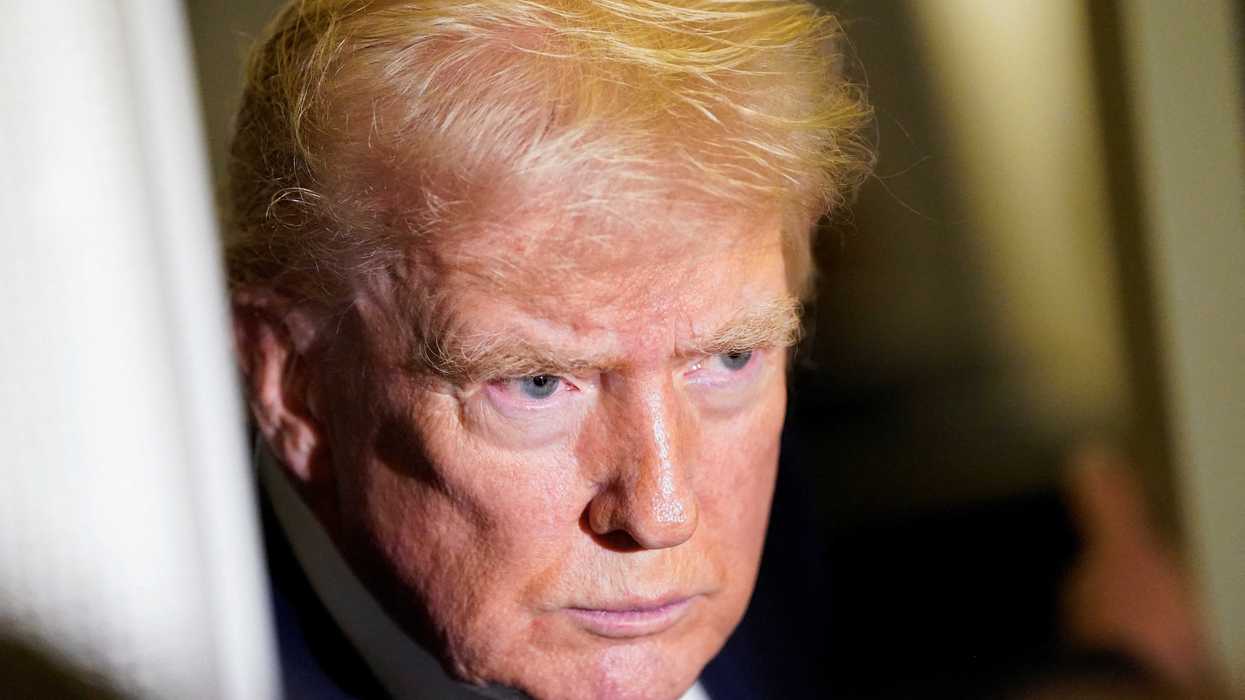
During an interview that aired on Wednesday morning, President Donald Trump responded to a question about the war in Iran by launching into a bigoted rant against transgender people.

The New York Post’s Miranda Devine conducted the interview, asking the president for his response to people who have suggested that he was coerced or manipulated into starting the war by Israeli Prime Minister Benjamin Netanyahu, as some media reports have indicated.

“What do you say to people who claim that Bibi Netanyahu ‘tricked’ you into going into Iran?” Devine asked.

Trump responded by disparaging his critics as being against U.S. interests. “They’re just, you know, the enemy,” he said.

Trump then delved into name-calling, describing his political opponents as “dumocrats,” his new preferred insult to refer to members of the Democratic Party. He followed this by launching into a transphobic rant.


Federal Judge Blocks Trump’s Effort to Force Hospitals to Halt Trans Youth Care
The judgment overturns the Kennedy Declaration, which has forced 40 hospitals to drop gender-affirming care for minors.By Erin Reed , ErinInTheMorning  April 21, 2026


“These are people who don’t know what they’re doing,” Trump said of people criticizing his decision to start an unauthorized war. “They want men to play in women’s sports…they want transgender for everybody, surgery, they want transgender mutilization of our children.”

“He tricked me? I’m the one who started it,” Trump said, taking full ownership of the war in Iran.


Allison Chapman, project fellow on Gender Justice & Health Equity at Lawyers for Good Government, responded to Trump’s comments.

“Sure, ‘transgender for everyone’ and ‘transgender mutilization of our children’ are ‘just words’ — just inflammatory, othering, and in the case of ‘mutilization,’ imaginary words unfounded in fact, used to shift Americans’ focus away from Trump’s unlawful and endless military action in Iran, toward scapegoating an already marginalized group of people he was elected to represent,” Chapman told Truthout. “His words here are exactly why court after court rules that there is strong evidence of animus fueled legal attacks against transgender people.”

Trump’s assertion that children are receiving surgery as part of their gender-affirming care is highly misleading. Such surgeries are generally reserved for adults, and on the rare occasion that older teenagers are permitted to undergo gender-affirming surgery, it is after rigorous discussions involving their guardians, therapists, and medical doctors, who have determined it is necessary.

“In all cases, gender-affirming surgeries are only performed after multiple discussions with both mental health providers and physicians (including endocrinologists and/or surgeons), to determine if surgery is the appropriate course of action,” an Associated Press fact check pointed out.

Indeed, gender-affirming surgery is used to treat cisgender youth far more often than transgender kids, yet regulations and attempts to restrict care by several states and the federal government almost exclusively focus on the latter group.

Several medical organizations have stated that gender-affirming care — including care for trans youth — is not only safe but oftentimes life-saving.

Legal restrictions seeking to ban or limit gender-affirming care “are a baseless intrusion into the patient-physician relationship,” American Academy of Pediatrics President Susan J. Kressly said in December. “Patients, their families, and their physicians — not politicians or government officials — should be the ones to make decisions together about what care is best for them.”

This week, a group of transgender youth and their families filed a lawsuit against the Trump administration to block a federal criminal subpoena by prosecutors in Texas against a hospital in New York, seeking to obtain medical records of trans child patients.

“This is deeply personal, private information that belongs to these patients and these parents,” said Karen Loewy, senior counsel at Lambda Legal, who represents the patients.

“It’s really the providers they’re going after, and that is what we worry about. If there are no people left to provide this care, then it’s gone,” one parent of a trans child involved in the suit said.


 Bleeding Behind Bars Is Extra Grim When Prisons Fail to Offer Menstrual Products


Twenty-two states have laws requiring prisons to provide free menstrual products, but not all of them do.

By Victoria Law & Brian Dolinar ,
June 3, 2026

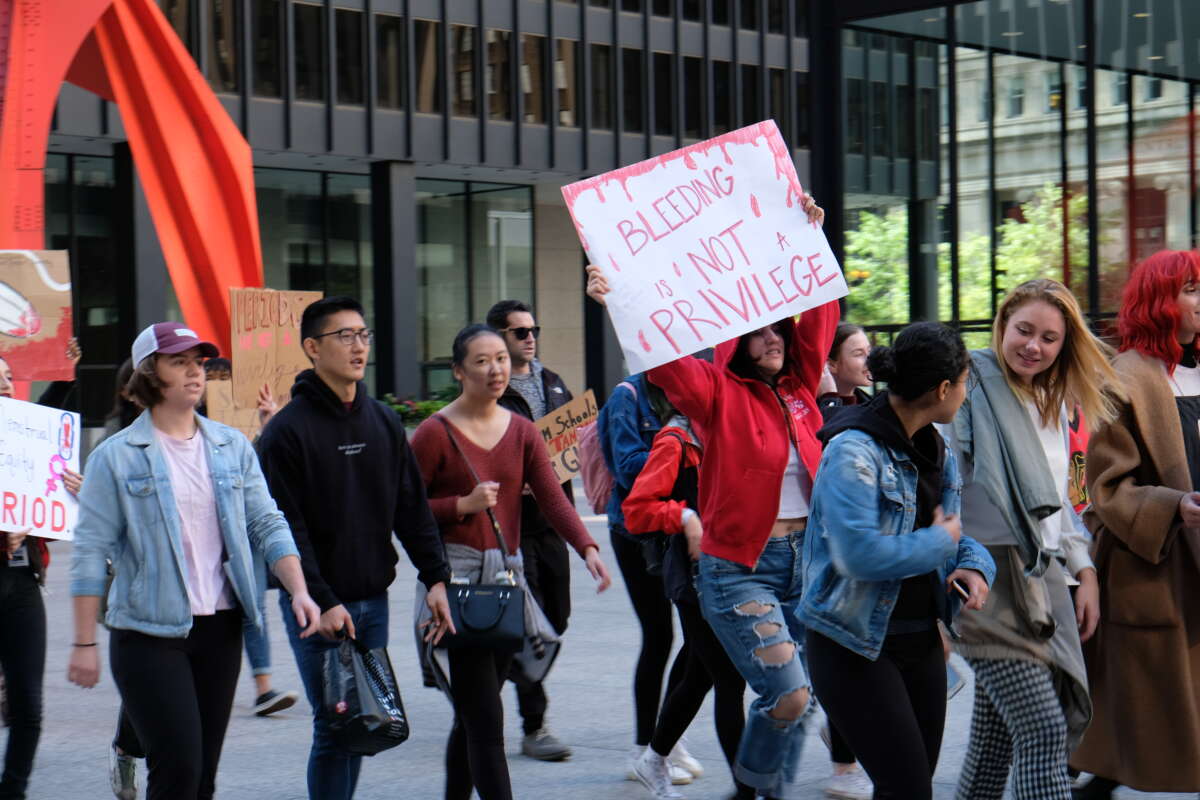
A rally for National Period Day in 2019 in downtown Chicago helps to launch a campaign for free menstrual products in Illinois prisons. Alexandra Riegler

“Why are they doing women like this? Are we the weaker sex?” Mishunda Davis told Truthout in a call from Logan Correctional Center, Illinois’s largest women’s prison. In 2022, the state passed legislation making menstrual products free for anyone incarcerated in Illinois prisons. Despite the law, Davis and others run out each month.

Menstrual care — or the lack of it — gets little attention in prisons. Women who bleed heavily or have a prolonged period can exhaust their weekly allotment of pads and tampons. Asking guards for more products can lead to punishment or abuse.

Now, a growing national movement for menstrual equity has included advocacy for people who menstruate behind bars. Miriam Vishniac, researcher and co-founder of The Prison Flow Project, told Truthout that, according to March 2025 data, there were 22 states with laws that “said they would give some amount [of menstrual products] for free to everyone.” Despite the progress, Vishniac said, there’s still a lack of information around how these laws are being implemented. “There are rules that say things should be happening, and then no monitoring or enforcement is ever talked about.

While it had dramatically dropped during the pandemic years, women’s incarceration increased nearly 4 percent from 2022 to 2023, double the rate of the rise in men’s incarceration. Nearly 90 percent of people in women’s prisons are under age 55. Similar data about both age and sex is not available for local jails. Many states still have not passed legislation or other protections around the right to menstrual products.

“When is our voice going to be heard?” Davis asked.


Free Phone Calls Saved Incarcerated People and Their Loved Ones $622.5 Million
Six prison systems have implemented free phone calls. A new report examines the impact of free communications. By Victoria Law , Truthout May 6, 2026

Sanitary Pads Are a Human Right

In 2016, New York City Council passed an ordinance making tampons and pads free to those incarcerated in city jails, the first law of its kind in the country. But in 2021, the city’s Department of Correction quietly stopped distributing free tampons.

It wasn’t until two years later that the Department of Correction (DOC) admitted to this violation, invoking a loophole about security. At a 2023 City Council hearing, a DOC official said that they feared tampons would be used to smuggle contraband and that people were using tampon applicators “to smoke drugs” and tampon strings “to light drugs.” But tampons weren’t entirely banned from Rikers Island — they remained for sale at commissary, the sole store inside that carries approved items, for $15.66 per 40-tampon box. In contrast, a 40-count box costs less than $10 at local drug stores.

After being grilled at a city council hearing, the Department of Correction resumed distributing free tampons. But for two years, menstruating people earning anywhere from 55 cents to $1.55 per hour needed to work more than 15 hours to afford one box of tampons.

In 2018, two years after New York City passed its ordinance, Congress passed the First Step Act, which included a provision requiring that the Federal Bureau of Prisons make menstrual products available at no cost. The American Medical Association has endorsed free menstrual products for those in prison. Access to sanitary pads, argues Chandra Bozelko, a formerly incarcerated writer, “is not a luxury — it is a basic human right.”

Even when laws are passed, however, menstruating people are still left at the mercy of their captors.

“Systems often point to the existence of policy as evidence that the problem has been solved, while incarcerated people experience the exact opposite reality,” said Kim Haven, a formerly incarcerated woman and founding director of Reproductive Justice Inside. “The question is not simply whether products are ‘available.’ The real question is, can people access what they need consistently, safely, without humiliation, retaliation, bargaining, or dependence on officer goodwill? That distinction matters.”

Campaigning for Menstrual Equity


Mary Catherine Hanafee LaPlante was just 16 years old when she organized a rally for the first National Period Day in 2019 in downtown Chicago. Organizers collected donations of menstrual products for homeless shelters and prisons. She was shocked when she discovered that people incarcerated in women’s prisons often had to ration menstrual products, purchase them in commissary, or make their own out of whatever they could find. “The more I learned, the more horrified I became. It was inhumane in a way that should never be legal in this country,” Hanafee LaPlante told Truthout.

One of the rally’s sponsors, She Votes Illinois, invited Hanafee LaPlante to join the organization’s board as a youth representative. Together, they mounted a campaign for menstrual equity at schools, shelters, universities, and women’s prisons in Illinois. As Maureen Keane, co-founder of She Votes Illinois, recounted to Truthout, “Mary Catherine highlighted that people who menstruated in prisons were being overlooked in this initiative.” She Votes researched model legislation from other states and drafted a bill to provide free access to menstrual products.

At a rally for National Period Day in 2019 in downtown Chicago, Mary Catherine Hanafee LaPlante speaks about the need for menstrual equity.  Alexandra Riegler

While many other bills were specific to incarcerated women, the Illinois bill refers to those “who menstruate,” which includes transgender men who menstruate, Keane explained. The bill also provides free underwear for incarcerated people as well as free menstrual products to prison employees. The bill passed in 2022 with bipartisan support.

But even with legislation, Keane admits, “we know that’s not necessarily happening.”

In response to a recent Freedom of Information Act request for any policy related to menstrual products, the Illinois Department of Corrections replied, “IDOC does not possess or maintain records responsive to your request.”

Mishunda Davis gave a picture of how the law is implemented in prison. Every week, staff distribute 10 products, “pads or tampons depending on what they have to give you that week.” Women who are heavy bleeders may run out after a day or two, she said. If women share, they risk a disciplinary ticket.

Extra supplies and underwear can be purchased at commissary. Davis makes $27 a week at her job, but a box of 18 tampons costs $10, more than one-third of her wages. Commissary was also only available once a month at Logan; at men’s prisons, commissary is every two weeks.

After the women mounted a campaign, they were allowed to shop at commissary every two weeks. “It seems since everyone had their family calling Springfield,” Davis wrote over the prison’s text messaging system, “they [are] trying to shop us on time.”
Access Is a Power Issue

Illinois isn’t the only state where menstruating people must face shame and humiliation.

Texas law states that prisons must provide “up to ten feminine hygiene products per day that comply with applicable federal standards for comfort, effectiveness, and safety.”

But that’s not what happens in the state’s women’s prisons, where staff hand out one 24-pack of pads and five tampons per month.

“I have always wondered who decided the amount and how did they come to say five regular tampons were enough,” mused Aisha Bailey, who is currently imprisoned at the Lane Murray Unit in Gatesville, Texas.

Texas prison uniforms are white and, she says, staff are unsympathetic if someone bleeds through their clothes.

Bailey is in the segregation unit, where staff are supposed to distribute supplies the first weekend of each month. But, she said, “security assigned to the building doesn’t always pass them out … then during those times you can hear people yelling for an officer and requesting pads/tampons. Most officers that work solitary forget so someone may spend a day or two asking for the pads.”

Kayelin Tiggs, founder of the Ohio Coalition for Menstrual Equity and board member of the Prison Flow Project emphasized the importance of exact language in the bill. “The law specifically states that it’s not just free products, it’s free products with 24-hour access. It’s free products at the appropriate amount that you need. It’s free products when you need them,” Tiggs told Truthout.

Tiggs led a campaign to pass a law in Ohio. That law, which took effect in March 2026, contains language to ensure menstruating people receive an adequate supply of products. “But,” she concedes, “a lot of the other states do not have that specific language in there.”

Haven notes that, no matter what the law, the problem remains with incarceration itself. “What is especially important is understanding that menstrual access inside is not merely a ‘women’s issue’ or a supply issue. It is a power issue,” she said. “Control over hygiene, bodily care, movement, and privacy has historically functioned as a mechanism of institutional control in carceral settings. Menstrual deprivation becomes part of a larger architecture of dehumanization.”


This article is licensed under Creative Commons (CC BY-NC-ND 4.0), and you are free to share and republish under the terms of the license.


Victoria Law

Victoria Law is a freelance journalist who focuses on incarceration, gender and resistance. Her books include Resistance Behind Bars: The Struggles of Incarcerated Women (2009), Prison by Any Other Name: The Harmful Consequences of Popular Reforms (2020), “Prisons Make Us Safer” & 20 Other Myths about Mass Incarceration (2021), and Corridors of Contagion: How the Pandemic Exposed the Cruelties of Incarceration (2024).


Brian Dolinar

Brian Dolinar is an independent journalist based in Urbana, Illinois. His articles have appeared at The Appeal, In These Times, The Nation, and Truthout. You can follow his stories by subscribing to his Substack newsletter called “Sentences.”
As Detained Immigrants Strike Against ‘Chaos and Cruelty,’ Advocates Demand ‘Not Another Dime for ICE’

“Americans want real accountability and reform, and there is no version in Congress that reins in ICE and addresses the abuses we are witnessing,” said the head of America’s Voice.
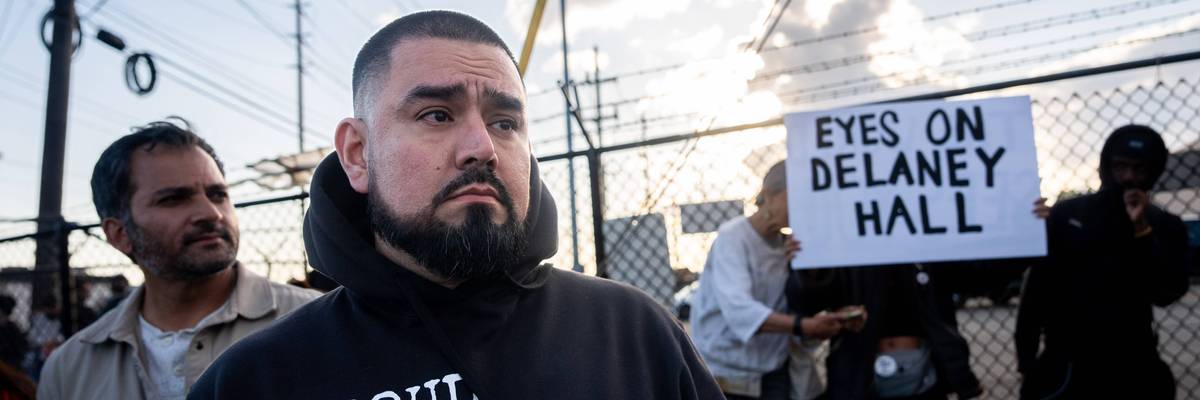


Protestors stand behind barricades near the Delaney Hall immigrant detention center on June 1, 2026 in Newark, New Jersey.
(Photo by Adam Gray/Getty Images)

Jessica Corbett
Jun 01, 2026
COMMON DREAMS

With US senators returning to Capitol Hill on Monday after a Memorial Day recess, Republicans are working to get a second budget reconciliation package to President Donald Trump’s desk—and critics of his mass deportation campaign continue to push back against giving immigration enforcement agencies $72 billion.

Much of that money would go to the US Department of Homeland Security and two of its agencies, Customs and Border Protection (CBP) and Immigration and Customs Enforcement (ICE). Trump’s deportation agenda notably got over $170 billion in last year’s budget reconciliation package, dubbed the One Big Beautiful Bill Act.

Since Trump signed that legislation last summer, he has deployed federal agents to various communities across the country, including Chicago and the Twin Cities, where they were documented violating the rights of US citizens and immigrants alike—even killing Renee Good and Alex Pretti in Minneapolis.


Immigrants who have been caught up in such operations have often been held in “inhumane conditions” at detention centers. For example, according to a lawsuit filed last week, a tent encampment at the Fort Bliss military base in El Paso, Texas “has become notorious for flagrant human rights abuses that people endure during their detention—they are confined to windowless enclosures in tents and suffer egregious physical abuse by guards; abhorrent medical and mental health care, including for people with chronic conditions like cancer and HIV; indiscriminate use of solitary confinement to punish and silence victims of guard abuse; and other flagrant constitutional violations, including exposure to measles, tuberculosis, and other diseases.”

“Not even a year in, there already have been three reported deaths at Camp East Montana,” the complaint notes. “In one case, a man was beaten to death after asking for his asthma medication—a death the medical examiner later ruled a homicide. A fourth man died shortly after being released from Camp East Montana, where he had been denied the chemotherapy that he needed to treat his cancer.”

Overall, from Trump’s return to office early last year to late April, ICE has reported more than 50 detainee deaths. An Associated Press investigation published last week found that at least 10 of them, all men, died by suicide.

“Not another dime for ICE—not while children are locked in trailer prisons, detainees are on hunger strike, and protesters are being pepper-sprayed for demanding basic decency,” Vanessa Cárdenas, executive director of the group America’s Voice, said in a Monday statement.

As her group detailed:
Detainees at Delaney Hall in Newark, New Jersey are on a hunger and labor strike, now in its fifth day, citing reported infestations, inadequate medical care, and no air conditioning, with protests outside met by masked ICE agents deploying pepper spray and tasers. At the Desert View Annex in Adelanto, California, at least 20 detainees launched a hunger strike citing a lack of medical care, unsafe drinking water, and mold. At Dilley, Texas, more than 6,300 children have been detained since the start of Trump’s second term in facilities described by those inside as a trailer prison, with lights on 24 hours a day and children as young as two months old among those held. Meanwhile, DHS Secretary Markwayne Mullin has threatened to halt processing of international travelers at Newark Airport amid the ongoing dispute with New Jersey officials over conditions at Delaney Hall.

Following protests on Friday and Saturday nights at Delaney Hall, Newark Mayor Ras Baraka imposed a curfew from 9:00 pm to 6:00 am ET. Multiple people who did not comply with it on Sunday night were arrested.

CBS News reported that as the curfew took effect, “a warning was issued to the protesters who had gathered outside the zone. Thirteen minutes later, state police in riot gear rushed toward the crowd. Officers on horses came in from the other side, surrounding the crowd and herding them away into a standoff.”


Discussing the New Jersey demonstrations during an interview on Fox News, Mullin claimed that “they’re not just exercising their First Amendment” rights; “these are violent protesters that are there to injure everybody—that’s even bystanders.”

A DHS spokesperson said in a Monday statement to Fox News Digital that “RIOTERS WILL NOT SLOW US DOWN.”

“The perimeter around Delaney Hall is FULLY closed... No rioters breached the perimeter last night. Our ICE operations continue undeterred,” the spokesperson added. “ANYONE who attempts to obstruct law enforcement or disrupt our operations will be prosecuted and face justice.”


Meanwhile, the Communications Workers of America (CWA), District 1, directed attention to those inside the facility, saying in a Monday statement that it “stands in full solidarity with the people detained at Delaney Hall in Newark who have laid down their labor and refused their meals to demand dignity, safety, and freedom.”

As CWA District 1 detailed:
Make no mistake: This is a labor struggle. The people held inside Delaney Hall are forced to cook meals, clean the floors, and keep the facility running—for as little as one dollar a day. These workers are on strike to protest the unconscionable conditions they are forced to endure and the basic due process they are entitled to, but have been denied.

While the private contractors who operate these detention centers bank millions, the workers who sustain them are denied the most basic protection and respect. When workers in those conditions organize, withhold their labor, and act together to demand better, they are doing what working people have always done to win justice. We recognize a strike when we see one.

The labor movement was built on the principle that no person should be exploited, silenced, or treated as less than human because of who they are or where they come from. The demands coming from inside Delaney Hall—an end to medical neglect, an end to exploitative labor, the release of the elderly, the young, and the sick, and the restoration of basic due process—are the same demands for dignity, equity, and justice that animate our own fight every day. An injury to one is an injury to all.

We honor the courage of the strikers and of the families and community members standing watch outside the facility, and we defend their right to peaceful protest. And we condemn in the strongest terms the escalation and violence by ICE and state police against people peacefully exercising their constitutional rights.

Cárdenas of America’s Voice called out Trump, Mullin, and Stephen Miller, the president’s White House deputy chief of staff for policy and homeland security adviser, who is infamous for pushing the family separation policy during his first term.

“The Trump-Miller mass purge machine is running unchecked, and Mullin isn’t bringing accountability,” Cárdenas said Monday. “Instead, this administration continues draining resources from real public safety, separating American-born children from their parents, and spending millions on masked agents while American families are unable to make ends meet.”

“The Senate has a clear choice to make: Side with the chaos and cruelty or listen to the American people,” she continued. “Poll after poll reveals that the public resoundingly rejects masked and armed agents inflicting random violence against immigrants and Americans alike.”

“Americans want real accountability and reform, and there is no version in Congress that reins in ICE and addresses the abuses we are witnessing,” she stressed. “This administration has made clear that reform is not on the table. Congress should not give them another dime to prove it.”


Both chambers of Congress are narrowly controlled by Republicans, but efforts by Senate Majority Leader John Thune (R-SD) and House Speaker Mike Johnson (R-La.) to advance immigration enforcement legislation have been hampered by Trump’s controversial $1.776 billion slush fund for insurrectionists. However, as of Monday, after losses in court, the Trump administration is backing off its push for the fund for now, meaning the bill may soon move forward on Capitol Hill.

“I can’t think of a less appropriate time to pour another $72 billion into ICE and CBP—especially without requiring meaningful reforms or accountability measures,” Bridget Moix, a leader at Quaker organizations including Friends Committee on National Legislation, FCNL Education Fund, and Friends Place on Capitol Hill, wrote Friday for Religion News Service.

“As Quakers, we reject the false choice between security and human dignity,” Moix added. “True safety cannot be built through fear, cruelty, or unchecked power. Lasting security comes from thriving communities, functioning institutions, economic opportunity, and respect for human rights.”

A Movement Is Growing to Close the Largest ICE Jail on the East Coast


An ICE jail in rural Pennsylvania has been accused of medical neglect, providing unsafe water, and serving spoiled food.
June 2, 2026

Democratic Pennsylvania Congressmembers Chris Deluzio and Summer Lee speak with journalists after their unannounced congressional visit to the Moshannon Valley Processing Center in Clearfield County.Courtesy of U.S. Rep. Summer Lee

As people defy a police crackdown and flock to support hunger strikers at Delaney Hall in New Jersey, a campaign is growing in rural Pennsylvania to shut down ICE’s largest immigration jail on the East Coast, where a man with advanced kidney failure worries he may become the fourth person held there to die in the past three years.

“No treatment was given to me whatsoever when clear blood was spotted when using the restroom,” Izzy Aly said in a statement read by county resident Sherilyn Sheets at the bimonthly Clearfield County commissioners meeting last Tuesday. Sheets then played an audio recording of Aly, pleading with the commissioners in his own voice: “There is no question that my situation is precarious to say the least. Please do something.”

Immigration and Customs Enforcement (ICE) arrested Aly in December at the Philadelphia International Airport as he flew home to Florida from a U.S. Customs and Immigration Services-approved visit to Egypt to handle his recently deceased father’s estate. He had attended school in the Orlando area for about a decade and had a pending green card application, but was taken to the Moshannon Valley Processing Center. The 1,876-bed ICE jail opened three years ago in a former prison that now holds mostly asylum seekers and longtime U.S. residents. Commissioners in this Republican-leaning county, which backed Trump by 75 percent in 2024, will vote by September on whether to renew its $268 million, five-year contract for the detention hub with ICE and private-prison corporation GEO Group, and their meetings have been packed with people calling on them to cancel it.

“Clearfield County should not and cannot be complicit in suffering,” said the second person to comment at a May 26 meeting, Tony D’Orazio, chair of the Clearfield County Libertarian Party and board member of the Libertarian Party of Pennsylvania.

D’Orazio told Truthout he learned about Moshannon last year and attended his first meeting Tuesday when he read a social post by Aly’s friend in Florida and realized Aly was detained “right here in my county, which got me looking into it a whole lot more.”

Opponents of the Moshannon facility have traveled from around the state in recent months to attend the meetings, but for the first time last week, the county solicitor refused to let them speak, citing time constraints.

“This has become a convenient soap box to address federal immigration issues,” complained Commissioner Tim Winters, who is chair of the board, at the May 26 meeting before motioning to adjourn

.

Izzy Aly in 2023, before he was detained by ICE in December 2025 and sent to the Moshannon Valley Processing Center, where he was told he has Stage 3b chronic kidney failure and says he hasn’t received adequate medical care
.Courtesy of J. Mark Barfield

While Winters has called Moshannon “a major economic driver,” D’Orazio argues it has had a “negative impact on tourism” since “people are coming to the region to protest this facility, not necessarily to see the beauty of Clearfield County. It’s also expensive.”

Clearfield’s three commissioners told PennLive they toured Moshannon “two or three times over the last five years,” but “have not spoken with any incarcerated people during those preplanned visits.”

Democratic Congressmembers Summer Lee and Chris Deluzio made an unannounced visit Tuesday to Moshannon, where Rep. Lee said they were granted a “pretty sanitized tour” of the women’s unit and saw at least two people held there who are pregnant.

Officials denied Rep. Deluzio’s request to meet with Randy Cordova Flores, a Peruvian father and asylum seeker arrested in February at a traffic stop in Springdale, Pennsylvania. Last August, Rep. Lee was turned away from a visit after she sent an inquiry about medical care for another asylum seeker, Maklim Gomez Escalante, who was detained there after being hospitalized for heart problems.

As the lawmakers briefed journalists on their visit, they stood in front of a billboard showing the “cost to detain one immigrant in Philipsburg for a year” is about $48,000, compared to about $22,000 to “educate one child.”

A note at the bottom of the graphic explained it was, “Created and paid for by local residents, clergy and advocates,” and listed a website — moshannonvalleyprocessingcenter.com — that offers “Ten Ways to Take Action,” including: “Attend a Commissioner Meeting.”

The barbed wire-surrounded prison at 555 Geo Drive in Philipsburg briefly shut down in 2021 when the Biden administration instructed federal prisons to end their use of private prisons. It reopened later that year, when it contracted with ICE with help from the Moshannon Valley Economic Development Partnership. Leonard Oddo, the current warden of Moshannon, is a member of the Partnership.
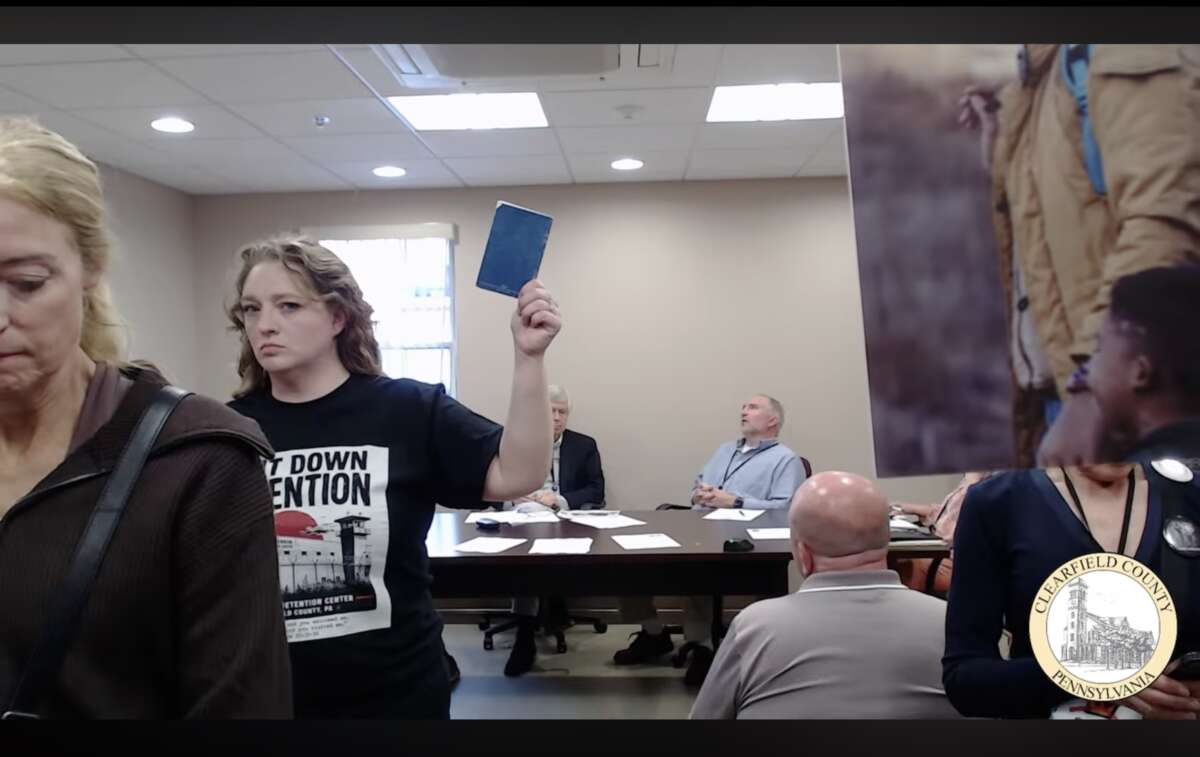
Bobbi Erickson, with the Shut Down Detention Coalition, turns her back on Clearfield County Commissioners who refuse to let her and others from outside counties speak during the public comment portion of a May 26 meeting about why they should vote to cancel their contract with ICE and GEO Group for the Moshannon Valley Processing Center.Youtube/ @clearfieldcountygovernment7019


Since then, complaints about conditions have been steady. Most recently, about 100 people incarcerated at Moshannon started a hunger strike in April to protest spoiled food and alleged medical neglect. About a week before Izzy Aly arrived in December, Fouad Saeed Abdulkadir became the third person to die at the jail after ICE said he suffered “medical distress.” Abdulkadir was an Eritrean national and imam from Ohio whose federal habeas corpus petition and emergency motion pleading for his release to obtain adequate medical care were denied by a U.S. District judge.

Abdulkadir’s death while held at Moshannon along with those of Frankline Okpu and Chaofeng Ge, is evidence of “a systemic crisis,” said Zeynep Emanet, the civic engagement manager at CAIR Philadelphia, during a press conference last week by the Shut Down Detention Campaign to demand Aly’s immediate release “before another preventable tragedy occurs.”

Several members of the campaign are visiting people at Moshannon as part of a long-standing support network bottom-lined by Juntos, a Philadelphia-based immigrant-rights group.

About 100 people incarcerated at Moshannon started a hunger strike in April to protest spoiled food and alleged medical neglect.

“You actually get to look into their eyes while they’re telling you about one of the most traumatic moments in their lives, when ICE took them, and how they’ve been coping with that this whole time,” Adrianna Torres-Garcia, co-director of the Free Migration Project, told Truthout last week, after they made the four-hour drive from Philadelphia to the rural jail.

Torres-Garcia said people they met during their most recent visit told them the drinking water at the jail is brown and “doesn’t taste good,” echoing similar complaints by others, including Aly, who said a nurse told him to drink more water when he complained of abdominal pain.

Joining the group for her second visit was Bobbi Erickson, who lives in neighboring Jefferson County and co-founded Indivisible Mayday. She told Truthout people at the jail lack privacy, as they practically have to yell during visits to be heard over the top of a plexiglass barrier that separates them from visitors.

“I asked the man I was visiting with, ‘How is the food?’,” Erickson recalled. “He responded, ‘bad,’ and the guard right over his shoulder said, ‘Tell her it’s good.’”

“His main question to me was, ‘Why am I here?” Erickson said. “The only thing I could tell him is money, because there’s some rich CEO getting richer.”

Back in Florida, friends of Aly report he has lost his apartment, car, and even his pet cat while in detention. J Mark Barfield is coordinating a movement to “Help Izzy Get His Life Back,” after volunteering with him for about seven years in Florida’s Libertarian Party.


“If there is an ICE detention facility near you, find out who’s running it, find out how you shut it down, and start organizing immediately.”

“He last messaged me on December 22, saying he was about to board the airplane, and I messaged him several times saying, ’Where are you? Are you home yet?’ And I didn’t hear from him,” Barfield told Truthout. By February, Aly was able to obtain Barfield’s number and called him seeking help.

“He is frequently outspoken against unfair practices and what he sees as injustice,” Barfield noted, “so if anything, it may be a bit ironic that he’s suffering through the very thing that he fights so hard against.”

Barfield said Aly told him the water at Moshannon “frequently has a yellow hue to it,” with white flecks, a “coppery taste” and a “metallic odor” at times.

Erickson told Truthout she saw a large water storage tank at Moshannon “that is clearly in disrepair.”

When asked about the water quality and condition of the water tank at its facility, a GEO Group representative said in a statement to Truthout that “our support services are monitored by ICE and if “issues are identified, we quickly resolve all of ICE’s concerns as required by ICE’s Quality Assurance Surveillance Plan.” The representative claimed that access to “off-site medical specialists, imaging facilities, Emergency Medical Services, and local community hospitals is also provided when needed.”

As Aly marked the start of his fifth month in detention, he told Barfield his “pain is growing more acute.”

Across the country in California, complaints about poor food and lack of medical care prompted at least 20 people to launch a hunger strike in May at the GEO Group-run Adelanto ICE Processing Center, and protests in support of hunger strike launched Memorial Day at Delany Hall continue as well. Five of the men who launched the April hunger strike at Moshannon were put in solitary confinement.

D’Orazio and Erickson say they will attend the next Clearfield County Commissioners meeting next week once again to urge them to cancel the Moshannon contract instead of renewing it.

“Seeing that we have these facilities that make it easy to separate people from their families and from the pursuit of happiness guaranteed in our Constitution, not just to citizens, but to everybody on our shores, is really disheartening,” D’Orazio said, “but what really brings me hope is that there are so many people willing to speak up and say it’s wrong.”

When Erickson and others were refused a chance to participate in public comments during the last meeting, they stood and turned their backs as commissioners continued with old business. Erickson thinks people coming to speak from around the state have not been disruptive and urged commissioners to “read the Constitution.”

“I’m hyperfocused on Moshannon,” Erickson told Truthout, “which I think is what everyone should do. If there is an ICE detention facility near you, find out who’s running it, find out how you shut it down, and start organizing immediately.”

This article is licensed under Creative Commons (CC BY-NC-ND 4.0), and you are free to share and republish under the terms of the license.


Renée Feltz is an award-winning investigative journalist whose coverage of immigration, mass incarceration, environmental justice, and more spans 25 years. She is a former news co-director at Democracy Now!.


For 25 Years, the War on Terror Has Turbocharged Surveillance and Imperialism


Truthout and Haymarket Books examine the world made by the War on Terror and the struggle against it.

By Maya Schenwar , Khury Petersen-Smith , Maha Hilal , Negin Owliaei , Truthout/HaymarketBooksPublished
June 3, 2026

Truthout was founded in 2001, with George W. Bush in the White House and war hawks circling the halls of power. Haymarket Books was founded the same year. Over the wildly tumultuous political period since, our two organizations have connected organizers, activists, and curious readers with books, essays, and reported pieces that have informed and aided their efforts to understand the world and fueled their struggles to change it.

To honor our anniversaries, Truthout and Haymarket Books are coming together for a series of live-streamed events, focusing on crucial political moments and movements from the last 25 years.

In our first conversation, Truthout editor-in-chief Negin Owliaei and Maya Schenwar, director of the Truthout Center for Grassroots Journalism, joined Truthout contributors Khury Petersen-Smith and Maha Hilal to focus on the impact of the so-called “war on terror” and the social movements that have emerged since. We draw on lessons from the war on terror and the anti-war movement of the 2000s to inform today’s struggles against war and imperialism.

Trump sidelined a bipartisan celebration to create propaganda machine


U.S. President Donald Trump speaks during the National Republican Congressional Committee (NRCC) annual fundraising dinner in Washington, D.C., U.S., March 25, 2026. REUTERS/Ken Cedeno

June 01, 2026 
ALTERNET

In light of my post yesterday about Trump’s plans for a Trump rally on the mall to celebrate the start of America’s 250th birthday festivities — designed, in his words, for “patriots” and promising to be “wild” — several of you wanted to know more about how it’s being planned and paid for.

This year’s 250th anniversary events, commemorating America’s founders’ refusal to be bound by a tyrant, were supposed to be planned by a nonpartisan, nonprofit group created by Congress in 2016 via a bipartisan congressional caucus of more than 350 members.

That nonpartisan, nonprofit group is called “America250.”

“America250” still exists, at least in theory. It lists as Honorary National Co-Chairs George W. Bush, Barack Obama, Laura Bush, and Michelle Obama. Its ex-officio members include present and former government officials drawn from both parties. You can read more about it at the “Official website of the U.S. Semiquincentennial Commission,” here.

But “America250” is not planning this year’s 250th anniversary events on the mall or anywhere else in official Washington. Trump and his MAGA allies circumvented Congress and created their own planning committee, confusingly named “Freedom 250.”


Trump’s “Freedom 250” describes itself in much the same way “America250” does — as a “non-partisan organization leading the celebration of our Nation’s 250th birthday.” See here.

But unlike “America250,” Trump’s “Freedom 250” is bankrolling events promoting Trump and his political agenda (which is why most of the performing artists who originally agreed to participate dropped out last week when they learned of the ruse).

The “Freedom 250 toolkit” lists as its “core theme” elevating “President Trump’s Freedom 250 vision” — boosting Trump’s supposed achievements and not his many failures (such as two impeachments, criminal conviction on 34 felony charges, attempted coup against the United States, incitement of an attack on the U.S. Capitol, disastrous war in Iran, etc.) — analogous to Trump’s executive order requiring that the Smithsonian remove details about his impeachments from museum exhibits.


Not surprisingly, Trump’s “Freedom 250” is also designed to make money for Trump. Trump’s personal business is now trademarking the term “Trump 250,” along with a logo nearly identical to America250’s logo.

The Trump Organization has filed several trademark applications in connection with America’s 250th anniversary celebration, all featuring the Trump name as a centerpiece of the highly anticipated festivities. In one filing, a “Trump 250” image was trademarked to be used on a variety of merchandise including bumper stickers, tote bags, drinkware, clothing items, and golf balls. A wordmark application was also submitted for the name “Trump 250” on Friday.

Trump’s online store is already selling sweatshirts, a $200 dollar blanket, and golf balls with that logo.


Like the White House ballroom project, Trump’s “Freedom 250” is also a pay-to-play scheme. People and companies with financial interests likely affected by Trump are encouraged to make tax-deductible donations to gain access to, and seek favors from, him.

Corporations pay between $500,000 and $10 million to become Freedom 250 “sponsors.” A corporation giving $1 million or more will be invited to a “private Freedom 250 thank you reception” hosted by Trump. For $2.5 million or more, sponsors will even get a speaking role at the Fourth of July celebration in Washington. (Major donors so far include Lockheed Martin, ExxonMobil, Oracle, Palantir, Mastercard, and United Airlines.)

Who else is paying for Trump’s “Freedom 250” festivities? You and I, at least in part.

Tucked away inside last year’s sprawling 870-page “One Big Beautiful Act” was an allocation of $150 million for “events, celebrations, and activities surrounding the observance and commemoration of the 250th anniversary of the founding of the United States.”


Most of those funds are going to Trump’s “Freedom 250” rather than to the nonpartisan “America250.” Why? When Congress appropriated the $150 million, only America250 was planning celebrations for the 250th. But now that Trump’s Freedom 250 is up and running, Trump’s Interior Department has doled out $100 million to it ($25 million has gone to the nonpartisan America250).

Oh, and unlike other groups created by Congress, Trump’s Freedom 250 doesn’t have to disclose anything about its spending until 2027.

So the answer to your questions about how America’s 250th is being planned and paid for — and why it’s becoming a propaganda vehicle celebrating Trump — is that Trump has pushed aside the nonpartisan group Congress set up in 2016 to plan it and substituted his own Trump-loyalist group, to which Trump’s Interior Department is siphoning off most of the taxpayer funds.

This is exactly what Trump did to the Kennedy Center, the Smithsonian Institution, the National Capital Planning Commission, and every other semi-public body Congress established for the common good.

This is the way authoritarianism substitutes for democracy — slowly and incrementally, until the whole system suddenly tips over.

But this particular example is especially ironic because “America250” was supposed to celebrate our fight for democracy against arbitrary tyranny. Trump’s “Freedom 250” is doing exactly the opposite.


Robert Reich is a professor of public policy at Berkeley and former secretary of labor. His writings can be found at https://robertreich.substack.com/.
'Radical crackdown' as Trump turns the Postal Service into a weapon


Terry Schwadron
June 03, 2026 
ALTERNET


Donald Trump is wasting no time on legal niceties in pushing for quashing of mail ballots for the November election.

Last Friday, one day after a federal judge declined temporarily to block the provision in Trump's election-related executive order, the U.S. Postal Service essentially announced that it would only deliver mail ballot applications to voters that the federal government recognizes, stopping the delivery of applications to tens of millions or more.

What the Postal Service rules made public last Friday was that it would strictly follow new mail-in ballot rules that require states to submit voter names, addresses and unique ballot barcodes for federal elections. The order also sets forth mandatory "best practices" for federal elections including Election Mail logos, tracking barcodes and design reviews.

No Democratic-run state as well as some Republican-run states has agreed to provide these names and private information to the government, arguing instead that this order is unconstitutional.

Whatever the wording, two things are true: Trump is seeking to stomp out mail-in voting with a federal order telling the states how to run their elections, and despite that single judge's decision not to put a stop to the order right now, the legal issues here are still very much in question.

Nevertheless, we should view this as a shot at blocking mail ballots that Trump has decided will run against his leanings about how the election should turn out. Along with redistricted Congressional lines now being upheld by the U.S. Supreme Court, attacks on voting machinery and vote-counting methods, the reduction of polling places particularly in rural, minority districts, Trump and Republicans are going full bore at derailing our November elections. The Supreme Court is expected to rule on two elections-related cases, one on a Republican effort to strike state laws that allow late-arriving ballots postmarked by Election Day, and the other about erasing more legal limits on campaign spending.

A Broad Campaign for Control


However broad the Trump campaign to control elections is, the challenges must be specific about each aspect. What we are seeing already in the redistricting cases is that confusion is building about which contradictory court orders in different states are changing or upholding procedures for early voting in primaries going on even now.

The official explanation from the Postal Service is that the rule would help determine how many ballot applications were mailed and allow officials to compare that figure with the number of returned to detect potential issues for further investigation. The rule would apply to general, special and runoff federal elections, but not primaries or ballots sent to military and overseas voters.

The postal service apparently would create state-specific "Mail-In and Absentee Participation Lists" through a new Federal Ballot Mail Portal. The proposal would also let the USPS return outbound federal ballot mailings that do not meet the new standards or are not tied to state-submitted voter lists.

Where Trump sees "rigged" elections through encouraging voting from home, democracy defenders see aggressive steps to block the vote.

In its statements, Democracy Docket headed by election lawyer Mark Elias calls these Postal Service rules "a radical crackdown on mail voting" and "an alarming step" towards trying to control who can vote this November. It also represents a massive expansion of federal control over voting, without congressional authorization.

Trump's March 31 executive order on elections directed the Postal Service to begin rule-making on mail-in and absentee ballot services. It triggered immediate lawsuits that have yet to be heard. The judicial ruling against blocking the new procedures said the challenge was premature because agencies had not yet carried it out. Publishing the new rule – expected today — could be the start of implementation as well as a period of public comment.

Democrats and voting rights groups argue that Trump's order intrudes on states' authority over elections and have defended mail-in ballots. The use of mail-in balloting expanded during COVID for health reasons, and ballot by mail strategies are used by both major parties, but Trump has decided the practice favors Democrats.

Under the Constitution, states run elections and only Congress can set national standards.

The lawsuits challenging limits says the new rules will lead to eligible voters being unable to cast ballots. In part, that's because the lists would rely on Department of Homeland Security databases that have been shown to have serious flaws.


The resolutions of all these cases would be easier with a huge turnout of voters.
Ex-marine fighter pilot tears apart Trump Pentagon chief for flouting military rules


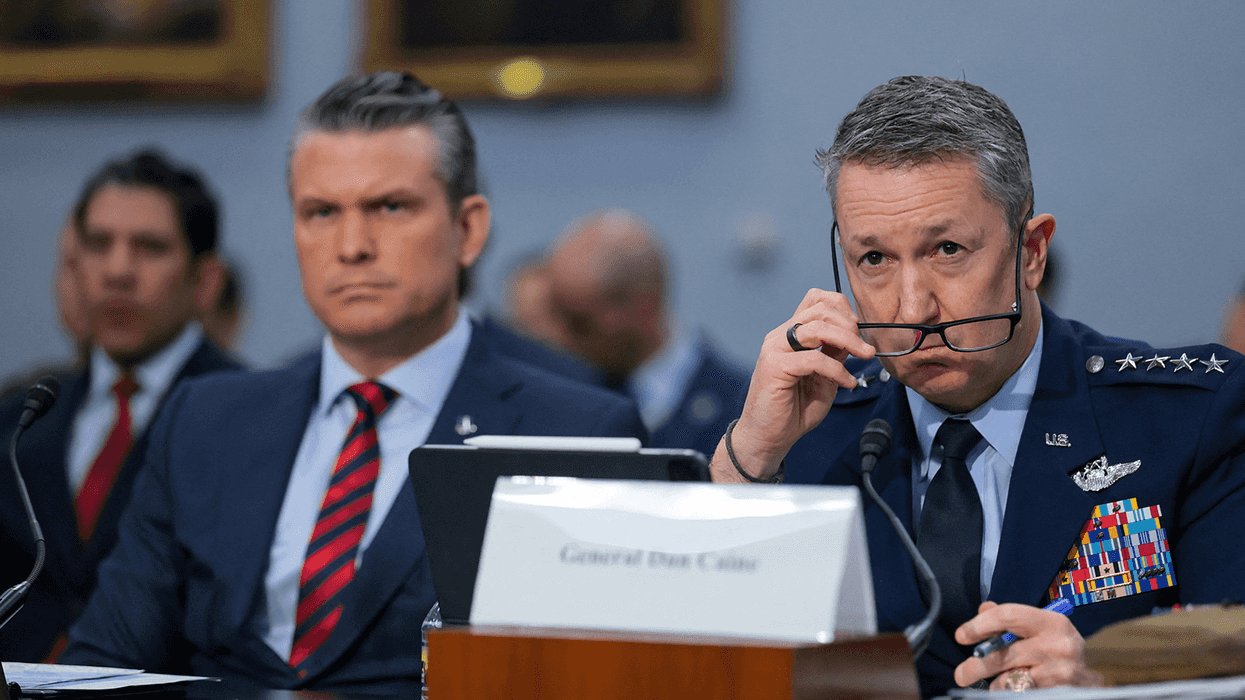
U.S. Secretary of Defense Pete Hegseth and Chairman of the Joint Chiefs of Staff General Dan Caine attend a House Appropriations Subcommittee on Defense hearing on President Donald Trump's FY2027 budget request for the Department of Defense, on Capitol Hill in Washington, D.C., U.S., May 12, 2026. REUTERS/Jonathan Ernst

June 03, 2026
ALTERNET


An ex-Marine fighter pilot tore into President Donald Trump's Pentagon during a Wednesday appearance on CNN, taking the agency to task over damning new reports about promotions being blocked for women and minority officers.

Earlier this week, the New York Times reported that Defense Secretary Pete Hegseth had, potentially in defiance of military rules, intervened to block nine officers from being added to a list for promotions, half of whom were either women or people of color. This revelation came amidst a growing trend of Hegseth firing, demoting or otherwise disrespecting military officers who are not white men, or those who had previously participated in pro-diversity activities.

During Wednesday's edition of The Situation Room on CNN, co-host Pamela Brown discussed the reports with Amy McGrath, who previously served as a fighter pilot for the Marine Corps and retired after 20 years of service, achieving the rank of lieutenant colonel. She has also become a frequent Democratic candidate for Congress from Kentucky, running unsuccessful bids for the House in 2018 and, most notably, to unseat Mitch McConnell in the Senate in 2020. She also sought the 2026 Democratic nomination for McConnell's seat, but lost in the primary to former state representative Charles Booker.

In the interview, McGrath explained how the candidates put forward for this promotion list are already the "best of the best," having "spent their entire careers in doing very hard jobs, very high performance," and added that they face the "toughest scrutiny of performance records of any profession that I know" in order to get there.

"Takes months of review, and these boards, they make sure you've done the tough jobs," McGrath said. "They make sure you've done them very well. All of these officers have done this, or they wouldn't have gotten to this point. And for the names to be pulled by Secretary Hegseth, clearly, because of race and gender, is outrageous, and it's beneath what America stands for. And unfortunately, there's not much that folks in the military can do about it."

McGrath further touched on the broader campaign by Hegseth to purge the military of what Brown called "so-called wokeness."

"Pete Hegseth and his team are trolling the military records and social media accounts of officers, and they're punishing anyone who has ever served on a diversity task force, potentially in the past, or have said anything having to do with championing diversity in the past," she explained. "They're punishing anyone who was involved in the withdrawal of Afghanistan."

She continued later: "And this sends just a chilling message to everyone in the Pentagon and everyone within DOD. They're walking around, people are walking around scared right now... trying not to get fired. And that's, you know, a problem. It's ultimately a problem for our national security writ large."


McGrath also called it "absolutely wrong and outrageous" for officers to be punished for things in the past that they had no choice but to do once given orders, likening it to the purge of the Justice Department of any employees who were assigned to the classified documents case involving President Donald Trump and his Mar-a-Lago residence.

Rubio confronted in live hearing with video proving he 'lied to Congress'


U.S. Secretary of State Marco Rubio testifies at a U.S. House Foreign Affairs Committee on Capitol Hill in Washington, D.C., U.S., June 3, 2026. REUTERS/Evelyn Hockstein

June 03, 2026
 ALTERNET


Rep. Ted Lieu (D-Calf.) hammered Secretary of State Marco Rubio as he appeared in a House Foreign Affairs Committee hearing on Tuesday over questions about President Donald Trump's fitness for office. Rubio's reactions led Lieu to claim he was lying under oath.

Lieu showed the footage of the December Cabinet meeting in which Trump appeared to doze off next to Rubio.

"Oh my God," Rubio could be heard saying.


Lieu asked whether Rubio had "been at more than one meeting where President Trump was asleep."

"That's false," Rubio said. "That's false. I've never seen him fall asleep. On the contrary, the guy doesn't sleep, which is a big problem because he calls me at two in the morning. He calls me at five in the morning. And, you know, I like to sleep a little bit. You know, not 12 hours, but at least six."


Trump's insomnia was addressed by CNN medical expert Dr. Jonathan Reiner. Reiner said that chronic insomnia can be “a severe illness," in large part because it can add "about 3-1/2 years to one’s age and [contribute] to a decline in mental functions."

"Secretary Rubio, I'm going to show you in a moment that you just lied to Congress," Lieu cut in.

"Oh, ok," Rubio said.


"This is a Cabinet meeting from last month where Donald Trump is sleeping while you are talking. Please show this video," Lieu said. "You are literally talking about issues of war and peace, and Donald Trump is sleeping right next to you."

Rubio denied it again.

Trump's disappearance from public view is raising questions, as he hasn't held any events or press conferences in about a week. Trump did speak to the New York Post on Tuesday in a interview that revealed a new medical malady.


"If Donald Trump cannot stay awake at these important meetings where the cameras are rolling, can you imagine what he is like when the cameras are not there? Have you been at classified meanings were Donald Trump has fallen asleep?" the congressman asked.

Rubio replied again that he'd never been in any meeting in which Trump fell asleep.

"So, you are lying again? Lying consistently to Congress," Lieu responded.

He went on to say that Trump's drowsiness "caused other countries to perceive him differently." He claimed that Trump is mocked as "weak and feeble."


Lieu then showed a clip from the French News in which Trump appears to fall asleep at a Memorial Day ceremony last month. His eyes appeared to be closed for a large portion of the ceremony.

"There's something wrong with his cognitive acts, and the fact that on a number of occasions Donald Trump will contradict himself and literally — in literally the same meeting or interview," Lieu continued. He showed another clip in which Trump "says the Iranian military is both destroyed and not destroyed at the same time."

Lieu closed by praising Rubio, saying that he's done a lot to travel around the world and trying to clean up the "mess that was left to you."

Security expert explains how 'nuts' Trump put the US in a downward spiral

U.S. President Donald Trump looks on as he speaks to reporters onboard Air Force One, on travel from West Palm Beach, Florida, to Joint Base Andrews, Maryland, U.S., February 16, 2026. REUTERS Elizabeth Frantz
June 03, 2026  
ALTERNET

According to distinguished security scholar Phillips P. O’Brien, the leadership of President Donald Trump has set the United States on a downward spiral in which it is “weaker every day.” Perhaps even more alarming, the US “may never come back” from the diminished state Trump will leave it in.

O’Brien — whose book War and Power is widely cited by strategy experts — asserts that there are several factors driving the country’s decline under Trump, but the most looming is the president’s decision to launch war with Iran.

“The US does not control its own destiny at this point in the war,” writes O’Brien. “Indeed every day the American position is weakening. The US is in a far weaker state than it was when the ceasefire was announced on April 7, and will be in weaker position next week when I write this (unless Trump surrenders)... Recently we are seeing arguably the greatest example of the growth of American global weakness that Trump has accelerated. Trump has shown that the USA cannot control either Iran or Israel — indeed that he is panicking as those two states are doing what they want regardless of his threats or wishes. The idea of the USA as either the indispensable partner or unstoppable enemy is gone. It may never come back.”

O’Brien says evidence of this weakening can be seen by looking back to June 2025. After the U.S. joined Israel in a bombing campaign against Iran, the Israelis wanted to continue the attack, while Trump wanted it over fast. When he ordered Israel to stop, at the time, the country yielded.

No longer. “In the last few weeks Trump has tried to do something similar and the Israelis are basically not reacting, but doing what Netanyahu wants to do,” specifically in Lebanon. Israel has not only persisted in attacking its neighbor but has seized sizeable territory, complicating peace negotiations. “This Israeli military action has been driving Trump nuts,” says O'Brien, but “unlike last year, however, Trump cannot simply order the Israelis to turn around — and as such is getting desperate,” lashing out at Netanyahu in a screaming, curse-laden phone call. Israel has only continued to step up its military efforts. “This is what I mean about the USA getting weaker every day,” says O’Brien.

At the same time, Trump keeps insisting that a deal is close, even as the Iranians say they’ve cut off talks. And all the while, the president is posting that everyone should “just sit back and relax, it will all work out well in the end — it always does!”

“Look closely at the power imbalance here,” notes O’Brien. “It is the US government that is desperate to keep up the fiction that the negotiations are going well, that Iran is making major concessions and that a deal is close. The Iranians, on the other hand, are happy to project the opposite image; that they can walk away from the talks and are happy to let this string for longer.”

What’s more, writes O’Brien, “This weakness ties into what Trump is doing with the GOP and the federal government…People need to ask themselves why Trump is prizing absolute subservient loyalty over anything. It's not just that he wants to punish his enemies… Trump is setting up a parallel system to protect himself and maintain his power, and that is based on total control of the GOP and executive government. This might actually be the thing that makes U.S. decline unstoppable. He is, as always, willing to destroy the country to save himself.”

O’Brien points to many domestic circumstances that are weakening the country, all driven by Trump’s efforts, from the collapsing economy, to his electoral revenge campaign, to the appointment of inexperienced, incapable loyalists to key positions, to his wildly corrupt slush fund.

“Why is Trump doing what seems to be decisions to make himself less popular and less politically secure going forward?” writes O’Brien. “The answer is not because he is stupid…it is because he is adopting what could be called a scorched earth strategy to protect himself and his power going forward. He wants absolute and total control of the GOP, even if that means he might lose a seat here or there. And he wants a federal government that will do whatever he wants when he wants.”

O’Brien ends with a dire warning: “It sets him up to corrupt either the November vote or its results. People are being too blase about this election. Trump has a party that is completely under his sway and a federal government that is staffed by uber loyalists. It gives him terrible and powerful options to subvert democracy.”
Trump's worst economic bomb is about to drop: analysis

(Reuters)
June 03, 2026
ALTERNET

While warning signs have been flashing ever since President Donald Trump’s war with Iran resulted in the closure of the Strait of Hormuz, fallout in the form of a major economic disaster is yet to manifest. “That won’t last forever,” writes the American Prospect columnist Ryan Cooper, who warns that “something is going to snap.”

The danger wouldn’t be so looming if the war appeared to be nearing its end, but as Cooper points out, there is little evidence to support such a hope, noting that Iran has “cut off contact with American negotiators, and the two sides are once again shooting at each other. Trump, for his part, recently told a CNBC reporter that I’ really don’t care. I couldn’t care less’ if negotiations are over. They ‘started to get very boring,’ he added.”

So apparently, according to Trump himself, he’s feeling no pressure to make a deal, which is exactly what he said in early May. Cooper warns that this places the U.S. in a dangerous position, because while there hasn’t been a “truly major crisis” yet, “it’s only a matter of time before one or more of the severely strained parts of the global economy breaks.”


Total catastrophe has so far been avoided based on four factors. First, despite Trump’s best efforts to oppose a green-energy transition, companies and countries around the world have leaned into alternative energy as fossil fuel prices have shot up. At the same time, many nations, particularly in Asia, have begun rationing oil consumption, which while painful, has helped stave off collapse. But a third “more ominous” factor, says Cooper, is that the world has been forced to draw heavily on existing stocks of oil and natural gas.

According to Cooper, “Many people saw the Iran war coming, and filled up every oil tanker and storage facility they possibly could. A great deal of that has since been used up. The vast storage complex at Cushing, Oklahoma (regarded as a storage benchmark), has declined from 33 million barrels to 24.5 million — and they can’t be fully emptied. ‘You can’t draw them down to zero because there is gunk at the bottom of the tanks,’ oil analyst Matt Smith told CNN.” At the same time, countries around the world are depleting their reserves.


“We’re approaching unheard of inventory levels,” Exxon Senior Vice President Neil Chapman said recently. “Once you get to that point, then you’ll see price shoot up.”

A fourth factor, writes Cooper, is “the behavior of the media and financial markets. The D.C. political press can be relied on to uncritically repeat Trump’s preposterous lies about an imminent deal, no matter how many times they have been proved false. Traders on oil and oil futures markets, being either deluded by the media or blinded by wishful thinking or simply incapable of believing that the president of the United States is as stupid and insane as he in fact is, have consistently expected the strait to open back up soon…Oil prices again fell sharply after Trump’s latest promise.” Despite this market manipulation, Cooper warns, “Sooner or later, oil traders are either going to face reality, or bankrupt themselves.”

As Cooper points out, “reserve releases and comically underpriced oil futures are effectively subsidizing oil consumption.” While a few countries, primarily in Asia, have taken measures to reduce oil usage, many world leaders “have encouraged their nations to continue using energy at normal levels, and therefore to chew through global inventories more quickly. That means if and when the supply shock hits, it will hit even harder.”


On that note, Cooper dives into the looming crises that are poised to destroy several key sectors of the economy.

“The most obvious one is in oil itself,” Cooper explains. “As storages dwindle and run out, the only way to match demand to supply will be for the price to rise high enough to destroy something like 10 to 20 percent of global oil consumption. And because a great deal of oil demand is obligatory and therefore not very price-sensitive, that price will likely be north of $150 per barrel. That means gas and diesel at the pump in the $8-to-$10 range, and a corresponding price hike for anything that needs to be transported, or involved in plastic in some way, which is to say basically everything.” Other sectors like agriculture, aluminum, and industrial commodities are in similarly precarious situations due to plunging stock and skyrocketing prices, the fallout from which will be wide-ranging and devastating.

And worse still, notes Cooper, “even if the Strait of Hormuz opens tomorrow, these problems are going to take years to resolve.” Oil fields will take months to resume production, vital infrastructure will take years to rebuild, and the need to restock reserves will drive years of structurally higher demand.


What’s more, the situation is still in flux, and it could continue to deteriorate in ways no one has forecasted. All of this, says Cooper, suggests that an economic bomb is about to go off, the likes of which the world has never seen.

“You know what they say,” he concludes. “It’s always darkest right before it gets pitch-black.”