Friday, June 12, 2026

The state and its workers: China’s class politics after 1989

Chinese workers protest

First published at Phenomenal World.

In April 1989, a series of explosive pro-democracy movements erupted across China. These movements and their political fate remain poorly understood today. While conventional accounts tend to depict liberal intellectuals and elite college students as the main protagonists, millions of workers and working-class urban residents also participated in the movement, especially in its final weeks. Although many joined initially out of sympathy for students on hunger strike, they soon began to articulate their own distinct visions of democracy, demanding the replacement of the bureaucratic system of enterprise management with workers’ participation and self-representation. They established independent and democratically run workplace organizations which began to publish pamphlets denouncing the “Stalinist dictatorial bureaucracy” for causing inflation to spiral. The only remedy was to place control over consumer goods in the hands of their producers. Their rhetoric blended the discourse of the Cultural Revolution with invocations of various other historical uprisings. One handbill called on the masses to “storm the Bastilles of the twentieth century.”

Between mid-May and early June, these working-class actors were on the frontlines of the unrest. As martial law was declared and military regiments marched towards Beijing, masses of ordinary people flocked to the outskirts of the city and tried to obstruct them. They erected barricades and formed human chains, they brought water and food to soldiers, imploring them to lay down their arms. They formed armed quasi-militias to monitor the whereabouts of the military and maintain critical public services. Factory workers organized shopfloor committees, strikes, and slowdowns, while rumors of a general strike abounded. Beijing almost became a self-governing territory, not all that dissimilar to Petrograd’s self-organized and self-armed soviets in the months between the February and October Revolutions of 1917. When the Chinese Communist Party (CCP) launched a final crackdown on the night of June 3, 1989 to liquidate these committees, workers fought back with stones. They lit tires, Molotov cocktails, and their own bodies. Hundreds sacrificed their lives.

Reclaiming the working-class character of the 1989 movements casts recent Chinese history in a new light and reshapes our understanding of the country’s current conjuncture. The moment marked a fundamental rupture between two modes of industrial class politics in post-Mao China, particularly in terms of the relationship between the Party-state and the industrial working class. Previously, the Party-state’s nominal political commitment to upholding workers’ “masterly” social status, along with the institutional framework of socialist public property, made the working class a political-economic force to be reckoned with, capable of contesting the meaning of “socialism” in ways big and small. After 1989, however, the Party-state changed course, dismantling both these pillars of the old order. This gave rise to a new iteration of the industrial working class which evoked the classic image of the proletariat, toiling in capital’s satanic mills under the whip of the labor market and the despotism of private interests. How did this transition take place? And how might the process of class recomposition in contemporary China affect the long-term outlook of this great power? 

Before 1989

After the death of Mao Zedong in 1976, China’s high politics entered a period of leadership struggle eventually resulting in Deng Xiaoping’s ascent. In their quest to consolidate popular support, the post-Mao Party leadership recognized the importance of securing mass consent from industrial workers, who were said to constitute the “ruling class” in socialist society. Two significant wage increases were implemented between 1977 and 1979. The planning apparatus deemphasized industrial capital accumulation, encouraging factories to budget more spending for workers’ consumption and livelihood needs. For a moment, the Party leadership appeared as open-minded reformers endorsing a critical rethinking of Chinese socialism, which in turn inspired everyday workers to broaden their horizons. These workers criticized the Party-state in ways previously unthinkable and imagined alternative socialist futures.

Interest in the Yugoslavian model of heterodox socialism began to trickle down from intellectual and policymaking circles to rank-and-file workers. While the first group looked to Yugoslavia for lessons on how to build market socialism, the second was more enthused by what they saw as a radical experiment in workplace democracy. In early 1981, workers at the Wuhan Boiler Factory argued that a worker-elected management committee should be the firm’s highest decision-making body rather than the Party branch. Such forces were emboldened by the strike wave and independent union activity then sweeping across Poland in 1980. Within weeks, grassroots Chinese workers were heard citing the “Polish incident” and contemplating the possibility of staging their own equivalent.1 Between late 1980 and mid-1981, strikes centering the demand for independent unions broke out in major industrial cities including Shanghai, Wuhan, Shenyang, Anshan, Harbin, Beijing, Chengdu, and Taiyuan.

The Party leadership scrambled to come up with a response. Unwilling to tolerate workers’ attempts to carve out political independence, yet unable to break the socialist link between the state and the working class, leadership eventually devised a concessionary strategy. They gave public enterprises expanded autonomy to manage their own financial affairs and strengthened shopfloor institutions of workplace democracy, though they were still restricted by the parameters set by Party branches. The next few years thus became known as the “golden era” of the Staff and Workers’ Congress (SWC), when many workers leveraged these shopfloor institutions within their enterprises to collectively manage the issues that mattered the most to their material livelihoods: distribution of housing, allocation of job opportunities for workers’ children, wages and bonuses, and improvement of welfare amenities such as canteens, nurseries, and clinics.

Practices of workplace democracy under the political opening afforded by the early post-Mao era had a profound material impact. During a quarterly SWC meeting at the Shanghai 12th Cotton Mill, for example, worker representatives raised an issue that was not on the pre-approved meeting agenda: the overcrowded and badly ventilated bathhouse for women workers. The bathhouse had been so cramped that five or six workers had to squeeze themselves under one shower during peak hours. Some workers passed out in the space. The factory leadership had known about the inadequate bathhouse for years, but they avoided improvements, prioritizing productivity over working conditions. This time, however, the SWC passed a resolution to expand and repair the women’s bathhouse, calling the managerial staff onto the stage to clarify their positions. Sure enough, the Shanghai 12th Cotton Mill eventually renovated the building.

Yet the golden era did not last long. Such practices increasingly irritated policymakers, who believed that they distracted public enterprises from addressing the more pressing issue of boosting productivity and thus contributed to the state’s persistent fiscal crisis. The worsening economic chaos in Yugoslavia made Chinese politicians mindful of the “dark side” of workers’ democracy. This culminated in a policy reversal in mid-1984 sidelining democratic institutions within factories and concentrating managerial powers in the hands of factory directors. The Party leadership still walked a tightrope. Even as they reneged on workplace democratization, they could not allow themselves to be seen to be betraying the principle that workers were the ultimate rulers of the socialist society. While the urge to discipline workers was evident in the content of the policy turn, it had to be concealed in its form, giving workers further opportunities to engage in diverse, subtle, and often surprising forms of shopfloor activism.

This led to a contradictory situation. In some places, state authorities encouraged factories to hold workers’ elections for enterprise directors before imposing reforms to concentrate managerial power. The ballots, highly symbolic but largely controlled from above, were meant to demonstrate that the impending concentration of authority enjoyed popular support. Yet in many cases workers derailed the electoral processes or used them to advance their demands. Some workers who nominated themselves to stand in the elections had been disqualified by the state, yet they continued with “illicit” campaigns, making public speeches and leafleting their colleagues, often forcing the authorities to address their grievances. Other workers disobeyed the top-down instruction to vote for the state’s favored candidates, or agitated to recall their factory directors a few months after the elections. They insisted that because workers had elected them, they should also have the power to recall them.

These moments of contention during the second half of the 1980s failed to reverse a general trend of increasing managerial despotism and power concentration across China’s urban public enterprises. Factory directors were more inclined to impose unilateral decisions without seeking workers’ input. Some nullified resolutions passed by the SWC while others adopted punitive managerial styles, imposing fines on workers for falling short of production targets or even for taking bathroom breaks. Union cadre complained that many factory directors had developed “a habit of autocracy.”

Naturally, the experience of exercising relatively robust workplace democracy for a few years and then suddenly losing this power was painful for many workers. This intensified shopfloor tensions. In addition to sporadic strikes, discontent with management produced various forms of creative everyday resistance. Workers shirked their obligations, wasted time, gossiped, piled up furniture at the factory director’s door, or even staged dirty protests on the workshop floor. In the late 1980s it became more common for workers to physically beat their factory directors, many of whom found it necessary to hire bodyguards. It was difficult to tame this unruly behavior, both because firing workers was still very difficult under the socialist property regime and as a result of the deep ideological investment in workers’ “masterly” status.

By 1989, then, China’s industrial politics had become immensely problematic. Shopfloor tensions were at boiling point, as workers expectations, conditioned by decades of socialist struggle, failed to align with the new balance of power in the factories, which had tipped in favor of the directors. This configuration created particularly fertile conditions for large-scale political activism among parts of the working class. Over those fateful weeks in May and June, workers’ discontent with their everyday conditions escalated into a fundamental critique of the Party-state bureaucracy that had centralized managerial control within enterprises — a critique culminating in a vision that could arguably be called “socialist democracy.” In the face of this, the post-Mao Party leadership’s ability to maintain popular consent broke down once and for all.

The end of the socialist worker

After 1989, the political elite entered a period of soul-searching to figure out how to reform China’s political economy in the wake of the crisis that had fundamentally shaken the Party-state. This necessarily raised the question of how to restructure China’s industrial class politics. Some politicians — retrospectively labeled “conservatives” — proposed the rollback of grassroots economic autonomy. In its place, they sought to extend bureaucratic chains of command in economic management at all levels and deploy the Party-state’s repressive apparatus to punish “petty economic crimes,” a term so broad and vague that it could be applied to virtually anything. Such measures would have built a regime of terror not dissimilar to the militarized system of political and industrial management erected in 1969–71 to rein in the volcanic rebel mobilizations of the early Cultural Revolution. Fortunately for China’s ruling elite, a solution far less laborious and politically costly was made possible by the changing tides of the global economy: the dismantling of the socialist property regime and the turn to full-blown capitalism.

The rise of capitalistic property relations accelerated after 1992, when Deng Xiaoping made a highly symbolic and well-publicized tour of Southeast China’s special economic zones in support of foreign and private capital. The Party-state repealed the policies hitherto restricting the scale of foreign investment and the size of privately owned companies. Attracted by low-cost labor and natural resources, foreign capital flocked to China to set up manufacturing operations, while large-scale domestic firms grew rapidly. As a result, new industrial hubs mushroomed across coastal China, attracting millions of migrant workers seeking employment from the country’s rural hinterlands. Unlike many urban workers in the 1980s who enjoyed relatively robust job security and could plausibly see themselves as claims-making stakeholders in their workplace communities, migrant laborers were hired hands, employed on the basis of a wage-labor relationship, subject to a labor market made despotic through unilateral managerial control, most often without any guarantee of decent working and living conditions or even timely payments.

Those employed in public enterprises also experienced dramatic changes in the 1990s and 2000s. The Party-state launched one of the most momentous privatization drives in history, with most enterprises sold to their previous managers or to outside investors, often through opaque financing and valuation practices underwritten by North Atlantic investment banks. Firms that remained partially government owned were typically restructured into publicly listed firms subject to shareholder-value expectations imposed by the capital market. These reforms created massive waves of lay-offs. Millions of workers lost their jobs, welfare entitlements, and sense of communal belonging. Those that remained in employment were often much more precarious because of new dispatching and sub-contracting arrangements. Some laid-off workers joined migrant workers in coastal China’s new industrial sweatshops; others struggled to get by in the collapsing economies of their hometowns, becoming domestic day laborers, street vendors, sex workers, scavengers, and beggars. Though the Party-state managed to push through this program in large part without relying on physical force after the events of summer 1989, these shifts nevertheless produced immense social suffering which the repressive apparatuses would now have to contain.

According to the official statistics, the proportion of the urban workforce employed in public enterprises dropped from 82 percent in 1991 to 27 percent in 2005. While it is hard to tell precisely locate these figures, there is no denying the thorough transformation of China’s industrial working class, in terms of both social composition and political character. Even though Chinese workers never actually achieved “masterly” status in the 1980s, the Party-state’s official commitment to this status enabled workers to imagine new political possibilities and fight for their realization. By contrast, since the 1990s, official discourse and public policy have treated workers as little more than those who sell their labor for a wage, a framework codified by the 1995 Labor Law. Under this arrangement, capital was able to keep the cost of labor low, solidifying China’s status as the “sweatshop of the world” for more than two decades (although the flight of manufacturing capital from China has accelerated since the late 2010s). The human cost of this labor regime has been seen in such tragedies as the fire at the Zhili Toy Factory in 1993, which claimed eighty-seven lives, and string of suicides committed by workers at the Foxconn plant in Shenzhen over the course of four months in 2010.

Workers have continued to resist this capitalistic configuration of industrial class politics. Existing research has meticulously documented the dynamics of labor strikes and protests among both workers facing lay-offs in public enterprises undergoing privatization and those demanding pay and benefits in coastal China’s private sweatshops. Yet the political horizon that informs the visions and strategies of labor resistance has been radically altered. It has become much more difficult for workers to translate their concrete grievances into a systematic critique of their workplaces and wider society. Without an institutional framework that grants workers security and defines workers and managers as more or less nominally equal members of workplace communities, labor resistance has become sporadic, fragmented, and illegal. Shopfloor contests testing the everyday balance of power between workers and managers is more muted. The working class no longer poses the kind of political-economic threat to the ruling elite that it did in the 1980s.

China’s “market reform” reconsidered

In existing scholarship and popular accounts, both inside China and further afield, the concept of “market reform” has been deployed to characterize China’s trajectory in the post-Mao era. The story of China’s economic transition was narrated as a move from a system in which economic activities were conducted under state planning and top-down command, to one in which economic actors gained increasing latitude to compete through market mechanisms. This was a move from a “planned economy” to a “market economy.” In this paradigm, the salient trend is the creation of more spheres of market activity outside state control, and hence the typical objects of analysis are grassroots merchants and entrepreneurs, foreign capitalists and experts, economic technocrats, and so on.

Yet this elevation of “market reform” as the master concept flattens out two very different kinds of industrial class politics that emerged after Mao’s rule: the unruly politics of the pre-1989 period, and the more restrictive settlement that emerged in its wake. While various policy measures since Mao’s death could all be described as market reforms, they have operated under vastly different parameters of class politics and property relations. As far as property is concerned, the decisive transformation was not simply the expansion of the market sphere, but rather the severing of ties between industrial producers and the means of production to which they had hitherto been able to lay some political claim. Recognizing the discontinuous transition between these two modes of industrial class politics demonstrates that the story of China’s post-Mao reform and economic ascent was disorderly and tumultuous, not linear or teleological.

The implications of this are far-reaching. Over the past decade, the Chinese economy has entered a slowdown, as its export-led growth engine has lost momentum due to trade wars and competition from the increased productive capacity of other countries in the global South where labor is even cheaper. Many analysts in both Chinese and anglophone discussions have argued that China’s growth strategy should now focus on increasing domestic consumption. The Chinese government’s commitment to boosting domestic consumption, however, is largely discursive, consisting of cosmetic policy measures such as handing out discount coupons and gift cards. But China’s domestic demand remains weak. The historical process outlined above helps us make sense of this predicament. The radical decline of Chinese workers’ power since the 1990s explains the absence of a political force that could have counteracted the interests of the state-capitalist elite and pushed the government to enact robust and enduring mechanisms of economic redistribution. Instead, we have a highly repressive labor regime that reinforces a dynamic of weak consumption.

The slowdown has led numerous companies to ratchet up labor intensity and squeeze costs even further to maintain profit margins. Increasingly unbearable levels of exploitation, precarity, and downward mobility have become pervasive in blue-collar and white-collar sectors alike. This has led to a notable surge of anti-capitalist sentiment in recent years, along with nostalgia for China’s socialist past, especially among students and young workers who never experienced it themselves. Yet Chinese workers still lack institutional channels to act on their grievances collectively, as the space for labor organizing continues to shrink under Xi Jinping’s reign. This contradiction between the buildup of class antagonisms and the absence of a means to express them could prove difficult to contain. These are the legacies of the transformation of China’s industrial class politics at the turn of the 1990s.

  • 1

    A series of dock-worker strikes following the establishment of Solidarity in August 1980, culminating in a four-hour national “warning” strike in March 1981 following the forcible removal of Solidarity delegates from the Polish national council. 


Google’s New AI-Fueled Search Bar Threatens to Further Upend Journalism Industry

Independent journalism needs a lifeline to survive as Google urges readers toward AI summaries instead of article links.
June 9, 2026
Jared Rodriguez / Truthout


Honest, paywall-free news is rare. Please support our boldly independent journalism with a donation of any size.

Google made an announcement last month that could turn the journalism world upside down, accelerating the internet’s shift toward an overwhelmingly AI-driven landscape and serving the Trump agenda of media suppression.

At its developer conference in May, the company announced the most disruptive changes to Google Search in over 25 years. Google Search will further demote its index of the web — a list of links that information-seekers can explore as they choose. Instead of prominently displaying links, it will increasingly become a destination that answers questions directly through AI, linking only to the sources it decides to reference in its overview. On the majority of our tests, the AI overview was followed by a heavy block of sponsored results and a combination of videos, short clips, trending posts, and discussions. Index links — for example, to articles on news sites and research studies — were given only a small fraction of real estate. Additionally, Google is aggressively pushing readers to use AI Mode, which completely removes the index links.

In practical terms, this means users of the world’s largest search engine will see, in response to their queries, a summary generated by an AI bot developed by a corporate behemoth with close ties to the Trump White House.

This seismic move builds upon the launches of AI Overview in 2024 and AI Mode in 2025, shifting toward nearly eliminating the user’s ability to search autonomously, and toward an overwhelmingly AI-driven experience of the internet (and therefore, for many people, of life).

We must take into account the political context in which this shift transpires. Alphabet (Google’s parent company), along with Facebook’s parent company (Meta), as well as Amazon, Apple, Microsoft, and Nvidia, were among major tech companies that donated to President Donald Trump’s inauguration. They have also consistently capitulated to Trump’s recent manipulations.


Op-Ed |
Billionaires Are Encroaching on the Free Press. Let’s Act to Defend It in 2026.
Independent grassroots journalism committed to the pursuit of liberation is an antidote to billionaire-dictated media. 
By Maya Schenwar & Negin Owliaei , Truthout  December 17, 2025


Last fall, Alphabet’s subsidiary YouTube agreed to a $24.5 million settlement in a lawsuit stemming from the platform’s suspension of Trump’s YouTube channel. The majority of the settlement will go toward Trump’s now-infamous White House ballroom. Meta, similarly, agreed to a $25 million settlement in 2025. $22 million of that sum was designated to go to Trump’s presidential library.

Meta, like Google, has long been making moves that have severely destabilized the news industry. Facebook CEO Mark Zuckerberg decided in 2018 that the platform would prioritize showing Facebook users posts made by their friends and dramatically reduce their ability to see posts made by news organizations that they had chosen to follow. In other words, due to a single algorithm change, the more than 758,000 people who had at the time eagerly signed up to receive links to all of Truthout’s articles in their Facebook feeds suddenly stopped seeing the majority of our posts. This caused a major drop in traffic across the board to news sites, many of which had been persistently encouraged by Facebook to grow their brands on the platform. At Truthout, over 90 percent of our traffic from Facebook disappeared, which decreased our overall traffic by 40 percent and, consequently, the donations we rely on to survive.

Chaotic changes at Twitter also played a role in destabilizing the journalism ecosystem. In 2022, when Elon Musk finalized his takeover of that platform, the move quickly turned the social media site into a cesspool of far right trolls, disinformation, and bot-generated content. This toxicity and disinformation spiral forced many people on the left to leave X, which decreased traffic to progressive websites from the platform.

Over the course of these changes, news organizations like ours have struggled to respond to corresponding significant declines in readership and revenue, along with our readers’ understandable loss of trust in the social media platforms and search engines that initially allowed us to grow. Sudden algorithmic changes, news deprioritization, and increased implementation of AI summaries are shaking the economic foundation of journalism itself. Meanwhile, publishers are being sold the idea that they can cut costs by replacing staff with AI.

The connections to the Trump agenda aren’t hard to see. Trump has been an outspoken critic of news organizations, particularly those that are left-leaning and critical of his administration. Facebook and Google are suppressing journalism on their platforms and weakening news organizations’ ability to hold Trump to account, while also donating to Trump and settling multimillion-dollar lawsuits in his favor.

Whether Facebook and Google are capitulating to Trump due to fear of economic retribution, shared politics, or a desire to increase their stock prices or keep up with technology, the impact is devastating for journalism and democracy.
AI Is Eroding Journalism — and Obscuring Truth

We’ve already seen some corporate publishers try to jump on the AI bandwagon, arguing that AI will come for our costly but necessary industry one way or another. They frame AI as a way to solve journalism’s most intractable problem: the cost of reporting. But in reality, they’re proposing a vision of journalism resembling content without the journalists — just regurgitated slop of varying accuracy.

Take one high-profile example from last year: Just two months after the Chicago Sun-Times laid off 20 percent of its staff, the paper issued an AI-generated summer reading list sourced from a third-party company. One key problem: Several of the books on the list didn’t actually exist. Some outlets are going so far as to create AI-generated “writers,” complete with fake names and photos, to author their AI-generated articles. And in one notable case, an AI news initiative meant to provide more information in areas with limited access to local news was scrapped after it repeatedly plagiarized the local journalists actually doing that work.

The irony is that the misinformation and deepfakes created by AI make the need for journalists more urgent than ever. For example, during the height of the war on Iran, we watched AI-generated fakery wreak havoc on the sphere of public information. And it should come as no surprise that Grok, Elon Musk’s AI chatbot most known for spewing racist hate and distributing child sexual abuse material, further spread inaccuracies when users called upon it for help with fact checking. Right now, those of us who are real human journalists are still able to act as a bulwark against AI-introduced errors. What happens when we’re taken out of the mix?

These inaccuracies are perhaps one of the reasons why people are reluctant to get their news from AI chatbots in the first place. Make no mistake — these changes are being forced upon an unwilling public. Fewer than 1 percent of Americans say they prefer getting their news from chatbots, compared to other news sources, a recent Pew Research survey found. For people who do use chatbots for news, roughly a third of them say they have a hard time determining what’s actually true, and about half say they see news from chatbots that they think is inaccurate.

They are right to be skeptical. A recent study from the AI research company Forum AI found that the answers that top AI chatbots provided on questions about elections were riddled with errors; more than one-third of responses included fact errors of some type. Oftentimes those errors sounded incredibly precise, the research found, giving an undeserved air of confidence to factual inaccuracies. Those chatbots also regularly pulled from commercial sources in their summaries — even using websites like firearm retailer Ammo.com to answer questions about gun control, the researchers discovered.

Trusted news outlets have policies for issuing corrections and clarifications. Publications like ours maintain policies and avenues for offering such corrections and feedback. Who can a reader hold accountable if a Google AI summary is incorrect? Matched with the likelihood of factual errors, the lack of accountability has terrifying implications.

On a deeper level, the hyperindividualization of chatbots also poses some bleak questions about the escalating fragmentation of our shared sense of reality. For years, we’ve heard media critics sound the alarm about how social media has helped false information travel far further at much quicker speeds. Additionally, Big Tech companies, understanding that their bottom line requires eyeballs to stay on their platforms as long as possible, designed the algorithms that feed us information to be as addictive as possible by sticking us in echo chambers.

Now AI could atomize us all even further. Study after study has shown that AI chatbots are sycophantic, offering users excessive praise and telling them what they want to hear. And the timing — ahead of a high-stakes election, at a moment when trust in media is at new lows, and in a period where the future of journalism itself is at risk — could not be worse.
An Existential Threat to Journalism

As the Google Search changes take their toll, we will very likely see a new round of cost-saving measures at longstanding newsrooms. These steps will likely include massive layoffs and downsizing, more aggressively invasive revenue generation tactics, mergers, consolidation and closures. It will be harder for existing news sites to continue publishing and nearly impossible for new newsrooms to reach a large enough audience to become financially viable.

Organizations like Truthout — ones that depend on community-building and audience growth to sustain their work — will be among the most impacted.

For 25 years, Truthout has survived by publishing impactful investigative journalism and analysis; distributing full editions 365 days a year; and building a community of readers who support us with small, hard-earned donations.

Eighty percent of our $3 million yearly budget comes from small donors alone. Of those, 8,000 readers support us with monthly donations. Back in 2018, when Facebook decided to suppress the circulation of posts made by organizations, thereby cutting readers off from seeing many articles shared by the news organizations they had intentionally decided to follow, Truthout’s total traffic declined by 40 percent, as nearly all of our traffic from that platform disappeared.

The consequences of the impending changes to Google’s search engine promise to be even more explosive. Google Search is our single largest source of traffic; it’s the route by which 27 percent of our readers find us. And visitors who find us via Google Search are more likely to stay for longer, engage with our work, and donate than those who find us through social media.

If even half of that 27 percent disappears, it will have a devastating impact on our journalism.

Truthout is just one example; journalism organizations across the field will be devastatingly affected by Google’s new move, just as they were impacted by Meta’s abrupt algorithmic shift. The entire journalism ecosystem will shoulder this blow, particularly independent publishers and news sites that depend on traffic and aren’t bankrolled by large corporations.
How Do We Resist?

The sudden shift in Google Search presents us with a pointed question, not only about journalism, but about the future of humanity: How much of our autonomy will we cede to AI? To what extent will we adopt an “oh well!” mentality? Or will we seek creative ways to resist, even when it may feel impossible to confront the largest corporations on the planet?

We cannot allow ourselves to become mired in the trap of inevitability-based thinking.

When grappling with questions around the future of AI, it’s helpful to remind ourselves of how the people — yes, actual humans — are relating to all this. The truth is, most people in the United States are concerned about AI. In fact, in a deeply divided country, AI is something of a uniting cause. A significant majority of Americans rate the “societal risks” of AI as high, with majorities worried that AI will disrupt human connection and inhibit creativity. People in this country are overwhelmingly more worried than excited about how AI has become enmeshed in everyday life. Meanwhile, across political lines, most people in the U.S. oppose the building of data centers in their communities. This is a mobilizable base.

Why should an entirely AI-driven future be inevitable, when most people don’t really want one? Instead of assuming the die is cast, let’s imagine a world in which the onslaught of AI threats is fuel for a broad-based movement.

This movement isn’t just aspirational: It’s already begun. Some of the most hopeful organizing in recent years can be seen in local fights against data centers. Communities are pushing back against corporate giants like Blackstone, BlackRock, and xAI. And from Arizona to New York to Wisconsin and beyond, they’re often winning. According to Data Center Watch, in 2025, local opposition efforts prevented or stalled dozens of data centers, totaling around $156 billion in investment funds.

Meanwhile, we can all respond to Google’s shift toward AI with concrete steps to support independent media and reject the “inevitability” assumption.

Instead of jumping to social media or a search engine for our news, let’s return to visiting news websites directly. Each of us can maintain a list of trusted publications to visit each day. Bookmark your favorites, and return to them. Sign up for email newsletters from your trusted publications, and create filters so that those newsletters arrive in your primary inbox instead of in spam or “promotions.” Subscribe to print publications. Commit to simply reading the news.

Double down on media literacy, practicing discernment and critical thinking as you read and watch the news. In a time when mammoth corporations are attempting to literally tell us what to believe, these commitments are acts of rebellion.

Additionally, since Google Search’s overwhelming prioritization of AI will severely impact revenue for many publications, it’s time to support independent journalism with your money as well as your readership. If you can afford to give, do so, at any level. Without material support from readers and viewers, many independent journalism organizations will fall by the wayside amid the AI onslaught.

For foundations and major donors, there’s a clear mandate here: It’s time to fund our journalism organizations while we experiment and determine new ways of expanding our audiences and driving traffic. We need room to try things — to test out strategies to map an online world beyond Google.

Funding these experiments doesn’t just help one organization or even one sector: As journalism organizations figure out new methods to reach readers, we can share those strategies with other groups, expanding the potential for grassroots groups, unions, and more to connect with human beings in a manner not dictated by the whims of giant corporations’ platforms.

Truthful journalism is an essential public good, and as Google and Meta wage algorithmic warfare against it, it’s essential to protect it. Foundations, donors, and folks connected with money should prioritize journalism alongside other urgent issues, recognizing that trustworthy information is a bulwark against rising fascism.

Finally, we must all adopt a resistance mindset in relation to AI’s slippery slope. Each day, we have an opportunity to choose another way. Resist inevitability. Resist inertia.

Our ability to access facts — and to discern truth from disinformation — is at stake. How will we fight back?

This article is licensed under Creative Commons (CC BY-NC-ND 4.0), and you are free to share and republish under the terms of the license.


Negin Owliaei

Negin Owliaei is Truthout‘s editor-in-chief. An award-winning journalist, she previously worked at Al Jazeera‘s flagship daily news podcast, The Take.


Maya Schenwar

Maya Schenwar is director of the Truthout Center for Grassroots Journalism. She is also Truthout‘s board president. She is the co-editor of We Grow the World Together: Parenting Toward Abolition; co-author of Prison by Any Other Name: The Harmful Consequences of Popular Reforms; author of Locked Down, Locked Out: Why Prison Doesn’t Work and How We Can Do Better; and co-editor of the Truthout anthology Who Do You Serve, Who Do You Protect? Police Violence and Resistance in the United States. In addition to Truthout, Maya’s work has appeared in many publications including The New York Times, The Guardian, NBC News and The Nation, and she has appeared on Democracy Now!, MSNBC, C-SPAN, NPR, and other television and radio programs. Maya is a cofounder of the Movement Media Alliance (MMA) and Media Against Apartheid and Displacement (MAAD). She lives in Chicago.


Ziggy West Jeffery

Ziggy West Jeffery is Truthout‘s executive director and board co-chair of The Real News Network. He is a passionate advocate of independent media and social justice. You can follow him on Bluesky.

The Displacement of Gaza and Her Wildlife

by | Jun 12, 2026 

Starting from the modern-day West Bank, Jesus rode his donkey westward around the Mount of Olives toward Jerusalem for what would be his Last Supper. As he passed through the ancient olive groves that blanketed the hillsides, he would have been surrounded by the rich natural life of the Levant.

Nestled between the Eastern Mediterranean and the Arabian Desert, the Levant encompasses modern-day Jordan, Lebanon, Syria, Palestine, Israel, and Cyprus. For thousands of years, this fertile region has teemed with life, offering its inhabitants a generous bounty from both land and sea. The clear Mediterranean waters provided a menu of fish such as tuna, seabream, grouper, and mackerel, while inland, a vibrant array of plants and animals – known collectively as the Levantine fauna – flourished among the groves, fields, and hills.

Yet today, amid the chaos of modern conflict, these once-generous lands are being scarred and tormented, most notably in Gaza. Much like the Palestinian people themselves, the animals are being driven out or killed.

Historically, at night, along the 24-mile-long Gazan coastline, loggerhead and green turtles would annually crawl through sand, dig a hole, and lay eggs. The night sky gives cover to the notoriously shy breeders. Those same sands today no longer provide hospitality to the turtles; instead, they give refuge to a displaced human population.

In an Al Jazeera piece, Palestinian Journalist Eman Alhaj Ali described the current state of where sand meets water.

“When we reached the beach in az-Zawayda, there was no joy to be found. Instead, we saw pale, wrinkled faces filled with sorrow and despair. The shoreline was crowded, but not with beachgoers. Starved, exhausted people who had lost homes, loved ones and hope were living in tents in inhumane conditions.

Alhag Ali continued, “The beach did not have almost any infrastructure to sustain the thousands of people camped on it. There were makeshift toilets that provided almost no privacy and that radiated foul odor, especially at night. Fresh water was difficult to find and we had to walk long distances to get just a gallon. Diseases, including diarrhea, hepatitis, and flu, were rampant – and so were pests like flies and scorpions. The whole place was covered in garbage.”

In addition, Gazan fishermen are now targets of severe Israeli attacks. Discouraged from going offshore in search of larger fish, they hang close to shore, limited to a less productive fishery. Runoff pollution from destroyed infrastructure undoubtedly leaches into the sea, poisoning the water.

The United Nations wrote, “After 7 October 2023, the Israeli military changed its conduct toward Gaza’s fishers. While prior to 7 October 2023 fishers were restricted to operating within limited and fluctuating zones offshore of the Gaza coast, since the escalation of hostilities fishers have faced blocked access to the sea and their livelihoods through systematic attacks by the Israeli military, all without the sea being designated as a combat zone.”

As for the skies, the Levant acts as a major flyway for migratory birds. Situated between Eurasia and Africa, transient flyers hug the coastline as they rest and refuel on their journey. According to the Palestine Wildlife Society, “More than 500 million birds pass over the Middle East twice a year in the autumn and spring migration.”

Sand dunes, wetlands, and agriculture fields all support the biannual trips. In particular, the Wadi Gaza Coastal Wetlands is a massive concern. UNESCO reports, “Wadi Gaza is considered one of the most important coastal wetlands located on the Eastern Mediterranean Basin, very rich in biological diversity (both flora and fauna). The wadi is also a station point for the migratory routes from north to south and from south to north.”

The continued Israeli bombings since October of 2023 have directly affected a portion of the Wadi, and with the destruction of infrastructure throughout Gaza, sewage and saltwater have progressively encroached into the wetlands.

Reports of poaching circulate as an estimated 2.1 million Gazans survive among the wreckage. Succumbing to starvation and malnutrition, the population continues to face famine conditions, the loss of livestock, and restricted aid.

The New Arab tells the story of a Gazan man named Tariq Al-Sheikh. Out of desperation, Al-Sheikh has taken up trapping wild birds to provide protein for his family and to make money at the market. Left with few options, the 32-year-old man patiently waits for an unsuspecting sparrow to fly into his net. Al-Sheikh acknowledged the concern of continued Israeli hostility and the possibility of losing his life.

The environmental outlook for the Palestinians is bleak, in particular the Gazans. As current events evolve, bombs continue to drop, and poverty worsens. Heavy metals from munitions continue to pollute the land and water. The destruction of infrastructure leaves little room for wildlife to thrive, as rubble now litters the landscape.

Sirens, explosions, and the displacement of people have replaced olive groves. The living animals are likely to be picked off by a starving population, and the fauna that provided protection for wildlife is a fraction of what it once was.

Christopher Bancroft is a Wyoming native, writer, and photographer specializing in hunting, fishing, and conservation stories. Passionate about the outdoors and the natural world, Bancroft seeks to highlight the human and environmental impacts of critical issues through authentic storytelling. Many of his previous works can be found on the MeatEater website.
US Turnaround on International Vaccines Comes Too Late for Hundreds of Thousands

The State Department finally overruled RFK Jr.’s defunding of a group that vaccinates 60 percent of children globally.
June 11, 2026

A Kenyan health worker receives a dose of the Oxford/AstraZeneca vaccine, part of the COVAX mechanism by GAVI, The Vaccine Alliance, to fight against COVID-19 at the Kenyatta National Hospital in Nairobi, Kenya, on March 5, 2021.SIMON MAINA / AFP via Getty Images

In an extraordinary public display of administration infighting, Secretary of State Marco Rubio told the Senate foreign relations committee on June 2 that he was wresting back control of U.S. contributions to an international vaccine consortium — Gavi, the Vaccine Alliance — from Health and Human Services Secretary Robert Kennedy Jr. and his anti-vaxxer entourage. It was time, Rubio announced brusquely, to “re-engage” with Gavi, which was established in 2000 and takes the lead in vaccinating roughly 60 percent of the world’s children.

Across the public health world, there was a collective sigh of relief. “I hope it is a reset,” Professor Gavin Yamey, director of the Center for Policy Impact in Global Health at Duke University, told Truthout. “I hope it is a sign of support. Traditionally global health has been a remarkably bipartisan concern.” Yamey hopes that Rubio’s announcement will turn the page on the “aberration” of the U.S.’s recent “unprecedented” disengagement with international public health needs.

Gavi is a private organization that is funded by a combination of contributions from governments around the world and from private philanthropy. While the U.S. contributions, which make up about one-seventh of the organization’s total funding, are authorized by Congress and have traditionally been administered by the State Department, RFK Jr. essentially demanded control over the process when he came into office. And, in 2025, the State Department, preoccupied as it was with the administration’s stampede away from multilateralism and overseas aid, acquiesced.

Kennedy has long been a vaccine skeptic, and he has been particularly outspoken in his opposition to the use of a mercury-containing compound named thimerosal as a preservative in multi-dose vaccines. Wealthy countries, which generally use single-dose vaccines, have generally phased out the compound’s usage in vaccines; but in poorer countries, where aid agencies and medical systems have long relied on multi-dose vaccines — which are easier to transport, to store, and to distribute to large numbers of patients at speed — it is still vital to use the preservative in some vaccines so as to prevent contamination of batches.

RFK Jr. has long argued that thimerosal is a neurotoxin that can cause autism. Numerous scientific studies disagree with this — and the scientific consensus is that this type of mercury compound is harmless when used in vaccines. But Kennedy has rarely let science stand in the way of his anti-vaccine ideology, and by June of last year, the Health and Human Services secretary was ordering a cessation of payments to Gavi until the vaccine consortium phased out its usage. “No causal connection has been found,” Sarah Despres, who was counsellor to Health and Human Services secretary Xavier Becerra during the Biden administration and now consults with nonprofits on immunization policy, said of Kennedy’s beliefs about thimerosal triggering autism. “But Secretary Kennedy just doesn’t believe any of that.”


3 of RFK Jr.’s Favorite Anti-Vax Studies Are Being Retracted or Scrutinized
Kennedy has responded to outbreaks of measles and whooping cough in the US by pushing disinformation about vaccines. By Chris Walker , Truthout June 4, 2026


Despite the fact that Congress had authorized $300 million in spending for 2025 — and despite the fact that, according to Gavi, only 14 percent of the vaccines that it distributes contain the compound — Kennedy decided to hold up distribution of all the money to Gavi. In 2026, Congress authorized the same amount again, and, once more, RFK Jr. refused to release it, meaning that $600 million of agreed-upon U.S. contributions to the organization were not paid out. Until last week, Rubio’s State Department had sat by quietly and simply watched as Gavi struggled to meet its vaccination goals absent U.S. support.

“RFK took the mantle and stopped all funding to Gavi,” says Switzerland-based Dr. Seth Berkley, who was CEO of Gavi for 12 years and is now a senior adviser to the Pandemic Center at Brown University.

The vaccine consortium has calculated that because of Kennedy’s short-sighted decision, “600,000 children will ultimately die from not receiving vaccines.”

Berkley told Truthout that the vaccine consortium has calculated that because of Kennedy’s short-sighted decision, “600,000 children will ultimately die from not receiving vaccines.” (Originally, they had estimated the excess deaths would reach 1.2 million, but through some creative rearrangement of its vaccine regimens they have managed to get out more vaccines than they had initially thought possible, even without U.S. funding.)

The huge increase in child deaths expected in the wake of RFK’s action is in addition to the staggering global death toll associated with the administration’s decision to use DOGE to kill off USAID in early 2025. Brooke Nichols, an infectious disease mathematical modeler at Boston University, calculated last July that in the first months following USAID’s demise, 330,000 people died who would likely not have died had USAID programs remained in place. By November, that number had topped 600,000 — and two-thirds of these victims were children. In Ituri Province, in the Democratic Republic of the Congo, CDC monitoring offices have been shuttered; Ituri is now the epicenter of an uncontrolled Ebola outbreak.

In 1990, around the world 12.6 million children under the age of 5 died. Every year from then until 2025, that number declined. In 2024 it was down to 4.6 million. But last year, with Gavi funding cut and USAID destroyed, the number rose again, for the first time this century, reaching 4.8 million. Those excess deaths are the direct consequences of the U.S.’s stampede away from public health interventions on the international stage.

Kennedy’s action has forced Gavi to cut back on its global emergency stockpiles of vaccines for cholera, meningitis, Mpox, yellow fever, and Ebola.

Historically, the U.S. has provided roughly 15 percent of Gavi’s funding. Even though, in recent years, it has been outspent by the U.K., with other large donors being Germany, the EU, Japan, and the Gates Foundation, its contributions remain hugely important. Take away hundreds of millions of dollars, and, explains Berkley, it forces impoverished countries to pony up co-pays for vaccines that used to be distributed free of charge; in consequence, those countries are forced to choose which vaccines to pay for and which to forego. More generally, says Berkley, Kennedy’s action has forced Gavi to cut back on its global emergency stockpiles of vaccines for cholera, meningitis, Mpox, yellow fever, and Ebola. As these stockpiles — which Gavi lets impacted countries access free of charge during epidemics — dwindle, the risk of significant outbreaks rises.

For Yamey, Kennedy’s actions are equivalent to “holding vulnerable children in low and middle income countries to ransom.” Kennedy’s demands for Gavi to summarily stop using thimerosal, Yamey told Truthout, were calculated to cause “massive upheaval and enormous changes to the entire vaccine pipeline.”

Like so much else about the Trump administration’s withdrawal from the U.S.’s international obligations, in the long run the anti-Gavi action orchestrated by Kennedy has been hugely counterproductive. “For every one dollar you invest in vaccines, you get a 54-dollar return,” argues Berkley. “It’s an amazing public health tool.”

Hence, for Berkley and others who have followed this trainwreck, the administration’s apparent U-turn on Gavi funding, coming in the midst of a multi-country Ebola outbreak and with diseases such as polio once more increasing in prevalence, is long overdue. “If the State Department retakes over the relationship,” Berkley says, “it should become more rational and more based on science. If that’s true, it’s a good thing for the world.”
Trump pressuring GOP to expunge his impeachments: report

June 11, 2026 
ALTERNET

President Donald Trump is planning to hassle Congress to expunge his impeachments.

The president is trying to get Republican lawmakers to remove his impeachments from the record even though legally such a move is impossible, reported The Wall Street Journal’s Annie Linskey, Olivia Beavers and Natalie Andrews on Thursday.

“It should be done because I did nothing wrong,” Trump told the Journal. “It was a rigged deal—it was a whole rigged situation.”

The Journal noted that this could backfire, saying “Any move to attempt to erase the two impeachments, in 2019 and 2021, would open up a debate about Trump’s past behavior in office, forcing GOP lawmakers to relitigate charges of abuse of power, obstruction of Congress and inciting an insurrection. Facing the prospect of losing their majority in the House, Republicans are trying to shift focus to the economy and high costs, the issues that voters care about most.”

Yet even though “the measure likely wouldn’t be considered until after the November election,” the issue could still become a political lightning rod. “Trump has posted news clips about voiding the impeachments on his Truth Social account,” the Journal reported. “But this week, he played down his own role in the effort. ‘If they want to do it, I’m honored by it,’ the president said.”

The Journal added that House Speaker Mike Johnson (R—LA) has discussed the resolution with Trump. He has also discussed it with Harvard law professor emeritus Alan Dershowitz

“I think it makes a lot of sense the more the evidence comes out, the more we know they really were sham impeachments,” Johnson told the Journal, later adding that “we were saying it at the time, now we know. And they make a very compelling case that it should be expunged from the record, because it was a hyperpartisan attack job.”

Speaking with this journalist for Salon in 2019, Dershowitz — who later defended Trump during one of his impeachment trials — denied that he would ever refuse to step down if he lost an election, which is what prompted the impeachment at which Dershowitz did not represent Trump.

“No president will refuse to step down if his opponent is elected in his place,” Dershowitz told Salon. “It just will not happen, and the American public would never tolerate it.”

Discussing the Wall Street Journal, CNN’s correspondents agreed that Trump’s attempt to scrub the impeachment is both purely symbolic and likely to resurrect the Ukraine coercion and election denying scandals that prompted those impeachments in the first place.


Trump and right-wing organizations smear beloved boxing icon with lies: report


Boxing hero Muhammad Ali watches replay of his March 1966 title fight against Henry Cooper. (Wiki Commons)

June 09, 2026 
ALTERNET

President Donald Trump’s controversial America’s 250th anniversary includes a set of mobile museums carrying displays about the nation’s history and prominent figures. But one of the displays is angering the religious community because it falsely claims that Muhammad Ali disavowed Islam.

“It is a stunning slight to the man — a beloved global icon, ambassador of peace, athletic legend, and cultural titan — and to Islam, a faith under siege by the Trump administration and others and for which Ali was a powerful envoy to mainstream America,” said former MS NOW analyst and producer Jonathan Larsen, describing the Freedom 250 organization’s so-called “Freedom Trucks.”

“After converting to Islam, he changed his name to Muhammad Ali though he later disavowed the religion,” the Freedom 250 truck Muhammad Ali display claims. But Ali never disavowed, renounced, or converted from Islam, said Larsen. “He died a Muslim and reportedly had a Muslim funeral.

Regardless, six of Trump’s trucks are currently traveling the country as part of the 250th anniversary commemorations.

Larsen reports the nation’s leading Muslim advocacy organization, the Council on American-Islamic Relations (CAIR), is horrified at the untruth, responded to the falsehood, saying, “We call on the Freedom 250 Mobile Museum to correct the record.”

The displays were produced with the help of two right-wing Christian organizations — Hillsdale College and the media company PragerU — so Larsen said it is no surprise the Freedom Truck exhibits “predictably skew toward Christianity, elevating its role and focusing more on Christian figures, some of them with little relevance to the arc of America’s story and obscure even to history buffs.”

But Ali is one of the most famous Muslims in the world, as well as possibly the most famous American Muslim in history, said Laesen.

“His conversion to Islam was a seminal moment of the 1960s, setting up the legal battle over his refusal to fight in the Vietnam War that robbed him of more than three years of boxing at his peak,” Larsen added. “A fearless advocate for racial equality and justice, Ali spent much of his life after leaving the ring as an ambassador for peace, especially in the Muslim world.

Prager U is known for hacking together inaccurate history videos that enrage historians. Despite its name, PragerU is not a university. It is a conservative nonprofit that produces short videos on historical, economic and climate topics. The organization is founded and run by conservative talk-show host Dennis Prager and funded by a number of like-minded philanthropists.

One of the videos in its history series, in which two modern-day animated kids travel back in time to talk to abolitionist Frederick Douglass, has come under some of the harshest criticism from historians and academics.

The video suggests that Douglass, a former slave, believed founders’ decision not to abolish slavery in the U.S. Constitution was worth it because it helped convince the Southern colonies to join the Union: “Our system is wonderful, and the Constitution is a glorious liberty document. We just need to convince enough Americans to be true to it,” says cartoon Douglass.
Scared of ICE, Angry at Trump, and Facing Red Tape, Many Are Skipping World Cup

Hotel bookings lag in all US host cities, and in several a majority of hotel owners say the tournament is a “non-event.”
June 10, 2026

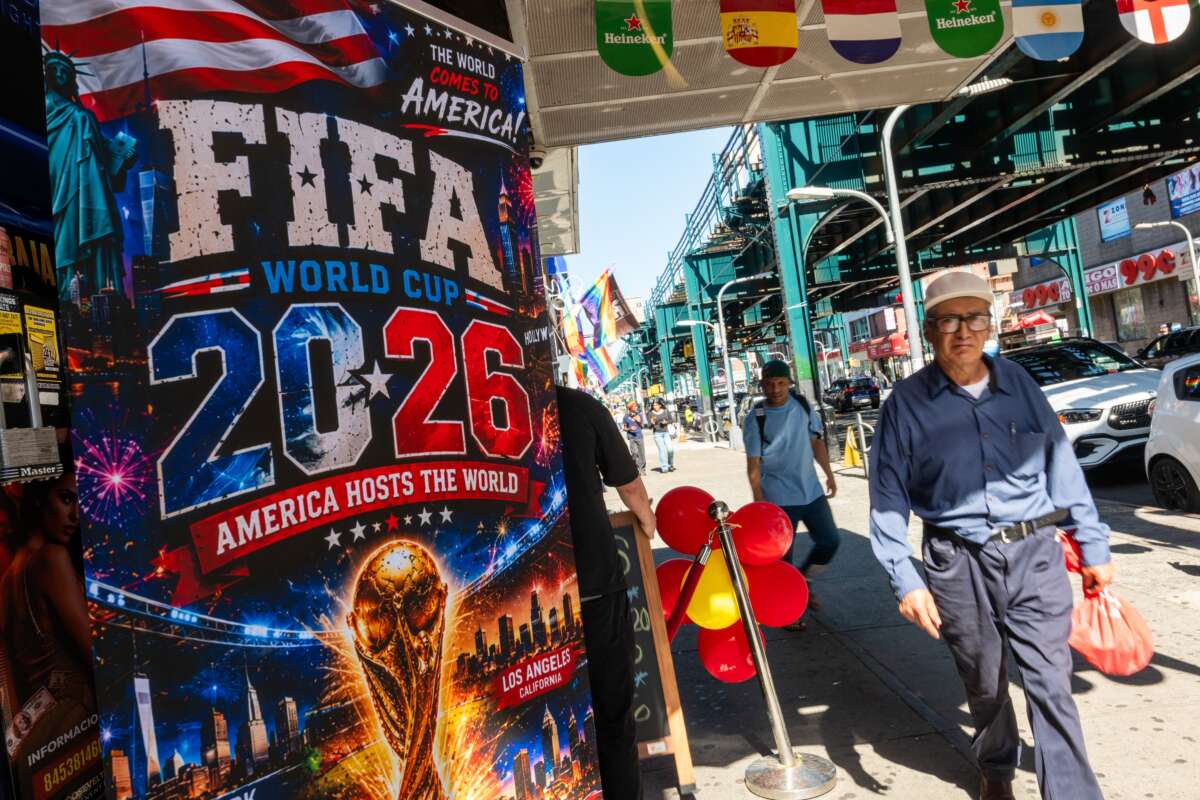
Businesses along Roosevelt Avenue prepare for the World Cup by displaying flags, soccer jerseys, and banners on June 9, 2026, in the Queens borough of New York City.
Spencer Platt / Getty Images

Since Donald Trump’s second inauguration, the number of international travelers visiting the United States has fallen by more than 5 percent. The number of Canadians visiting the country has plummeted by more than 20 percent.

All told, the fall-off in international tourism has translated into a decline of $8.4 billion in tourists’ spending in the U.S.

The World Travel and Tourism Council has estimated that 80 million more people traveled internationally in 2025 as compared to 2024. Yet, with horror stories circulating of tourists being arrested and sent to immigration detention centers for weeks or months, and of travelers having to hand U.S. border agents access to their cell phones and laptops, none of that tourism boom is filtering down to the U.S. And would-be tourists may grow even more leery if Trump succeeds in implementing his proposal to force many of them to disclose the last five years of posts on their social media accounts.

Many Canadians are outraged at Trump’s continued attacks on their country and by his repeated declarations that Canada should be annexed by the U.S. And many Europeans are horrified by the U.S.’s turn toward a nativism that in some ways resembles European fascism from nearly a hundred years ago. Put simply, an awful lot of people the world over are voting with their feet and their wallets; they are simply choosing to go elsewhere and spend their tourism money in countries that don’t make foreigners feel so unwelcome and scared.

For the travel industry, which generally operates on thin margins, the soccer World Cup was supposed to be a tonic. Hoping to boost the event, FIFA, the international soccer governing body, went out of its way to sweeten the deal for Trump; it gave him a golden replica of the World Cup trophy and awarded him a gilded “FIFA peace prize” in place of the Nobel for which he so loudly yearns.

Related Story


Earlier this year, the tourism industry seemed to expect all of this FIFA sycophancy to pay off. In the 16 host cities, spread across Canada, the U.S., and Mexico, hotels raised their prices for World Cup stays by an average of more than 300 percent. Yet according to recent survey data gathered by the American Hotel and Lodging Association, in all of the 11 host cities in the U.S., hotel bookings haven’t taken off, and in several of the cities a majority of hotel owners now describe the tournament as a “non-event.” In consequence, hotels have again begun lowering their prices. The New York Times recently reported that room prices for World Cup dates in the host cities are now down 40 percent from their peak earlier this year.


The stadiums will likely be filled, but fewer will come from overseas and make a full-length vacation of it.

In normal times, an administration with the opportunity to showcase the country it governs during the world’s premier international sporting event would go out of its way to make life easy for visitors before and during the event. But instead of taking this route, the Trump administration is doubling down on its hostility to foreign visitors.

Newly installed Secretary of Homeland Security Markwayne Mullin has been doing the rounds on conservative media for the past few weeks, repeatedly threatening to shut off international travel in and out of airports in cities with sanctuary policies. If the administration follows through, international flights in and out of New York, Los Angeles, San Francisco, Chicago, Boston, Portland, Seattle, and numerous other cities would be banned, making it all but impossible for most international travelers to easily access the U.S.

At the same time, Immigration and Customs Enforcement (ICE) has repeatedly threatened to make its presence felt inside soccer stadiums, sowing deep unease among fans and workers alike. As I wrote in Truthout recently, Unite Here Local 11 workers, who staff the concessions at the SoFi stadium in LA, have voted to walk off the job should ICE start raiding soccer games in the city of Angels.

More generally, citizens of 38 countries are impacted by either full or partial travel bans into the U.S., and citizens from dozens of additional countries are facing freezes on the processing of their visas — which in practice means that unless those residents already have entry visas, they will not be coming into the United States for the World Cup. In other words, people from upward of one-third of the world’s countries (nearly all people of color from Africa, Asia, and parts of Latin America) now face almost insurmountable logistical hurdles when trying to enter the country legally. The ban extends to citizens of Haiti, Iran, Senegal, and the Ivory Coast — all four of which are fielding World Cup teams. Astoundingly, this means that their fans will automatically be excluded from attending the tournament. Last week, a Somali referee, who was supposed to be officiating in the games, was denied entry into the U.S.

Even for those technically allowed in, the cost will be prohibitive. Many tourists now have to pay a $250 “visa integrity fee.” For a family of three or four, that’s the equivalent of adding another international ticket into their shopping cart. And citizens of a slew of countries, many of them World Cup participants, now have to post a “bond” of between $5,000 and $15,000 to ensure that they don’t overstay their visas. While the State Department has promised to waive these fees for players and other team members, as well as for fans who purchased World Cup tickets before April 15 and filled in additional paperwork via the FIFA website, the mere existence of such a bond system will likely scare off many would-be visitors.

But the travel industry’s woes related to the World Cup go even deeper still. For months now a growing chorus of groups and individuals has called for a boycott of Trump’s World Cup. The advocates of the boycott include ex-FIFA head Sepp Blatter, as well as a vice president of the German Football Federation. More than a hundred civil and human rights organizations have also published a letter warning World Cup visitors of the dangers of visiting the U.S. under Trump.

All of this is adding up to a moment of truth for the tourism industry in a Trumpified America. Sure, the stadiums will likely be filled — and many fans will put down tens of thousands of dollars to see their teams play. But they won’t be filled with nearly as many international fans as is the norm for World Cup games. People may come in and out for a day or two from neighboring states, but fewer will come from overseas and make a full-length vacation of it. And in consequence the demand for hotel rooms and the amount of money injected into the tourist economy won’t be nearly as high as organizers thought they would be.