Wednesday, June 17, 2026


Norwegian Budget Includes Money to Construct World’s First Ship Tunnel

Norway Stad Ship Tunnel rendering
Norway has tentative set initial funding to start construction of the world's first ship tunnel (Kystverket)

Published Jun 12, 2026 6:18 PM by The Maritime Executive

In a surprise development, the new Norwegian government budget restored hope for the construction of the world’s first ship tunnel. While it is still not a certainty, it means the tunnel was revived about eight months after the government said it was not proceeding because the costs were too high.

Proponents of the plan to build the more than mile-long tunnel as a route to avoid one of the most exposed areas of the Norwegian coast succeeded in putting approximately $15.8 million into the new government budget. It is a small portion of the estimated construction cost of $900 million, but it means the project could select its main contracts and place some early contracts. Preparatory work would include demolition of buildings at the selected site, as well as the need to award contracts for new water pipelines on both sides of the tunnel.

The idea of building a tunnel at Stad, Norway, has been on the drawing boards for many years. It was proposed as a way for coastal ships to avoid the exposed region, challenging weather, and improve operating efficiency. They would bore a tunnel 50 meters high (164 feet) through the land at a point that is the shortest distance, approximately one mile, through the Stad peninsula. It would have a width of 36 meters (118 feet), meaning it would accommodate coastal vessels, including the passenger ships that run along the coast.

The plan had coalesced in 2024 and begun serious planning. The government initially said it would support a construction cost of approximately 3 billion NOK (just over $315 million). By the time the plans were completed, the Norwegian Coastal Administration, however, was reporting an estimated construction cost of 9.6 billion NOK (just over $1 billion).

Prime Minister Jonas Gahr Støre told Norwegian broadcaster NRK in October 2025 that the tunnel was simply too expensive. Proponents, however, refused to give up, and by early 2026, the Coastal Administration reported it was improving the plan with a goal of reducing costs. Three groups, AF Gruppen, Eiffage Génie Civil, and the Skanska/Vassbakk & Stol consortium, submitted bids, and they were working with the bidders to improve the plans.
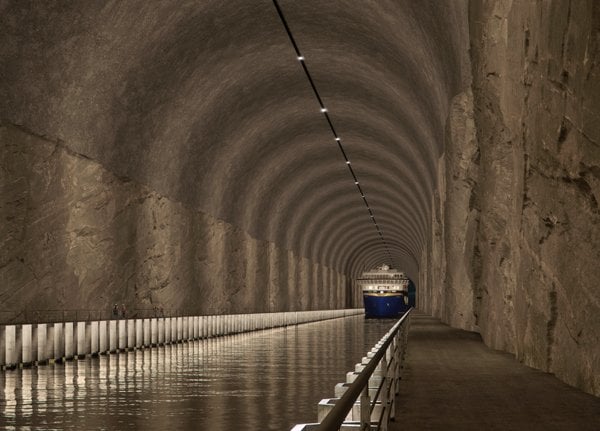
 

The tunnel would run for one mile and permit coastal ships to avoid the dangerous section of the coast (Kystverket)


At the request of the government, the Coastal Administration says it submitted revised plans at the beginning of March. The cost has reportedly been lowered to approximately 8.6 billion NOK (a little over $900 million). Previously, they had said it was estimated that construction would take five years.

It seems with some surprise, proponents were able to work the initial funding into the budget proposal, which was released on June 7. As late as last month, the Prime Minister and the Finance Minister had both said there was no money set aside for the tunnel. The Norwegian Parliament (Stortinget) is scheduled to issue a final approval of the budget by June 19.

The Norwegian Coastal Administration reports that if the funding is maintained, it can announce the final contract after having previously completed its evaluation of the bids from the three groups. It says other contracts are ready to be tendered, including the demolition and the water pipelines.

It aims to start construction in 2027, said project manager Harald Inge Johnsen, provided the government maintains the current funding for the start of construction.  “We are ready as soon as we receive instructions from the Ministry of Trade, Industry and Fisheries," said Eirar Vik Arset, the Director General of the Norwegian Coastal Administration (Kystverket).

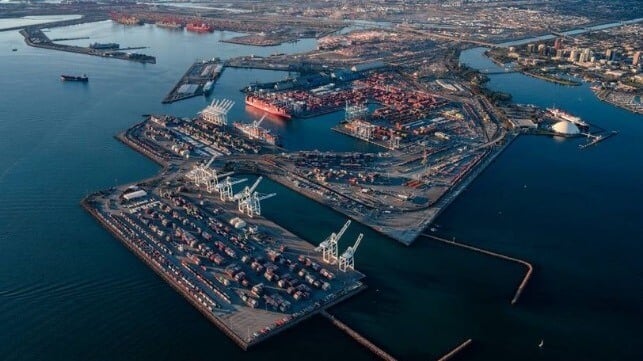
 

SoCal Ports Have Very Strong May with Positive Near-Term Outlooks

SoCal ports
SoCal's dual ports reported very strong May volumes with increases driven by import volumes (Port of Long Beach)

Published Jun 16, 2026 6:35 PM by The Maritime Executive

The twin ports of Southern California reported strong May volumes rebounding from the softness of a year ago when tariffs impacted shipping and a continued slow pace into this year. The ports presented an optimistic near-term outlook, pointing to the strength and resilience of the economy and the prospects of possible relief on inflation and energy prices from the movement toward a peace agreement with Iran.

“Our strong May performance reflects the resilience of the American consumer and the ability of businesses to adapt in a continuously changing environment,” Port of Los Angeles Executive Director Gene Seroka told reporters at a media briefing. “We're seeing cargo move for a combination of reasons, including inventory replenishment, concerns about fuel costs, trade-policy uncertainty, and preparation for upcoming retail seasons. Companies are operating with shorter planning horizons and taking advantage of opportunities when they emerge.”

The Port of Los Angeles processed 840,165 TEUs in May, a 17 percent increase from a year ago when operations were impacted by uncertainty surrounding trade policy and global supply chains after Donald Trump rolled out his reciprocal tariff program on Liberation Day. Seroka pointed out that it was a result only surpassed during the pandemic surge in cargo volumes.

Similarly, the Port of Long Beach recorded its third busiest May. It had a 31.7 percent year-over-year increase, moving 842,030 TEU in May. It actually edged out the Port of Los Angeles to be the busiest U.S. port in May.

The Port of Los Angeles noted that its volume increases were driven by strong imports, which were up 26 percent compared to last year. It was also three percent ahead of the port’s five-year average. However, Los Angeles saw its sixth of the last nine months decline in export volumes. They tumbled 10 percent, with port officials pointing out the difficulties for U.S. exporters and saying something needs to be done to address these challenges.

The Port of Long Beach saw a similarly strong performance in imports, which rose 40 percent. It also had a nearly 33 percent increase in exports.

Both ports are slightly ahead of last year at the end of the first five months of 2026. The Port of Los Angeles reports that indicators show a strong June, with Seroka reporting they are expecting a volume above 900,000 TEU. Similarly, the Port of Long Beach says it is currently on pace with its busiest year on record.

The National Retail Federation, however, has warned that it believes retailers have advanced the busy season for imports and are stocking up early. In its forecast, NRF expected the year to have peaked and said volume will now decline through the remainder of 2026.

GAO: U.S. Navy's Unmanned Systems Programs Needed Restructuring

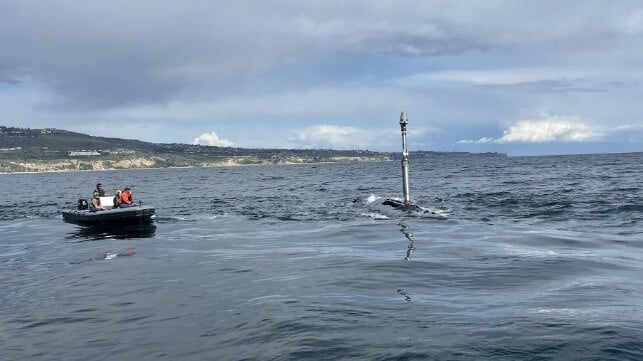
XLUUV
GAO cited the XLUUV sub as a program that has been delayed due to management challenges (USN)

Published Jun 16, 2026 10:21 PM by The Maritime Executive

In a new unclassified version of a study on the U.S. Navy's unmanned systems efforts, the Government Accountability Office (GAO) says that the service needed to reorganize its acquisitions programs in order to give robotic autonomous systems the resources and leadership focus that they deserve, instead of letting them fall through the cracks when manned weapons platforms take priority. The USN has already taken actions in response, and has concurred with the findings. 

The classified version of the GAO's audit report was completed in March 2025, and it focused on organizational issues that have slowed down the service's adoption of unmanned vessels, subs and aircraft. After interviewing 200 defense officials and visiting the Navy's development and testing centers, the GAO made three main findings. 

First, leadership turnover and changing priorities made it hard to focus on specific goals, even on modifying the service's organizational structure for autonomous systems acquisition - a task the Navy had itself identified more than a decade prior. 

Second, autonomous systems programs were all housed within the organizational structures for different domains - surface vessels with surface vessels, aircraft with aircraft, subs with subs. This put them in competition with manned platforms for dollars. Meanwhile, enabling technologies that are required for all kinds of unmanned systems (in all domains) had no specific home and were not adequately resourced. 

Third, the Navy was setting requirements for its unmanned programs early on, locking in the specifics before developing the technology. While normal for big-ship acquisition programs, a rigid approach to requirements created challenges for the Large Unmanned Surface Vessel (LUSV) and Extra Large Unmanned Undersea Vehicle (XLUUV) programs, GAO found, causing delays and blocking the evolution of the systems' capabilities. 

To get at these issues, GAO recommended putting robotic autonomous systems of all kinds - subs, boats, ships, and aircraft - into one portfolio and managing it as a whole, with a focus on developing capabilities rather than specific devices.  A "capability-centric" and iterative approach would align better with commercial best practice, GAO concluded. 

The Navy agreed with GAO's conclusions, and in late 2025 it rolled out the new "Portfolio Acquisition Executive Robotic Autonomous System (PAE RAS)," adopting GAO's phrasing and conceptual structure. PAE RAS absorbed about 200 projects from 25 program offices, all under Rebecca Gassler, former chief engineer of the secretive Project Overmatch effort. The Navy's new "marketplace" framework for the Medium Unmanned Surface Vessel (MUSV) is the most visible early result of PAE RAS's new approach: it brings a distinctly commercial feel, putting the onus on the developer to deliver a functioning product without committing Navy R&D dollars up front.

GAO also advised Congress to sunset a 2021 clause in the defense authorization bill that required the Navy to put an existing program executive office (PEO) from elsewhere in the NAVSEA organizational structure in charge of buying autonomous systems - meaning that one PEO was dual-hatted with the extra job of "acquisition executive agent for autonomy." This person was initially the PEO Unmanned and Small Combatants (PEO USC), the rear admiral responsible for the Constellation-class frigate and the Littoral Combat Ship. In its classified report in March 2025, GAO asked Congress to help the Navy "take actions related to a key stakeholder for acquiring autonomy"; Congress subsequently allowed the Navy to appoint someone of its choice, not an existing PEO, and the position is now held by a longtime autonomous systems engineer, Ryan Fitzgerald. 

The unified organizational approach echoes the brief period in 2015-18 when the Navy had two offices with a comprehensive unmanned-systems function: the Deputy Assistant Secretary of the Navy for Unmanned Systems and the Director of Unmanned Systems, with purview over programs in all domains. Both were disestablished within a few years of launch, but some of the same leaders from that time period are now in charge again at PAE RAS. 


Polaris Evaluates "Unmanned Bridge" for Open-Ocean Navigation

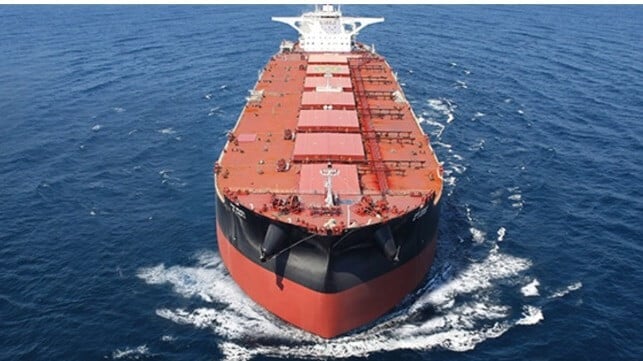
Press handout image courtesy Polaris Shipping

Published Jun 16, 2026 8:06 PM by The Maritime Executive

Most recent AI-navigation ventures have been in the realm of "assisted navigation," with the modest goal of augmenting the bridge team, but some are forging ahead into the realm of truly unmanned operations - at least in benign conditions. Korean tech firm Avikus - along with its parent company HD Hyundai Heavy Industries, Polaris Shipping and ABS - has launched a study on a "conditional unmanned bridge" system for low-risk use in the open ocean. It is an early test of the technology's potential to not only improve safety, but also reduce labor hours.

"The unmanned bridge concept is expected to be the first form of autonomous shipping to enter the market under the IMO MASS Code framework," explained Jaeho Kang, Co-CEO of Avikus, in a statement released Tuesday. A non-mandatory MASS Code was adopted by IMO last month, and will be formalized in mandatory form in 2030; in between, Avikus says, data and experience from real-world testing will help inform the final rule. Avikus' autonomous navigation support system has type approval from DNV, and it is installed as standard equipment on newbuilds from HD Hyundai, giving it an early leg up on achieving commercial scale. 

In the test with Polaris, Avikus will work with ABS and HD Hyundai to design a system and operating framework for fully unmanned operations during open-ocean passages, where traffic is light. The test case is a 325,000 dwt very large ore carrier (VLOC), which navigates long stretches of open ocean for much of its operating lifespan. 

Polaris will pull on its own operational data from the vessel to determine where the boundary should be between unmanned and manned conditions on the bridge, Polaris chief operating officer DoHoon Kim said in a statement, taking into account crew response times. Avikus will pull together the technical requirements; HHI will handle any vessel design modifications required; and ABS will evaluate the concept's safety and its regulatory compliance, including a gap analysis. 

"The technical complexity of the concept lies not in any single system, but in the interactions between autonomous navigation, vessel design and the conditions during unmanned bridge periods," ABS Chief Technology Officer and SVP Patrick Ryan said in a statement. "ABS will apply a structured safety evaluation, drawing on hazard identification, functional safety analysis, and alignment with the IMO MASS Code, to get a clear, evidence-based picture of the unmanned bridge concept."


Study finds positive aging videos affected women’s views of getting older – for the better

Researchers theorize that having a positive aging role model might be enough to change one’s own thinking: 'If they look good with gray hair, I might too'


University of Connecticut


Women who view TikTok videos of others comfortable with their gray hair and laugh lines start to feel more positive about their own aging the more they watch, a new UConn study has found, potentially influencing a woman’s ability to age well later in life.

For almost as long as time, or at least as long as television, film, and print media have been around, women have been held to a different beauty standard than men, penalized if they don’t have smooth skin and perfectly highlighted hair well into old age, says Amanda Cooper, an assistant professor of interpersonal communication at UConn.

“Anti-aging messages, particularly around beauty care, have been prominent for a long time,” she says. “Historically, an older man has been labeled ‘a silver fox,’ but a woman who gets gray hair has been called an ‘old lady.’ There’s been this double standard in aging for a long time, and now it’s amplified for younger women in addition to older women.”

Cooper says she and her co-authors, UConn graduate student Lexi McNamara and Heather Gahler from the University of Wisconsin, were dismayed when they first started to notice on social media that women in their 20s were using anti-aging products and promoting dermatological procedures to erase signs of aging on their young faces.

Plastic surgery used to be something relegated to mostly mid-life, Cooper says, now a growing number of teenagers are looking at minimal creases in disgust.

“I don’t want to blame everything on social media, but my guess is they’re hearing the anti-aging messages that used to be targeted to older women thanks to our constant media intake. I don’t know if we can fully prove that, but I think that’s what the change is. Younger women seem to be more conscious of their aging and more concerned about how to make sure they’re going to age the right way or appear not to age at all.”

Several years ago, Cooper says she read an article about and started exploring the positive aging movement on TikTok, featuring mostly middle-aged and older women posting videos about the good parts of aging.

Hashtags like #GrayHairDontCare bring up videos of radiant women talking about how much they love their gray locks, she says. Other similar searches produce videos about how crow’s feet are merely proof of a life filled with joy and laughter.

The team started to wonder whether watching these videos would have any effect. Their study – “Examining the Effects of Viewing Positive Aging TikTok Videos on Aging Outcomes and Attitudes Among Young, Middle-Aged, and Older Women,” which was published last month in the journal Communication Research – sought to put the question to the test.

Shifting the Dial

Groups of women identified as younger, middle-aged, and older watched videos of women either touting the positives of aging or talking about travel. They then were asked questions soliciting their feelings on aging: What are your concerns about aging? Do you feel negative or positive emotions about it? How confident are you in your ability to age well?

“We found that women who watched those positive aging reels increased their positive emotions about aging. They felt more upbeat about aging and also felt more confident in their ability to age well as compared to the control group that watched travel videos,” Cooper says. “It means that watching these videos of older woman talking positively about aging can at least somewhat shift the dial on how women are feeling about their own ability to age.”

The team theorizes that merely having a positive aging role model might be enough of an influence to change one’s own thinking. Cooper says it might allow a person to feel more comfortable with the idea that if someone else looks good with gray hair, they might too.

While all three age groups of women in the study were affected by the positive aging videos, the middle-aged and older subgroups were more significantly affected, she notes, which might be because aging is more salient in their lives.

“There can be moments of panic around aging, of course, but when women see examples of successful aging or when they hear positive messages it can help them feel more confident,” Cooper says.

“Shifting attitudes about aging is important because women reinforce some of the negative messages about aging and penalize each other,” she continues. “Our society as a whole does this, but we also do it on a micro level. If we can promote communication environments that are positive, we can empower women to feel better about their aging.”

The study also notes the positive aging videos brought about another thought change among those who watched them: Viewers started feeling more positive about older people in general.
Cooper says that was an exciting finding, perhaps with a profound effect of reducing ageism and prejudice against older people.

“We should be creating more content that celebrates the markers of aging and gives permission for women to age, whether that’s talking about gray hair or wisdom gained,” Cooper says. “My call to content creators would be to create more messages that do this. Let’s create more content that features older women and messages about aging as an experience that can be meaningful and triumphant.”

Journal

DOI

Method of Research

Subject of Research

Article Title


Peabody locks out workers at NSW coal washery, Australian union says


Peabody’s North Antelope Rochelle Mine (NARM). (Image courtesy of Peabody Energy)

US coal producer Peabody Energy has locked out workers at its United Wambo Washery in New South Wales for two weeks, Australia’s Mining and Energy Union (MEU) said on Wednesday, escalating a pay dispute.

Workers have been taking protected industrial action since early May after rejecting an offer that included annual wage increases of 2.5% and changes to bonus arrangements, the union said.


Peabody confirmed the lockout in an emailed response to Reuters, saying it applied to employees participating in the industrial action.

“The company’s latest offer will continue to place employees among the highest paid in the region,” a company spokesperson said, adding that it remained committed to reaching a resolution.

MEU Northern Mining and NSW Energy District president Robin Williams said the parties were close to reaching an agreement and that the company was “prolonging the dispute rather than resolving it.”

(By Anjali Singh; Editing by Anil D’Silva and Subhranshu Sahu)


Petra Diamonds cuts put nearly 1,800 jobs at risk, union says


Conveyer at the Cullinan diamond mine, South Africa. (Image courtesy of Petra Diamonds.)

South Africa’s National Union of Mineworkers (NUM) has condemned Petra Diamonds’ (LON: PDL) decision to place its Finsch mine into business rescue and begin a retrenchment process at Cullinan, warning the moves could jeopardize nearly 1,800 jobs and destabilize mining communities across the country.

The union says the business rescue process at Finsch, announced in May,  has left about 689 workers facing uncertainty, while a Section 189A notice at Cullinan threatens roughly 1,090 positions. Together, the developments place thousands of livelihoods at risk at two of South Africa’s best-known diamond operations, NUM said.

Petra’s decision to curtail operations at both mines comes amid a prolonged downturn in the natural diamond market, marked by weak prices for smaller stones and geopolitical tensions in the Middle East.


Last week, business rescue practitioners Daniel Theodorus van Jaarsveld and Luke Bernard Saffy formally assumed control of Finsch and began preparing a restructuring plan that creditors will eventually vote on.


“Workers are not a liability on a balance sheet; they are the creators of value and wealth in the mining industry,” NUM Petra Diamonds chief negotiator Masibulele Naki said in a statement. “Without workers, there is no production, and there is no profit.”

Blame debate

Petra said in a June 10 shareholder update that Finsch had begun suspending production while business rescue practitioners prepare a restructuring plan and negotiate a path forward with creditors.

NUM argues mining companies too often turn to retrenchments and business rescue before exhausting alternatives. Naki rejected the industry’s focus on labour costs, saying executive pay, management decisions, market conditions and operational inefficiencies also contribute to financial challenges.

The union acknowledged weaker diamond demand, falling rough diamond prices and competition from laboratory-grown stones, but said workers should not bear the burden of problems they did not create. NUM said it will participate fully in consultations at both mines and push for close regulatory oversight.

Market outlook

The labour dispute comes days after De Beers reported renewed interest in natural diamonds among younger consumers in the US, a trend that could eventually support producers across Africa after several difficult years for the industry.

Independent diamond analyst Paul Zimnisky said his research paints a more cautious picture. Natural diamond demand has contracted sharply during the past four years amid what he described as a “perfect storm” of industry and economic pressures, although higher gold prices, tariffs and labour costs helped support jewellery sales values last year.

Zimnisky noted he is seeing early signs of price support in the rough diamond market that could signal a recovery for mined diamonds. He estimates global natural diamond production will fall to about 90 million carats this year, the lowest level since 1987 and down sharply from more than 150 million carats only a few years ago.

The supply contraction could eventually help rebalance the market, but any recovery may come too late for workers facing uncertainty at Petra’s South African operations.


Australian LNG Strike Threatens Global Gas Supply as Qatar Recovery Lags

The ongoing strike action at Australian LNG facilities of Inpex is expected to disrupt operations significantly, a senior official at the Japanese energy firm told Bloomberg on Tuesday.

Workers at Inpex’s Ichthys LNG facilities last week voted to escalate the strike action at all three sites to work stoppages of up to 8 hours per day, up from 4 hours previously.  

“We anticipate imminent disruption to production at both onshore and offshore Ichthys LNG facilities,” Bill Townsend, senior vice president corporate at Inpex, said in emailed comments to Bloomberg.

“In the context of current global fuel supply constraints, the disruption is expected to be significant,” the official added.

The industrial action that started on June 3 has already disrupted some LNG loadings at the Ichthys LNG project in recent days, raising market concerns that supply from Australia, currently the world's second-largest LNG supplier with most Qatari output shut-in, could drop in the coming days and weeks.

Earlier this week, the Australian Fair Work Commission denied Inpex a request to stop the strike at the Ichthys facility that would affect production and exports at the 9.2-million-ton facility.

The disruption to global LNG supply from Australia could add to the price pain for energy importers in Asia, the world's largest LNG market.

Benchmark gas prices in Europe and Asia slumped early this week following the announcement of a U.S.-Iran agreement, but flows from Qatar are yet to resume, pending a safe reopening of the Strait of Hormuz.

Such reopening could begin as soon as Friday, when the U.S. and Iran are expected to sign the agreement in Switzerland. But LNG supply from the Middle East would begin flowing weeks later, if the deal holds and the Strait of Hormuz opens to safe navigation.

State firm QatarEnergy, which halted LNG output in early March, has told its customers that it could restore about 50% of its production capacity within a month after safe navigation through the Strait of Hormuz is restored, sources with knowledge of the plans told Bloomberg on Tuesday. Within two months, Qatar could return 80% of its capacity, according to Bloomberg’s sources. 

By Charles Kennedy for Oilprice.com


Australian Regulator Clears LNG Strike

The Australian Fair Work Commission has denied Inpex a request to stop a strike at the Ichthys facility that would affect production and exports at the 9.2-million-ton facility.

According to a Reuters report, the operator of Ichthys had applied to the labor regulator for a suspension of the industrial action amid persistent failure to reach an agreement with trade unions. The WTC, however, sided with the strikers, rejecting the Japanese company’s argument that suspension of normal operations at the LNG platform would affect the Australian economy adversely.

“I do not regard this to be a significant disruption. At least some of the previous production will not be lost as soon as the loading ban is lifted,” the deputy president of the Fair Work Commission, Michael Easton, said, as quoted by the publication.

Workers at Ichthys last week voted to escalate the strike action at all three sites to work stoppages of up to 8 hours per day, up from 4 hours at the beginning of the industrial action. The escalation began on June 11 in a development that could further tighten global gas markets, already tight because of the LNG export disruption in the Persian Gulf.

LNG prices in Asia are 75% higher than they were before the war between the United States and Israel against Iran began at the end of February. Now that the two appear set to make peace, hopes for a quick rebound in gas flows out of the Gulf have been rekindled—but it may be premature.

Qatar's state firm QatarEnergy expects the damage to the Ras Laffan LNG complex, the world's single largest LNG-producing facility, to cost it about $20 billion per year in lost revenue and to take up to five years to repair. This means a full resumption of Qatari LNG flows is highly unlikely, making supply from elsewhere, including Australia, more important for global markets.

By Irina Slav for Oilprice.com


Kootenay Silver halts work at Mexico project after miner goes missing in accident


Columba silver project. Credit: Kootenay Silver

Kootenay Silver said on Friday a contract miner was involved in an accident at its Columba silver project in Mexico and has not yet been located by the rescue team.

The company has temporarily stopped all exploration activities at the project while the investigation is ongoing.


Accident occurred on Thursday in the F Vein shaft at the Columba project.

Kootenay did not provide further details on the nature of the accident.

The company said authorities had been notified and an investigation into the incident was under way.

“Safety is always of paramount importance, and we must do everything we can to prevent accidents of any severity now and in the future,” the Canada-listed silver explorer said.

(By Sumit Saha; Editing by Leroy Leo)


Eduardo Bolsonaro conviction deepens crisis for brother's bid to lead Brazil

Eduardo Bolsonaro conviction deepens crisis for brother's bid to lead Brazil
Eduardo Bolsonaro has lived in the US since last year and, as a result, lost his seat in the House of Representatives for failing to attend congressional sessions. / lula marques/agencia brasilFacebook
By bnl Sao Paulo bureau June 17, 2026

Brazil's Supreme Court convicted former congressman Eduardo Bolsonaro, son of former far-right president Jair Bolsonaro, for attempting to influence his father's coup-plot case through contacts with the administration of US President Donald Trump.

Jair Bolsonaro, a close political ally of Trump, is serving a 27-year sentence under house arrest over a plot to overturn his 2022 election defeat to President Luiz Inácio Lula da Silva, and is barred from running for office until 2060.

A four-justice panel unanimously backed the ruling on June 16, sentencing Eduardo Bolsonaro to four years and two months in prison. The decision also bars him from seeking elected office for 12 years and imposes a fine of BRL162,000 ($31,800). The sentence is expected to be served under a semi-open regime, and he could face arrest if he returns to Brazil from the United States, where he has lived since 2025.

Prosecutors argued that Eduardo Bolsonaro sought support from US authorities to pressure Brazil's judiciary, including through sanctions against Supreme Court justices and trade measures targeting Brazilian exports. Justice Alexandre de Moraes, who authored the opinion, concluded that the evidence supported the charge of coercion during legal proceedings. "It is not the role of a Brazilian federal deputy to lobby abroad against their own country," Moraes said, adding that parliamentary immunity would not have shielded Eduardo Bolsonaro's conduct even had he remained in office rather than on leave.

Eduardo Bolsonaro said he had not been properly informed of the proceedings and argued the case was designed to block his political return. His brother Flávio Bolsonaro, the right wing's presidential hopeful, went further, calling on Moraes to recuse himself "since in theory he is the victim" and describing the ruling on social media as resembling "revenge, a personal matter," adding: "We are not living in a full democracy."

The panel also ruled that Brazil's Clean Record Law applies to the case. Because the conviction was handed down by a collegiate court and relates to a crime against the administration of justice, the justices said, Eduardo Bolsonaro becomes ineligible for public office from the date of the ruling until eight years after he has fully served his sentence — a period that could stretch to as much as 12 years and two months, depending on when the sentence is deemed complete.

Political fallout

The ruling lands as the Bolsonaro family's electoral prospects show signs of strain on multiple fronts. A CNT/MDA poll published the same day, cited by Reuters, found leftist incumbent President Lula da Silva would beat Flávio Bolsonaro 49.3% to 36.8% in a hypothetical October runoff, a wider margin than the 44.9-40.2 split recorded in April.

Eduardo's conviction compounds a separate controversy that has already dented his brother's standing. Flávio Bolsonaro was reported by Intercept Brasil to have solicited financing from Daniel Vorcaro, the banker at the centre of the collapse of Banco Master, for a film about their father's life. The messages, extracted from a phone seized during a Federal Police probe into the failed lender, pointed to negotiations over a $24mn contribution, with $10.6mn paid out in six transfers between February and May 2025. Flávio initially denied the reports before acknowledging that Vorcaro had agreed to fund the production, insisting the arrangement involved no public money and no favours in return. The disclosures rattled markets in May, with the real and the Bovespa both falling sharply on the day the story broke, and have weighed on the senator's polling since.

Seeking to move past the scandal, Flávio Bolsonaro travelled to Washington in late May for a closed-door Oval Office meeting with Trump, accompanied by Eduardo. The senator said afterwards that Trump had asked about their father's health and that the two had discussed organised crime, tariffs and critical minerals. But the visit, which Flávio publicised widely on social media, did little to halt the slide in his polling numbers.

Estadão columnist Roseann Kennedy argued that Eduardo's conviction has handed Lula a ready-made campaign narrative on national sovereignty, noting that the verdict came just as the president was attending the G7 summit in France promoting the same theme. She wrote that the case also exposes Flávio, long backed publicly by his brother, to renewed scrutiny over his association with threatened US tariffs on Brazilian goods, on top of the Banco Master affair, a combination she said risks alienating the independent voters likely to decide the race.

Allies within the Bolsonaro camp have reportedly begun weighing contingency plans, including a possible bid by Senator Rogério Marinho as an alternative candidate should Flávio's pre-candidacy weaken further, according to Kennedy.