Wednesday, June 17, 2026


Egypt Clears $6 Billion in Energy Debt and Opens Door to a New Gas Boom

  • Egypt has cleared nearly $6.1 billion in arrears owed to international oil companies, paving the way for a new wave of investment from Western energy majors, including Shell, Chevron, Eni, and BP.

  • The country is emerging as a strategic battleground between the U.S. and its allies on one side and China and Russia on the other.

  • Beyond hydrocarbons, Egypt's importance stems from its control of the Suez Canal and SUMED pipeline

The announcement from Egypt’s petroleum and mineral resources minister Karim Badawi that the country has paid all its outstanding debts to foreign oil firms is as welcome to international oil companies and their governments as it is to the country itself. Egypt has become one of the West’s prime targets in the hunt for replacement gas supplies after the loss of Russian flows following the 24 February 2022 invasion of Ukraine. Officially, it holds around 93 trillion cubic feet (Tcf) of proven natural gas reserves, but unofficially, it is believed to hold three or four times that at least. In fact, the U.S. Geological Survey estimates that the Nile Delta Basin Province alone holds up to 286 Tcf of undiscovered, technically recoverable natural gas. Its strategic weight is amplified by its sitting astride so many critical hydrocarbon transit routes, and by its longstanding political influence across the Arab world. So, the payment of the near-US$6.1 billion owed to international firms clears the way for the planned expansion of Western gas and oil developments across the country. However, as with all such global energy reservoirs, China and Russia are looking to do precisely the same thing and overtake the significant on-the-ground advantage established by the West.

Looking ahead, Egypt has implemented a strict, multi-layered economic defence mechanism specifically designed to prevent another vicious cycle of foreign currency depletion and runaway debt. It was the enormous wave of development of primarily Egypt’s gas reserves that previously helped exacerbate the serious currency problem in the country that began in earnest after Russia invaded Ukraine. Not only did this dramatically increase prices for wheat in the country (one of the world’s biggest importers of the foodstuff) but it also led to the removal of billions of dollars’ worth of foreign investment from the country. That said, on 6 March 2024, Egypt was allowed by the IMF to expand its US$8 billion financial support package and further offers of financial aid were opened from the World Bank and the European Union. The key measure in this debt-defence package that will work to the advantage of foreign firms operating in Egypt is that it is drastically reducing the level of state ownership in energy projects to further limit the country’s sovereign liability if projects face delays. Another key measure likely to significantly reduce the chance of a new debt spiral precluding regular payments to international oil companies is the abandonment by the Central Bank of Egypt of the artificial pegging of the Egyptian pound.

Given the very recent settlement of its energy sector debt, Egypt is likely to see a major expansion in the activity of Western firms in the very near future. British supermajor Shell is targeting Q4 this year for first gas at the Mina West field in the deepwater Northeast El Amriya concession in the Mediterranean Sea. Initial flow tests are clocking in at 45 million standard cubic feet of gas per day (mmcf/d) alongside 1,000 barrels per day (bpd) of high-value condensates, while Phase 1 of the project is engineered to inject a total of 160 mmcf/d of gas and 3,000 bpd of condensates directly into Egypt’s domestic grid. Shell is also set to further explore the Sirius exploratory well and the potentially ultra-high-reward Velox well in the North Cleopatra block within the Herodotus Basin. At the same time U.S. supermajor Chevron has launched new drilling at the giant Nargis field, with a very conservatively estimated 3.5 Tcf of natural gas reserves. The firm has also secured a 27% participating interest in the ultra-deepwater North Cleopatra offshore block that places it directly alongside operator Shell (36%), QatarEnergy (27%), and Tharwa Petroleum (10%) in a massive collaborative exploration front along some of Egypt’s primary gas assets. Moreover, Italian giant Eni has committed to an US$8 billion investment plan, including fast-track development at the newly unveiled Denise exploration well (which holds around 2 Tcf of gas) in the East Mediterranean. Meanwhile, Great Britain’s BP has pledged a US$5 billion exploration framework to fund new wells in the Mediterranean and Nile Delta, building on its historic US$12 billion investments in the West Nile Delta project.

That said, China has now shifted from its previous focus in Egypt on logistics and manufacturing in the Suez Canal Economic Zone (SCZONE), to its upstream sector.  State-owned supermajor China National Offshore Oil Corporation announced its first investment in Egypt’s gas and oil sector last October, targeting deepwater blocks in both the Mediterranean and the Red Sea to secure an entry point into North African upstream markets. Its United Energy Group had earlier signed a memorandum of understanding to explore immediate joint investment opportunities in oil and gas production, renewable energy, and regional energy trading. Underscoring these developments as part of a broader supply chain integration, Chinese firms also launched a US$2.4 billion logistics and container terminal investment at Ain Sokhna Port. This is intended to streamline commodity and energy flows out of the SCZONE. Meanwhile, Russia views Egypt as a critical geostrategic partner to redirect its trade and establish a permanent energy gateway into Africa and the Middle East, given tightening Western sanctions on it. To this effect, state-controlled Zarubezhneft has committed to a US$14 million drilling agreement targeting the onshore North Khatatba block in the Nile Delta, while Rosneft maintains a 30% stake in the giant offshore Zohr gas field. On a broader note, Russian President Vladimir Putin has proposed a framework to transform Egypt into a centralised Russian grain and energy hub, looking to blend fuel and agricultural distributions to sidestep European shipping sanctions. The leader’s longer-term ambitions were reflected in the US$25 billion financing package agreed in 2017 to construct the Al-Dabaa nuclear power plant in Egypt. The construction phase as stalled at around 33% complete, but the first reactor is still supposedly on track to connect to the power grid in 2028, with all four units fully operational by 2030. Given how the U.S. and its allies have regarded Iran’s nuclear industry over the years, it appears unlikely that these deadlines will be met.

The degree to which both Western and Eastern powers want to expand their footprints in Egypt reflects more than just the country’s gas and oil reserves. For a start, it is also the only country in the Eastern Mediterranean gas hotspot region with operational liquefied natural gas (LNG) export capacity and is consequently ideally placed to become the top regional export hub for the gas. Equally important is Egypt’s command of one of the world’s great maritime bottlenecks -- the Suez Canal -- a route that historically has carried roughly a tenth of global oil and LNG shipments. The country also controls the Suez–Mediterranean Pipeline, linking the Ain Sokhna terminal on the Gulf of Suez to the export hub at Sidi Kerir on the Mediterranean coast. This line provides a critical workaround for moving Gulf crude to the Mediterranean without relying on the canal itself. The strategic value of the Suez system is heightened further by the fact that it is among the few major energy transit points not under China’s direct influence. Specifically, Beijing already has considerable control over the Strait of Hormuz through the all-encompassing ‘Iran-China 25-Year Comprehensive Cooperation Agreement’, as fully analysed in my latest book on the new global oil market order. The same deal also gives China a hold over the Bab al-Mandab Strait, through which commodities are shipped upwards through the Red Sea towards the Suez Canal before moving into the Mediterranean and then westwards. This was achieved as it lies between Yemen (the Houthis having long been supported by Iran) and Djibouti (over which China has also established a stranglehold through debts connected to its multi-generational Belt and Road Initiative’ power-grab project).

Finally, Egypt has long been viewed as a political heavyweight in the Arab world — in many respects rivalling, and at times surpassing, Saudi Arabia’s influence. Cairo was a central force behind the rise of Pan?Arabism after the two World Wars, the movement that argued that Arab strength lay in shared political, cultural, and economic identity, with its most prominent advocate being Egypt’s own Gamal Abdel Nasser, who led the country from 1954 to 1970. The era produced several defining expressions of this ideology: the union between Egypt and Syria as the United Arab Republic from 1958 to 1961; the creation of OPEC in 1960; repeated confrontations with Israel; and ultimately the 1973–74 oil embargo — all explored in detail in my latest book. For both the West and the East, Egypt is still ultimately about far more than gas and oil. It is a contest for the only state in the region that combines major reserves, LNG export capacity, control of critical sea lanes, and a legacy of political leadership across the Arab world.

By Simon Watkins for Oilprice.com


India’s Solar Capacity Set for 22% Annual Growth Through 2035

India’s solar capacity is set to surge by 22% each year by 2035 as the data center boom will drive increased power consumption, a new report by Nuvama showed on Monday.   

The consultancy estimates that India’s total power demand will rise by 6% every year over the next decade, “driven by economic growth, rising urbanisation, manufacturing expansion and increasing electrification across sectors,” according to the report cited by Indian news outlet ANI.

Solar growth will vastly outpace overall power demand as power-intensive data centers will drive 22% compound annual growth rate (CAGR) in solar energy capacity from 2026 to 2035, the report found.

“Our base case suggests green hydrogen and data centre capacity shall add another 251GW solar capacity, while it is 406GW capacity in the bull case scenario,” Nuvama analysts said in the report.

“Given solar capacity expansion in our base case, the share of solar shall rise from 28% in FY26 to 61% by FY35 and to 65% in the bull case,” they added.

India expects to nearly quadruple its solar power capacity and triple wind power-generating assets within ten years, according to the new Generation Adequacy Plan published by the country’s Central Electricity Authority earlier this year.

India projects to have a total of 509 gigawatts (GW) of solar power capacity installed by the end of the 2035-2036 fiscal year, up from 140 GW installed solar PV capacity as of January 2026.   

“The installed generation capacity projection in 2035-36 shows that the country is moving toward a strong transition to non-fossil energy. Renewable sources, especially solar PV, hydro, and wind, will dominate future capacity, supported by Energy Storage Systems,” according to the policy.

In 2025, India boasted that it was five years ahead of schedule when it achieved its target of having 50% of its installed electricity capacity coming from non-fossil fuel sources.

However, India's electricity grid is expanding at a slower pace than the boom in renewable energy installations, leading to an increased share of clean energy curtailments and threatening to slow the solar and wind boom in the world’s most populous country.   

By Tsvetana Paraskova for Oilprice.com

China Reclaims Solar Crown With Record-Breaking Perovskite Panel

  • China's Trina Solar has set a new world record for commercial-scale solar efficiency, achieving 29.2% conversion efficiency and 907 watts of output using advanced perovskite-silicon tandem technology.

  • The breakthrough surpasses South Korea's Qcells and highlights growing progress in combining perovskite and silicon layers to capture more sunlight and generate significantly more power from the same panel area.

  • While perovskite technology promises lower costs and efficiencies above conventional silicon panels, the industry's next challenge is proving long-term durability and scaling production

Last year, South Korea’s Qcells set the world record for large-area silicon solar cell efficiency, a development that promised to dramatically shrink the size of solar projects and slash costs. Qcells, a subsidiary of South Korea’s giant conglomerate Hanwha Corp, set the world record after achieving 28.6% efficiency by combining a top light-absorbing layer of perovskite with a bottom silicon layer to capture a broader spectrum of sunlight. For some context, high-end commercial solar panels typically operate at 21% to 23% efficiency, meaning they convert about a fifth of the sunlight striking them into usable electricity. More importantly, unlike many high-efficiency records achieved only on lab-scale cells, Qcells’ efficiency was demonstrated on an industry-standard cell designed for mass manufacturing.

But China has now managed to wrestle back the title of the world’s most efficient solar panel maker: leading Chinese solar firm Trina Solar has officially shattered the world record for solar module efficiency, achieving a conversion efficiency of 29.2% and an unprecedented peak power output of 907 watts.

Trina’s solar cell isn’t just any solar cell. Its record was achieved using a perovskite-on-silicon tandem design, which stacks two different solar materials on top of each other to capture a broader range of sunlight. The perovskite layer absorbs higher-energy wavelengths while the silicon layer captures light that would otherwise pass through, allowing the cell to convert more of the sun’s energy into electricity. The company also developed a new interconnection structure between the two layers that reduces energy losses and improves the flow of electrical current through the cell, helping push efficiency to record levels.

Like Qcells’ earlier record, Trina achieved the breakthrough on industry-standard 210 mm wafers rather than small laboratory cells. The company reported efficiencies of 29.2% on full-size cells and 32.6% on half-cut cells, demonstrating that the technology can be manufactured at commercial dimensions. The resulting module produced 907 watts of power, up sharply from the company’s previous record of 808 watts and well above the output of conventional solar panels currently deployed in the field.

The result pushes perovskite technology further into commercial territory. Researchers have been posting impressive efficiency figures for years; the challenge has been reproducing them on modules large enough to manufacture at scale.

From Microscopic to Groundbreaking-Size

While individual lab cells have reached higher standalone efficiencies on a microscopic level, we are now talking about commercial scale applications. 

Conventional silicon panels are nearing the limits of what the technology can deliver. Perovskite-silicon tandem cells offer a way around that by capturing a broader range of sunlight and generating more electricity from the same panel area.

Now, the race is to manufacture them at scale and keep them operating reliably for decades in the field.

Perovskites are a class of materials that share a specific, diamond-like crystal structure. Perovskite solar cells can convert a wider spectrum of sunlight into electricity compared to traditional silicon. 

Indeed, perovskites can be layered directly on top of traditional silicon solar cells, with these "tandem" cells absorbing the colors of light that silicon misses and pushing theoretical maximum efficiencies to over 40%. They can be applied in extremely thin layers, allowing them to be sprayed or printed onto flexible films, windows or curved building surfaces. 

Further, unlike silicon, which requires high-temperature, energy-intensive manufacturing, perovskites can be processed into inks and printed at room temperature, dramatically lowering production costs. Whereas commercially available perovskite solar cells exist, they are currently not yet widely available for standard residential rooftop installations, in large part because pure perovskite cells degrade rapidly when exposed to outdoor elements like moisture, heat, and UV light.

However, several pioneering companies have started manufacturing and shipping them at scale. This includes California-based Caelux, whose "Active Glass" technology allows factories to build Hybrid-Tandem modules right on their existing assembly lines without redesigned silicon cells or complex overhauls, while UK-based Oxford PV has started shipping modules that boast efficiencies up to 24.5% to utility-scale customers in the U.S. and Europe.

By Alex Kimani for Oilprice.com


ETM seeks other Spanish mines as it waits for Greenland rare earth resolution


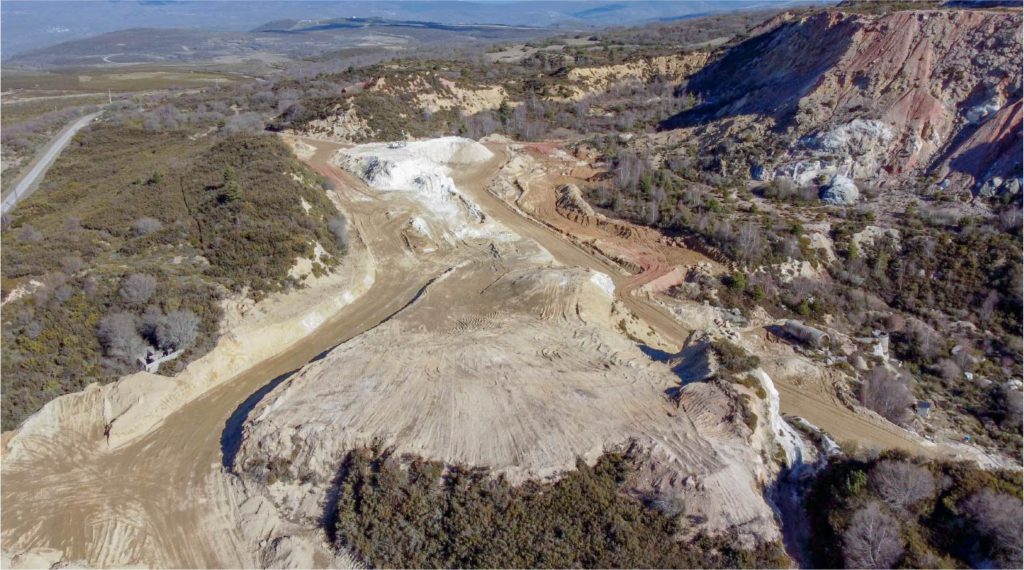
Penouta mine in Spain. Credit: Strategic Minerals Europe

Energy Transition Minerals is hoping to expand further in Spain’s Galicia province as it awaits a resolution of legal challenges over its huge rare earths project in Greenland, its managing director said.

Daniel Mamadou told Reuters in an interview that the company expects to restart mining in 18-24 months at the Penouta tin and tantalum project it bought last year in Galicia, where operations were suspended in 2024 after a dispute over environmental permits.


“Galicia itself has a very ambitious plan to restart its mining industry,” Mamadou said, adding that up to 52 old mines are due to be tendered for development.

“We believe that the Penouta operation could be the centre of an expansion in Galicia … we might be able to benefit from economies of scale and position.”

ETM has detailed neither expected production levels nor capex at the Penouta project, but the International Tin Association said the mine produced 351 metric tons of tin in concentrate in 2023.

Seeking dialogue with Greenland

ETM owns the Kvanefjeld project in Greenland, one of the world’s largest undeveloped rare earth deposits, but has been halted from developing it since a 2021 government ban on uranium, a byproduct.

The company expects a court appearance later this year in its long-running legal dispute with the government over the project.

“We’ve also tried to push a parallel track of dialogue, which so far has not been yielding any meaningful traction, but I think this is about to change,” Mamadou said.

Greenland has been advertising itself as a mining destination open for business, he added.

The firm also said last week exploration has identified new mineralized zones that contain uranium concentrations below the threshold in the government’s uranium ban.

ETM is also in dispute with China’s Shenghe Resources, its second biggest shareholder with a 6% stake, after ETM in April terminated a 2018 deal that envisioned the two jointly developing Kvanefjeld.


Asked if ETM had severed its relationship with Shenghe to attract investment from US and other Western investors as it seeks a Nasdaq listing, Mamadou declined to comment on the dispute.


(By Eric Onstad; Editing by Jan Harvey)

AU

Singapore to launch gold clearing with JPMorgan, other banks


Singapore skyline at the Marina. Stock image.

Singapore plans to launch a gold-clearing system this year, with banks including JPMorgan Chase & Co. and Deutsche Bank AG set to participate in the city-state’s push to become a hub in the global bullion market.

The Singapore Exchange will establish the over-the-counter clearing mechanism by the end of 2026, with inter-bank trading expected to build up from next year, said Gan Kim Yong, the country’s deputy prime minister and chairman of the Monetary Authority of Singapore.

“We are not seeking to replace established centers of gold trading and liquidity,” he said at the Asia-Pacific Precious Metal Conference on Monday. “Instead, Singapore can serve as a trusted node in the global gold ecosystem – connecting regional demand with global liquidity and supporting market activity during Asian hours.”

Singapore’s latest move intensifies competition with Hong Kong to become a major regional hub for trading gold. In recent months, both cities have advanced plans to capitalize on strong demand for the precious metal, with many banks remaining bullish about the long-term prospects for an asset coveted by investors as an alternative store of wealth.

Hong Kong’s central clearing system is expected to be ready by July and the special administrative region has signed up five Chinese and six international banks.

The new clearing system in Singapore will serve as “a foundational layer for the clearing and settlement of gold flows during Asian trading hours,” said SGX Group chief executive officer Loh Boon Chye. “We are also exploring a physically deliverable gold futures contract to give the market an exchange-based tool for price discovery and risk management.”

In Singapore, DBS Group Holdings Ltd., Oversea-Chinese Banking Corp., United Overseas Bank Ltd. and ICBC Standard Bank Plc, as well as JPMorgan and Deutsche Bank, will take part as clearing members after signing a memorandum of understanding with the Singapore Exchange at the conference on Monday.

“As investor demand for global gold grows, we see Singapore playing a complementary role alongside other major hubs by supporting liquidity across time zones and meeting evolving client needs,” said Wai Mei Hong, JPMorgan’s Singapore senior country officer.

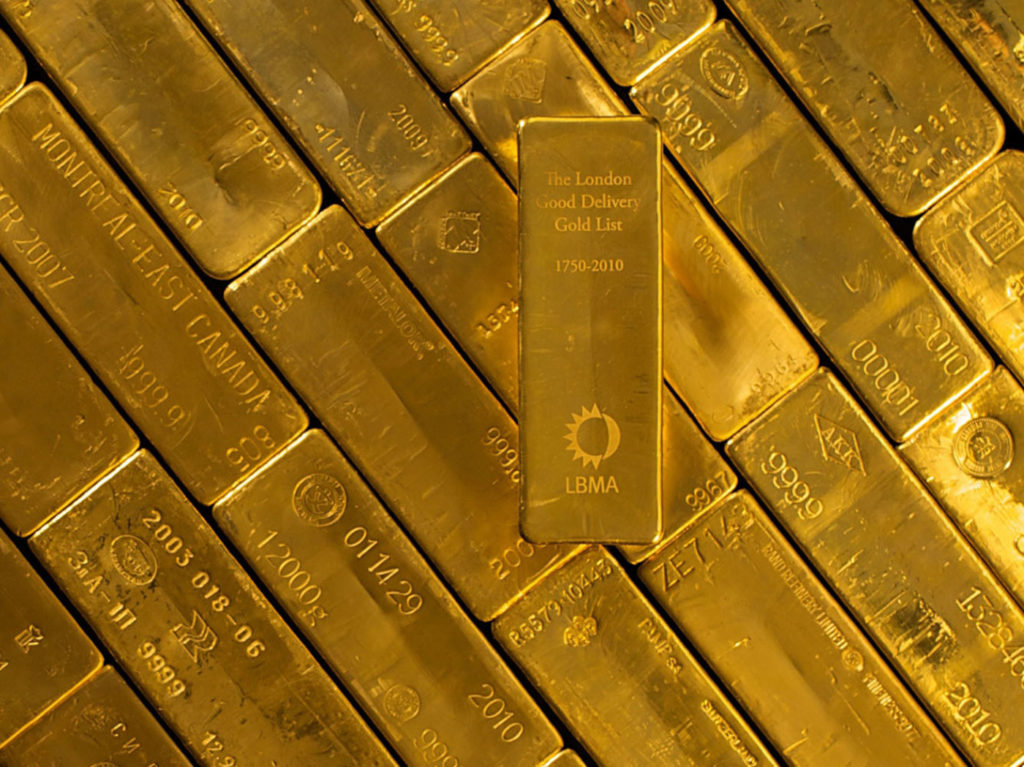
The clearing system will be aligned with the industry-standard London Good Delivery framework for large bars, as well as delivery and settlement standards for kilobars adopted by major exchanges in Chicago and Shanghai.

“The gold market works best when liquidity and infrastructure are connected across regions,” Deputy Prime Minister Gan said. “With an established clearing infrastructure and strong market ecosystem, Singapore can support a more seamless global market across time zones – from Asia, to Europe, to the Americas.”

MAS will also introduce central bank gold vaulting services by October this year, he said, and will allow foreign monetary authorities to actively manage bullion holdings with a select group of banks based in the city-state. Attracting sovereign reserves would significantly boost liquidity in the local market and strengthen Singapore’s standing as a global trading center.

The central bank is also set to expand tax exemptions for eligible funds and family offices investing into physical investment precious metals, Gan said, referring to a specific technical term on the purity and form of gold.

As the government pushes to strengthen Singapore’s gold sector, some local banks are also rolling out products to meet growing demand. DBS, the city-state’s biggest lender, will allow customers to hold tokenized gold in the second half of the year. Meanwhile, institutional and high-net-worth clients of OCBC can now trade and store gold with the bank.

(By Yihui Xie)

London gold market weighs earlier auction to suit Asian traders


Credit: LBMA

The London Bullion Market Association is considering moving its morning gold auction to an earlier time to accommodate traders in Asia.

The potential shift would be “to reflect and to allow price discovery within the Asian time frame,” LBMA chief executive officer Ruth Crowell said on Monday. This is “something that I know the market has asked for for many years, but I think it comes at the right time,” she told the Asia-Pacific Precious Metal Conference in Singapore.

Crowell did not specify a new time or times under consideration, or say when the possible change might occur.


The LBMA Gold Price is currently set twice daily, at 10:30 a.m. and 3:00 p.m. London time, in US dollars on an electronic platform. The price is the benchmark used by miners, refiners, investors and central banks worldwide.

A daily London pricing auction was first introduced in 1919, with a second, afternoon auction added in 1968 to reflect growth in the US market. The current benchmarks replaced the old London Gold Fix, a telephone-based system that was discontinued in 2015.

The potential shift to an earlier London auction underscores the growing weight of Asian demand in the global bullion market. Gold has been thrust into the spotlight as geopolitical tensions and trade uncertainties drive central banks and investors toward the metal as a safe haven, with the spot price soaring to a record earlier high this year before retreating after the outbreak of the US-Iran war.

(By Yihui Xie and Preeti Soni)


Gold fever sends some vintage luxury watches to the melting furnace


Stock image.

Omega’s Constellation watch has been flashed in campaigns, movies and at the Met Gala by stars like George Clooney and Nicole Kidman, turning it into a symbol of luxury and glamour.

But with gold prices near record highs struck in January, some such classic watches are being melted down as the value of their metal content outstrips their resale worth.


Used models by the likes of Omega and LVMH’s TAG Heuer are most hit by the trend, according to Reuters interviews with over a dozen traders, industry experts, and investment advisers.

British dealer Jon White of Gold Traders melted down an 18-carat late-1970s Constellation in excellent condition in May, one of dozens of mainstream luxury watches he has had scrapped this year as demand for investment gold has risen.

“Beautiful watch. But in reality, had the customer consigned that to auction, what would they have achieved?” White, who also manages an auction house, told Reuters.

The gold content of the Constellation watch, one of many models produced by Swatch-owned Omega, was worth £5,750 ($7,749), 35% more than its estimated £4,000-4,500 auction value, White said.

James Lamdin, founder of Watches of Switzerland’s second-hand unit Analog Shift, said melting was “primarily happening with contemporary pre-owned and also with older vintage watches that are not already collectible.”

Spokespersons for Swatch and Rolex said they would not comment for this story. LVMH, Richemont, Patek Philippe and Audemars Piguet did not respond to requests for comment.

Liquid gold

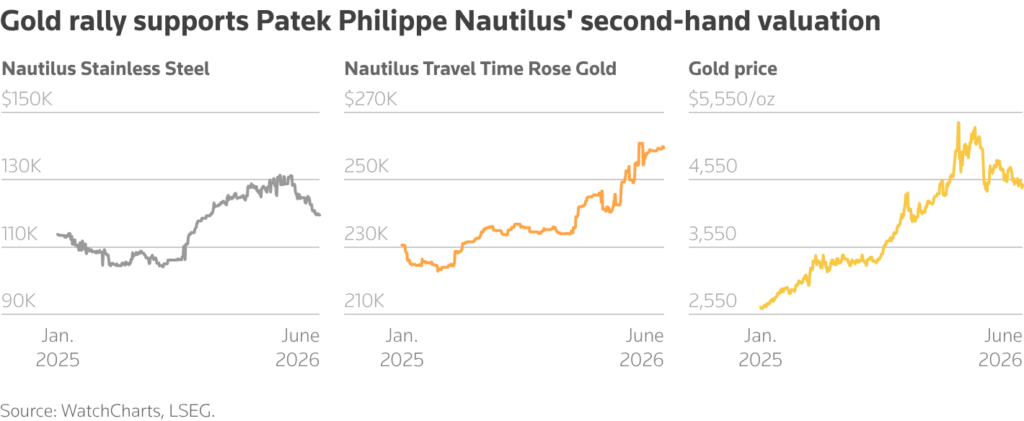
Gold prices surged to a record $5,600 an ounce in January as geopolitical concerns and trade worries pushed investors towards safe-haven precious metals. Gold now hovers around $4,200 per ounce, almost double its 2024 average.

The market price for used watches has not moved in the same way, however.

“I find it very sad, because obviously once something has been melted, it’s gone forever,” said Adrian Hailwood, a specialist in horological history.

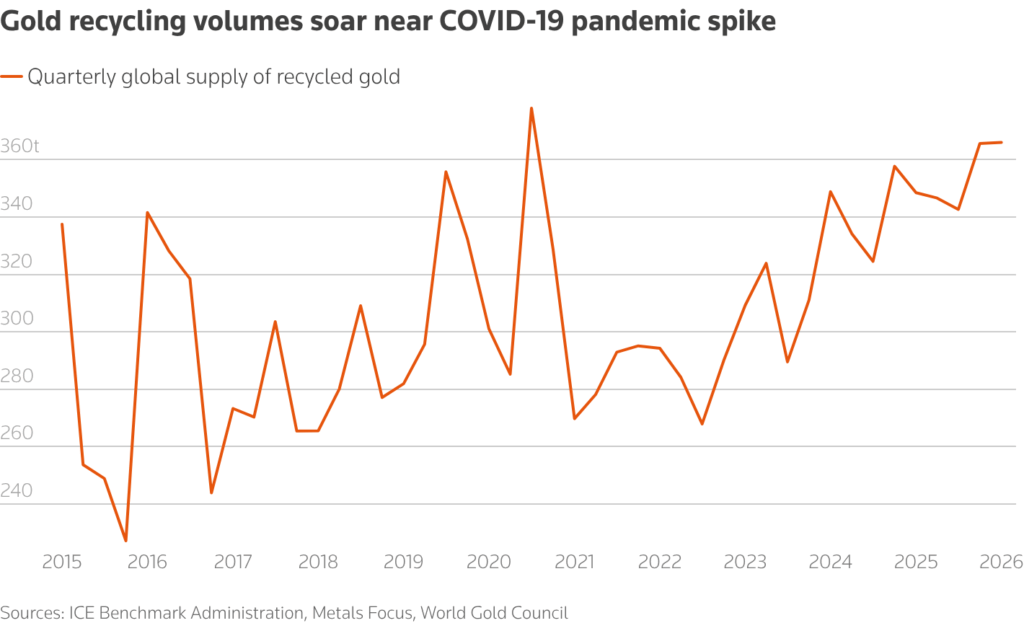
There are no official figures showing how many luxury watches are being melted. World Gold Council data shows overall gold recycling in the first quarter rose 5% to 366 tonnes, while gold jewellery demand rose 31% in value to $47 billion.

Watches can hold anything from a sliver of gold to more than 200 grams, meaning their scrap value can run into tens of thousands of dollars. In an Omega Constellation, the gold can be found in the case and the strap.


With gold expected to reach between $5,400 and $6,300 an ounce this year, the pressure to dismantle some watches will continue, especially as traders that resell them must cover costs and the expense of providing a warranty.

New watches that are over-produced might also be melted down.

“I’ve seen a lot of totally mediocre watches get melted down,” said Lamdin. “There’s a lot of unsold overstock in the Swiss market. And those watches are basically brand new, unworn, and they’re just getting stripped down… they made too many of them.”

“But when you have something that’s vintage and rare and has some story or some patina, that’s where it becomes a short-sighted tragedy.”

The resale trap

High-end brands that tightly manage new production like privately owned Patek Philippe and Rolex command the highest premiums over melt value, three industry experts said.

For some models “the wait lists are astronomical. You’re talking anything from two to eight years,” said Simon Lazarus, head of PR and content at online luxury watch platform Chrono Hunter.

Rolex accounted last year for 61% of the sales value of new Swiss watches priced above 3,000 Swiss francs ($3,770), up from 57% in 2023 despite lower volumes, according to Vontobel.

Less exclusive brands like TAG Heuer, Breitling and Omega struggle to command high new retail prices, however, as buyers can buy a second-hand timepiece for much less.

Models like Omega’s Speedmaster often depreciate sharply once sold, exposing them to scrapping, three experts said.

To sell or not to sell

Higher gold prices motivated retired New York engineer Mitchell Talisman to sell two gold watches and a chain containing a combined 35 grams of gold with 58% purity for $2,660 cash in December.

“I’d had a bunch of stuff sitting in a safety deposit box for over 10 years,” he told Reuters.

For some owners however, the idea of selling a watch only for it to be melted by a dealer is too much to bear.

“It may be a family piece, it may be their first watch,” said Hailwood.

“They don’t like the idea of it being destroyed, so they keep it.”

($1 = 0.7421 pounds)

($1 = 0.7873 Swiss francs)

(By Alessandro Parodi; Editing by Lisa Jucca and Alexandra Hudson)


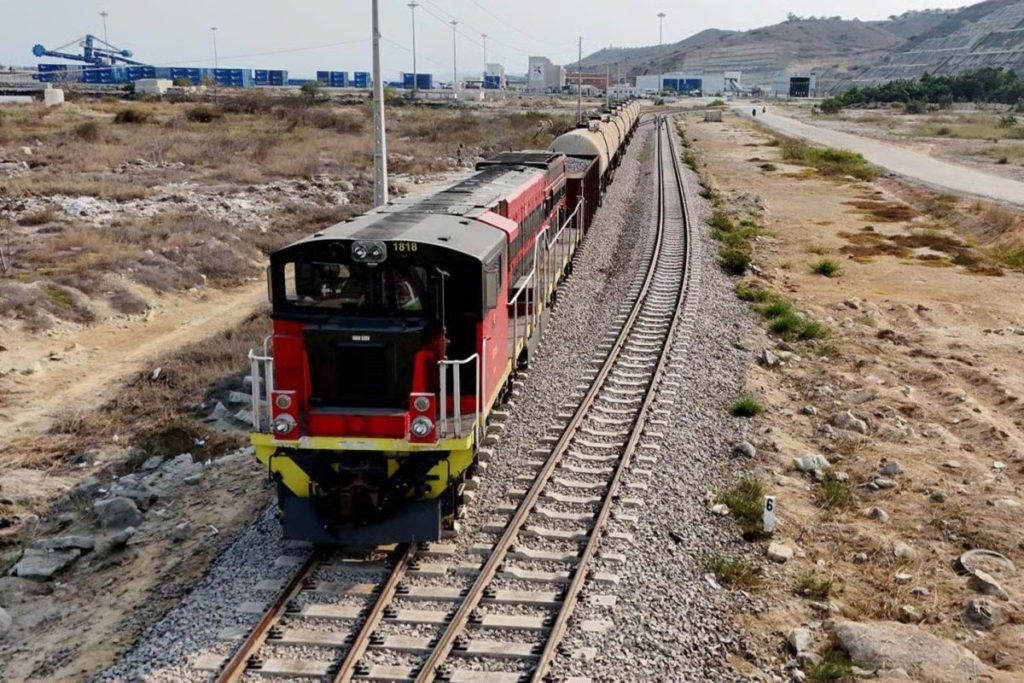
Lobito railway receives first Congo shipment after flood repairs


Lobito Atlantic Railway received its first copper shipment from the Democratic Republic of Congo since reopening a flood-damaged section of the corridor, restoring traffic on a key export route for central African minerals.

The link between the port of Lobito and Huambo, closed for about two months because of severe flooding, was restored after emergency repairs, the railway operator said in a June 13 statement.


“The arrival of this first international train from the DRC demonstrates the resilience of our operation and the extraordinary commitment of our teams,” LAR chief executive officer Nicholas Fournier said in the statement.

LAR said it maintained cargo flows during the disruption through a contingency plan that saw freight transferred between trains and trucks on either side of the flood-damaged section of the track.

The corridor is a key conduit for copper and cobalt exports from Congo to the Atlantic and forms part of Western-backed efforts to develop transport links for critical minerals.

(By Candido Mendes)

E.S.G./ NET-ZERO

Vale plans to invest $2.6 billion in decarbonization initiatives


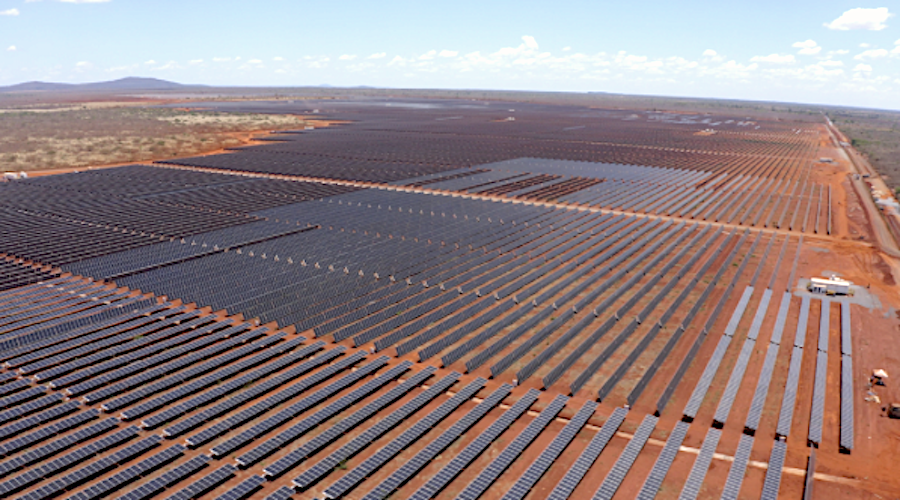
Sol do Cerrado solar complex in Minas Gerais. (Image courtesy of Vale.)

Brazilian miner Vale plans to invest up to 13 billion reais ($2.56 billion) in decarbonization initiatives to meet its voluntary emissions reduction targets and mitigate climate-related risks, a sustainability report showed on Monday.

The company did not specify the timeframe for the investment. The amount includes up to 4 billion reais for decarbonizing operations, with 24% invested in the medium term and 76% in the long term.

Another 8 billion reais is linked to building industrial complexes focused on low-carbon technologies, which includes steelmaking transition technologies and iron ore briquette development.

The remaining 1 billion reais would go for research and development, the firm said.

Vale invested 9 billion reais in decarbonization initiatives from 2020 to 2025.

Through these initiatives, Vale sees potential for financial and environmental returns for its business, Grazielle Parenti, executive vice president of sustainability, said in an interview with Reuters.

“Within Vale’s governance framework, all projects and decisions of this caliber are evaluated using an environmental, social, and governance matrix that identifies potential risks and opportunities for each one,” she said.

The company also warned on Monday it could face carbon costs of up to 22 billion reais at present value from carbon pricing mechanisms, with substantial impacts expected from 2030 onwards.

($1 = 5.0686 reais)

(By Marta Nogueira and Fernando Cardoso; Editing by Aurora Ellis)


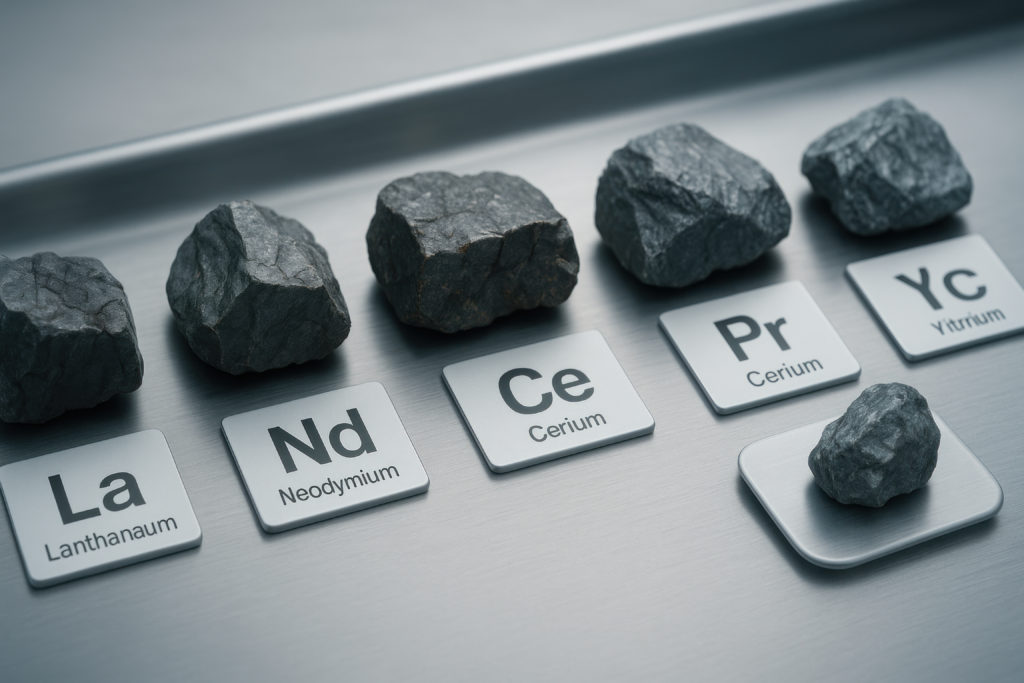
India seeks rare earth samples from Rosneft-owned Siberian deposit


Stock image.

Indian miner IREL is in talks with Rosneft to source rare ‌earth samples from Tomtor, the Siberian deposit acquired by the Russian oil producer last year, as New Delhi seeks to secure supplies of critical minerals dominated by China, a source said.

The talks are taking place through government channels, ​said the source, adding that the samples would be processed in Russia before being shipped ​to India.


India is keen to study the mineral composition of the deposit before ⁠considering deeper engagement, said the source, who has knowledge of the matter and spoke on ​the condition of anonymity as the discussions are confidential.

State-backed IREL is at the forefront of India’s global ​outreach to secure rare earth supplies to meet rising domestic demand and wean itself off dependence on China, with ties between the two neighbours remaining frosty.

IREL, India’s Department of Atomic Energy, which oversees the state miner, the ​foreign ministry, the mines ministry and Rosneft did not respond to Reuters‘ requests for comment.

Tomtor is ​located in Russia’s Siberian region of Yakutia and is considered one of the world’s largest undeveloped rare earth deposits.

The ‌United ⁠States has imposed sanctions targeting Russia’s energy sector, with measures affecting Rosneft and Lukoil, to pressure Moscow over the war in Ukraine.

Rare earth elements are critical for making permanent magnets used in electric vehicle motors and a range of other clean energy and defence applications.

In November, New Delhi approved a ​73 billion rupees ($770.77 million) program ​to support rare ⁠earth magnet manufacturing.

India lacks commercial-scale facilities capable of refining and separating the full range of rare earth elements to high purity levels.

Last year, India was ​scouting rare earth samples from neighbouring Myanmar with the assistance of a powerful ​rebel group, ⁠Reuters reported.

IREL is also in talks with Japanese and South Korean companies on plans to manufacture rare earth magnets commercially, Reuters reported last year.

The company is also exploring rare earth mining opportunities in Argentina, Australia ⁠and Malawi, ​and plans to begin rare earth magnet production in 2029 ​to 2030, the source said.

India has the world’s third-largest rare earth reserves, estimated around 7.23 million metric tons, but does not currently ​produce rare earth magnets domestically.

($1 = 94.71 rupees)

(By Neha Arora; Editing by Mayank Bhardwaj and Christian Schmollinger)


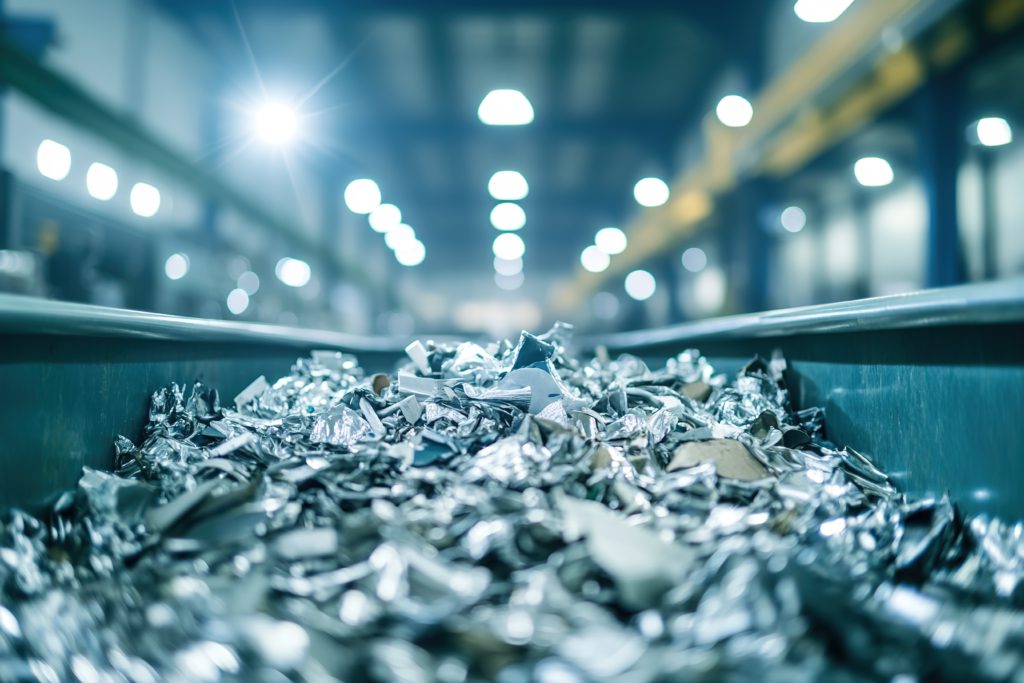
Soaring scrap aluminum exports threaten UK defence, auto supply chains, industry group says


Stock image.

Soaring exports of aluminum scrap risk leaving Britain short of a critical material needed for defence, clean energy, digital technologies and the auto industry, manufacturing trade body Make UK said.

It warned the UK could face a crisis if more scrap continues to flow overseas, with industry moving abroad in search of better access to scrap markets. This risks jobs, investment and supply chain resilience.


Make UK said domestic industry could need as much as 6 million metric tons of available scrap for recycling by 2035 to help meet projected aluminum demand of 8 million tonnes under the government’s Critical Minerals Strategy and Modern Industrial Strategy.

“The size of the prize is significant, with UK aluminum (scrap) collection and sorting alone needing to grow by 25% each year,” said Daniel Paterson, director of sector specialisms at Make UK.

“But this important opportunity will be lost if the UK continues to export a critical material that our future economic growth sectors and national security and resilience depend on.”

Data from information provider Trade Data Monitor showed UK exports of aluminum waste and scrap at 624,314 metric tons last year, a 43% jump from 2016. Over the same period UK aluminum scrap shipments to India increased 94% to 198,779 tons.

UK aluminum scrap exports to the United States at 23,560 tons last year showed a jump of 989% from 2024.

“UK exports to the US increased dramatically after Section 232 tariffs excluded aluminum scrap from their scope,” Make UK said in a release.

US President Donald Trump imposed 50% tariffs on aluminum imports in June last year.

Make UK called for investment in domestic sorting and pre-processing capacity, stronger collection and enforcement standards and targeted measures to retain certain aluminum alloys in the UK. It also urged the government to engage urgently with the EU to secure equivalent treatment if Brussels introduces aluminum scrap export restrictions.

The European Commission is working on measures to curb aluminum scrap leaving Europe after warning that scrap exports risk leaving EU metals industries short of material needed for recycling and decarbonization.

(By Pratima Desai; Editing by Nia Williams)


Qamco confirms termination of Hydro aluminum marketing deal


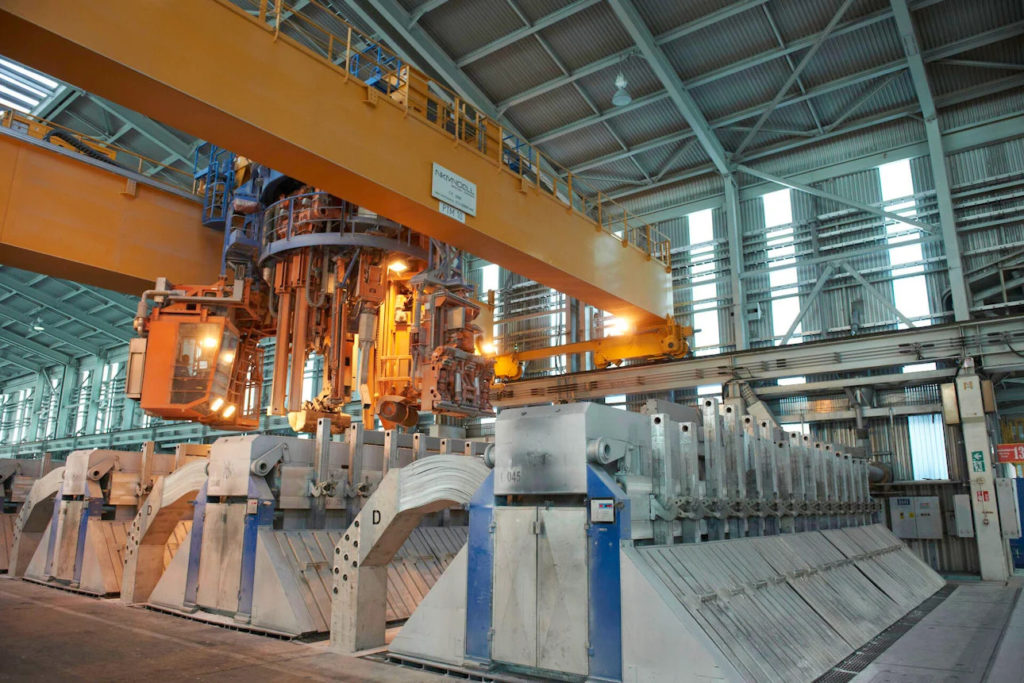
Potroom at the Qatalum aluminum smelter in Qatar. (Photo: Halvor Molland/Hydro)

Qatar Aluminum Manufacturing Co, known as Qamco, on Sunday confirmed partner Norsk Hydro’s role as marketing agent for their Qatalum aluminum joint venture had been terminated. It did not provide a reason.

“Following the termination, Qatalum will assume responsibility for the marketing and sale of its aluminum products on a provisional basis,” Qamco said in a statement, adding that it continued to engage constructively with Hydro to ensure an orderly transition.


Reuters reported on Friday that Qatalum had cancelled the commercial agreement under which the plant supplied metal to Hydro; Hydro issued a force majeure notice to customers.

Qamco does not expect any material adverse impact on financial or operational performance at 648,000-metric-ton-per-year Qatalum, which has only been operating at 60% of capacity since March after the outbreak of the Iran war.

Qamco said it was “investigating the circumstances” of the disclosure by Hydro, which it said was obliged to maintain confidentiality and coordinate on any public release of information.

Qatalum was founded in 2006 as a 50-50 joint venture between Hydro and state-owned Qatar Petroleum, now known as QatarEnergy; QatarEnergy holds 51% in Qamco.

(By Tom Daly; Editing by Tomasz Janowski)