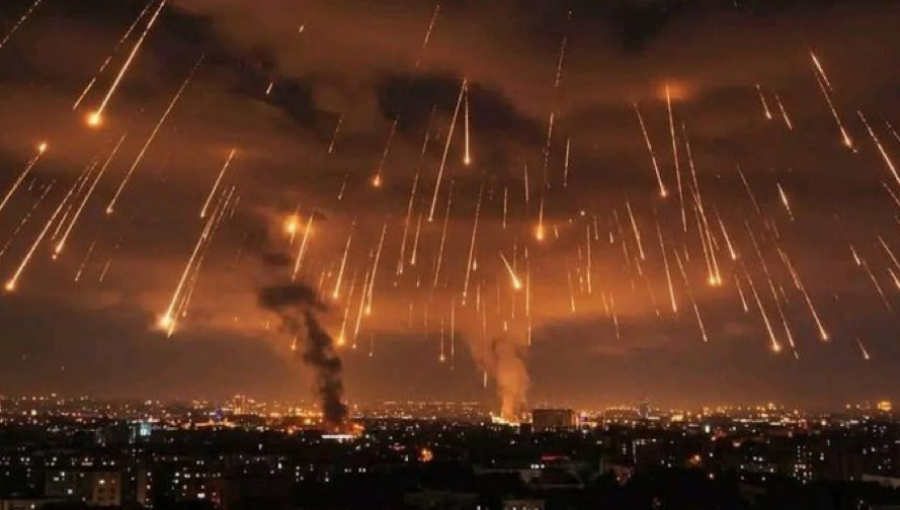
Sunday, July 12, 2026

France remembers 'old demons' of antisemitism on first annual Dreyfus day

Sunday saw France observe its first annual day of commemoration for Alfred Dreyfus, a Jewish army officer wrongly convicted of treason in one of the country's most notorious cases of antisemitism. With reports of hate speech on the rise, President Emmanuel Macron said France had yet to shed its "old demons" of prejudice.


Issued on: 12/07/2026 - RFI

France's President Emmanuel Macron and Charles Dreyfus, grandson of Alfred Dreyfus, pay tribute to the French army officer on the first national day of commemoration in his memory. Dreyfus was wrongfully convicted of treason in a case that exposed institutional antisemitism in 19th-century France. © AFP - THOMAS SAMSON

The inaugural commemoration fell on the 120th anniversary of France's highest appeals court recognising Dreyfus's innocence on 12 July 1906.

Macron declared the date a national day of remembrance last year in honour of "the victory of justice and the truth against hatred and antisemitism".

He led a ceremony near the courthouse in Paris on Sunday that was also attended by Dreyfus's grandson Charles, aged 99 and one of the few people still living who knew the officer personally.

Macron said the commemorations would also honour those who came to Dreyfus's defence. Their quest for the truth "reminds us that antisemitism, whatever its roots or supposed explanations, is the enemy of the Republic", he said in his speech.

"Yet we know that the old demons of antisemitism have never completely disappeared from our country. We know this because antisemitic acts, far from dying out, continue to target people simply because of who they are."

France – home to the largest Jewish population in the EU – has seen reports of antisemitism soar following the Hamas attacks of 7 October 2023 and the subsequent war in Gaza.

According to figures from the French Interior Ministry, more than half of anti-religious acts reported in 2025 targeted Jews.

National scandal


In 1894 Dreyfus, a Jewish army captain from Alsace, was accused of passing military secrets to Germany.

Vilified by France's antisemitic press, he was convicted on flimsy evidence and sentenced to life on a penal colony off the coast of French Guiana.

As his family protested his innocence and more evidence came to light implicating another officer, a growing number of public figures came to his defence – notably writer Émile Zola, who in 1898 penned an open letter accusing the French military and government of a deliberate miscarriage of justice.


"J'accuse" a letter written to the French President by author Emile Zola in defence of Alfred Dreyfus, was on the front page of the l'Aurore newspaper on 13 January 1898. © Public domain via Wikimedia Commons

Public outrage grew and the "Dreyfus Affair" split the country into Dreyfusards, who demanded his exoneration in the name of justice, and anti-Dreyfusards who refused to question military authority.

Dreyfus was pardoned in 1899 and finally exonerated in 1906. He was reinstated to the army and later served in the First World War.

He died on 12 July 1935 at the age of 75 – 29 years to the day after his name was cleared.

Symbolic statue

A statue of Dreyfus – holding a symbolically broken sword upright in salute – was also unveiled in front of the Court of Cassation on Île de la Cité on Sunday.

The French state has made other gestures to correct the historic injustice, including posthumously promoting Dreyfus to the rank of brigadier general in November 2025.

In 2021, Macron inaugurated France's first museum dedicated to the Dreyfus Affair and institutional discrimination more broadly, housed in Zola's house in Médan to the west of Paris.

A bronze statue by French artist Louis Mitelberg, aka Tim, depicting Captain Alfred Dreyfus. Made in 1985, it was installed in front of the Cour de Cassation, France's highest civil court, on 12 July 2026 as part of the first national day of commemoration for Dreyfus. © AFP - THOMAS SAMSON

While historians and others have called for Dreyfus to be admitted to the Pantheon, France's monument to national heroes, no president has yet granted that honour.

In Sunday's speech, Macron also called for the names of the Righteous Among the Nations – the title given by Israel to non-Jews who sought to protect Jews from the Nazis – to be displayed "on every house, every building, every place where Jews were sheltered, taken in or saved" in France.

Mayor of Paris Emmanuel Grégoire, who also addressed the ceremony, said that a square named for Maurice Barrès, a nationalist writer and politician who wrote antisemitic tracts denouncing Dreyfus, would instead be called "Place Lucie Dreyfus" in tribute to the officer's wife, who campaigned fiercely on his behalf.


From space rovers to hunger maps: How AI is reshaping humanitarian aid


Published on

Artificial intelligence (AI) is often discussed for its potential threats to humanity. But humanitarian organisations are using it to predict hunger, map destruction and deliver aid without sending people into danger.

Delivering food through conflict zones, minefields and floods can put humanitarian workers at mortal risk.

Now, technology developed to control rovers on distant planets is being adapted to take aid workers out of some of the world’s most dangerous aid missions.

Project AHEAD, a collaboration between the World Food Programme, Germany’s aerospace research centre DLR, the Red Cross and technology partners, is developing remotely operated vehicles capable of carrying supplies through areas considered too dangerous or difficult for conventional delivery trucks.

Footage from a DLR test site in Germany shows a SHERP all-terrain vehicle wading into open water and climbing over rough ground.

Sensors scan the terrain ahead while an operator controls the vehicle remotely, allowing it to travel without anyone sitting behind the wheel.

The system draws on DLR’s experience developing remotely operated and autonomous planetary rovers, including the MMX rover built to explore Phobos, one of Mars’s moons.

The same push to use emerging technology in humanitarian work extends beyond physical deliveries.

HungerMap Live, a publicly available platform developed by the World Food Programme, uses machine learning and near-real-time data to track food insecurity across more than 95 countries.

It combines information on factors including conflict, weather, climate hazards and economic conditions to help identify emerging hunger crises, according to the organisation.

“Everybody can check it out, HungerMap Live, on the internet. You can get real-time data, and right now we’re even looking into forecasting food security 90 days into the future,” said Bernhard Kowatsch, director of the WFP’s Global Accelerator and Ventures division.

Using AI to map a disaster

Reliable maps are also critical to humanitarian responses. Without information about roads, buildings and population centres, aid workers may struggle to decide where to evacuate people, establish shelters or deliver supplies.

After two powerful earthquakes struck northern Venezuela in June, limited geographical data made it difficult to assess the damage and prioritise assistance.

The Humanitarian OpenStreetMap Team says it used machine learning to extract information about buildings from satellite imagery. Volunteers then reviewed the images through its MapSwipe app, marking areas where structures appeared damaged.

“Within four days after the earthquake, we were able to mobilise more than 600 volunteers that were basically swiping left and right on the mobile app, indicating: yes, this building area is damaged; no, this building area is not damaged,” said Leen D’hondt, director of technology and data at the Humanitarian OpenStreetMap Team .

“And that actually helped early responders to go to the right areas for food delivery and for all the other necessities that we might need right after the earthquake,” D’hondt added.

For all the speed AI can add, D’hondt said the technology cannot yet match the accuracy of detailed work carried out by human mappers.

“Manual mapping still provides the best quality. However, sometimes speed is more important,” she said.

“Sometimes it’s more important to know more or less where the buildings are. They’re not perfectly mapped, but we know how many people are living in that area. And that’s where AI and machine-learning models come into the picture right now.”

Despite rapid advances, insiders say such systems are still far from being routinely incorporated into emergency responses around the world.

“Right now, there aren’t really systems integrated into these emergency protocols in most countries,” said Monique Kuglitsch, innovation manager at the Fraunhofer Heinrich Hertz Institute.

“There are exceptions. In India, they do have an AI-based early-warning system that is operational. Also in Europe, we have an AI forecasting system from the European Centre for Medium-Range Weather Forecasts, which is operational. But in a lot of countries, it’s still experimental.”

The Geography Of Terrorism Has Shifted – Analysis


Key Takeaways:

Islamic State’s operational center has shifted to Africa: In the first half of 2026, Africa accounted for nearly 90% of ISIS-claimed attacks (up from 9% in 2018), with Nigeria (250 attacks), DRC (138), and Mozambique (56) seeing the highest activity and heavy casualties, especially in the DRC.

Syria remains ideological core while secondary hubs grow in Pakistan and Philippines: Syria focuses on symbolic and sectarian messaging; ISKP activity has largely moved to Pakistan (20 attacks but 248 casualties, high lethality), with smaller persistent operations in the Philippines.

Future threat is Africa-based with global reach: ISIS will increasingly launch or inspire attacks worldwide from African and South Asian hubs using digital networks, remote radicalization, AI tools, and diaspora communities, requiring counter-terrorism efforts to pivot toward Africa and Pakistan.


Introduction


From its epicentre in Iraq and Syria, the threat of terrorism by the Islamic State (ISIS) has moved in two directions. Two hubs have emerged, one in Africa, in the Sahel and another in South Asia, in Khurasan.

While terrorism by the Islamic State will continue to threaten Syria and Iraq, most attacks in the future will be conducted and organised in the two theatres of Africa and Afghanistan-Pakistan. The Islamic State is trying to revive in other regions like in Southeast Asia but countries like the Philippines and Indonesia are fighting them.

The Islamic State will conduct more attacks than Al Qaeda. After its leader Saif Al Adil moved from Afghanistan to Mashad and Tehran in Iran, the Al Qaeda has come under the control of Iran’s Islamic Revolutionary Guard Corps (IRGC). In the global terrorism map, the Islamic State will remain the most powerful non-state threat group in the immediate and short term.


The Context


The Islamic State has compiled its own attacks in the first six months of 2026. ‘Amaq News Agency of the Islamic State released an infographic on July 6, 2026 that identify Africa as the epicentre of Islamic State activity. Based on the data, attacks identified as “assaults,” refer to military raids, accounted for the majority (205), followed by bombings (75), and ambushes (51). Most of these strikes occurred in Africa, with Nigeria (250), the Democratic Republic of the Congo (138), and Mozambique (56) representing the largest share of activity. In terms of casualties, the DRC (769), Nigeria (696), and Niger (290) were the bloodiest.


Following is a translation of the infographic:


Results of Attacks by Islamic State Fighters During the First Half of the Year 2026

587 Operations205 Assaults
75 Bombings
51 Ambushes
30 Assassinations
8 Commando
218 Others
2529 Killed and Wounded, Including 25 Officers and Commanders
8 Aircraft Destroyed and Disabled
6 Drones
1 Helicopter
1 Civilian Craft
56 Vehicles Seized
380 Vehicles Burned and Disabled
67 Armored
196 Four-Wheel Drive
117 Others


Burned:17 Churches
84 Military Positions
1484 Houses

CongoAttacks: 138
Killed and Wounded: 769

NigeriaAttacks: 250
Killed and Wounded: 696

NigerAttacks: 39
Killed and Wounded: 290


PakistanAttacks: 20
Killed and Wounded: 248

MozambiqueAttacks: 56
Killed and Wounded: 150

Burkina FasoAttacks: 10
Killed and Wounded: 122

SomaliaAttacks: 25
Killed and Wounded: 113

SyriaAttacks: 31
Killed and Wounded: 50

MaliAttacks: 11
Killed and Wounded: 42

AfghanistanAttacks: 2
Killed and Wounded: 26

PhilippinesAttacks: 3
Killed and Wounded: 15

Iraq
Attacks: 2
Killed and Wounded: 8

The global operational architecture of the Islamic State (IS) has undergone a profound and measurable transformation. An analysis of independent data from BBC Monitoring alongside the group’s internal propaganda released via the Amaq News Agency for the first half of 2026 confirms a stark reality: the geographic epicenter of IS operations has unequivocally shifted to Sub-Saharan Africa. Meanwhile, traditional strongholds in the Levant serve primarily as ideological anchors, while secondary Centers of Gravity (COGs) are consolidating in Khurasan (specifically Pakistan) and East Asia (the Philippines).


The African Epicenter: Territorial Expansion and Unprecedented Lethality


By the midpoint of 2026, Africa accounted for nearly 90% of all IS-claimed attacks globally. This represents a staggering escalation from just 9% in 2018. Sub-Saharan Africa is no longer just a wilayat (province) of convenience; it is the group’s undisputed operational core.

A comparative analysis of BBC Monitoring and Amaq data reveals not just the volume of attacks, but their devastating human cost. While independent monitoring tracks 217 attacks in Nigeria and 135 in the Democratic Republic of Congo (DRC), Amaq inflates these slightly to 250 and 138, respectively. This minor discrepancy is typical of insurgent propaganda, yet both datasets confirm the macro-trend: West and Central Africa are absorbing the brunt of IS violence.


Crucially, the lethality in the DRC outpaces Nigeria. According to Amaq’s internal metrics, the 138 assaults in the DRC resulted in 769 casualties, compared to Nigeria’s 696 casualties across 250 attacks. The BBC report corroborates this, noting that Christian civilians in the DRC are bearing the brunt of these operations. The group is actively claiming territorial expansion in North-West Nigeria and Haut-Uele province in the DRC, signaling a shift from asymmetric insurgency to attempts at localized governance and control.


The Ideological Core: Syria’s Enduring Role

Despite the massive shift in kinetic operations toward Africa, Syria remains the ideological heartbeat of the Islamic State. With 30 claimed attacks in the first half of 2026, Syria is the busiest operational theater outside of Sub-Saharan Africa. However, its value is overwhelmingly symbolic and messaging-driven.

As noted in the group’s al-Naba editorials, Syria is utilized to delegitimize regional authorities— framing President Ahmed al-Sharaa as “Agent 90” and exploiting localized sectarian tensions. IS strategically claims targeted killings of religious minorities to foster insecurity, using Syria not for immediate territorial reconquest, but to project enduring relevance and attract foreign fighters.
Secondary Centers of Gravity: The Khurasan Shift and East Asia

Perhaps the most critical intelligence gathered from the recent data sets is the strategic relocation of secondary IS threats. The Islamic State Khurasan Province (ISKP), historically viewed as a Western-facing threat emanating from Afghanistan, has drastically reduced its footprint within Afghan borders, claiming only two attacks. Instead, the operational weight of this region has shifted across the border into Pakistan.

While the volume of attacks in Pakistan remains comparatively low (20 attacks), the lethality is disproportionately high, resulting in 248 casualties. This indicates a highly refined, targeted campaign.


Operations in Pakistan’s Khyber Pakhtunkhwa region are marked by targeted assassinations of political opponents and Shia Muslims. This high casualty-to-attack ratio demonstrates a lethal outshoot Center of Gravity that requires immediate counter-terrorism focus.

Concurrently, the Philippines maintains a low but persistent operational tempo with 3 claimed attacks. While seemingly negligible compared to African figures, the persistence of IS in Southeast Asia ensures the group maintains a foothold for regional network facilitation and radicalization.

The Future


To survive, sustain, flourish and thrive, threat entities moves rapidly to border regions, ungoverned territories, and under-governed spaces. Africa and South Asia and parts of Southeast Asia feature prominently. The world will increasingly witness terrorism both in Africa and South Asia. In the immediate, short and mid term, the world will also witness attacks mounted elsewhere but originating from Africa and Asia.

Although the geography of terrorism has shifted, by exploiting the digital networks, the threat groups are able to conduct long range deep penetration strikes. Technologically, the most advanced Islamic State affiliate, the Islamic State Khorasan Province (ISKP) has provided a template. The ISKP actively radicalises and recruits those in their territory and overseas. In addition to mounting attacks in Afghanistan and Pakistan, their operators coordinates with likeminded threat entities as well as susceptible individuals in the diaspora and migrant communities. After radicalisation and recruitment, the ISKP recruiters handle the operators remotely. Their financiers resource them with funds and their combat tacticians with their knowhow.

Through sophisticated digital networks, the group bypasses physical borders to inspire, guide, and radicalise supporters and sympathisers worldwide turning them into attackers. The group’s remote recruitment and attack model relies on several distinct tactics the ISKP utilizes invitation-only channels on apps like Telegram to vet prospective recruits and deepen ideological engagement. Multilingual propaganda operations—led by outlets like the official al-Azaim foundation—translate extremist content into various languages, including Pashto, Urdu, Tajik, Uzbek, and English, to broaden their global reach. The ISKP also exploits Artificial Intelligence (AI) for automated recruitment, tailoring radicalisation pathways to individual vulnerabilities and operating continuous chatbots to mimic human interaction. Operatives rely on decentralised communication to remotely incite and guide individuals to form cells, networks and groups in diaspora and migrant communities, orchestrating planned attacks without directly training the operatives on the ground.

Conclusion


The first half of 2026 data categorically proves that the Islamic State is no longer a Middle Eastern insurgency with global aspirations; it is an African insurgency with global outshoots. Counter-terrorism coalitions must recalibrate their resource allocations. While vigilance in the Levant remains necessary to suppress ideological resurgences, the kinetic fight must pivot entirely to Sub-Saharan Africa, with specialized intelligence efforts directed at dismantling the highly lethal, evolving networks in Pakistan and the Philippines.


About Prof. Rohan Gunaratna
A specialist on the global threat environment, Rohan Gunaratna is Professor of Security Studies at the S. Rajaratnam School of International Studies, Nanyang Technology University and the founder of Singapore's International Centre for Political Violence and Terrorism Research.
View all posts by Prof. Rohan Gunaratna →


The Sedition Act: Malaysia’s Enduring Tool Of Lawfare – OpEd


July 13, 2026 
By Murray Hunter

Key Takeaways:

Sedition Act 1948 used against activist Chegu Bard: The Malaysian politician was convicted in Johor Bahru for a Facebook post linking the King and PM Anwar Ibrahim to alleged casino discussions in Forest City, fined RM5,000 (20-month jail default), and disqualified from contesting elections.
 
Criticism of selective enforcement and broken reform promises: Once a key Pakatan Harapan reform pledge (including by Anwar), the colonial-era law continues to be weaponised against opposition figures, activists, and critics questioning royalty, governance, and major projects like Forest City.
 
Call for abolition: The vague, broadly applied Act is seen as lawfare that chills free speech, contradicts constitutional democracy, and protects elites; critics urge repeal in favour of narrower laws (e.g., defamation) to restore public trust and genuine political discourse.


The Urgent Need for the Abolition of this Colonial Relic


In the annals of Malaysian political theatre, few props have proven as versatile and enduring as the Sedition Act 1948. This colonial relic, inherited from British efforts to suppress anti-colonial sentiment, continues to cast a long shadow over the nation’s fragile democracy.

Its latest high-profile casualty, activist and politician Badrul Hisham Shaharin, better known as Chegu Bard stands convicted in the Johor Bahru Sessions Court for a Facebook post linking high-level figures, including the Yang di-Pertuan Agong and Prime Minister Anwar Ibrahim, to alleged discussions about a casino project in Forest City.

Fined RM5,000 with a 20-month jail term in default, Chegu Bard now finds himself disqualified from contesting in upcoming state or parliamentary elections. One more activist’s voice is silenced, one potential challenger removed from the political board. This is not justice; it is lawfare, the strategic weaponization of legal processes to achieve political ends.

The Sedition Act exemplifies this perfectly.

Enacted during the dying days of the British Colonial Empire, it criminalizes speech with a “seditious tendency”, which is anything considered by the powers to be as a dangerously vague threshold where intention is irrelevant and truth offers no defence. Section 3 defines seditious acts as those exciting disaffection against the government, promoting ill-will between races, or crucially in recent usage, bringing the rulers into hatred or contempt.

Pakatan Harapan (PH), including Anwar Ibrahim’s PKR, once campaigned vigorously on this reform agenda. Their 2018 manifesto explicitly promised to revoke the Sedition Act alongside other draconian laws.

Reformasi rhetoric filled the air. Yet, upon assuming power, the promises evaporated. By 2022, the commitment had been diluted to a vague “review” of draconian provisions. Today, under the unity government, the Act remains not only on the statute books but actively wielded against critics, particularly those questioning power alignments involving royalty, development projects, and political elites.

A Pattern of Abuse

Chegu Bard’s case is far from isolated. The Act has been invoked against opposition figures, activists, academics, and ordinary citizens alike. From Tian Chua to Wan Ji, and countless others flagged for social media posts, the patterns are clear. Selective enforcement that chills dissent while protecting vested interests.

Critics rightly point out how the law stifles legitimate public discourse on corruption, crony capitalism in projects like Forest City, and the boundaries of royal influence in a constitutional monarchy. Blogs and statements have highlighted concerns over royalty-linked businesses in logging, mining, and other sectors, yet raising these invites sedition probes.

Malaysia is a constitutional parliamentary democracy, not a feudal state. The 1993 constitutional amendments removing legal immunity for rulers underscored equality before the law. Yet the Sedition Act effectively creates a protected class, contradicting both constitutional spirit and the King’s own recent affirmations of equal justice.

This creates a perverse chilling effect. Citizens self-censor, journalists tread carefully, and politicians calculate risks before speaking. As someone who has personally felt the Act’s heavy hand, I can attest to its psychological toll.

The uncertainty of investigation, the legal costs, the reputational damage, and the looming threat of disqualification from public life. It transforms active citizenship into a hazardous pursuit.

Hypocrisy in High Places

The greatest irony lies with Pakatan Harapan. Once victims of repressive laws under Barisan Nasional, with Anwar himself enduring persecution, the government now preside over the Sedition Act’s continuation. Promises made in opposition become liabilities in government. The unity administration defends its use as necessary to “protect the royal institution,” but this rings hollow when the same tool suppresses broader political debate.

Zaid Ibrahim, a veteran legal mind and former minister, has publicly highlighted Chegu Bard’s predicament, noting how conviction bars electoral participation. Such disqualifications conveniently thin the ranks of vocal critics ahead of polls.

Malaysia’s democracy suffers when discussion of major projects, often involving foreign investment, environmental impact, and potential conflicts of interest is equated with sedition. Forest City itself, a massive Johor development with Chinese backing, has long invited scrutiny over its economic viability, social effects, and reported gambling links.
Public interest demands open debate, not courtroom suppression.

Abolishing the Sedition Act would not leave Malaysia lawless. Existing provisions in the Penal Code for defamation, incitement to violence, or threats provide ample recourse. What it would remove is a blunt instrument prone to political abuse. International bodies like ARTICLE 19, where SUHAKAM, and the Malaysian Bar have repeatedly called for its repeal. A moratorium on its use, pending full abolition, would signal good faith.

True reform requires more than cosmetic review. It demands political will to embrace robust free speech as a cornerstone of mature democracy. In an era of social media and heightened public awareness, clinging to 1948 legislation signals insecurity, not strength.

Chegu Bard’s conviction is a symptom of deeper malaise, as the reluctance of Malaysia’s political class willingness to relinquish such tools of repression.

As economic pressures mount, corruption allegations persist, and developmental decisions shape the nation’s future, silencing voices only breeds resentment and cynicism.

The rakyat deserves better. Malaysia’s constitution enshrines freedom of expression with reasonable restrictions. The Sedition Act far exceeds what is reasonable in a modern democracy. Its abolition would honour the Reformasi spirit that once animated Pakatan Harapan, restore public trust, and allow genuine discourse on royalty, governance, and national direction.

Until then, lawfare will continue to distort the political landscape, disqualifying activists like Chegu Bard while the powerful evade scrutiny. The time for empty promises has passed. Abolish the Sedition Act before more careers, voices, and democratic aspirations are extinguished under its repression.


About Murray Hunter

Murray Hunter has been involved in Asia-Pacific business for the last 30 years as an entrepreneur, consultant, academic, and researcher. As an entrepreneur he was involved in numerous start-ups, developing a lot of patented technology, where one of his enterprises was listed in 1992 as the 5th fastest going company on the BRW/Price Waterhouse Fast100 list in Australia. Murray is now an associate professor at the University Malaysia Perlis, spending a lot of time consulting to Asian governments on community development and village biotechnology, both at the strategic level and “on the ground”. He is also a visiting professor at a number of universities and regular speaker at conferences and workshops in the region. Murray is the author of a number of books, numerous research and conceptual papers in referred journals, and commentator on the issues of entrepreneurship, development, and politics in a number of magazines and online news sites around the world. Murray takes a trans-disciplinary view of issues and events, trying to relate this to the enrichment and empowerment of people in the region.
View all posts by Murray Hunter →
WWIII

Who Fires The Shot?
Closing The Authority Gap In Indo-Pacific Autonomous Warfare – Analysis

A Saildrone Explorer unmanned surface vessel operates with the fast response Coast Guard cutter Robert Goldman in the Arabian Gulf during Exercise Phantom Scope, Oct. 7, 2022. Photo Credit: Navy Chief Petty Officer Roland Franklin


July 13, 2026 0 Comments
Geopolitical Monitor
By Burak Oktenli


Key Takeaways:

Authority gap in Indo-Pacific autonomous warfare: Rapid integration of unmanned systems across coalitions (AUKUS Pillar 2, Quad, etc.) has outpaced agreement on who can authorize lethal force, creating a critical sovereignty and legal challenge that existing technical standards cannot solve.

Divergent national doctrines: The US, Japan, India, Australia, and South Korea operate under different legal, constitutional, and policy ceilings on autonomous lethality, making full harmonization politically impossible.

Proposed solution: Coalition Authority Interoperability Protocol: A computable framework (national authority mapping, dependency caps, cryptographic multi-signature rules, and auditable accountability layer) that respects sovereign differences, enables safe machine-speed operations, and fails conservatively in contested environments.


A Question no Data Standard can Answer


The Indo-Pacific is where autonomous military systems and coalition operations are converging most quickly. Unmanned surface vessels, autonomous undersea platforms, and autonomous airborne surveillance assets are entering service with the United States, Australia, Japan, India, the Republic of Korea, and others. Increasingly they are meant to operate not nationally but together: inside AUKUS Pillar 2, in Quad maritime-awareness initiatives, and in the ad hoc coalitions that the region’s contingencies keep producing.

Those partnerships share networks and messages. They do not share a doctrine on who may authorize an autonomous system to use force. The United States permits human-supervised autonomous engagement for defined defensive applications under Department of Defense Directive 3000.09. Japan, operating under postwar constitutional constraints, holds a more restrictive ceiling. India ties its participation to a strict reading of meaningful human control. Australia sits at a ceiling aligned to its AUKUS interoperability commitments.


These are not technical mismatches that a data standard can fix. They are sovereign positions on the lawful use of force, and they diverge.

The existing coalition interoperability stack does not address that divergence, and it was never built to. Standards such as NATO’s STANAG 4586, the Federated Mission Networking framework, and partner message-exchange arrangements coordinate the network, the control link, and the political side of information sharing. They let one contributor’s ground station task another’s platform and keep the data flowing. None of them governs the authority layer: Whose national constraint applies when a shared autonomous asset is about to act, and how does a coalition reconcile members who operate at different authority ceilings inside a single mission?

The omission is not an oversight. The stack was built for an era in which the consequential decision, the decision to fire, was always taken by a human operator whose national chain of command supplied the authority for it. Authority travelled with the human and was resolved through the ordinary command relationship, so the standards never had to represent it explicitly. Autonomous systems break that assumption. When the action is taken by the system itself, at speeds that may preclude a real-time human decision, authority can no longer be left implicit in a command relationship the system has outrun. It has to be represented, computed, and enforced as an explicit property of the coalition’s technical architecture.

Partners Who Do Not Agree

The region’s security architecture is not a single alliance. It is a lattice of overlapping arrangements, AUKUS, the Quad, Five Eyes, and coalitions assembled mission by mission, whose members hold materially different national doctrines on autonomous lethality. The Congressional Research Service, tracking the international debate over lethal autonomous weapons under the Convention on Certain Conventional Weapons, records the community stratifying into broad groupings, with Australia, India, the Republic of Korea, and the United States historically resisting a blanket prohibition while supporting human-control principles, and others pressing for stricter limits.

The regulatory picture compounds the doctrinal one. The United States governs autonomous lethality through a directive framework that allows human-supervised autonomous engagement under defined conditions while requiring appropriate human judgement over the use of force. Japan’s constraints are constitutional in origin and treat autonomous lethal engagement with caution. India couples a doctrinal preference for strategic autonomy with a strict interpretation of human control. The Republic of Korea, operating under acute peninsular threat conditions, has tended to resist categorical prohibitions that would foreclose defensive autonomy. Australia has aligned its operational ceiling to its AUKUS commitments, accepting a degree of convergence with United States and United Kingdom practice that the other regional partners have not. China, the actor against which much of this coordination is oriented, has meanwhile enacted its own vertical, technology-specific AI rules.

These positions are stable precisely because they are sovereign. A coordination mechanism that asked Japan to relax its constitutional posture, or India to subordinate its reading of human control to a coalition default, would not survive contact with the partners’ domestic politics. The realistic move is therefore to treat divergence not as a problem to be harmonized away but as a fixed boundary condition that any workable coalition mechanism has to accommodate.

Making Authority Computable

The proposal here is a Coalition Authority Interoperability Protocol: four mechanisms that turn coalition authority coordination into a computable process running above the existing arrangements rather than replacing them. It is additive by design. STANAG 4586, Federated Mission Networking, the Mission Partner Environment, AUKUS Pillar 2 working groups, and Five Eyes sharing continue to operate as the network, control, and political layers. The protocol adds the authority layer that sits on top of them.

Mapping Layer


The first mechanism is a mapping layer. Each participating nation formalizes its authority-tier structure in a machine-readable national authority profile: how many tiers it recognizes, what each one permits (defensive interception only; supervised autonomous engagement; system-initiated engagement within agreed rules of engagement), the thresholds that separate them, and the legal basis for each. Profiles are published before any specific deployment and registered with a shared coalition registry. The layer then builds a pairwise map that establishes where one nation’s tier is functionally equivalent to another’s, and computes a coalition floor: the most conservative tier that every participating nation can endorse. Engagements requiring anything above that floor are simply not coalition-authorized for that composition.

For illustration, a United States tier permitting human-supervised autonomy with a functional veto maps cleanly onto a partner’s on-the-loop tier with a mandatory override, while a more permissive United States tier for system-initiated defensive engagement may have no equivalent at all in a more restrictive partner’s structure, in which case it simply falls outside the coalition floor for any operation that partner joins.

Two properties matter for what follows. The mapping is reversible, so every coalition-authorized engagement decomposes unambiguously into the contributing national tiers and the audit trail can trace any action back to specific national authority sources. And it is parameterized by national profile rather than by alliance identity, so the same machinery that reconciles a United States tier with a NATO partner’s also reconciles it with Japan’s, with no re-engineering beyond swapping the profile in. Coalition geometries in the region are fluid, and a layer keyed to alliance identity would have to be rebuilt for every novel grouping; a layer keyed to national profile is reused without rebuilding.

Dependency Cap

The second mechanism is a dependency cap, the computable form of an accommodation NATO has practiced for two decades: national caveats, under which the rules of engagement for any given operation reflect the intersection rather than the union of member willingness. The cap maintains, at every moment of a deployment, the maximum autonomous-authority tier that every participant has endorsed for the operation, and recomputes it when membership changes, when a nation amends its profile, or when the mission transitions, for example from a peacetime patrol to active hostilities. It is conservative by construction, so the lowest participating tier sets the ceiling and no contributor is bound by another’s more permissive posture. It admits per-capability differentiation, so an interception cell and a logistics cell can carry different caps. And it is auditable end to end. Caveats have historically been enforced through pre-deployment political accommodation and human supervision; at the tempo of autonomous air and maritime operations, that human enforcement is mechanically infeasible, and the cap is what lets the same accommodation scale.

Cryptographic Substrate


The third mechanism is the cryptographic substrate through which coalition authority decisions are signed across sovereign boundaries. Each nation runs its own hardware security modules holding its national signing keys. A coalition strike order in a given category is valid only when an agreed number of the participating nations have signed it, with the threshold configured per category and per coalition. Defensive interception against a confirmed inbound threat can default to a single participant’s signature, because it cannot wait for cross-national consensus. Offensive engagement against pre-vetted target categories can require a majority. Engagement against categories that were not pre-vetted can require unanimity, which is equivalent to giving any participant a veto. None of these thresholds is fixed by the mechanism itself; each is negotiated per coalition and per category during the pre-deployment phase, recorded in the relevant national profiles, and then enforced by the hardware at the speed of the operation. The two guarantees the substrate provides are that no single nation can unilaterally authorize a coalition action above the agreed threshold, and that no outside party can forge one: forging a valid coalition signature would require either compromising the agreed number of national modules or breaking the underlying cryptography, both of which sit outside the threats the design is built to withstand. The separate problem of quantum threats to those signature primitives is handled by a post-quantum substrate developed elsewhere and is not the concern here.

Accountability Layer

The fourth mechanism is the accountability layer. Coalition operations span multiple sovereign jurisdictions, each of which keeps its own audit log as classified national property and will not expose the contents to its partners. The protocol resolves the tension between coalition accountability and national secrecy with a hash-bridge construction: each nation keeps its own cryptographically chained ledger, and at each cross-sovereign event, a sensor handover, an authorization relay, an engagement command, the originating nation publishes a cryptographic hash of the relevant entries rather than the entries themselves. The hash does not reveal the classified content. It proves that the content exists, that it was committed to the originating nation’s ledger before the transmission, and that any later tampering would be detectable. An agreed verification body can then confirm that every link in a cross-sovereign authority chain traces to a specific national source without reading any nation’s classified data.

AUKUS and a Quad-Composition Patrol


Two settings show why the Indo-Pacific region, rather than the transatlantic one, is where this design earns its keep. AUKUS, announced in September 2021, structuresits advanced-capabilities work under Pillar 2, covering artificial intelligence and autonomy, undersea capabilities, quantum, hypersonics, cyber, and information sharing. Its working groups set trilateral interoperability expectations that are tighter than a large alliance’s floor and broader than an intelligence-sharing partnership’s focus, because the trilateral contemplates joint development, joint deployment, and joint operational employment of autonomous systems.

The three partners occupy three positions on the authority spectrum. The United States is at the permissive end under Directive 3000.09. The United Kingdom is more constraining, maintaining a human in or on the loop for lethal decisions. Australia is intermediate, committed to interoperability with United States standards while preserving its own domestic decision pathways. Under the protocol, the dependency cap for trilateral operations defaults to the more conservative lethal-autonomy ceiling while leaving permissive authority intact for defensive-only tasks such as autonomous interception of an inbound missile or torpedo. That is not a constraint on anyone’s sovereignty; it is the coalition floor that would apply whenever the more conservative partner takes part, exactly as it would in any other coalition that partner joins. Pillar 2’s emphasis on joint development adds a wrinkle the protocol handles directly: a system built jointly by two or more partners carries a shared profile recording the most constraining of their national doctrines for the relevant tiers, and operates under that shared profile in trilateral missions.


There is also a supply-chain dimension that the region cannot ignore. Recent analysis of the unmanned-systems supply chain finds that nearly every drone in the war in Ukraine depends on Chinese components at the level of airframes, magnets, batteries, and chips, a dependency that allied assessments have since mapped in detail for NATO planners. The protocol does not solve that problem, but it can register it: the national profile schema admits an optional attestation field in which a contributor records the component-provenance state of the systems it brings, so that the coalition’s cap computation can take supply-chain exposure into account where a nation chooses to expose it.

The harder and more representative case is a maritime patrol assembled at short notice from United States, Japanese, Indian, and Australian contributors, an operational composition that approximates the Quad’s potential security application. Each contributor operates autonomous maritime systems at a different ceiling, and there is no pre-established trust infrastructure across the four when tasking begins. In the days before deployment, each publishes its profile to the coalition registry, the pairwise maps are built, and the dependency cap resolves to the most conservative of the four lethal-engagement ceilings. Cross-certification provisions machine-level trust across the four national key hierarchies inside the deployment window, defaulting to two-of-four authorization for offensive engagement against pre-vetted maritime targets and single-signature authorization for defensive interception. The audit chain is initialized with the four ledgers and runs throughout.

The payoff is concrete. Without such a mechanism, a four-nation maritime coalition facing a short-notice tasking has two poor options. It can defer autonomous employment entirely and run its shared assets at the speed of manual authorization, surrendering the tempo advantage that autonomy was meant to provide. Or it can proceed on an ad hoc understanding of whose rules apply, and absorb legal and political risk that only surfaces after an engagement. Computing the binding ceiling in advance from published profiles, provisioning trust within the deployment window, and gating every autonomous action on a verifiable multi-party authorization offers a third path: the coalition operates at machine tempo while staying, at every moment, inside the authority all participating sovereigns have granted. NATO, by contrast, is the easy case, because much of the trust infrastructure the protocol provisions on the fly already exist there; the design degrades gracefully toward it.

Failing Safe


A coalition mechanism has to specify not only nominal operation but failure. The protocol is engineered to fail conservatively: any transition that narrows the coalition’s authority executes immediately on diagnosis, while any transition that restores authority requires positive evidence of recovery. The characteristic coalition failures are a partner’s profile proving ambiguous at mapping time, conflicting signatures on a single action that indicate communication failure, clock skew, or tampering, and a network partition that splits the coalition into separated signature pools whose independent decisions may contradict on reunification. In each case the recovery pathway is the same in spirit: the coalition’s aggregate authority contracts to the most conservative envelope its trusted members can jointly support, fresh authorization is required under the reduced roster, and every transition is preserved in the audit record.

Sovereignty by Design


The maritime character of the theatre sharpens each of these. A coalition patrolling contested waters lives in a communications environment that is intermittent by default and actively contested under tension, where satellite links degrade, line-of-sight relays drop with sea state and distance, and an adversary may jam or spoof at the moment of greatest consequence. The partition case is therefore not an edge case but the expected operating condition, and a protocol that authorized autonomous action optimistically during a communications gap would be unsafe by design. This one treats loss of consensus as loss of authority: when a contributor cannot be reached to confirm a shared action, the coalition’s authority for that action contracts rather than persists, and an asset beyond the reach of confirmation falls back to the most conservative ceiling its standing authorization permits. Recovery is evidence-gated, not time-gated. When connectivity returns, the prior envelope is not restored automatically; the protocol requires fresh authorization under the verified roster and reconciles any divergent decisions toward the more conservative outcome, keeping an auditable record of the whole sequence for the after-action legal review that combined autonomous operations will inevitably attract.

The organizing commitment is that interoperability must not come at the cost of sovereignty. In the Indo-Pacific, where the partners’ positions reflect deep constitutional, legal, and strategic differences, a mechanism that required convergence on a single doctrine would be dead on arrival. This one takes divergence as a fixed input and engineers around it. Each partner publishes its own profile, keeps its own constraints, and contributes to a coalition whose aggregate authority never exceeds what its most conservative participating member permits for a given action. No partner is asked to authorise what its national doctrine forbids, and none is bound by another’s more permissive ceiling.

The region’s partnerships are converging on combined autonomous operations faster than they are converging on a shared doctrine of autonomous authority, and they are unlikely ever to fully converge on the latter, because the divergences are sovereign rather than technical. The value of making the authority layer computable is that it lets partners operate across that divergence rather than waiting for it to resolve. Demonstrated across the AUKUS trilateral and a Quad-composition maritime coalition, the approach suggests that authority interoperability in the Indo-Pacific is an engineering problem with an engineering solution, and that solving it is a precondition for the combined autonomous operations the region’s security architecture increasingly assumes.

This article was published by Geopolitical Monitor.com

About Geopolitical Monitor
Geopoliticalmonitor.com is an open-source intelligence collection and forecasting service, providing research, analysis and up to date coverage on situations and events that have a substantive impact on political, military and economic affairs.
View all posts by


What is Russia targeting with its missiles?

What is Russia targeting with its missiles?
Civilian deaths are rising from Russian missile strikes, but is it deliberately targeting urban centres with its growing barrage of missile strikes? / bne IntelliNewsFacebook
By Balthasar Hesse in Berlin July 12, 2026

Civilian deaths in Ukraine hit a record monthly high in May, driven by a shortage of Ukrainian air-defence interceptors rather than a shift in Russian targeting as the Kremlin escalates its missile barrage, officials say.

Russia continues to target residential housing and has bombarded Kyiv in the last two weeks with some of the largest bombardments of the war. In the first two weeks of July more than 50 civilians have been killed already, according to the UN.

“Russia has directed attacks at major urban centres throughout the war. In fact, key centres such as Kyiv, Kharkiv, Odesa, Dnipro, and Lviv have been repeatedly targeted for coercive pressure, including experiencing multiple double-tap Russian strikes, which, for example sequentially target infrastructure and then emergency responders,” according to new research by the CSIS Futures Lab analysis of oblast-level damage reports from 2023 through early 2026.
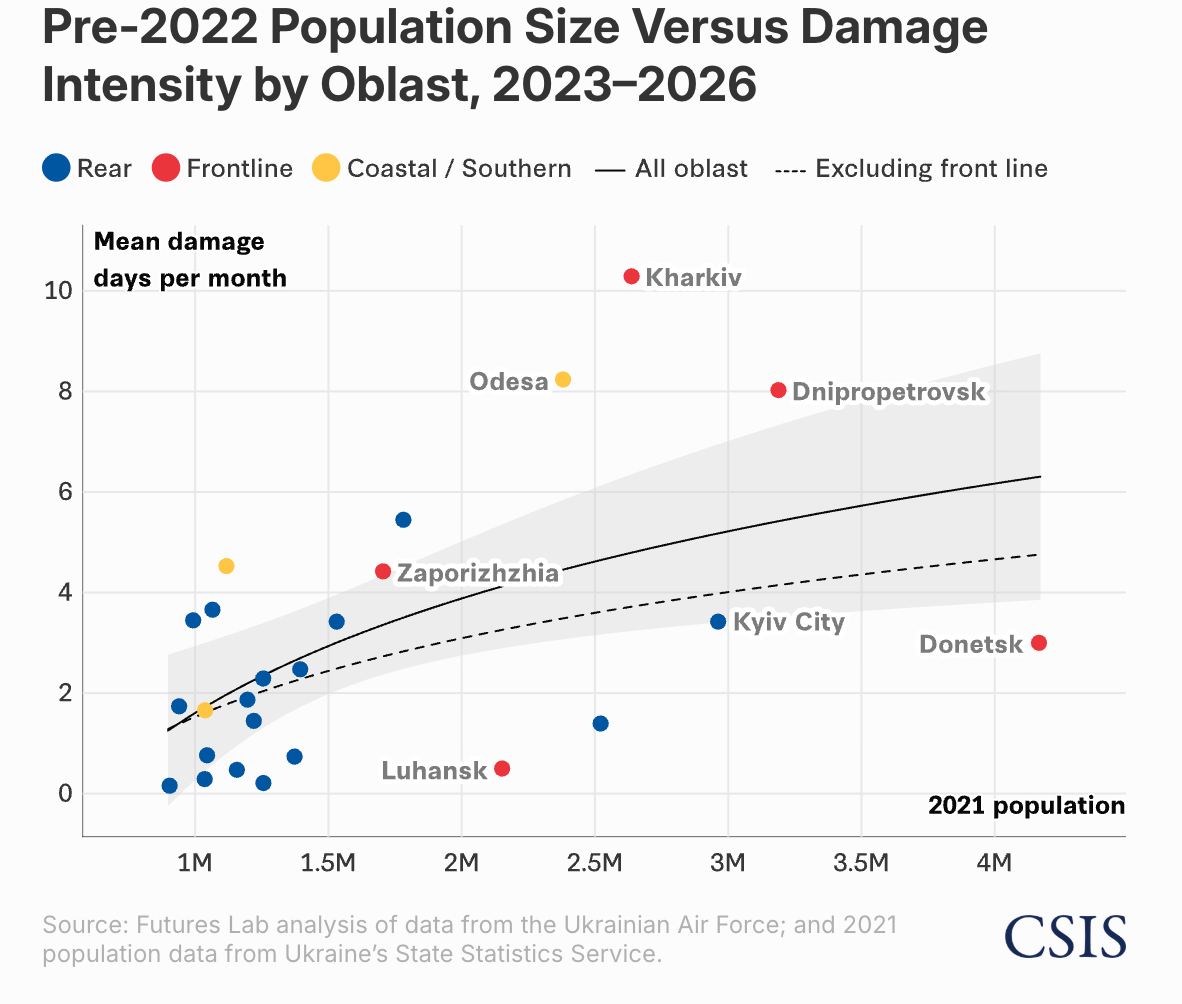
So, Russia is trying to terrorise Ukraine's population by hitting homes. Yes. But it’s more complicated than that. Russia’s missile and drone campaign in Ukraine is a coercive strategy built around geography, according to CSIS. That shows that reported damage in Ukraine has increased sharply, but it is also becoming more concentrated in frontline and southern regions, as well as areas with industrial, energy, and port infrastructure in addition to major urban centres.

“This pattern suggests that Moscow is using long-range firepower to disrupt logistics, strain critical infrastructure, pressure civilians, and impose cumulative costs on Ukraine’s ability to fight, repair, govern, and negotiate,” authors Yasir Atalan and Benjamin Jensen said in the report.

The Russian campaign has been shaped by the strategic value of targets, the rapid growth of Shahed-type drone launches, winter attacks against energy infrastructure, and the expansion of a drone-dense kill zone near the front.
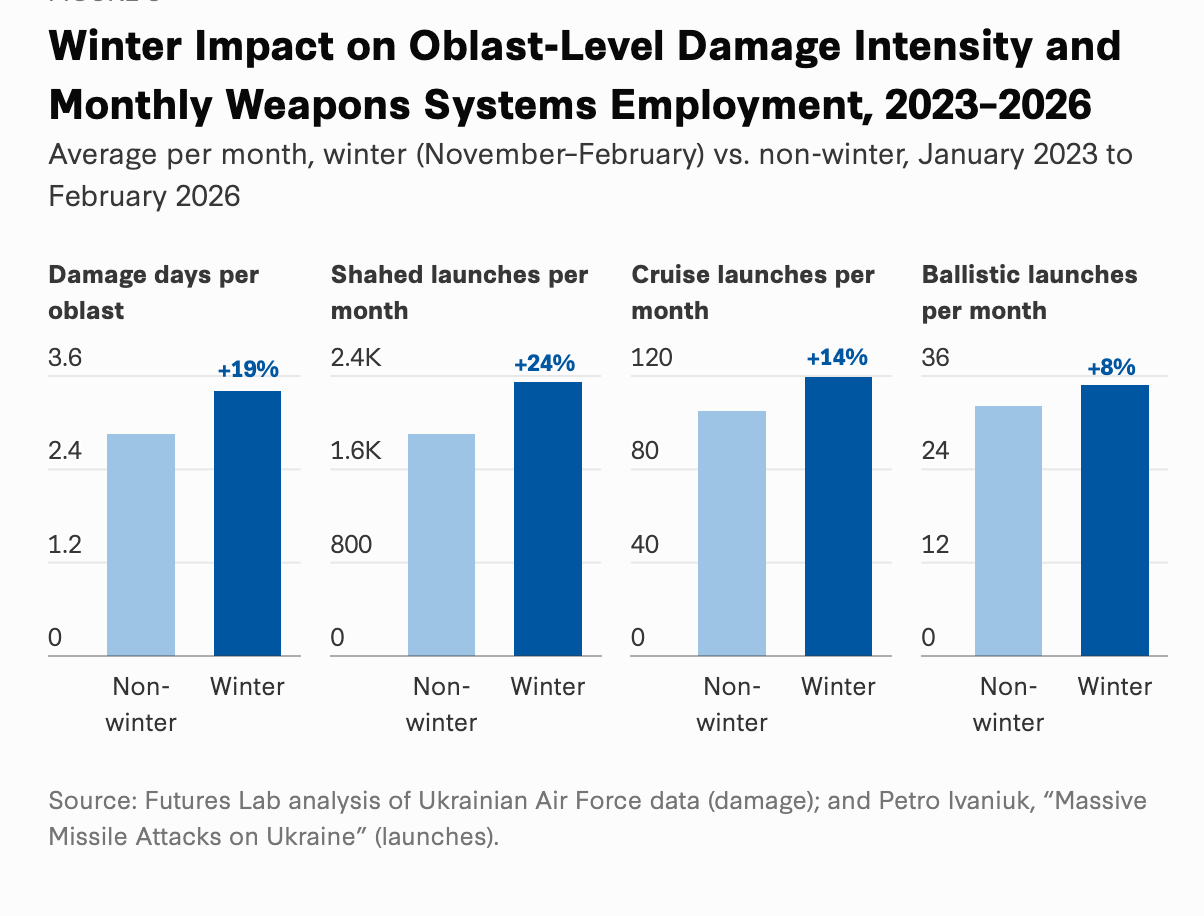
 

Shahed drones did not enter the fray until September 2022, and only in the single digits that first month. By October 2022 that rose to 510 missiles and drones of all types and by the second half of 2025, Shahed launches alone totaled 5,000–6,000 per month.

“Russia uses firepower strikes as a form of coercion to impose military, economic, and psychological costs on the Ukrainian state and society so that Kyiv and its supporters will accept an outcome more favourable to Moscow—a classic punishment strategy,” CSIS said.
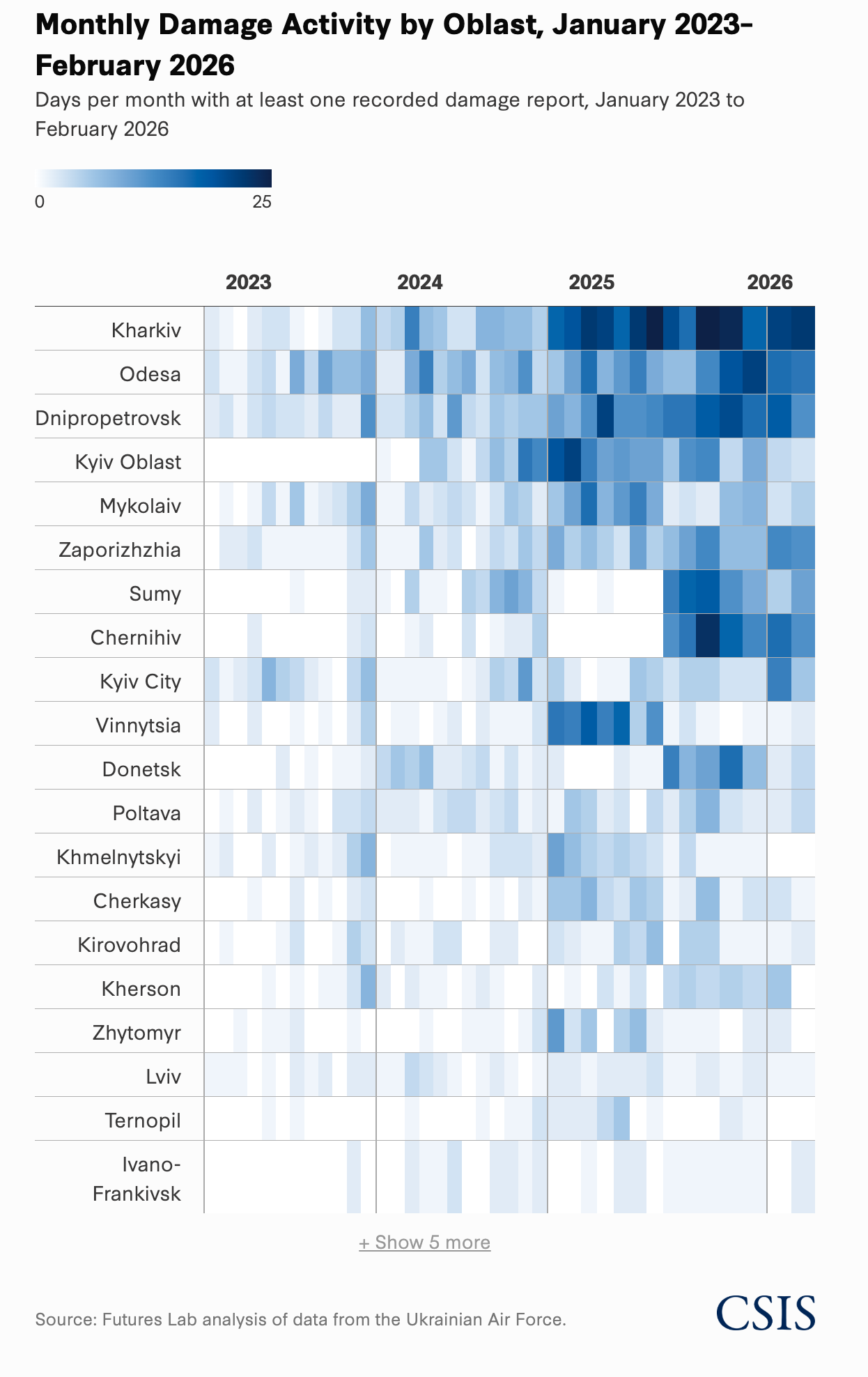
 

The analysis of Russian strikes reveals three overarching trends:

Russia’s reported strike damage has increased over time, while the geography of damage has become more concentrated in key target areas;

Many missile and drone attacks are aimed at logistical nodes that support Ukraine’s battlefield operations, especially in frontline and southeastern oblasts, where strategic strikes overlap with a denser ecosystem of artillery, glide bombs, FPV drones, and loitering munitions: and

Strategic industrial bases, energy infrastructure, ports, and major urban centers have become recurring targets as Russia seeks to raise the costs for Ukraine’s economy, civilians, and political leadership.

Attacks on critical infrastructure weaken the physical systems that allow Ukraine to move goods, repair damage, sustain industry, export commodities, and support military operations. Attacks on major cities and residential areas, meanwhile, apply psychological pressure and signal that civilian life will remain vulnerable as long as the war continues. All that is in addition to degrading the adversary’s ability to fight.

In addition, proximity still shapes Russia’s attacks. Western oblasts are targeted less often, with most reported damage remaining concentrated in eastern and southeastern Ukraine. Like Ukraine, Russia’s drone factory in the Alabuga Special Economic Zone in Tatarstan continues to innovate that allows Moscow to increase strike volume, depth, and frequency. Belarus’s operational role has also given Russia more options for routing drones and complicating Ukrainian air defense.

“Russian thinking connects this general coercive logic to a broader concept of strategic deterrence in which nuclear, conventional, informational, and nonmilitary tools are combined to shape adversary decisionmaking across peace, crisis, and war,” says CSIS.

Drilling into the geographic strike patterns they are shaped by five broad considerations: target location, range scaling, Belarusian involvement, seasonal campaigning, and the expanding kill zone near the front, says CSIS.

CSIS analysis reveals that target proximity, specifically to the front line and to Russian launch areas, influences targeting decisions.

Russia’s growing use of Shahed-type one-way attack drones has allowed Russia to scale up long-range attacks.

Belarus appears be taking on an expanded role in Russia’s strike architecture by increasingly supporting routing, diversion, and navigation for loitering munitions.

The seasonal logic of Russia’s winter energy campaigns has helped shape targeting decisions.

The spread of drones, loitering munitions, glide bombs, and artillery has expanded the contested zone near the front, making the front line and nearby rear areas more vulnerable to repeated damage.

“When examined together, these factors explain why Russia’s campaign has not simply become larger over time but also shifted how—and where—strikes are concentrated, dispersed, and sequenced,” CSIS said.
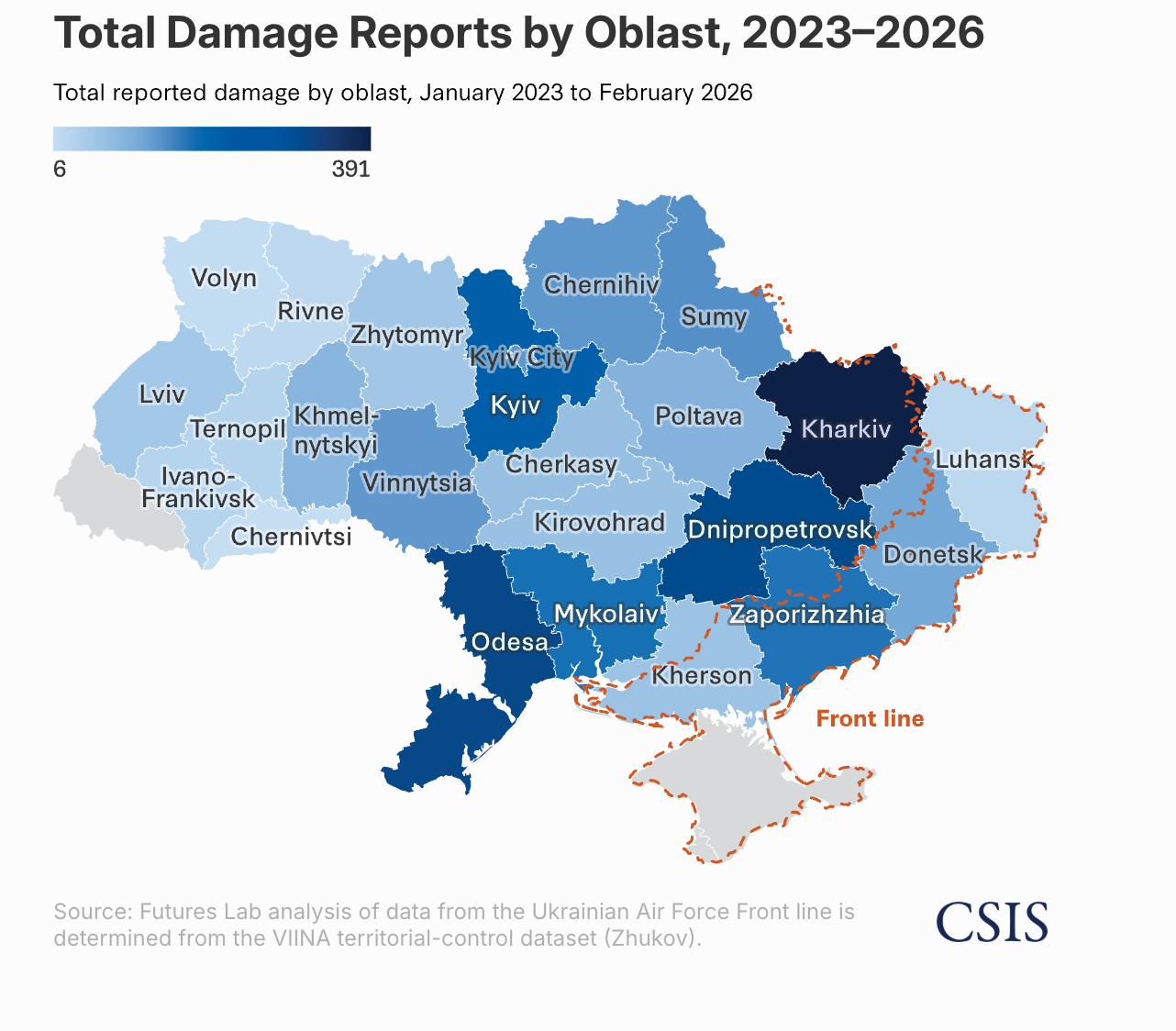
 

The final factor explaining the evolution of the strike patterns is the changing character of the battlefield near the front. Over the last two years, the traditional concept of a static front line has increasingly dissolved into a chaotic, expanding “front zone.” 

This has been the revolution that the change to modern asymmetric war has brough thanks to the cost-to-kill ratio becoming a major factor in conflicts; hundreds of cheap drones trump a few powerful and accurate missiles. Russia has both. Ukraine lacks boht the missiles and interceptors needed to bring Russia's missiles down.

But Ukraine does have millions of drones and that has resulted in a  kill zone that extends up to 30km from the forward line of contact and is characterized by mixed, overlapping positions where soldiers must prioritize basic survival and distinguishing friend from foe is highly difficult. Conventional warfare of position-vs-position has given way to a stochastic war that is entirely unpredictable and positions have become indefensible.

“In this environment, conventional linear warfare involving position-against-position combat has been replaced by isolated small teams that are sustained entirely by drone-based supply lines.,” the authors said. And as drone innovation continues this indefensible “front zone” is expanding fast. The traditional fortified trench has been replaced by the drone pilot position and much more fluid fighting. 

Ukraine’s targeting strategy

As the war moves into the air, both sides have adopted what Dr. Karl Mueller called the “power of coercive air power.” Moscow has been following this strategy since the beginning thanks to its advanced missile production and technology, but it has only become an option for Ukraine relatively recently after its investments into drone technology has produced a raft of new classes of drone. The coercer aims to shape the adversary’s course of action by making a particular option appear more attractive than the alternatives.

By contrast, the Armed Forces of Ukraine (AFU) says it goes out of its way to avoid the so-called collateral damage and strictly sticks of hitting military and industrial targets.

That claim has been supported by the sustained and escalating attacks on Russia’s oil refineries that has caused a country-wide fuel crisis, but it has been more recently put under the spotlight following a Ukrainian attack on the Russia-controlled university town of Starobilsk in the Lugansk region in Donbas in May that killed 21 people –  mostly teenaged students in their beds in a dormitory. There have also been numerous attacks on towns on the Russian side of the border on civilian railways and other logistics assets that have killed civilians.  Bankova claim there was a military target in Starobilsk. The Kremlin said there is not. Independent media access to Starobilsk was not granted.

Ukrainian strikes on Belgorod's energy grid has killed civilians but UN monitors have been unable to verify the competing claims. Those cases turn on individual targeting decisions and the evidence available to check them, not on the broader mechanics of missile stocks and refinery repair schedules.

The conflict is escalating and increasingly turning into a competition between drones vs missiles, where Russia has the overwhelming advantage in the latter. As the war goes into its fifth year, Russia uses a mix of ballistic missiles, cruise missiles, glide bombs, one-way attack drones, and first-person-view (FPV) drones to pressure Ukraine across different parts of the battlefield and in the rear.

“Because these systems serve varying purposes, glide bombs and artillery-heavy strikes are concentrated closer to the front, while ballistic and cruise missiles target higher-value infrastructure and military targets. Shahed-type one-way attack drones meanwhile enable Russia to expand the scale, frequency, and geographic reach of its strike campaign at relatively little expense,” says CSIS.

Both sides are using the escalation of the drone war to coerce the other to come to the negotiating table with improved terms. The exchange has descended into a slugfest of inflicting as much pain on the other in the hope to forcing them into talks. The upshot is both sides are more willing to engage in talks, but neither side is willing to backdown.

The slugfest has made bolstering Ukraine’s dwindling air defences critical. At the Ankara Nato summit Ukrainian President Volodymyr Zelenskiy said that Ukraine has already won on the water, pushing Russia’s Black Sea Fleet out of its home port in the Crimea, and its drone operators have brought the war on the land to standstill. “Now the war is going to be fought in the sky,” Zelenskiy told his Nato allies.

Russia is "deliberately exploiting Ukraine's shortage of Patriot interceptor missiles," Ukrainian air force spokesman Yuriy Ihnat said last week. Ballistic missiles are Russia’s “last advantage” Zelenskiy said in Ankara, against which Kyiv currently has almost no defences.

The missiles have not changed much. What stops them has.

Ukraine's long-range campaign against Russia is more focused than Russia’s. It has been specifically oil, gas and military-industrial has surged in the last year, primarily targeting Russia’s oil refineries. The attacks have also been scaled up with high profile barrages on the key Baltic oil terminals of Primorsk and Ust-Luga in June, again on St Petersburg oil facilities on the day Russia’s flagship St Petersburg International Economic Forum (SPIEF) opened and Russia’s ASEAN summit in Kazan shortly afterwards. While these attacks were on industrial targets, there was clearly a strong propaganda angle to them.

An independent analysis published by Meduza in May found the frequency of Ukrainian strikes deep inside Russia has held at more than 30 verified attacks a month since mid-2025, with "no surge in strike intensity in 2026," despite a run of high-profile hits on Moscow, Tuapse, Perm and other oil towns.

What has changed is precision rather than volume, as Ukraine’s drone tech is clearly advancing rapidly. Ukraine's military has increasingly targeted refinery components that take longer to repair than just the refineries themselves. More accurate drones can go after the distillation units, rather than randomly striking the facilities themselves, according to Sergei Vakulenko, a senior fellow at the Carnegie Russia Eurasia Center.

Previously, the small payloads of Ukraine’s drones could set fires but the damage was superficial and repaired in a matter of days. By destroying specific equipment that was imported, sanctions delay or prevent repairs. A hit on the Moscow refinery in July has taken it out of action for the rest of the year, due to the difficulty the owners have in finding spare parts.

Ukrainian drones have hit Russian refineries at least 194 times so far this year, the Financial Times reported in June, citing Polish analytical group Rochan Consulting, with the share of strikes on genuinely new targets holding at 10-20%, largely unchanged from a year earlier. Kyiv describes the campaign as "long-range sanctions" rather than a bombing surge.

The casualty pattern on Russian territory has not shown a comparable monthly climb: Russian authorities reported 47 civilian deaths across the country in May, and independent outlet Fonar's cumulative estimate for the worst-hit Belgorod region, 429 dead since 2022, has accumulated gradually rather than spiked.

Read together, the shifting patterns of strikes and targeting point to the same mechanism: each side adjusting to the other's defences and repair capacity, rather than to a shift in either government's stated targeting doctrine.

Russia's published categories, logistics, energy and urban pressure, are the same ones CSIS documented before the interceptor shortage became acute. Ukraine's own targeting categories have similarly held steady, according to a PILPG review, concentrated on oil and gas export infrastructure and military supply lines.

The quartermasters and repair crews are shaping this year's casualty count as much as the generals are -- and for now, that is the part of the story that holds up against the data.

The interceptor gap

Is Russia deliberately targeting civilians with missiles in order to terrorise the Ukrainian population?

The UN Human Rights Monitoring Mission in Ukraine (HRMMU) has recorded a steady rise in verified civilian deaths through 2026: 161 in January, 191 in February, 211 in March, 238 in April and 274 in May. Long-range missiles and drones caused 36% of civilian casualties in March and 45% in May, the mission said, with most deaths occurring in cities far from the front line.

The rise coincides with a well-documented shortage of Patriot interceptors; the only system Ukraine has capable of shooting down ballistic missiles. Stocks of the PAC-3 interceptor missiles have become so low that the AFU has started to ration them, firing only one rather than the usual two or three to bring down an inbound missile. The AFU has also been using the interceptors in manual mode to avoid them chasing slower, less sophisticated targets, like drones, which can be downed by other cheaper means. The situation is reminiscent of the artillery shell shortage that plagued the AFU in the second year of the war when it also ran out of ammo..

Ukraine’s ballistic missile interception rate has collapsed dramatically — from 40% at the beginning of the year to 20% in spring, and nearly 0% by mid-summer, according to Forbes Ukraine.  Ukraine intercepted none of 23 Iskander-M ballistic missiles and six Zircon and Oniks missiles fired at Kyiv on July 6, air force data showed; for the month, Ukrainian air defences downed just four of 49 ballistic missiles fired at the country.

The shortage of interceptors is global, not Ukraine-specific: production of Patriot interceptors has been stretched by simultaneous demand from conflicts in the Middle East, leaving Kyiv competing with other buyers for a dwindling supply.

With Patriot missile stocks running critically low, US President Donald Trump has promised Zelenskiy a licence to make Patriot missiles during the Nato summit. However, as IntelliNews reported it could take years to set up a factory and the need for air defence is now. Patriot interceptors are amongst the most complex missiles in the world and strict American technology controls as well as severe supply chain shortages means Ukraine is unlikely to be able to make domestically produced interceptors for several years.