Saturday, September 26, 2026


Coal India digs beyond coal into batteries, renewables and critical minerals

Coal India digs beyond coal into batteries, renewables and critical minerals
/ Albert Hyseni - UnsplashFacebook
By IntelliNews - Mumbai bureau September 25, 2026

State-owned coal mining giant Coal India (NSE: COALINDIA) has an ambitious plan to expand into new areas. According to a government of India note published on September 20, the company is planning to expand its footprint in coal gasification and coal-to-chemicals, thermal and renewable energy and battery storage, critical minerals and even advanced materials and diversified minerals.

At present, Coal India Ltd (CIL) is involved in four coal gasification and coal-to-chemicals projects spanning fertilisers, industrial chemicals and synthetic natural gas (SNG). The coal gasification process involves conversion of coal to synthesis gas, or syngas, which can then be utilised to produce SNG, ammonia, urea, ammonium nitrate, methanol and a number of other chemicals.

Coal India’s two coal gasification projects come in the form of Talcher Fertilizers with its annual urea production capacity of 1.27mn tonnes and Bharat Coal Gasification & Chemicals with capacity to produce 0.66mn tonnes of ammonium nitrate each year.

CIL is also participating in two SNG projects with Coal Gas India Ltd having the capacity to produce 633.6mn normal cubic metres (Nm³) of SNG annually, while the CIL-BPCL Chandrapur coal-to-SNG project is designed to produce an additional 633.6mn Nm³ per year.

On the coal gasification front, CIL is working on a pilot project at the Kasta West Block of Eastern Coalfields. The first phase came online in May last year, while the second phase started in June.

In the power sector meanwhile Coal India is working in-sync with Damodar Valley Corporation (DVC) to set up a 2×800 MW brownfield expansion at Chandrapura in the coal-rich eastern Indian state of Jharkhand, through an equal joint venture partnership.

The company is also eyeing a significant presence in the renewable energy space. It has already commissioned about 550 MW of solar capacity.  In addition to this, CIL is now looking at rooftop solar projects as well as ground-mounted and captive solar power projects. Reports suggest company plans to work via two separate models: solar power projects for captive use and commercial renewable-power projects.

Since battery storage is a vital chain in the renewable energy ecosystem, CIL is marking its presence there as well. An 187.5-MW/750 MWh battery energy storage system (BESS) project is currently under development for TGGENCO at Choutuppal in the state of Telangana, with a four-hour storage duration, the government said.

Added to this, CIL is developing an 80-MW/320 MWh BESS portfolio across four locations in Odisha with another four-hour duration period planned when finished.

With the rapid growth in industries such as battery storage, electric vehicles, renewable energy, electronics, advanced manufacturing, aerospace and defence, the requirement for critical minerals has also become very important. To capitalise on this opportunity, CIL intends to use its graphite assets in Madhya Pradesh and Chhattisgarh, as well as rare earth element and rare-metal assets in Andhra Pradesh and Maharashtra. As a result, the company is looking to set up an integrated graphite value chain.

R&D

Coal India is also boosting its research & development expertise. At present, the company funds the CIL Centre of Sustainable Energy at the Indian Institute of Technology (IIT) Madras with INR879mn ($9.16mn) dedicated to focusing on sustainable materials, mine repurposing and energy transition.

The company also supports CLEANZ at IIT Hyderabad, an INR980mn project with a focus on clean coal technology and low-grade Indian coal.

Furthermore, CIL is expanding its research and innovation programme, with a focus on digital mining, automation, advanced energy technologies and the development of indigenous solutions for the coal sector. Linked to this, the company has set up the CIL Centre for Innovation in Mining at IIT (ISM) Dhanbad with financial support of INR675mn - the centre is working on Mining 4.0 technologies, the Internet of Things (IoT), smart mining systems, immersive technologies and 5G applications.

A separate CII Centre at IIT (ISM) Dhanbad has received INR100mn and focuses on innovation and incubation, including prototyping, virtual reality, simulation and automation technologies.

Looking at the bigger picture, CIL’s wider R&D portfolio is made up of 20 projects with a total outlay of INR2.31bn. The projects cover technologies intended to improve mining efficiency and safety while supporting the company’s transition towards new energy and technology-driven operations. Key initiatives include an underground coal gasification project at Kasta West, the deployment of 5G captive networks across opencast and underground mines, development of bifacial perovskite solar cells and the application of artificial intelligence and geophysical exploration technologies for critical mineral exploration.

To this end, CIL has been consistently upping its R&D spending in recent years. Expenditure increased from INR613mn in FY2023-24 to INR2.46bn in FY2024-25 before declining to INR1.84bn in FY2025-26. It has provisioned an R&D budget of INR2.25bn for FY2026-27. The planned allocation rises to INR3.5bn in FY2027-28, INR4bn in FY2028-29 and INR5bn in FY2029-30.

The government of India has thus outlined a broader technology strategy for Coal India that includes strengthening the National Coal Conservation and Energy Efficiency Rating (NaCCER), expanding the hub-and-spoke model for research and accelerating the movement of technologies from research and development to commercial deployment.

It is a strategy that places greater emphasis on indigenous and future-ready technologies, with coal gasification, advanced materials, battery technologies and other emerging solutions identified as areas with potential to support the sector’s longer-term needs and reduce reliance on imported technologies.

 

Extreme El Niño could cost Latin America 2% of GDP, ECLAC warns

Extreme El Niño could cost Latin America 2% of GDP, ECLAC warns
/ unsplashFacebook
By bne IntelliNews September 23, 2026

An extreme El Niño event could wipe at least 2% off Latin America and the Caribbean's gross domestic product over three years and push as many as 4.8mn more people into poverty by the end of the decade, the United Nations Economic Commission for Latin America and the Caribbean (ECLAC) said in a new report.

The Santiago-based commission said half of the cumulative output loss would come in the first year after the event. It expects energy, fishing, agriculture and some infrastructure to suffer most. The warning came in a special report led by ECLAC Executive Secretary José Manuel Salazar-Xirinachs.

"Responses adopted once the emergency has been declared are considerably more expensive than preventive measures based on adequate anticipation. It is imperative that we shift from a response after losses to anticipatory management of climate risk," Salazar-Xirinachs said.

The report cited projections from the US National Oceanic and Atmospheric Administration (NOAA). NOAA puts the chance of El Niño reaching very high intensity during the northern hemisphere's autumn and winter of 2026-2027 at more than 90%. It gives a 69% probability of a historic "Super El Niño", with sea surface temperature anomalies of more than 2.5C or 3.0C in the Niño 3.4 region.

ECLAC said human-driven climate change was amplifying natural variability. It noted that global average temperatures were 1.55C above pre-industrial levels in 2024.

The commission said the economic effects would vary widely across countries and would last. It expects lower real output, inflationary pressure and higher poverty, as falling household income feeds through the region's economies.

Power grids exposed

The report said the region's power sector was especially vulnerable. Hydropower accounts for more than 70% of electricity generation in several countries, and more than half of installed capacity is over 30 years old.

ECLAC estimated a 60% chance of below-normal rainfall in the October-December quarter. It said 31.1% of the region's territory was on high alert. Hotter weather would drive up demand for air conditioning in cities such as Lima, São Paulo and Mexico City while water supplies were shrinking. According to the report, that raises the risk of blackouts and higher operating costs.

Fisheries and farms at risk

A weaker upwelling of cold Pacific waters would reduce phytoplankton and disrupt the marine food chain, ECLAC said. That could send stocks of anchovy, sardine and hake deeper or push them to migrate. During earlier Super El Niño episodes, the regional fish catch fell 52.7% in 1972-1973 and 26.9% in 1997-1998. Those episodes also brought harmful algal blooms and widespread coral bleaching.

ECLAC cited analysis by the Food and Agriculture Organization (FAO) showing a more than 70% probability of drought hitting agriculture in the coming months in several areas. These are Central America's Dry Corridor, Colombia, Venezuela, Cuba, the Dominican Republic and Haiti. The report said drought could threaten staple crops, animal feed supplies and rural incomes.

Call for anticipatory action

To stop climate shocks from turning into prolonged social and economic crises, ECLAC urged governments to adopt a 10-point policy package. It called for climate risk to become a permanent part of national policymaking and regulation. It also called for stronger protection of strategic infrastructure, wider early warning systems, and financial buffers such as reserve funds, catastrophe bonds and insurance.

The commission also recommended targeted cash transfers to vulnerable households and support for livelihoods in the Dry Corridor and fishing communities. It called for restoring reefs and mangroves and for flexible fishing quotas and closures. On energy and water, it urged countries to add more solar and wind power so grids depend less on rainfall, share energy reserves and manage cross-border river basins jointly. It also recommended curbing urban power demand during heatwaves.


LATAM BLOG: Trump keeps Machado's medal and Rodríguez's oil

LATAM BLOG: Trump keeps Machado's medal and Rodríguez's oil
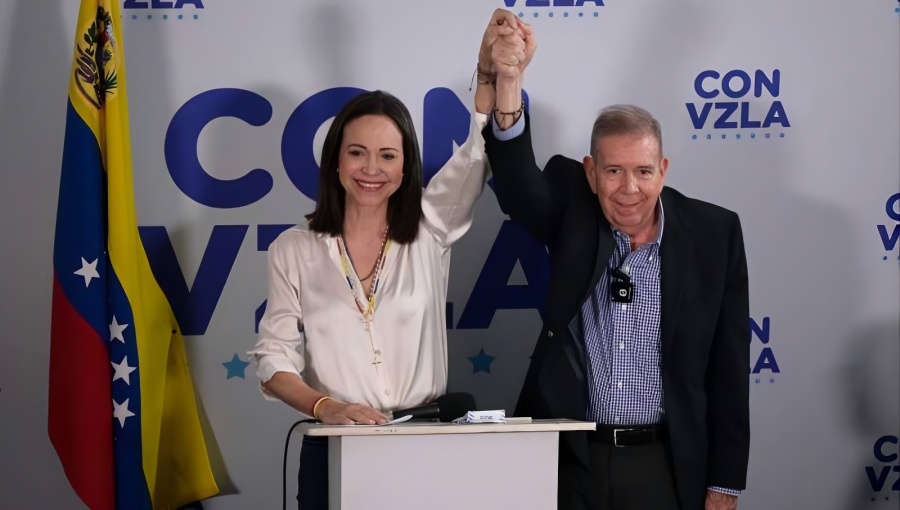
María Corina Machado and Edmundo González, the opposition's 2024 candidate. Machado has been unable to return to Venezuela despite repeated attempts.

By Cynthia Michelle Aranguren Hernández September 24, 2026

María Corina Machado made three failed attempts to reach Venezuela from Panama by sea and air on September 21 and 22, her team said. On the second of those days Delcy Rodríguez, the country's acting president, held her first meeting with Donald Trump in New York.

The latest setbacks bring to seven the number of thwarted homecomings since the opposition leader and Nobel Peace Prize laureate left Venezuela clandestinely in December, according to Pedro Urruchurtu, her international relations adviser. "They are not allowing her to return to her own country," he wrote on X.

The overlap of dates captures how far Machado's fortunes have turned. On January 15, she presented Trump with her Nobel medal, framed and inscribed, calling it "recognition for his unique commitment with our freedom". The Norwegian Nobel Committee had already stated that the laureate's title can be neither shared nor transferred, and critics dismissed the gesture as a last-ditch bid for Trump's favour. The US leader nonetheless called the gift "a wonderful gesture of mutual respect". Shortly after US forces seized Nicolás Maduro on January 3 and whisked him to New York to face narcoterrorism charges, Trump said Machado lacked "the support or the respect within the country". It was a striking verdict. Barred from the July 2024 presidential election by the regime-controlled Supreme Court, the firebrand opposition leader had backed Edmundo González to stand in her place, and Washington itself later recognised him as the winner of a vote Maduro stole.

Yet Trump has since built his Venezuela policy around Rodríguez, Maduro's former vice-president, who took over after his capture and has proved receptive to US demands, opening the oil and mining sectors to foreign investors and releasing hundreds of political prisoners. On the day Machado lunched at the White House, Rodríguez was delivering the state of the nation address in Caracas, tiptoeing between keeping the Chavista base happy and starting to meet Washington's demands. Trump, who called her "a terrific person" who is “doing a great job,” has seemed content with the arrangement ever since.

Eight months on, Machado cannot get home. This week's first attempt was to be made by boat through the Panama Canal and across the Caribbean. Immigration formalities had been completed when the operator cancelled, citing mechanical problems, according to Idania Chirinos, an NTN24 journalist travelling with her. Plans to fly to Aruba and Curaçao and continue by sea also came to nothing. Machado holds a diplomatic passport that Panama issued on humanitarian grounds. Spanish daily ABC, whose correspondent accompanied her, said the document confers no citizenship.

Her team has not said who stopped her. A flight manifest listed her among the passengers of an aircraft that never took off, but it does not explain why. Asked about the matter, Trump denied telling her not to return.

The evening in New York gave Rodríguez rather more. The White House described the encounter as an informal pull-aside at a reception Trump hosted on the sidelines of the UN General Assembly, and published no readout. Marco Rubio, secretary of state, Scott Bessent, Treasury secretary, and senior aides Susie Wiles and Stephen Miller attended. Rodríguez called it "a historic meeting" that advanced co-operation on energy, mining and security.

Behind the handshake sits a major oil agreement Trump announced on August 28. Under it, a US-backed operator will develop 17 fields holding an estimated 65bn barrels, about a fifth of Venezuela's proven reserves. This month Washington also removed Venezuela from its list of countries that have "failed demonstrably" to combat drug trafficking, the first time it has escaped that designation since 2005.

Machado's exclusion owes as much to Washington as to Caracas. Twin devastating earthquakes struck northern Venezuela on June 24, eventually killing more than 6,500 people, and her most determined push to go home came in their aftermath. The Wall Street Journal reported that she boarded a private flight in Virginia bound for Curaçao, a trip cleared with US authorities. The aircraft was turned back over North Carolina after Washington signalled it did not support the journey. She flew commercially to Panama on June 28, where Copa Airlines then refused to let her board a flight home, citing fears of reprisals from Caracas.

Machado accused the Rodríguez government of shutting commercial airspace to keep her out, adding that it "had to reverse the decision". The authorities said the main airport at Maiquetía had closed because of severe earthquake damage, and US marines were later deployed to help rebuild it.

Washington's argument was that her return would distract from relief. US officials called it "counterproductive", and administration officials anonymously dismissed her persistence as "grotesque political opportunism". On July 15 Cartwright Weiland, a State Department official, told Congress: "She is a Venezuelan citizen and has the right to return." Rubio, long Machado's most prominent champion in Washington, was reported in January to have argued against backing her after Maduro's ouster, and in June urged her to be patient. This month he said she was entitled to return whenever she chose, and that Washington wanted her to have security guarantees.

Meanwhile her political space has narrowed. US-brokered talks between the Rodríguez government and parts of the opposition, under way since August, exclude Machado and Edmundo González. On September 2 Trump said Venezuela was not "ready yet" for a vote. Rodríguez said: "I don't set a date." The constitution's 180-day limit on an interim presidency has already expired.

That leaves Machado campaigning from abroad. On September 20 she endorsed a proposal by Bernie Moreno, a Republican senator, for a presidential election on July 24 2027, a date neither Caracas nor Washington has backed. Three days later Rodríguez used her debut address to the UN General Assembly to pledge that Venezuela would hold elections, but she declined to say when. "The Venezuelan people, with their ancestral wisdom, will decide the right moment," she said.

Machado's standing at home is an asset Washington has so far chosen not to use, preferring to strike lucrative deals with what is, in effect, a facelifted continuation of the very Chavista regime that wrecked the country's oil industry over the past two decades. An AtlasIntel poll for Bloomberg, taken in the days after the earthquakes, put Rodríguez's disapproval rating at 63.3% and found that Venezuelans trusted Machado more than state institutions. More than half of respondents rated the government's response to the disaster "very poor", and 45.7% said electing a new president mattered more than reconstruction.

Analysts see the imbalance in the relationship with Washington as the defining fact of Rodríguez's rule. "Delcy Rodríguez is a hostage of Trump as long as he is in the White House," María Isabel Puerta Riera, a political scientist, told Efecto Cocuyo. Machado's predicament mirrors it. Her fate also rests with a president who accepted her prize but not her claim to lead.

Croatian opposition seeks to oust PM over waste scandal

Croatian opposition seeks to oust PM over waste scandal
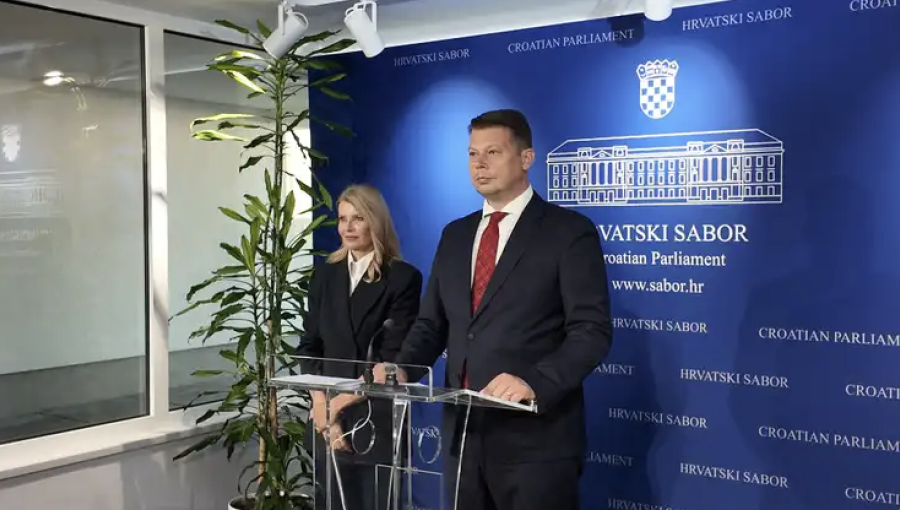
SDP leaders announce they are seeking a vote of confidence in PM Andrej Plenkovic. / SDPFacebook
By IntelliNews September 26, 2026

Croatia's main opposition Social Democratic Party (SDP) has submitted a no-confidence motion against Prime Minister Andrej Plenkovic over the illegal dumping of tens of thousands of tonnes of waste near the central town of Gospic, escalating political pressure on the government over the environmental scandal.

SDP lawmakers submitted the motion to parliament on September 25 with 54 signatures, seeking a debate on Plenkovic's political responsibility for the affair, a party statement said. The initiative has also won support from the green-left Mozemo! party and several smaller opposition groups, while the right-wing Most party and independent MPs Marija and Nino Raspudic have signed the motion.

"Today, we submitted a proposal to the Croatian parliament to initiate a vote of confidence in Prime Minister Andrej Plenkovic, along with 54 collected signatures from MPs," SDP political secretary Sasa Djujic told a news conference in parliament.

The motion focuses on the discovery of between 34,000 and 37,000 tonnes of waste at an industrial site near Gospic, much of it imported from Italy in 2023 and 2024. Investigators suspect illegal waste-management activities, while prosecutors are examining possible corruption and failures of state oversight.

Djujic said the scale and duration of the dumping meant political responsibility extended beyond those directly involved in handling the waste.

"Andreј Plenkovic has been leading the government for years, which passes regulations, regulates oversight and elects people to lead institutions," he said. "Citizens therefore have the right to demand an answer from him as to how the system he leads allowed such a case."

The opposition argues that around 37,000 tonnes of waste could not have been transported and stored over several years without failures in supervision. It also links the affair to changes in waste-management regulations and what it describes as a weakening of safeguards protecting the public interest.

The SDP also highlighted the State Inspectorate and its former head Andrija Mikulic, who was appointed by Plenkovic's government and was arrested in November 2025 in a corruption investigation related to illegal waste disposal. Mikulic denies the allegations.

"We are particularly raising the issue of the State Inspectorate and the corruption suspicions related to its former head, Andrija Mikulic, who was appointed by the Plenkovic government," Djujic said.

SDP deputy speaker Sabina Glasovac accused the government of systematically weakening environmental controls, saying waste imports had tripled since 2015 while supervision had declined.

"Waste imports have tripled since 2015, supervision has been decreasing for ten years and the control system has been weakening, you abolished shipment notifications in 2019 and the importer register in 2021, while fines have been reduced seven times," she said.

The controversy has intensified following public protests. Thousands gathered in central Zagreb on September 5 for a demonstration organised by the NGO Gospić je naš dom, demanding action over the waste stored near Gospic. The protest came after repeated government promises to accelerate the cleanup.

The government says the operation is unusually complex because much of the material is buried and there is no suitable facility in Croatia for its disposal. It has selected contractors to cover the site and remove waste stored in bags and is seeking a European company capable of handling the buried material.

Plenkovic said earlier this month that the cleanup was entering a new phase and that a procedure for removing the buried waste should be completed within 20 days. The government estimates that about 4,500 tonnes of waste is on the surface, with another 32,000 to 33,000 tonnes of ash buried at the site.

Environmental concerns were heightened this week by findings from experts working with Croatia's anti-corruption office USKOK, which detected hundreds of thousands of microplastic particles in groundwater monitoring wells near the site. The findings do not establish that public drinking water is unsafe, and the government has said testing has found no evidence requiring residents to stop using the public water supply.

The SDP argues, however, that the case exposes wider weaknesses in Croatia's waste-management system.

"Our position is clear - the prime minister must be held accountable for the way his government managed this problem and for the lack of timely protection of citizens," Djujic said.

The government has rejected opposition claims that it bears political responsibility for the illegal dumping, stressing that prosecutors and anti-corruption investigators are pursuing those responsible and that the priority is to remove the waste safely.

Turkey's electric car share leaps from 1% to 22% in three years

By Ben Aris in Berlin September 25, 2026

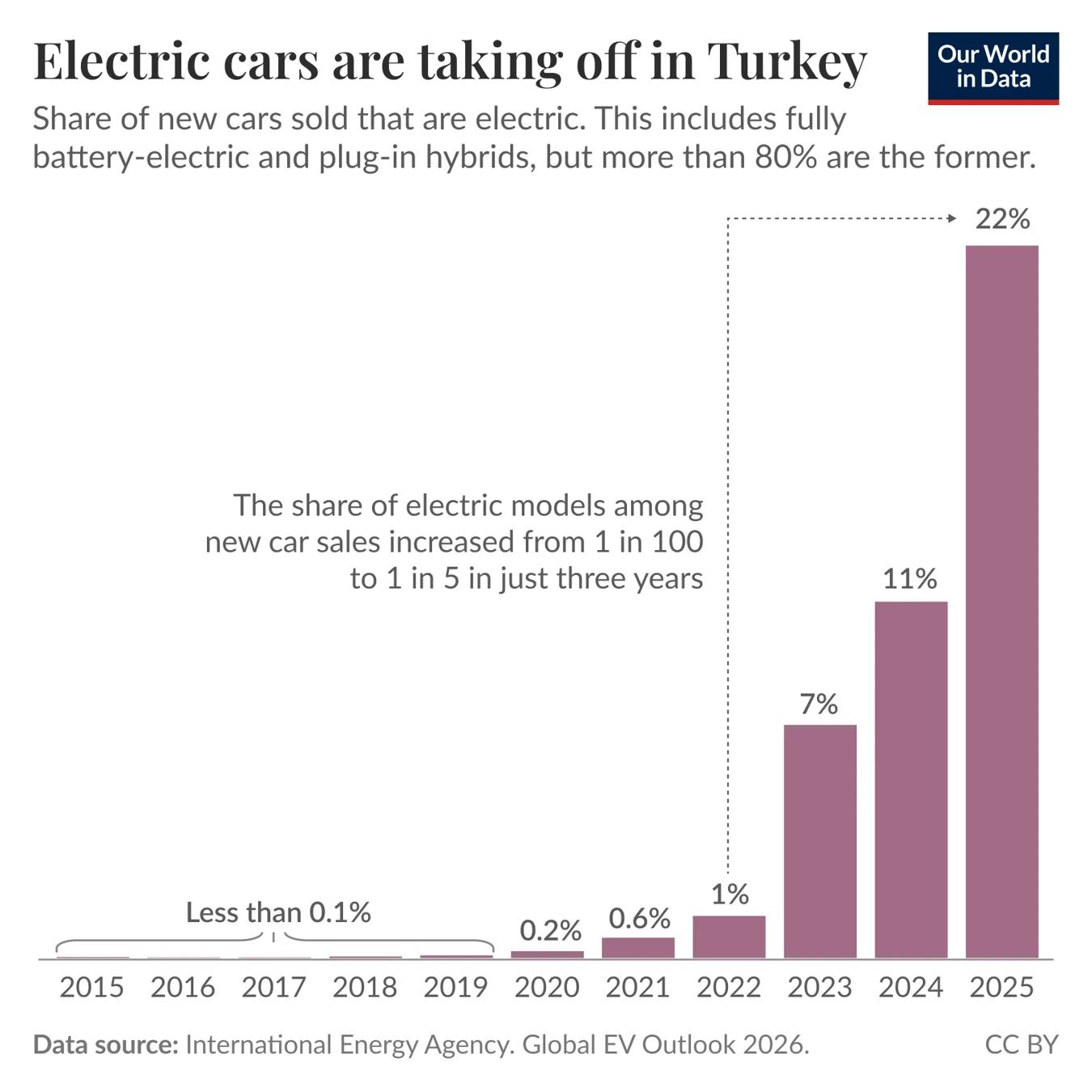
More than one in five new cars sold in Turkey in 2025 was electric, up from one in 100 in 2022, data compiled by Our World in Data show.

Share of new cars sold in Turkey that are electric, 2015-2025, including plug-in hybrids. Source: International Energy Agency, Global EV Outlook 2026, chart by Our World in Data (CC BY).

Electric models took 22% of new car sales last year, double the 11% of 2024 and up from 7% in 2023, according to figures from the International Energy Agency's Global EV Outlook 2026. As recently as 2020 the share was 0.2%. The numbers include plug-in hybrids, but more than 80% of the cars are fully battery-electric.

The data show a more than twentyfold rise in three years. The website credits a 2023 tax change that cut the registration tax on electric cars relative to petrol and diesel models, timed to coincide with the launch of Togg, the government-backed domestic EV maker that quickly became market leader, along with cheaper imports, many of them Chinese. By 2025 Turkey had matched the EU average for the electric share of new car sales.

The boom rode on a record year for the car market in 2025, when passenger car and light commercial vehicle sales rose 10.5% to 1.37mn units, according to the Automotive Distributors and Mobility Association (ODMD). Nearly 192,000 fully electric cars were sold, up 82% y/y, with Togg delivering 39,020 and Tesla 31,509.

Growth has slowed in 2026 as the overall market contracts. Electric car sales fell 12.3% y/y to 105,951 units in January-August, and dropped 32% in August alone, ODMD data show. Because passenger car sales fell faster, down 13.8% to 564,241, the fully electric share still edged up to 18.8% in the first eight months. Hybridstook a further 33.1%, meaning more than half of new cars sold had some form of electric drive.

The slowdown is concentrated at the top end. Sales of electric models rated above 160 kW fell 65.3% in January-August, while those below that threshold rose 7.3%. Togg has kept its lead, selling 30,734 cars in the period against 4,368 for Tesla.

Electric cars remain a small part of the fleet. There were 472,157 registered at the end of August, up 53% y/y but still only 2.6% of Turkey's 18mn passenger cars.

Schneider Electric to launch €1.2bn bid for Bulgaria's Shelly

Schneider Electric to launch €1.2bn bid for Bulgaria's Shelly
Bulgarian smart-home technology maker Shelly Group at IFA Berlin. / Shelly GroupFacebook
By bne IntelliNews September 24, 2026

France's Schneider Electric (SCHN.PA) plans to launch a voluntary public takeover offer for Bulgarian smart-home technology maker Shelly Group (SLYG.BB) at €70 per share, valuing the company at about €1.2bn, the companies said on September 24.

The acquisition would expand Schneider's presence in connected homes and residential energy management, combining Shelly's smart-device and software platform with Schneider's global reach and energy-management expertise.

Shelly shares rose 4.3% by 0859 GMT, while Schneider shares fell 0.5%.

The all-cash offer represents a 22% premium to Shelly's September 23 reference price and a 27% premium to its unaffected price on July 28, the companies said.

The offer is subject to regulatory approval and a minimum acceptance threshold of 95%. Schneider expects the deal to close in the first quarter of 2027 and said it intends to pursue full ownership and a possible delisting if successful.

Shelly's founders, Dimitar Dimitrov and Svetlin Todorov, who together hold about 57% of the company, support the deal and have agreed to sell their stakes under certain conditions.

Dimitrov, who owns about 29% and is co-CEO, plans to tender his shares and reinvest part of the proceeds alongside Schneider. He is expected to remain co-CEO after completion. Todorov, who owns about 28%, has agreed to sell his stake in two tranches, with the second subject to merger-control clearance.

RBC Capital Markets analyst Mark Fielding called the deal a "sensible bolt-on acquisition" that continues Schneider's smart-buildings strategy, noting that its value was less than 1% of Schneider's market capitalisation.

Jefferies said the deal had "strong rationale and high potential for synergies" with Schneider's residential business.

Shelly, which sells smart plugs, meters, locks and cameras as well as cloud services, has grown revenue by more than 40% annually since 2022 and sells products in more than 100 countries.

The Sofia-based company reported first-quarter 2026 revenue of €33.3mn, up 25.6% year-on-year.

Shelly said Schneider intends to maintain its headquarters, organisational structure and workforce in Bulgaria for at least three years after completion, including its research and development and engineering operations.

The offer has not yet been formally registered or published. Schneider's bid vehicle is expected to register it with Bulgaria's Financial Supervision Commission, with clearance expected by late November or early December.

Shelly announced in July that it was in preliminary talks with Schneider over a potential offer.

Bulgaria's battery boom: From zero to global leader


Mihail Ivanov  
in Sofia
DW

In under two years, Bulgaria has become one of the world's most battery-intensive energy markets. Can the surge last — and what will it mean for conventional power generators?


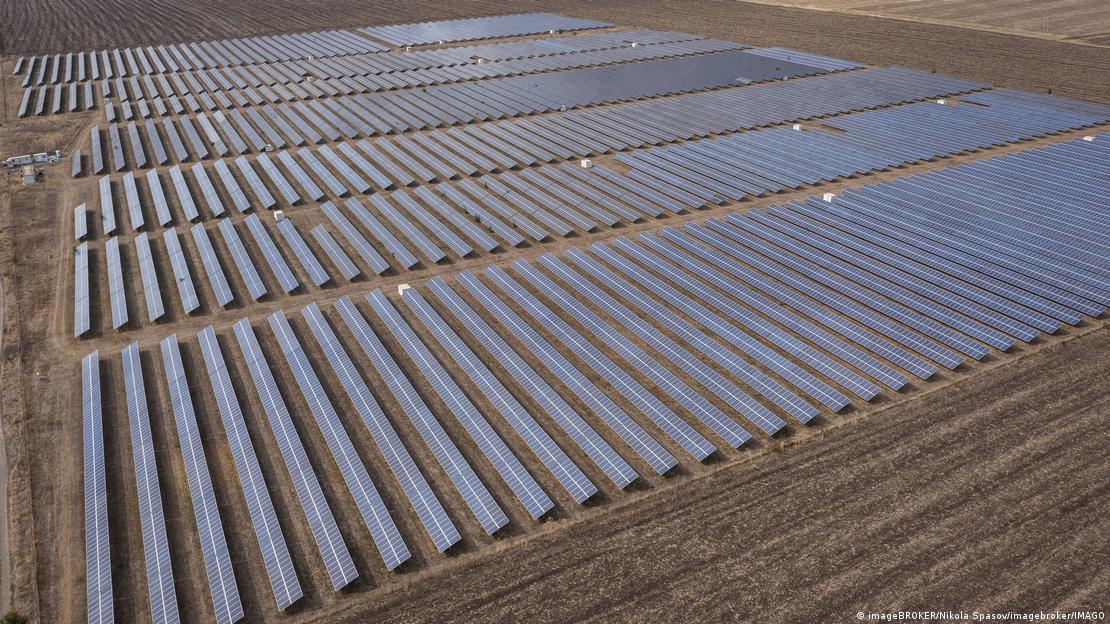
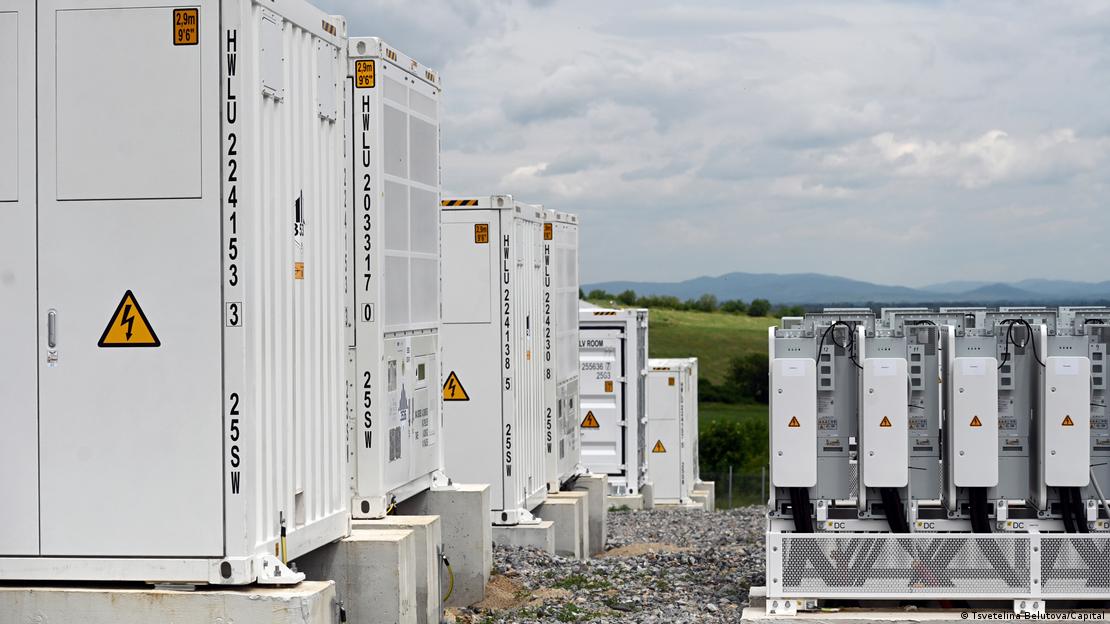
Powerhouse in southeastern Europe: Bulgaria has one of the world's highest ratios of battery storage to total power capacity in the world. Pictured here: a solar park with storage batteries in Maglizh, Bulgaria
Image: Tsvetelina Belutova/Capital


The international energy sector currently has a curious case study in an unlikely place: Bulgaria, a country in southeastern Europe with a population of just 6.4 million, now has one of the world's highest ratios of battery storage to total power capacity, outpacing markets like California, Germany and China.

In less than two years, Bulgaria's battery storage capacity has gone from zero to making up nearly a quarter of the country's total installed power capacity, fueled by EU funding and private capital worth close to €3 billion ($3.4 billion), according to calculations by Bulgaria's leading business publication Capital.

Bulgaria was lucky enough to escape the worst of the heatwaves and droughts that forced a cut in nuclear and hydro output in Hungary and Romania this summer.

During that period, it turned its batteries into a key grid stabilizer for neighboring markets and profited by storing cheap solar power and selling it in the evening when prices spike
.
Bulgaria used its batteries this summer as a key grid stabilizer for neighboring markets
imageBROKER/Nikola Spasov/imagebroker/IMAGO

And while experts say the Bulgarian battery boom went "under the radar," it remains to be seen how this rapid development will affect the other generators of power, whether the current business model is sustainable and whether private investment will dictate a shift in the national strategy for the country's energy transition.

What is the Bulgarian battery boom?


In January 2026, a report by the energy think tank Ember estimated Bulgaria's battery capacity — both operational and in the pipeline — to be 1.66 GW.

Eight months later, capacity had more than tripled to 5.4 GW, according to data from ENTSO-E. Bulgaria's Ministry of Energy told AFP it had already reached 5.7 GW.

"Two years ago, no one imagined we would have even half of this capacity," Ivaylo Stanchev, editor-in-chief of the business publication Capital, told DW.

Stanchev compiled one of the country's most comprehensive lists of battery projects, filling a gap left by the absence of an official public database. The list itself reflects investment levels that have outpaced official forecasts.

Ivaylo Stanchev, editor-in-chief of the business publication Capital, says that Bulgaria having this kind of battery capacity was unimaginable just two years ago
Image: Capital

While the rapid battery buildout was sparked by the Next Generation EU recovery fund and the subsequent RESTORE programs, which approved €700 million ($797 million) in funding for 113 projects, Stanchev estimates that private investment amounted to almost three times that figure: roughly €2 billion.

Although most of the lithium batteries come from China, the investors are mostly from Bulgaria or from other European countries, which see potential in the growing niche.

How much can the batteries store?

"When fully charged, the batteries can store enough energy to power the whole country for several hours," said Stanchev, drawing a comparison that, although practically impossible, illustrates the scale of the development.

Its effects are already tangible: Bulgaria produces a large amount of solar energy and buys more from Greece and Romania.

Daily prices during the summer tend to be low or even negative during the sunniest hours of the day, allowing batteries to buy cheap energy, store it and discharge it in the evening, when local and international markets need it, at a higher price.

The main export destination is Romania, which was particularly badly hit during the summer as it had to reduce nuclear capacity because of the drought along the Danube.

Bulgaria, historically a net exporter, has thus turned into a regional battery hub, with an operational storage capacity that is now greater than that of Greece and Romania combined.

What is the impact of this rapid development?

There is no measurement that isolates the batteries' specific electricity price contribution, but Bulgaria's average price fell relative to other countries in the region during the first summer of large-scale battery operation.

And while households in Bulgaria are subject to fixed electricity prices set by the state and have not yet seen a reduction in their electricity bills, industrial companies benefited from the change.

"Between August 1 and August 16, the average day-ahead electricity price per MWh in Bulgaria was €132.2 — almost €14 lower than the price in Romania, even though they used to be almost equal," said Stanchev, adding that the difference comes mainly from the evening hours where the batteries' effect is most at play.

Additionally, the batteries bring more security to the grid both domestically and regionally — as well as more revenue from exports and potential tax revenue from the company profits, he explained.

It is estimated that approx. €700 million in EU funding and roughly €2 billion in private money have powered Bulgaria's battery storage boom
Image: Tsvetelina Belutova/Capital

Yet, these effects are part of the summer period snapshot, raising questions about the sustainability of the model throughout the year.
Is this all good news?

"Such record development should always be taken with a pinch of salt," said Kaloyan Staykov, chair of the Management Board of the Energy Management Institute in Bulgaria, adding that the year-long effects of the vast battery buildout "are yet to be seen."

Staykov argues that, while a positive development for the market overall, the shift has come at a cost for conventional energy generators.

"While the electricity price during the evening peak is now down, the generation that used to be more profitable during those hours needs to make up for the lower revenue stream, which pushes up the baseload price," he said.

This issue points to a broader one. "Investments in batteries go beyond any national strategy for what the sector will look like in 10 or 20 years' time," he said, adding that "the role of national strategic roadmaps is changing from a leading one, to a following one."

This comes at a time when Bulgaria is slowly pursuing a transition away from coal, including the expected phase-out of coal mining.

At the same time, the country is advancing the rehabilitation of a massive pumped-storage hydropower plant (Chaira) and intends to build two new nuclear reactors at the Kozloduy Nuclear Power Plant in the years to come.
The rise in renewable energy and the risk of cannibalization

Between 2022 and 2026, photovoltaic buildout in Bulgaria more than quadrupled, according to data from ENTSO-E.

Kaloyan Staykov of the Energy Management Institute in Bulgaria cautions that the year-long effects of the vast battery buildout 'are yet to be seen'
Image: Maria Sabotinova

Private investors seized on the potential offered by this technology by building battery storage at solar parks and elsewhere — a development that was facilitated by the fact that it is in general easy to obtain permits for such batteries in Bulgaria.

Delyan Dobrev, a former MP and energy minister from the center-right GERB party who has recently stepped down from politics, announced in an interview with Focus news agency in September what he describes as advanced talks with US giant Tesla for an additional battery complex — one he says is expected to be among "the largest in Europe."

Yet Staykov warned that it remains to be seen how much more growth the market and grid can absorb in the short-term, as the system adjusts to this new reality and investors realize the first-mover advantage may already be shrinking.

As more batteries connect to the grid, revenue per unit can fall. Yet both Staykov and Stanchev agree that introducing ancillary services that allow batteries to discharge energy to stabilize the grid will be key in the future.

Such a development would be new for Bulgaria and might ease concerns about potential cannibalization, in other words batteries competing away their own margins as capacity grows.

"This year we managed to capitalize on the situation, although no one can predict what the markets will look like this autumn or in three years' time," said Staykov.

Edited by: Aingeal Flanagan


Mihail Ivanov Reporter and correspondent for DW's Bulgarian Service
Why farmers are pairing crops with solar panels
DW
September 25, 2026

From cooler soil to paid grazing land, farmers in the US are finding that solar panels can do more than generate power.


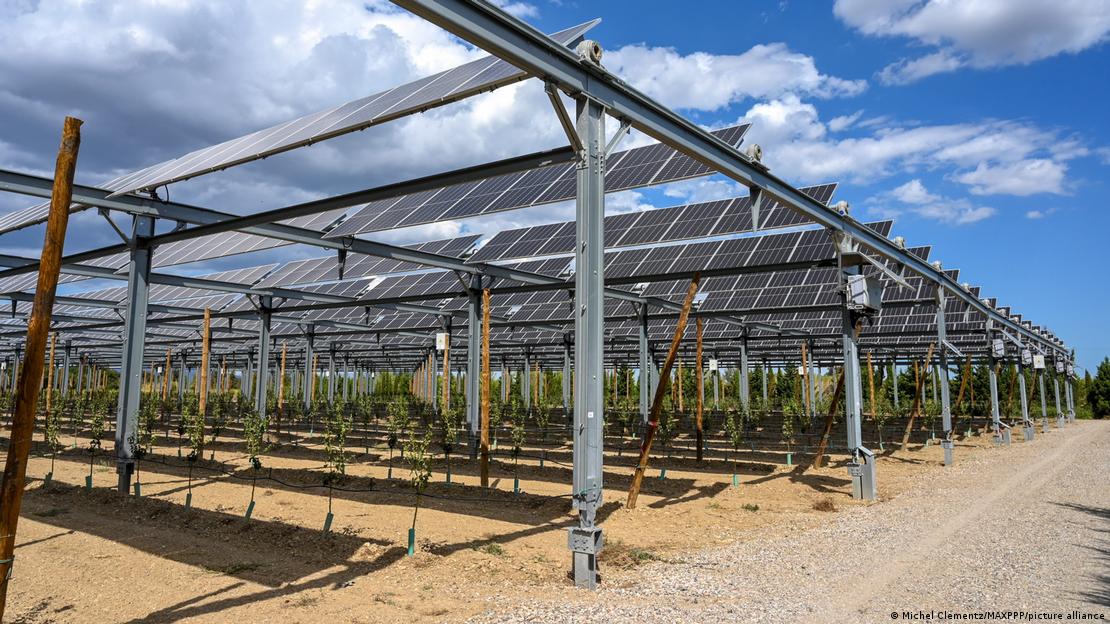
An agrivoltaic pilot project shades a pear orchard in Llupia, France, part of a push to protect crops from droughts, frost and other extreme weather
Image: Michel Clementz/MAXPPP/picture alliance

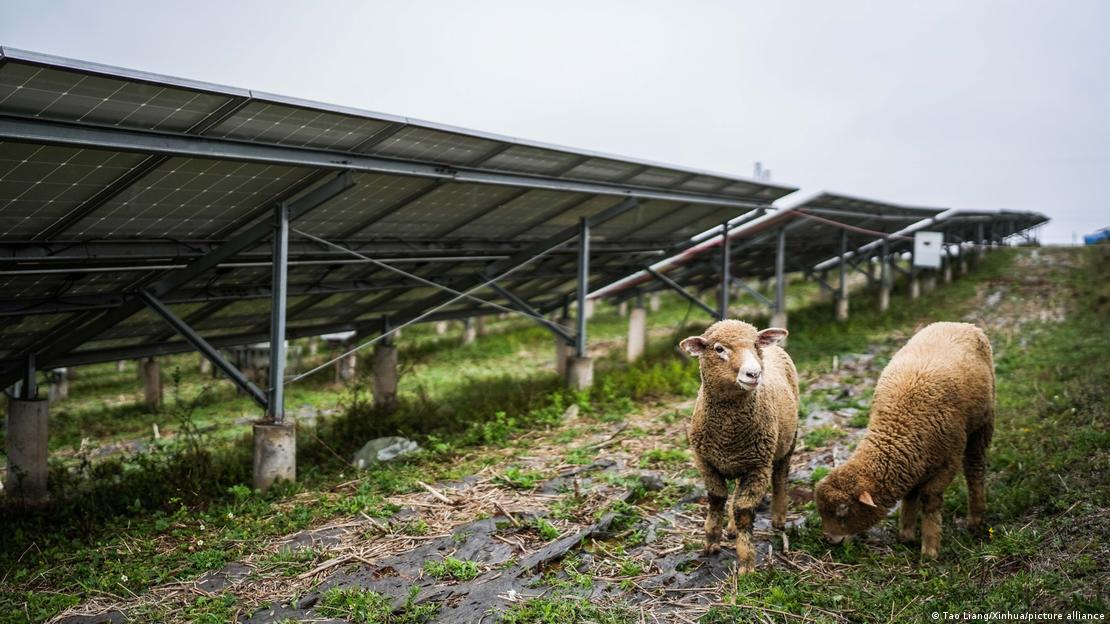
Traditionally, solar panel farms are quiet — save for the faint hum of the inverter. But on about one in 10 of American solar farms, there's a new sound reverberating through fields: baaaa.

Letting sheep roam under solar panels is just one of many forms of a burgeoning strategy called agrivoltaics, where crops grow or livestock graze in tandem with renewable energy infrastructure.

It's not only of potential benefit for the animals, which get additional shade. The panels can also protect crops from the elements as well as divert water to them, creating cooler, damper conditions that even boost yields.

And even the solar panels themselves tend to respond well to this co-existence — as the cooler they are, the more electricity they produce per watt of sunlight.

"Having concrete or something underneath the solar panels — you're going to have lower efficiency than having something like plants that are transpiring and cooling off on the land surface," Carl Bernacchi, professor of plant biology and crop sciences at the University of Illinois Urbana-Champaign, told DW.

While the potential is enormous, especially as climate change puts more and more heat stress on agriculture, the practice is still in its infancy. In Europe, if agrivoltaics were implemented on just 1% of available agricultural land, the continent could exceed its solar energy targets for 2030.

But uptake has been slow: agrivoltaics represents just 18.4 gigawatts of energy worldwide as of mid-2025, less than 1% of the world's solar capacity.

Sheep graze under solar panels in Guizhou province, southwest China, part of a growing practice of pairing livestock with solar energy production
Image: Tao Liang/Xinhua/picture alliance

What thrives under the panels


The idea for agrivoltaics dates back to 1981, when two German scientists published an article titled "Kartoffeln unter dem Kollektor" (or "Potatoes beneath the collector"). But the first pilot project didn't begin until 2004 in Japan, a land-constrained country, where there's particular concern over balancing solar deployment with the protection of farmland.

There are three main types of agrivoltaics: horizontal, where panels look directly up at the sky, vertical, where they're placed in large rows, perpendicular to the ground, and integrated, often installed atop greenhouses.

Research suggests shade-tolerant crops stand to benefit. That includes berries, grapes and tomatoes — where the panels' steel framing often doubles as trellises — as well as peaches and peppers.

The panels can also prevent water from fully evaporating, creating a more humid microclimate that benefits the soil — though humidity is a double-edged sword, sometimes introducing plant disease.

Sheep have also proven to be a particularly good match. Compared to cattle or goats, they're generally easier to manage around solar infrastructure, less likely to damage equipment, and small enough to fit comfortably beneath panels. The practice has other sustainability upsides too: sheep manure fertilizes the soil, and sites require less herbicide.

"If we look at the sheep industry, this has been a real paradigm shift for them, where instead of having to pay to lease land to graze their animals — now they're actually getting paid to graze," said Austin Kinzer, an agrivoltaics specialist at the American Farmland Trust conservation movement . "So it completely puts the economics on its head and is a huge opportunity for the sheep industry, which is really struggling in the US pretty much since World War II."


Solar panels raised on steel supports shade a French orchard, one of several agrivoltaic setups now in use across Europe
Image: Michel Clementz/MAXPPP/picture alliance


A double climate win

Agrivoltaics sit at a rare intersection of climate mitigation (cutting emissions) and adaptation (adjusting to a warming planet).

"It is both, which is pretty unique as far as climate solutions go," Kinzer said.

The practice offers one answer to where solar panels could go, helping to produce cheaper and more efficient energy, while also benefiting crops that might struggle due to rising temperatures or volatile weather.

And research suggests that climate change will only make regions grow drier, "broadening areas where agrivoltaics can mitigate crop yield penalties (even boosting yield) and improve overall profitability," writeresearchers in a journal article for Proceedings of the National Academy of Sciences (PNAS).

A dual-income stream can also offer farmers some insurance should temperature or weather knock out a season's plantings.

"Being able to have that alternate form of income, it's massive for folks who are depending on weather to make their living that is becoming increasingly more extreme and varied," Kinzer said.

Not every farm benefits


So why has adoption been so slow?

"In theory, it's a win-win scenario," Bernacchi said. "But of course, with any technologies, there are always caveats and issues."

One reason is that agrivoltaics don't work everywhere. In America's arid West, where heat stress and less available water can threaten crops, yields stayed the same or even rose under panels. In the humid Midwest, on the other hand, panel shading limited photosynthesis and led to reduced yields in maize and soybeans.

For cash crops, where there's a very small margin for profit, even a minor reduction in yield is a no-go for many farmers.

Then there's the expense. For solar producers, every added inch to mount panels higher means more labor and steel costs. And farmers might need to find new equipment or change methods to adapt to a new system.

"Farmers want to learn from other farmers," said Kinzer, who works with farmers across the US to see how agrivoltaics are being adopted. "They want to hear from folks who are doing it. And so there's a little bit of a chicken-and-the-egg problem for farmers: In most cases, they can't just go across the street or into the next county over and see a project like this and talk to the farmers doing it."

Bridging the divide between farmers and solar

Solar power's land footprint has made it controversial in certain communities — some farming associations have protested converting farmland into acres of solar panels, arguing their members cease to be farmers and become energy producers instead.

It's a tension agrivoltaics helps to address.

One survey found that more than 80% of Americans would be more likely to support solar development in their community, if it allowed for the co-production of energy and agriculture — about 10% more than those that support solar development in general.

"There's this cultural conflict between the farmers who want to farm and the solar companies that want to produce electricity," Bernacchi said. "And agrivoltaics really does bill itself as sort of a middle ground. You can still farm and still get the electricity from the same land."


Edited by: Tamsin Walker

Josh Axelrod Reporter covering extremism, disinformation and technology.