Wednesday, October 07, 2026

Quebec separatist party wins provincial election in test of Canada's unity

Separatists won provincial elections in Quebec on Monday, with a promise to hold a vote on leaving Canada after US President Donald Trump leaves office, testing Prime Minister Mark Carney's message of national unity.


Issued on: 06/10/2026 - RFI

Parti Quebecois Leader Paul St-Pierre Plamondon, centre, speaks to supporters after winning the provincial election in Montreal, Quebec on Monday, 5 October, 2026. Graham Hughes/The Canadian Press - 

According to preliminary results, the Parti Quebecois (PQ) won 59 of the 127 seats in the National Assembly, followed by the Quebec Liberal Party (PLQ) on 40 seats.

While it fell short of a majority government in Canada's French-speaking province, PQ's win still upends Canada's political landscape as the country confronts a trade war and annexation threats levelled by the United States.

It also comes just two weeks before Canada's oil-producing province of Alberta, an economic powerhouse, holds a vote on whether it wants to begin the process of leaving Canada.

The results make PQ leader Paul St-Pierre Plamondon, a 49-year-old lawyer known by his initials PSPP, Quebec's next premier.

At a jubilant victory party in Montreal, he invoked "the courageous struggle" francophones have endured in a part of the world increasingly dominated by English speakers.

That struggle "will find meaning when (francophones) obtain their own country," he said.

"We deserve it," he added, calling a referendum a chance "to decide what our national future will be."

Prime Minister Mark Carney congratulated PSPP, saying that "building a stronger Quebec is core to our mission of building a stronger Canada."

The prime minister is popular in Quebec, and the separatist win was not seen as a repudiation of his stance toward Trump, whose confrontational policies have infuriated Canadians.

Instead, the PQ's rise after more than a decade in opposition has been tied to frustration over affordability and an enduring desire to protect the French language in a majority anglophone country.

Surveys suggest that only about 30 percent of Quebecers want independence, but PSPP has maintained he will call a referendum on leaving Canada, just not while Trump is in office.

Call for calm debate

He has said a decision on Quebec's independence "requires conditions that allow for an informed and calm debate."

That shouldn't be "hijacked by the theatrics of an unpredictable president," he added, ruling out a referendum until at least 2029.

Quebec has held two previous votes on leaving Canada. Federalists won comfortably in 1980, but the 1995 result was excruciatingly close, with just 50.58 percent voting to stay in Canada.

First-time voter Alexia Gomez, 19, invoked tensions with the United States when she told AFP she opposed an independence referendum.

"If Quebec becomes independent it would make us politically, economically and militarily vulnerable," she said.

Lydie Periard, a 22-year-old student, said she was "very worried" by the PQ's victory, condemning what she termed the party's "populist" stance on immigration. The PQ has backed immigration cuts, particularly for non-French speakers.

The PQ replaces a party, known as the Coalition for Quebec's Future (CAQ), that advocated strongly for the province's distinctive culture within Canada, without supporting separatism.

Lacking a majority, the PQ will struggle to advance its separatist agenda.

The two largest opposition parties after Monday's vote, the Liberals and Conservatives, both declared they would never back a referendum on independence.

PSPP may not have majority backing for an independent Quebec, but his plans to target the British monarchy appear far more popular.

Canada is part of the British Commonwealth. King Charles III, Canada's head of state, is represented in Ottawa by the governor general. Lieutenant governors represent the monarchy in the provinces, including Quebec.

In a 2025 Leger poll, 87 percent of Quebecers said they felt no attachment to the British monarchy, and only 31 percent expressed a favorable view of King Charles.

PSPP has said his government could cut off funds for the lieutenant governor, calling it a "masquerade that wastes money."

 

Belgian physicist wins Nobel for turning Antarctic ice into a telescope

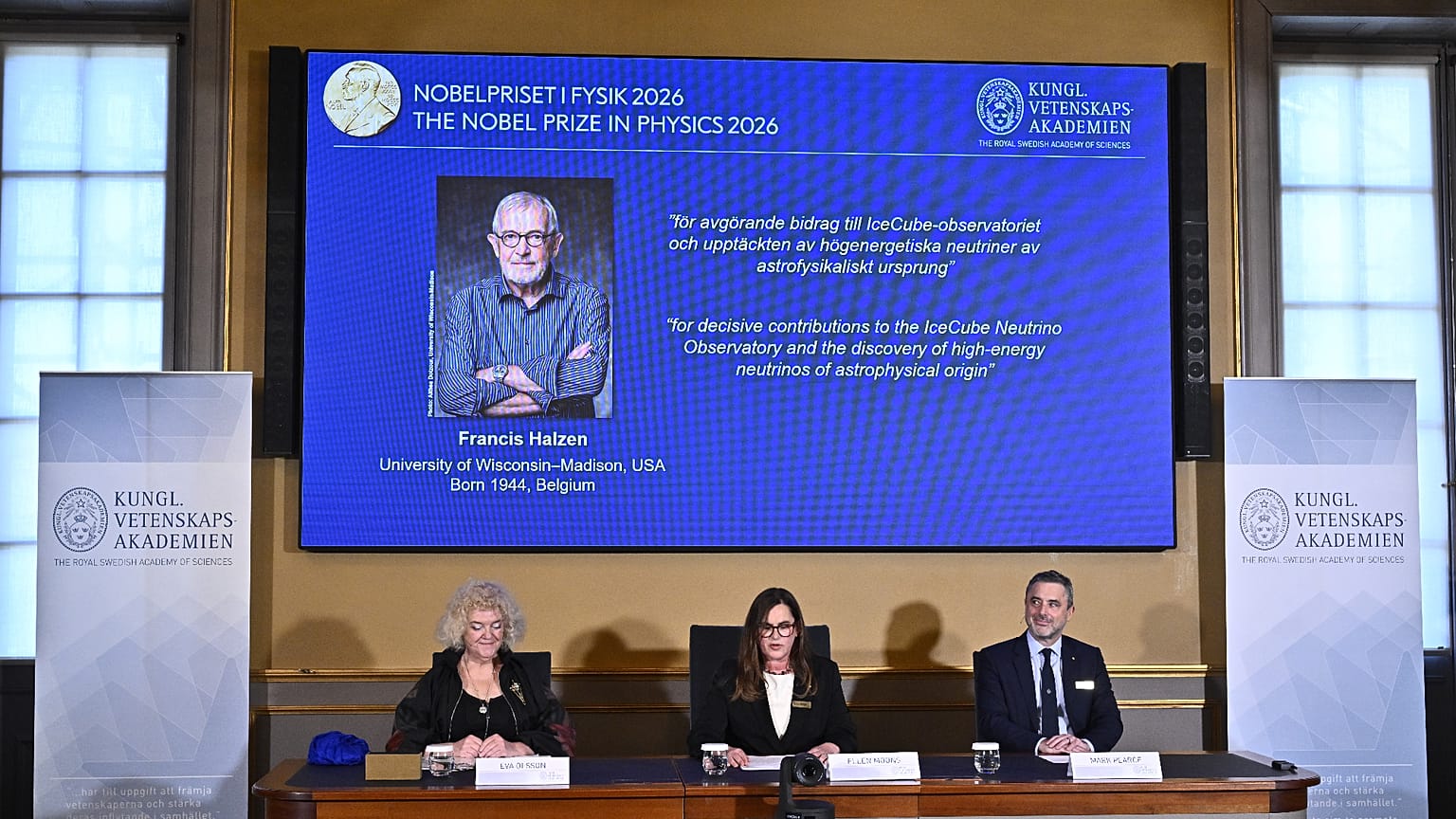
A portrait of Francis Halzen is shown on the screen as the panel announce the recipient of the 2026 Nobel Prize in Physics at the Royal Swedish Academy of Sciences, Stockholm.
Copyright AP Photo

By Una Hajdari & Jonathan Benton with AFP
Published on

Belgian Francis Halzen, 82, turned a cubic kilometre of Antarctic ice into the world's largest neutrino detector. On Tuesday, his hunt for "ghostly messengers" from the distant universe won him the 2026 Nobel Prize in Physics.

Buried deep in the ice at the South Pole sits a detector the size of a cubic kilometre, built to catch some of the most elusive particles in the universe. On Tuesday, the man who dreamt it up won the Nobel Prize in Physics.

Belgian physicist Francis Halzen won the 2026 Nobel Prize in Physics on Tuesday for pioneering work that uses Antarctic ice to capture neutrinos from the far reaches of the cosmos.

"This year's prize is about ghostly messengers from space," Ellen Moons, secretary general of the Royal Swedish Academy of Sciences, told a news conference in Stockholm.

The jury honoured Halzen "for decisive contributions to the IceCube Neutrino Observatory and the discovery of high-energy neutrinos of astrophysical origin".

The academy said his work had been fundamental to the observatory, which it described as "a cubic kilometre of ice that is equipped with light sensors," and that it had "paved the way for a new kind of astronomy".

The detector lets researchers capture neutrinos, rare subatomic particles, "from extremely energy-rich processes in the distant universe".

Halzen, 82, was born in Tienen, Belgium, and is a US citizen. He is a professor at the University of Wisconsin–Madison, where he directs the Institute for Elementary Particle Physics.

Speaking to the news conference by phone from Italy shortly after the announcement, he said, "it was a great surprise, and I obviously didn't expect it."

"But it's a great pleasure to hear about this prize," he added.

A giant eye in the ice

High-energy neutrinos form in the same violent cosmic environments as other particles. Unlike the others, though, they travel through space in a straight line and arrive intact.

"Neutrinos reach us without changing direction or losing energy. This means they can provide information that is not available in any other way," the academy said in a statement.

The catch is that they are fiendishly hard to spot. "Cosmic neutrinos with extremely high energies are very rare, so an enormous volume of ice is needed to observe an adequate number of collisions," the jury said.

Halzen first floated the idea of the observatory in 1988, and it quickly won over other researchers. Preliminary tests followed a few years later, but the detector was not completed until 2011.

He has served as principal investigator of IceCube, located at the Amundsen-Scott South Pole Station in Antarctica and the world's largest neutrino detector.

"For me, the main pleasure of it, besides winning the Nobel Prize, is that I hope this reflects on the really courageous people who joined me in the beginning of this project," Halzen said.

From Leuven to Antarctica

Halzen earned a master's degree in physics from KU Leuven in 1966 and a doctorate in 1969.

Since the 1970s, he has been a leading figure in cosmic ray and astroparticle physics, publishing research on cosmic ray anomalies and quark matter.

He has also sat on advisory committees including those of the Sudbury Neutrino Observatory in Canada and Germany's Max Planck Institutes.

Halzen's award is the second Nobel of the season. On Monday, the medicine prize went to US psychiatrist and neurologist Karl Deisseroth and German scientists Peter Hegemann and Georg Nagel for their pioneering work in optogenetics, which uses light to control nerve signals.

The chemistry prize follows on Wednesday, with the literature laureate due on Thursday. The most closely watched award, the peace prize, will be announced on Friday.

US President Donald Trump lobbied hard for it last year, and Venezuelan opposition leader MarĂ­a Corina Machado, who won it, later gave him her Nobel medal. The committee is aware he will be watching closely again.

The economics prize closes the Nobel season on Monday 12 October.

Each Nobel comes with a diploma, a gold medal and 12 million Swedish kronor (€1.1mn), shared if a prize has more than one winner.

The laureates will receive their awards at a formal ceremony on 10 December, the anniversary of the death in 1896 of Alfred Nobel, who created the prizes in his will.

 Franco-Japanese duo Kagan and Soai win 2026 Nobel Prize in chemistry


The Nobel Prize in chemistry was awarded on Wednesday to French scientist Henri B. Kagan and Japan’s Kenso Soai for unravelling the mystery of why only one of two forms of certain molecules occurs in nature.

Issued on: 07/10/2026 - RFI

Portraits of the Frenchman Henri Kagan (left) and Kenso Soai (right) from Japan were shown on a screen at the Royal Swedish Academy of Sciences in Stockholm as they were awarded the 2026 Nobel Prize in Chemistry. Fredrik Sandberg/TT News Agency - Fredrik Sandberg


By:  Paul Myers

Many molecules can exist in two mirror-image forms, but in nature only one form often predominates – a phenomenon known as homochirality. Chemists have long struggled to explain how this happens.

Kagan and Soai's discoveries helped show how chemical reactions can be steered towards one molecular form rather than the other, work that has proved important in fields including pharmaceutical manufacturing, the Nobel committee said.

"They have enabled chemists to drive chemical reactions that lead to homochirality," the jury added.

One area of this field, asymmetric catalysis, had already been recognised with a Nobel Prize in 2001.

Kagan, professor emeritus at Paris-Saclay University, was not among the recipients then despite being widely regarded as one of the fathers of the technique. The omission prompted protests at the time from France’s Research Ministry.

Soai, 76, was out shopping near his home when he was informed of his award.

Nobel Prize announcements begin, with hopes of a 'less controversial year'
'Most incredible day of my life'

“This is the most incredible day of my life,” the laureate said in a telephone interview with the Nobel Foundation.

The professor at the Tokyo University of Science added: "I think our prize should lead people to recognise the importance of molecular chirality. I am therefore particularly happy about that."

Like hands, some molecules, known as chiral molecules, can exist in “right-handed” or “left-handed” forms.

They have identical physical properties but can have very different biological properties.

"Henri Kagan and Kenso Soai have provided a solution to a chemical mystery that is over a century old: how homochirality can emerge spontaneously. The chemical reactions they have developed are spectacular," said Heiner Linke, chair of the Nobel Committee for chemistry.

"Their discoveries have been decisive for chemists who design reactions for the manufacture of pharmaceuticals."

French economist shares Nobel for 'creative destruction' theory of innovation
Literature prize on Thursday

The Nobel Prize in chemistry was first awarded in 1901. Jacobus Henricus van 't Hoff from the Netherlands was honoured for discovering the laws of chemical dynamics and osmotic pressure in solutions.

In 1911, the Frenchwoman Marie Curie won the Nobel Prize in chemistry, eight years after sharing the physics prize – becoming the first person to win Nobel Prizes in two scientific fields.

The accolade in chemistry is the third of the 2026 Nobel science prizes to be awarded.

On Monday, the American psychiatrist and neurologist Karl Deisseroth and his German colleagues Peter Hegemann and Georg Nagel were given the honour in medicine for their work in the field of optogenetics.

Francis Halzen from Belgium won the 2026 Nobel physics prize on Tuesday for groundbreaking work using Antarctic ice to capture particles originating in the cosmos.

In addition to being one of the world’s most prestigious awards, the Nobel winner receives a diploma, a gold medal and a cheque for 12 million kronor – €1 million.

After chemistry, it will be the turn of literature on Thursday. The Nobel Peace Prize will be announced on Friday and the economics prize will bring the Nobel award season to a close on 12 October.


How light became a remote control for the brain, and won a Nobel Prize

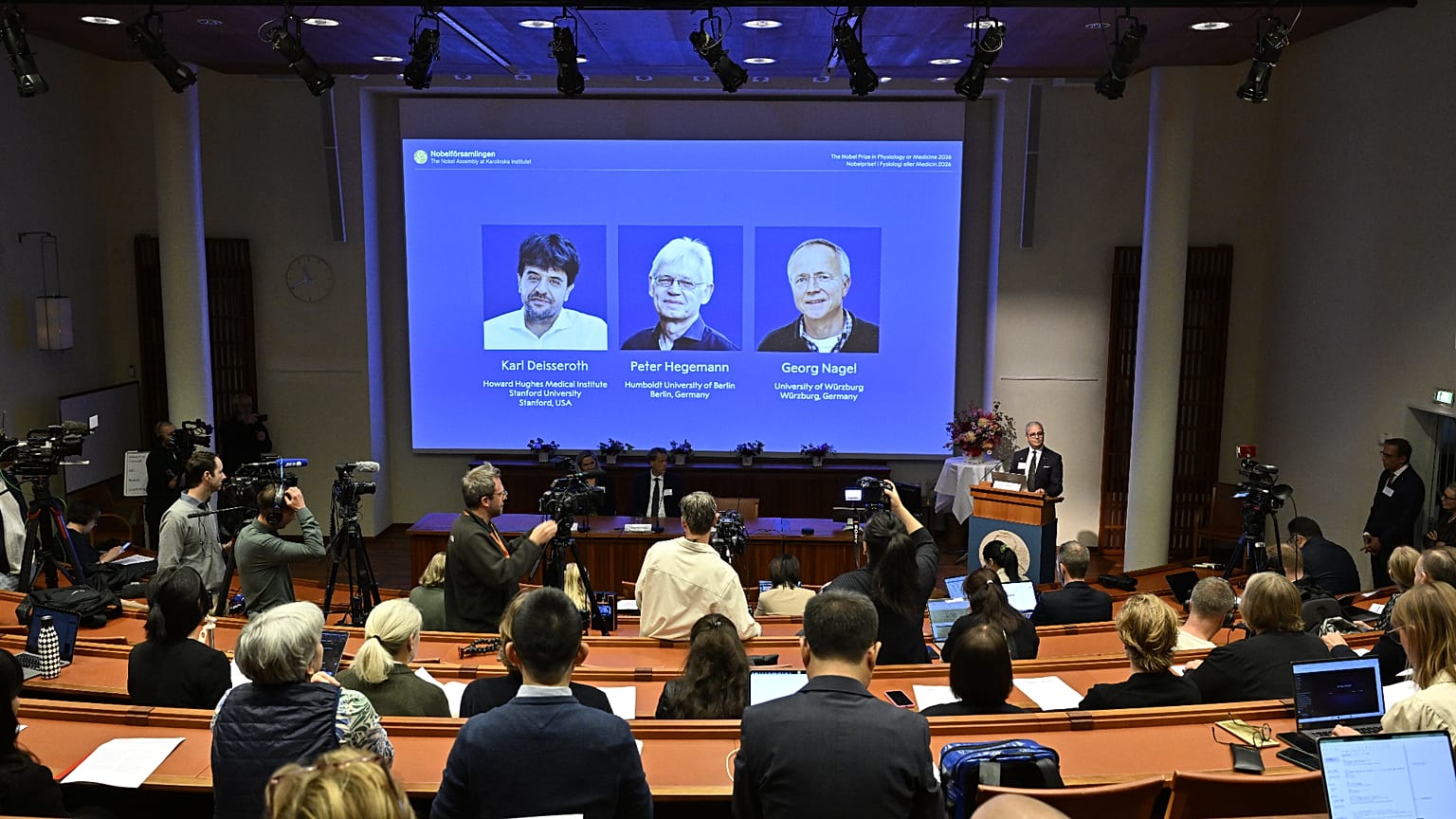
Portraits of Karl Deisseroth, Peter Hegemann and Georg Nagel are shown on the screen as they are awarded the 2026 Nobel Prize in Physiology or Medicine.
Copyright Pontus Lundahl/TT News Agency via AP

By Marta Iraola Iribarren
Published on

Optogenetics, the technique that lets scientists control brain cells with light, has won the 2026 Nobel Prize in Medicine.

Karl Deisseroth, Peter Hegemann and Georg Nagel won the 2026 Nobel Prize in Medicine for their work in light-gated ion channels and optogenetics, a method that lays the foundation "of a new era in neuroscience", the Nobel Assembly at Karolinska Institutet announced on Monday.

But what exactly is optogenetics, and how did the laureates develop the technique?

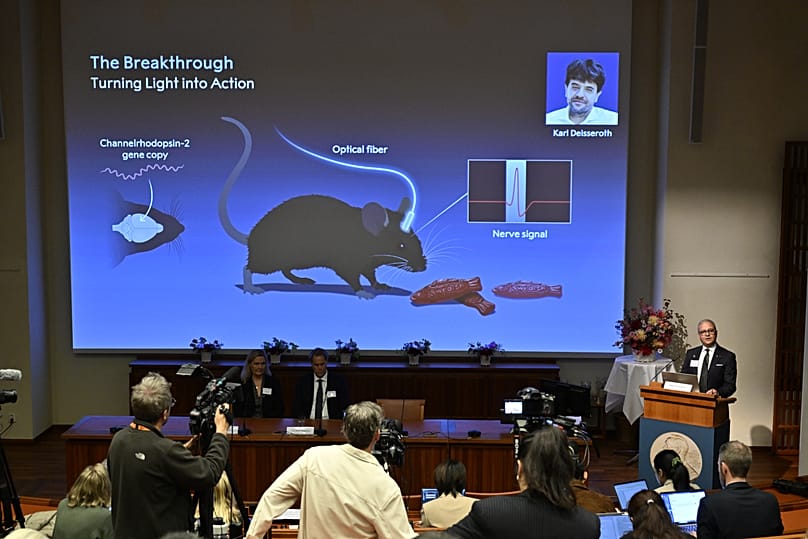
Optogenetics is a method for controlling selected cells using light as a remote control. It allows scientists to switch cells on or off in a living brain and investigate how particular cells and neural circuits influence behaviour.

This new method was given the name optogenetics in 2006, but the story behind the technique began more than a decade earlier, when Peter Hegemann was studying the unicellular alga Chlamydomonas, an organism famous for swimming towards light.

Hegemann wanted to understand what makes algae move towards light. He studied its eyespot, a tiny orange dot on the cell’s surface that detects light. Through a series of experiments, Hegemann and his colleagues identified light-sensitive proteins called channelrhodopsins, which allow algae to detect light and respond to it.

Together with Georg Nagel at the Max Planck Institute for Biophysics in Frankfurt, he inserted the algal genes into frog egg cells and human kidney cells and proved that channelrhodopsin was indeed a light-controlled ion channel.

When exposed to blue light, the channel opened in just 0.2 milliseconds, allowing positively charged ions to flood into the cell and generate a tiny electrical impulse.

Years later, Karl Deisseroth, the third laureate, introduced the channelrhodopsin gene into rat nerve cells. By shining blue light on the cells, they could trigger nerve signals, showing that the protein could act as a light-controlled switch. He then used the technique to control nerve cells in the brains of living mice.

For example, scientists could trigger movements in a mouse's whiskers or wake sleeping mice simply by switching on a light.

A portrait of Karl Deisseroth is shown on the screen as he, Peter Hegemann and Georg Nagel are awarded the 2026 Nobel Prize in Physiology or Medicine. Pontus Lundahl/TT News Agency via AP

What does the future hold?

The discovery “provides opportunities for mapping the brain in a way that we could once only dream of,” said Per Svenningsson, chair of the Nobel Committee for Physiology or Medicine, in a press release.

Optogenetics is currently used primarily as a research tool. By allowing researchers to turn targeted cell types on or off using pulses of light, it enables scientists to establish direct cause-and-effect relationships between neural activity, brain function, and behaviour.

It allows researchers to map the neurons involved in emotional states such as fear, anxiety or reward. They can also map specific neural circuits governing pain, thirst, attention or aggression.

Optogenetics is also widely used in research into neurological or psychiatric conditions such as depression, schizophrenia, anxiety, Alzheimer’s disease, Parkinson’s disease and epilepsy.

The science has also entered clinical trials to treat retinitis pigmentosa, a genetic disease that causes blindness due to the loss of light-detecting cells in the retina.

By delivering light-sensitive opsin genes into surviving retinal cells, researchers have enabled a blind patient wearing light-emitting goggles to regain partial vision and perceive high-contrast objects.

WHO: Reports of a possible second pneumonia death

07.10.2026, DPA

Photo: Pia Bayer/dpa

The World Health Organization (WHO) has asked Russia for information regarding a possible further death from pneumonia in the Siberian city of Irkutsk.

WHO expert Abdirahman Mahamud said in Geneva on Wednesday that the request was prompted by a media report that had been verified and deemed credible.

No response has yet been received, he said. 

The Russian authorities have also been asked for further information regarding the first case - the death of a female scientist who worked at the Institute for the Control of Plague Diseases in Irkutsk. 

The 28-year-old woman died last Friday. The official cause of death is listed as pneumonia of unknown origin. 

WHO chief Tedros Adhanom Ghebreyesus has said the organization does not have a complete picture of the situation and cannot conducted a full risk assessment.

According to the WHO, Russia reported that the young female scientist had not died of pneumonic plague, but of pneumonia of unknown origin. There had been no accident at the institute.

The WHO has asked for details including what tests were carried out on the woman and around 200 other people, exactly what materials she had been working with, what safety measures were in place at the institute, and whether she had been vaccinated and, if so, against which diseases, said WHO specialist Maria Van Kerkhove.

She added that the WHO had been notified of nearly 4,000 plague cases from 10 countries between 2019 and 2025, including 423 deaths.


WHO says cannot conduct full risk assessment on Russia plague reports


Geneva (AFP) – The World Health Organization said Wednesday it could not produce a full risk assessment as it did not have the whole picture from Russia on the suspected plague death of a laboratory technician.


Issued on: 07/10/2026 - 

WHO Director-General Tedros Adhanom Ghebreyesus urged Moscow to provide more information © Fabrice COFFRINI / AFP

The WHO, the United States and the European Union have all urged Moscow for more information after the death of the 28-year-old woman, who worked at the Irkutsk Anti-Plague Research Institute in Siberia.

"The lab worker died after being hospitalised with severe pneumonia. Initial media reports suggested pneumonic plague following an accidental lab exposure," said WHO chief Tedros Adhanom Ghebreyesus.

"WHO is aware that the Russian government held a meeting on October 2 because they suspected a resident of the Irkutsk oblast (region) had contracted a dangerous infection," he told a press conference.

Tedros said the WHO asked Moscow for more information on Saturday, in accordance with the International Health Regulations.

The IHR provide a legally binding framework defining countries' rights and obligations in handling public health events and emergencies that could cross borders -- and countries are asked to respond within 24 hours.

Russia responded -- on Tuesday -- saying no plague case had been reported in the Irkutsk region and that around 200 contacts had been quarantined.

The WHO has asked for more information on the lab tests conducted on the fatality, on the contacts, and details on their health status, said Tedros.

"We don't yet have the full picture of this event and we're not able to conduct a full risk assessment," he stressed.

"Timely, complete and transparent information sharing under the international regulations is essential to clarify conflicting reports and enable an accurate assessment of potential public and risks."

- 'What did she die from?' -

Maria Van Kerkhove, the WHO's director of epidemic and pandemic management, added: "We don't understand how she was infected."

The WHO's Maria Van Kerkhove said the UN health agency wanted to know more on the tests conducted in Siberia © Fabrice COFFRINI / AFP

If pneumonic plague "is ruled out, what did she actually die from?", she said.

Van Kerkhove said the UN health agency wanted to know what tests were done, the specifics of the results, and what further analysis was being done if the cause of death was not yet known.

Furthermore, "what contacts were put under quarantine or under follow-up; what did that involve; if the quarantine period is over?", she said.

As to whether Moscow should have provided more information, she said: "The simple answer is always: yes."
'Community-acquired' infection

Silviu Ciobanu from the WHO Europe office's public health intelligence alerts and reponse operations unit, said that "given the timeline given in IHR is 24 hours, obviously it's not OK.

"The sooner we get information, the better the outcome."

The laboratory is in the Siberian city of Irkutsk © TATYANA MAKEYEVA / AFP

Moscow has said the woman died from a community-acquired severe pneumonia of unknown origin, he added.

Van Kerkhove said there were people whose deaths were ascribed to unknown causes of pneumonia, but there were now laboratory methods that can determine the causative agent, such as PCR testing and genetic sequencing.

Community-acquired infection "would mean outside of the lab", she added.

Russia warned Wednesday against "false" information as reports emerged of a second suspected case of plague, with its health agency saying it had determined there were "no epidemic risks for the population".

Tedros said he wanted more clarification from Moscow following two media reports of "a second employee with pneumonia of undetermined cause".

"We asked Russia to respond to that... because any reporting that comes, we cannot ignore it," he said, adding "I hope we will get an answer to that, formally."

Between 2019 and 2025, 10 countries reported suspected human plague cases to the WHO, six of which reported confirmed cases.

Overall, 3,847 suspected cases and 423 deaths were reported, giving case fatality rate of 11 percent.


Russia denies plague death but quarantines hundreds without explanation

ARCHIVE: quarantine during a Marburg fever outbreak in Kenya, 8 October 2014.
Copyright Ben Curtis/Copyright 2024 The AP. All rights reserved.

By Knarik Papoyan & Euronews Russian
Published on

Rospotrebnadzor said Darya Shipilova, 28, died of "pneumonia of unknown aetiology" with no links to her work at the Irkutsk Anti-Plague Institute, but imposed quarantine on her contacts, confined 60 colleagues inside the facility and restricted access to hospitals including a maternity ward.

Russian authorities have insisted a lab researcher who died in Siberia last week did not have the plague while quarantining nearly 200 of her contacts, confining more than 60 colleagues inside their institute and restricting access to multiple hospitals, all without explanation.

Darya Shipilova, 28, a researcher at the Irkutsk Anti-Plague Research Institute, was admitted to Shelekhov District Hospital in late September and died last Friday night.

Russia's national health watchdog Rospotrebnadzor said biological samples from her body found no microorganisms linked to her professional work and that she died from "pneumonia of unknown aetiology."

The agency said its special commissions had found no accidents involving pathogenic microorganisms at the institute. Kremlin spokesman Dmitry Peskov told reporters to rely solely on Rospotrebnadzor's statements.

Between 189 and 197 of Shipilova's contacts were placed under observation and quarantine, according to figures cited by independent and regional media.

Initial tests among those contacts returned negative. More than 60 staff members of the anti-plague institute were effectively confined inside the facility for several days.

Quarantine restrictions were also imposed on hospitals in Irkutsk, including a maternity ward, according to reporting by multiple regional and international outlets.

Patients at one facility said doctors cited plague as the reason. Relatives of a woman in labour were refused entry to the ward despite having paid for partner-assisted birth.

The head of neighbouring Buryatia, Alexei Tsydenov, initially said after Shipilova's death that she had died of plague, then amended this to "possibly plague".

Irkutsk regional authorities posted a message on Friday asking residents not to travel to the satellite town of Shelekhov because of plague, then deleted it.

Governor Igor Kobzev described the cause of death as "pneumonia of unknown aetiology" on Monday.

What are international authorities saying?

The World Health Organization said it assessed the public health risk from the incident as low to moderate for Irkutsk region, low for Russia as a whole and very low for the WHO European region.

It said Russian authorities had identified Shipilova's contacts and were monitoring them, and that they had detected no dangerous infectious disease agents among those contacts.

The European Centre for Disease Prevention and Control told Euronews it was "closely following the situation" and was in contact with the WHO.

"We are aware of a case of pneumonia of unknown origin in eastern Russia that is suspected to be plague. This suspicion has not yet been confirmed," an ECDC representative said.

US authorities are also monitoring developments, while Kazakhstan and Kyrgyzstan have strengthened sanitary controls at their borders with Russia.

Uzbekistan has also strengthened its public-health preparedness after reports of a suspected case of a particularly dangerous infectious disease in Russia’s Irkutsk region, while stressing that the diagnosis has not yet been confirmed.

Online theories swirl

Two unofficial theories have circulated in Russian media. The first, reported by Telegram channels SHOT and Baza, holds that Shipilova accidentally broke a test tube containing the plague pathogen in the laboratory.

Several specialists consider this unlikely, noting that work with high-risk pathogens is conducted inside sealed safety cabinets with protective suits and strict decontamination protocols.

The second theory is that the infection was acquired during field research in a region with natural plague reservoirs. The head of Buryatia publicly denied that Shipilova had visited the region.

The official diagnosis has not been confirmed or ruled out by published PCR test results.

Plague is caused by the bacterium Yersinia pestis. Its most common form, bubonic plague, affects the lymphatic system. Pneumonic plague, which can spread between people via airborne droplets, is considered the most dangerous.

Russia's most recent confirmed human cases were recorded in the Altai region in 2014, 2015 and 2016, all involving people who handled marmots.

Human plague cases in Russia remain rare despite natural reservoirs existing in several regions.


EU countries to discuss suspected plague outbreak in Russia

The case centres on a lab worker in Siberia, Russia.
Copyright Alexander Zemlianichenko/Copyright 2021 The AP. All rights reserved.


By Jorge Liboreiro
Published on

European health authorities are closely following the suspected plague outbreak in Siberia, Russia. The European Commission and member states are set to discuss the matter on Wednesday morning.

Representatives from the European Commission and member states plan to discuss the suspected outbreak of pneumonic plague in Siberia, Russia, as national authorities scramble to get a clear picture of the situation.

A meeting of the Health Security Committee, which evaluates serious cross-border health threats, will take place on Wednesday morning in Brussels. The meeting was already scheduled, but the item has been added to the running order.

"I can confirm the incident in Russia will be on the agenda of the Health Security Committee," a Commission spokesperson told Euronews.

The case revolves around a female lab worker at the Irkutsk Research Anti-Plague Institute, in south-eastern Siberia, who died on 2 October in uncertain circumstances. Her death was attributed to a "pneumonia of unknown aetiology".

Russian authorities say they have found no evidence that her illness was caused by any of the pathogens she worked with and insist the situation is under control.

The hospital where the lab worker was treated was placed under quarantine. About 200 people who had been in touch with her went into strict medical observation.

Separately, Kazakhstan, Kyrgyzstan and Uzbekistan introduced precautionary measures at their borders to prevent the possible spread of infectious diseases.

The World Health Organization (WHO) said on Tuesday that none of those people has shown symptoms so far and early testing has been negative, although it noted it was "unclear" which pathogens were tested.

The WHO noted the risk for the European region was "very low".

In a statement, the European Centre for Disease Prevention and Control (ECDC) said the suspicion of a plague outbreak was "not yet confirmed".

"There is little travel between Irkutsk and the EU, particularly at present due to Russia's war against Ukraine," the agency said.

"Based on the limited information currently available, there are no reports of secondary cases or sustained human-to-human transmission."

Brussels and Washington are closely monitoring the evolving situation and have urged Russia to provide accurate and transparent information.

Pneumonic plague occurs when plague, an infectious disease caused by bacteria, infects the lungs. It is the most serious form of the disease and can be spread from person to person. If left untreated, it has a case-fatality ratio of 30% to 100%.


Pneumonic plague suspected in Russia: What we know and what is the risk to Europe?


By Marta Iraola Iribarren
Published on

The death of a staff member at an anti-plague institute in Russia following a laboratory accident has put the spotlight on plague and how it spreads.

A staff member at the anti-plague institute in Irkutsk, Russia, died after a test tube broke in the laboratory, regional media reported, citing unnamed sources close to the region’s security services.

Russian authorities said they found no evidence that her illness was caused by any of the pathogens she worked with. But the case has raised alarm in Russia after unconfirmed media reports suggested she might have died of pneumonic plague — a less common but severe form of plague that can spread from person to person.

Russian media reported that around 200 people, who had been in contact with the deceased worker, were under strict medical observation and that several hospitals in the region were closed and placed under quarantine.

“As ... the contagion was in a lab (and has presumably well disinfected) and people were rapidly quarantined, it is highly unlikely that it will spread further- and thus, whilst it is contagious, it is unlikely to have the opportunity to spread,” Alice Hughes, professor of conservation science at the University of Melbourne, said in comments to the Science Media Centre.

Yet, public health authorities are following closely any developments.

The European Centre for Disease Prevention and Control (ECDC) told Euronews that it is “closely monitoring the situation” and is in contact with the World Health Organization.

“We are aware of the case of pneumonia of unknown origin in eastern Russia that is suspected to be the plague. That suspicion is not yet confirmed,” a spokesperson said in a written statement.

The spokesperson added that based on the limited information currently available, there are no reports of secondary cases or sustained human-to-human transmission, and noted that there is “little travel” between Irkutsk and the European Union and European Economic Area countries, “particularly at present due to Russia’s war against Ukraine”.

Plague has been absent from Europe for more than 50 years; however, human cases are reported in Africa, particularly in the Democratic Republic of Congo and Madagascar.

What do experts say about the risk?

While the information surrounding the suspected case in Russia is very limited, experts noted that sporadic pneumonic cases are not rare.

“Plague is not a historical disease,” said Zania Stamataki, associate professor of viral immunology at the University of Birmingham in comments to the Science Media Centre. “It remains endemic in rodent populations across Africa, Asia and the Americas, and human cases occur every year, including outbreaks of the pneumonic form.”

According to Brendan Wren, professor of microbial pathogenesis at the London School of Hygiene & Tropical Medicine, “there shouldn’t be too much concern as the transmission of Yersinia pestis between humans is generally poor”.

What is pneumonic plague?

Pneumonic plague occurs when plague, an infectious disease caused by bacteria, infects the lungs.

Pneumonic plague is the most serious form of the disease and is the only form of plague that can be spread from person to person. If left untreated, it has a case-fatality ratio of 30% to 100%.

According to the World Health Organization (WHO), it is especially contagious and can trigger severe epidemics through human-to-human transmission via respiratory particles. However, recovery rates are high if the disease is detected and treated in time.

The incubation period can be as short as 24 hours and any infected person may pass it via respiratory particles to other humans.

What are the symptoms?

Pneumonic plague develops when bacteria spread to the lungs of a patient with untreated bubonic or septicemic plague, or when a person inhales infectious droplets coughed out by another person or animal infected.

Symptoms typically appear one to three days after infection. They include severe respiratory problems such as shortness of breath and coughing, often with bloody or watery mucus.

What is the treatment?

If untreated, pneumonic plague can be rapidly fatal. Early diagnosis and treatment are essential for survival and to reduce complications. Common antibiotics used against enterobacteria can effectively cure the disease if given early.

“Plague is a serious infectious disease. However, it can be diagnosed and treated with antibiotics readily available in Europe,” the ECDC spokesperson noted.

In cases of pneumonic plague, patients should be isolated and their contacts traced and treated, the agency says on its website.

Are there vaccines?

The WHO does not recommend vaccination except for high-risk groups, such as laboratory personnel who are constantly exposed to infection and health-care workers.

Because human plague is rare in most parts of the world, public health agencies see no need to vaccinate people other than those at particularly high risk of exposure.


France earmarks a further €7m to help fight DRC's worst-ever Ebola crisis

France has decided to allocate an additional €7 million this year to combat the Ebola epidemic currently ravaging the Democratic Republic of the Congo (DRC). This comes as Kenya announced its first-ever death from the disease.


Issued on: 06/10/2026 - RFI

Jean-NoĂ«l Barrot (C), France's Minister for Europe and Foreign Affairs, visits the Ebola Treatment Centre Rwanpara in Bunia to express France's support for those involved in the response to the outbreak on 3 October, 2026. © HARDY BOPE / AFP

The French Foreign Minister Jean-Noël Barrot announced the spending package on Tuesday.

Barrot, who visited the Democratic Republic of Congo late last week to show Paris' support for local authorities and humanitarian workers, said the French contribution now totals €23 million this year.

The announcement of funding comes as Kenya reported its first-ever Ebola death on Tuesday.

The Kenyan Health Minister Aden Duale stated that the man fell ill about a month ago and had received treatment in the DRC before travelling by road to Kampala, the Ugandan capital, to catch a flight to Nairobi on 3 October.

The minister noted that the man had been tested and found positive for the deadly virus, adding that he "unfortunately passed away" on Monday night.

Duale said that they had listed 28 contacts of the deceased, including family members and healthcare workers, but that so far "only one test has turned positive and is the one that we have just discussed".

"I wish to assure the public not to panic, as all systems are in place to mitigate the spread of the disease," he added.

Kenya has previously never recorded an Ebola case and Kenyans reacted furiously to government plans earlier this year for the creation of an Ebola facility at Laikipia Air Base, about 200 kilometres from Nairobi.
Fighting a 'megafire'

Medical charity Doctors without Borders (MSF) warned again on Monday of an "alarming surge" in Ebola cases in the North Kivu region of eastern DR Congo and called for more treatment capacity.

In mid-May, already several weeks late, the DRC declared its 17th Ebola outbreak, an extremely deadly disease that has already killed more than 15,000 people in Africa over the past 50 years.

As of 2 October, the World Health Organization had recorded 4,082 deaths out of 8,463 cases since the emergence of the Bundibugyo strain of the virus, for which there is still neither a vaccine nor a specific treatment.

Violence against healthcare workers in DRC hampers Ebola response

Starting in the northeastern Ituri province, Ebola has spread to seven provinces in the country. Ituri, North Kivu and the northeastern Haut-Uele (northeast) account for the majority of the reported cases.

MSF said the outbreak in North Kivu had "intensified dramatically since early September, with the province now accounting for nearly 40 percent of all newly confirmed cases nationwide".

"It is like fighting a megafire," said Stephanie Hoffmann, the coordinator of the MSF Ebola treatment centre in the city of Butembo, close to North Kivu's border with Uganda.
Build trust in communities

"With new hotspots emerging every week, treatment capacities remain largely insufficient and inadequate. This situation places current patients and entire communities at even greater risk," MSF said.

MSF said capacity to treat the contagious viral disease in North Kivu was "stretched to the limit".

As of late last week, 34 percent of confirmed Ebola patients were still being treated in non-specialised health facilities that "lack the resources and expertise required... raising the risk of further transmission among patients and healthcare workers".

"Because there are not enough beds available, we are sometimes forced to refer confirmed Ebola patients elsewhere, despite the significant risk this poses to the wider community," Hoffman explained.

She said it was also vital to build trust with local communities, some of whom have been suspicious of the treatment centres.

"More than 60 percent of Ebola-related deaths continue to occur in the community," she pointed out.

"Patients must be willing to seek care early and accept isolation measures. Without that trust, we risk seeing more deaths and further spread of the disease into neighbouring areas."
EU suspends beef exports from Namibia due to foot and mouth disease

The largest market for Namibian beef, the European Union, announced it has suspended imports after an outbreak of foot-and-mouth disease, which wreaked havoc in Europe 25 years ago.


Issued on: 06/10/2026 - 15:17

Namibia announced its first outbreak of foot-and-mouth (FMD) in September 2026, prompting the EU to suspend exports from 6 October. The disease affecting cattle has been detected in other countries on the continent such as South Africa. Here, farmers prepare their animals for vaccination at a farm near Cape Town, on 15 February, 2026. 
AFP - RODGER BOSCH

Namibia announced last month its first outbreak of foot-and-mouth (FMD) in its primary commercial livestock zone in 60 years, prompting a nationwide ban on livestock movement and meat exports.

"The EU has decided to temporarily suspend the entry into its territory of fresh meat of cattle, sheep and goats...," the EU delegation announced.

The suspension included meat from relevant farmed and wild hooved animals, and certain processed meat products, it said in a statement.

Processed meat that had undergone "the most severe risk-mitigating treatment" remaied eligible for entry, it said.

The EU is Namibia's largest beef market, accounting for more than 80 percent of beef exports.

Around 10 million kilogrammes of Namibian beef went to Europe annually, EU ambassador Ana Beatriz Martins said in an interview with Namibia's NMH media.
Found at 11 farms

A quarter of 40,000 direct jobs involved in exports to Europe would be affected by the suspension, she said.

During the last major FMD outbreak in the EU in 2001, more than six million animals had to be culled, the delegation's statement said.

FMD causes fever and blisters near the hoof and in the mouth that prevent animals from feeding and sometimes leads to death.

The disease has struck several southern African countries, including Botswana, Eswatini, Lesotho, Mozambique, South Africa, Zambia and Zimbabwe.

Since the outbreak in southern Namibia was declared on 22 September, it had spread to 11 farms, officials said.

The government's disease-control response included intensified surveillance, tracing and testing, movement controls, veterinary roadblocks and biosecurity measures, agriculture ministry spokesman Romeo Muyunda told AFP.