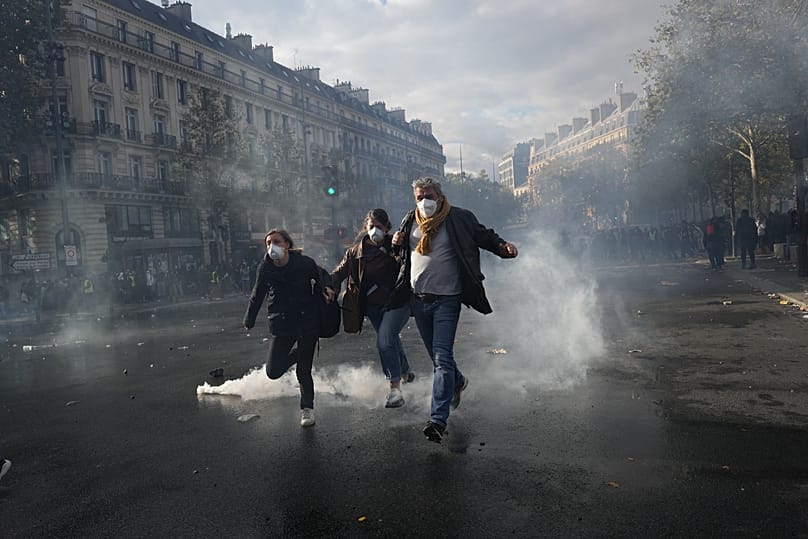
Monday, October 19, 2026


Protesters block access to Louvre museum in Paris in support of demonstrations
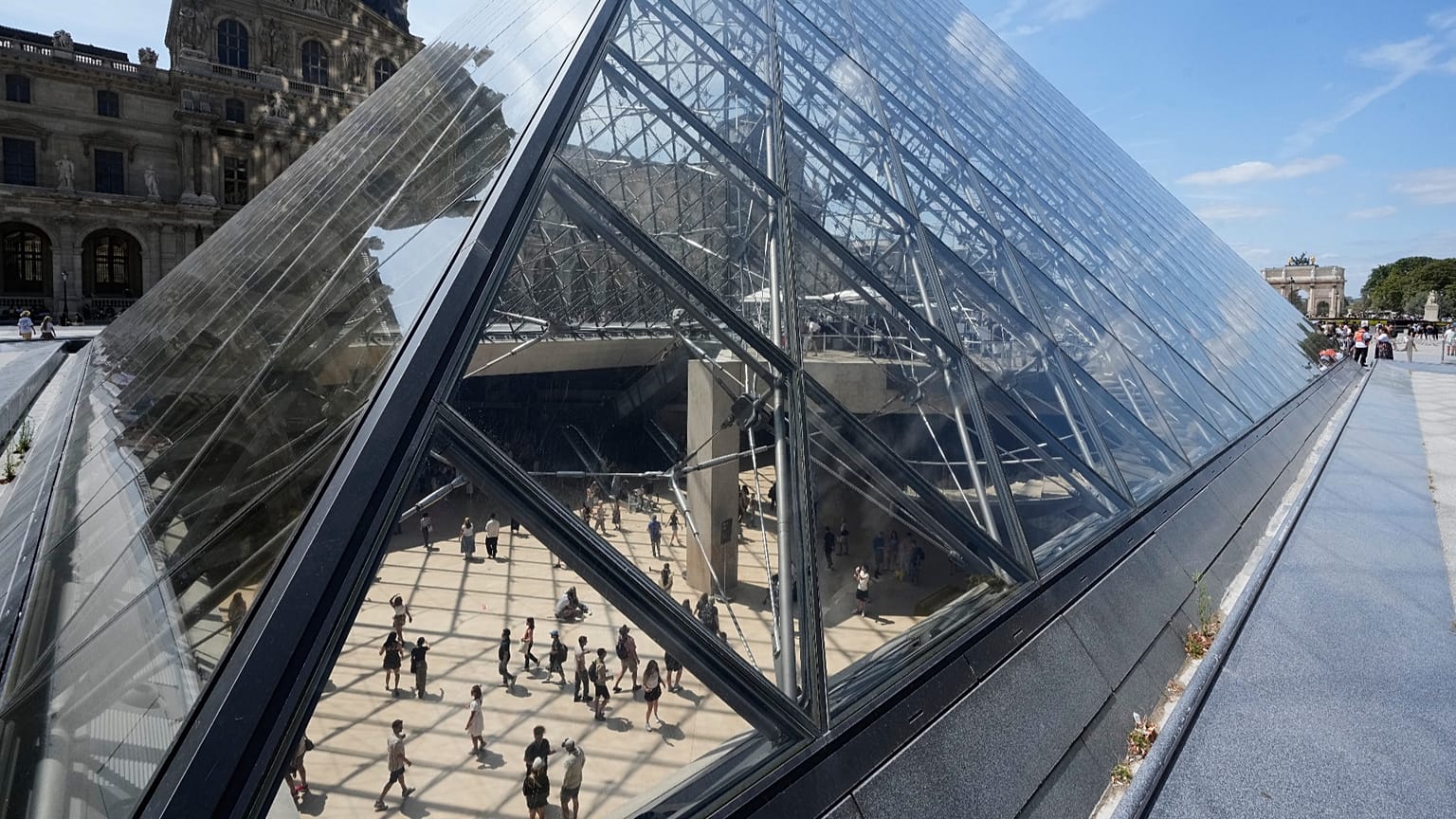
Visitors walks inside the pyramid during the reopening to the public of the Apollo Gallery at the Louvre museum in Paris, 22 July, 2026
Copyright AP Photo

By Olivier Tolachides & Gavin Blackburn
Published on

Protests initially began last month with students protesting over conditions in lycées across the country but have escalated to cover a broader range of concerns such as the cost of living.

Protesters blocked entrances to the Louvre museum in Paris on Monday in support of a nationwide high school student protest movement and to denounce "police repression", the museum's management and unions told the AFP news agency.

The museum could not open as scheduled because of a protest led by students from the Ecole du Louvre, management said.

A leaflet displayed outside the museum read: "We are proud to announce that we are blocking the world's largest museum."

Nationwide, more than 2,330 people were taken into police custody over the weekend, 70% of whom were adults, Justice Minister Gerald Darmanin said on Monday.

More than 2,000 shops were expected to have been affected by the weekend's violence across France, with damage running into "hundreds of millions of euros", according to chamber of commerce president Alain Di Crescenzo.

Protests initially began last month with students protesting over conditions in lycées across the country but have escalated to cover a broader range of concerns such as the cost of living and inflation.

This is a developing story and our journalists are working on further updates.


Looting and buildings ablaze: France's violent Saturday protests in 10 pictures
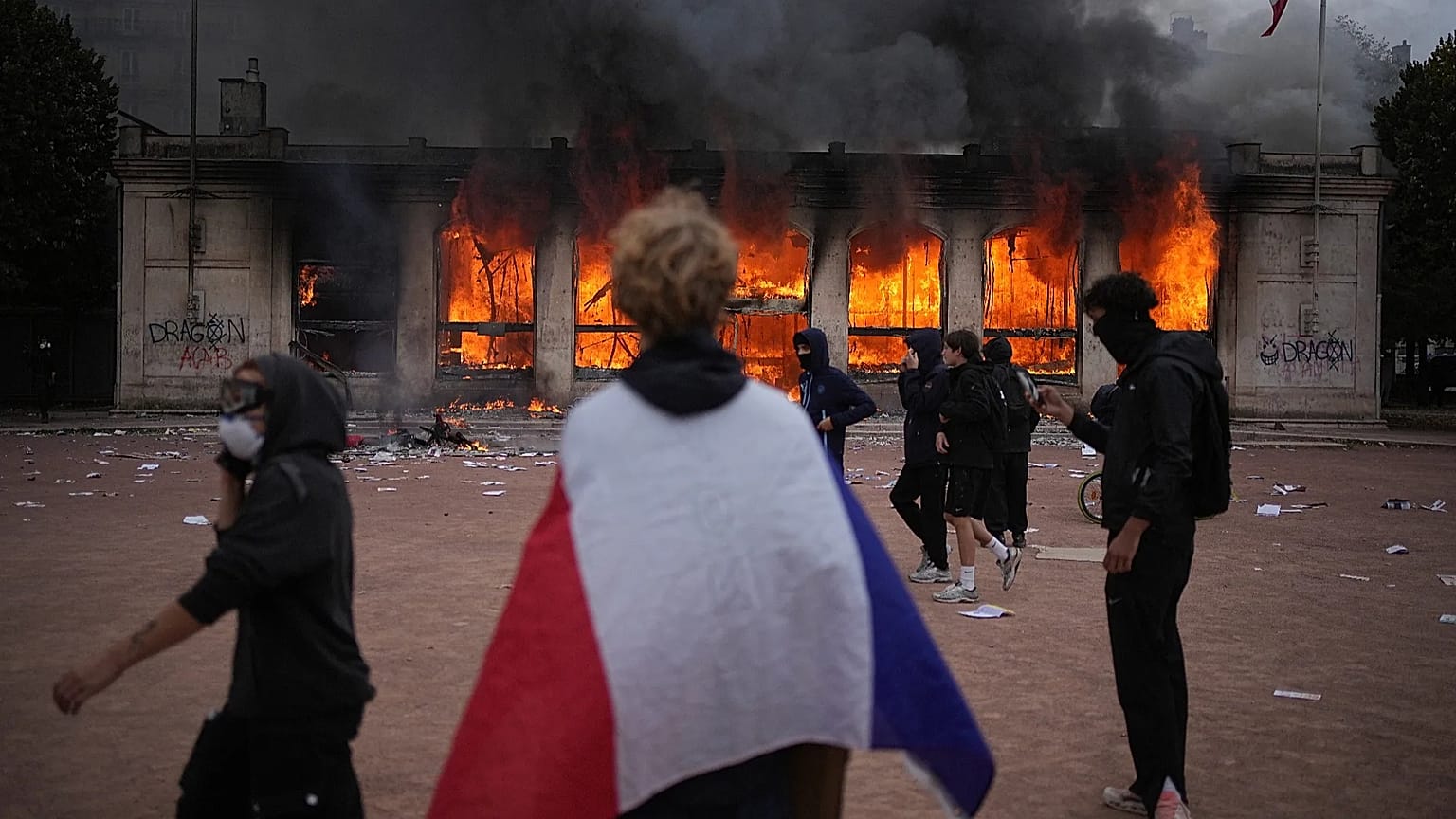
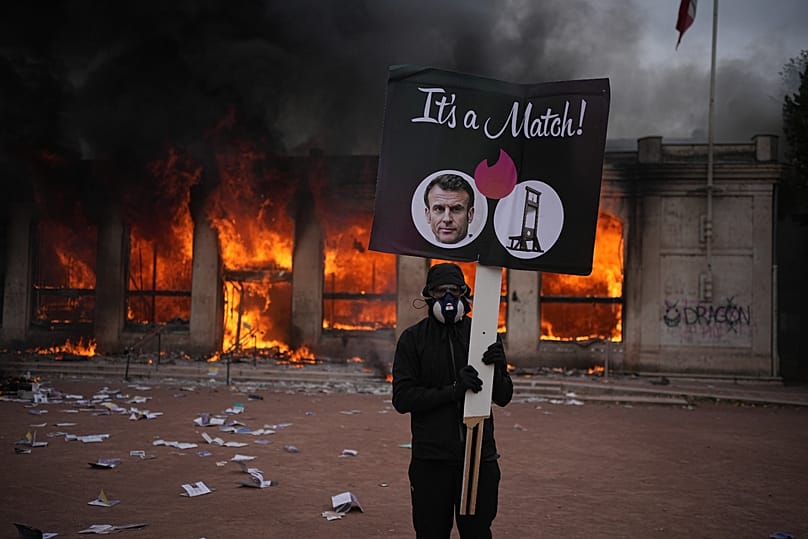
A protester wraps a French flag around them in front of the burning tourism office during a demonstration in Lyon, France, Saturday, Oct. 17, 2026.
Copyright Copyright 2026 The Associated Press. All rights reserved

By Nathan Rennolds
Published on


Addressing the protests in a post on social media on Saturday evening, French President Emmanuel Macron said there was "no place for violence" in France.

Cost-of-living protests descended into violence across parts of France on Saturday as demonstrators clashed with police officers and set buildings and vehicles alight.

More than half a million people are thought to have joined the demonstrations, including 110,000 in the French capital, Paris. Violence also broke out in cities such as Lyon, Marseille, Bordeaux, Rennes, Strasbourg, Grenoble, Nice, Toulouse, and Limoges, where the town hall was almost completely destroyed in a fierce blaze.

French Interior Minister Laurent Nuñez said on Sunday that more than 500 police officers, gendarmes, and firefighters were injured during the protests, with 1,800 people arrested.

Euronews has put together 10 of the most dramatic images from the day.
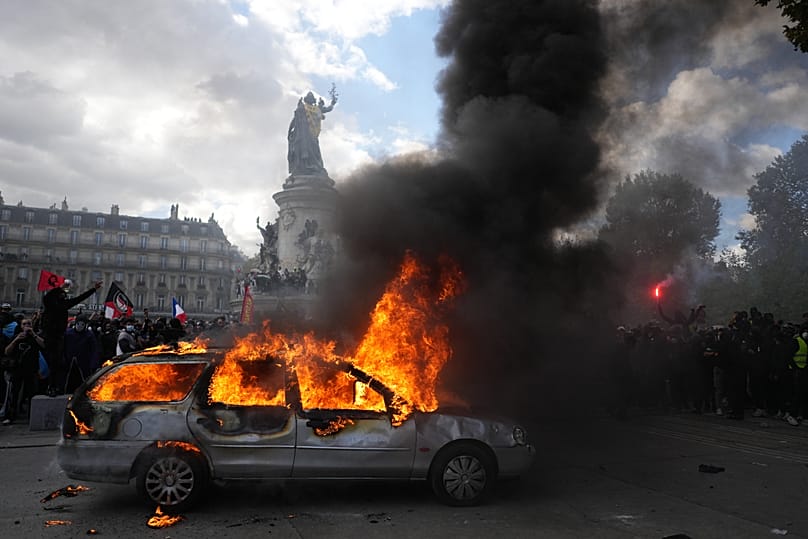
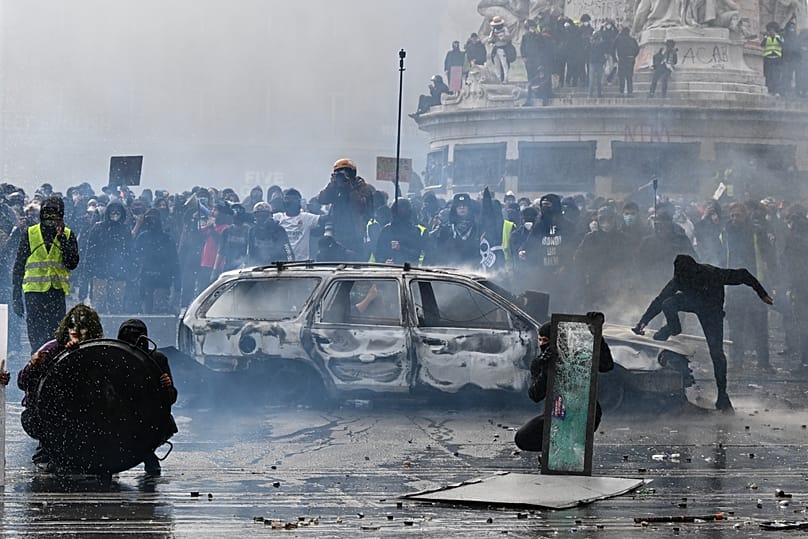
A car burns at Republique square during a protest against rising living costs, joining students' grievances, in Paris, Saturday, Oct. 17, 2026.
A car burns at Republique square during a protest against rising living costs, joining students' grievances, in Paris, Saturday, Oct. 17, 2026. Copyright 2026 The Associated Press. All rights reserved
A burning tourism office during a demonstration against rising living costs and in solidarity with students’ grievances in Lyon, France, Saturday, Oct. 17.
A burning tourism office during a demonstration against rising living costs and in solidarity with students’ grievances in Lyon, France, Saturday, Oct. 17. Copyright 2026 The Associated Press. All rights reserved
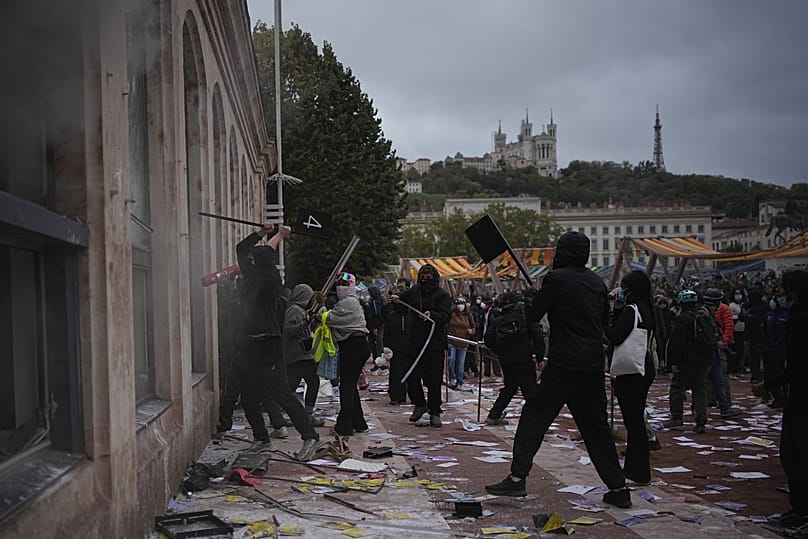
Protesters attack a tourism office during a demonstration against rising living costs, joining students' grievances, in Lyon, France, Saturday, Oct. 17, 2026.
Protesters attack a tourism office during a demonstration against rising living costs, joining students' grievances, in Lyon, France, Saturday, Oct. 17, 2026. Copyright 2026 The Associated Press. All rights reserved
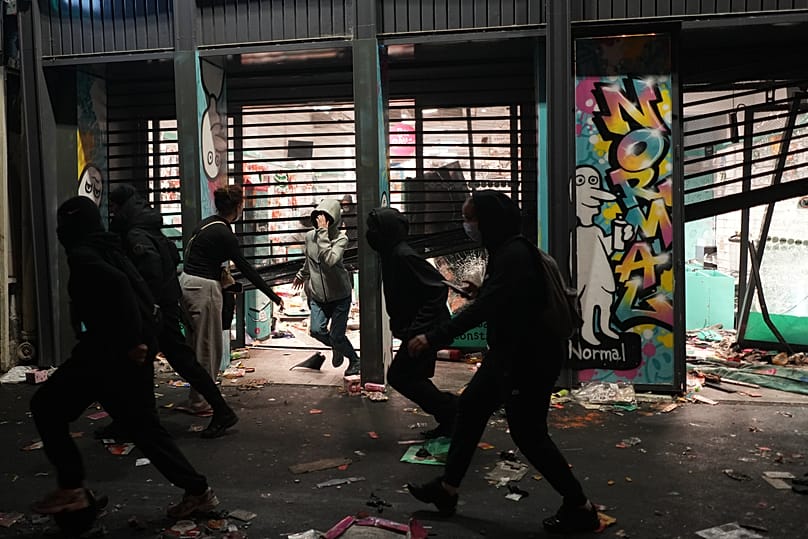
Protesters run past a looted store during a demonstration against rising living costs, joining students' grievances, in Paris, Saturday, Oct. 17, 2026.
Protesters run past a looted store during a demonstration against rising living costs, joining students' grievances, in Paris, Saturday, Oct. 17, 2026. Copyright 2026 The Associated Press. All rights reserved
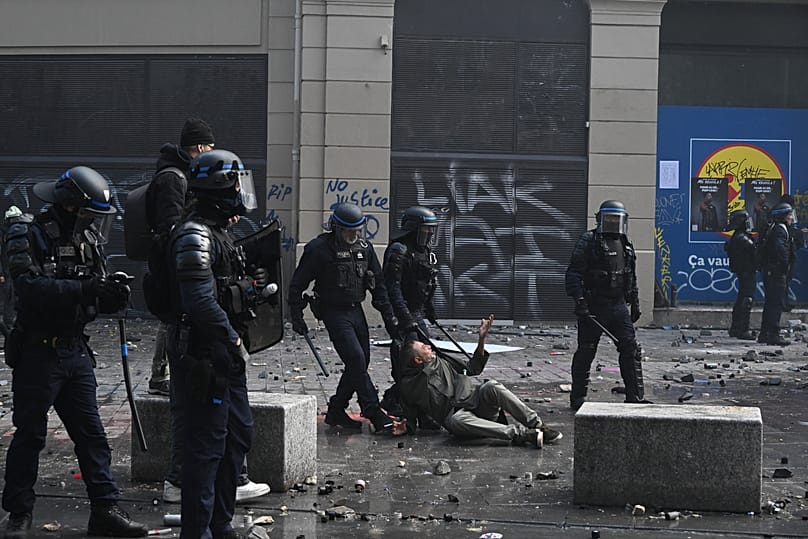
Police detain a protester during a demonstration against rising living costs and students' grievances, in Paris, Saturday, Oct. 17, 2026.
Police detain a protester during a demonstration against rising living costs and students' grievances, in Paris, Saturday, Oct. 17, 2026. Copyright 2026 The Associated Press. All rights reserved
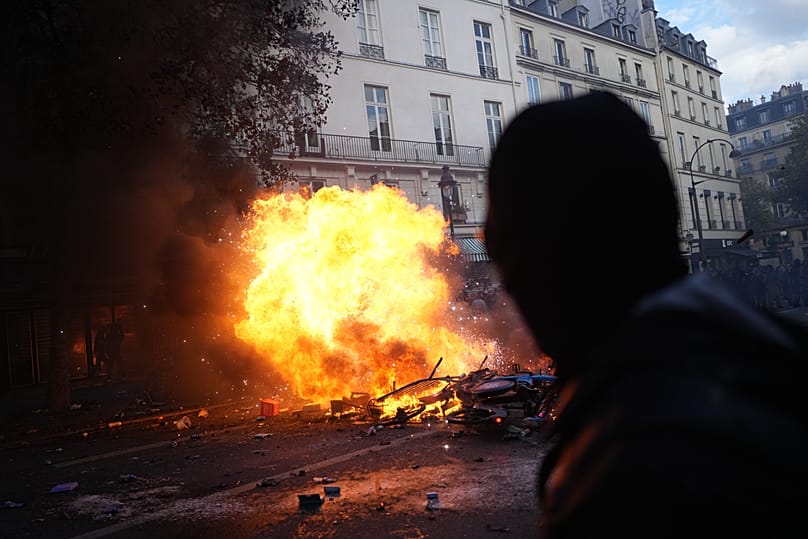
Protesters stand in front of burning bicycles during a demonstration against rising living costs, joining students' grievances, in Paris, Saturday, Oct. 17, 2026.
Protesters stand in front of burning bicycles during a demonstration against rising living costs, joining students' grievances, in Paris, Saturday, Oct. 17, 2026. Copyright 2026 The Associated Press. All rights reserved
Police scuffle with protesters during a demonstration against rising living costs, joining students' grievances, in Paris, Saturday, Oct. 17, 2026.
Police scuffle with protesters during a demonstration against rising living costs, joining students' grievances, in Paris, Saturday, Oct. 17, 2026. Copyright 2026 The Associated Press. All rights reserved
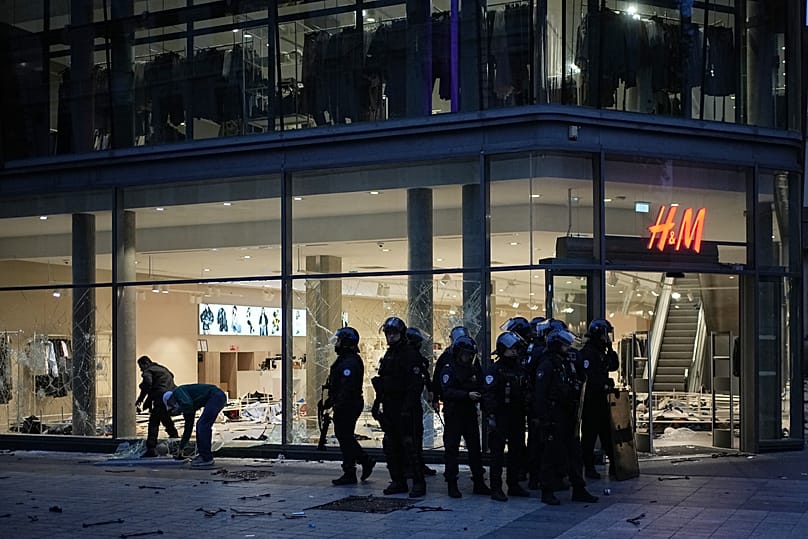
Police officers stand guard in front of a looted store during a demonstration against rising living costs, joining students' grievances, in Lyon, France, Saturday, Oct. 17.
Police officers stand guard in front of a looted store during a demonstration against rising living costs, joining students' grievances, in Lyon, France, Saturday, Oct. 17. Copyright 2026 The Associated Press. All rights reserved
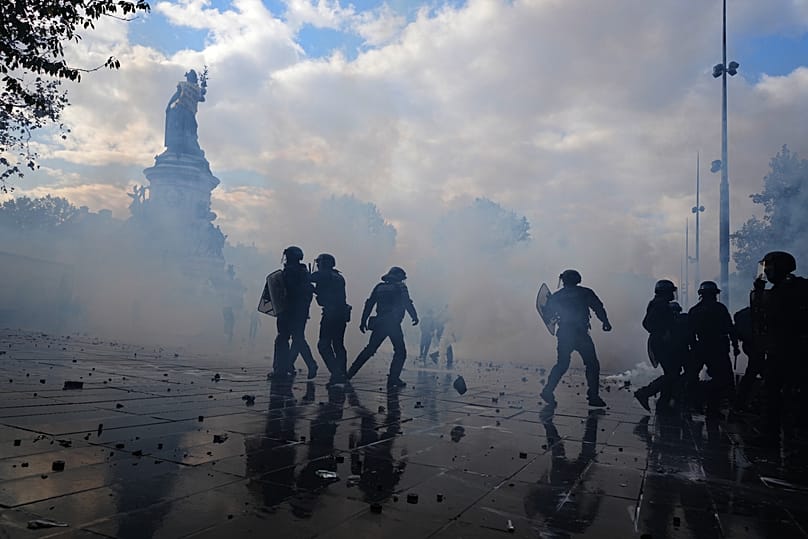
Protesters confront police during a demonstration against rising living costs and in support of students’ grievances in Paris, Saturday, Oct. 17, 2026.
Protesters confront police during a demonstration against rising living costs and in support of students’ grievances in Paris, Saturday, Oct. 17, 2026. Copyright 2026 The Associated Press. All rights reserved
Protesters run to leave the Republique square during a demonstration against rising living costs, joining students' grievances, in Paris, Saturday, Oct. 17, 2026.
Protesters run to leave the Republique square during a demonstration against rising living costs, joining students' grievances, in Paris, Saturday, Oct. 17, 2026. Copyright 2026 The Associated Press. All rights reserved


'We tore it up': French looters brag online as minister admits police 'lost control'
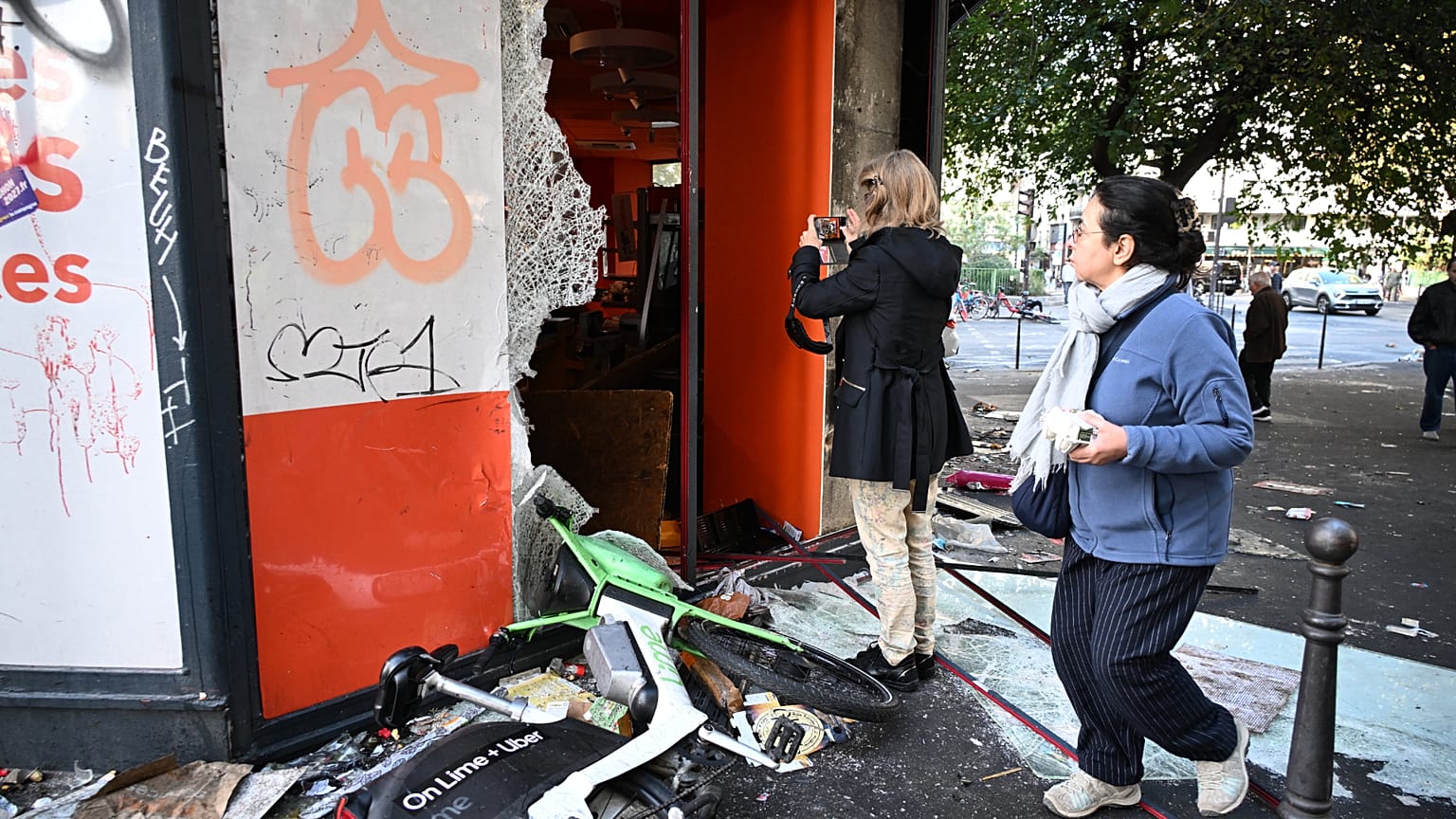
Shopkeepers in Paris surveyed the damage after a night of rioting.
Copyright AP Photo

By Simon Ormiston
Published on


More than 2,000 shops were hit and the damage is put at hundreds of millions of euros, leaving the government to answer for its failure to see the violence coming.

Young people who took part in the weekend’s looting in France have posted videos on TikTok and X boasting about the goods they took and about beating the riot police.

“Thank you Paris, thank you Paname,” a young man says in one video on TikTok, using a slang name for the capital. "You’re killers, guys, we tore it all up."

His eyes are red, apparently from tear gas, and he goes on to list his haul. "I grabbed some new Under Armour," he says, referring to the American sportswear brand.

He then turns to the CRS riot police. "You ran like that, guys, we wiped you out," he says, before signing off: "Generation Z, respect."


‘You save money by looting’

In a second video, a young man explains to an interviewer why he joined in. He says he was protesting about fuel prices because his mother has a car, and that he took clothes and goods from a sports shop.

"In the end, you save money by looting," he says.

Asked for his view of France, he says: "I think France is racist, and we should all be equal." He says a restaurant turned him away earlier that day but let in "a French person".

The interviewer asks whether looting will only reinforce the image of "the North African who steals". He replies: "If we carry on like this, it’s going to be chaos."

‘You couldn’t look shopkeepers in the eye’

The bravado contrasts sharply with the mood in government. On Monday, Interior Minister Laurent Nuñez admitted that police had lost control.

"On Saturday, in some major cities, you couldn’t look shopkeepers in the eye after hundreds of shops had been looted and tell them we hadn’t lost control," he said.

Nuñez acknowledged a "lack of anticipation" in the deployment of security forces. He said around 60,000 police and gendarmes were on duty nationwide on Saturday, too few to handle the large crowds of rioters and looters on the fringes of the demonstrations.

"Given the damage that has been caused, it was only right that I should hand in my resignation," he said. President Emmanuel Macron refused to accept it

Damage in the ‘hundreds of millions’

Around half a million people marched across France on Saturday against the cost of living. The protests then turned into some of the worst violence the country has seen in years, with town halls and shops looted and set on fire.

In Paris, crowds of masked men in black hoodies yanked at metal shutters until they gave way. They cleared shelves of cigarettes, sunglasses, clothes, jewellery and food, AFP journalists reported. Looters left a supermarket with bags stuffed with cakes, fruit juice and alcohol.
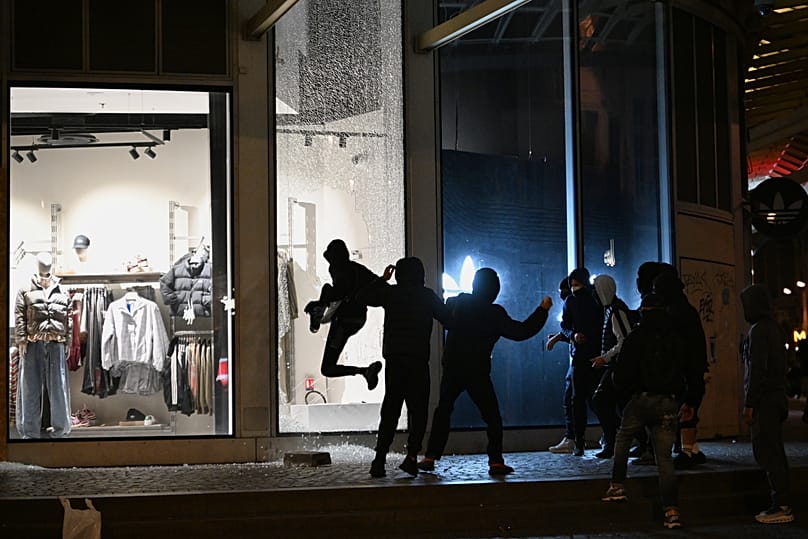
Stores across Paris had windows smashed and products stolen by gangs of youths in hoodies. 18 October, 2026. AP Photo

Antique clocks disappeared from a small jewellery shop, and whole display racks of sunglasses vanished. Inside some shops, looters smashed cash registers onto the floor, only to find them empty.

More than 2,000 shops are expected to have been affected nationwide, according to Alain Di Crescenzo, president of the chamber of commerce. He put the damage at "hundreds of millions of euros".

More than 2,500 people were arrested, and almost 1,000 members of the security forces were injured. Protesters were hurt too, among them a demonstrator whose hand was blown off by a police crowd-control grenade.

Justice Minister Gérald Darmanin said more than 2,330 people had been taken into police custody over the weekend, 70% of them adults.


France: Rioters Set Limoges City Hall Ablaze


Protests and riots in Paris, France on 17 October 2026. 

Photo Credit: Jorge Jaramillo, Wikimedia Commons

October 19, 2026
 Al Bawaba News
By Osama Ali


Key Takeaways:

The 143-year-old Limoges town hall was heavily damaged by fire on Saturday, October 17, during nationwide demonstrations against rising living costs, with the roof collapsing onto lower floors except in the western wing.

Mayor Guillaume Guérin alleged the attack was premeditated and said people inside feared for their lives; firefighters controlled the blaze by Sunday morning.

Prime Minister Sébastien Lecornu pledged that the building would be rebuilt, public services maintained, and insurance compensation accelerated.


(Albawaba) — A French town hall that survived two world wars has been devastated by fire during nationwide unrest, with the mayor of Limoges alleging a deliberate attempt to burn down the building while people were inside.

Residents confronted the damage on Sunday, October 18, after flames tore through the 143-year-old landmark during Saturday’s demonstrations against rising living costs.


The ornate, 19th-century building became one of the most striking scenes of destruction during France’s worst unrest in years, Reuters reported.

Mayor Guillaume Guérin alleged that the attack was premeditated and said those inside had feared for their lives. His account did not establish who organised the attack.

Haute-Vienne prefect Maurice Barate said the roof had collapsed onto lower floors except in the western wing. Officials described the building as severely damaged and largely lost, with assessments continuing.

Firefighters battled the blaze overnight before bringing it under control on Sunday morning.

Guérin condemned the destruction, saying no disagreement or demand could justify attacks on public property.

Prime Minister Sébastien Lecornu pledged that the town hall would be rebuilt. He also promised continuity of public services and government efforts to accelerate insurance compensation, according to Le Monde.

The immediate challenge now extends beyond restoring a historic landmark: authorities must maintain the services it provided while determining the full extent of the damage.


About Al Bawaba News
Al Bawaba provides top stories and breaking news about the Middle East and the world. The Al Bawaba network consists of several web portals and media platforms.
View all posts by Al Bawaba News →



India’s Cockroach Party sparks alleged US-backed Modi regime-change fears

India’s Cockroach Party sparks alleged US-backed Modi regime-change fears
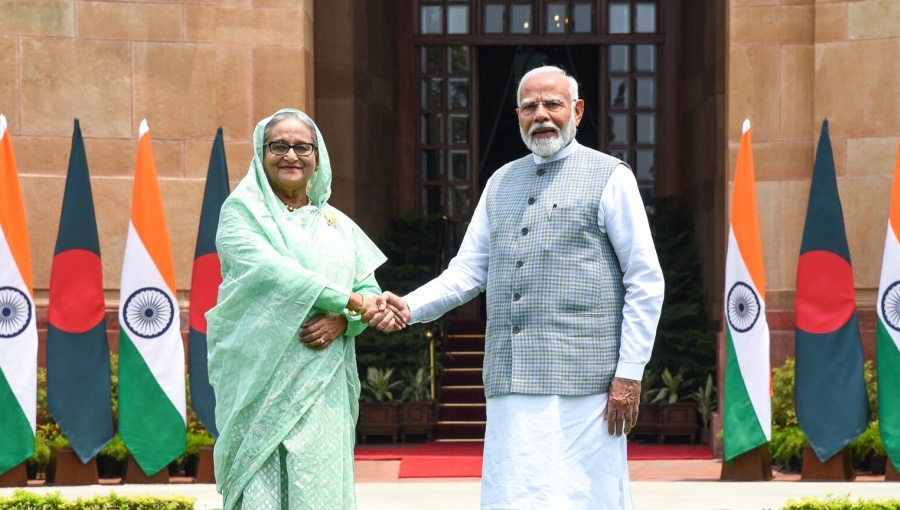
Modi with the now deposed, but living in India, former Bangladeshi leader Sheikh Hasina just two years ago / Prime Minister's Office IndiaFacebook
By Mark Buckton in New Taipei October 19, 2026

India's Cockroach Janta Party (CJP) won its first fight by shaming a minister out of office. Its second, against the country's election chief, is starting to look like an attempt to topple a government.

Delhi Police detained founder Abhijeet Dipke for the second time in less than a week on October 16 as he set off for a "Lehra Do Tiranga" (Wave the Tricolour) flag march at Connaught Place, a major financial, commercial, and shopping district located in the heart of the Indian capital, the BBC reported. Thousands of police and paramilitary personnel sealed off Central Park, the planned venue, and the movement's three main leaders were once again taken into custody.

The march came five days after those leaders walked free on a promise to keep the peace.

Less than a week earlier police took Dipke off his plane at Delhi airport, and he and co-conveners Saurav Das and Ashutosh Ranka, also detained that weekend, were released the next day on an INR50,000 ($526) surety bond "for maintaining peace and good behaviour, for a period of one year", Delhi Police said. However, Das and Ranka were back at the Jantar Mantar protest site, which the police had closed to demonstrators, on October 13, and the next day were sent to Tihar Jail for five days, accused of breaching their bonds.

Police then banned the October 16 march, and the CJP went ahead anyway with planning the gathering.

The movement is barely five months old. It began in May as an online joke after Chief Justice Surya Kant likened some unemployed young people to cockroaches, and by late July its protests over leaked exam papers had forced Education Minister Dharmendra Pradhan to resign, after a march on parliament turned violent. That was a policy win. The demand now is the resignation of Chief Election Commissioner Gyanesh Kumar and the scrapping of the Special Intensive Revision (SIR) of voter rolls, which the opposition says is stripping legitimate voters from the lists and which the Election Commission says targets dead, duplicate and ineligible names.

Pressed on the streets in defiance of police bans, that demand goes to the legitimacy of Prime Minister Narendra Modi's 12-year tenure as head of the government itself.

The Dhaka template

The movement's allies are not helping. Neha Bora, president of the All India Students' Association (AISA), the student wing of the Communist Party of India (Marxist-Leninist) Liberation, said in a video addressed to Bangladesh that circulated on October 15 that the Gen Z movement "first started in Bangladesh", congratulated Bangladeshis "for showing us the way" and called India's protests "a movement for democratic and voting rights", Varthabharati reported. Bora was subsequently detained on her way to the October 16 march.

As a result, the Bharatiya Janata Party (BJP) - the party of Prime Minister Modi - through its national spokesperson Pradeep Bhandari called her remarks an "open admission" of a planned regime change.

The reference point is August 2024, when students in neighbouring Bangladesh to the east turned a protest over job quotas into an uprising that drove Sheikh Hasina into exile in India, where she now lives. Nepal's Gen Z later protests in September 2025 brought down KP Sharma Oli's government and went on to overturn the political order at the polls in March.

India is a far harder target though. Modi has run the country since 2014 and won a third term in 2024, and, as Sadanand Dhume argued for the Council on Foreign Relations in a July essay, political, financial and technological power in India is not concentrated in one city the way it is in Dhaka or Kathmandu. The crowds are also smaller than the rhetoric: the BBC counted 200-300 people at Connaught Place at the start of the evening, well outnumbered by police and journalists.

American involvement

Dipke's own CV, however, is what gives the foreign-hand theory its traction. He was living in the US and studying at Boston University when he launched the CJP in May, and returned to India only in June to take it onto the streets.

Within a week of the launch, Kerala BJP president Rajeev Chandrasekhar had called the campaign a "classic cross-border influence operation", the National Herald reported.

The accusations have multiplied since. On October 16 former BJP MP Brij Bhushan Sharan Singh blamed Elon Musk for the Delhi protests, offering no evidence, and when US Congresswoman Pramila Jayapal backed the anti-SIR protests, India's ambassador in Washington, Vinay Mohan Kwatra, called her comments "unacceptable interference" in India's "internal affairs", The Hindu reported.

To date, no one has produced evidence that Washington funds or directs the CJP. The suspicion draws instead on the historical record. In Serbia, US government money - about $41mn over 1999 and 2000, according to the Washington Post - paid for opposition polling, training for the Otpor student movement in Budapest and thousands of cans of spray paint before Slobodan Milosevic fell in 2000.

Washington funded the exiled Ahmed Chalabi's Iraqi National Congress for years before flying him back into Iraq in 2003, and in 2019 it recognised Juan Guaido, a Venezuelan legislator with a postgraduate degree from George Washington University, as his country's interim president. When that failed, US forces took the direct route in January and captured Nicolas Maduro.

Hasina herself was reported in August 2024 to have blamed Washington for her fall, saying she was ousted for refusing to hand over St Martin's Island in the Bay of Bengal, though her son later denied she had issued the statement. The US State Department called any suggestion of US involvement "laughable".

Why India, why now

The motive, for anyone inclined to look for one, is not hard to find. India became Russia's biggest buyer of seaborne crude after 2022, Modi hosted Vladimir Putin and Xi Jinping at the BRICS summit in New Delhi in September, and Washington has spent more than a year trying to bend New Delhi's energy policy - first with a 50% tariff in August 2025 and now with the late Lindsey Graham's "hellish" sanctions law, which lets the White House impose tariffs of up to 100% on the biggest buyers of Russian oil and gas. A Modi distracted by unrest at home would be significantly easier to deal with.

The case against US involvement though, is at least as strong. Washington already holds those tariffs as leverage, Indian refiners are cutting Russian purchases on price alone, and US Ambassador Sergio Gor said as recently as October 15 that a trade deal was "very close". Stoking chaos in the world's most populous country, a legitimate democracy and Washington's main counterweight to China in South Asia, would be a reckless way to win concessions it is already getting.

The red salute

Viewed from another angle, Bora's message, which mentioned a "red salute" in reference to her Bangladeshi audience, invites the mirror-image suspicion that even Moscow or Beijing could work through India's communist left.

At present, there is no evidence for that either. CPI(ML) Liberation is a small domestic party with a handful of MPs, Russia is one of New Delhi's oldest partners, and while China would hardly mourn an India absorbed by unrest, there is no sign it has tried to engineer one - yet.

What the cockroaches have shown since May is that youth anger over jobs and exams, and now over the vote, is real, and that Modi's government can be made to give ground.

But by defying the police days after promising to keep the peace, and by borrowing Dhaka's language, the movement risks handing Modi's ministers the foreign-plot story they have already leant on.

Could India be headed back to its 1970s norm of ruling party supporters imagining foreign agents under every bed?


Australian Employees want climate action but don't trust employers’ claims: report


Curtin University


Australian workers want employers to take action on climate change but are increasingly sceptical of corporate promises, with a new report finding that only 14 per cent believe their own employer is making good progress on climate commitments.


The Curtin Centre for Applied Ethics (CCAE) report, ‘Employee Expectations of Corporate Climate Action’, surveyed 2048 workers from across Australia and found widespread support for corporate climate action, but strong demand for independent verification and accountability.


Co-author Professor Anthony Langlois, Director of the CCAE, said the findings revealed a significant trust gap between employee expectations and perceptions of corporate performance.


“Employees are not questioning whether businesses should act on climate change. For most Australians, that question has already been settled,” Professor Langlois said.


“The challenge for employers is credibility. Workers want to see evidence of real progress, not simply commitments or communications campaigns.”


The report found 97 per cent of employees believe large Australian companies have a responsibility to address climate change, while 76 per cent expect their own employer to take action.


However, despite 57 per cent saying their employer had made a public climate commitment, only 14 per cent believed meaningful progress was being made.


Professor Langlois said the findings highlighted the importance of transparency as businesses navigate increasingly complex environmental, economic and social challenges.


“Our research suggests employees are ready to support corporate climate action, but they are unwilling to take it on trust,” Professor Langlois said.


“In an era shaped by what we describe as a polycrisis, where environmental, economic and social pressures increasingly overlap, organisations need to demonstrate not only that they are acting responsibly, but that they can prove it.”


Co-author Professor Astghik Mavisakalyan said trust in climate claims rose dramatically when independent checks were involved.


“Most employees assume greenwashing is common, and very few accept sustainability claims at face value,” Professor Mavisakalyan said.


“Employees are far more likely to trust climate claims that are independently audited or backed by mandatory disclosure requirements than claims that rely solely on self-reporting.”


The report found 79 per cent of employees believe greenwashing is common, while 85 per cent would trust climate claims if disclosure was required by law and subject to penalties for misleading statements. By comparison, only around 44 per cent trusted self-reported claims or voluntary commitments.


Climate change was also found to be a workplace issue rather than just an environmental concern, with employees expecting impacts across cost of living, health, jobs and security over the next two decades.


The study found three in four employees were concerned about climate change, with cost of living emerging as the area where workers expected it to have the greatest impact.


Professor Mavisakalyan said the findings had important implications for employers competing for talent.


“Climate performance is increasingly influencing workplace decisions,” Professor Mavisakalyan said.


“A substantial share of employees indicated they would accept lower pay to work for a company with strong, verified climate credentials, suggesting climate action is becoming part of how workers assess employers.”