Monday, October 19, 2026


A Culture of Death

by | Oct 15, 2026 | 6 Comments

“It is forbidden to kill; therefore all murderers are punished unless they kill in large numbers and to the sound of trumpets.” — Voltaire (1694-1778)

A government that claims the authority to kill persons after they have been subdued, disarmed, tried, convicted and confined in prison has made a startling claim about the nature of political power. It claims not merely the authority to protect the innocent from violence, but the authority to inflict violence when no immediate threat exists.

It claims that the taking of human life, which it rightly condemns when committed by private individuals, somehow becomes morally permissible when committed by government agents. This is the fundamental contradiction of the death penalty: Government killing the helpless protects the living.

The Declaration of Independence offers a radically different understanding of government. All human beings possess natural rights, and governments are instituted to protect those rights. Government’s just powers derive solely from the consent of the governed. Government is not the owner of our lives. It is our creature, established to protect rights that precede its existence. Its authority is limited, and it cannot legitimately claim powers that the people whom it governs do not themselves possess.

Individuals possess a natural right to defend themselves against an unlawful attack. They may use necessary and proportionate force to repel an aggressor. Because the people possess that right, they can delegate it to the government, including to a military for defensive purposes. Government’s legitimate authority to wage defensive war is a moral and legal derivation of the people’s preexisting right of self-preservation.

But what right does an individual possess to kill a defeated enemy who has surrendered, is disarmed and locked in a jail cell? What right does a private person possess to execute a prisoner who no longer presents an immediate threat? None. The right of self-defense does not include the right to kill a helpless captive as retribution for a past offense.

And if the people do not possess that right, how can they delegate it to government? The principle is straightforward: Government cannot legitimately acquire, through the consent of the governed, a power that the governed themselves do not possess.

Confinement protects society. Execution reveals the state’s claim to omnipotence.

Defense Secretary Pete Hegseth’s plans to have a convicted defendant executed publicly and livestream the killing represent a particularly repulsive vision of state power. If implemented, such a spectacle would not demonstrate the strength of American civilization. It would advertise its moral depravity. It would turn the deliberate destruction of a human being into political entertainment, with the machinery of government serving as producer and promoter.

There is something profoundly disturbing about officials who would turn a human death into a public performance. What lesson would such a livestream teach? That the state is entitled to kill, that its violence deserves an audience, and that adults and children should watch with approval as the life of a powerless, wheelchair-bound prisoner is extinguished by military sharpshooters? That the proper response to wrongdoing is not the restraint of power but the celebration of its most lethal expression?

This is a cruel and unusual descent into barbarism, a glorification of government killing and an invitation to cultivate a culture of fear and death. Civilization advances when it restrains violence, even in response to terrible crimes. Barbarism advances when violence becomes an instrument of public spectacle and collective gratification.

The military’s involvement makes the proposal still more grotesque. The Department of Defense exists to defend the country against external threats, not to transform the execution of prisoners into a propaganda production. The armed forces should not be reduced to stagehands for a political morality play in which the government celebrates its power over a captive’s life.

A free society should be especially suspicious when government seeks to dramatize its capacity to kill. The Framers understood that all government power must be confined and limited, not worshiped. Publicly celebrated executions would encourage the opposite attitude: Reverence for the state’s ability to destroy rather than respect for its obligation to protect.

A government that wishes to demonstrate moral seriousness should protect the innocent, prosecute crime fairly, provide due process and confine dangerous offenders securely. Life imprisonment incapacitates a murderer without requiring society to pretend that killing is an act of healing. It also leaves open the possibility of correcting a wrongful conviction.

None of this diminishes the suffering of murder victims or their families. Their losses are profound, and their endless grief deserves compassion rather than political exploitation. But the state does not honor victims by imitating the violence that destroyed them. It honors them by establishing a system of justice that refuses to confuse vengeance with virtue.

The values underlying both the Declaration of Independence and the Constitution reject a government with unlimited authority. The Framers established a limited government whose legitimacy depends on what was actually consented to by the governed. Consent is not a blank check, and a democratic majority cannot make every exercise of government power morally legitimate simply by funding it.

The death penalty transforms the government from the protector of life into its deliberate destroyer, then asks the public to call the destruction justice. A publicly streamed execution would take that contradiction to its obscene extreme, turning death into spectacle and state violence into pornographic entertainment.

A free people should reject this culture of death.

The measure of a civilized government is not how efficiently it kills a helpless prisoner, or how many spectators it can gather to watch. It is how faithfully it restrains its own power, even when anger, fear and the demand for vengeance make restraint politically inconvenient.

Government exists to protect our natural rights, not to become the final and unquestionable arbiter of who deserves to live. When the state claims that its right to kill is inherent and righteous, it demands a submission that no free people should grant.Share

Andrew P. Napolitano, a former judge of the Superior Court of New Jersey, is the senior judicial analyst at Fox News Channel. Judge Napolitano has written seven books on the US Constitution. The most recent is Suicide Pact: The Radical Expansion of Presidential Powers and the Lethal Threat to American Liberty. To find out more about Judge Napolitano and to read features by other Creators Syndicate writers and cartoonists, visit www.creators.com. COPYRIGHT 2025 ANDREW P. NAPOLITANO – DISTRIBUTED BY CREATORS.COM


South Korea’s Hedging Strategy

by | Oct 19, 2026 | 0 Comments

Republic of Korea (ROK) leaders are having to navigate an increasingly challenging policy course to avoid having their country become entangled in an array of dangerous security problems, both in East Asia and elsewhere in the international system.

The most recent example involved Seoul’s actions in Ukraine.  In late September 2026, the Kiev regime transferred two North Korean prisoners of war, who had been fighting with Russian forces, to South Korea.  That move was highly confidential, lest it put the ROK government in a highly compromising position.  Disclosure of the information could not only cause a rift in Seoul’s delicate relations with Moscow, but could also create a dangerous confrontation between the two rival Korean states.

Instead of maintaining the required discretion and confidentiality, however, Ukraine president Volodymyr Zelensky announced the transfer to the world during a speech before the United Nations General Assembly. Zelensky also sharply criticized North Korea and its leader, Kim Jong-un, for deploying troops on Russia’s behalf.  South Korean media then reported that the two captured soldiers had expressed their desire to defect to the ROK. Tensions between North and South Korea promptly spiked.

So did the anger of the ROK administration toward Zelensky.  South Korean President Lee Jae Myung immediately accused Ukraine of violating a nondisclosure agreement between Seoul and Kiev about the transfer. Ukraine flatly denied making such a deal.  The ROK’s risks of being drawn into the maelstrom of the Russia-Ukraine war seemed to rise.

Seoul already was resisting pressure from Kiev to sell sophisticated weapons to Ukraine. Zelensky’s government has asked the ROK on several occasions, most recently in early August 2026, to send air defense missiles and other crucial systems. Seoul has repeatedly declined those requests.  Zelensky’s clumsy conduct regarding the North Korean prisoners of war episode is not likely to enhance Kiev’s prospects going forward.

Yet NATO members, including the United States, have long been pressing the ROK to approve such arms sales.  Indeed, Seoul has faced such calls since Russia’s invasion of Ukraine in February 2022.  It has not been easy for ROK leaders to resist that pressure, but they have done so to this point.

Lee’s stance on the Ukraine arms sale issue is consistent with his government’s overall policy to try to reduce tensions with North Korea.  He has even gone beyond endorsing President Trump’s willingness to hold a summit meeting with North Korean dictator Kim Jong Un before the end of 2026.  In a major speech in late September, Lee called on the United States to ease its onerous, longstanding economic sanctions against Pyongyang, and to accept a freeze on North Korea’s nuclear weapons program rather than continue Washington’s hoary insistence on the abolition of that program.

South Korea is making a concerted effort to avoid becoming entangled in the Russia-Ukraine conflict, to promote a possible rapprochement between Washington and Pyongyang, and to ease the ROK’s own tensions with North Korea.  Lee and his advisers are also attempting to steer a middle course with respect to the mounting animosity between Japan and the People’s Republic of China.  Both Beijing and Tokyo seek Seoul’s backing regarding a number of disputes.  One emotional spat is the territorial dispute between Japan and the PRC over control of the Senkaku (Diaoyu) islands, which has led to several provocative deployments of maritime vessels in the past year.

Japan’s prime minister, Sanae Takaichi, wants her country to play a more active and assertive role in regional security affairs. She also favors adopting a more hardline posture toward China – especially on the issue of Taiwan’s de facto independence.  During one debate in the Japanese Diet, she ignored a longstanding warning from Beijing. Asked repeatedly about a hypothetical Taiwan security contingency, Takaichi stated that a military confrontation over the island would constitute a “survival-threatening situation” for Japan, a deliberate invocation of the Japanese constitution’s “collective self-defense” clause that would permit direct military intervention. That stance went significantly beyond Tokyo’s traditional position that its military forces exist solely for national self-defense and to fulfill treaty obligations.

Lee and other ROK leaders make it clear that their country is not willing to go down such a confrontational path.  Their cautious, prudent stance annoys pro-Taiwan partisans in the United States as well as members of that contingent in Japan.

Seoul’s current geopolitical headaches are classic examples of the challenges that a midsize power located in a volatile neighborhood must face.  A weaker “client state” has little choice but to comply with the wishes of the strongest regional power or of a distant, very strong protector.  “Client state” was an accurate description of the ROK’s status until the past few years.  Seoul relied heavily on the United States and Washington’s principal ally in East Asia, Japan, for defense.  The implicit tradeoff for such protection was a willingness to obediently follow Washington’s wishes on most security and economic issues.

But as a midsize power instead of a heavily dependent client, Seoul now has far more policy options.  Moreover, there likely will be a greater number of instances in which important ROK national interests do not closely align with those of the United States – or at least not with the policies Washington has adopted.  We are now seeing Seoul responding to that altered incentive structure by embracing actions that are designed to minimize risks and enhance the country’s international appeal and influence.

Based on the Lee administration’s handling of Kiev’s quest for support in its war against Russia, extremely delicate relations with Pyongyang, and the growing tensions between Tokyo and Beijing, South Korea’s current policymaking team is amassing an effective record.  The Trump administration should be pleased with that development.

Dr. Ted Galen Carpenter is a senior fellow at the Randolph Bourne Institute and the Libertarian Institute. He is also a contributing editor to National Security Journal and The American Conservative. He also served in various senior policy positions during a 37-year career at the Cato Institute. Dr. Carpenter is the author of 13 books and more than 1,600 articles on defense, foreign policy and civil liberties issues. His latest book is Unreliable Watchdog: The News Media and U.S. Foreign Policy (2022).
Burnham And Britain Need A Reversal Of Brexit – OpEd


By Mohamed Chebaro


Key Takeaways:

The article states that post-Brexit UK GDP is 6–8 percent lower per capita than it would have been inside the EU, and that Prime Minister Andy Burnham is now urging closer alignment, including food standards, emissions trading, and youth mobility, ahead of a 20 November UK-EU summit.

Burnham has framed rejection of stronger ties as a “dereliction of duty,” argued that Russia sought a Leave outcome, and cited shifting public opinion, while acknowledging that full freedom of movement, budget contributions, or euro adoption remain politically sensitive.

The author concludes that reopening the Brexit debate carries risks for Burnham’s leadership but that both the UK and the EU would benefit from closer association amid rising protectionism and geopolitical uncertainty.


The five essential qualities of a good political leader are vision, integrity, strong communication, empathy, and decisiveness. But above all is their ability to lead and make tough choices for the greater good during challenging times in the history of their nation.

Brexit has undoubtedly failed, even by the assessment of those who drove the leave agenda. Post-Brexit, the UK’s gross domestic product is between 6 percent and 8 percent lower per capita than it would have been had the country stayed in the EU. The economy is misfiring, resulting in the likelihood of more austerity and higher taxation.


But is EU membership the way to end the UK’s economic misery, help increase revenue, better defend the country, and improve social care?

At least Andy Burnham, the new prime minister, believes so. Even if the job is colossal, he seems willing to take the risk. Brexit remains the most divisive topic in Britain and any attempt to overturn the result of the 2016 referendum would be a “to be or not to be” moment for his leadership and political legacy.

After the parliamentary recess, Burnham made a strong return to Westminster by calling on MPs to back him in his bid for closer ties with Europe. He even went further, telling parliamentarians that rejecting closer ties would be a “dereliction of duty.”

Many in the UK agree with Burnham but dare not utter it.

In a UK-EU summit due to take place in Brussels on Nov. 20, Burnham hopes to advance a deal to align food standards with the bloc, link their emissions trading ‌systems and enable ‌more young people to live, work and study abroad, saying that such measures ⁠would help ⁠improve economic growth.


But Burnham also appears to have other things in mind. He was unafraid to claim in the run-up to his parliamentary statement that Russia influenced the narrow Brexit referendum result and warned voters in Europe of a similar threat to forthcoming elections.

In Britain, there is a growing consensus that Brexit has harmed the UK economy and its prospects for growth. Keir Starmer, the former leader, opted for closer ties but steered clear ‌of restarting a divisive debate. Burnham, however, is making the case that Britain has not benefited from quitting the EU and should take a “calm, clear-eyed look” at stronger ties.

Burnham’s bargain is based on a shift in public perception that is more in favor of rejoining the bloc. But this is not without risks. It might be OK to cooperate on trade, services, tariffs, the customs union and reducing immigration, but freedom of movement, contributing to the EU budget or steps to adopt the euro remain thorny matters.

The opposition Conservative Party and those further to the right believe that returning to the EU will not solve the UK’s economic problems or address its reduced clout internationally. But the number of those opposing stronger ties with Brussels is growing smaller, as more people take the view that, in a conflict-ridden and increasingly divided world, a closer association with neighbors is more reasonable than chasing a faraway dream.

On the eve of the Brexit referendum in 2016, it was possible to believe the UK could become a “beacon for free trade,” as Brexiters proclaimed. But even then the great wave of globalization seemed to be drawing to a close, with countries, particularly the US, showing signs of turning toward protectionism and tariffs.


In the event, Britain’s special relationship with the US failed to translate into a trade agreement to replace the privileged position it previously enjoyed in the EU. Free trade deals with Japan, India, Australia, New Zealand, South Korea, the Trans-Pacific Partnership and others have proved lucrative. But even collectively, these make up only a fraction of the losses the UK suffered by leaving the EU.

Faced with such realities, there is no doubt Burnham should consider whether the UK could do better by again aligning itself closely with the EU.

Whether Russia actually succeeded in affecting the outcome of the 2016 referendum remains uncertain. But it is obvious that Moscow was hoping for a leave victory — a result that weakened not only the UK but also the EU and NATO.

Reopening the Brexit debate could make or break Burnham’s premiership. But it looks increasingly likely that closer ties will benefit both the UK and the EU, especially at a time when adversaries from east and west are uniting to destroy the bloc.

Burnham and Britain need a reversal of Brexit. The EU stands to benefit, too, as the global architecture pivots toward protectionism, uncertainty and insecurity.


Mohamed Chebaro is a British-Lebanese journalist with more than 25 years of experience covering war, terrorism, defense, current affairs, and diplomacy.


About Arab News
Arab News is Saudi Arabia's first English-language newspaper. It was founded in 1975 by Hisham and Mohammed Ali Hafiz. Today, it is one of 29 publications produced by Saudi Research & Publishing Company (SRPC), a subsidiary of Saudi Research & Marketing Group (SRMG).
View all posts by Arab News →

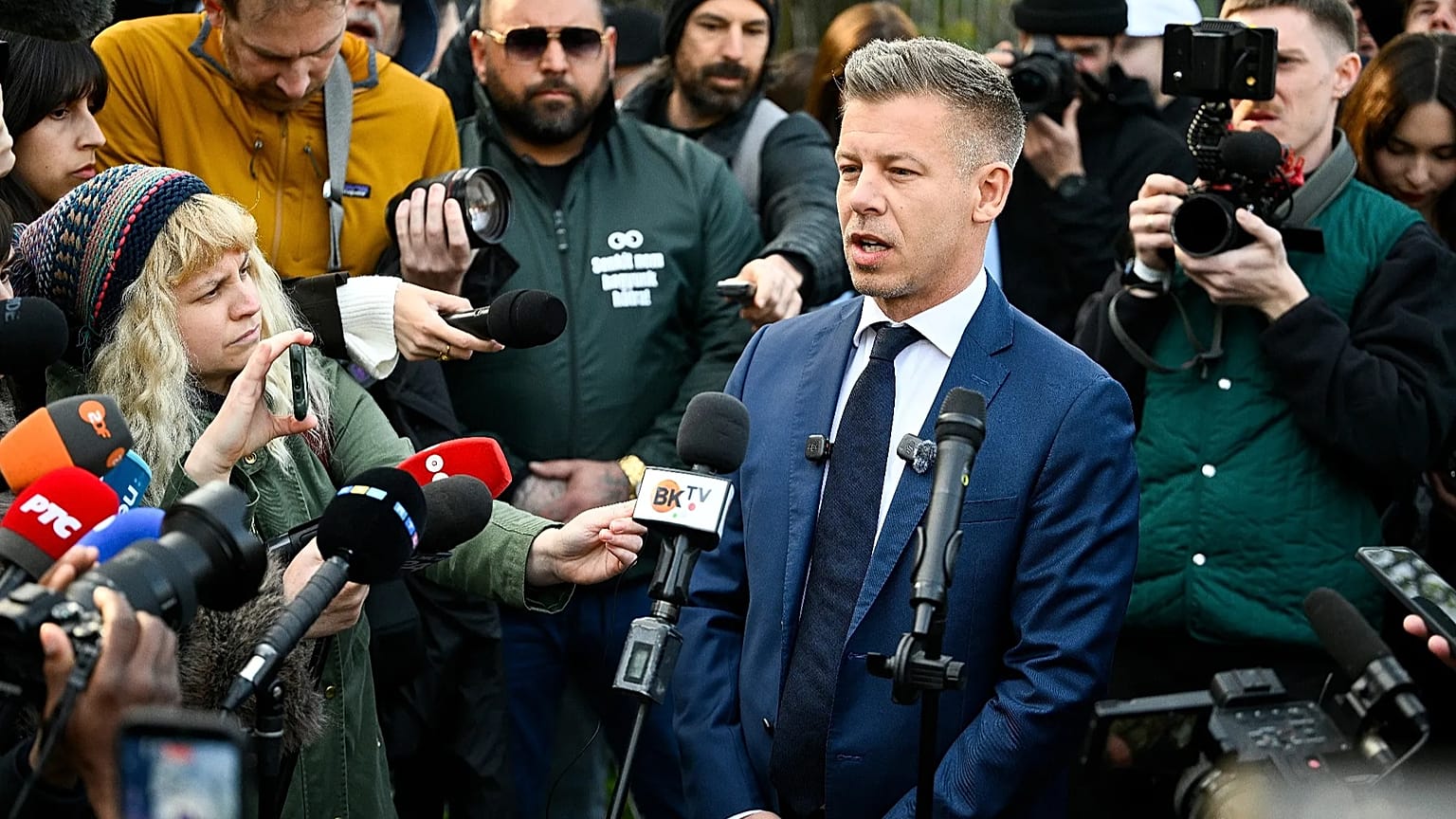
Hungary's Magyar links French riots to migration, says ‘shocking scenes’ justify hard line

 President of the opposition Tisza Party Peter Magyar talks to the media after casting his vote at a polling station during the general election in Budapest, Hungary, Sunday,
Copyright AP Photo

By Sandor Zsiros
Published on


Hungary’s Péter Magyar said riots in France justified his tough migration stance, echoed by Poland’s Donald Tusk. Left-wing critics accused him of exploiting the unrest, despite most protesters being French nationals.

Hungarian Prime Minister Péter Magyar linked the riots in France to immigration, saying the “shocking scenes” vindicated his government’s tough migration policies.

Anti-austerity protests turned violent in several French cities on Saturday, with looting reported in Paris, Lyon and Marseille. Several buildings were set on fire, including the historic town hall in Limoges.

“Seeing this senseless destruction and unjustified violence, perhaps it is now clear to everyone why Hungary takes the toughest possible stance on migration,” Magyar wrote on social media on Sunday, alongside a video showing buildings on fire.

“We will not relax our efforts to protect our external borders or change our immigration policy,” he added.

In his post, Magyar also said that the "overwhelming majority of European countries" want a tougher approach to migration and have "finally woken up".

“The Europe we all love is in serious trouble today. We also have a responsibility to help preserve our continent as the most wonderful place for our grandchildren," he said.

At a European summit held this week, a group of countries, including Denmark, Italy and Hungary, pushed for stronger language on migration in the conclusions.

French President Emmanuel Macron warned against “the stigmatisation” of immigrants and Spanish Prime Minister Pedro Sánchez praised their positive contribution.

Polish Prime Minister Donald Tusk also commented on Sunday, without explicitly referring to France. He said Poland would “neither repeat nor pay for” other countries’ mistakes, stressing that Warsaw would maintain its strict asylum policy.

“We are firmly defending the border against illegal migration; we have our own asylum policy (we do not accept applications); we deport those who break Polish law,” Tusk wrote on X on Sunday.

“On security issues, we will be relentless. That is what I told the leaders of Europe in Brussels,” he added.

Magyar’s remarks drew criticism in Hungary. András Jámbor, a left-wing activist and Budapest councillor, accused the prime minister of exploiting footage of the French riots for political gain.

“It is deeply disturbing that the Hungarian Prime Minister chose not to address the people’s legitimate demands and the unjustified violence, but instead to label them migrants,” Jámbor said.

“Although some protesters have an immigrant background, as do some members of the wider population, this demonstration is about more than that,” he added.

Macron will deliver an address to the nation at 8pm Sunday.


Albania's PM refuses to quit with protests against university conditions in sixth day

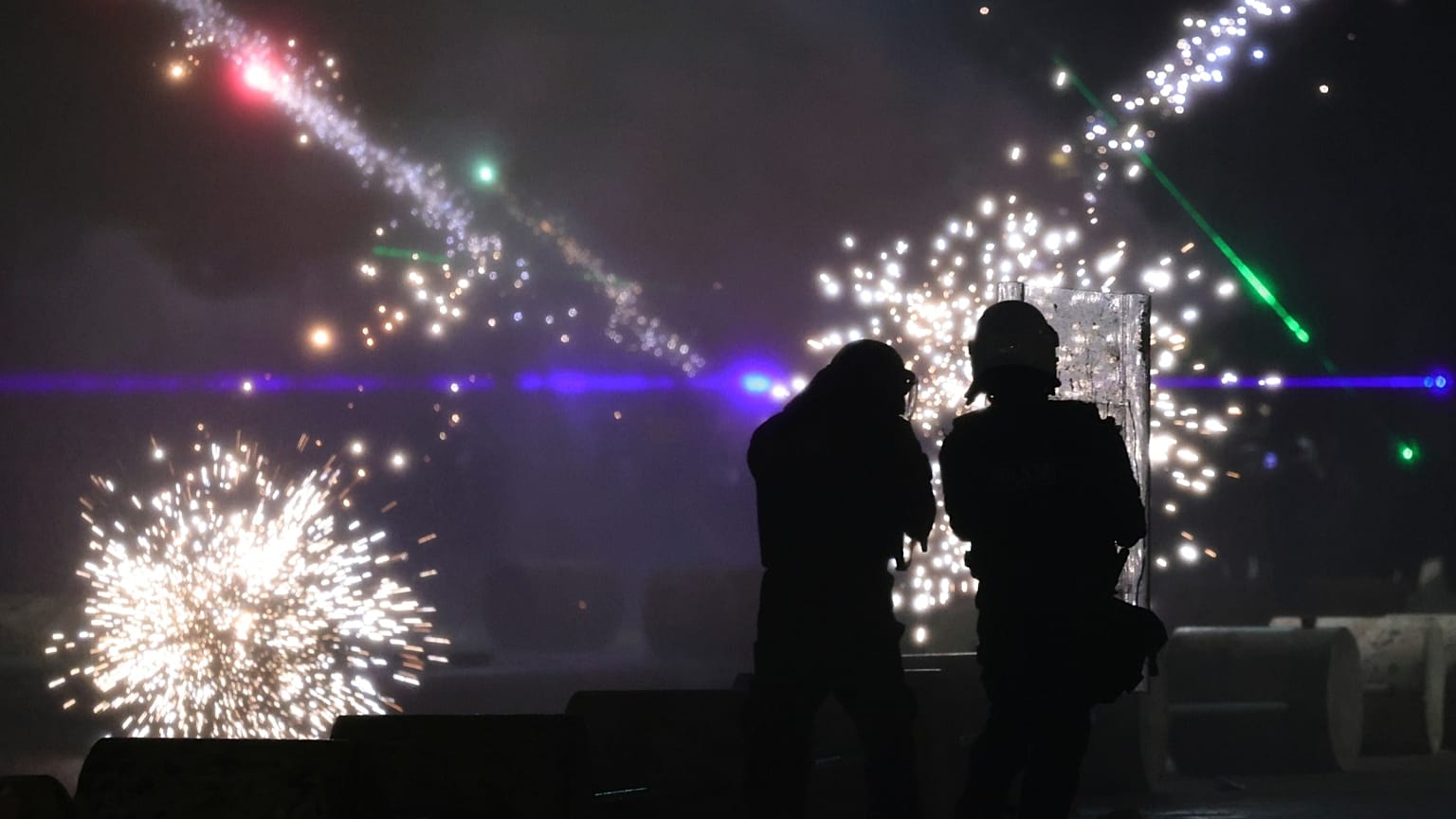
Protesters throw flares and fireworks at police during clashes at an anti-government demonstration in Tirana, 18 October, 2026
Copyright AP Photo

By Gavin Blackburn
Published on

The unrest follows months of anti-government protests in the Balkan nation, initially sparked by a controversial resort development in an ecologically protected area linked to US President Donald Trump's family.

Albanian police fired water cannon and tear gas on Sunday as violent anti-government protests entered a sixth day and Prime Minister Edi Rama rejected demonstrators' demands that he resign.

Violent demonstrations have rocked Tirana since Tuesday with protesters calling for action over poor university conditions, high tuition fees and corruption.

Hundreds of protesters gathered again at noon in front of the education ministry chanting "Rama, resign" amid a tense standoff with police.

After police attempted to disperse the crowds, the protests scattered across the city centre escalating in hours-long violent clashes.

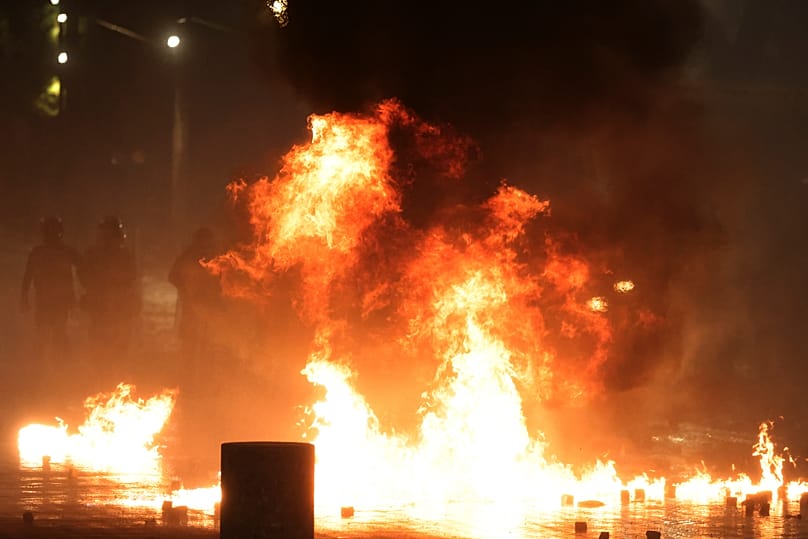
Protesters set litter bins in the streets on fire, smashed windows, including at the headquarters of the governing Socialist party, and set fire to a police station and the entrance of the interior ministry.

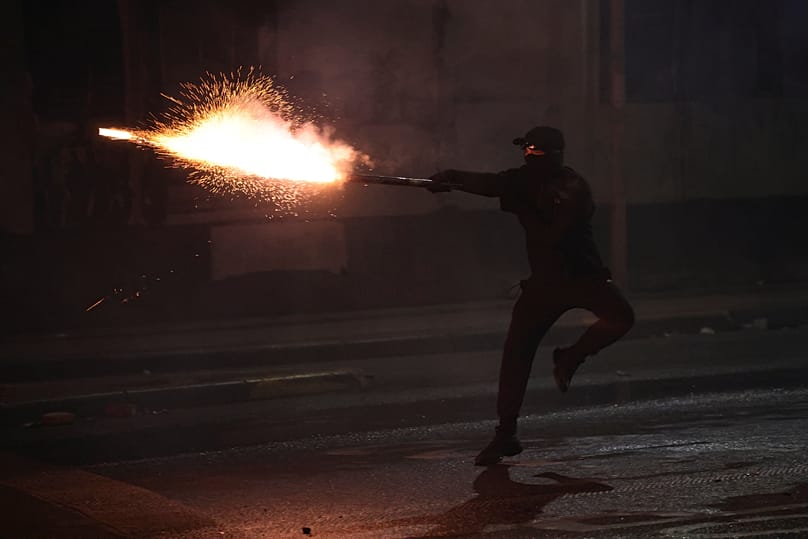
Chaotic clashes extended to the main boulevard and square with demonstrators throwing rocks, Molotov cocktails and firing pyrotechnic devices, as the police responded with rubber bullets and tear gas, according to an AFP journalist.

Protesters throw petrol bombs at police during clashes at an anti-government demonstration in Tirana, 18 October, 2026 AP Photo

Ambulances were seen rushing in and out of the scenes of clashes to pick up the injured.

The ministry of Health told the AFP news agency that 16 police officers were injured, 14 of them when protesters attacked the police station.

Albert Nushi, from the police public security department said on Sunday night that a police station in Tirana was attacked with Molotov cocktails and pyrotechnic devices that endangered both officers and people held in custody.

"An attack on a police station is not a protest. Violence against police officers, attacks on institutions, and actions that endanger human lives cannot be tolerated," he said.

He urged protesters to stay away from masked individuals behind the violence and "assemble in a peaceful manner".

According to the Ministry of Health, 28 people were injured on Sunday; 19 police officers, four protesters, four passers-by and a journalist.

Before the protest, shops and offices in the city centre secured their doors and windows with metal shutters, while city workers removed paving stones to prevent them being thrown by protesters.

In a video broadcast lasting more than an hour, Rama ruled out resigning, stating that the protests are the "work of an outside hand".

According to Austrian federal press service, Rama’s official visit to Federal Chancellor Christian Stocker scheduled for Monday, had been cancelled by the Albanian side.

Protesters throw petrol bombs at police during clashes at an anti-government demonstration in Tirana, 18 October, 2026 AP Photo

Buildings on fire

Writer and activist Lura Elezi, 38, told AFP that she is protesting for "a better life, rule of law and against crime and corruption".

"I love my country, but my government does not respect us, it defies us. Every citizen must take responsibility for their country, taking on the duty to lead, to love, and not to destroy one's own nation", she said.

Tirana saw its harshest violence on Saturday when protesters threw rocks, Molotov cocktails, metal objects and pyrotechnic devices at police, and torched cars and litter bins to use as barricades against advancing police.

Buildings including a court, banks and a post office were set on fire or severely damaged.

According to a health ministry report issued Sunday, 65 people were injured, including 37 police, with 12 people hospitalised during Saturday’s protests.

Since Tuesday, 272 people have been injured in the clashes, including 169 police, the ministry said.

A hooded protester aims fireworks at police during clashes at an anti-government demonstration in Tirana, 18 October, 2026 AP Photo

Albania's close ally the United States reacted late on Saturday with its embassy in Tirana urging "restraint and calm on all sides".

The European Commission in a written statement “condemned the use of violence in Tirana and other cities”, adding that the response to it “must remain proportionate”.

"In a candidate country firmly committed to the EU accession process...grievances should be handled through constructive dialogue and in a peaceful manner," the statement said.

The unrest follows months of anti-government protests in the Balkan nation, initially sparked by a controversial resort development in an ecologically protected area linked to US President Donald Trump's family.


Portugal

Thousands of young people launch a housing protest in Lisbon

Monday 19 October 2026, by Esquerda.net


Tweet
Version imprimable


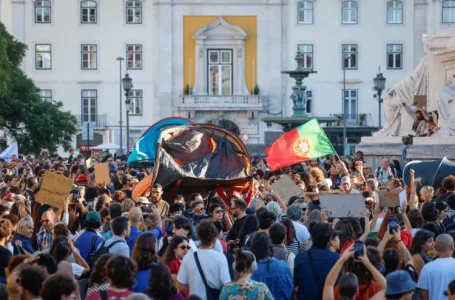
The slogan is “Can’t manage anymore? Then pitch your tent!” Protesters gathered in Rossio Square and set up their tents to demand solutions guaranteeing the right to housing. In Porto, a popular assembly brought together thousands of people and decided to re-erect tents in D. João I Square. [1]

The vast majority of those participating in the encampment are young people who, in their statements to the media, testify to the impossibility of becoming independent and leaving their parents’ home, even though they already have a degree and a job. Parents are often cited as examples to illustrate how much the situation has changed in recent decades: while a couple’s salaries were once sufficient to rent or buy a home with a mortgage, today, children do their accounts and realize that it’s nothing more than a dream.

The protesters are not holding back their criticism of the current government, which has adopted measures that benefit only landlords and real estate funds through tax exemptions: the recent amendment to the rent law, passed in its first reading [2] with the support of the far-right Chega party, weakens tenants. Their criticism also targets statements made by members of the government last week in response to the Porto encampment, with the Prime Minister calling the social movements selfish, and a minister asserting that the government will not heed the cries of the street.

Once the Rossio square was occupied, a popular assembly was held, rich in testimonies about the housing crisis. The slogan “the people united will never be defeated” was heard, and Grandola, Vila Morena [3] was sung several times .

In Porto, thousands of people once again decided to spend the night in D. João I Square
The encampments in Portugal began on Saturday October 10th in Porto, where, despite police repression, D. João I Square was the scene of gatherings and nighttime assemblies throughout the week. That Saturday, thousands of people gathered again in the late afternoon, in solidarity with the right to housing movement, but also to protest against the police intervention early Thursday morning.

During the public meeting held in the early evening, it was decided to put up tents to spend the night on site.

"It was an unequivocal vote, almost unanimous. People are outraged and want to support us. More and more people are joining us," said Cristiana Leal, one of the organizers of the demonstration, who called for "more people to come and help the government hear the cries from the street: Lisbon is crying out, Porto is crying out, and in Faro too, there has been a strong mobilization."

17 October 2026

Translated by International Viewpoint from Inprecor. First published Esquerda.net.

Footnotes

[1] Photo by António Pedro Santos: Start of the Lisbon camp for the right to housing.

[2] In the Portuguese Parliament, the vote "na generalidade" is the first of three stages in the adoption of a text, before the article-by-article examination and the final vote.

[3] This song by José Afonso, broadcast on the radio, on the night of 24-25 April 1974, signalled the military uprising that overthrew the dictatorship.