Tuesday, October 20, 2026


Spain’s housing crisis explodes
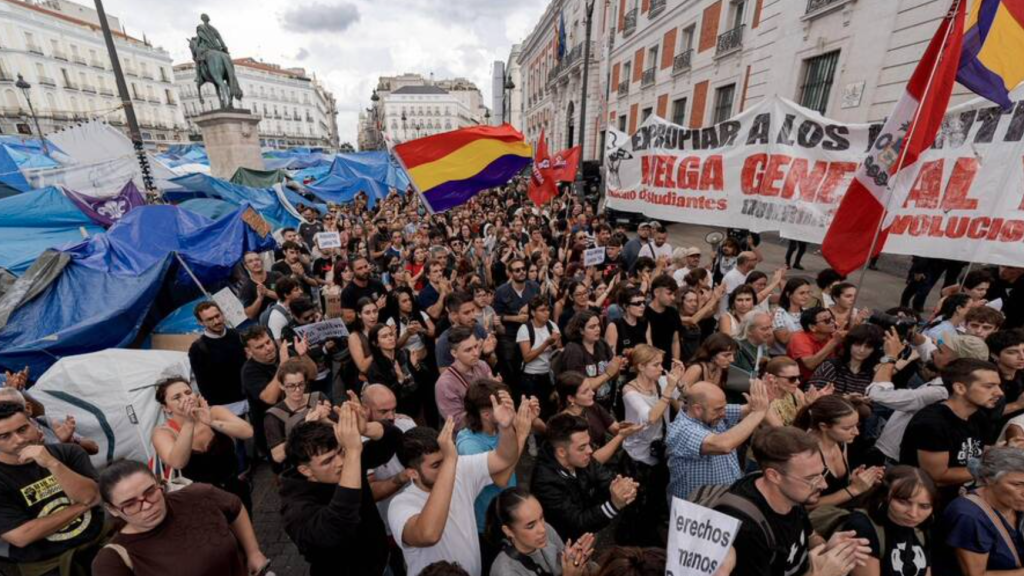
Demonstrators protesting Spain's housing and rental crisis, on Madrid's Puerta del Sol with the protest encampment visible in the background (2 October 2026)

First published at Rosa-Luxemburg-Stiftung.

In Madrid the political landscape has been turned on its head. Public outrage over the attempted eviction of a 87-year-old woman in Madrid from the apartment she had lived in since 1953 brought tens of thousands of people across Spain to the streets demanding measures to alleviate rising rent.

The Sindicato de Inquilinas de Madrid, the Madrid Tenants’ Union, coming off an international housing right’s congress held in Madrid just the week before the headline grabbing eviction, played its cards skillfully, mounting a series of direct actions and clear demands over the course of five days that succeeded in forcing the government to pay attention.

On 5 October, Pedro Sánchez, with no credible candidate to his left, announced an early general election in a bid to capitalize on the public outcry, which reframed the political discussion previously dominated by an ascendant right.

Meanwhile, Spain’s tenants’ rights movement, the Confederation of Tenants’ Unions of Spain, and various left-wing organizations are scaling up their protests after parliament rejected the government's attempt to pass legislation to alleviate Spain’s housing crisis.

A rental freeze and an end to evictions?

The bill had been proposed by the Social Democrats in the PSOE-Sumar coalition government. A watered-down version of a proposal put forward by tenants' unions, the bill was dubbed Decreto Maricarmen, Maricarmen's Law, in honour of the elderly woman who had been evicted by Urbagestión, a vulture fund of property speculators just days before, on 23 September.

Maricarmen’s Law comprised a package of four urgent measures. These included a freeze on rent prices for the duration of the housing emergency, and regulation of seasonal leases and renting by room — referred to as ‘anti-scam measures’, as many landlords use these tactics to circumvent housing legislation, shorten leases, and raise prices in high-demand areas.

The bill also proposed a ban on evictions without the provision of alternative accommodation, for which public authorities would be responsible, as well as the automatic renewal of leases beyond the current five-year limit. In other words, landlords would not be able to evict tenants or increase rents without a justified reason.

From the perspective of the Confederation of Tenants’ Unions, these demands represent a starting point. They are limited measures, however, as they fail to address fundamental issues such as the recovery of social housing sold to investment funds in 2008.

Nor would they have established effective control or reduce rents, which would do something to help alleviate the hardship currently experienced by a large proportion of the population. However, the measures would serve to reduce some of the damage. In particular, the indefinite renewal of rental agreements would put a stop to future speculation.

From activist congress to national movement

The unplanned sit-in at Puerta del Sol had been preceded by a wave of protests that week. After four years in Barcelona, The District, southern Europe’s largest international property fair, was held in Madrid for the first time between 22 and 24 September, drawn there by neoliberal Madrid governor Isabel Díaz Ayuso.

In response, the Madrid Tenants’ Union and the European Action Coalition for the Right to Housing and the City (EAC) organized the international counter-summit EL BARRIO. The event condemned the use of housing as financial assets and championed the right to housing. EL BARRIO brought together over 70 groups from more than 20 countries worldwide, as well as 160 observers and housing activists from outside the local context.

The housing movement, along with other anti-fascist, climate and left-wing groups, organized three instances of direct action at the property fair The District’s event. They blocked the venue’s main access road, blocked the rear entrance from the inside, and disrupted Isabel Díaz Ayuso’s welcome speech to investors who had just arrived in Madrid intent on dividing up what remains of the city as though it were a Monopoly board.

Just hours later, the Madrid Tenants’ Union led an event in support of Maricarmen, with speeches and performances by Spanish celebrities, such as Ana Belén, Juan Diego Botto, Marwan, Eddi Circa, Rozalén and Inés Hernand. The event brought Maricarmen and her situation into the public debate, challenging the dominant narrative.

That very night, there was a call for those willing to resist the eviction to set up camp outside the property. Around 150 people gathered and some fifty tents were pitched outside number 46 Calle Alcalde Sáinz de Baranda.

This is a street in a central neighbourhood, next to Madrid’s Retiro Park. In 2025, there were more than 24,500 evictions in Spain. Seventy-five percent of these involved rented properties, but incidents of resistance against evictions are usually seen in working-class neighbourhoods.

The El Barrio counter summit

Maricarmen’s story debunks some of the rhetoric employed by the far-right in Europe. In this case, the person facing eviction was a 87-year-old white Spanish woman. She is a former employee, now a pensioner, who had never failed to pay her rent or fulfil her obligations under the system. She could be the mother or grandmother of many far-right supporters.

The night passed without incident until, after hours of peaceful resistance and following the use of tear gas inside the building by the National Police, the court-appointed agents succeeded in carrying out the eviction in front of the eyes of numerous international groups who had come to Madrid for the EL BARRIO counter-summit.

Following the eviction, Maricarmen had to be taken straight to hospital. A picture of Maricarmen,distraught, wheeled out of the building on a stretcher, went viral across the world.

From that moment on, the protest snowballed. Isabel Díaz Ayuso’s cruel remarks in response to the images added to the outrage she had provoked in recent weeks by spending more than €6 million of public money on a penthouse destined for use as a personal residence.

On the afternoon of 23 September, a rally was organized outside the ‘Ayuso Penthouse’ to demonstrate against Maricarmen’s eviction. The protest spilled out from the designated area, culminating in a police charge after demonstrators blocked the Paseo de la Castellana, one of the capital’s main thoroughfares.

A day later, the International Counter-Summit EL BARRIO began. Their presence in Madrid helped to raise international awareness of the dispute. Against this backdrop, the Union decided to change the summit’s agenda and organize a demonstration for Saturday 26 September, with a powerful message: “Ni una Maricarmen más” (“Not one more Maricarmen.”)

The demonstration was a resounding success. The turnout of nearly half a million people exceeded all expectations and culminated in a camp set up in Puerta del Sol with a very clear demand: pass the Maricarmen Law.

The legislation was not passed, but, given the enormous repercussions and the serious reputational damage to Urbagestión following Maricarmen’s eviction, after years of refusing to sit down to negotiate, the vulture fund agreed to allow her to return home under the original terms. Although this only solves one individual case, the struggle and process that led to this outcome are what make the case so significant and illuminate the way forward, while parliamentary politics drags its feet.

Weak response by government

After months of Prime Minister Pedro Sánchez cultivating a profile on the international stage as a beacon of the left, observers outside the Spanish State cannot understand why he is finding it so difficult to pass four basic measures to protect citizens from speculation.

Certainly, he is facing difficulties caused by the balance of power in parliament, but the lack of political will is plain to see, despite the Spanish Government currently being made up of 23 ministers, who are also elected members of parliament, of which five belong to left-wing electoral alliance Sumar.

To understand Sánchez’s move, it is important to understand how the Spanish legislature works, particularly the concept of the royal decree-law.

The royal decree-law is a legislative instrument with the force of law that the Spanish government can adopt in response to an extraordinary and urgent situation, bypassing the usual parliamentary procedure. It comes into force on the day of its publication in the Official State Gazette but initially has only provisional validity. The Congress of Deputies then has 30 days to ratify or reject it. If it is rejected or not ratified in time, it ceases to be in force.

Instead of putting forward the version of Maricarmen’s Law proposed by the Tenants’ Union, Spain’s Council of Ministers moved forward with two different bills.

The first included a set of unambitious measures, which in any case would have expired in 2028 or 2030, and tax breaks for landlords.

The second provided for the automatic renewal of tenancy leases, which the Union had identified as the most important measure.

This sparked mistrust among both social movements and the left-wing party Podemos, who suspected that the second bill was intended to fail. The view on the streets, however, was clear. The proposed laws, despite being a far cry from a definitive solution, did offer some respite for thousands of people. Podemos, having initially wavered in their position, bowed to popular demand and announced they would back the bill the day before the vote.

Unsurprisingly, the right-wing Partido Popular, the People’s Party, and the far-right VOX voted against the bill.

A left wing government dependent on minority support

What complicates the situation in the Spanish parliament is that the progressive PSOE-Sumar coalition government is propped up by eight smaller parties. Two of these hold enough seats in Parliament to tip the balance of the vote. These are the Basque Nationalist Party (PNV), with 5 seats and Junts per Catalunya, with 7. The PNV and Junts are conservative nationalists representing, respectively, the Basque and the Catalan bourgeoisie.

The five MPs from the PNV voted in favour of the first bill and against the second.

For its part, Junts announced almost a year ago that it would block any parliamentary bill put forward by this government, as it was not complying with the agreements made when they first formed the current coalition. These agreements include the amnesty law, which would allow Carles Puigdemont, the leader of Junts, to return from exile in Belgium. He has been there since 2017 when he was removed as president of the Generalitat, the Catalan autonomous government, following Catalonia’s unilateral declaration of independence.

In the face of so much public pressure, the seven Junts MPs, whose support was needed to push through the housing bills, agreed to negotiate, but ultimately voted against both bills. It is also worth mentioning that three of these MPs own rental properties, and one is a property developer.

Landlords in parliament

In fact, 86 percent of all MPs in the current parliament own one or more residential properties. Almost 20 percent supplement their salaries with income from letting and property speculation. Seventeen PSOE MPs, including the Prime Minister, and the Minister for Housing, are landlords. Furthermore, several former senior PSOE officials have gone on to work for property companies or speculative property agencies.

This would go some way towards explaining why Parliament has voted against a law which, in the words of Alicia del Río, spokesperson for the Tenants’ Union, “ protects not only the right to housing, but also the right to health, education and life”. Del Río is referring to the problems faced by children who have had to change schools because they have been forced out of their neighbourhoods, as well as to mental health issues, and the numerous suicides which have been linked to evictions.

According to the Tenants’ Union, the Spanish State has a: “ Parliament purely driven by profit, which defends speculation over human life. And — even more serious — a Parliament that is irreparably distancing itself from its people.”

The Tenants’ Union has called attention to a significant discrepancy between the views of the general public, 68 per cent of whom support rent controls, and those of their parliament. For this reason, the Tenants’ Union is committed to continuing to translate the public discontent on this issue into real legislative improvements through organization. What is more, they are clear about the means to achieve this: a general strike for the right to housing and against the cost-of-living crisis.

Sánchez making a virtue out of necessity

This is not the first time that Pedro Sánchez has used a political storm to his advantage. Following the failure of the two royal decree housing bills, the leader of the PSOE is opening the door to an early election. While the circumstances can hardly be called favourable, they are certainly less challenging than two weeks ago, and it may well be the best possible moment in the coming months.

Before the sit-in at Plaza del Sol began, Sánchez presided over a paralyzed parliament, an international crisis in Ceuta, and a far-right takeover in the streets. Following Maricarmen’s eviction, Sanchez now has a campaign focus and can blame Junts for his failure to bring in a single measure to alleviate the housing crisis in his eight years in government.

On a broader scale, the Tenants’ Union appears to have sparked a new cycle of left-wing protests capable of shifting the Overton window of mainstream political discourse.

However, the climate of tension and fragmentation within the political Left is currently preventing this discontent from being channeled into electoral politics. Still mired in disputes over power and ego, the institutional Left has been unable to articulate a compelling alternative that can win over a large section of left-wing voters, leaving them without an option they can identify with.

Sánchez is looking to win those voters over by championing left-wing issues, but after two terms as prime minister, it is clear he lacks the resolve to pass legislation to protect the right to housing from market forces.

María del Vigo works as a project manager and communications officer at the Rosa Luxemburg Foundation’s Madrid Office.

Miriam Bue is spokesperson for Madrid' tenants union, where she is also in charge of international relations.

 

The Indian state wages war on its citizens

police repression India

First published at Anti*Capitalist Resistance.

India is seeing an ongoing crackdown by the state against mass popular mobilisations in New Delhi and across major urban centers. It represents an aggressive escalation in its long-standing assault on democratic rights. What began as scattered grievances over administrative overreach, economic stagnation, and systemic exam leaks has coalesced into a national confrontation.

A call was given for a mass protest demanding the resignation of the Chief Election Commissioner, Gyanesh Kumar, who had been exposed for his illegal activities. Kumar has overseen 13 crore (130 million) people being removed from the electoral register — which campaigners are calling a fundamental attack on democracy in India.

The Bharatiya Janata Party (BJP) government’s response has not been one of democratic engagement, but of naked coercion: mass police detentions, preventive roundups of youth organisers, the blockade of transport networks, and the militarisation of public spaces. This has been treated as a movement for regime change, accused of being “foreign funded”, and attacked with the entire might of the coercive apparatus.

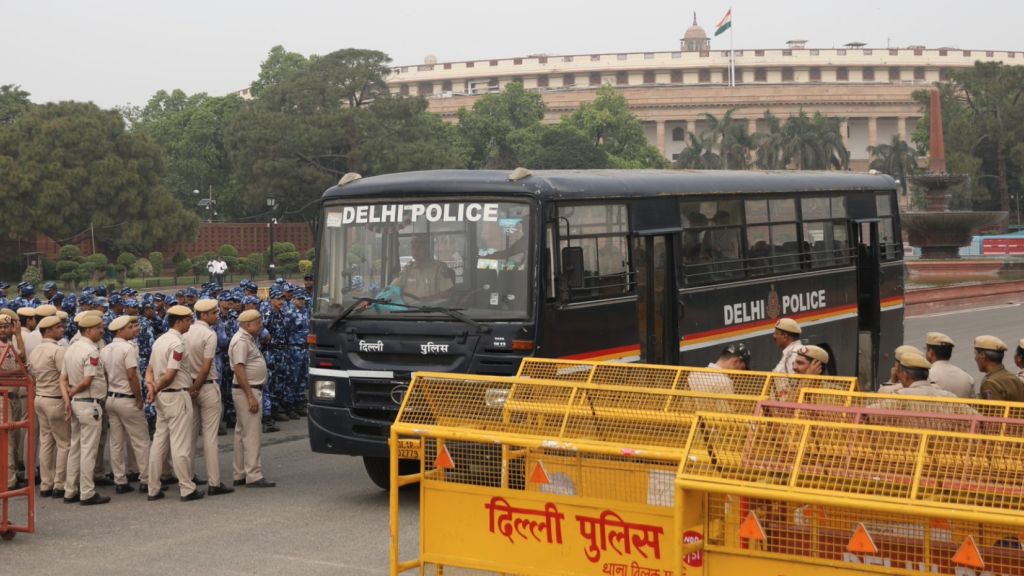
Historically designated protest grounds like Jantar Mantar, alongside public institutions such as Akashvani Bhavan, have been transformed into fortified zones surrounded by multi-layered steel barricades, riot police, and paramilitary personnel drawn from sensitive border territories. In the capital, the cancellation of long-distance passenger trains and the systematic shutdown of dozens of metro stations serve a single operational purpose: to physically sever the working masses, students, and rural migrants from the political center of the nation.

Under the pretext of preserving “public order” and ensuring “public safety,” the ruling apparatus has deployed coercive state instruments against peaceful assemblies of citizens, parliamentarians, and student activists. Yet, far from demonstrating the structural strength or self-assurance of the state, this heavy reliance on police power signals a crisis of political legitimacy. When a government must deploy thousands of armed personnel and declare vast swathes of its capital off-limits to block citizens from approaching the Election Commission of India (ECI), it implicitly reveals that the ideological consent upon which its hegemony relies has worn thin. The state is forced to govern through administrative decree and raw police force.

10 October: State repression and the defence of democracy

The events in Delhi on 10 October 2026 raise questions that go beyond the conduct of individual police officers. The state mobilised its administrative and coercive resources to prevent a political demonstration from taking place. Airport detentions, restrictions on public transport, barricades and mass preventive detention formed parts of a coordinated operation. The protest demanded the resignation of Chief Election Commissioner Gyanesh Kumar over alleged irregularities in the Special Intensive Revision of electoral rolls. Instead of facilitating public scrutiny of an institution exercising enormous power over political participation, the authorities sought to prevent citizens from assembling to challenge it. More than 7000 were ‘detained’ not ‘arrested’ — a semantic joke.

The underlying issue was the credibility of the electoral system. Democracy requires opportunities to question how electoral rolls are prepared, how exclusions are corrected and how officials exercise their powers. Suppressing those questions through police action weakens the democratic legitimacy that electoral institutions are supposed to sustain.

Delhi Police defended the refusal of permission to demonstrate by referring to security concerns and the organisers’ failure to provide the required notice. According to The Indian Express, the application was submitted on 7 October against a ten-day notice requirement. That explanation deserves consideration, but it does not settle whether the subsequent measures were justified. A procedural dispute cannot by itself justify detaining organisers as their aircraft lands, obstructing travel across the city or rounding up people near possible protest sites. The Union home ministry instructed state and Union Territory governments to cooperate with Delhi Police and take preventive steps against protesters travelling to the capital. This extends responsibility beyond particular police stations. Negotiation over timing, location and practical arrangements was another available course. The authorities instead used the permission system to prevent the assembly, turning administrative regulation into a powerful restriction on political participation

A Marxist analysis must connect these actions to the state’s role in maintaining existing relations of power. The capitalist state presents itself as representing society as a whole while preserving a social order structured by unequal ownership, exploitation and concentrated economic power. This does not mean that every police decision follows an instruction from a capitalist. State institutions possess their own procedures, interests and degrees of autonomy; democratic struggles have also established rights within them. Nevertheless, those rights become vulnerable when popular mobilisation challenges established authority. The events of 10 October expose how readily the defence of public order can become the defence of political incumbency.

The range of people detained reinforces this interpretation. The supplied reports name former chief ministers Pinarayi Vijayan, Mamata Banerjee, Arvind Kejriwal and Manik Sarkar, alongside students, activists, lawyers and journalists. These politicians have different programmes and records, including records of exercising state power themselves. Their right to protest must nevertheless be defended. At the same time, prominent names should not obscure the experience of ordinary detainees. For an unknown student or young worker, being taken to an undisclosed location, losing contact with relatives or struggling to obtain legal assistance can have particularly serious consequences.

The reported treatment of advocate Fidel Tom illustrates the danger to legal safeguards. According to The Wire, he went to the Sanjay Colony police post to seek the release of three detained students and was himself detained. The report records allegations that police assaulted him and the students. These allegations require independent investigation; they should not be presented as judicially established findings. But their implications are grave. If a lawyer seeking access to detainees can himself face detention and alleged violence, the means of challenging police power becomes insecure. Subsequent release does not resolve questions about what happened in custody or who should be held accountable.

The detention of journalists raises a related question about public scrutiny. Complaints from The Quint, Scroll and Newslaundry, including allegations that reporting phones were seized, have come. Journalists at protest sites document police behaviour, preserve testimony and enable official claims to be checked. Removing them weakens these forms of accountability. Press freedom consequently concerns the public’s ability to know how coercive authority is being exercised in its name. Detaining reporters during a crackdown obstructs that knowledge precisely when it is most necessary.

Reports of assaults by right-wing individuals introduce another disturbing dimension. The material available on the internet includes journalists’ accounts identifying alleged attackers and recording statements justifying violence against protesters. This establishes collusion between police and those individuals, and demands scrutiny of how far the authorities protected demonstrators and acted against their attackers.

Despite the restrictions, demonstrations emerged at several locations across Delhi, including Dilli Haat and the Safdarjung flyover. The blockade of Jantar Mantar displaced protest without extinguishing it. That persistence matters, but courage alone cannot overcome organised repression. Democratic resistance needs legal support, reliable documentation and solidarity among workers, students and other citizens. Electoral accountability must be connected to freedom of assembly, protection in custody and independent reporting. The lesson of 10 October is that democratic rights require organised defence whenever the state obstructs their exercise. Waiting for the next election leaves unanswered the immediate question of whether people can act collectively to challenge those who govern them.

The core of public anger: Institutional decay and the compromised role of the ECI

At the epicenter of this popular upheaval is a deep and pervasive anger directed at the Election Commission of India and Chief Election Commissioner (CEC) Gyanesh Kumar. Long celebrated by liberal constitutionalists as an impartial arbiter standing above the political fray, the ECI is increasingly recognised by workers, peasants, students, and marginalised communities as an administrative organ integrated into the ruling party’s power structure.

The catalyst for this movement is the Special Intensive Revision (SIR) of electoral rolls. Billed by the state as an administrative “clean-up” of voter databases, the national rollout of the SIR has resulted in the deletion of over 13 crore (130 million) names from draft voter rolls across 30 States and Union Territories. The scale of this voter disenfranchisement — exceeding the entire population of major industrial nations — has fundamentally altered the electoral landscape. In state after state, the impact of these deletions has fallen disproportionately on working-class households, migrant labor populations, Dalits, Bahujans, and religious minorities. By weaponising bureaucratic verification criteria, the state has manufactured a mechanism that strips disenfranchised populations of their basic democratic franchise under the cover of technological modernisation.

This crisis of electoral legitimacy stems directly from the implementation of the Special Intensive Revision across the country, where millions of citizens have found their names systematically purged from voter databases. The administrative drive has provoked a two-fold response: on one side, an unprecedented internal fracture within the constitutional body itself, and on the other, mass street resistance led by student groups, youth movements, and a broad opposition coalition demanding the restoration of voting rights and the removal of top election leadership.

Crucially, the anger on the streets is validated by unprecedented internal fractures within the Election Commission itself. An investigative report by The Indian Expressexposed that two of the three sitting Election Commissioners — Sukhbir Singh Sandhu and Vivek Joshi — formally recorded at least 14 written dissents over ten months against decisions executed unilaterally by CEC Gyanesh Kumar. These dissents documented a pattern of administrative overreach:

  • Arbitrary Alteration of Form 6: In May 2025, an unapproved field was added to Form 6 — the statutory application for new voter registration — requiring applicants to state whether they or their ancestors appeared in the “electoral roll of the last SIR”. Despite written warnings from Joshi and Sandhu that changing Form 6 without statutory amendments was “unauthorised and illegal,” the change was retained, blocking countless first-time and young voters from registering.
  • Centralisation of Digital Architecture: Both dissenting Commissioners warned of the “gradual centralization of the electoral roll database” via ERONet and ECINet. They recorded that state-level election officers and statutory Electoral Registration Officers (EROs) — historically the local custodians of voter rolls — were systematically denied full access to the portal. Control was consolidated within the ECI’s central IT division in New Delhi, stripping away the decentralized safeguards that had historically checked centralized electoral tampering.
  • Overriding Judicial Directives: In Goa, ground-level EROs found 97 voters eligible following Supreme Court-mandated hearings regarding “logical discrepancies”. Yet, despite eight urgent communications sent by state officials to the ECI IT division requesting software access to restore these names, the central authority refused to enable the rollback option, resulting in the disenfranchisement of eligible citizens.
  • Unauthorised Legal Appeals in West Bengal: In West Bengal, where judicial tribunals were formed to hear SIR appeals, Commissioner Sandhu formally queried who had authorised the ECI to file over 16 lakh appeals seeking the deletion of voters whom judicial officers had cleared for inclusion—noting that neither he, Joshi, nor the state’s Chief Electoral Officer had approved these legal actions.1

These internal disclosures demonstrate that the ECI’s neutral constitutional façade has broken down. The systematic override of statutory officers, the arbitrary deployment of unvetted software, and the exclusion of majority opinions within a constitutional body violate Section 18 of the 2023 Election Commissioners Act, which mandates unanimous or majority-based decision-making. The institutional referee has been converted into an administrative organ of the ruling party at the centre.

The ruling party’s rhetoric: Tacit admission of alignment

In response to the growing mass movement, the ruling BJP and its sympathetic media channels have launched a campaign to discredit the protests. Protesters, student leaders, and opposition parties have been branded as “anti-national,” “foreign-funded,” and agents of an illegal “regime change” conspiracy designed to destabilise the nation.

Yet, from a critical political perspective, this rhetorical line contains an unintentional admission. By framing protests against the Election Commission as an attempt at “regime change,” the ruling party implicitly acknowledges the complete political alignment between its government and the ECI.

If demanding the resignation of a Chief Election Commissioner or insisting on an audit of compromised voter rolls is treated as an existential threat to the government itself, then the conceptual boundary separating the ruling party from the electoral machinery ceases to exist. The state’s defence of CEC Gyanesh Kumar is not a defence of constitutional independence; it is the defence of a key operational asset. By equating criticism of the ECI with a treasonous assault on the state, the ruling party confirms the core allegation of the movement: that the Election Commission has been absorbed into the ruling regime, operating not as an independent referee, but as a guarantor of political continuity for the incumbent power structure.

Class forces, tactical strengths, and structural weaknesses

A dialectical analysis of the anti-ECI movement requires moving beyond liberal constitutionalist narratives of “saving institutions” to examine the underlying class dynamics, structural forces, and social contradictions driving the crisis.

A rigorous class analysis reveals that the movement is defined by a fundamental contradiction between its tactical strengths and its strategic limitations. While the movement excels in broad-front mobilisation, unifying diverse class interests, and channeling mass youth militancy, it remains constrained by the political hegemony of the bourgeois opposition, which maintains an instrumental view of democratic rights and an inherent propensity for compromise with the capitalist state.

The movement’s strength: Broad-based tactical mobilisation

The chief strength of the current political moment lies in the scale, breadth, and social composition of the anti-ECI front. The defence of elementary democratic rights — specifically the universal right to vote — has served as a powerful unifying axis, bringing together political forces that were historically divided:

  • The Parliamentary Opposition: The coalition unites 19 political parties within the INDIA bloc, spanning national parties like the Indian National Congress to regional parties such as the Samajwadi Party (SP), Aam Aadmi Party (AAP), Rashtriya Janata Dal (RJD), and the All India Trinamool Congress (TMC). Notably, it has drawn in long-standing non-aligned regional entities like Naveen Patnaik’s Biju Janata Dal (BJD), signaling a widening rift between regional bourgeois factions and the centralised federal executive.
  • The Left and Student Fronts: Communist and Left parties, including the CPI(M) and CPI(M-L), alongside cadre-based student unions like the All India Students’ Association (AISA) , the Students Federation of India, have provided organisational discipline, ideological clarity, and street militancy.
  • Spontaneous Youth Movements: The massive participation of the Cockroach Janta Party (CJP) has expanded the struggle beyond traditional party cadres, drawing in hundreds of thousands of unorganised, unemployed youth, urban students, and precarious workers.

From a Marxist standpoint, this broad front demonstrates that in periods of autocratic consolidation, the fight for basic democratic freedoms — freedom of assembly, fair elections, and freedom from state harassment — can temporarily unite heterogeneous social classes. The working class and urban youth have recognised that the erosion of democratic rights directly impairs their ability to organise, demand employment, and resist economic exploitation.

The movement’s weakness: The bourgeois opposition as the political limit

However, this coalition contains deep internal class contradictions that constitute the primary strategic weakness of the movement. The leadership of the parliamentary opposition remains firmly in the hands of bourgeois and petty-bourgeois parties — most notably the Congress and regional capitalist parties.

A Marxist assessment highlights the structural limitations of relying on these bourgeois factions:

  1. Instrumental Approach to Democratic Rights: Bourgeois political parties do not view democratic rights as fundamental tools for working-class emancipation, but as instruments for securing state power. They engage with mass movements opportunistically — using street protests to gain leverage over the ruling party, secure concessions, or engineer favourable electoral outcomes.
  2. Fear of Uncontrolled Class Mobilisation: While the bourgeois opposition is eager to use popular outrage over voter deletions to weaken the BJP, it remains terrified of mass movements overflowing the boundaries of parliamentary politics. The moment street mobilisations threaten broader property relations, challenge industrial policy, or demand structural redistribution, the bourgeois opposition instinctively pulls back, seeking to de-escalate the conflict.
  3. Inability to Reform the Autocratic State: The parliamentary opposition presents the ECI crisis as a problem of individual corruption or bad appointments (i.e., replacing CEC Gyanesh Kumar) rather than a manifestation of the modern capitalist state apparatus. Because these parties themselves manage state capital at the regional level — and have historically utilised police machinery, case withdrawals, and administrative centralism when in power — they cannot and will not dismantle the structural instruments of state repression.

Consequently, the bourgeois opposition acts as a political brake on the movement. Left to their own devices, these parties will inevitably attempt to channel mass anger away from sustained street action and back into safe, legalistic, and electoral channels that leave the fundamental economic and state structures intact.

The role of the Cockroach Janta Party (CJP) and the rise of Neha Bora

The present movement is characterised by a dynamic interplay between new, decentralised youth movements and disciplined, ideologically committed student leadership.

The emergence of these new political forces highlights two distinct models of contemporary resistance. On one side stands the Cockroach Janta Party, representing an anti-establishment youth base rooted in satirical digital activism and mass pressure-group tactics focused on systemic issues like exam leaks and electoral integrity. On the other side stands cadre-based student leadership, exemplified by Neha Bora and AISA, which brings ideological clarity, direct physical confrontation with state barricades, and a class-conscious defence of constitutional rights to the forefront of the struggle. At the same time, one perceives a problem. In today’s world, using the Social Media to get political views across is important. At the same time, as the experience with cadres who ecome media faces, both in the CPI(M) and in the CPI(ML) in the past have shown, these cadres imagine themselves more important than the organisationn and its ideology and politics. There is no guarantee such a thing will happen. But it is for the CPI(ML) to consider this seriously.

The Cockroach Janta Party (CJP): Spontaneity, alienation, and its boundaries

The emergence and rapid expansion of the Cockroach Janta Party (CJP), founded by figures like Abhijeet Dipke alongside convenors Saurav Das and Ashutosh Ranka, represents a significant development in contemporary Indian youth politics. Originating as a satirical social media movement sparked by judicial elitism, the CJP quickly transformed into a genuine mass pressure group.

The CJP’s trajectory demonstrates how deep structural crises in capital — specifically mass youth unemployment, the commercialisation of education, and widespread exam paper leaks — can catalyze political consciousness. After leading a weeks-long agitation at Jantar Mantar that forced the resignation of Union Education Minister Dharmendra Pradhan, the CJP expanded its mandate to include institutional integrity, launching the “Election Commission Thik Karo” (Reform the ECI) campaign.

From a class perspective, the CJP reflects both the strengths and vulnerabilities of petty-bourgeois and working-class youth spontaneity:

  • Strengths: The CJP captures the acute alienation of a generation facing precarious employment and institutional decay. By utilising decentralised networks, pop-culture satire, and direct calls to action, it bypasses the stagnant organisational structures of traditional political parties. Its ability to mobilise thousands of non-party youth across cities like Mumbai, Bengaluru, and Delhi has forced the state onto the back foot.
  • Boundaries: As an eclectic pressure group drawing explicit parallels to historical movements like the JP Movement of the 1970s, the CJP risks ideological diffusion. Without a clear class analysis or an organisational structure rooted in the workplace and educational institutes, non-party youth movements are vulnerable to state co-optation, exhaustion, or ideological drift. While the CJP’s refusal to enter electoral politics keeps its pressure-group identity intact, its long-term impact depends on whether its base can be linked to broader working-class struggles.

The rise of Neha Bora: Vanguard cadre and the defense of free speech

In contrast to the spontaneous pressure-group model of the CJP, the prominent role played by student leader Neha Bora — PhD scholar at JNU and National President of the All India Students’ Association (AISA) — illustrates the vital function of disciplined, cadre-based Left politics.

Bora emerged as a national symbol of resistance through direct, physical confrontation with the security apparatus: from leading barricade-breaching acts at Jantar Mantar to enduring hunger strikes and state detentions. Her political prominence reached a flashpoint following her speech in Gorakhpur, where she directly challenged Uttar Pradesh Chief Minister Adityanath, accusing his administration of presiding over paper leaks, unemployment, extra-judicial bulldozer demolitions, and communal polarisation.

The state’s immediate response to Bora’s speech — multiple police complaints, FIR demands by ruling party functionaries, physical threats of “medicine” from state ministers, and coordinated online hate campaigns — demonstrates the autocratic state’s low tolerance for unyielding critique.

As political analyst Anand Teltumbde notes, Bora’s speech falls squarely within the protection of constitutional speech guaranteed under Article 19(1)(a). Her characterisation of state power was not an isolated personal insult, but a factual reference to official public records — including the Adityanath government’s controversial statutory withdrawal of pending criminal cases against its own leaders. Teltumbde highlights the stark class asymmetry of the state’s legal machinery: while executive leaders utilise public rhetoric emphasising physical force (“thok diye jayenge”, “mitti mein mila denge”), the state weaponises police powers against a young female scholar for giving voice to documented facts.

From a Marxist standpoint, Neha Bora’s leadership provides key lessons for the movement:

  1. The Role of the Intellectual Vanguard: Bora exemplifies the role of the organic intellectual who connects student grievances with the broader systemic crises of state capital and authoritarianism.
  2. Rejection of Individual Hero-Worship: While charismatic individual leaders serve as vital catalysts during moments of high drama, a Marxist assessment warns against substituting individual heroism for collective mass organisation. The ultimate power of leaders like Bora stems not from personal charisma alone, but from the cadre organisation (AISA) and class-conscious mass movements standing behind them.
  3. Defending Democratic Space for Class Struggle: The defense of figures like Neha Bora against state repression is not merely a matter of liberal legal defense; it is an absolute necessity for the working-class movement. If the state succeeds in criminalising harsh political dissent against executive heads, the political space required for working-class organising, unionisation, and anti-capitalist agitation will be completely shut down.

The horizon of the Anti-ECI movement and the road ahead

The anti-ECI movement has brought the Indian state face-to-face with a profound crisis of legitimacy. By exposing the administrative manipulation of voter rolls, the centralisation of digital systems, and the subversion of internal constitutional safeguards, the movement has stripped away the illusion of electoral neutrality. The state’s reliance on police blockades, metro closures, and mass detentions confirms that it is increasingly governing through physical force rather than political consent.

Yet, the movement stands at a critical historical crossroad. If it remains confined to the political horizons of the bourgeois opposition, its energy will inevitably be drained through legalistic appeals, minor administrative compromises, or absorption into the upcoming state electoral cycles. Bourgeois political parties will attempt to use the movement as a bargaining chip, abandoning the demand for structural institutional reform the moment their immediate parliamentary objectives are secured.

To transform this moment into a lasting victory for democratic and social rights, the movement must push beyond the boundaries of bourgeois constitutionalism. The spontaneous youth energy represented by the Cockroach Janta Party must be fused with the ideological discipline and class clarity of cadre-based Left organisations. The struggle to reform the Election Commission must be recognized as part of a larger, systemic struggle against the authoritarian capitalist state.

We are all aware that the system will not be replaced by a system of workers’ democracy tomorrow. But we need to fight to widen the democratic space. Beyond getting rid of the individual Gyanesh Kumar, beyond even toppling the BJP government, we need to fight so that it becomes more difficult to reimpose an authoritarian system. For this we must demand the following:

  • State funding of elections, and an end to all donaions to parties for electoral purposes
  • The scrapping of the Electronic Voting Machines (EVMs) and a return to the ballot
  • Replace the current First Past the Post system by an Open List Proportional representation at both Parliamentary and Assembly Level elections.

Only by constructing permanent, self-sustaining institutions of working-class, student, and peasant power — capable of mounting sustained resistance in the streets, workplaces, and educational institutions — can the masses defend their basic democratic rights, defeat state repression, and advance toward real political and economic liberation.


Vote for Québec solidaire to block the right and open horizons

Quebec solidaire poster

First published in French at Presse-toi à gauche. Translation and introduction by Richard Fidler for Life on the Left.

Quebec’s general election on October 5 was contested by five parties. Four are right-wing: the pro-independence Parti québecois (PQ), which replaced the Coalition Avenir Québec (CAQ) in government, and the Liberals and Conservatives. The latter three are federalist or autonomist in constitutional orientation. Challenging these parties was the left-wing and pro-independence Québec solidaire, founded in 2005, which won nine seats compared to the 11 it held in Quebec’s National Assembly.

This was a difficult election for QS. Quebec politics today are dominated by the rightward trend evident throughout the hemisphere and QS is far behind the capitalist parties in public opinion polls.

The online weekly journal Presse-toi à gauche supports Québec solidaire and the party’s left wing, now identified as “The Party of the Streets,” which aims to build support for QS in the unions and social movements. Also supporting QS in this election campaign was an open letter signed by about 100 activists and journalists, entitled “The only shield against austerité.”

In the following article, PTàG editor Bernard Rioux makes the case for voting for QS, while pointing to serious deficiencies in its electoral platform. 


Vote for QS to block the right and open horizons

In a Quebec political landscape where the other four political parties are proposing tax cuts, partial privatizations or a disengagement of the state, Québec solidaire’s program is distinguished by an opposite orientation. This is based on the idea that contemporary social problems do not come from a state that is too present, but from a state that is insufficiently equipped and whose resources are too concentrated in the hands of the society’s wealthiest. This simple reversal of the diagnosis has a political significance that goes beyond the content of each measure taken in isolation. It keeps alive, in the public debate, the hypothesis that broader public intervention is not only possible, but desirable.

The importance for the social left of voting for Québec solidaire despite the limits of the definition of its social project

This rejection of the logic of reducing the welfare state can be seen first and foremost in taxation. The tax on large fortunes, aimed at assets of more than $25 million, reaffirms the principle of redistributing wealth at a time when the other parties are proposing instead to reduce the tax burden on the wealthiest taxpayers or corporations. While the real return on this tax will depend on the extent of tax avoidance strategies, its very existence in the electoral debate prevents the issue of wealth distribution from disappearing from the political agenda.

By proposing a 3 percent cap on rent increases, a moratorium on evictions, a fight against speculation, and the penalization of abusive landlords, as well as the acquisition of thousands of properties to offer them below the market price, among other measures, Québec solidaire is not content to mitigate the effects of a market deemed to be failing. It holds that the state can once again become a direct actor — owner, regulator, even competitor — rather than a mere arbiter. It is exactly the same logic that underlies the project of public non-profit grocery stores: by capping the margins of large chains and creating public outlets, QS proposes that the state compete directly with the private sector instead of limiting itself to regulating it from without.

In health care, the massive return to CLSCs [community health clinics], placing them in the front line, goes in the same direction: it reaffirms the principle of a universal public system at a time when the growing use of the private sector is not condemned by the CAQ, the Quebec Liberal Party, or especially by the Conservative Party of Quebec, which presents the private sector as a solution to strengthening access to the health care system. Free contraception, eye and dental care for minors, and universal school meals are part of the same philosophy: to expand, rather than contain, the scope of what the community collectively undertakes to cover.

Québec solidaire also proposes a whole series of measures aimed at fighting women’s poverty and domestic violence, and giving victims of domestic violence more means to find safety and regain their autonomy.

What distinguishes this program from a simple policy of defensive resistance, however, is that it is not limited to protecting the gains: it opens up projects that, once started, can create their own dynamics of transformation. Reform of the voting system and referendums by popular initiative are not simple administrative measures: they change the rules of the democratic game themselves, which can facilitate the adoption of more ambitious reforms than those included in the current program. Similarly, the Constituent Assembly co-constructed with the First Peoples places the independence project within a participatory approach that goes beyond the traditional electoral framework and leaves the door open to a broader refoundation of the social contract.

Mission-based funding for community organizations, the climate emergency fund, the gradual phase-out of oil and gas infrastructure, and the massive development of free public transit for young people and seniors all work together to chart a coherent trajectory: each measure, taken alone, corrects a specific inequity, but as a whole this installs an institutional infrastructure — fiscal, democratic and energy — on which more important transformations could then be supported. It is in this sense that Québec solidaire’s program can be read as a brake on the neoliberal trend in Quebec politics.

Faced with the right-wing policies defended by the other major political parties, a vote for Québec solidaire is therefore a vote in defence of the interests of the popular majority. This is all the more important for activists from the various social movements — trade-union, feminist, popular, student, etc. A joint declaration by activists from these different social movements could be an important contribution to the defence of the gains of the popular majority.

The limits of defensive demands incapable of presenting an alternative social project to capitalism

Québec solidaire’s program shifts from the dominant right-wing discourse of the other parties. It reaffirms the legitimacy of public intervention, fiscal redistribution and market regulation. But this shift, as real as it is, takes place almost entirely within the existing framework of capitalist property and economic power relations. The problem is constantly posed in terms of insufficient or unfair results produced by the market, but rarely in terms of who controls the means of production and who therefore holds the decision-making power.

This absence has concrete effects on the nature of the solutions proposed. Let’s take the most telling example: the $2 billion “Trump provision” intended to support companies affected by the tariff war. It is a transfer of public funds to the private sector to help it maintain jobs and transform production, without any quid pro quo in terms of ownership, governance or workers' control over these companies. The state thus finances the survival and restructuring of capital rather than considering, for example, the nationalization of strategic companies or the establishment of workers’ cooperatives as alternatives.

The 2035 Transition Plan constitutes, in relation to the prevailing climate inaction and the refusal of the other parties to make a clear break with the exploitation of hydrocarbons, a set of important redistributive and regulatory measures. But, if we analyse these proposals from the systemic bases of the crisis, they fall short of the necessities posed by the climate emergency and the loss of biodiversity.

The crisis is described more as a problem of governance and poor choices than as the result of a capitalist economic system hung up on growth incapable of respecting planetary boundaries. Thus the 2035 Transition Plan states: “In reality, the climate crisis is the result of poor economic choices as well as ineffective and poorly targeted policies.” The proposed climate targets fall short of the scientific urgency highlighted by the IPCC. The nationalization of renewable energies is not presented as a priority. The industrial policy relies on partnership with employers rather than on public and democratic planning. Public transit remains partially commodified, since free travel is restricted to young people and seniors. The construction of public transit infrastructure is left to the private sector. The protection of the territory is mainly based on a regulatory framework, while the exploitation of mining and forestry resources remains largely in the hands of large Canadian and American multinational companies. The plan aims to strengthen food autonomy without calling into question agro-export agriculture, a large part of which is focused on animal production.

As for the independence project, the text presents it mainly through the prism of a constituent and participatory approach, co-constructed with the First Peoples — which distinguishes it from the Parti Québécois in terms of method. But there is no sufficiently developed link between independence and a critique of Quebec’s structural dependence on foreign capital, continental value chains or international financial institutions.

Independence is therefore thought of mainly as an institutional reform and as national recognition, rather than as a break with relations of economic domination that go beyond the Canadian framework alone. For an anti-imperialist reading of sovereignty, this leaves intact the question of who would really own an independent Quebec and what its relationship would be to militarist alliances like NATO and NORAD. These questions are all the more important when confronted with the PQ project, defined in its Blue Book as a project of independence which, in this analysis, remains marked by a neocolonial orientation.

Finally, in the field of labour itself, the program remains largely within the parameters of the existing wage system: an increase in the minimum wage, an improvement in conditions in the community sector, and the hiring of staff in the public services. These are real gains for workers, but there are no measures to affect economic democracy in the strongest sense: no mention of increased representation of workers on boards of directors, union vetoes over closures and relocations, expansion of the cooperative or self-managed sector, or a plan of nationalizations democratically controlled by those who work there.

It can therefore be argued that Québec solidaire acts as a brake on the neoliberal trend by reaffirming the role of the redistributive state. This is why the mobilization to broaden its electorate is an important issue for the left. But this strategic choice should not prevent us from understanding that QS’s proposals do not, on their own, provide a strategic compass for the radical transformation needed to shift economic decision-making power out of the hands of capital.

Such a transformation is essential to confront the economic, social and ecological crises faced by the people of Quebec, like the rest of humanity.

Voting for QS can thus help block social retreat and the slippage to the right, while leaving open the need to build, beyond its current program, a real ecosocialist alternative to capitalism.


On violence in fighting occupation: The case of Palestine

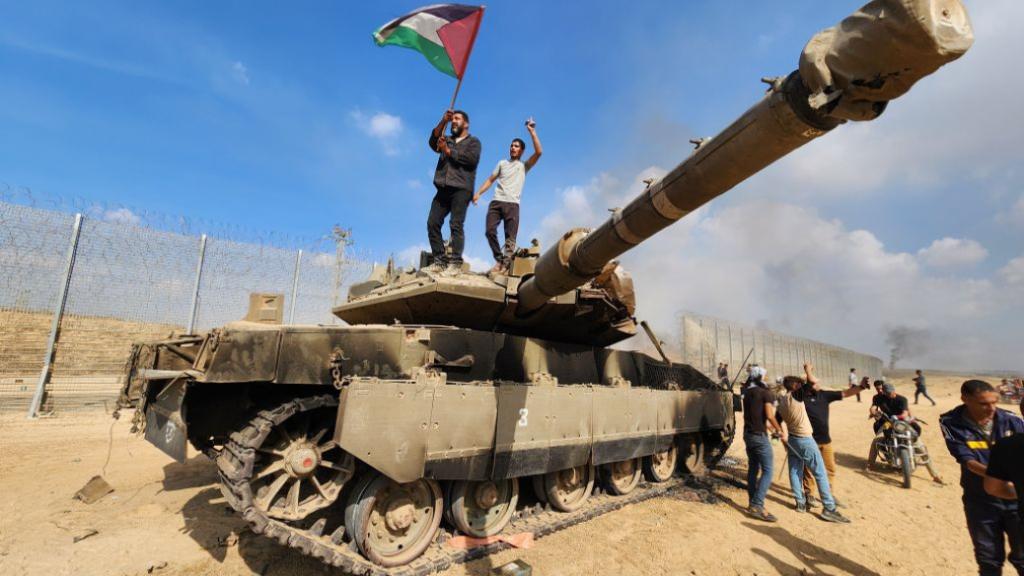
October 7 Israeli tank Palestine flag

First published at New Politics.

Author’s note: The following text is a postscript, dated February 22, 2026, to recent editions — Arabic, German, and Spanish — of my 2025 book, Gaza Catastrophe: The Genocide in World-Historical Perspective. The postscript discusses Palestinian liberation strategy and its various manifestations since the completion of the Israeli occupation of Palestine in 1967. In this regard, it is important to bear in mind the results of the most recent public opinion poll conducted in Gaza and the West Bank on August 20–25 by the Jerusalem Media and Communications Centre (JMCC). Asked about the “best method to achieve the Palestinian people’s goals of ending the occupation and establishing a state,” only 13.3% chose “military means” (9.7% in Gaza and 15.7% in the West Bank), while 17.8% were in favor of “non-violent resistance,” and a majority of 55.8% in favor of “peaceful negotiations.” This bears witness to the degree of exhaustion of the population of the 1967-occupied Palestinian territories, with 58.6% trusting no Palestinian personality and 55% trusting no political faction. Rebuilding a sustainable Palestinian popular emancipatory struggle in those territories will require a lot of patient effort.


The farther we move from what has befallen the Palestinian people since the Hamas-led operation on October 7, 2023, the clearer becomes the magnitude of the disaster triggered by what I have described as “the most catastrophic miscalculation ever in the history of anticolonial struggle.” Seizing the opportunity provided by that fateful operation and the apparent war crimes that it involved, the far-right government of Israel felt unrestrained, even widely supported, in launching the most murderous and devastating war ever waged against the Palestinian people — one that has rightly been recognized as genocidal by many scholars, human rights organizations including the well-known Israeli organization B’Tselem, and various international bodies.

The massive death toll and the total human cost resulting from Israel’s onslaught, the full extent of which won’t be known for some time, are compounded by the unprecedented intensity of destruction of all means of life in the Gaza Strip: buildings, infrastructure, natural environment. The main aim of this mass destruction is the forced displacement of the Gazan population, i.e. the furthering of the ethnic cleansing of the land of Palestine between the Jordan River and the Mediterranean Sea that has been core to the Zionist settler-colonial enterprise since the foundation of the State of Israel in 1948. In parallel, creeping ethnic cleansing and annexation have intensified to an unprecedented level in the West Bank.

Consequently, the Palestinian people are farther from self-determination today than at any time since the unarmed popular uprising, known as the First Intifada, that started in December 1987 in the territories seized by Israel in the June 1967 war, i.e. the West Bank and Gaza, usually designated as the Occupied Palestinian Territories (OPTs). The Palestinian movement now faces a long period of retreat under duress. In this most tragic period of its history, the question of how it can secure its survival and go on to fight back with any chance of success must be prioritized.

Stages of struggle

The assessment must necessarily start from the peak impact that the Palestinian people’s struggle achieved in the late 1980s. Indeed, the Intifada provoked a deep crisis in Israel’s society, polity, and military. A strong opposition to the continued occupation of the OPTs emerged. The “Labor” wing of Zionism came back to power in 1992, defeating the Zionist far-right Likud party. They engaged with the Palestine Liberation Organization (PLO) — which Israel had hitherto castigated as “terrorist” — in the negotiations that led to the 1993 Oslo Accords.

The Israeli army withdrew from the densely populated areas of the 1967-occupied Palestinian territories and handed rule over them to the PLO-based Palestinian Authority (PA). But the PLO leadership had committed the major error of not insisting on including in the accords the freezing of settlements. This issue led to the collapse of the Oslo “peace process” by the end of the century. The expansion of Zionist settlements and the increase in oppressive measures against the Palestinian population led to growing popular anger that the Islamic fundamentalist Hamas (Arabic acronym for the Movement of Islamic Resistance, originally a branch of the Muslim Brotherhood) capitalized on by waging a series of indiscriminate suicide attacks against the Israelis. This contributed to renewed polarization through which Israel’s society and polity shifted back rightward.

It is against this background that the PLO leadership made another major error in what was called the Second Intifada, in allowing for the use of the light weapons that the Israeli occupation had authorized PA troops to possess for the purpose of policing the Palestinian population. This episode started in the autumn of 2000 in response to the provocation staged by rightwing Zionist leader Ariel Sharon at the Al-Aqsa compound in Jerusalem and in protest against the betrayal of the hopes created seven years earlier. The effect, however, was the opposite of that of the First Intifada. The Second Intifada saw the return of Likud to power under the leadership of Sharon — the military commander of Israel’s invasion of Lebanon in 1982 and the man condemned for his role in supervising the horrible massacres at the Sabra and Chatila camps in Beirut. This was followed in 2002 by the most violent Israeli onslaught on the OPTs until that year.

Since then, a much-crippled Palestinian Authority has ruled part of the OPTs under the thumb of the Israeli occupation. Benefiting from popular disgust with the PA’s subservience and corruption, Hamas won the Palestinian parliamentary election of 2006. Clashing with the PA, which refused — with Western encouragement — to abide by the election’s outcome, Hamas took over Gaza in 2007, two years after Israel’s withdrawal from the Strip, leading to a partition of the semi-autonomous parts of the OPTs. Today, Hamas’s semi-autonomous government of Gaza under Israeli oversight has been wiped out, most of the Strip has been reoccupied by Israel, and a quasi-colonial administration is being put in place in the remaining part under the direct supervision of U.S. president Donald Trump in person. The PA, in turn, is under intense pressure from the United States to abide by Israel’s requirements in furthering its subservience to occupation authorities.

The setback from the aftermath of the First Intifada until today’s disastrous state of affairs for the Palestinian people is enormous. This series of defeats of armed struggle episodes, after the major success achieved by an unarmed popular uprising, provides clear and important lessons for the Palestinian struggle, stemming from a general strategic reflection on struggles against foreign occupation with regard to the means they resort to. This is a pragmatic discussion: except for war crimes, such as the deliberate killing of children and non-combatants, armed resistance to foreign occupation is an undisputable right in international law. Whether violent means are effective in each specific case, however, is another question entirely. Here again there is no general rule: the history of struggle against colonial domination and foreign occupation has witnessed successful cases of each of violent and non-violent struggles, as well as of combinations of both.

Liberation strategies

When a foreign army occupies a land whose population is hostile to it and from where withdrawal is an option for the invader, a great imbalance in military strength can be successfully compensated by asymmetric means, such as guerilla operations harassing the occupying army, in order to bring it to conclude that the cost of continuing occupation is higher than whatever benefit is derived from it. This dynamic is very much compounded by the ability of the liberation struggle to win over the minds, if not the hearts, of a major section of the aggressor country’s population.

The Vietnamese resistance against U.S. occupation, combined with the antiwar movement in the United States, achieved that result in 1973. The Lebanese resistance to Israeli occupation achieved it in 2000 on a background of opposition by a significant portion of Israel’s population to continued occupation. When the Israeli army was occupying the densely populated areas in the OPTs from 1967 until 1993, guerilla attacks harassing it made strategic sense. Ultimately, however, it was the non-violent Intifada and its impact on the Israeli population that proved decisive in getting Israel’s military to favor withdrawal from those areas, leading to the Oslo Accords.

The situation is fundamentally different when confronting a state entrenched in a territory that it sees as its one-and-only land, inhabited by a population that overwhelmingly sees that state’s armed forces as their own. There is no way under such circumstances to compensate for the enemy’s overwhelming military superiority by asymmetric military means: it is not going to surrender or withdraw its forces under the impact of transborder guerilla attacks. Indeed, it will rather retaliate with all the power of its superior military to achieve deterrence, inflicting brutal devastation on the attackers’ territory to deter them from repeating their attacks.

Thus, when Hezbollah carried out a guerilla operation across Lebanon’s border with the Israeli state in 2006, it was met with devastating retaliation that destroyed whole areas inhabited by its sectarian-cum-political popular constituency. Never again did Hezbollah resort to such cross-border attacks. Yet, when it launched a self-limiting bombing exchange with Israel in solidarity with Gaza in October 2023, it eventually paid a huge price, with Israel decapitating the organization and destroying much of its military capabilities a year later. Hezbollah had believed that it had accumulated enough deterrent means — rockets and missiles provided by Iran after 2006 — to keep the mutual bombing within limits. This proved to be a fatal miscalculation.

Hamas’s miscalculation in October 2023 was far worse, in that its consequences have been much more dreadful. In October 2023, Israel had been governed for less than a year by the most extreme far-right coalition in its history, the farthest to the right of any freely elected government in the world — a coalition that included openly racist groups advocating the annexation of the OPTs and expulsion of their population. To any rational assessment, it was obvious from the very morning of October 7 that Israel’s retaliation would be hugely murderous and devastating, way beyond anything it had done in all its many wars since its foundation in 1948. For anyone concerned, unlike Hamas, with the strategic impact of the Palestinian struggle on the Israeli population, it was obvious likewise that the effect of the attack would be a massive swing toward the most extreme hatred of Palestinians.

Breaking the Zionist consensus

What, then, could a rational and efficient perspective for Palestinian liberation consist of? Given the realities on the ground, it should necessarily involve a strategy of popular struggle aimed at dividing Israeli society and changing Israeli politics. Despite the growing hegemony of the extreme right, Israel’s political regime is still based on proportional electoral representation of its citizens, one-fifth of whom are Palestinian citizens of Israel (PCI). This means that, were about two-fifths of Jewish Israelis to be convinced of the need to end the occupation of the 1967 territories and accept Palestinian rights, this would be enough to provoke a major rupture of the Zionist consensus.

For years, however, the Palestinian resistance in the OPTs has been torn between subservient collaboration on the part of a PA relying upon Arab and international pressure on Israel to improve its lot, and armed confrontation led by Hamas, consisting in successive rounds during which Israel would confront Hamas’s low-tech rockets with much more murderous and destructive bombing. None of the two Palestinian administrations — neither the PA in the West Bank nor Hamas in Gaza — have shown the least interest in addressing the Israeli population and winning over a significant section of it to the support of Palestinian rights. Both remain deeply suspicious of any alliance with political forces independent from them — be they Arab or Jewish or, most importantly, mixed – within Israel’s pre-1967 boundaries, and fear losing control of the territories under their administration, a control that is very much antithetical to the type of local self-organization that was the First Intifada’s strength at its peak in 1988. New initiatives toward popular mobilization only came from the grassroots of Palestinian society, pointing to what kind of popular resistance is possible.

In March 2018, independent activists in Gaza initiated what they called the Great March of Return, i.e. weekly demonstrations toward the fence surrounding the Strip. This went on powerfully for a year and then continued with a reduced impact until the end of 2019. The initial popular success of that endeavor led the Hamas leadership to take control of it and steer it toward a deal with Benjamin Netanyahu’s government in March 2019, easing the blockade imposed on Gaza and allowing an increase in Qatari funding of the Hamas administration. This cooptation, along with Israeli forces’ murderous firing on the marchers (over 200 killed and thousands injured between March 2018 and March 2019), the setting of an unrealistic goal (the implementation of the Palestinian refugees’ right of return to their 1948 territory of origin), and most crucially the lack of simultaneous similar mobilization in the West Bank, where neither the PA nor Hamas favored extending it, ultimately curtailed the effectiveness of the endeavor. Nevertheless, it demonstrated what kind of pressure mass, non-violent resistance can unfold.

The next significant experience was more spontaneous. It was the beginning in May 2021 of a popular uprising in the West Bank, as well as among Palestinian citizens of Israel, ignited by the eviction of Palestinians in the Sheikh Jarrah neighborhood of East Jerusalem. The important popular mobilization that unfolded within a few days was stifled by Hamas’s interference, when it started launching rockets from Gaza, thus initiating an exchange of bombing that resulted, as usual, in many more Palestinian casualties than Israeli, and quickly dampened the popular uprising’s momentum. What we have seen over the last two-and-a-half-years in Gaza represents a catastrophic culmination of the same pattern.

In the face of the present disaster, it is to be hoped that the Palestinian people will find its way to new popular non-violent resistance struggle throughout the OPTs, in order to mobilize maximum international pressure as well as split off at least a significant minority of Israel’s Jewish population from the Zionist consensus. Only by such struggle, combined with international solidarity and the global Boycott-Divestment-Sanctions (BDS) movement, the natural complement of a non-violent popular strategy, can Palestinian rights be efficiently asserted. This prospect is reinforced by the surge — in reaction to the Gaza genocide — of Palestine solidarity in Western countries, including the United States, and most crucially among American Jews, especially the younger generations. Continuing to resort to reactive violence — however legitimate and humanly understandable it is, especially after the Gaza genocide and in the face of ever more brutal aggression against the Palestinian population in the West Bank — would inevitably be used as a pretext by Israel and its U.S. sponsor, now the quasi-colonial overseer of Gaza, to unleash yet more mayhem with a view to speeding up the ethnic cleansing of Palestine.

Gilbert Achcar grew up in Lebanon and has lived and taught in Paris, Berlin, and London. He is Professor Emeritus at SOAS, University of London. His many books include The Clash of Barbarisms (2002, 2006); Perilous Power: The Middle East and US Foreign Policy, co-authored with Noam Chomsky (2007); The Arabs and the Holocaust: The Arab-Israeli War of Narratives (2010); Marxism, Orientalism, Cosmopolitanism (2013); The People Want: A Radical Exploration of the Arab Uprising (2013); Morbid Symptoms: Relapse in the Arab Uprising (2016); The New Cold War: The United States, Russia, and China from Kosovo to Ukraine (2023); and Gaza Catastrophe: The Genocide in World-Historical Perspective (2025).