Friday, October 02, 2026

 Hundreds of French schools remain closed as riot police clash with student protesters


Some 400 French schools were closed Friday as the student protests that began in high schools in the Paris region last week have spread across France and grown increasingly violent. The students are protesting against teacher shortages, dilapidated school buildings and overcrowding in classrooms.


Issued on: 02/10/2026 
By: FRANCE 24

Cover image: High school students in Marseille protest outside their school on October 1, 2026. © Miguel Medina, AFP
01:42


Riot police clashed with high school students across France on Friday and unions called for teachers to strike as President Emmanuel Macron's government battled to contain increasingly violent protests over classroom conditions and education funding.

Tear gas choked the streets in the eastern city of Strasbourg, ​fireworks were aimed at ‌police lines in Marseille in the south and rubbish bins set ablaze in Rennes in the west.

Rights groups have accused the police of using heavy-handed tactics against minors, including the use of batons, tear gas and non-lethal flash-ball guns. French authorities ⁠have opened four investigations to examine ​accusations of police violence.

One such probe will examine the case of a 16-year-old, who suffered an eye injury after police fired rubber bullets into a crowd of protesters, according to his friends.


In Rennes, the tension was already palpable outside the Jean-Mace high school with students dressed in black, wearing balaclavas and standing not far from a heavy police presence.

“As far as we’re concerned, we’ve won – our school is closed this morning,” said Lola, 16, who declined to give her last name.

She condemned what she said was police violence.

“It makes us even angrier – the police have no right to hit us or use tear gas on us.”

French CRS riot police apprehend a protester during clashes outside the Lycee Deodat-de-Severac high school as part of nationwide protests by high school students to demand the hiring of substitute teachers, increased resources and better learning conditions, in Toulouse, France, October 2, 2026. © Nacho Doce, Reuters


James, a high school student in the northern city of Lille, also denounced what he called "extremely violent police repression, which inevitably fuels students' anger."

"When we see fellow students being beaten, choked, blinded in one eye, and tear-gassed from all sides while we're simply trying to have a dialogue with the government, of course it makes people angry," he said.
'Outsiders'

Some 170 students have been wounded since the start of the movement, Education Minister Édouard Geffray said, while more than 100 high schools have suffered “severe damage”.

Speaking Friday evening, he said that some 735 high schools out of the country's 3,700 had been affected "in one way or another" – though he stressed that this was 30 percent fewer than Thursday.

At least 65 staff members – including 40 high school principals – have also been injured as the protests have at times turned violent. Geffray said that three staff members had been injured on Friday, compared with 31 the day before.

In La Ciotat, near Marseille, a young person ⁠sprayed petrol at a teacher, said a spokesperson for that region's educational authority. In a social media clip broadcast by BFM TV, a man is seen wiping his face after a hooded person wearing a face-mask sprays a liquid from a bottle at him. ‌Reuters was not able to verify the circumstances.
'Apocalyptic scenes' as France school protests escalate


Cover image: © France 24
04:24


Protesters in Pantin, on the outskirts of Paris, set items including fences on fire and threw firecrackers at ⁠riot police, before running away.

Interior Minister Laurent Nunez said images from the eastern city of Belfort showing a group of youths encircle a lone policeman and kick him to the ground were of a "rare violence and intolerable".

He said police had arrested 1,747 on Friday, adding there had been "projectiles thrown, attacks on law enforcement, teachers, journalists, passersby".

After a government crisis meeting on Thursday, a source close to the prime minister said the demonstrations had morphed from a protest movement to urban violence, and Justice Minister Gérald Darmanin has said it had been hijacked by "outsiders".

Several students in the Paris region whom Reuters spoke to earlier in the week said they were staying away from the protests on Friday due to escalating violence.
'A real state of anxiety'

Six months before next year's presidential election, opinion polls consistently show the ​deep unpopularity of Macron and his centre-right government. Planned budget cuts, which exacerbate the funding crisis in education, have fuelled the discontent.

Trade unions meanwhile called a teachers’ strike for Tuesday, a week after public-sector workers walked out.

"(The violence) is regrettable, but ... when demands go unheard for years, and given the ‌political and geopolitical context, there are several conditions that put ... students in a real state of anxiety," teacher Sandra Champain-Seller said.

The protests erupted in the Paris region last week but have turned increasingly violent as they spread nationwide.


French high school students gather outside the Lycée Voltaire high school as part of nationwide protests to demand the hiring of substitute teachers, increased resources and better learning conditions, in Paris, France, October 2, 2026. The slogans read "Support 93" and "The police are supposed to protect us, not beat us up". © Sarah Meyssonnier, Reuters

Four hundred high schools – roughly one in 10 – were closed on Friday due to the unrest, while Geffray urged parents to keep their children from protesting.

Some parents supported the protests.

Vincent Martin joined his daughter ​outside Hélène Boucher high school, in Paris, saying students were "fundamentally right to demand ... better learning conditions".
Budget cuts

The students blockading the high schools have voiced anger over overcrowding ​in classrooms, regular shortages of teachers and rundown buildings, blaming years of under-investment.

"We are 35 per class, we don’t have enough ​chairs in classrooms, the one-hour lunch break (is too short) for everyone to get food," 15-year-old Kesia told Reuters in the Paris suburb of Pantin before running off as the police used tear gas.

Under the draft 2027 budget presented by the government on Thursday, the education ​budget is set to increase by a below-inflation 1.7 percent to €65.53 billion ($73.77 billion), excluding teacher pensions.

Education is traditionally the largest budget item, but that changes next year with debt servicing costs expected to reach €74.5 billion, according to the draft bill.

According to the OECD global policy forum, French spending on education is in the middle of the range among member countries and increased between 2015 and 2022, but its share of the budget has slightly decreased.

Intelligence agencies reportedly told the crisis meeting that the protest movement had been initiated by politicians from the left-wing France Unbowed party (LFI).

Senior ⁠LFI lawmakers dismissed the allegations, accusing the government of politicising the protests ahead of the election.

(FRANCE 24 with Reuters and AFP)


France closes 400 schools as student unrest over conditions continues


France has closed hundreds of secondary schools amid violent student protests, as ministers urged parents to keep children away from blockades and warned families could be billed for damage.

Issued on: 02/10/2026 - RFI

A sixth-form student adds fuel to a burning barrier during a protest outside Le Corbusier Lycée in Aubervilliers, north of Paris, on 1 October 2026. AFP - LOU BENOIST


Around 400 of France’s 3,700 secondary schools were closed on Friday on the orders of police prefects, with many schools switching to online lessons.

Education Minister Edouard Geffray urged parents to intervene, warning that young people were putting themselves at risk.

“Children are in danger on the streets,” he told BFMTV. “Parents must, quite clearly, take action and tell their children not to go [to the blockades]."

The protests began over staffing, funding and school conditions and have spread rapidly across the country.

The Interior Ministry said 1,027 secondary schools were affected on Thursday, including 222 that were blockaded. Around 30 university campuses were also blocked.

It said 1,949 people were arrested on Thursday alone, mainly in connection with violence, unlawful gatherings and attacks on people in positions of authority.

A total of 305 police officers, gendarmes and firefighters were injured during Thursday’s unrest, while Geffray said 170 pupils and 65 education staff had been hurt since the movement began.

More than 100 secondary schools had also suffered serious damage, he said.

Riot police face off with protesting students carrying out blockading action at the Lycee Kerichen secondary school, in Brest in western France, on 1 October. AFP - FRED TANNEAU


Parents made to pay

Justice Minister Gerald Darmanin said he had asked prosecutors to seek civil liability against parents whose children were responsible for vandalism, potentially leaving families to pay for repairs.

“When schools are vandalised, when bus shelters are attacked, when public transport is targeted, we will now hold parents civilly liable,” he told radio network RTL.

“It’s not the minor who pays, it’s the parents,” Darmanin said, arguing that the approach could prove “far more useful than detention”.

He said around 90 percent of those detained were minors, while roughly a third of those arrested had been held in connection with violence against other people.

Darmanin described those responsible as an “active and violent minority” and questioned whether all of them were secondary school students.

He said the unrest had moved beyond a conventional student protest to become a matter of “public order”, with the authorities concerned about further violence over the weekend and during a national day of action scheduled for Tuesday.


First concession

The government has accused the hard-left France Unbowed party (LFI) of contributing to the radicalisation of the movement and seeking to exploit the unrest.

The prime minister’s office has described the protests as a “manoeuvre organised by LFI and its proxies on the far left”.

LFI coordinator Manuel Bompard rejected the accusation and urged the government “not to descend into conspiracy theories”.

The government’s claims that LFI has orchestrated the unrest have not been independently established.

At the same time, the government has made its first concrete concession to the movement.

On Thursday night, Geffray announced that a proposal in the 2027 budget to introduce registration fees for non-scholarship students in BTS vocational higher education courses and those in preparatory classes for entrance exams for France's elite universities would be dropped.

The planned charges – €178 for BTS students and €270 for those in preparatory classes – had drawn criticism from student groups, trade unions and parties on the left.

Geffray was due to meet secondary school organisations, parents’ associations, education unions and representatives of the national student council on Friday.

“One of the difficulties with this movement is that there is no single national demand,” he said. “It all stemmed from a fairly diverse range of local demands.”

Student organisations are nevertheless calling for protests to continue, with the movement now looking towards Tuesday’s national day of action.

Hundreds of high schools in France cose as new protests against conditions erupt


By Gavin Blackburn
Published on

The students say their school hours are excessively long, conditions inadequate including overheated classrooms, and that there are too many staff absences.

French high school students lit fires outside schools and faced off with police on Friday as a protest movement that has forced the closure of some 400 establishments showed no sign of abating.

The movement, which began last week in the Paris region and rapidly spread nationwide, has seen teenage pupils at lycées in their final years of schooling block access to buildings and clash with police.

The Ministry of Education said earlier on Friday that 564 schools had "been the subject of actions or disruptions since the start of the day."

The students say their school hours are excessively long, conditions inadequate including overheated classrooms, and that there are too many staff absences

The government says the grievances are legitimate but has condemned what it has described as "urban violence."

Students have accused police of using excessive force and causing injuries by regularly firing tear gas canisters to disperse the protests.

In Paris on Friday, fire damaged the entrances of two high schools, Leonard de Vinci in the south of the city and Gaston-Bachelard in the southeast, with the fire brigade called to extinguish the blazes, an AFP photographer said.
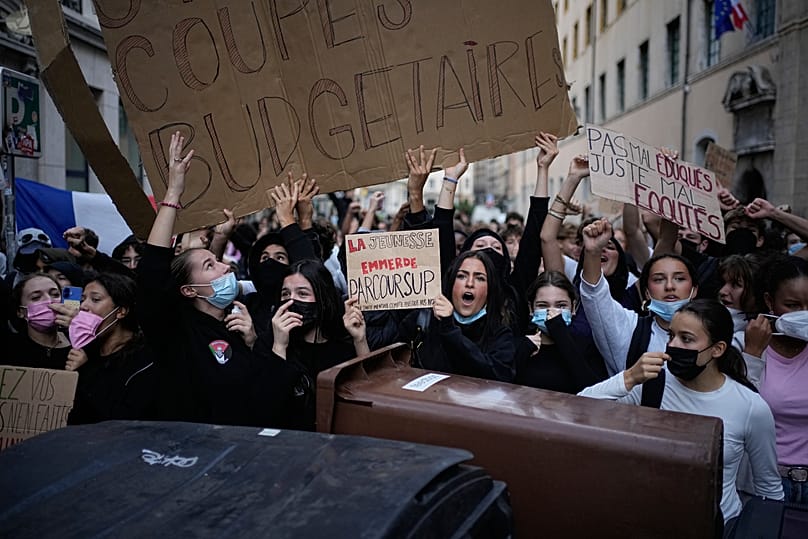
Students hold a sign reading "Stop budget cuts" as they protest against under-resourced schools in Lyon, 2 October, 2026 AP Photo

'Held hostage'

Education Minister Edouard Geffray said "the high school student movement is being held hostage by ultra-violent fringe groups," adding that nearly 400 high schools out of the 3,700 in the country were expected to be closed on Friday.

Many high schools have also planned to conduct classes remotely, particularly in the southern city of Marseille.

At least 65 staff members have been injured, including 40 high school principals, since the start of the movement, Geffray told BFMTV.

Some 170 students have been wounded while over 100 high schools have suffered "severe damage."

"Parents must clearly step up and tell their children not to go" to the protests, he added. "What matters now is ensuring our children are no longer out on the streets, because they are in danger."

Justice Minister Gérald Darmanin said he has asked prosecutors to hold parents liable for damage caused by their children during the protests and "pay for repairs."

Since the start of the movement, around 2,000 people have been taken into police custody," 90% of whom were minors," Darmanin told RTL.
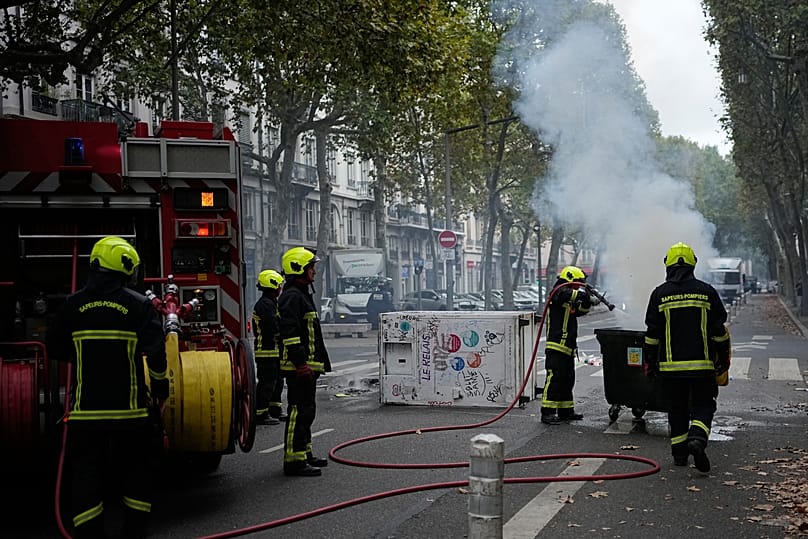

Firefighters extinguish a fire as students protest against under-resourced schools in Lyon, 2 October, 2026 AP Photo
'We've won'

In the western city of Rennes, the tension was already palpable outside the Jean-Mace high school with students dressed in black and wearing balaclavas standing not far from a heavy police presence.

"As far as we're concerned, we've won, our school is closed this morning," said Lola, 16, who declined to give her last name.

She condemned what she said was police violence. "It makes us even angrier, the police have no right to hit us or use tear gas on us."

Police used tear gas at the Kerichen high school in Brest, in western France, an AFP photographer said.

The protests have also made a strong political echo just over half a year before presidential elections, with the government accusing the hard left France Unbowed (LFI), whose firebrand leader Jean-Luc Melenchon is again standing for the presidency, of being behind the movement.


French police clash with teens blockading


schools as unions stage day of protests


French teenagers on Tuesday clashed with police as they kept up a blockade of high schools in cities across the country to demand better conditions and more teacher hirings. The escalating standoff came as unions staged a day of demonstrations against a cost-cutting budget drafted by Prime Minister Sébastien Lecornu's embattled government.


Issued on: 29/09/2026 
By: FRANCE 24
Video by: Antonia KERRIGAN


Cover image: The protests, which started in the Paris region, have sometimes turned violent. © Sameer Al-Doumy, AFP
03:10


French teenagers on Tuesday set fire to rubbish bins and hurled projectiles at police who responded with batons and tear gas, as pupils kept up blockades and protests at hundreds of high schools, demanding better conditions.

The movement in the lycées, which handle the final years of school in France, has angered the government.

Since last week, high school students have staged protests outside their schools over grievances including timetables, class sizes and a shortage of teachers as well as overheated classrooms during the recent heatwaves.

The protests started in the Ile-de-France region around Paris but have now spread to other cities nationwide.

According to the education ministry, 400 schools were affected by protests or disruptions on Tuesday, out of some 3,700 across the country.

Some 40 were blockaded and 44 faced attempted blockades. Ten people, both students and staff, were wounded and hundreds, most of them minors, were detained.

"440 were detained across national territory," Interior Minister Laurent Nunez said on BFMTV. "We don't have the final tally yet, but I'm told two thirds led to police custody."

Education Minister Édouard Geffray condemned the violence.

"Legal proceedings have been initiated against these actions. This violence is unspeakable," Geffray posted to X.

"To legitimise it or ... call for an expansion of the blockades is to endanger both our students and public officials. It is irresponsible."

In one lycée in the Paris suburbs, teachers formed a line around protesting students in a bid to protect them from the police.

Masked pupils gathered outside the Lycée César Baggio in Lille, in northern France, setting bins on fire, an AFP photographer reported.

Bus shelters and advertising billboards were vandalised, with bottles, paving stones and various objects hurled at police, who responded by firing tear gas.


There were 40 arrests on Tuesday and 10 people -- students and staff -- were wounded.
 © Sameer Al-Doumy, AFP

In the western city of Nantes, teens piled up dozens of bins to prevent entrance to the Lycée Gabriel Guist'hau, while in Paris there was an uneasy standoff between 30 students and a contingent of police at the Arago school.

Similar clashes were also reported in cities including Marseille in the south, Bordeaux in the west and Lyon in the southeast.
'Children of the suburbs'

Around 80 students gathered outside the Lamartine school in Paris, brandishing slogans including "More hours of lessons than sleep" and "8am to 6pm: are we pupils or under arrest?"

There were tense scenes at the Lycée Brequigny in the northwestern city of Rennes – Brittany's largest high school – where around a hundred students hurled projectiles at the building, an AFP video journalist said.


Police fired tear gas at teenagers in Lille and Lyon and hit them with batons near Paris. © Sameer Al-Doumy, AFP

The actions came as unions staged a day of nationwide demonstrations and strikes over the budget of Prime Minister Sébastien Lecornu, a close ally of President Emmanuel Macron.

The CGT union said 300,000 marched across France, including 70,000 in the capital. Police put the Paris figure at 30,000, including 8,000 firefighters. Public transport was not badly affected however.

"The anger is immense. I warn the government – it must address the demands and revise the draft budget, which is dangerous for the country and is driving us straight into the wall of recession at 200 kilometres an hour," the head of the CGT union Sophie Binet told BFM TV.


Cover image: © France 24
01:47


Lecornu said on Monday any escalation of demonstrations at high schools would be "irresponsible" and lashed out at the hard-left France Unbowed (LFI) party, who he accused of encouraging the protests.

Interior Minister Laurent Nunez said 164 arrests took place on Monday and 180 schools were affected, adding: "We cannot tolerate excesses."

In the low-income Paris suburb of Seine-Saint-Denis, the district's LFI mayor Bally Bagayoko joined a protest of hundreds of students at the Lycée Paul-Eluard.

Leading students in a rendition of the national hymn, the Marseillaise, he described the protests as "completely legitimate" and complained that low-income areas received less resources than higher-income ones.


Students carry a placard reading 'Be young and shut up'. © Philippe Lopez, AFP

When a crowd formed, police with anti-riot shields struck the students and an AFP journalist with batons.

"We, the children of the suburbs, are abandoned and neglected," said 16-year-old Victoire, a student at the school, denouncing conditions at the establishment as "unsanitary".

"Sometimes, violence can be legitimate," Bagayoko, who denied accusations he had set fire to a bin at the school, told BFM TV on Tuesday. "But whenever it can be avoided, it is better," he added.

(FRANCE 24 with AFP)


Transport suspended in some French cities as school protests continue

French Prime Minister Sébastien Lecornu convened a crisis meeting Thursday as students staged new protests against understaffing, onerous schedules and overheated classrooms, with public transport affected in several cities. More than 1,900 people, most of them students, have been detained and hundreds of police injured amid the increasingly violent protests, the interior ministry reported.

Issued on: 01/10/2026 -
By: FRANCE 24 


Anti-riot police officers face protesting students outside Le Corbusier secondary school in Aubervilliers, northern Paris, on October 1, 2026. © Lou Benoist, AFP

French students set fire to bins and erected blockades outside schools in several cities, protesting against overcrowded classrooms, teacher shortages and crumbling facilities.

Several school principals were injured, harassed or assaulted during blockades at high schools on Thursday, according to reports from regional education authorities, prefectures and union representatives.

Riot police have lined up against the students, and the force has launched internal probes after accusations of brutality against three pupils, said Interior Minister Laurent Nunez.

Police have already detained hundreds of protesters at the lycées, which students aged 15 to 18 attend for their final three years of secondary education in France.

In ​the Parisian suburb of Saint-Denis, crowds of young people massed in front of a line of police. One student ​held up a sign that read: "Can we explain ourselves without being teargassed?"

The interior ministry said police and gendarmes had made 1,949 arrests on Thursday, while 305 officers had been injured. Nunez condemned what he described as "unbridled violence".


Hundreds held, dozens wounded as French school protests escalate
Cover image: © France 24
02:29


Prime Minister Sébastien Lecornu convened a crisis meeting in the afternoon, asking his ministers to cancel their travel plans over the coming days due to the blockades led by high school students in order to let prefects handle the situation, his entourage reported.

The government said the demonstrations had become "urban violence" and cited the intelligence service to justify claims that it had been organised by the radical left.

Manuel Bompard, a leading figure in the left-wing France Unbowed party (LFI), quickly dismissed the claim, accusing the government of "sinking into conspiratorial thinking".

"LFI has always advocated non-violent demonstrations," LFI lawmaker Louis Boyard told BFM TV after a readout of the crisis meeting was shared with reporters.

"The government, by turning it into a political battle, has added fuel to the fire by insulting and repressing high school students," he added.

"This sense of frustration will not be dealt with through batons; it will be dealt with by showing ‌consideration for these young people," he said.

This latest wave of social unrest comes with tensions already running high over inflation, particularly soaring fuel prices – and just seven months away from France's presidential election, where opinion polls suggest far-right leader Marine Le Pen is the frontrunner.

A security source said there had been 900 blockades or related incidents across the country on Thursday.

More than 160 schools were shut down, and university students joined the protests in Paris, Marseille and other cities.

And the authorities in the Paris region said around 50 schools had been "the scene of violence, clashes and damage".
'It's unbearable'

Since last week, pupils have staged protests outside schools over a range of grievances. They range from timetables, class sizes and a shortage of teachers to overheated classrooms during this year's heatwaves.

The protests have spread across the country from the Paris suburbs.

University students also joined in Thursday, blocking access to around 30 campuses, a student union said.

Among reports of school staff being targeted was one incident in the southern port city of Marseille when a school principal and his deputy were inadvertently splashed with petrol as protesters were trying to fill containers.

In the northwestern city of Nantes, firefighters had to intervene to extinguish a fire in the entrance of a high school "following a gathering marked by violence towards staff", the regional education board said.

Authorities reported violence near high schools, mainly in Nantes, blaming "violent individuals" who "join the students to carry out acts of vandalism".

READ MOREFrench police clash with teens blockading schools as unions stage day of protests

In the northeastern city of Strasbourg, trams were ordered to halt to "restrict the movements of rioters and demonstrators", the regional prefect said.

Raphael, a 17-year-old who did not give his surname for fear of reprisals, was among the protesters outside a school in Strasbourg, where some used barriers to obstruct the nearby tramway tracks.

"There are 35 of us per classroom. With 35°C in summer, it's unbearable. There aren't enough toilets, and there are water leaks in some rooms," Raphael said.

"The building is falling apart, the cafeteria is too small. There's zero budget, zero resources, not enough supervisors," he said.

Nearby, students took photos of themselves in front of burning rubbish bins, holding up the sign with their school's name ripped off the tram stop.

Most pupils did not take part in any vandalism, instead breaking into a sprint down an avenue when the police fired tear gas.

In the southern city of Toulouse, hundreds of young people flooded the tram tracks, some toppling trash cans and starting fires, hurling projectiles or smashing bus shelters, AFP journalists said.

In the northern city of Lille, AFP reporters saw young people wearing black hoodies destroy the glass of a bus stop. Firefighters intervened to put out the flames on upturned dustbins set on fire.

The government has accused the left-wing LFI of encouraging the protests.

But LFI's candidate for the 2027 presidential election, Jean-Luc Mélenchon, said on Wednesday that his party "called for non-violent methods of struggle".

In neighbouring Belgium, there were protests and damage at a handful of schools in the eastern city of Liège, police said.

(FRANCE 24 with AFP and Reuters)


Fact check: What's going on with Spain's 'Maricarmen' housing protests?


By Leticia Batista Cabanas
Published on

Spanish protests against the eviction of 87-year-old Maricarmen have led to misleading claims about Spain's housing activists and the wider rental crisis.

Thousands of people are protesting across Spain after authorities evicted Maricarmen Abascal from her home in Madrid.

Maricarmen, who is 87 years old, had been living there for over 70 years. Images of police forcibly removing her from the flat on a stretcher have now turned the legal dispute into a symbolic fight for housing activists.

The protesters marched through Madrid, camped out in Puerta del Sol, and organised demonstrations in other Spanish cities.

They are using Maricarmen's case to protest the wider housing crisis: rising rents and a shortage of affordable homes, which are fuelling fears that tenants can no longer afford to stay in major cities.

The situation has become a very politicised debate, fuelling several false, misleading, and selectively edited claims.

A legal decision

One of the most prominent claims circulating online is that Maricarmen’s eviction was "illegal". This is false: courts authorised the eviction after a years-long dispute over a protected rental contract dating back to the 1950s. It was carried out under a valid court order, despite the backlash it received.

Maricarmen's father originally held the lease, which later passed to her mother and then to Maricarmen herself. The courts ruled that this second transfer could continue for only two years unless Maricarmen had a recognised disability above 65%; authorities recognised hers at 50%.

Spain's Supreme Court upheld the owner’s position, which meant the old, protected tenancy had legally expired and the company could recover the flat. The eviction was therefore lawful.

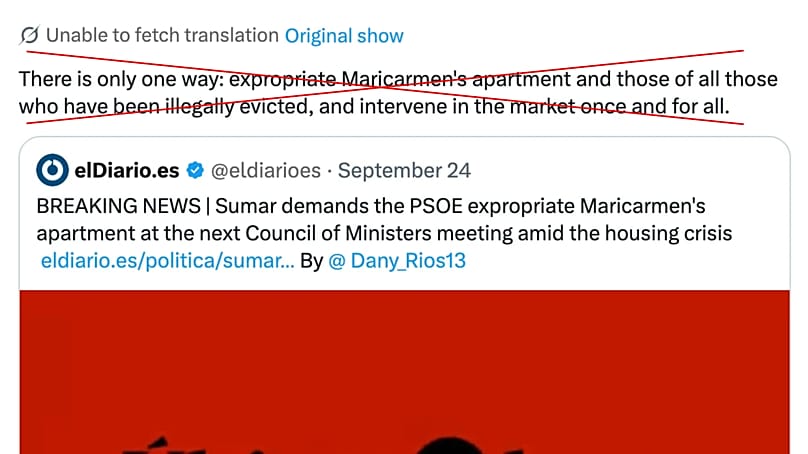
A tweet calling Maricarmen's eviction "illegal"
A tweet calling Maricarmen's eviction "illegal" Canva

The goal of the protests

So, contrary to what some misleading headlines imply, protesters are not arguing whether the eviction was lawful, but whether it was fair.

This is partly because, under Francisco Franco’s dictatorship laws, married women could not legally sign financial contracts or property leases independently.

Maricarmen's mother could inherit the lease only by subrogation upon her husband's death. Had she been a co-owner or co-signer from the start, Maricarmen's inheritance of the lease would have counted as the first subrogation, legally protecting her right to stay in the home for life.

Protesters also point out that Maricarmen is 87, has lived in the property for more than seven decades, and continued paying her protected rent.

After the old tenancy ended, property management company Urbagestión proposed a rent of around €1,650 a month, far above the roughly €440 to €500 she had previously paid. This is higher than her monthly pension of around €1,350, therefore forcing a vulnerable long-term tenant out because she cannot afford the new rent.

Protesters are asking for stronger protections against evictions of vulnerable tenants, longer or automatically renewed rental contracts, and tighter limits on rent increases.

Some groups also want tougher rules on speculative housing practices and greater public intervention in the rental market. They are now pressing parliament to approve new protections for vulnerable tenants and longer lease terms.

Other false and misleading claims

Another disputed claim going around online is that the Sindicato de Inquilinas, Spain's main union for tenants, prevented Maricarmen from reaching an agreement with the owner before the eviction.

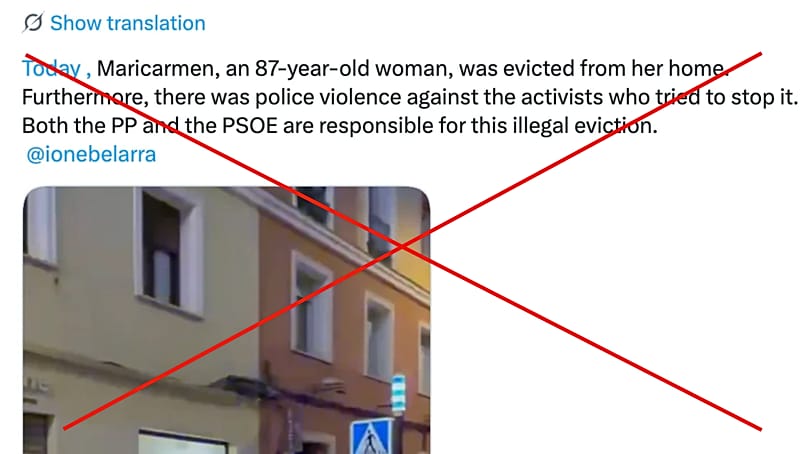
Another tweet calling Maricarmen's eviction "illegal"
Another tweet calling Maricarmen's eviction "illegal" Canva

Urbagestión says the union made it hard to contact Maricarmen directly, while Maricarmen’s lawyer says the opposite: that the company had refused repeated attempts to negotiate.

Urbagestión has also accused people involved in the dispute of coercion, extortion and hacking phones and email accounts. However, the company did not provide evidence for these claims in reporting reviewed by fact-checkers like Spain's Maldita.es.

Another misleading assertion comes from a shortened video of Maricarmen herself. In the clip, she appears to blame left-wing Prime Minister Pedro Sánchez specifically for her situation, but the full interview adds more names: she also criticises Madrid regional president Isabel Díaz Ayuso, Madrid mayor José Luis Martínez-Almeida (both members of the right-wing Popular Party) and Urbagestión itself. The clip therefore uses a genuine quote but removes the wider context of her answer.

A separate false claim involved two protesters called "Irene and Pablo" who spoke to elDiario.es at a protest camp at the Puerta del Sol square in Madrid. Some social-media users suggested they were Pablo Iglesias, former leader of far-left party Podemos, and MEP Irene Montero, from the same party.

However, a quick look at the article itself shows us that they are actually a different 28-year-old woman and 37-year-old man, with no indication that they were the politicians in question.

The next steps

Maricarmen has now accepted an agreement that will allow her to return to the apartment once she leaves hospital. Under the new arrangement, she will pay roughly the same as her previous rent, around €500 a month, capped at 30% of her income. The agreement creates a new tenancy; it does not overturn the court ruling that ended her old, protected lease.

Meanwhile, Spain's government has proposed measures that would extend some eviction protections and lengthen rental contracts, but parliament still needs to approve them. Protesters are therefore continuing their campaign and pushing politicians to adopt those measures while demanding broader reforms to Spain's housing system.


From ocean waste to fabric: inside Spain’s sustainable fashion revolution


By Monica Pinna
Published on

Every year, more than 12 million tonnes of plastic ends up in our oceans. Spanish fashion company Ecoalf transforms marine waste and discarded materials into fabrics and clothing through a circular supply chain. But can sustainable fashion transform an industry built on overproduction?

There are almost 5,000 fishermen and one not-for-profit foundation behind Spanish sustainable fashion brand Ecoalf. Every day, the fishermen recover waste caught in their nets, while the Ecoalf Foundation has developed a system to give that waste a second life, turning it into raw material, ultimately, fabric.

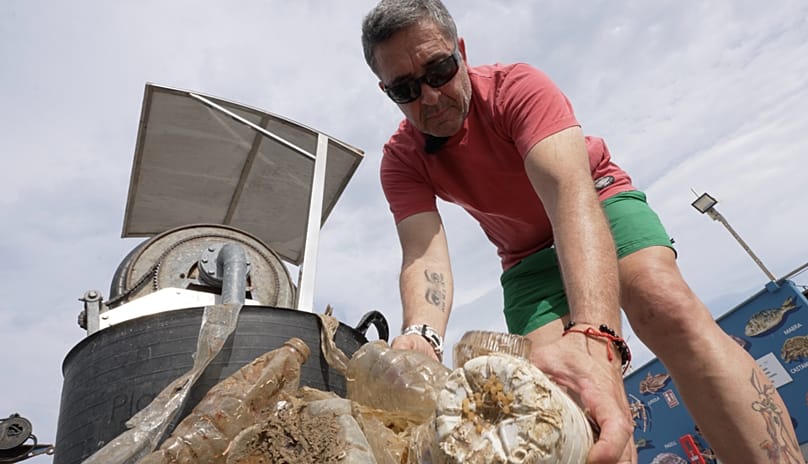
"Plastic alone now accounts for around 80% of everything we bring up. This is our daily reality,” says fisherman Tony Beltrán, while showing the waste that got caught in his nets off the coast of Gandía, south of Valencia. **“**Even before recycling became popular, we were already collecting it, the only difference was that we didn't separate it."

Fisherman Tony Beltrán showing some of the waste caught in the nets off the coast of Gandía, south of Valencia. September 2026.
Fisherman Tony Beltrán showing some of the waste caught in the nets off the coast of Gandía, south of Valencia. September 2026. © Monica Pinna, Euronews

Since 2015, the Upcycling the Oceans project, launched alongside the creation of the Ecoalf Foundation, has recovered more than 2,000 tonnes of marine waste, the equivalent of around 100 truckloads of rubbish. Today, the initiative involves around 80 ports and has expanded to France, Italy, Greece, Egypt and Thailand. Yet, it’s still a drop in the ocean: the Foundation points out that every minute, the equivalent of a truckload of plastic ends up in the world's oceans.

“Our goal has always been to bring together 10,000 fishermen across the Mediterranean so that, together, we can help clean up the Mediterranean Sea,” explains Andrea Ruzo, director of the Ecoalf Foundation.

Of all the materials recovered from the sea, most of them, like glass and metals, follow conventional recycling routes. But around 5% of this waste are plastic bottles, which are transformed into what Ecoalf calls Ocean Yarn.

“The first step, once the waste has been collected, is to shred it and turn it into flakes and then pellets, that’s the stage before spinning,” explains Ángela Pérez, Ecoalf’s expert in textile innovation and sustainability.

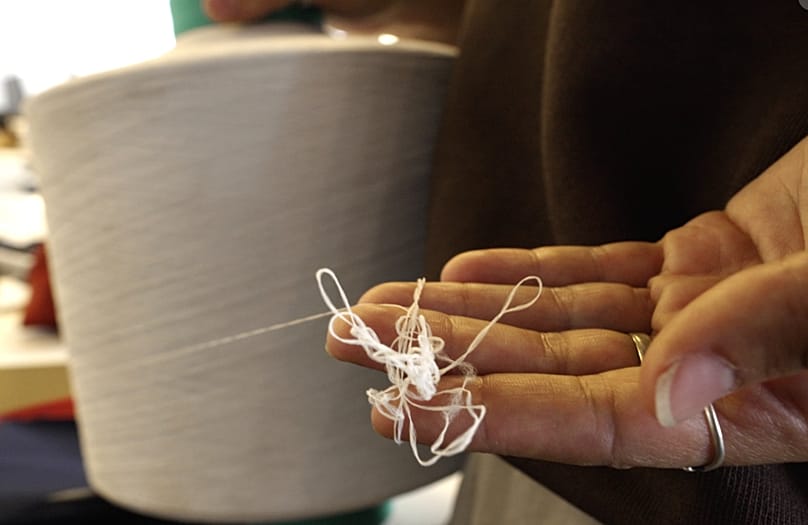
Ocean Yarn, the fiber produced from plastic bottles recovered from the sea.
Ocean Yarn, the fiber produced from plastic bottles recovered from the sea. © Monica Pinna

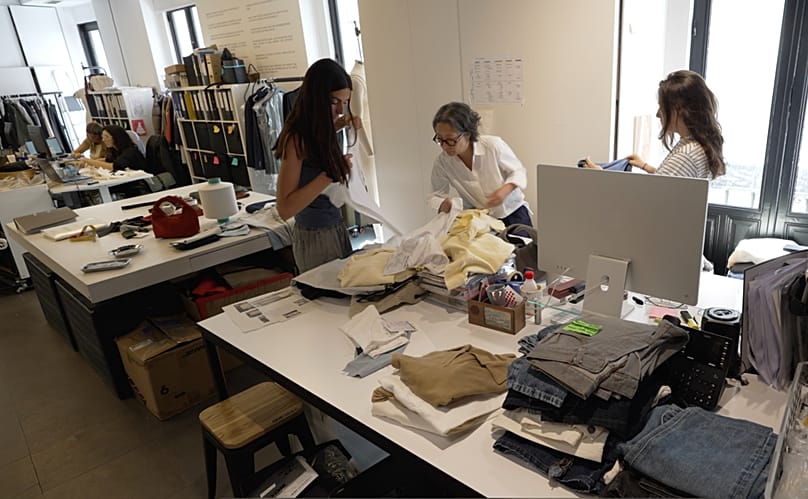
The beating heart of this supply chain is Ecoalf’s headquarters in Madrid, where ocean yarn and other recycled materials are turned into fabrics.

Since its creation in 2009, the company continues to source raw materials from a range of waste well beyond plastic bottles. Some fibres come from discarded fishing nets, others from tyres or recycled natural textiles, such as cotton and wool. The goal, the company says, is to reduce the environmental impact of both production and the finished garment, while maintaining its look and quality.

Julie Sohn, Ecoalf’s Creative Director at Madrid’s headquarters.
Julie Sohn, Ecoalf’s Creative Director at Madrid’s headquarters. © Monica Pinna

Circularity influences the decisions a fashion designer makes throughout the design process says Julie Sohn, Ecoalf’s creative director.

“It changes everything from the very beginning. Everything is designed so that the garment can be completely disassembled, without any additional processing, and re-enter the circular economy,” she says.

Among the pioneers of sustainable fashion, Ecoalf was founded with a clear ambition: to prove that a business can succeed while helping transform one of the world’s most polluting industries. 17 years later, the company has grown into a global brand, with annual revenues of around €65 million, 300 employees and dozens of stores worldwide.

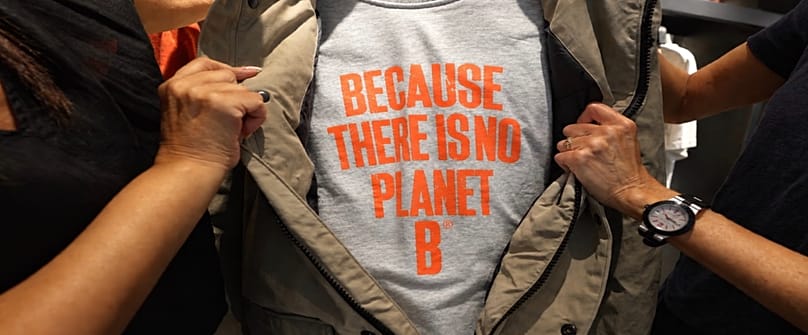
Ecoalf’s slogan, “There is no Planet B,” is featured throughout its collections.
Ecoalf’s slogan, “There is no Planet B,” is featured throughout its collections. © Monica Pinna

“The problem we’ve been facing in recent years is mass overconsumption and overproduction. Brands need to move beyond sustainable capsules or focusing on a single material. We need to learn to design with eco-design principles from the very beginning,” explains Carolina Álvarez-Ossorio, Ecoalf’s chief marketing officer.

But could sustainable fashion eventually replace fast fashion? There is still a long way to go according to Álvarez-Ossorio, who is also convinced designers have a role to play in finding new ways to work with purpose and ultimately help protect our planet.

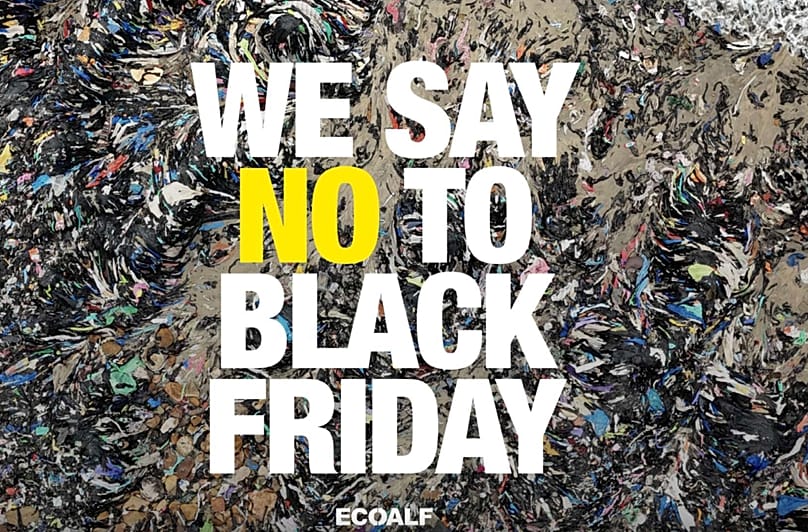
Ecoalf anti Black Friday campaign.
Ecoalf anti Black Friday campaign. © Ecoalf

Ecoalf is a striking example of the circular economy, but it also raises a bigger question: can recycling the waste we already produce ever compensate for new waste we continue to create?


Humanoid robots: China builds them, but Germany could supply the joints and hands

Germany's future in humanoid robots may lie in the details, as German automotive suppliers are top-class in joints and motors for tiny components.
Copyright Copyright 2026 The Associated Press. All rights reserved


By Franziska Müller
Published on


Europe has so far built few humanoid robots, yet could profit from each one. German car part suppliers may play a key role in joints, says a Fraunhofer study.

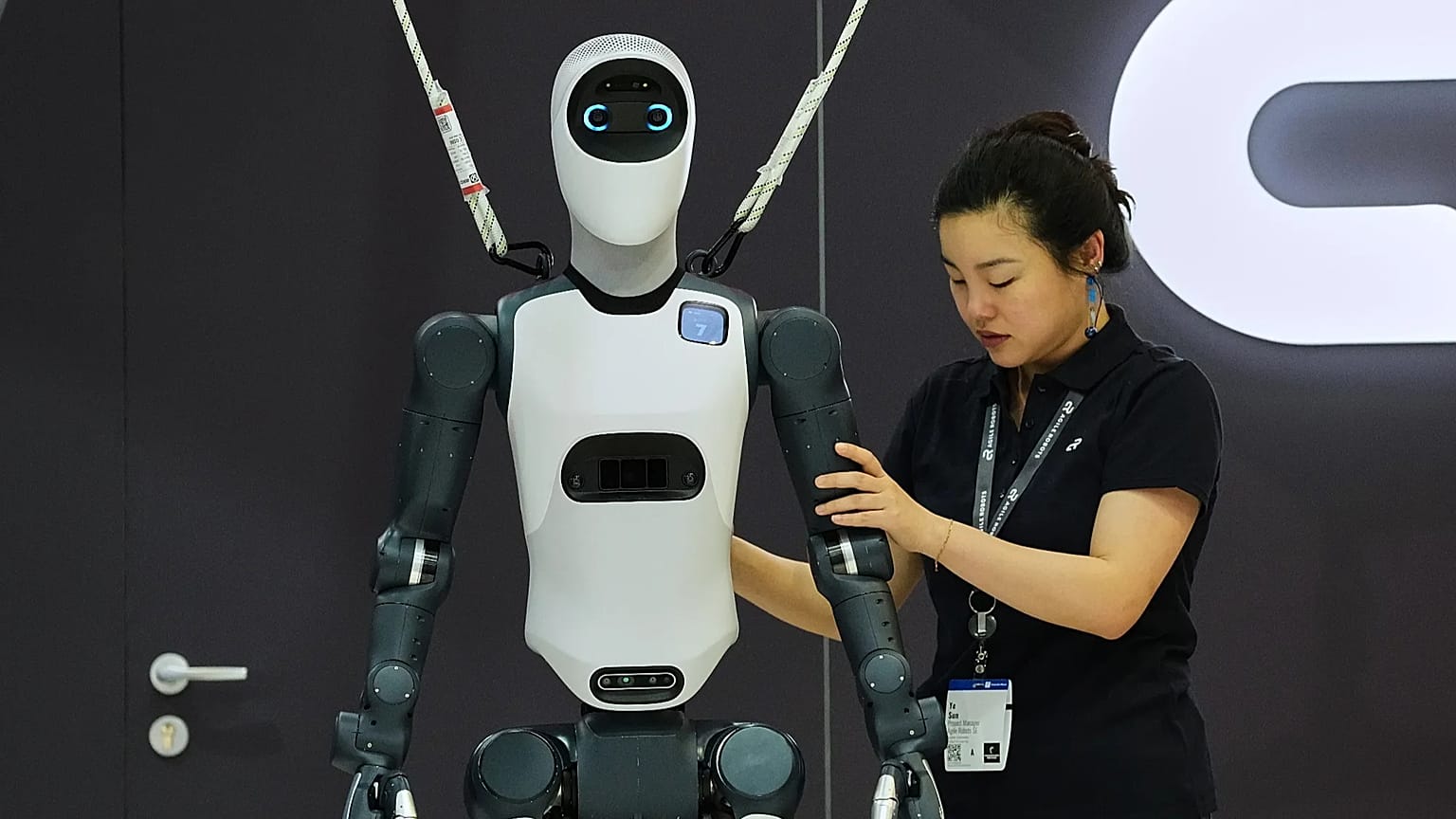
At first glance, humanoid robots look like a field dominated by the big tech corporations: artificial intelligence, cameras, sensors, software.

But beneath their casing lies a great deal of traditional industry.

Every leg, every arm and every hand contains motors, gearboxes, bearings and sensors — components European companies have been producing for decades.

German research is still at the starting point in the race to develop humanoid robots, but industrial suppliers are already far ahead when it comes to specialised parts.

Researchers are now asking whether Europe even needs to build humanoid robots itself in order to benefit from a potential boom in the technology.

Could conventional industrial companies simply become suppliers to a new robotics sector? Or will this value creation also relocate to China or the United States?

Europe so far plays hardly any role in finished machines

China currently dominates deliveries by a clear margin and has overtaken the United States. Europe so far plays hardly any role in finished machines. Yet German companies could still profit from their potential march to victory.

An unusual strategy could emerge for Europe: not building the robot itself, but supplying the parts it is made of.

According to a specialist report by the Fraunhofer Institute for Manufacturing Engineering and Automation IPA, this component business could be much easier for Germany in particular to capture.

"In principle, the potential along the German and European supply chain is very large," says the author of the paper, Vincent Bezold, head of the Automated Manufacturing Systems business segment at IPA.

Together with consultancy P3, IPA has examined what opportunities this opens up for industrial suppliers.

They already have the expertise and production facilities for the components humanoids urgently need — and, according to recent comparisons, a specific advantage over Chinese parts of this kind.

IPA expects the market to be worth around 30 billion dollars by 2030.

China dominates global deliveries of humanoid robots

Around 19,100 humanoid robots were delivered in the first half of 2026. A huge share of them — 97 percent — came from China, according to data from research company Smart Analytics Global (SAG) published in August 2026.

For the whole of 2026, researchers expect around 60,000 robots to be shipped, rising to half a million by 2030.

According to SAG, China is currently winning the race to develop AI-powered humanoids. Agibot, a company based in the greater Shanghai area, alone has delivered 8,400 robots. US firms such as Tesla, Figure AI and Agility Robotics are lagging behind.

However, the number of humanoid robots in commercially productive use is still low. Mass production off the assembly line has not yet been reached, and despite China’s high shipping volumes the market is far from settled.

With government backing, China’s industry is working hard to accelerate the rollout of humanoid robots into widespread use.

The goal is clear: humanoid robots in manufacturing, logistics and warehousing. In these areas, robots could perform clearly defined tasks, SAG notes.

Their profitability and productivity can be easily compared and optimised here. Even so, the leap from "robots that can put on a show" to "robots that can work reliably" has yet to be made, SAG adds.

Humanoid robots need more than 40 joints

Behind every AI robot sits a classic mechanical engineering industry. Before the software can link all the components together, they have to be mechanically and technically sound.

Conventional industrial robots manage with seven joints, while humanoid robots need more than 40. Each joint means a motor, gearbox, bearing and sensor.

While Chinese companies such as Agibot are already shipping thousands of humanoids, several of the firms producing crucial components for these machines are based in Germany.

Gearboxes, motors, sensors and grippers are part of the traditional business of German and European automotive suppliers. These include German companies such as Schaeffler, Bosch, Schunk, Wittenstein and Neugart. They could also sell these parts to robot manufacturers.

China is producing these components as well, but so far with significantly shorter lifetimes.

"They don’t happen to run, as recently in Beijing, a half marathon as a PR stunt by chance. They do it because they wouldn’t withstand a full marathon," explains Sebastian Reitelshöfer, head of robotics research at the University of Erlangen–Nuremberg, in an interview with the ARD-Finanzredaktion.

According to Reitelshöfer, some components in these flagship models would only last "one or two weeks".

In his assessment, some showcase models developed in China still have durability problems in certain parts: individual components can only be operated for a few weeks under heavy load

By contrast, some European designs from the automotive sector would last far longer.

That, however, is precisely where one of the difficulties lies, Bezold tells Euronews. Supply chains are primarily developed locally around the original manufacturers.

"As a large proportion of humanoids currently comes from China, corresponding supplier structures are likely to form there as well, just as they did in Germany around the automotive industry," Bezold estimates. There are particular gaps in specialised components.

Not all components are competitive yet

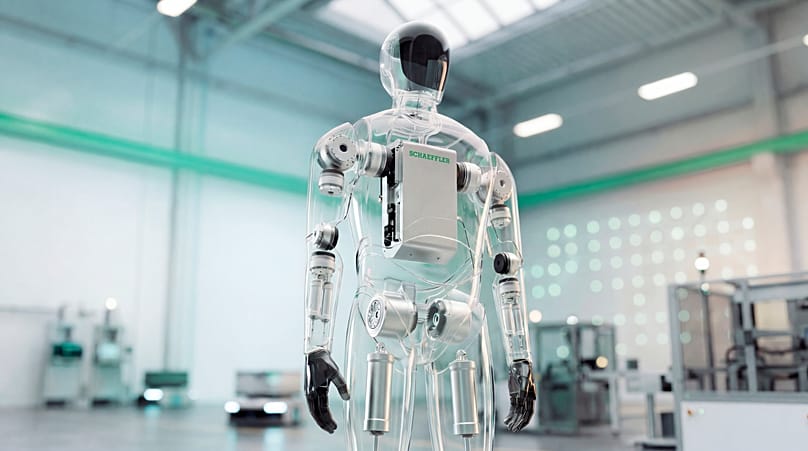
In August, Schaeffler unveiled a new gearbox developed specifically for humanoid robots. The company’s name also appears in the white paper by the Fraunhofer Institute for Manufacturing Engineering and Automation.

The automotive supplier based in Herzogenaurach specialises in motors and drive technology. Its new strain wave gear – a high-precision specialist gearbox for industrial robots – is designed to transmit movements as accurately and powerfully as possible in the smallest installation space. According to the company, the new gearbox meets the core requirements of humanoid robot joints.

Schaeffler develops and supplies key components for scaling up humanoid robotics.
Schaeffler develops and supplies key components for scaling up humanoid robotics. Bild: Schaeffler

A new production method could also cut manufacturing costs by more than 25 percent and reduce material consumption by over 75 percent. That makes the strain wave gear competitive.

"The re-shaped strain wave gear is another example of how we are industrially advancing core robotics components and preparing them for high-volume series production," says Schaeffler’s President Humanoid Robotics, David Kehr. The company is creating solutions "designed for quality, cost-effectiveness and scalability". Series production is expected to start in mid-2027.

At the Hannover Messe in April 2026, the company received the Hermes Award for its development of humanoid robot joints. The prize underscores Schaeffler’s key role as a component supplier in the field of humanoid robotics, the company said in a subsequent statement.

The award specifically recognised the actuators platform used in shoulder, elbow and knee joints in robots. According to Schaeffler, actuators account for around 50 percent of the total cost of a humanoid. They are therefore a central lever for competitiveness.

Schaeffler is thus not simply trying to sell a single part for a robot. The company is looking to define part of the robot’s architecture.

Robot hands from Germany

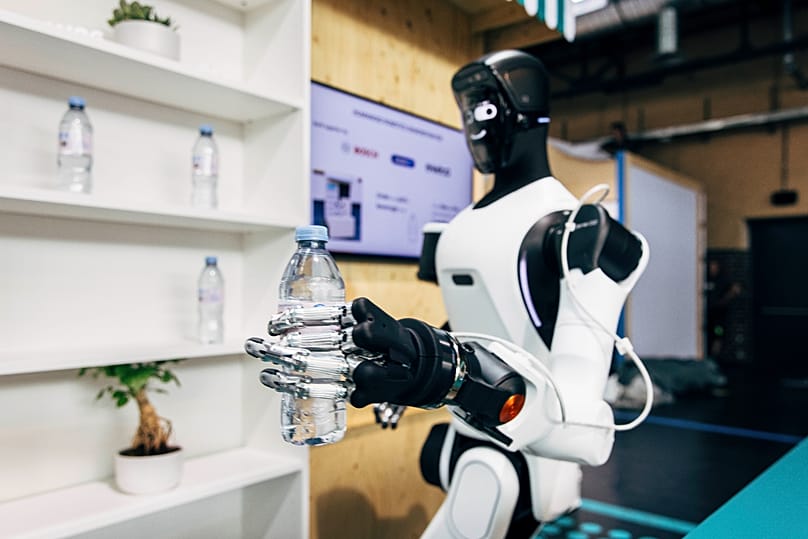
How far this approach can go is illustrated by a partnership between Bosch and Schunk, two other German firms. Since June 2026, the two companies have been working together on a robot hand that can be integrated into different humanoid robot systems. This moves beyond individual parts such as gearboxes or motors to a complete key component of the humanoid robot.

Schunk has spent around 20 years developing robot hands and specialises in gripping technology. Bosch contributes precision mechanics, electronics and software, and is expected to manufacture the hand in series later on.

For Bosch Connected World 2026, Bosch and Schunk jointly integrated a robot hand into a humanoid robot system.
For Bosch Connected World 2026, Bosch and Schunk jointly integrated a robot hand into a humanoid robot system. Foto: Bosch

"Robot hands are a key component in advancing humanoid robotics in production and enabling more flexible and precise work than with conventional gripping systems," said Mathias Pillin, Chief Technology Officer at Robert Bosch GmbH, when the collaboration was announced.

The hand is particularly crucial for industrial use: it has to grip different workpieces, modulate force and operate reliably over long periods. At the same time, it should be compatible with as many robot platforms as possible. Hands are also among the hardware elements that most strongly influence the cost of a humanoid robot.

Supplying parts does not mean controlling the whole production

But a strong components business does not in itself amount to a robotics industry. The key question, therefore, is how much value creation remains in Europe if Chinese or US companies control the robot platforms, the software and access to customers.

For Fraunhofer IPA and P3, the crucial issue is not only whether Europe produces its own humanoid robot, but also where the industrial value chain takes shape. This is the core business of many European suppliers, who could reap substantial profits by entering the market.

From Bezold’s perspective, "access to manufacturers of humanoid robots" is the biggest shortcoming, because there are relatively few manufacturers in Europe and, as things stand today, only a small number of humanoid robots are actually built there. "That makes it harder for European suppliers to become part of the relevant value chains at an early stage."

According to the specialist report, hardware is just as decisive as software development for the economic viability, scalability and industrial impact of humanoid robots. IPA and P3 see an opportunity here for European suppliers and call for coordinated action by industry, policymakers and researchers.

"Suppliers who engage early with actuators, gearboxes, batteries, dexterous hands and lightweight structures can help shape future reference architectures and secure long-term positions in emerging supply chains," the study says. IPA considers the opportunity tangible if action is taken immediately. The authors criticise funding policies that focus exclusively on artificial intelligence.

The humanoid robots that will one day work in factories do not necessarily have to come from a single European plant. Europe may instead be hidden in their joints, hands and drives.

The crucial question is who sets the technical standards

Whether this will develop into an industrial strength of its own, or whether Europe will simply become a supplier of parts for robots from China and the US, is still unclear. What is likely to be decisive is who not only delivers individual components, but also helps define the standards and architectures of the next robot generation.

In its study "Humanoid Robotics 2040", Germany’s mechanical and plant engineering association VDMA argues that the entire production and supply chain should also be brought to Europe.

Over the coming years, VDMA expects a mass market for humanoid robots. Its study (source in German) "Humanoid Robotics 2040", published in April 2026, considers annual sales in the millions to be possible by 2042.

If Europe wants to help shape these markets, the study says it will need "far more capital, stronger support for start-ups and bolder industrial steps". Bezold also argues: "We ourselves need more manufacturers of humanoid robots in Europe." The industry association recommends treating humanoid robots as a priority and getting involved in the supply chain as early as possible. "That also means telling users that they should not be afraid to back projects even if the precise outcome is not entirely clear at the beginning," Bezold explains.