Is A Return To Civil War In Yemen Inevitable? – Analysis
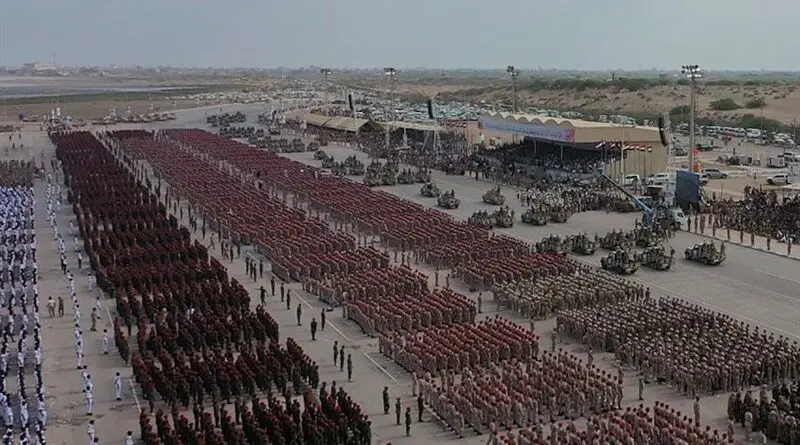
Houthi military parade. Photo Credit: Tasnim News Agency
July 29, 2026
Arab News
By Jonathan Gornall
Key Takeaways:
After nearly four years of relative calm, the Houthis have escalated by attacking Saudi targets, striking ships, and declaring a blockade on the Bab al-Mandab Strait, drawing Yemen back into the widening US-Iran conflict that has already closed the Strait of Hormuz.
Analysts see the moves as partly opportunistic support for Iran and partly driven by the Houthis’ own goals of gaining leverage, deterring Saudi Arabia, reinforcing domestic legitimacy, and positioning themselves as an indispensable regional actor.
The escalation raises the risk of reigniting Yemen’s internal war and further disrupting global oil and shipping routes, with calls for renewed Saudi-Houthi talks and a halt to the broader Iran conflict to prevent a larger regional or global crisis.
For almost four years, Yemen has been enjoying a period of relative peace. So why do the Houthi militia suddenly appear to be doing their best to provoke a return to large-scale military operations in the country?
The answer, analysts believe, is that the war in Iran, which has steadily escalated out of control, embroiling the Arab Gulf states, leading to the closure of the Strait of Hormuz and dramatically impacting global oil supplies, is now dragging Yemen into its orbit.
“The Houthis had been waiting to see whether their military involvement might be needed or called for in the conflict between the US and Iran, and had largely kept their powder dry, apart from a limited number of attacks targeting Israel,” wrote Nabeel A. Khoury, a former US deputy chief of mission at the US Embassy in Yemen, in an analysis issued by the Arab Center Washington DC.
Despite their backing for Hamas during the 2023-25 war in Gaza, he added, the Houthis had “initially kept a low profile during the war on Iran launched by Israel and the Trump administration in February 2026.”
With the signing of the June 2026 memorandum of understanding between the US and Iran, there was even “some optimism in the region that the war might be coming to an end and that the Yemen front would not be re-opened.”
The 14-point Islamabad MoU declared the immediate and permanent termination of military operations on all fronts and the reopening of the Strait of Hormuz to all traffic, pending an envisioned “final deal,” due to have been reached within 60 days.
But no sooner had the MoU been signed, than it began to unravel.
On July 7, following a series of “unwarranted, dangerous” attacks on three commercial ships in the Strait of Hormuz, US Central Command launched a series of retaliatory strikes against more than 80 targets in Iran, “to impose heavy costs for targeting and attacking commercial shipping crewed by innocent civilians in an international waterway.
For its part, Iran claimed it had struck the ships because they were attempting to navigate via a new route through the strait, which the US had been trying to open up in contravention of the provisions of the MoU.
The following day, at the NATO summit in Ankara, US President Donald Trump declared the ceasefire with Iran was over.
“I don’t want to deal with them any more … They’re sick … vicious, violent people,” he said.
In Yemen, tensions were also beginning to boil over.
On July 12, Yemeni government aircraft bombed Sanaa airport, part of the territory in the north that is controlled by the Houthi rebels.
The attack appeared to have been prompted by the return of an aircraft which had carried Houthi representatives to Tehran for the long-delayed funeral of Ali Khamenei, the supreme leader of Iran who was assassinated by an Israeli airstrike in February.
“The Houthi terrorist militia, supported by the Iranian regime, prevented Yemeni national aircraft from landing at the capital’s airport, Sanaa, and insisted that the Iranian aircraft violated Yemeni airspace,” said the Yemeni government in a statement.
“Therefore, the airport runway was targeted.”
The Houthis’ response was to fire a salvo of ballistic missiles and drones at Saudi Arabia’s Abha International Airport, 100 km from the Kingdom’s border with Yemen.
“Air defenses intercepted a ballistic missile threat launched by the terrorist Houthi militia towards the southern region,” a spokesman for the Saudi-led coalition posted on social media.
Then, on July 20, the Houthis announced that they were finally doing what many had feared they would — entering the war by imposing a blockade on the Bab Al-Mandab Strait at the southern end of the Red Sea, tightening the grip on global oil supplies already being exercised by Tehran in the Strait of Hormuz.
In a message to shipping companies, the Houthis’ Humanitarian Operations Coordination Center, warned that no voyages to or from Saudi ports on the Red Sea should be contemplated, “as any such activity would expose the violating vessels to sanctions.”
Any ships that ignored the ban “may be subject to targeting in any location within the operational reach.”
The first victim of the proposed “sanctions” was the Saudi-owned Encelia, a 250-meter oil-products tanker, which was struck by a missile late on July 22, causing a fire in the bow.
That weekend, Saudi air defense systems intercepted two ballistic missiles and a drone fired from Yemen, aimed at Aramco oil refineries in Yanbu.
On Saturday, Iran’s foreign minister, Abbas Araghchi, said developments in Yemen “cannot be attributed to Iran.”
In an interview with the state newspaper, Iran Daily, he called for dialogue and added that the clashes in and around the Bab Al-Mandab Strait were “rooted in old disputes and issues between Yemen, Saudi Arabia and the countries of the region.”
But, said Khoury, “the recent internal flare-up between the Houthis and Yemen’s internationally recognized government, as well the buildup of tensions with Saudi Arabia, point to the likelihood of a Yemeni front being opened in the renewed escalation between Iran and the US.”
On July 23, President Trump, reacting to the attacks on Saudi shipping in the Red Sea, the Houthi blockade and the subsequent climb in oil prices, issued a stern warning.
“A year ago the US attacked, very powerfully, the Houthis, for their interference with commerce and trade, by shooting at ships,” Trump wrote on Truth Social.
“Since that time, and during our conflict with Iran, they have acted very responsibly. Unfortunately, now they are starting up again, shooting at two Saudi Arabian ships last night.”
He added: “If they do this again, the US will hold Iran responsible, in that the Houthis are a Surrogate and/or Proxy of Iran, and major military punishment will be inflicted upon Iran and, of course, the Houthis, themselves, who I am very disappointed with.”
On Friday, Mohammed Al-Jaber, the Saudi ambassador to Yemen, attempted to pour diplomatic water on the fire.
“The Kingdom of Saudi Arabia has sought, and continues to seek, to support all de-escalation and peace efforts, and to back the efforts of the UN envoy to Yemen to reach a comprehensive political solution that ends the suffering of the Yemeni people,” he wrote in a post on X.
“However, the terrorist Houthi militia continues to insist on pursuing the path of escalation and violence instead of the path of de-escalation and peace, in service of external agendas that have no connection to Yemen and do not serve the interests of its people.”
Regardless, he added, “the Kingdom of Saudi Arabia will remain … a supporter of the brotherly Yemeni people throughout all of Yemen, and a backer of its legitimate government, until Yemen enjoys security, stability, and peace.”
On Monday, April Alley, an analyst who worked on Yemen’s peace process at the UN, told The New York Times there was “real concern that the internal Yemeni war could reignite.”
It was no coincidence that the Houthis were seeking to escalate conflict in Yemen precisely when Saudi Arabia was working hard to re-route oil exports via the Red Sea.
She added: “The Houthis are good at smelling blood in the water.”
Egyptian journalist Abdellatif El-Menawy told Arab News that “a return to full-scale civil war is not inevitable, but the risk is now higher than at any point since the 2022 truce.”
Renewed Houthi attacks in the Red Sea and possible Saudi retaliation “could reactivate Yemen’s internal front lines and pull the country back into a wider regional conflict.”
The Houthis, he said, wanted “more than control of northern Yemen.”
“Their objective is to secure recognition as the country’s dominant power, dictate the terms of any national settlement, and use their position near Bab Al-Mandab to establish themselves as a regional actor that cannot be ignored.”
In a recent analysis, Ahmed Nagi, a senior Yemen specialist at the International Crisis Group, proposed that “the most effective way to contain the crisis would be to reactivate the direct political track between the Saudi-led coalition and the Houthis.”
“The two sides could return to the broad understandings reached prior to the Gaza war that began in October 2023.”
But, in order to achieve “sustainable calm,” it was “imperative to bring a halt to the latest US-Iranian clashes, lest they engulf Yemen and plunge the region back into another years-long conflict to the detriment of all concerned.”
It might already be too late, feared Khoury.
With the Houthis having closed the Bab Al-Mandab Strait, “in a desperate attempt to help Iran build pressure on the world economy, an already dangerous regional conflict could metastasize into a global calamity,” he said.
According to a briefing by Chatham House, the Houthis are not simply doing Tehran’s bidding.
“The Houthis are deeply embedded within the ‘Axis of Resistance’ and reliant on Iranian military assistance,” wrote Farea Al-Muslimi, a research fellow in the think-tank’s Middle East and North Africa Programme.
“But they retain significant autonomy, particularly in pursuing domestic political objectives. Their interests frequently overlap with Tehran’s, but they do not always coincide.”
For the Houthis, he believes, “maritime disruption in the Red Sea serves several purposes besides supporting Iran.
“It provides leverage over the international community, acts as a deterrent against regional adversaries — particularly Saudi Arabia — and reinforces their domestic legitimacy by portraying the movement as capable of confronting powerful external actors.”
About Arab News
Arab News is Saudi Arabia's first English-language newspaper. It was founded in 1975 by Hisham and Mohammed Ali Hafiz. Today, it is one of 29 publications produced by Saudi Research & Publishing Company (SRPC), a subsidiary of Saudi Research & Marketing Group (SRMG).
View all posts by Arab News →

No comments:
Post a Comment