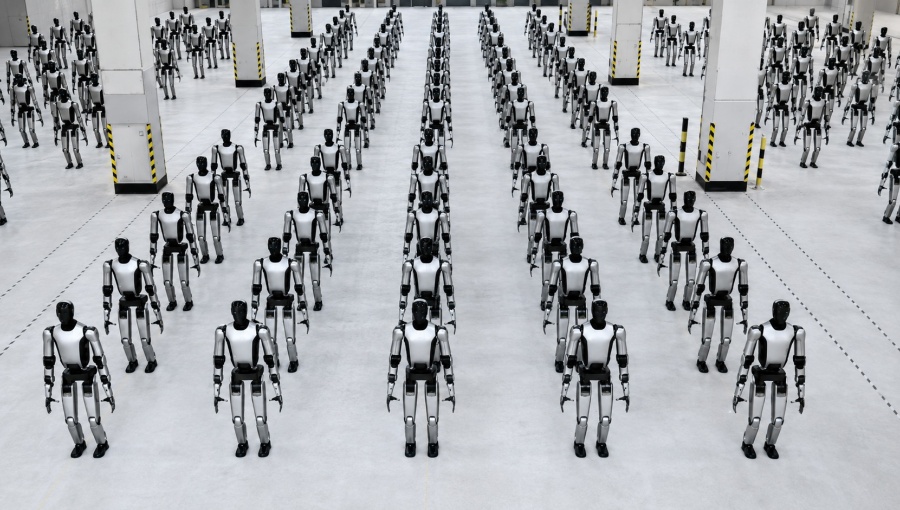
Humanoid robotics has become one of the fastest-growing corners of the global technology industry - and one of the newest fronts in the US-China tech rivalry. On July 29, the US Federal Communications Commission (FCC) added new foreign-made humanoid robots, four-legged "robot dog" models and power inverters to its list of restricted imports, in a move aimed squarely at Chinese manufacturers. FCC chairman Brendan Carr said the step was needed to "secure America's critical supply chains" against devices that could be remotely controlled or used for surveillance or cyberattacks.
China's commerce ministry called the move protectionist overreach and vowed to "resolutely retaliate," with analysts pointing to Beijing's dominance of rare-earth processing - used in robot motors and actuators - as its likeliest lever, Statista reports.
The ban lands just as investment in the sector is accelerating sharply. In the first half of 2026 alone, $4.39bn was invested in humanoid robotics startups worldwide, according to data from market platform Tracxn cited by Statista - meaning this year's spending is already on course to surpass the entire previous decade combined. In 2025 alone, more than $3bn was invested globally, itself more than the total for 2017-2024 combined.

Investment in humanoid robotics startups worldwide. Source: Tracxn, via Statista.
China and the US are the clear epicentres of that spending. Cumulatively between 2017 and the first half of 2026, China drew $4.4bn into humanoid-robot startups, just ahead of the US on around $3bn - together accounting for the large majority of global investment. A distinct second tier is led by Canada, followed by Japan, Israel and the UK, underlining how concentrated the startup ecosystem remains despite the global interest.

Cumulative investment in humanoid robotics startups by country, 2017-H1 2026. Source: Tracxn, via Statista.
China's edge extends to manufacturing volume as well as funding: Chinese firms Unitree Robotics and Agibot each produced more than 5,000 humanoid robot units in 2025, more than any other country's makers. US rivals Boston Dynamics and Tesla, with their Atlas and Optimus models respectively, are aiming to ramp up production through 2026, while Europe's push is led by smaller players - Engineered Arts in the UK and Neura Robotics in Germany. Europe currently has no mass-production capacity of its own for humanoid robots, a gap Agibot has been trying to fill: the Chinese firm was in talks with Serbia in February to build the continent's first humanoid-robot plant, a roughly €100mn investment that would make Belgrade, rather than Brussels or Berlin, Europe's entry point into the industry.
Humanoid robots - built with a head, torso, two arms and two legs to work in human-designed spaces - are pitched as more flexible than fixed industrial machines and better suited to physically demanding or repetitive work than wheeled service robots. Recent coverage in the journal Nature has described the technology as nearing genuine commercial usefulness, with early models already able to lift and sort items on production lines or perform basic household tasks such as opening doors and operating light switches.


No comments:
Post a Comment