Stevens Posts Bizarre, Racist Rant Against El-Sayed as He Surges Ahead in Polls
The Stevens campaign has already faced scrutiny over some of her backers’ racist and Islamophobic messaging.
By Sharon Zhang ,
El-Sayed has criticized the U.S. policy of funding Israel, but has also previously called for ending unconditional foreign military aid to other countries that commit abuses like Egypt, Saudi Arabia, Qatar, the UAE, Jordan, and Pakistan.
Stevens’s post has been lambasted by critics as racist and Islamophobic, in part due to its invocation of the bigoted trope that Muslim people want to commit violence against Jewish people.
“Haley Stevens trying hard to compete with John Fetterman for the title of most racist elected Democrat in America,” said Zeteo editor-in-chief Mehdi Hasan.
Pro-Israel lobby watchdog AIPAC Tracker criticized Stevens for conflating AIPAC with Jewish people. “AIPAC isn’t a Jewish organization, Haley. It’s a pro-Israel organization. You, a non-Jewish person, are stoking dangerous antisemitism by conflating the two,” the group wrote.
The post came after two polls came out this week showing that El-Sayed is surging in the polls, just days before the primary election next week.
On Wednesday, a poll by Tavern Research found that 46 percent of likely primary voters said they were choosing El-Sayed, versus 36 for Stevens. Meanwhile, Emerson College Polling/WLNS/WOODTV found in another poll on Thursday that El-Sayed would get 54 percent of the vote, pulling out a 15-point lead over Stevens’s 39 percent.
Stevens’s campaign has already faced criticism in recent weeks over some of her backers’ bigotry — including from fellow Democrats who vocally back Stevens as well as right-wing figures.
Earlier this week, Stevens backer Rep. Hillary Scholten (D-Michigan) did not say whether she would back El-Sayed if he becomes the Democratic nominee. Her reasoning was openly Islamophobic, as she said to Semafor: “I will not stand beside someone who has allowed distinctly anti-American sentiment to enter our public dialogue.”
Last week, a woman who sits on Farmington’s school board, Angie Smith, also came under fire when she said she’s backing Stevens because she would represent “not just one race, but all races.”
“You have to know how to work the room, don’t just come in here speaking Arabic, don’t come out with your Arabic music on,” she went on. The video went viral online. Smith later apologized, and the Stevens campaign distanced itself from her comments.
The Stevens campaign has already faced scrutiny over some of her backers’ racist and Islamophobic messaging.
By Sharon Zhang ,
July 31, 2026
Rep. Haley Stevens, a candidate for Michigan’s open U.S. Senate seat, attends the Lansing Regional Chamber of Commerce “Meet the Candidate” series on July 29, 2026 in Lansing, Michigan.Bill Pugliano / Getty Images
On Thursday, Rep. Haley Stevens (D-Michigan) posted a bizarre and racist rant against opponent Abdul El-Sayed over his criticisms of AIPAC — even as Stevens’s campaign has already faced pushback for embracing bigoted attacks.
In a post on X addressed directly to El-Sayed late Thursday evening, Stevens said that “[e]veryone in America understands you want to blame all of your problems on Jewish Americans.” She said, without basis, that El-Sayed is a “celebrity” and a “part of the complainer class” who is in the race to secure the “next book or podcast deal.”
“Bro, I just want to work for Michigan,” Stevens concluded in her post.
The post was a quote tweet of an interview clip in which El-Sayed taunted AIPAC, which has spent roughly $30 million on Stevens’s campaign — a record amount of spending on one race for the pro-Israel group — via its super PAC, United Democracy Project (UDP). In all, UDP and other outside groups have spent $60 million backing Stevens, while El-Sayed has received $4.6 million from outside groups.
“When AIPAC watches this — come for me, see what happens,” El-Sayed said. “If you think you can beat money out of politics, money in your pocket, Medicare for All, come. But I’ll tell you what people don’t want, they don’t want money in a foreign government. They want money here.”
On Thursday, Rep. Haley Stevens (D-Michigan) posted a bizarre and racist rant against opponent Abdul El-Sayed over his criticisms of AIPAC — even as Stevens’s campaign has already faced pushback for embracing bigoted attacks.
In a post on X addressed directly to El-Sayed late Thursday evening, Stevens said that “[e]veryone in America understands you want to blame all of your problems on Jewish Americans.” She said, without basis, that El-Sayed is a “celebrity” and a “part of the complainer class” who is in the race to secure the “next book or podcast deal.”
“Bro, I just want to work for Michigan,” Stevens concluded in her post.
The post was a quote tweet of an interview clip in which El-Sayed taunted AIPAC, which has spent roughly $30 million on Stevens’s campaign — a record amount of spending on one race for the pro-Israel group — via its super PAC, United Democracy Project (UDP). In all, UDP and other outside groups have spent $60 million backing Stevens, while El-Sayed has received $4.6 million from outside groups.
“When AIPAC watches this — come for me, see what happens,” El-Sayed said. “If you think you can beat money out of politics, money in your pocket, Medicare for All, come. But I’ll tell you what people don’t want, they don’t want money in a foreign government. They want money here.”
El-Sayed has criticized the U.S. policy of funding Israel, but has also previously called for ending unconditional foreign military aid to other countries that commit abuses like Egypt, Saudi Arabia, Qatar, the UAE, Jordan, and Pakistan.
Stevens’s post has been lambasted by critics as racist and Islamophobic, in part due to its invocation of the bigoted trope that Muslim people want to commit violence against Jewish people.
“Haley Stevens trying hard to compete with John Fetterman for the title of most racist elected Democrat in America,” said Zeteo editor-in-chief Mehdi Hasan.
Pro-Israel lobby watchdog AIPAC Tracker criticized Stevens for conflating AIPAC with Jewish people. “AIPAC isn’t a Jewish organization, Haley. It’s a pro-Israel organization. You, a non-Jewish person, are stoking dangerous antisemitism by conflating the two,” the group wrote.
The post came after two polls came out this week showing that El-Sayed is surging in the polls, just days before the primary election next week.
On Wednesday, a poll by Tavern Research found that 46 percent of likely primary voters said they were choosing El-Sayed, versus 36 for Stevens. Meanwhile, Emerson College Polling/WLNS/WOODTV found in another poll on Thursday that El-Sayed would get 54 percent of the vote, pulling out a 15-point lead over Stevens’s 39 percent.
Stevens’s campaign has already faced criticism in recent weeks over some of her backers’ bigotry — including from fellow Democrats who vocally back Stevens as well as right-wing figures.
Earlier this week, Stevens backer Rep. Hillary Scholten (D-Michigan) did not say whether she would back El-Sayed if he becomes the Democratic nominee. Her reasoning was openly Islamophobic, as she said to Semafor: “I will not stand beside someone who has allowed distinctly anti-American sentiment to enter our public dialogue.”
Last week, a woman who sits on Farmington’s school board, Angie Smith, also came under fire when she said she’s backing Stevens because she would represent “not just one race, but all races.”
“You have to know how to work the room, don’t just come in here speaking Arabic, don’t come out with your Arabic music on,” she went on. The video went viral online. Smith later apologized, and the Stevens campaign distanced itself from her comments.
If Michigan Democrats nominate someone so out of touch with her constituents and so supportive of Trump’s opposition to human rights, many thousands of Michiganders will likely vote third party or stay at home in November.
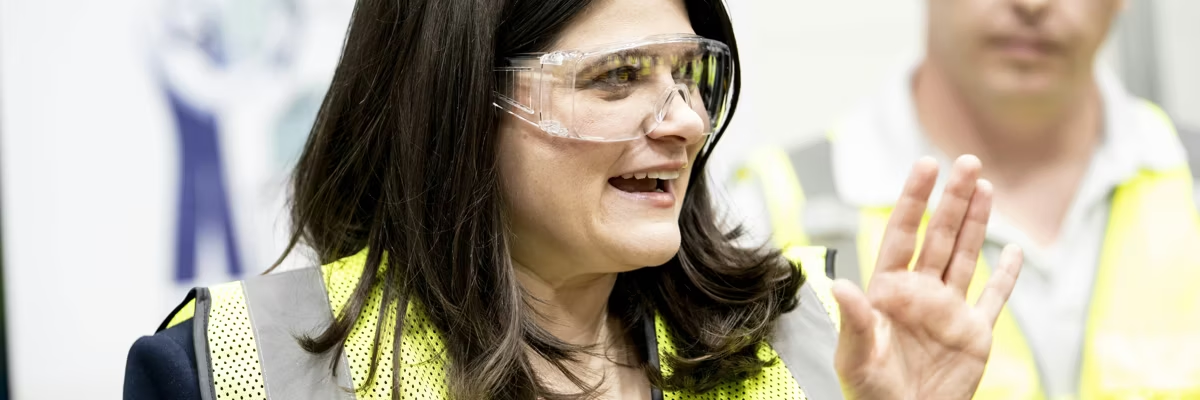
US Rep. Haley Stevens (D-Mich.) tours the Webasto Plymouth Plant on May 1, 2026 in Plymouth, Michigan.
(Photo by Sarah Rice/Getty Images)
Stephen Zunes
Jul 31, 2026
The Progressive
Michigan Democrats face a critical choice next Tuesday in what polls show is a tight primary race for the US Senate. It pits Rep. Haley Stevens, one of the more hawkish and pro-corporate Democratic members in the US House of Representatives, against public health official Dr. Abdul El-Sayed, a prominent progressive advocating Medicare for all, progressive taxation, and getting corporate money out of politics.
Much attention has been given to the Stevens campaign’s dependence on contributions from corporate donors and conservative political action committees (PACs), including those affiliated with the American Israel Public Affairs Committee (AIPAC). Various PACs supportive of Israel’s far-right government have donated up to $30 million to her campaign in appreciation of her strident opposition to conditioning military aid to Prime Minister Benjamin Netanyahu amid ongoing occupation, ethnic cleansing, apartheid, and genocide.
Stevens has supported Israel’s genocidal war on Gaza, voted to defund United Nations agencies helping Palestinian refugees, denounced Amnesty International and other human rights groups for documenting Israeli war crimes, and attacked the International Court of Justice for investigating Israeli violations of international law.
El-Sayed, on the other hand, opposes Israel’s actions in Gaza and the US’ provision of military aid. He has underscored the importance of conditional military aid in adherence to internationally recognized human rights standards to all nations and supports international legal institutions that consistently advocate for universal standards. He has stressed the differences between criticizing a government and attacking the religion or ethnicity of a nation’s population. For example, he also opposes US military aid to Egypt, an Arab Muslim country from which his parents came.
She could potentially use her position in the Senate, if elected, to support the Trump administration’s efforts to “dismantle” the International Criminal Court.
But Stevens’ dismissal of international humanitarian law goes well beyond Israel. She opposes any accountability for war crimes by any US ally.
Stevens was one of only a handful of Democratic members of the House to support a 2024 Republican-sponsored bill designed to punish anyone who directly or indirectly participates in the investigation or prosecution of those suspected of war crimes if they are part of a government allied with the United States.
The bill, which passed the House that June but never made it to the floor of the Senate, was rooted in the belief that the prosecution of suspected war criminals by the International Criminal Court (ICC) should be based not on the available evidence, the severity of the crimes, or what the law says, but on the geopolitical orientation of the government of those accused. While Stevens has no objections to prosecuting war criminals belonging to organizations or governments that the US government opposes, her backing of this bill would seem to indicate that she believes those supported by Washington should somehow be held unaccountable.
It’s not as if the ICC has an anti-Western bias. Since its founding in 2002, the ICC has indicted 73 people, including African warlords, Vladimir Putin and other Russian officials, and Hamas terrorist leaders. Only 2 of those 73 indicted have been affiliated with US-allied governments. However, it would appear that even that is too many for Stevens.
Indeed, Stevens’s list of those impacted by the sanctions she supported would have included some of the world’s most prominent human rights lawyers and international jurists, along with their immediate family members. Their property and other assets held in the United States would have been subjected to seizure and they would have been banned from entering the country.
Almost all of these targeted individuals have been involved in other war crimes prosecutions, including those stemming from atrocities in Rwanda, Sudan, the former Yugoslavia, Myanmar, Liberia, and elsewhere. None of them have ever shown any ideological bias against Israel or any other US ally. They simply believe that international humanitarian law should be defended regardless of political considerations—which is exactly what seems to upset Stevens.
Among those targeted by these sanctions would have been Theodor Meron—a Holocaust survivor, former Israeli Ambassador to Canada, and president of the International Criminal Tribunal for the former Yugoslavia—because he was one of the experts consulted by the ICC regarding suspected war crimes committed by Israeli leaders.
Another target would have been the prominent British human rights lawyer Amal Clooney, who has been involved in human rights cases in dozens of countries. She would be subjected to sanctions for her participation in an ICC Panel of Experts in International Law which, in addition to recommending the prosecution of three Hamas terrorist leaders, also supported the prosecution of two Israeli leaders. She is married to American actor George Clooney, a major Democratic Party fundraiser, and would have been banned from ever again living with or even visiting her husband in California.
The Biden administration, despite its own criticisms of the ICC and support for Israel in the face of large-scale war crimes in Gaza and elsewhere, issued a statement in June 2024 saying that it “strongly” opposed the bill because it “could require sanctions against court staff, judges, witnesses, and US allies and partners who provide even limited, targeted support to the court in a range of aspects of its work.”
Stevens, however, sided with Trump and her Republican House colleagues against the Democratic administration.
Indeed, the Trump administration imposed its own sanctions on the ICC in February 2025, although they were not quite as severe or comprehensive as those supported by Stevens. She could potentially use her position in the Senate, if elected, to support the Trump administration’s efforts to “dismantle” the International Criminal Court.
Stevens’s hostility to the ICC is not popular. Polls show that Americans have been broadly supportive of the ICC, with only a small minority supporting sanctions. And a poll released July 23 showed that Americans, by a nearly 2 to 1 margin, support arresting Israeli Prime Minister Benjamin Netanyahu, who was indicted by the ICC in 2024 (along with a Hamas leader) for multiple war crimes, including crimes against humanity.
This could be a big political mistake. If Michigan Democrats nominate someone so out of touch with her constituents and so supportive of Trump’s opposition to international law and human rights, many thousands of Michiganders will likely vote third party or stay at home in November, thereby risking handing this critical Senate seat to a right-wing Republican.
© 2023 The Progressive
Stephen Zunes
Stephen Zunes is a Professor of Politics and International Studies at the University of San Francisco, where he serves as coordinator of the program in Middle Eastern Studies. Recognized as one the country's leading scholars of U.S. Middle East policy and of strategic nonviolent action, Professor Zunes serves as a senior policy analyst for the Foreign Policy in Focus project of the Institute for Policy Studies, an associate editor of Peace Review, a contributing editor of Tikkun, and co-chair of the academic advisory committee for the International Center on Nonviolent Conflict.
Full Bio >
Michigan Democrats face a critical choice next Tuesday in what polls show is a tight primary race for the US Senate. It pits Rep. Haley Stevens, one of the more hawkish and pro-corporate Democratic members in the US House of Representatives, against public health official Dr. Abdul El-Sayed, a prominent progressive advocating Medicare for all, progressive taxation, and getting corporate money out of politics.
Much attention has been given to the Stevens campaign’s dependence on contributions from corporate donors and conservative political action committees (PACs), including those affiliated with the American Israel Public Affairs Committee (AIPAC). Various PACs supportive of Israel’s far-right government have donated up to $30 million to her campaign in appreciation of her strident opposition to conditioning military aid to Prime Minister Benjamin Netanyahu amid ongoing occupation, ethnic cleansing, apartheid, and genocide.
Stevens has supported Israel’s genocidal war on Gaza, voted to defund United Nations agencies helping Palestinian refugees, denounced Amnesty International and other human rights groups for documenting Israeli war crimes, and attacked the International Court of Justice for investigating Israeli violations of international law.
El-Sayed, on the other hand, opposes Israel’s actions in Gaza and the US’ provision of military aid. He has underscored the importance of conditional military aid in adherence to internationally recognized human rights standards to all nations and supports international legal institutions that consistently advocate for universal standards. He has stressed the differences between criticizing a government and attacking the religion or ethnicity of a nation’s population. For example, he also opposes US military aid to Egypt, an Arab Muslim country from which his parents came.
She could potentially use her position in the Senate, if elected, to support the Trump administration’s efforts to “dismantle” the International Criminal Court.
But Stevens’ dismissal of international humanitarian law goes well beyond Israel. She opposes any accountability for war crimes by any US ally.
Stevens was one of only a handful of Democratic members of the House to support a 2024 Republican-sponsored bill designed to punish anyone who directly or indirectly participates in the investigation or prosecution of those suspected of war crimes if they are part of a government allied with the United States.
The bill, which passed the House that June but never made it to the floor of the Senate, was rooted in the belief that the prosecution of suspected war criminals by the International Criminal Court (ICC) should be based not on the available evidence, the severity of the crimes, or what the law says, but on the geopolitical orientation of the government of those accused. While Stevens has no objections to prosecuting war criminals belonging to organizations or governments that the US government opposes, her backing of this bill would seem to indicate that she believes those supported by Washington should somehow be held unaccountable.
It’s not as if the ICC has an anti-Western bias. Since its founding in 2002, the ICC has indicted 73 people, including African warlords, Vladimir Putin and other Russian officials, and Hamas terrorist leaders. Only 2 of those 73 indicted have been affiliated with US-allied governments. However, it would appear that even that is too many for Stevens.
Indeed, Stevens’s list of those impacted by the sanctions she supported would have included some of the world’s most prominent human rights lawyers and international jurists, along with their immediate family members. Their property and other assets held in the United States would have been subjected to seizure and they would have been banned from entering the country.
Almost all of these targeted individuals have been involved in other war crimes prosecutions, including those stemming from atrocities in Rwanda, Sudan, the former Yugoslavia, Myanmar, Liberia, and elsewhere. None of them have ever shown any ideological bias against Israel or any other US ally. They simply believe that international humanitarian law should be defended regardless of political considerations—which is exactly what seems to upset Stevens.
Among those targeted by these sanctions would have been Theodor Meron—a Holocaust survivor, former Israeli Ambassador to Canada, and president of the International Criminal Tribunal for the former Yugoslavia—because he was one of the experts consulted by the ICC regarding suspected war crimes committed by Israeli leaders.
Another target would have been the prominent British human rights lawyer Amal Clooney, who has been involved in human rights cases in dozens of countries. She would be subjected to sanctions for her participation in an ICC Panel of Experts in International Law which, in addition to recommending the prosecution of three Hamas terrorist leaders, also supported the prosecution of two Israeli leaders. She is married to American actor George Clooney, a major Democratic Party fundraiser, and would have been banned from ever again living with or even visiting her husband in California.
The Biden administration, despite its own criticisms of the ICC and support for Israel in the face of large-scale war crimes in Gaza and elsewhere, issued a statement in June 2024 saying that it “strongly” opposed the bill because it “could require sanctions against court staff, judges, witnesses, and US allies and partners who provide even limited, targeted support to the court in a range of aspects of its work.”
Stevens, however, sided with Trump and her Republican House colleagues against the Democratic administration.
Indeed, the Trump administration imposed its own sanctions on the ICC in February 2025, although they were not quite as severe or comprehensive as those supported by Stevens. She could potentially use her position in the Senate, if elected, to support the Trump administration’s efforts to “dismantle” the International Criminal Court.
Stevens’s hostility to the ICC is not popular. Polls show that Americans have been broadly supportive of the ICC, with only a small minority supporting sanctions. And a poll released July 23 showed that Americans, by a nearly 2 to 1 margin, support arresting Israeli Prime Minister Benjamin Netanyahu, who was indicted by the ICC in 2024 (along with a Hamas leader) for multiple war crimes, including crimes against humanity.
This could be a big political mistake. If Michigan Democrats nominate someone so out of touch with her constituents and so supportive of Trump’s opposition to international law and human rights, many thousands of Michiganders will likely vote third party or stay at home in November, thereby risking handing this critical Senate seat to a right-wing Republican.
© 2023 The Progressive
Stephen Zunes
Stephen Zunes is a Professor of Politics and International Studies at the University of San Francisco, where he serves as coordinator of the program in Middle Eastern Studies. Recognized as one the country's leading scholars of U.S. Middle East policy and of strategic nonviolent action, Professor Zunes serves as a senior policy analyst for the Foreign Policy in Focus project of the Institute for Policy Studies, an associate editor of Peace Review, a contributing editor of Tikkun, and co-chair of the academic advisory committee for the International Center on Nonviolent Conflict.
Full Bio >
Stevens Dismisses Concerns About Campaign Finance, Super PAC Funding as ‘Educated Issue’
“It can’t be overstated how flippant and arrogant Stevens comes off when questioned about $60 million in super PAC spending for her in this race,” said one observer.

US Rep. Haley Stevens (D-Mich.) attends the Lansing Regional Chamber of Commerce “Meet the Candidate” series on July 29, 2026 in Lansing, Michigan.
(Photo by Bill Pugliano/Getty Images)
Julia Conley
Jul 31, 2026
COMMON DREAMS
With just days to go until the Michigan US Senate primary election, Rep. Haley Stevens, the preferred candidate of several Democratic establishment figures, suggested this week that campaign finance—a top issue in her race against former public health official Abdul El-Sayed—is a niche interest held by “educated” people and not working families, and appeared eager for voters and the press to stop asking her about the roughly $60 million outside groups have poured into the race on her behalf.
“It seems like we got the campaign finance zoomies,” the Michigan Democrat told reporters at an event with business leaders in Lansing on Wednesday, appearing mystified at the suggestion that ordinary voters would be interested to know her position on super political action committees, which can raise unlimited money from corporations and other groups and individuals to support a candidate’s run, and her significant backing from a super PAC affiliated with the increasingly unpopular American Israel Public Affairs Committee (AIPAC).
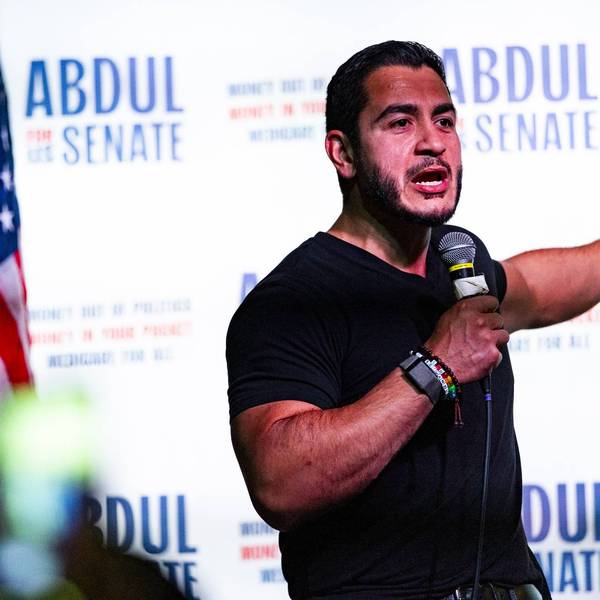
$60 Million ‘Crutch’ From Super PACs Is Proof That Stevens Isn’t Actually ‘Electable,’ Says El-Sayed
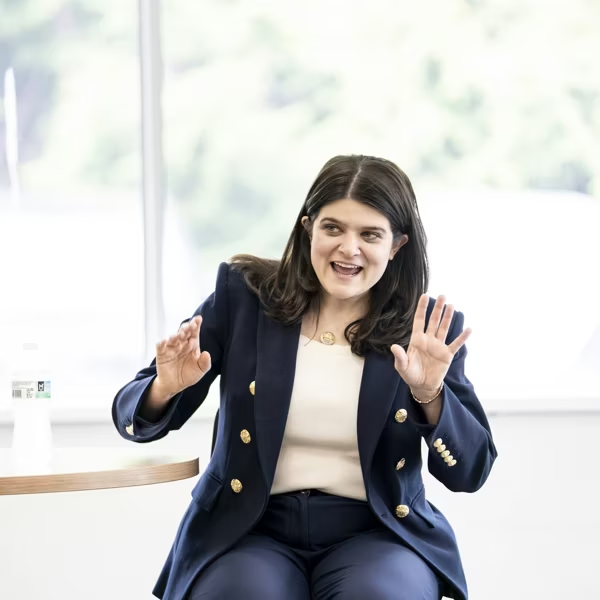
‘We Don’t Need to Be Unkind to Be Honest’: El-Sayed Asks Supporters to Criticize Haley Stevens on ‘the Issues’
“My opponent has done a great job talking about campaign finance. It’s an educated issue,” Stevens said, according to a report from Michigan Advance Thursday. “I even had someone who’s got a law degree asking me about some of the campaign finance stuff today. That’s totally fine, but you know what else? These families on paid leave? They need affordable daycare. They need good public schools to go.”
Journalist David Sirota of The Lever said that in what amounts to Steven’s “final argument” ahead of the election, the candidate suggested that pro-Israel and other groups’ attempt to “buy her a Senate seat—is merely an esoteric ‘educated issue’ that has nothing to do with corrupt lawmakers creating corrupt policies fueling the affordability crisis.”
As Mother Jones reported Friday, about half of the super PAC spending on Stevens’ behalf has come from United Democracy Project, which is affiliated with AIPAC, while a large chunk comes from the super PACs A Stronger Michigan and Center Forward.
Those groups have received millions of dollars from PhRHMA, a trade group representing pharmaceutical firms, and UnitedHealth Group—both key players in the for-profit healthcare industry that’s raised household costs for families across the country in recent years, with UnitedHealth slashing care expenses for nursing home patients and unlawfully using an artificial intelligence algorithm to deny coverage to people with Medicare Advantage. El-Sayed has notably made Medicare for All a key priority of his campaign.
“The outside spending picture for El-Sayed looks much different,” reported Mother Jones. “The biggest individual donor to Fighting for Michigan—El-Sayed’s main outside backer—is the candidate’s father-in-law, a nephrologist at a Detroit hospital who had given $300,000 as of July 15. Overall, the super PAC has expended about $2.8 million—less than one-tenth of what has been spent against El-Sayed by the United Democracy Project alone.”
Stevens attempted to shift the focus to her opponent’s support from his father-in-law at her meeting with the Lansing Regional Chamber on Wednesday, after she was asked about the record-breaking outside spending in the race by a business leader in the very first question of the event.
But another attendee brought up the issue again later, noting she had not specifically addressed concerns about the groups whose spending her campaign is benefiting from and asking whether she would back a bill proposed by Sen. Bernie Sanders (I-Vt.), an El-Sayed supporter, to abolish super PACs.
Stevens was noncommittal once again, suggesting concerns about super PACs are part of “campaign platform” favored by Sanders.
“He’s in the independent party,” she added. “I haven’t talked to him about it. I’m not trying to do any division.”
Stevens did allow that she “would love a constitutional amendment to get rid of money in politics and maybe make our elections shorter” and said she had spoken to Republicans about such a proposal.
But one observer said Stevens’ overall message that the financing of her campaign is an issue only voters with “a law degree” are interested in was “flippant and arrogant.”
Stevens has benefited from millions in AIPAC-backed super PAC spending as public approval has plummeted regarding the powerful pro-Israel lobby and the United States’ funding of Israel’s military, after nearly three years of the Israel Defense Forces’ assault on Gaza and Prime Minister Benjamin Netanyahu’s push for the US to join in attacking Iran—a conflict that has also had a direct impact on working families’ household budgets as gas prices have soared.
On Thursday, Stevens took direct aim at El-Sayed, a Muslim, for his focus on AIPAC during the campaign, addressing him in a lengthy post on X in which she said, “Everyone in America understands you want to blame all of your problems on Jewish Americans.”
The remark was widely condemned as “race-baiting,” and interpreted as one that conflated Jewish Americans with the pro-Israel lobby.
“When someone points out AIPAC is spending $50 million, it’s presented as ‘blaming Jewish Americans,’” said podcast host Adam Johnson. “I hate this shit so much, it’s gross, it’s bad faith, it’s sleazy, and it’s more manipulative, crybully smarm.”
“It can’t be overstated how flippant and arrogant Stevens comes off when questioned about $60 million in super PAC spending for her in this race,” said one observer.
US Rep. Haley Stevens (D-Mich.) attends the Lansing Regional Chamber of Commerce “Meet the Candidate” series on July 29, 2026 in Lansing, Michigan.
(Photo by Bill Pugliano/Getty Images)
Julia Conley
Jul 31, 2026
COMMON DREAMS
With just days to go until the Michigan US Senate primary election, Rep. Haley Stevens, the preferred candidate of several Democratic establishment figures, suggested this week that campaign finance—a top issue in her race against former public health official Abdul El-Sayed—is a niche interest held by “educated” people and not working families, and appeared eager for voters and the press to stop asking her about the roughly $60 million outside groups have poured into the race on her behalf.
“It seems like we got the campaign finance zoomies,” the Michigan Democrat told reporters at an event with business leaders in Lansing on Wednesday, appearing mystified at the suggestion that ordinary voters would be interested to know her position on super political action committees, which can raise unlimited money from corporations and other groups and individuals to support a candidate’s run, and her significant backing from a super PAC affiliated with the increasingly unpopular American Israel Public Affairs Committee (AIPAC).
$60 Million ‘Crutch’ From Super PACs Is Proof That Stevens Isn’t Actually ‘Electable,’ Says El-Sayed
‘We Don’t Need to Be Unkind to Be Honest’: El-Sayed Asks Supporters to Criticize Haley Stevens on ‘the Issues’
“My opponent has done a great job talking about campaign finance. It’s an educated issue,” Stevens said, according to a report from Michigan Advance Thursday. “I even had someone who’s got a law degree asking me about some of the campaign finance stuff today. That’s totally fine, but you know what else? These families on paid leave? They need affordable daycare. They need good public schools to go.”
Journalist David Sirota of The Lever said that in what amounts to Steven’s “final argument” ahead of the election, the candidate suggested that pro-Israel and other groups’ attempt to “buy her a Senate seat—is merely an esoteric ‘educated issue’ that has nothing to do with corrupt lawmakers creating corrupt policies fueling the affordability crisis.”
As Mother Jones reported Friday, about half of the super PAC spending on Stevens’ behalf has come from United Democracy Project, which is affiliated with AIPAC, while a large chunk comes from the super PACs A Stronger Michigan and Center Forward.
Those groups have received millions of dollars from PhRHMA, a trade group representing pharmaceutical firms, and UnitedHealth Group—both key players in the for-profit healthcare industry that’s raised household costs for families across the country in recent years, with UnitedHealth slashing care expenses for nursing home patients and unlawfully using an artificial intelligence algorithm to deny coverage to people with Medicare Advantage. El-Sayed has notably made Medicare for All a key priority of his campaign.
“The outside spending picture for El-Sayed looks much different,” reported Mother Jones. “The biggest individual donor to Fighting for Michigan—El-Sayed’s main outside backer—is the candidate’s father-in-law, a nephrologist at a Detroit hospital who had given $300,000 as of July 15. Overall, the super PAC has expended about $2.8 million—less than one-tenth of what has been spent against El-Sayed by the United Democracy Project alone.”
Stevens attempted to shift the focus to her opponent’s support from his father-in-law at her meeting with the Lansing Regional Chamber on Wednesday, after she was asked about the record-breaking outside spending in the race by a business leader in the very first question of the event.
But another attendee brought up the issue again later, noting she had not specifically addressed concerns about the groups whose spending her campaign is benefiting from and asking whether she would back a bill proposed by Sen. Bernie Sanders (I-Vt.), an El-Sayed supporter, to abolish super PACs.
Stevens was noncommittal once again, suggesting concerns about super PACs are part of “campaign platform” favored by Sanders.
“He’s in the independent party,” she added. “I haven’t talked to him about it. I’m not trying to do any division.”
Stevens did allow that she “would love a constitutional amendment to get rid of money in politics and maybe make our elections shorter” and said she had spoken to Republicans about such a proposal.
But one observer said Stevens’ overall message that the financing of her campaign is an issue only voters with “a law degree” are interested in was “flippant and arrogant.”
Stevens has benefited from millions in AIPAC-backed super PAC spending as public approval has plummeted regarding the powerful pro-Israel lobby and the United States’ funding of Israel’s military, after nearly three years of the Israel Defense Forces’ assault on Gaza and Prime Minister Benjamin Netanyahu’s push for the US to join in attacking Iran—a conflict that has also had a direct impact on working families’ household budgets as gas prices have soared.
On Thursday, Stevens took direct aim at El-Sayed, a Muslim, for his focus on AIPAC during the campaign, addressing him in a lengthy post on X in which she said, “Everyone in America understands you want to blame all of your problems on Jewish Americans.”
The remark was widely condemned as “race-baiting,” and interpreted as one that conflated Jewish Americans with the pro-Israel lobby.
“When someone points out AIPAC is spending $50 million, it’s presented as ‘blaming Jewish Americans,’” said podcast host Adam Johnson. “I hate this shit so much, it’s gross, it’s bad faith, it’s sleazy, and it’s more manipulative, crybully smarm.”

No comments:
Post a Comment