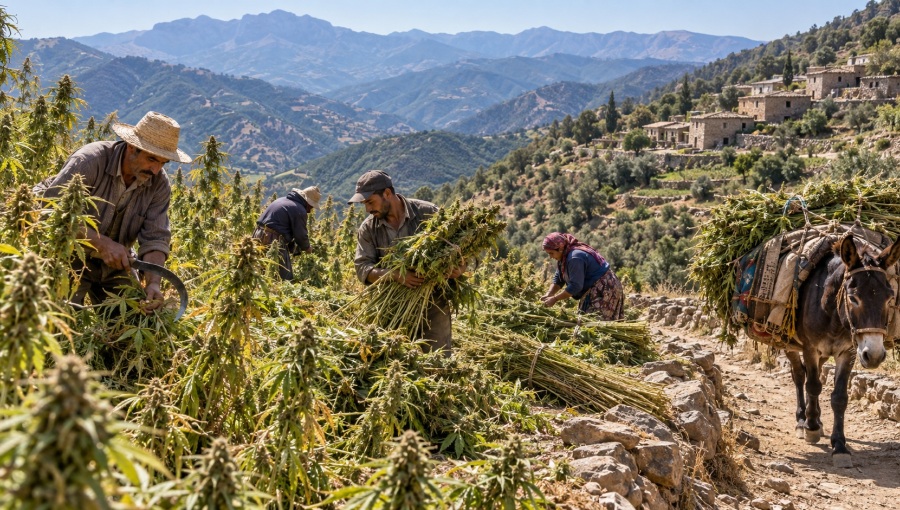
Africa’s regulated cannabis industries are expanding through cultivation projects and processing investments, but growth in licences and production has yet to be matched by clear evidence of sales revenue, export earnings or profitability.
The emerging businesses fall into distinct markets: industrial hemp, medicinal and pharmaceutical cannabis, and regulated cannabis-derived consumer products such as cosmetics and food supplements. Recreational cannabis is a separate category, governed by different rules on possession, cultivation and sales. Each market has its own customers, regulatory requirements and commercial prospects.
Developments during 2025 and the first nine months of 2026 reveal sharply different stages of maturity. Ghana is establishing trading arrangements around licensed low-THC cultivation, Botswana is testing industrial hemp production, and Morocco has progressed into medical, industrial and consumer-product processing. South Africa, meanwhile, permits private adult use but has yet to establish a legal framework for recreational cannabis sales.
Morocco provides the strongest evidence of an emerging regulated supply chain, with recorded harvests, processing capacity and registered products. Newer markets largely report licences, investment plans and cultivation trials rather than completed commercial transactions.
Ghana and Botswana take different routes into production
Ghana is developing trading infrastructure for low-THC cannabis, while Botswana is concentrating on industrial hemp trials.
Ghana first provided for licensed low-THC cannabis cultivation in 2020, but the Supreme Court struck down the provision in 2022. Parliament restored the legal basis through the Narcotics Control Commission (Amendment) Act, 2023 (Act 1100).
A licensing regime launched in February 2026 under Legislative Instrument 2475 covers 11 activities, including cultivation, processing, laboratory services and export. Permitted varieties must contain no more than 0.3% tetrahydrocannabinol (THC), the main psychoactive compound in cannabis. The framework covers authorised industrial, medical and research activities rather than recreational sales.
In April 2026, the Ghana Commodity Exchange and the Chamber of Cannabis Industry Ghana agreed to develop a trading framework to improve traceability, pricing and market access.
On July 31, 2026, the Narcotics Control Commission (NACOC) issued Ghana's first two cultivation licences to MG Adom Limited and Juliopta Limited. In September, NACOC expanded cooperation with the Council for Scientific and Industrial Research on testing, traceability and research.
Botswana approved its cannabis policy in April 2025 and passed the Cannabis Act that August. The legislation took effect in December, followed by implementing regulations in January 2026. The framework covers medicinal, scientific, research and industrial activities, with a 0.7% THC threshold for industrial varieties.
By February 2026, the National Cannabis Control Authority was operating and two companies had received pilot cultivation licences. The government said they would work with the National Agricultural Research and Development Institute.
President Duma Boko reported encouraging hemp cultivation results in July 2026. The government has designated the state-owned Dibete farm for initial cultivation, although commercial production there has not been established.
The commercial distinction is that Ghana is seeking to establish trading arrangements for licensed growers, while Botswana is assessing whether industrial hemp cultivation can support downstream investment and help diversify its diamond-dependent economy.
Morocco develops medical, industrial and consumer-product markets
Morocco has progressed beyond licensing into legal harvesting, processing and product development, with reported access to foreign markets.
Law 13-21, adopted in 2021, established a regulated framework for medical, pharmaceutical and industrial cannabis. Recreational sales remain prohibited.
The National Agency for the Regulation of Cannabis-related Activities (ANRAC) oversees cultivation in designated areas of Al Hoceima, Chefchaouen and Taounate, where approved cooperatives supply licensed buyers under contract.
Industrial cannabis is subject to a 1% THC threshold, while higher-THC varieties may be cultivated for authorised medical and pharmaceutical purposes. The resulting products serve different markets, ranging from pharmaceutical applications to approved cosmetics and food supplements.
Legal production reached 19,576 quintals (approximately 1,958 tonnes) of dry cannabis matter in 2025, up from 18,810 quintals in 2024, according to figures released in April 2026.
ANRAC issued 4,147 new authorisations in 2025, bringing the operational total to 5,765, including 5,492 cultivation authorisations covering 5,318 farmers. The legally harvested area reached 3,141 hectares, according to Medias24.
In April 2026, ANRAC reported that five operators had established processing plants during 2025, with a stated combined capacity of 560 tonnes, while 11 more facilities were under construction.
The regulator also recorded 110 new cannabis-derived products in 2025, bringing the total number of registered products on the market to 141. The new registrations comprised 50 food supplements, 59 cosmetics and one medicine, highlighting the distinction between consumer-product development and pharmaceutical cannabis.
ANRAC reported that Moroccan products had reached at least seven foreign markets, although the cited figures do not establish sales by product category or export earnings.
Enforcement remains substantial. ANRAC conducted 7,526 inspections in 2025 and withdrew 111 authorisations from 90 operators, according to director-general Mohamed El Guerrouj. Further withdrawal proceedings were initiated against operators and farmers.
Unregulated cultivation also remains extensive. An April 2025 study by the Global Initiative Against Transnational Organized Crime estimated total cannabis cultivation at 50,000–70,000 hectares, while Reuters cited a separate government estimate of 27,100 hectares of illicit cultivation in July 2025. The figures are not directly comparable but indicate substantial cultivation outside licensed channels.
Morocco's commercial challenge is to expand demand across its separate medicinal, industrial and consumer-product markets while making regulated supply chains attractive to established informal growers.
South Africa separates private use from commercial markets
South Africa permits private adult cannabis possession, cultivation and consumption but prohibits general recreational sales. Its licensed medicinal cannabis and industrial hemp sectors operate under separate regulatory arrangements.
A Constitutional Court ruling in September 2018 established private-use protections. President Cyril Ramaphosa signed the Cannabis for Private Purposes Act in May 2024, although its provisions remained uncommenced as of October 2026.
Draft regulations published in February 2026 proposed a 750-gram possession limit and a five-plant home-cultivation limit per adult. These limits were proposals, not operative legal thresholds.
The South African Health Products Regulatory Authority (SAHPRA) regulates medicinal cannabis, while industrial hemp falls under agricultural licensing.
Government departments told Parliament in March 2026 that more than 1,400 hemp permits and approximately 120 medical cannabis licences had been issued. These figures cover different regulatory categories and cannot be combined into a single measure of commercial activity.
The Department of Trade, Industry and Competition said in March 2026 that it was preparing a commercialisation policy and an overarching Cannabis Bill for introduction by mid-2027.
South Africa's unfinished recreational retail framework is therefore a separate issue from the development of its existing medicinal cannabis and industrial hemp industries.
Lesotho and Zimbabwe confront medicinal cannabis costs
Lesotho became Africa's first country to license medical cannabis in 2017, attracting foreign investment but struggling to broaden local participation because of high regulatory costs and demanding European pharmaceutical certification requirements.
Those barriers principally affect producers seeking access to regulated medicinal and pharmaceutical markets, where product standards and certification requirements differ from industrial hemp production.
Zimbabwe, which authorised medicinal cultivation in 2018, moved to reduce regulatory costs during 2026. Statutory Instrument 108 of 2026, issued in July, lowered selected fees, setting annual return charges at $1,500 and inspection fees at $400 plus inspection costs.
In August 2026, Cabinet approved further cuts covering industrial hemp registration, cannabis licensing and research permits. Implementation required additional statutory instruments. Finance Minister Mthuli Ncube presented the measures as part of a broader effort to reduce business costs.
The two countries illustrate how domestic licensing expenses and international pharmaceutical compliance requirements can independently affect producers' costs.
Other African markets remain divided
Malawi permits medicinal cannabis and industrial hemp production under its Cannabis Regulation Act, 2020, while Rwanda established a medical and research-related framework in 2021.
Zambia's Cannabis Act, enacted in 2021 to cover medicinal, scientific and research production, remained uncommenced as of October 2026. Its separate Industrial Hemp Act took effect in January 2025.
Uganda permits controlled cultivation subject to official approval under narcotics legislation that came into force in April 2025. Eswatini's longstanding drugs legislation allows ministerial licensing for specified medical purposes, while broader reforms have been proposed.
Nigeria and Kenya remain more restrictive. Nigeria's National Drug Law Enforcement Agency opposes legalisation. A decriminalisation proposal failed to advance in 2023, while the Cannabis (Medical, Industrial and Control) Bill, 2025, was listed for first reading in November 2025. No comparable commercial framework had been enacted as of October 2026.
Kenya maintains a general prohibition on cultivation and use, subject to limited statutory exemptions. On July 15, 2026, the High Court dismissed a Rastafarian petition seeking a religious exemption; the petitioners' lawyers said they intended to appeal the ruling.
Different markets face different commercial tests
Africa's cannabis industries cannot be assessed as a single market. Industrial hemp producers must establish competitive cultivation and processing costs and secure buyers for industrial inputs. Medicinal cannabis producers face pharmaceutical certification, quality control and tightly regulated distribution channels. Cannabis-derived cosmetics and food supplements require product approvals, retail distribution and consumer demand.
Recreational cannabis presents a different legal and economic question. Private-use protections, as in South Africa, do not automatically establish a lawful commercial retail market.
Researchers with the Cannabis Africana project, run by the universities of Bristol and Cape Town, have warned that agribusiness-focused regulatory systems risk excluding farmers who have cultivated cannabis informally for generations.
For investors, verified turnover, export receipts and operating margins will provide a clearer measure of performance than cultivation licences or announced processing capacity. For farmers, the calculation is whether prices paid by licensed buyers cover production and compliance costs while providing dependable income.
The next stage of Africa's cannabis development will therefore depend on commercial performance within each market category, rather than treating growth in licensing and cultivation as evidence of a single expanding industry.

No comments:
Post a Comment