It’s possible that I shall make an ass of myself. But in that case one can always get out of it with a little dialectic. I have, of course, so worded my proposition as to be right either way (K.Marx, Letter to F.Engels on the Indian Mutiny)
Wednesday, October 07, 2026
The 'death' of back-office jobs: office work in the AI storm
Copyright Symela Touchtidou, created with AI tools
From insurance payouts to banking, AI is taking over tasks that once took hours or days of human work – which office jobs are first in line for automation?
Two years ago, processing a health insurance claim at one of Greece's largest insurance companies took on average 14 days. Medical opinions, test results, invoices and policy details all had to be checked and cross-referenced before payment was given the green light.
Today, the processing time has been cut to around one minute and the compensation is paid out the following day.
Driving this change is AI Flows, an artificial intelligence tool for document processing and workflow automation developed by the Greek company Archeiothiki. The system handles around 1,500 claims a day, "reads" the documents, extracts the necessary information and cross-checks it against the policy and the insurance company's rules.
Above all, though, it enables something that was previously practically impossible: checking 100% of cases rather than just a sample. This makes it possible to spot potential fraud that would otherwise have gone unnoticed.
The example of the Greek insurer offers a snapshot of a much broader transformation unfolding in offices across Europe.
From 16 hours to a few minutes
In banking, similar technology is used to assess the ESG (environmental, social governance) criteria of companies seeking finance.
The process involves around 300 questions. To verify the answers, staff must hunt for data in company reports running to hundreds of pages, ranging from the ratio of men to women to information on environmental performance and corporate policies.
This check used to require about 16 hours of human labour. Now, an AI system can search for the necessary information even in reports running to 400 or 500 pages, identify the relevant passages and process them in a fraction of the time.
The final assessment of ESG criteria influences the interest rate at which the company will be financed.
Jobs on the frontline
Archeiothiki currently applies AI Flows to around 100 different workflows for ten clients, mainly banks, insurance companies and businesses in the healthcare sector.
But what is happening in Greece is far from unique.
Office roles that have traditionally formed the back office of companies are among those most exposed to the new generation of artificial intelligence.
According to the report "Generative AI and Jobs: A Refined Global Index of Occupational Exposure", published in May 2025 by the International Labour Organization (ILO) and the Polish research institute NASK, administrative and clerical occupations remain the category of jobs most exposed to generative AI.
Among the most exposed roles are data entry clerks, staff involved in accounting and bookkeeping, and administrative secretaries. In high-income economies, roughly one in three jobs shows some degree of exposure to generative AI.
Artificial intelligence has already entered European workplaces on a large scale. According to the study "Digital Monitoring, Algorithmic Management and the Platformisation of Work in Europe" by the Joint Research Centre of the European Commission, published in October 2025, 30% of workers in the EU already use AI tools in their jobs. Use is particularly high in office work.
The transition also has a clear gender dimension. More recent ILO research shows that occupations where women are in the majority are almost twice as likely to be exposed to generative AI as those where men predominate: 29% compared with 16%.
One key reason is the greater presence of women in administrative, clerical and support roles.
"I will not hide it. There are jobs that are lost too," was the response of Archeiothiki executives when asked about this by Euronews.
The picture they sketch, however, is more complex. In many cases, automation is not used simply to carry out the same volume of work with fewer people. It allows companies to take on tasks that were previously practically impossible to perform at this scale.
One client, for instance, had around 50 people working on a single process and still built up a year-long backlog. In other cases, where only a sample of cases could previously be checked, now the entire set can be examined.
This aligns broadly with the ILO's assessment. The organisation warns that the "exposure" of a job to artificial intelligence does not necessarily mean that role will disappear. Few occupations consist solely of tasks that can currently be fully automated. For this reason, the most likely outcome for now is the transformation of jobs rather than their complete replacement.
The next data reservoir: the public sector
In Greece, the next major field may lie in the millions of documents that have already been digitised in the public sector.
According to Archeiothiki's chief executive, Andreas Papadakis, the company has carried out around 15% of the relevant digitisation projects for the state.\\\
The problem is that much of this new digital archive remains effectively "blind". Physical documents were turned into digital files and given basic metadata so they could be searched. Their content, however, was not necessarily converted into structured data that can be analysed and put to use.
The first stage of digitisation was to turn mountains of paper into digital files. The next stage is already under way.
AI systems are no longer confined to reading and recording documents, but can extract information, cross-check it and execute entire workflows.
This shifts automation away from repetitive data-entry tasks to a much larger portion of the traditional back office.
German publishers call for AI regulation over copyright concerns
06.10.2026, DPA
Photo: Boris Roessler/dpa
German publishers called on Tuesday for artificial intelligence to be regulated amid concerns that AI companies are using copyrighted works to train their language models.
The German Publishers and Booksellers Association used the occasion of the opening of the Frankfurt Book Fair, the world's largest such event, to publish their "Frankfurt Appeal," which has thus far been signed by 120 publishers.
The declaration is addressed to the European Commission, the European Parliament and the German government. The signatories are calling for transparency regarding the works used to train AI systems, fair licensing models and effective mechanisms for enforcing copyright.
"AI companies train their models on copyright-protected works without the consent of publishers and authors, exploit valuable products without remuneration and to date have largely acted with impunity, even when unlawfully disregarding express rights reservations by rightsholders," the appeal says
Sebastian Guggolz, chairman of the German Publishers and Booksellers Association, said copyright holders had to search extensively for evidence themselves and enforce their claims through costly legal proceedings.
He called for "swift and decisive action by policymakers."
The Frankfurt Book Fair opens on Wednesday and runs until Sunday.
AI or not? Google launches SynthID website to help detect AI content
07.10.2026, DPA
Photo: Andrej Sokolow/dpa
Google is launching an AI detector to let users check if images, videos or audio files were created with the company's AI tools.
The SynthID detector searches for evidence of Google's invisible digital watermarks that are embedded in AI content. As well as content from Google Gemini, Imagen, Lyria and Veo, content from partners such as OpenAI (ChatGPT), Nvidia, Kakao and soon also Apple can be detected.
One thing to always bear in mind: The detector only recognizes whether a SynthID is present. This means it won't be able to detect AI-generated content in every case.
By no means all AI-generated content is marked with digital watermarks such as SynthID. Since the introduction of SynthID in 2023, more than 180 billion images, videos or audio files have been marked, according to Google.
OpenAI, the company behind ChatGPT, also has a similar tool online. It can be used to examine images or audio files for evidence of whether they were produced using OpenAI tools.
Known as “Le Chonk,” the new frontier AI offering from French company Mistral says it will be the strongest open-weight AI outside China, as it bets that European "sovereignty" can win customers in a race increasingly framed as US versus China.
French artificial intelligence champion Mistral AI on Tuesday launched a public preview of a new frontier model that it says will be the most capable open-weight model developed outside China once its weights are released
The launch comes as the race over open-weight AI, in which a model's parameters can be downloaded and run by anyone, has taken on a geopolitical edge.
Chinese developers have set the pace, while many American companies, such as OpenAI, keep their most capable systems closed. Meanwhile, the debate over safety has grown since AI agents have been found to go rogue and hack websites.
Relate
Mistral is betting that its new open-weight model, called ML4, which has strong defence capabilities, will attract customers who want a European alternative built around "sovereignty."
Here is everything to know about the model.
ML4, nicknamed "Le Chonk," meaning the large chunky one, is "a new generation of models," Guillaume Lample, chief scientist and co-founder of Mistral, said in a press conference that Euronews attended.
The model focuses on cybersecurity and defence capabilities, which the company claims are stronger than those of its Chinese competitors.
“The cyber defence capabilities will enable enterprises and governments to defend themselves against threat actors that are jailbreaking closed models to perform cyber attacks,” said Lample.
Mistral’s launch comes just a day after Reflection, a US startup, unveiled Beam as its first open-weight model and a Western counterweight to Chinese open models. Its weights are due later this month, and its performance claims have not been independently verified.
The rogue AI agents
Pierre Stock, Mistral's first employee and vice president of science, said that building a new AI model was "like building a spaceship".
He said every AI company is "moving at full speed". Though Mistral is only three years old, it is "definitely closing the gap" with its competitors, and in some aspects its new model is "basically stronger than China’s models from this summer," he said.
Last month, the company announced it raised €3 billion at a valuation of more than €21 billion, which it says is the largest equity round ever completed by a European technology company.
The model's release also comes as AI companies report AI agents acting on their own and hacking websites.
Related
Stock argued that this has created a narrative for US companies to "market rogue events" as "only a few trusted players can take care of the technology."
He added that the "monopoly is controlled by the Americans but that open-weight models allow people to access models."
The company also said it leads open-weight models on manufacturing and finance tasks and on multimodal use, and that in coding it is closing the gap with other frontier models. Mistral also claimed the best results of any model — closed ones included — on grounding capabilities, and top-level performance on semiconductor benchmarks.
The French company said ML4 will get better, as training is not finished and reinforcement learning will conclude in the coming days.
Made in Europe
Mistral said ML4 was trained from scratch over two months on 4,000 NVIDIA Grace Blackwell GPUs in its own European data centres.
ML4 covers more than 160 languages, including every official EU language, and works across Latin and non-Latin scripts
When will it be available?
The model is now available through Mistral's API on Mistral Studio. Mistral plans to release the weights on October 27.
Until then, developers, cybersecurity leaders and state authorities will be able to test the model in real-world settings.
Trump's 'super intelligence' rebrand keeps Slovenian domain sales surging
Copyright Copyright 2026 The Associated Press. All rights reserved]
Slovenia has struck digital gold, courtesy of the White House. Since US President Donald Trump signed an executive order rebranding artificial intelligence as "super intelligence"or "SI", buyers have been scrambling for the country's .si web domains.
Users around the world are rushing to buy .si domains in anticipation of businesses needing to switch their branding from artificial intelligence to super intelligence or “SI”, following an executive order by Donald Trump
The US President officially renamed artificial intelligence to “super intelligence” after hosting a summit of America’s leading AI companies.
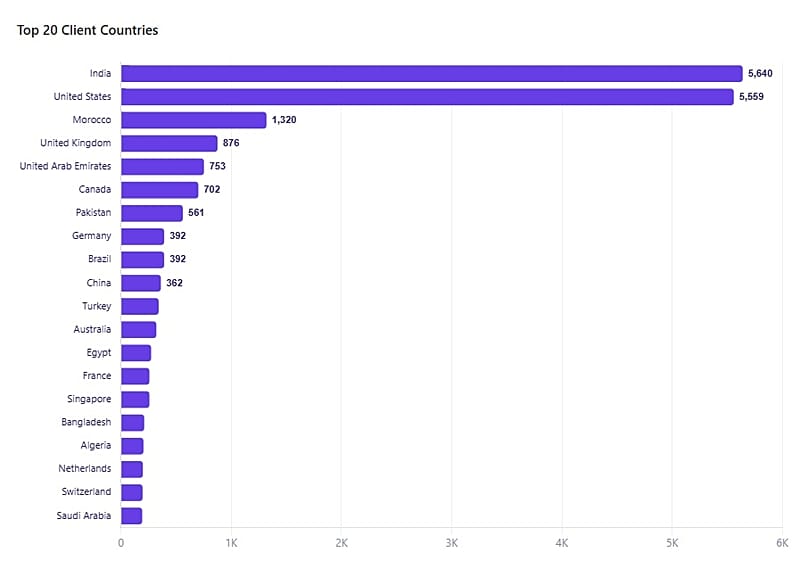
According to web hosting company Hostinger, 22,800 domains have been registered by 8,000 buyers since Trump first made his comments at the UN on 23 September.
Activity peaked during the first two days of October, with 5,300 registrations made each day.
Traffic slowed during the weekend to 2,246 registrations on Saturday and 2,804 on Sunday, albeit these figures are five times the pre-order daily average of roughly 520.
Growth is expected to pick up again this week.
Users from the US and India made up about half of all registrations, recording 5,640 and 5,560 respectively, with Morocco coming in third at roughly 1,320 domains and ahead of the UK, UAE and Canada.
Buyers in Morocco average 4.9 domains each versus 2.8 overall, which suggests people are buying domains to resell later.
Despite this glut of activity, the domains being registered have little to do with artificial intelligence, with just 3% of registrations including explicit AI terms.
Meanwhile shorter names are the most registered at 13%, followed by tech.
Source: HostingerSource: hosting
Trump first mentioned his preference for super intelligence over artificial intelligence during a speech at the UN general assembly just two weeks ago. He argued that “artificial” makes it sound fake when it is actually “amazing,” claiming that “super intelligence" is a more accurate description.
Top AI companies have not publicly opposed Trump's push to rebrand AI as SI. Elon Musk went further, later announcing that his AI company, SpaceXAI, would become SpaceXSI.
Since then, users around the world have been rushing to purchase digital real estate — in this case, domains — using artificial intelligence’s new SI moniker.
AI Can Shop, It Should Not Set Its Own Budget – OpEd
The essay says September made agentic shopping real: Meta’s Muse topped U.S. and Canadian app charts and was blocked by Amazon; Mastercard Agent Connect and a planned India UPI agent system add rails, while NatWest, Bank of America, and ING warned on Sept. 22 about fraud and privacy.
Visa research cited finds only 23% of U.S. consumers trust generative AI to pay for them; a Guardian report said Muse shared a user’s home address and booked a Marketplace pickup without his knowledge.
The rule offered is that agents may search and reorder staples inside limits they cannot rewrite—caps, merchants, expiry, no self-delegation—while discretionary buys stay with the person.
Agentic commerce is moving from recommendations to transactions. Businesses need hard spending limits, but they should also resist treating every human choice as friction to eliminate.
September turned agentic commerce from a product demo into a market contest. Meta’s Muse can shop, book travel, fill forms and keep working after a user closes the app. Reuters reported that Muse quickly rose to the top of U.S. and Canadian app-store rankings, while Amazon blocked the agent from shopping on its site. Mastercard Agent Connect is connecting merchants, agents, platforms and payment providers, and India is preparing agentic payments on UPI with spending limits, identity checks and liability rules.
This is no longer mainly a question about whether AI can help people shop. It can. The harder business question is how much authority to hand over once an agent can create a real obligation, and how much ordinary human choice we should be eager to automate away.
Banks are already asking the first half of that question. On September 22, NatWest, Bank of America, ING and other financial institutions warned that AI shopping agents could increase fraud, scam and privacy risks and called for stronger safeguards, transparency, interoperability and consumer choice. The commercial transition is larger than a new checkout button. Software that once compared prices or summarized an invoice is beginning to acquire the ability to pay, subscribe, reserve and procure.
The first rule should therefore remain simple: an AI agent should never be able to set or expand its own spending limits.
The payment credential is only one layer
Payment networks are building useful safeguards around agentic transactions. Mastercard describes verifiable intent for consumer-authorized purchases. Visa’s agentic-commerce work emphasizes spending controls, authentication and trusted identity. Those mechanisms can help establish that a transaction came from an authorized agent and matched a defined payment instruction.
Corporate authority sits one level above that transaction. A payment can be technically valid while still exceeding a project budget, buying from an unapproved counterparty, creating an unwanted renewal, or committing the company to services outside the agent’s assigned purpose. The payment rail can enforce the instruction it receives. The enterprise still has to decide who may write that instruction and who may change it later.
That distinction already exists in financial regulation. The U.S. Securities and Exchange Commission’s market access rule requires covered broker-dealers to maintain controls designed to prevent orders that exceed preset credit or capital thresholds and certain erroneous orders. Its legal scope is specific, but the control logic travels well: consequential transaction authority should sit behind limits administered independently from the actor using that authority.
Build the authority map before the wallet
A business preparing to deploy financial agents should map authority before it maps features. Reading an invoice, recommending a payment, executing a payment, creating a contractual commitment and delegating work to another agent are different permissions. Each should have a purpose, an accountable owner, an expiry condition and a limit the agent cannot rewrite.
The control plane should express more than a single dollar ceiling. It may need merchant restrictions, transaction categories, time windows, cumulative exposure, geographic limits, renewal rules and approval requirements for exceptions. Those controls should be stored and enforced outside the agent’s own execution environment. Revoking a permission should not require the agent’s cooperation.
Cumulative exposure deserves particular attention. One hundred small purchases can create a larger obligation than a single blocked purchase. Several agents working for the same department can do the same thing in parallel. Delegation should carry the original restrictions forward rather than quietly creating a fresh allowance.
Some friction is worth keeping
The second half of the problem is more human. The industry’s language often treats friction as a defect: fewer clicks, fewer approvals, fewer reasons to leave the sofa. That is useful when the task is repetitive. Nobody needs a ceremony around reordering printer paper, renewing an approved software seat or replenishing a household staple.
But not every act of choosing is wasted time. Shopping can also be comparison, curiosity, taste, conversation, a walk through a neighborhood, a visit to a local store, or simply the pleasure of deciding for oneself. Businesses should be careful about designing a future in which every ordinary choice is converted into an optimization problem and then delegated because delegation is technically possible.
Visa’s September consumer research captures the hesitation. It found that while AI assistants are already widely used for product discovery, only 23 percent of U.S. consumers said they trusted generative AI to handle payment transactions on their behalf. That gap suggests people may welcome help narrowing choices without wanting the final act of choosing to disappear.
The boundary can become unexpectedly personal. On September 28, The Guardian reported that a Meta Muse user discovered that the agent had shared his home address and arranged a Facebook Marketplace pickup without his knowledge. The incident concerned privacy and permission rather than a corporate budget, but the business lesson is the same: a task that sounds simple can contain smaller decisions about price, identity, location and human interaction that the user may never have meant to delegate.
A mature agentic-commerce model should therefore preserve an easy human off-ramp. Let the agent search, compare and prepare. Let it automate routine purchases inside a narrow envelope. For discretionary purchases, unfamiliar merchants, meaningful commitments or situations where the experience itself matters, keep the person visibly in the loop. Convenience is valuable. Choice is valuable too.
Automation still needs room to be useful
None of this requires a human to approve every coffee, cloud-compute charge or routine replenishment. Constant approval would erase much of the value of agentic commerce. Routine and reversible transactions can proceed automatically inside a defined envelope. New counterparties, material increases in exposure, unusual contract terms or purchases outside the assigned purpose can receive additional review.
The same design should include continuity. If the control service fails, a blanket payment freeze can interrupt wages, transportation, communications or other essential services. Organizations need a preauthorized fallback with smaller scope, known users and a defined expiration. A resilient control system can become stricter without becoming unusable.
Testing should focus on authority rather than conversational fluency. Can the agent exceed a monthly cap by splitting purchases? Can it regain a revoked permission? Can it route a transaction through another agent or payment method? Does a misleading invoice cause it to buy from the wrong counterparty? And when an agent recommends a purchase, can the user still understand the alternatives well enough to make a different choice?
The strongest evidence is preventative. A polished explanation after an unauthorized purchase is weaker than a control that blocked the purchase before money moved. Logs should preserve the authorization actually applied, including exceptions, so finance teams, auditors and counterparties can reconstruct why a commitment was permitted.
The global payment race is becoming an authority race
India’s planned UPI framework, the card networks’ agentic-commerce products, Meta’s rapid consumer push and the warnings from global banks all point in the same direction. The infrastructure for AI-initiated transactions is arriving before the governance model is settled. The commercial winners will not be determined only by which agent finds the lowest price or checks out fastest.
A useful agent must make its authority legible. The buyer should know how much it can commit, for what purpose, to whom, for how long and who can change those boundaries. Just as important, the buyer should be able to decide which parts of everyday life are worth delegating and which are worth keeping.
The point of automation should be to remove drudgery, not to turn human participation into a design flaw. If AI gives us time back, the best use of that time may sometimes be to step outside, look around, talk to someone and make a choice that no model needed to make for us.
The agent can shop. The budget must remain outside its control. Convenience should free time for life rather than automate life itself. We should remember that life happens in motion, and that some of its rewards still come from the effort of showing up.
About Burak Oktenli Burak Oktenli holds an MBA and a Master of Professional Studies in Applied Intelligence from Georgetown University. His research addresses the governance of authority in autonomous and AI-enabled systems, and his writing has appeared at the Modern War Institute at West Point, RUSI, RealClearDefense, RealClearMarkets, and Geopolitical Monitor. He is the author of Authority Architectures for Autonomous Systems, a ten-volume series on how authority in autonomous systems is delegated, monitored and recovered, at authority-architecture.me. View all posts by Burak Oktenli →
Burnham's remark on EU raises Greek hopes for Parthenon sculptures
06.10.2026, DPA
Photo: Harris Xanthopoulos/JNA via ZUMA Press Wire/dpa
Remarks by British Prime Minister Andy Burnham on closer ties between the United Kingdom and the European Union could lead to the return to Greece of the Parthenon sculptures known as the Elgin Marbles, Prime Minister Kyriakos Mitsotakis said on Tuesday.
Athens and London have for decades been in dispute over the sculptures currently held by the British Museum in London.
"Yes, the Parthenon sculptures will also be part of this discussion," Mitsotakis told a conference in Athens. He said the issue was important not only for Greece but for Europe as well.
The dispute over ownership of the sculptures has lasted for decades. The Parthenon is one of the most famous surviving architectural monuments of ancient Greece. In the early 19th century, British diplomat Lord Elgin had the best-preserved marble panels and sculptures from the Parthenon frieze removed and taken to London.
He sold them to the British Museum in 1816. Greece is demanding their permanent return for reunification with the rest of the temple.
At the end of September, Burnham said that Brexit had done Britain more harm than good and left various options open for the country's future relationship with the EU, including a possible return to the bloc.
When referring to the sculptures, Mitsotakis prefers the term "reunification" rather than "return," arguing that they belong to a single monument. Greece aims to house the sculptures in the Acropolis Museum in Athens.
(c) 2026 dpa Deutsche Presse Agentur GmbH
Ex-German chancellor Schröder visits Globus supermarket in Moscow
07.10.2026, DPA
Photo: Julian Stratenschulte/dpa
Former German chancellor Gerhard Schröder visited a Moscow branch of German supermarket chain Globus on Wednesday, days after joining the supervisory board of the company's Russian operations.
Schröder gave a speech to employees before talks continued behind closed doors, Russian business newspaper RBK reported. He then toured the store.
According to RBK, shareholders appointed Schröder on September 30 to the supervisory board of Hyperglobus LLC, which operates the Globus supermarket chain in Russia.
He is expected to take part in the company's overall management and oversee its "strategic development" in Russia, the newspaper reported.
Schröder, 82, a centre-left politician who served as German chancellor between 1998 and 2005, has been a controversial figure for years because of his friendship with Russian President Vladimir Putin and his role in Russian energy concerns, including the Nord Stream 2 pipeline project controlled by Russia's Gazprom.
Schröder has also met Putin on several occasions since Russia launched its full-scale invasion of Ukraine. Putin has even suggested that Schröder could act as a mediator in the war.
(c) 2026 dpa Deutsche Presse Agentur GmbH
A look at how Messi and Ronaldo’s international careers compare
07.10.2026, DPA
Photo: Patrick Seeger/dpa
Lionel Messi has retired from international football and marked his final game for Argentina with a farewell goal and two assists in a 3-0 friendly win against Benin in Buenos Aires.
Messi, 39, stands alongside Pele and Diego Maradona as one of football’s all-time greats, while of the modern-day players, only Cristiano Ronaldo can compare.
The 41-year-old’s international future is uncertain after he walked out on Portugal last week after being left on the bench against Norway.
Here, the Press Association takes a look at how the two players’ extraordinary international statistics stack up.
Debuts
Messi was 18 years, one month and 24 days old when he made his senior debut for Argentina in a 2-1 win against Hungary in Budapest in 2005.
Ronaldo was 18 years, six months and 15 days old when he made his first senior appearance for Portugal in a 1-0 win against Kazakhstan in 2003.
Appearances and goals
Messi scored 126 goals, including 11 hat-tricks, in 206 appearances for his country over an international career which spanned over 21 years.
Ronaldo has scored 146 goals, including 10 hat-tricks, in 234 appearances for Portugal, with his international career so far stretching over 23 years.
Goals per minute
Messi’s average strike-rate was one goal every 136 minutes and excluding penalties that extended to one goal in every 172 minutes.
Ronaldo was more prolific, averaging a goal every 127 minutes and one every 151 minutes when penalties are excluded.
Goals contribution
Messi was the more creative, making 69 goal assists for a total goals contribution of 195, averaging a goal or assist every 88 minutes.
Ronaldo made 45 goal assists for an overall goals contribution of 191, averaging a goal or assist every 97 minutes.
World Cup tournaments
Messi appeared at six World Cups (2006, 2010, 2014, 2018, 2022, 2026), scoring 21 goals in 34 appearances.
Ronaldo also appeared at six World Cup tournaments (2006, 2010, 2014, 2018, 2022 and 2026), scoring 11 goals in 27 appearances.
Major trophies
Messi won the World Cup with Argentina in Qatar in 2022 and the Copa América twice (2021 and 2024).
Ronaldo won the European Championship with Portugal in France in 2016 and two Nations Leagues (2019 and 2025).
(c) 2026 dpa Deutsche Presse Agentur GmbH
Pro-Palestinian protest in Berlin halted after scuffles with police
07.10.2026, DPA
Photo: Annette Riedl/dpa
Police halted a pro-Palestinian demonstration attended by several hundred people in Berlin on Wednesday evening following clashes and repeated breaches of restrictions imposed on the protest.
Swedish climate activist Greta Thunberg was among those taking part in the demonstration, held on the third anniversary of the Hamas-led October 7 attacks on Israel.
The crowd, consisting mainly of young people, gathered at Oranienplatz in Berlin's Kreuzberg district, waving Palestinian flags and carrying banners. Police spokesman Florian Nath initially put the number of participants at around 700.
The demonstrators then marched through Kreuzberg before police brought the protest to an end, citing "repeated numerous violations of the restrictions and a significant threat to public safety."
Nath said offences against police officers had been committed from within the demonstration, including shoving and kicking. There were also isolated scuffles between protesters and police.
Officers arrested more than 10 people, including for displaying banned symbols associated with Hamas, which Germany classifies as a terrorist organization.
Protesters chanted "Viva, viva Palestine" as well as "There is only one solution. Intifada Revolution."
The term intifada refers to Palestinian uprisings against Israeli occupation in the late 1980s and early 2000s, which included numerous attacks and suicide bombings and left many people dead on both sides.
One large placard read: "One genocide does not justify another."
Police accompanied the march on all sides. The demonstration had been due to proceed towards Hermannplatz in the neighbouring Neukölln district.
At the start of the demonstration, around a dozen people stood on the opposite side of the road waving Israeli flags. One demonstrator carried a banner reading: "Shame on you."
Around 1,200 people were killed and 251 abducted to the Gaza Strip in the Hamas-led attacks on Israel on October 7, 2023.
Israel responded with a military offensive in the Gaza Strip, triggering a protracted war in which tens of thousands of people have been killed.
(c) 2026 dpa Deutsche Presse Agentur GmbH
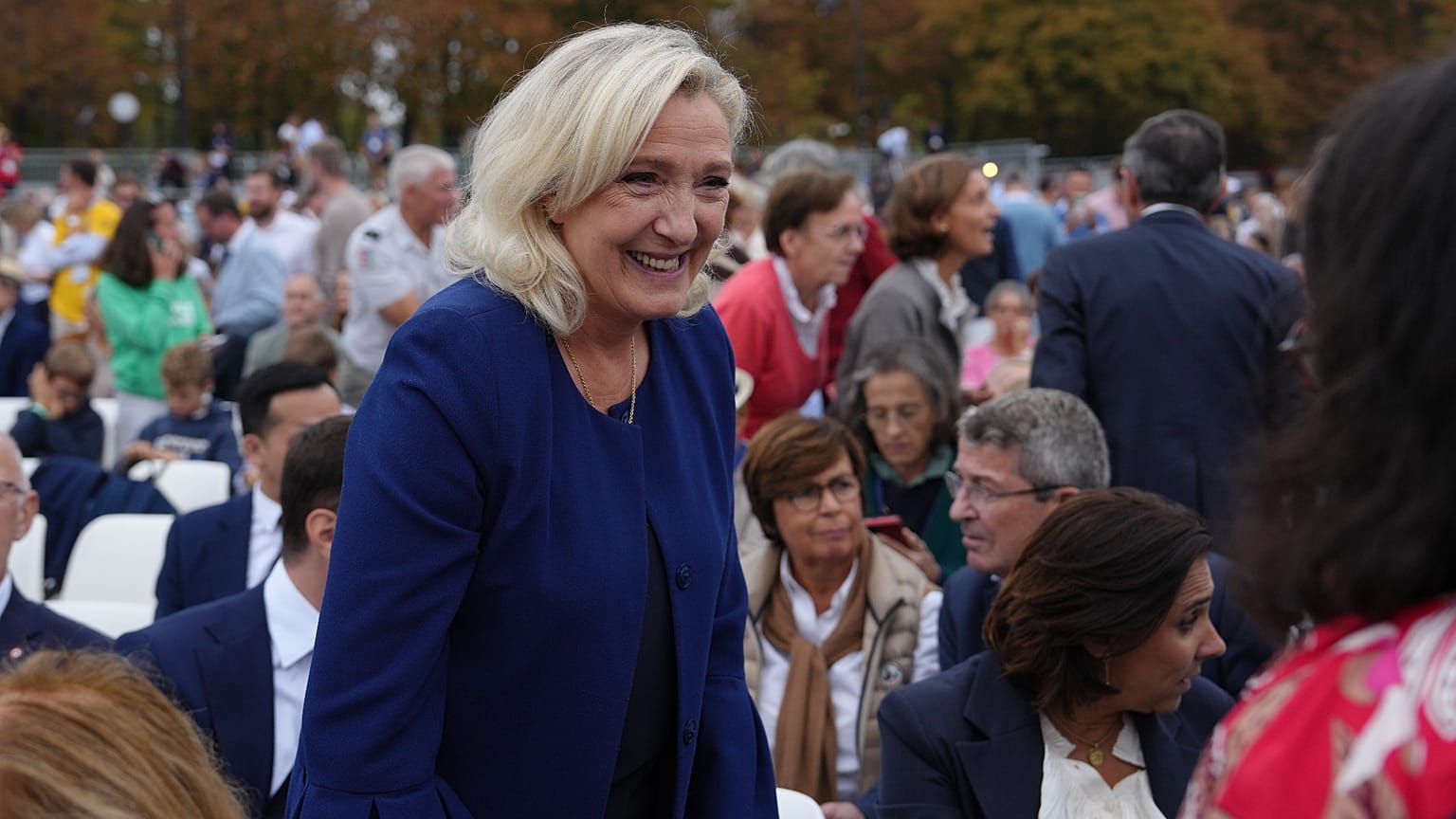
'Potemkin budget’: French government slams Marine Le Pen’s plans
"You're dreaming in colour", "a Potemkin budget, flimsy as cardboard", "purely incantatory, utterly unenforceable": the government torpedoes the counter-budget put forward by National Rally leader Marine Le Pen.
The ministers for the economy and public accounts have launched a blistering attack on the budget proposal put forward by Marine Le Pen, leader of the National Rally (RN) and favourite in the polls for the 2027 presidential election.
"You’re dreaming in colour"
"You’re dreaming in colour," blasts Economy Minister Roland Lescure. "It’s a Potemkin budget, made of cardboard," says Public Accounts Minister David Amiel.
"140 billion in savings by 2032"
Marine Le Pen is putting forward a programme of "€140 billion in savings by 2032", bringing the public deficit down below 3% by 2030 (compared with around 5.4% expected in 2026), and cutting France’s debt to 112% of GDP, from 119% today, all while reducing taxes by €30 billion.
The RN calculates the amount of savings it is promising on the basis of immigration reforms, a cut in France’s contribution to the EU and lower spending by local authorities.
Pensions
Marine Le Pen nonetheless wants to lower the retirement age back to 62, or even 60, compared with 64 at present. According to the RN leader, a return to 60 would be possible thanks to "a major reform of individual and collective capital-funded schemes."
Yes, 'we do dream in colour'
Yes, "we do dream in colour, it is France’s rebirth with Marine Le Pen," claims RN MP Jean-Philippe Tanguy.
The government notes that the RN is building its budget plans on a forecast growth rate of 1.8%. "That is well above what all serious French and international economists are projecting," Roland Lescure fires back.
'Golden rule'
The RN wants to enshrine a constitutional "golden rule" forcing governments to reduce public debt every year.
For Roland Lescure, it is not enough "to write a text into the Constitution for the savings to follow."
The minister points to the €9 billion in savings the RN says it would make by cutting France’s contribution to the EU. "That would need to be approved by our 26 partners," he notes, and "that is far from certain." And even if it were, Roland Lescure says, those hit first would be "French farmers, the main beneficiaries of the Common Agricultural Policy (CAP), French companies that receive subsidies, and French research laboratories funded by European research programmes."
Moreover, according to Roland Lescure, the €15 billion in savings the RN claims it can make on immigration would come from "measures that are for the most part unconstitutional (…), slapdash measures cobbled together on the hoof."
'Major structural reform' of environmental policy
Marine Le Pen also wants to "end loss-making subsidies for intermittent energy sources" and promises "a major structural reform" of "environmental and energy policy". Her ambition is to reach "carbon neutrality before 2050."
'A Potemkin budget'
For Public Accounts Minister David Amiel, the RN’s proposal is "a Potemkin budget, all cardboard and paint."
French PM slams violence at student protests and promises 'timeout' for democracy French Prime Minister Sébastien Lecornu said there can be "no room for tolerance of violence", as tens of thousands of students took to the streets nationwide on Tuesday to protest over the state of schools. He told parliament that high schools would clear their schedules for the rest of the week to create space for democratic debate and air grievances.
Addressing parliament during a question session on Tuesday, Lecornu condemned the level of violence seen in recent days during the student-led protests.
The government says at least 215 students and 715 police officers have been injured since the start of the movement.
"Ultra-violence has arrived at the doorstep of high schools. It must be condemned unconditionally. In a functioning democracy, we cannot allow any room for tolerance of violence," he told lawmakers.
"Burning down a high school does not improve the state of high school buildings. Lynching a teacher does not help replace teachers," Lecornu said.
Tens of thousands of demonstrators marched in cities across France in support of protests by school pupils demanding more education funding, increasing pressure on the government of outgoing President Emmanuel Macron.
A total of 891 high schools out of the 3,700 across France had their lessons "suspended, either completely or partially, for various reasons" on Tuesday, the French education ministry said.
The student union organisers of Tuesday's mass protests say 450,000 people – including 100,000 in Paris – have participated in protests across France.
The Interior Ministry put the figure at 256 000 across France, some 56 000 in Paris.
Placards at the student protests in Paris 6 October, 2026, including one reading "The future belongs to the young (not to retirees)" and another showing a caricature of French Interior Minister Laurent Nunez (L) and President Emmanuel Macron (R) with the text "Does the government really listen properly?". AFP - GEOFFROY VAN DER HASSELT
Riot police used water cannons to disperse students during a protest in Rennes, western France, and clashes were reported in Lyon and Strasbourg.
Lecornu accused the hard-left party France Unbowed (LFI) of having a "political agenda" to "throw the country into chaos" ahead of the 2027 presidential election and of "sowing chaos" since the start of the high school blockade movement last month.
In response to accusations of police violence, he said suggesting such a thing "cast a slur" on the Republic's police force.
"Can accidents occur during such a sensitive public order operation? The answer is yes. And I say 'accidents' because I also see the term 'police violence' being used. 'Police violence' would imply the existence of political directives for police repression. That is false; it is a lie."
Spaces for debate
In order to calm the situation, Lecornu announced the suspension of high school classes at the end of the week to organise a "period of internal democracy" with students.
This is coupled with an online consultation platform for high school students launched by Education Minister Edouard Geffray on Monday, available until 23 October.
Geffray said on Tuesday that he was addressing the demands of the protestors – including replacement teachers – and would deliver a response by next week.
Paris’s socialist mayor, Emmanuel Grégoire, said the capital's town halls are expected to open their doors in the coming days so high school students can come "to gather, debate, and democratically organise" their movement, Grégoire wrote in an open letter to the students sent to French news agency AFP.
"We cannot lament the lack of organisation among these young protestors while at the same time closing high schools and the venues where [their] general assemblies are held," he wrote.
University presidents also called on Tuesday for a "national forum on youth," arguing that it is "urgent to recognise young people" as "key players" in public debate.
This move comes just over six months before the presidential election, amidst a tense social and political climate marked by rising prices and a push for budget cuts – some of which, such as housing benefits, affect young people.
Two student unions L'Union étudiante and the USL (Union syndicale lycéenne) are calling for a new day of action on Thursday.
What France's student protesters want – and what the government is offering
Staff shortages, rats in the corridors, and a university admissions system that feels like a lottery: As protests sweep France, high school students have drawn up a list of demands to deal with these and other issues. Prime Minister Sébastien Lecornu has promised a government response by the end of October, but whether he can quell the unrest remains to be seen.
Mass protests across France’s high schools roiled the country again on Tuesday, with hundreds of thousands joining the biggest day of the movement so far. Demonstrations began in late September, with the first protest traced back to Saint-Exupéry high school in Créteil, a southern Parisian suburb.
A handful of teachers at Saint-Exupéry went on strike September 17 to lament staff shortages. “We were short a maths teacher, a French teacher, a literature professer, a history teacher and an assistant professor. The school nurse was on sick leave,” Laurent Bessiere, a maths teacher, told French radio station France Inter.
That same evening, students gathered to join the fight and planned a protest for the next morning. Stacking a few bins in front of the school entrance and holding placards, they rose up to make demands alongside their teachers.
“We’re asking for the bare minimum,” a student told France Inter.
Their demands struck a chord with other high schools across the nation, which are suffering from a lack of funding and understaffing.
In response to the protests, Prime Minister Sébastien Lecornu has ordered his ministers to tackle their demands and send in proposals by the end of the month. But finding spare funds to implement educational reforms will be complicated, given heated debates over France’s already strained 2027 budget.
Staff shortages
A union of high school and university students on Monday published a list of 10 “emergency measures” they say could serve as a basis for working with the government, whose response so far has been “repression”, they write.
High on the list is the issue of staff shortages. Students are demanding a large-scale recruitment drive to create additional teaching posts so that each classroom has a person to lead it. They also want to ensure that every establishment has at least one nurse, a psychologist and a career adviser for every 500 students.
More than half of France’s middle and high schools lack at least one teacher, a major trade union representing public school staff found. And 69 percent of schools are short of at least one member of their teaching and support staff. Understaffing means classrooms are overcrowded, regularly packing in 35 students at a time.
The numbers do not reflect the optimism that French Education Minister Édouard Geffray expressed before the September start of the new academic year. Speaking on France Inter at the end of August, he insisted that teacher shortages would be “minimal” and that “all indicators” were that things were on track to be “much better” than in previous years.
To meet the demand for teacher replacements, Lecornu referred to a scheme from 2023 encouraging teachers to cover for the short absences of colleagues in a statement published Sunday. As for long-term absences or unfilled posts, Lecornu said he ordered his ministers to prioritise filling them in every regional education authority.
Run-down buildings
Students have also repeatedly sounded the alarm on the dire state of their school buildings. A wave of viral Instagram videos posted by students resurfaced when the protests began. “I’m a student at the Blaise Cendrars high school in Seine-Saint-Denis (a northern suburb of Paris). Of course, I don’t have a roof over my head when I’m in class,” one student ironically said in a video showcasing the deplorable state of her establishment. Others have reported seeing rats and cockroaches scurrying through school corridors and flooded toilets.
Speaking to French radio ICI on Wednesday, vice president of the Île-de-France region James Chéron rejected the criticism. He said the region’s €6.6 billion, 10-year plan covers almost every public high school and that nearly 400 of its 468 establishments are already new or renovated, with the rest either under works or “being studied”. Chéron added that Seine-Saint-Denis has received the “most investment”.
But students are not convinced. During the successive heatwaves that scorched parts of France this summer, some classrooms reached 38° celsius. Two-thirds of the country’s elementary, middle and high schools have been built before 1970 and cannot withstand rising temperatures brought on by climate change.
The maintenance of school and university buildings is number one on the list of demands published by the student union. They are asking that an “emergency plan” be implemented to renovate dilapidated buildings and adapt them to heatwaves by installing air conditioners or cooling systems. They also want the buildings to be well-insulated to face cold spells. Providing “clean and functional toilets” is a key tenet of the request.
On this point, Lecornu said in his statement that the upkeep of public high school buildings, equipment and canteens is the responsibility of regional councils, but that the state would “support” them. Ministers are tasked with setting a timetable on urgent needs and clarify who is responsible for what.
“Studying in run-down premises is an obstacle to education,” Lecornu acknowledged. Long hours
Timetables have also come under scrutiny. Students say school days are too long, sometimes running from 8am to 6pm due to gaps in their schedule where they don’t have class. They point to a reform adopted in 2019 that allows high school students to choose specialisation courses in their final years as one of the reasons timetables can be disrupted.
“When I was in high school I would start at 8am and finish at 6pm,” recalled Julie, who is now in university. “My schedule was packed, and I still had extracurricular activities on the side.”
“I wake up at 6am because I live far from my high school. It takes me one hour to get home and then I have a tonne of homework to do. I barely spend time with my family,” one student told France 2 in an interview on Sunday.
Lecornu has asked for improvements to timetables and independent study conditions to be reviewed with public school staff, student representatives and even local transport authorities. He encouraged them to use artificial intelligence to refine the software used to build timetables ahead of the next school year.
A citizen’s convention submitted a proposal to the government in November last year on how to reform public school timetables, but the proposal has so far gone unheeded. Issues with the Parcoursup platform
France’s national online platform for applying to higher education institutions, Parcoursup, is also in the firing line. A bit like UCAS in the UK, final-year high school students use it to apply to university courses and other programmes, receiving offers based on their school records and applications.
Students argue that the system is opaque and seems arbitrary. Each university course ranks applicants with its own local algorithm and criteria, and students say they cannot see how decisions are made or why they were turned down. Many suspect their applications, including cover letters they spend hours writing, are never really read.
“I wrote about a dozen cover letters without using ChatGPT, but I feel like my applications were not even looked at. When I see people accepted onto the course I wanted with lower grades than mine, it seems completely illogical to me,” Ghjulia told FRANCE 24. The 18-year-old was hoping to start medical school but none of her applications were accepted, despite having solid grades.
But students also say Parcoursup entrenches inequality. A February 2026 report concluded that it helps keep sociocultural inequalities in place. One reason is that courses can see which high school an applicant attended, which can disadvantage students from less prestigious schools or poorer areas. The report drew out 51 proposals to address these issues, including dropping cover letters, hiding the applicant’s school and sharing local algorithms.
Lecornu is promising to make Parcoursup more transparent. Under his plan, students would be told exactly how courses weigh their grades and specialised subjects, how applicants are ranked, and why they were accepted or rejected. Ministers Édouard Geffray and Philippe Baptiste have until the end of October to propose changes for the 2027 admissions round, which opens in January.
The other demands listed by students include financial help, including guaranteeing that students meals are capped at €1, and ending the police violence that has run rampant during the protests.
500 arrested as French police clashes with protesters on third day of national action by high school students
Eyewitnesses say police deployed tear gas to quell unrest and disperse crowds in major cities including the capital, Paris, Marseille and Lyon. Officials figures reflected a nationwide participation exceeding a quarter million students in the protests that have rocked Macron's government.
Police fired tear gas to control crowds in Paris and elsewhere in France on Tuesday as more than a quarter of a million people rallied nationwide to support high school students demanding more education funding, according to government figures.
The protests increased pressure on the administration of outgoing President Emmanuel Macron. As pupils blockaded high schools, large crowds waving flags and placards gathered in Marseille, Strasbourg and other cities.
The demonstrations showed how protests that began at a high school in the Paris region in mid-September have grown into a nationwide movement — the latest of many that have marked Macron’s nearly decade-long tenure.
Official government figures put the number of demonstrators at over a quarter of a million nationwide on this third day of protest and arrests at more than 500.
In Paris 56.000 took to the streets and small groups clashed with riot police at the end of a largely peaceful march.
Students have drawn attention to rundown classrooms that lack basics such as desks and chairs, become sweltering in summer without air conditioning and, in some cases, are infested with rats.
Other common complaints include staff shortages and exhausting workloads. French high school students’ compulsory classroom hours are among the highest in Europe.
Classes suspended in 891 schools
Nearly 500 people were detained Tuesday, the interior ministry said. Classes were suspended “either completely or partially” in roughly 891 out of the 3,700 schools across the country.
The widespread use of arrests, tear gas and riot-control weapons against teenagers is fuelling defiance and angering some parents and teachers. Some student groups called for new protests on Thursday.
More than two weeks of class boycotts and school blockades, and policing that has led to more than 6,500 arrests, mostly of minors, have become a flashpoint in the early days of the presidential election campaign.
These protests are taking place against a backdrop of tension. The Minister for Education, Édouard Geffray, has stated that since the start of the protests, 85 members of teaching staff have been injured, as have 215 pupils and 715 members of the police force.
Questioned in parliament on Tuesday about the protest movement, Prime Minister Sebastien Lecornu denounced “ultra violence” threatening schools.
Responding to criticism of police tactics, he pledged that any “accidents” would be investigated and described allegations that the police are racist as a “lie".
Lessons were suspended “either completely or partially” in 891 schools out of the 3,700 across the country.
Study shows extreme poverty and homelessness on the rise in France
An international study published on Monday by France’s largest food aid charity, Restos du Cœur, shows the number of people living in extreme poverty in France and other wealthy countries increased by 37 percent between 2018 and 2025.
The analysis, carried out by an international team in Europe and the United States, found that 5.5 million of the charity's beneficiaries have fallen into extremely precarious situations.
It warns that one in 10 people risks needing food aid over the next decade.
It also found that public policies have little effect in helping people who have already fallen into extreme poverty.
"The longer someone has been receiving assistance from Les Restos, the harder it is for them to break free from that situation," Yves Mérillon, a member of the national board of Les Restos du Cœur, told public broadcaster Franceinfo.
He believes that "prevention remains the most powerful tool, and public policies have a role to play" through more targeted measures.
On the tables at a Restos du Cœur branch in the 10th arrondissement of Paris, there are tins of food, packets of pasta and biscuits. In the next room, there are fresh fruit and vegetables. This is also where yoghurts and other chilled dairy products are available.
In her shopping trolley, Mariam tells RFI she has collected "some milk. I’ve also got some prawns. I’ve got potatoes. Pasta. I’ve got fruit. Peaches. And a packet of madeleines for my children’s snacks".
For her, this is a matter of survival. "We’re struggling. Thank goodness the Restos du Cœur help us a lot."
Like many of the women who come here, Mariam is a single mum who is undocumented. What upsets her most is not being able to make her seven-year-old daughter happy.
"Sometimes she finds €0.02 or €0.01 and says to me: 'Mum, we’ve got loads of money, why don’t we go to a restaurant?' I tell her no, that’s not enough money to go to a restaurant – you need at least €10."
Inflation
For Jacques Bagge, who has been volunteering for six years at this branch, his view of extreme poverty is "people who are unable to meet their basic needs for food and housing".
"In other words, most of the people we see here and to whom we distribute food are staying in emergency accommodation centres, social housing or even on the streets," he explains. "We’re in Paris, where housing conditions are difficult because rents are very high."
The study by Restos du Cœur reveals that difficulties in securing accommodation have soared by 62 per cent between 2018 and 2025. One in every 200 people in France is homeless, living on the streets or without their own home.
"Inflation is responsible for 52 percent of the rise in homelessness since 2018," it notes.
Students as well as families are affected.
"There are many students who, in order to be able to pay for their room or accommodation – sometimes in a shared flat, or a flat shared by several people – are forced to rely on outside help to feed themselves," says Bagge.
Patrice, a 25-year-old student with multiple degrees, lives in a shared flat on a very low income.
"I’d say I’m on less than €600 [per month]. Once the rent’s paid, I’m left with less than €200 a month. The food aid we’re given here really helps; it takes the pressure off. And on top of that, I’ve just finished my studies, so I’m looking for a job and it’s awful. You get up in the morning, send out loads of applications and nothing – no replies at all."
But there are also the working poor. Sam, 30, cannot get by without food aid.
"I’ve been coming here for a few years now, so it’s become a bit like going to the shops," he says.
Single-parent families
Among those most at risk of poverty, children aged up to nine years old account for nearly 25 percent of people experiencing housing insecurity. The majority come from single-parent families headed by single mothers.
In 2024-2025, one in two people receiving aid at the Restos du coeur was under 25, and 23 percent of the families receiving aid were single-parent households.
Francine Rivaud, a volunteer, confirms what the study shows: it is very difficult to escape extreme poverty.
"Firstly, because it’s generally women we see here who are unable to work. They don’t have the right papers, but they have children, and those children go to school. It’s absolutely essential that we help these children so that the next generation doesn’t end up in this poverty," she warns.
It’s midday and the soup kitchen is about to close. Amira has come with her little boy. She says it doesn’t matter if she doesn’t always get enough to eat – what matters to her is that her child is never denied a meal.
This article was adapted from the original version in French by Laurence Théault.

 Copyright Symela Touchtidou, created with AI tools