Thursday, October 29, 2026


Sub-Saharan Africa faces the world's steepest climate adaptation bill at 3% of exposed GDP

Sub-Saharan Africa faces the world's steepest climate adaptation bill at 3% of exposed GDP
Air conditioning and irrigation would take more than half of the $1.2 trillion a year needed to protect people against 2°C of warming, with emerging markets carrying the heaviest load.Facebook
By Ben Aris in Berlin October 27, 2026

Protecting areas of Sub-Saharan Africa exposed to extreme heat, drought and flooding against hazards in a world 2°C warmer than pre-industrial levels would cost the equivalent of 3% of their projected annual GDP, the highest share of any region, according to the McKinsey Global Institute.

The estimate comes from the consultancy’s research arm in its report, Advancing adaptation: Mapping costs from cooling to coastal defenses, published in December 2025. The study examines the costs of 20 established adaptation measures, from air conditioners and white roofs to levees and sea dikes, combining climate models with population and economic data mapped to approximately one-square-kilometre grid cells.

McKinsey compared Sub-Saharan Africa’s projected adaptation burden with the 2% of regional GDP spent servicing external debt in 2024. The two figures are not directly comparable, as they use different GDP bases and refer to different periods. The Middle East and North Africa ranks second in the regional adaptation-cost comparison, followed by India.

The regional breakdown shows that protection would impose the heaviest relative costs on lower-income areas, with heat rather than coastal flooding accounting for most of the projected spending. Across regions encompassing much of the developing world, approximately 70% of adaptation costs would go towards protecting against heat, largely through air conditioning.

The global cost of providing protection to standards commonly found in developed economies could reach $1.2 trillion annually through 2050 under a 2°C warming scenario, more than six times estimated baseline expenditure.

The figure represents an annualised cost, including operating expenses and capital expenditure spread over the lifetimes of assets, rather than a forecast of actual spending. It also excludes some climate risks and adaptation measures.

A bill six times today’s

McKinsey estimates that annual spending on the 20 adaptation measures stood at approximately $190bn in its baseline, providing some form of protection to 1.2bn people.

Some 4.1bn people lived in places exposed to at least one of the climate hazards examined, and extending protection to all of them at developed-economy standards would have cost approximately $540bn annually under baseline conditions.

The resulting $350bn gap was concentrated in lower-income areas, where approximately $200bn in additional annual spending would be required. About 85% of people in low-income locations lacked protection, compared with roughly a quarter in high-income areas.

Under McKinsey’s 2°C warming scenario around 2050, taking account of projected population growth, an additional 2.2bn people would live in areas exposed to heat stress and 1.1bn more in areas exposed to drought. The additional population exposed to serious coastal flooding would be about 40mn.

The annualised cost of protecting exposed populations to developed-economy standards would rise to $1.2 trillion, approximately 6.2 times baseline spending and equivalent to about 0.8% of projected GDP in exposed areas.

About 60% of the cost would consist of recurring expenses, including electricity for cooling and water for irrigation, rather than capital expenditure.
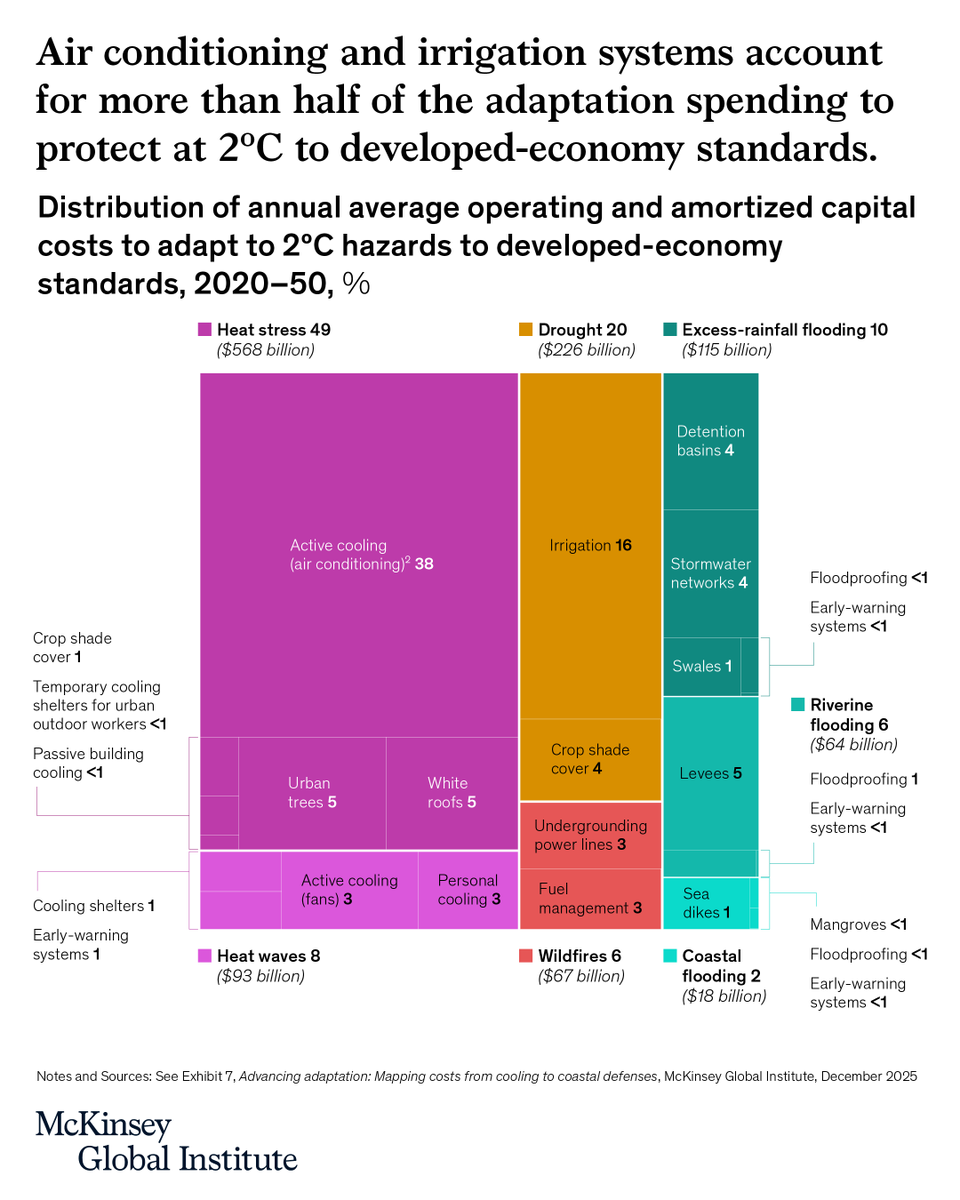
Air conditioning and irrigation together account for more than half the modelled annual adaptation cost at 2°C warming. Source: McKinsey Global Institute.

Heat stress alone accounts for 49% of the projected bill, or $568bn annually, with active cooling through air conditioning representing 38% of total adaptation costs. Including heat waves, heat protection accounts for more than half of the total.

Drought accounts for 20%, or $226bn, mostly for irrigation, followed by flooding from excess rainfall at 10% ($115bn), heat waves at 8% ($93bn), wildfires at 6% ($67bn) and river flooding at 6% ($64bn).

Coastal flooding accounts for just 2%, or $18bn, of modelled annual adaptation costs through approximately 2050. More than 40% of the world’s population would live in areas exposed to heat stress at 2°C warming, compared with fewer than 1% exposed to serious coastal flooding under the study’s definitions.

However, the relatively small coastal-flooding allocation does not capture all the longer-term consequences of rising sea levels, including risks beyond 2050 and some impacts on small-island states.

The heat season would also lengthen, from less than 12 weeks on average to approximately 16 weeks annually at 2°C, increasing pressure on electricity grids as cooling systems operate for longer periods.

Roughly three-quarters of heat-protection costs would be recurring operating expenses. As IntelliNews has argued, in large parts of the world air conditioning is becoming existential rather than a luxury.

Poorer regions pay most

In absolute terms, Greater China and India would face the largest adaptation costs, each exceeding $200bn annually under the 2°C scenario.

In India, the estimated cost would be approximately $125 per person, more than a third of the amount allocated per capita in the central government’s 2025 budget.

About 60% of India’s population and 30% of Nigeria’s already live in places experiencing annual heat stress under McKinsey’s definition, yet air-conditioning coverage is approximately 10% in India and 3% in Nigeria.

In the United States, where only 4% of the population faces heat stress under the same definition, air-conditioning coverage exceeds 90%.

India’s summer heat is already a drag on economic growth, and the McKinsey report highlights one example of a relatively low-cost response.

Ahmedabad, a city of about 7mn people in western India, recorded more than 1,300 deaths during a heat wave in May 2010. In 2013, it introduced South Asia’s first city heat-health action plan, incorporating colour-coded warnings, additional cooling spaces and painted “cool roofs” for low-income homes.

Across Greater China, emerging Asia, India and Sub-Saharan Africa, more than half the population could live in places exposed to heat stress under a 2°C warming scenario.

Protecting low-income locations would cost an average of 1.7% of their GDP, rising to 2.5% in low-income rural areas, compared with 0.8% in middle-income locations and 0.5% in high-income ones.

Emerging Asia currently spends approximately 0.6% of GDP in exposed locations on adaptation measures but would need 1.4% under the 2°C scenario.

The average estimated cost of protection across exposed populations is approximately $130 per person annually, compared with baseline spending of about $45.

In the United States, the $130 benchmark is equivalent to less than four hours of average wages. In Bangladesh, it amounts to about half a household’s average monthly income, illustrating the sharply different affordability of adaptation measures across income levels.

If Sub-Saharan Africa, India and other lower-income regions maintained their existing protection levels as the planet warmed, their spending would cover only about 15% of the cost of providing developed-economy standards of protection. Even if spending increased in line with economic growth, coverage would reach only about 25% of the estimated requirement.

North America already spends approximately 0.4% of GDP in exposed areas on adaptation, enough to meet its projected 2°C requirements if expenditure keeps pace with economic growth. Similar growth-linked spending could deliver full coverage in Advanced Asia.

Europe’s problem is drought

Europe and the former Soviet space face a different distribution of climate risks.

Fewer than 10% of people in the EU30, North America and McKinsey’s “Other Europe and Central Asia” region would live in places exposed to heat stress at 2°C warming, with drought accounting for a larger share of adaptation requirements.

If existing levels of protection were maintained, more than 40% of adaptation spending in those regions would go towards drought measures, compared with slightly more than a third allocated to heat stress.

Warsaw, Toronto and Kyoto are among the cities identified by McKinsey as having no exposure to the four broad hazard groups under its baseline definitions but facing exposure at 2°C.

European cities could consequently experience heat waves as part of a recurring annual disaster season, alongside the growing costs of managing water shortages.

A good buy nobody is paying for

McKinsey estimates that the benefits of adaptation, measured as avoided economic damages, are approximately three times its costs under baseline climate conditions, rising to four times at 1.5°C warming and seven times at 2°C.

These are modelled benefit-cost ratios rather than guaranteed financial returns.

Air conditioning delivers estimated benefits equivalent to three to five times its costs, while cheaper measures such as fans and white roofs can offer higher benefit-cost ratios but provide less comprehensive protection.

Urban sea dikes generate estimated benefits exceeding 10 times their costs, while rural sea dikes deliver benefits of less than 1.5 times costs, reflecting differences in the value and concentration of assets protected.

“If adaptation spending decisions were based only on cost-benefit economics, there would be no resiliency gap today,” the report says.

McKinsey outlines two potential spending paths as the world approaches 2°C warming.

Maintaining today’s levels of protection would require annual spending to rise to approximately $470bn, or 2.5 times the baseline, but would cover only about 40% of the full projected adaptation requirement.

If expenditure increased in line with incomes, annual spending would reach approximately $670bn, covering about 60% of the estimated requirement.

Maintaining existing protection levels would require around $6 trillion in cumulative capital investment by 2050, while extending developed-economy standards of protection to all exposed populations would require approximately $15 trillion.

The estimates distinguish the cost of maintaining protection as climate hazards intensify from the considerably larger investment needed to close existing protection gaps.

As of October 2025, 141 countries had a formal adaptation plan, up from 84 five years earlier, but McKinsey found that only a fraction established clear priorities or included cost estimates.

Where adequate protection is absent, the costs of climate-related losses ultimately fall on households, businesses, insurers and governments.

“Ultimately, someone will have to pay for risks,” the authors conclude.


Russia hosts 48 African nations in Moscow as the race for Africa heats up

Russia hosts 48 African nations in Moscow as the race for Africa heats up
Grain, fertiliser, reactors and an anti-colonial message are winning Moscow friends on the continent, but its economic weight there is still a fraction of Europe's or China's. / bne IntelliNewsFacebook
By Ben Aris in Berlin October 28, 2026

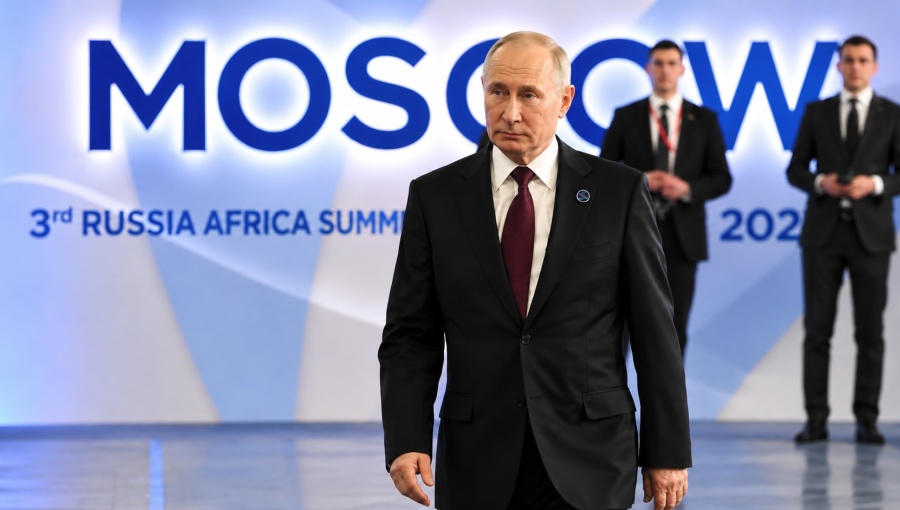
Delegations from 48 of Africa's 54 countries, 22 led by heads of state, are in Moscow for the third Russia-Africa summit, where Putin is selling Russia as Africa's anti-colonial partner.

President Vladimir Putin opens the third Russia-Africa Economic and Humanitarian Forum at Gostiny Dvor on October 28 alongside the African Union's current chair, Burundi's President Evariste Ndayishimiye.

He will then receive the heads of the continent's main regional blocs - among them the African Union, the African Continental Free Trade Area, ECOWAS, SADC and COMESA - and Afreximbank in the Kremlin's St Andrew's Hall, TASS reported. The leaders' summit proper follows on October 29.

The summit is due to approve a cooperation plan for 2027-2029, and 33 intergovernmental documents are lined up for signing with African states, Kremlin aide Yuri Ushakov said on October 26.

The gathering is the high point of a push that began at the first summit in Sochi in 2019, and it comes as the US, Europe, China, the Gulf states and Turkey compete for the same partners, minerals and votes.

Russia is well ahead of most of its rivals, bar China: military governments in the Sahel have sent French and US troops home and turned to Moscow, and not one African government signed a 51-nation statement backing Ukraine at the UN in September. In economic terms Russia is still a small player, with 0.5% of Africa's foreign economic interaction, according to calculations by Vedomosti.

Bigger than St Petersburg

This is the first of the summits to be held in Moscow. The inaugural one, in Sochi in October 2019, came before the invasion of Ukraine and drew all 54 African states, 43 of them at head-of-state level. The second, in St Petersburg in July 2023, was held 17 months into the war and drew 49 delegations but only 17 heads of state, after the Kremlin accused the West of trying to undermine it.

This year's turnout sits between the two, despite fresh Russian complaints. Foreign Ministry spokeswoman Maria Zakharova accused Western governments in September of pressuring African states to stay away, without naming the countries involved.

Moscow's appeal is that Russia never held colonies in Africa, while the Soviet Union backed the continent's independence movements and educated much of its elite, a head start in what IntelliNews has described as a new Great Game in its long read on Russia in Africa.

In St Petersburg Putin told delegates that Moscow had "invariably provided support during the African countries' difficult fight against colonialism", and wrote off debts and promised free grain. This time his address is due to stress sovereign development on an equal footing and Africa's access to resources, fertiliser and modern technology, according to Ushakov.

Grain, fertiliser and guns

Russia's trade with Africa topped $27bn in 2025, about 1.5 times its level at the time of the 2023 summit, Ushakov said. Russia shipped more than 18mn tonnes of grain to the continent last year and 13mn tonnes in the first nine months of 2026, and more than 2.2mn tonnes of mineral fertiliser so far this year, he said, according to TASS.

Russia's share of Africa's fertiliser imports rose from 4% in 2018 to 18-20% in 2025, producer UralChem told TASS on October 27. Its own sales to the continent grew from 100,000 tonnes to about 1mn tonnes over the same period, and it says it shipped about 135,000 tonnes free of charge in 2022-2024, covering the transport costs too.

Those grain flows are now under strain. Russian wheat exports were heading for a 60% collapse in September after Russia and Ukraine began striking each other's grain ports, a food price shock that falls hardest on North African importers. Weapons are the other staple: Africa accounts for 30% of the order book of state arms exporter Rosoboronexport.

Reactors for the continent

Nuclear power leads Russia's technology offer. Russia's nuclear exports are booming, and state nuclear corporation Rosatom is building 28 reactors abroad in nine countries, chief executive Alexey Likhachev said in August. Egypt's El Dabaa is the only one in Africa: four 1,200 MW VVER-1200 units, with first fuel due in 2027 and grid connection in 2028. Rosatom is in talks to add two more, which would lift the plant's capacity from 4.8 GW to 7.2 GW.

Egypt's Nuclear Power Plants Authority accused Rosatom in a June letter of structural defects in the foundation slabs of three units and of failing to uphold nuclear safety culture, Politico reported in August, citing leaked documents.

Elsewhere the deals are at an earlier stage. Ethiopia signed a nuclear action plan with Rosatom in Moscow in September 2025, Rwanda agreed a small modular reactor roadmap in July, Russia agreed in 2023 to build a plant in Burkina Faso and Uganda picked Russia and South Korea for two nuclear plants the same year. Mali's delegation came to Moscow to press for faster progress on its own planned plant, the Sahel Tribune reported.

Every reactor sold brings decades of Russian fuel, servicing and often financing with it - the reason uranium is the new gas in Moscow's dealings with emerging markets. Russia is also chasing African uranium itself, in Namibia and Niger.

The anti-colonial card

Putin presents Russia's offer as a partnership between sovereign equals, set against Western sanctions, aid conditions and the legacy of empire. The message has landed hardest in the Sahel, where Burkina Faso cut diplomatic ties with France in June over what it called "neo-colonial ambitions".

Moscow took the argument to the UN this month. A Russian-drafted resolution that counts unilateral economic sanctions among contemporary forms of colonialism cleared the General Assembly's Fourth Committee by 85 votes to 49, with 23 abstentions, on October 15, according to the UN's meetings coverage. South Africa, Egypt, Ethiopia, Algeria and Ghana voted in favour, while the US, the UK, Japan and all 27 EU member states voted against. African support was broad but not unanimous: Morocco abstained and no vote was recorded for Nigeria or Kenya. The text now goes to the full General Assembly.

Africa's 54 states hold no permanent seat on the UN Security Council, only three of its ten rotating ones, and the African Union's Ezulwini Consensus demands two permanent seats with veto rights. In the council Africa often looks to Russia and China, two veto-holding members, to carry its positions, and Foreign Minister Sergei Lavrov has called the continent's bid for a permanent seat "legitimate", Africanews reported in September 2024.

Putin's address to the summit will focus on "the priorities for Russia's engagement with the continent's nations within the UN", Ushakov told TASS.

Hearts, not wallets

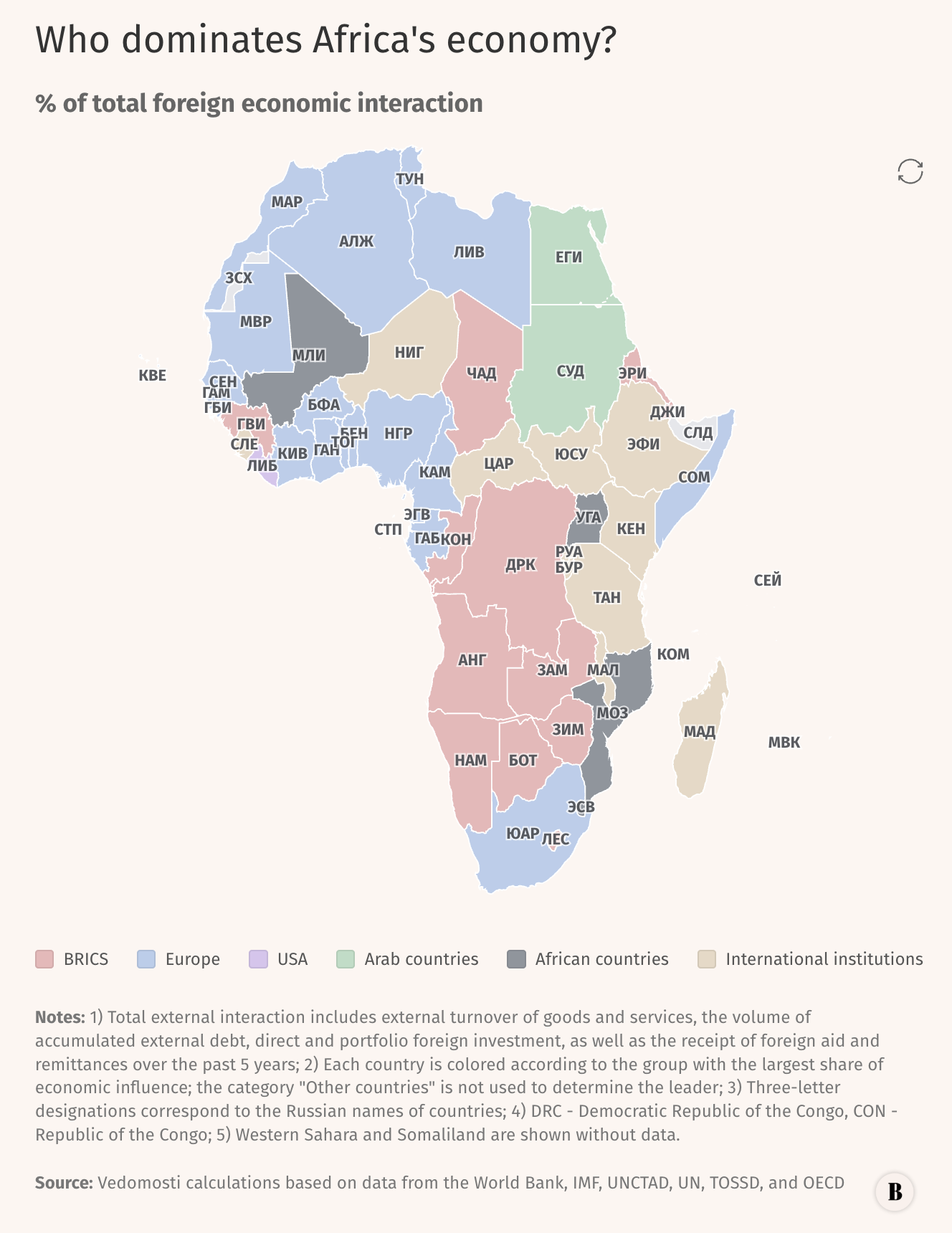
Europe still accounts for 28.5% of Africa's total foreign economic interaction - trade, external debt, investment, aid and remittances - against 10.0% for the US and 16.4% for the BRICS countries, according to Vedomosti's calculations from World Bank, IMF, UNCTAD, UN, TOSSD and OECD data. China alone has 7.8%, India 2.1% and Russia 0.5%. Altogether the flows came to $5.27 trillion, or 167% of Africa's GDP.

Who dominates Africa's economy: each country is coloured by the group with the largest share of its foreign economic interaction (country labels in Russian). Source: Vedomosti calculations based on World Bank, IMF, UNCTAD, UN, TOSSD and OECD data.

BRICS is gaining fastest in trade. Its members' goods exports to Africa rose 65% in 2015-2025, from $187bn to $309bn, while OECD exports grew 18% to $287bn, a fall in real terms. China is now the largest single supplier, with $161bn, or 21% of the total, and BRICS countries hold the biggest shares in East Africa, at 31%, and Central Africa, at 19%.

In finance BRICS lags far behind. Its members hold 11% of the stock of foreign direct and portfolio investment in Africa, $106bn of $981bn, against $438bn for Europe and $250bn for the US. China is the largest single creditor, with $84bn, or 7.2%, of Africa's $1.17 trillion external debt, but BRICS countries supplied only $20bn, or 2.9%, of the $689bn of foreign aid the continent received in 2019-2024.

PartnerShare of Africa's foreign economic interaction (%)
Europe28.5
- France4.9
- UK3.8
BRICS16.4
- China7.8
- India2.1
- Russia0.5
Other African countries11.0
International institutions10.3
US10.0
Arab world7.7
Total ($ trillion)5.27
Total (% of GDP)167

Trade, accumulated external debt, direct and portfolio investment, and aid and remittances over five years. Source: Vedomosti calculations based on World Bank, IMF, UNCTAD, UN, TOSSD and OECD data.

The 0.5% figure misses Russia's role as a supplier of grain, arms and nuclear technology that create long-term dependence, Ekaterina Novikova of the Plekhanov Russian University of Economics told Vedomosti. Russia's military and political influence is far greater than its economic role, said Mikhail Margelov, vice-president of the Russian International Affairs Council, who described Africa not as a continent carved into spheres of influence but as one of "competitive coexistence" among many outside powers.

Nigeria and the bilateral marathon

Putin met Mozambique's Daniel Chapo, Equatorial Guinea's Teodoro Obiang Nguema Mbasogo and Libya's Mohamed al-Menfi on October 27, on the sidelines of a Gas Exporting Countries Forum summit. Egypt's Abdel Fattah el-Sisi, Ethiopia's Prime Minister Abiy Ahmed and the Republic of Congo's Denis Sassou Nguesso are due on October 28, followed on October 29 by Ndayishimiye and the leaders of Madagascar, Zimbabwe, Namibia and Sudan, according to Ushakov's schedule. October 30 is set aside for ten more: Ghana, Mali, Mauritania, South Sudan, the Central African Republic, the Democratic Republic of Congo, Togo, Eritrea, Somalia and Comoros.

Nigeria, Africa's most populous country, is not on the published list. Vice President Kashim Shettima, who represented President Bola Tinubu in St Petersburg in 2023, is leading the delegation, Nigeria's ambassador to Moscow, Joseph Olusola Iji, told TASS.

Nigeria is the kind of partner Moscow needs if its African ties are to move beyond the Sahel. Its crude output averaged 1.53mn barrels per day in September, above its Opec quota for a fifth month running, and the Dangote refinery, Africa's largest, launched a $1.6bn IPO in September. Abuja asked for Russian oil and gas technology at the 2023 summit.

Summits have struggled to turn into contracts before. St Petersburg produced no new energy deals, and the 33 documents due this week will be judged on how many become reactors, fertiliser plants and trade rather than memorandums, as Moscow tries to turn political goodwill on the continent into an expanding pull that shows up in the numbers.


Putin pitches Russia as Africa's partner in a multipolar world, eyes $50bn trade

Putin pitches Russia as Africa's partner in a multipolar world, eyes $50bn trade
BRICS now outweighs the G7 and the West wants Africa back in financial bondage, Putin told the Russia-Africa forum as he promised to double trade to $50bn. / bne IntelliNews

By Ben Aris in Berlin October 28, 2026

Vladimir Putin told African leaders in Moscow that a multipolar world was "truly becoming a reality", pitching Russia as their partner against a West he accused of neo-colonialism.

Putin was opening the plenary session of the third Russia-Africa Economic and Humanitarian Forum on October 28, a day before the leaders' summit, according to the Kremlin transcript. Delegations from 48 African countries, 22 of them at head-of-state level, have confirmed they will attend, Vedomosti reported.

BRICS countries have accounted for more than 40% of global GDP at purchasing-power parity over the past five years and the G7 for less than 30%, Putin said, and BRICS' share "will only grow further - to the benefit of developing countries". Africa, with its natural resources, its demographics and its position on transcontinental trade routes, deserves much of the credit, he added.

The speech set out the logic of Putin's big bet on the Global South Century. Cut off from Western markets by the war in Ukraine and sanctions, Moscow is building new markets and partners among emerging economies, and Russia in Africa is a large part of that turn. Its pitch to the continent is that the West has spent decades bleeding the Global South of its wealth, while Russia presents itself as offering a partnership between equals.

Russia's own share of Africa's foreign economic interaction - trade, debt, investment, aid and remittances - is still only 0.5%, against 28.5% for Europe and 16.4% for the BRICS countries, according to Vedomosti calculations published on October 27.

Building a multipolar world meets resistance from countries "accustomed to thinking in colonial terms and becoming fabulously - yes, fabulously - rich at the expense of others", Putin said. Such countries resort to "tariff wars, illegitimate sanctions, economic dictate, blackmail and interference in the internal affairs of others", he said.

"Western countries are making aggressive attempts to drive Africans back into financial bondage, imposing on them the financial resources they so desperately need on extortionate terms, which force them to pay back many times over to service and repay such debts, to the detriment of their long-term development plans," he said.

He quoted Thomas Sankara, the first president of Burkina Faso, who called debt "a skilfully managed reconquest of Africa" in 1987, and said little had changed since. Value added in African manufacturing is less than 2% by expert estimates, and only 15% of the continent's $1.5 trillion of annual trade is conducted within Africa, Putin said.

Russia runs programmes with several African countries that turn debt into funding for national growth projects, and wants Africa to have a bigger say in the International Monetary Fund and the World Bank, both of which need to be reformed to serve developing economies, he said.

Africa is "rightly called the continent of the future", Putin said. The centre of global population growth will shift to Africa from 2030 and the continent's population will pass 2.5bn by 2050, about 70% of them under 30, according to UN forecasts he cited. The African Development Bank puts average growth on the continent at 4.2%, above the world average, and 12 of the 20 fastest-growing economies are African.

Students, not raw materials

Russian business in Africa "does not engage in the predatory, neo-colonial exploitation of natural and human resources" but processes raw materials on the spot, creating jobs and tax revenues, Putin said.

The number of African students in Russia has risen 1.5 times since 2020 to a record of about 40,000, and Russian government scholarships for Africa have nearly tripled, with the quota raised to 5,500 places for the 2026-2027 academic year, Putin said.

A programme launched this year pays African students' travel, accommodation, food and tuition in Russia, and 58 Russian open-education centres teaching Russian and basic subjects now operate in 29 African countries, he said. More than 200 civil servants from 20 African countries have been through a Russian training programme in digital government.

Trade to double

Russia-Africa trade exceeded $27bn last year, up from $18bn in 2022, Putin said, adding that this was "not enough". Customs data show that trade fell 2.4% in 2025, with Russian exports making up most of it.

"I am convinced that in the very near future we can increase this figure further, at least twofold, and certainly pass the $50bn mark," he said, according to the Russian transcript.

Russia is one of the most reliable guarantors of food security on the continent and more than 40 African countries already receive Russian fertiliser and grain, Putin said. Russia exported 13mn tonnes of agricultural products to Africa in 9M26, and shipments to some countries have grown "not by percentages, but several times over", he said.

The flows are under pressure after Russia and Ukraine started striking each other's grain ports, a food price shock that falls hardest on African importers. Russia is ready to deliver all contracted grain to Africa by other routes and already uses some, including the Baltic, Deputy Foreign Minister Georgy Borisenko told Interfax on October 28.

Imports of African agricultural produce reached about $4bn this year, covering 8% of Russia's import needs. "But 8% is not that much. So what does that tell us? That the figure certainly must and will grow," Putin said. Russia is offering seeds, fertiliser, farm machinery, storage and processing, and plans agricultural and machinery hubs with some African countries, he said.

Payments, technology, water

Putin called for more trade settled in national currencies, more correspondent links between Russian and African banks, and a switch to the Bank of Russia's financial messaging system and the Pan-African Payment and Settlement System. That would protect payments from "politicised interference by unfriendly countries", he said, in line with the wider BRICS Pay push to trade outside the dollar system. "Some countries simply do not have their own financial systems but are tied to European financial systems. Of course, that limits sovereignty," he said.

"We have been at the forefront in the global race to achieve technological sovereignty," Putin said, adding that Russia has two domestic large language models and that "our competitors have to catch up with us in some sectors". Russia is willing to share its high-tech and digital know-how with Africa, he said, and presented a "sovereign development platform" for African states at an exhibition after the session.

Russia will localise production of Russian medicines and vaccines in Africa and set up laboratories and diagnostic centres, Putin said. Russia's consumer health watchdog Rospotrebnadzor has supplied 15 mobile laboratories to eight African countries and trained about 450 specialists under a programme now extended to 2029.

Russia is also offering water management, irrigation and hydropower, a priority after the African Union made sustainable access to clean water its goal for this year. Hydropower generator RusHydro (MOEX: HYDR) is ready to design new plants, modernise existing ones and build modular generation for remote areas, Putin said, recalling the 55th anniversary of the Soviet-built Aswan High Dam in Egypt.

More than 30 energy projects are under way jointly in 16 African countries, Putin said, and he invited African airlines to start flying to Russia.

Leaders are due to adopt an action plan for the Russia-Africa partnership for 2027-2029 at the summit on October 29.

Jets, reactors and fertiliser

Ethiopia took delivery of its first 12 Su-35 fighter jets a year ahead of schedule and will receive four S-400 air defence batteries, Prime Minister Abiy Ahmed said on X on October 28. State arms exporter Rosoboronexport confirmed the jet delivery, and its chief executive Alexander Mikheyev told the Vesti TV channel that African countries account for more than 30% of its order book.

State nuclear corporation Rosatom has legally binding agreements with 29 of Africa's 54 countries and is in active talks with 40-42, chief executive Alexei Likhachev told reporters, TASS reported. Rosatom is in advanced talks to supply 100 MW floating nuclear plants to Egypt, Togo, Namibia and Tanzania, Reuters reported.

Reactor sales lock buyers into decades of Russian fuel and servicing - uranium is the new gas in Moscow's dealings with emerging markets - and Russia's nuclear exports are booming.

Fertiliser producer PhosAgro (MOEX: PHOR) delivered more than 1.3mn tonnes to Africa in 9M26, already above its 2025 total of nearly 1mn tonnes, and aims to double its 2025 volume this year, First Deputy CEO Sergei Pronin told TASS. Russia could start with projects worth several billion dollars in Burkina Faso, Mali and Niger, Deputy Prime Minister Alexander Novak told TASS on the sidelines of the forum.

Burundi's President Evariste Ndayishimiye, who chairs the African Union, told the same session that Africa wants to process its resources at home and did not want to serve only as a source of raw materials.


Russia says US is in talks to use its LNG technology in Alaska

Russia says US is in talks to use its LNG technology in Alaska
Kremlin deputy chief of staff Maxim Oreshkin says Washington is actively discussing Russian-built offshore liquefaction platforms for an Alaskan LNG plant. / bne IntelliNews
By Ben Aris in Berlin October 28, 2026

The US is in active talks to use Russian technology for an LNG plant in Alaska, Kremlin deputy chief of staff Maxim Oreshkin said on October 28.

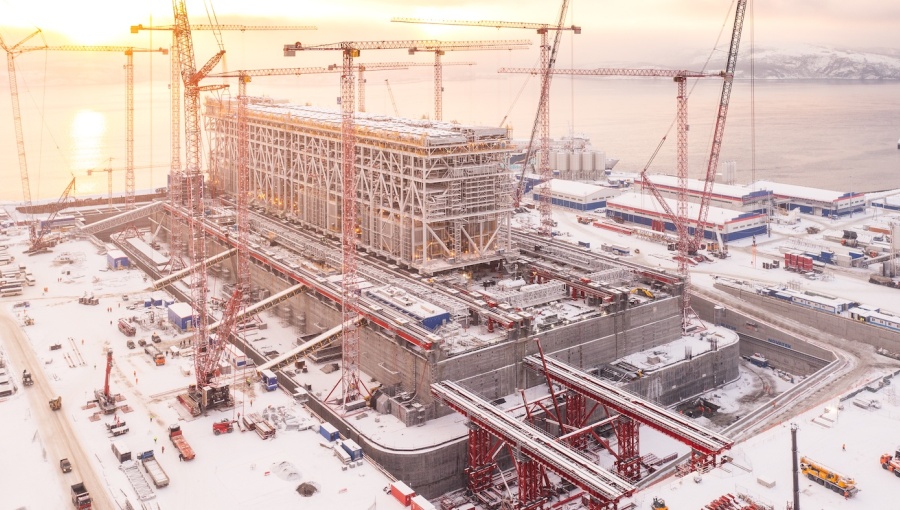
Russia is "the first and only country in the world" to have built technology for turnkey liquefaction plants mounted on platforms placed in coastal waters, Oreshkin told a media forum held alongside the Russia-Africa summit in Moscow, the Prime news agency reported. A "gigantic plant" built near Murmansk in recent years assembles the platforms, each of them in effect a ready-made LNG plant, he said.

"The use of such platforms in Alaska is now being actively discussed, and our American partners understand that using Russian technological solutions gives far more efficient economics than the solutions the US itself has now," Oreshkin said.

The yard Oreshkin described is Novatek's (MOEX: NVTK) Centre for Construction of Large-Tonnage Offshore Structures at Belokamenka, which builds liquefaction trains on concrete gravity-based foundations and has been under US sanctions since February 2024. Putin said after his August 2025 summit with Donald Trump that the two sides were discussing joint energy projects in Alaska, but Oreshkin's comments are the most specific yet from the Kremlin, and they come days after US reporting that Novatek executives discussed funding Polar LNG, a US start-up planning an export plant on Alaska's North Slope, through an intermediary. Polar LNG's chief executive resigned in September after learning where the money came from.

Polar LNG said in March it was seeking US approval to buy discounted equipment from Novatek's sanctioned Arctic LNG 2 project, including a partly built liquefaction train, for a first phase costing $8bn-9bn. In February, Texas investor Gentry Beach said he had signed a deal with Novatek in autumn 2025 to use a mobile LNG unit built at its Murmansk-region yard. Novatek has told the New York Times it intends to take a minority stake in Polar LNG, but denies controlling the venture.

Oreshkin credited Western sanctions for the platforms, saying Russia relied on American oil and gas technology 20-30 years ago - an argument Putin also made at the St Petersburg International Economic Forum in June.

"None of this would have happened if we had not worked on our own technological sovereignty, if there had not been additional sanctions pressure on the Russian energy industry. It forced us to implement our own solutions, and our engineers to come up with new technological approaches," he said.

Deputy Prime Minister Alexander Novak was more guarded on the same day, saying Russia is not in talks with US companies about a return to Russian oil and gas projects. "Whether they come back or not depends first and foremost on them," Novak said on the sidelines of the forum, Vedomosti reported. The Financial Times reported on October 27 that Washington and Moscow were discussing reviving a joint US-Russian oil project off Sakhalin once the war in Ukraine ends, and a role for US companies in restoring Russian oil supplies to Europe through the Druzhba pipeline.

US Energy Secretary Chris Wright said "quite possibly" when asked by CNBC on October 27 whether more tankers of Russian diesel would follow the first cargo shipped under a US sanctions waiver. Wright has defended the deal as an incentive for Moscow to end the war.


80% of Ukrainians want refinery strikes on Russia to go on even if US cuts aid

80% of Ukrainians want refinery strikes on Russia to go on even if US cuts aid
Four in five Ukrainians back continuing refinery strikes even if the US cuts aid, a KIIS poll found. / bne IntelliNews

By Ben Aris in Berlin October 28, 2026

Four in five Ukrainians want Kyiv to keep hitting Russian oil refineries even if Washington cuts aid, a Kyiv International Institute of Sociology (KIIS) poll found.

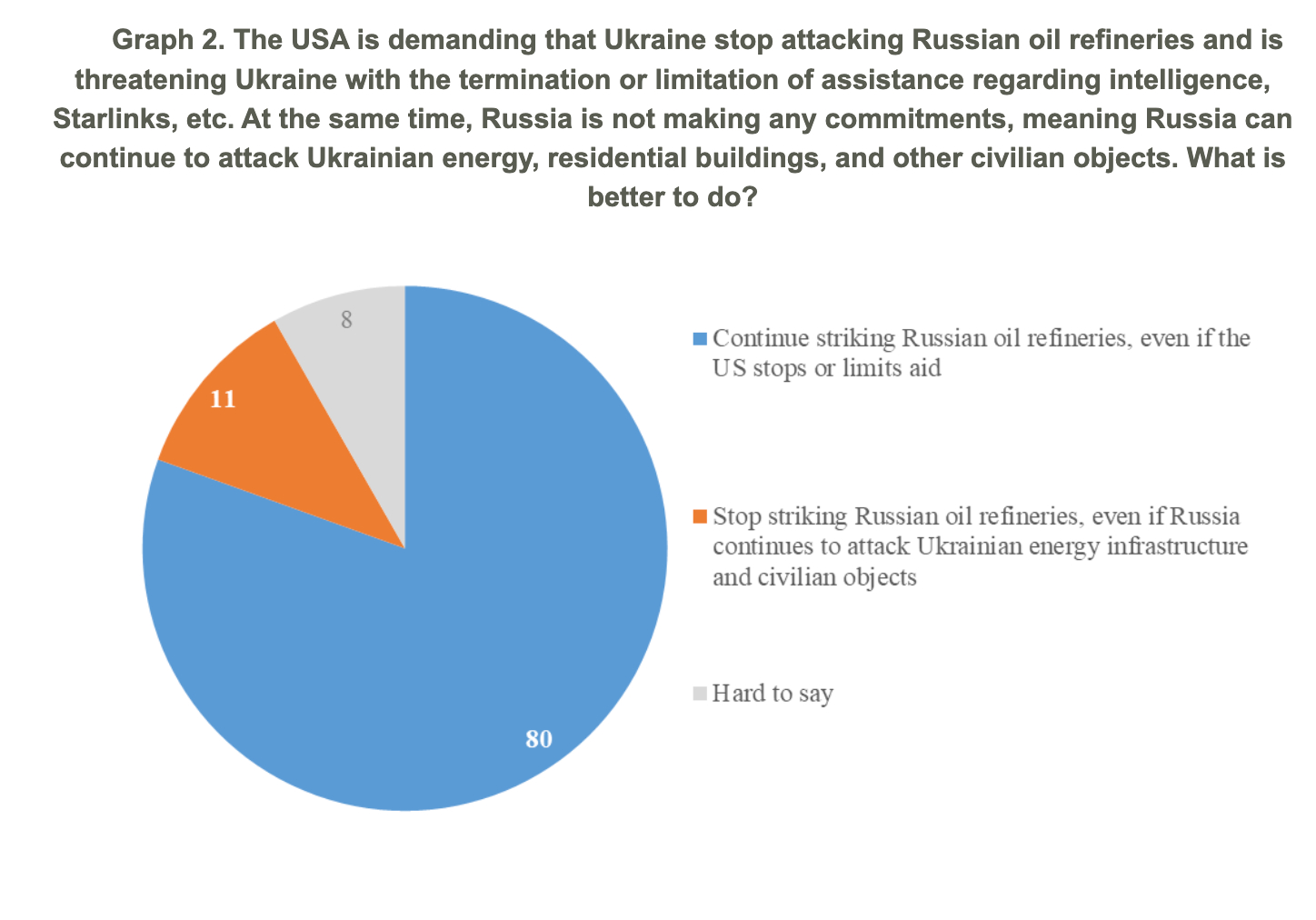
Graph 2: "The USA is demanding that Ukraine stop attacking Russian oil refineries and is threatening Ukraine with the termination or limitation of assistance... What is better to do?" Share of respondents, %, October 16-25, 2026. Source: Kyiv International Institute of Sociology (KIIS)

Some 80% of respondents said the strikes should continue even if the US stops or limits its support, while 11% said they should stop and 8% were undecided, according to a KIIS press release published on October 28. The question set out a scenario in which the US threatens to end or curb help with intelligence and Starlink terminals while Russia makes no commitments and remains free to keep attacking Ukraine's energy system and homes.

Washington has spent weeks pushing Kyiv the other way. US President Donald Trump struck a diesel deal with Vladimir Putin on October 9 after Kyiv refused to halt its drone campaign against Russian refineries, and US envoys then told Ukraine it would get no reward for stopping. The strikes have taken a large share of Russian refining capacity offline, as the refinery damage ledger shows, and Kyiv says it will stop only if Moscow ends its own attacks on Ukraine's grid.

KIIS interviewed 828 adults by telephone between October 16 and October 25 in all government-controlled regions. The formal margin of error is up to 4.4 percentage points, with an unquantified extra bias from wartime conditions, the pollster said.

Some 63% said they were ready to endure the war for as long as necessary, 5% said about a year and 21% said a few months to half a year, with 11% undecided, in the same survey. The figure has recovered from a low of 48% in late April and has barely moved through the pressure of October.

KIIS survey waveReady to endure the war as long as necessary, %
January 202665
Early March 202654
April 20-27, 202648
July 20-August 3, 202661
September 12-21, 202662
October 8-16, 202662
October 16-25, 202663

Source: Kyiv International Institute of Sociology (KIIS) press releases, January-October 2026

Some 76% said Ukraine should keep up armed resistance even if Russia tries to freeze Ukraine into submission by leaving people without power, heating and sewage, practically unchanged since August-September. Resolve was weakest in the east, where 58% backed resistance and 24% said Kyiv should comply with Russia's demands.

In a separate question, 62% said they trust President Volodymyr Zelenskiy and 35% did not, compared with 43% trust and 52% distrust among respondents polled on October 8-9. KIIS said the jump was most likely a “rallying around the flag” effect following US pressure, while noting that methodological differences could explain part of the gap.

"Despite the pressure factors outlined above, Ukrainians remain steadfast in repelling the enemy: the majority are ready to endure the war as long as necessary, and insist that despite a possible severe winter, Ukraine should not accept Russian peace terms, and believe that even at the risk of losing USA support, it is necessary to continue striking Russian refineries," said KIIS executive director Anton Grushetskyi.

He added a warning for the government: "Ukrainian society wisely mobilized for unity during this difficult period, but the Ukrainian authorities must also learn the right lessons."