Thursday, November 05, 2026


Fortescue's First "Green" Bulker Bunkers Ammonia at Port Hedland

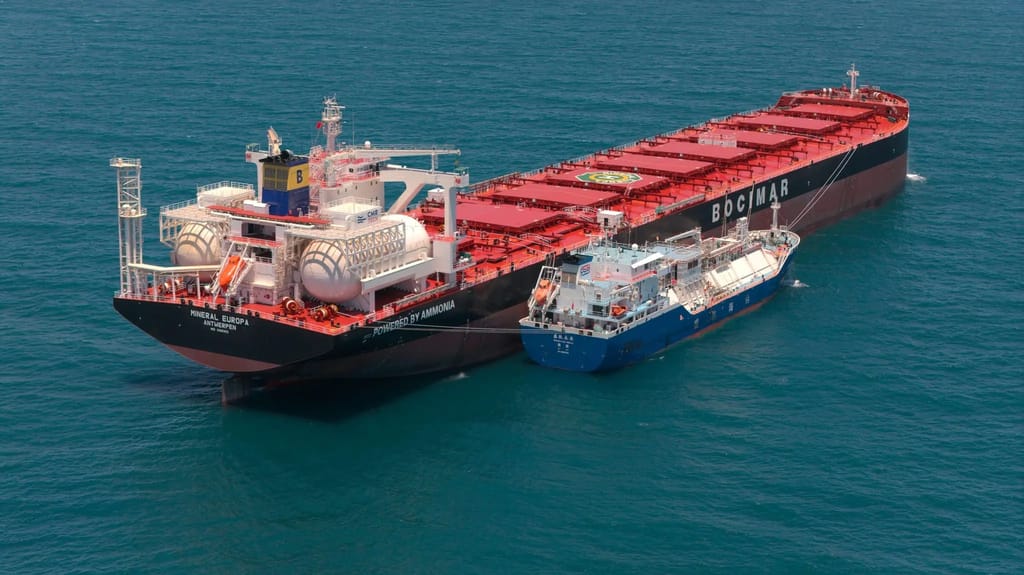
Fortescue bulker
Courtesy Fortescue

A Capesize ore carrier has fueled up with green ammonia at Port Hedland, Australia, in a first for the Australian market and for mining giant Fortescue's export operations. 

The Fortescue-chartered Mineral Europa is a 200,000 dwt bulker operated by Belgian owner CMB.Tech. She is deployed on the core trade lane from Port Hedland to China - the destination for two-thirds of the global iron ore trade.

The green ammonia used at Port Hedland has no carbon emissions when used as a marine fuel, according to Fortescue. Port authority Pilbara Ports says that if multiplied across the Australia-centered iron ore fleet, switching to ammonia bunkering could cut emissions by as much as 4.5 million tonnes of CO2 annually. 

Norwegian ammonia producer Yara has a massive conventional natural gas-to-ammonia plant in the Pilbara region, positioning it to add carbon-capture ammonia production in future. 

Another firm, WAH2 Clean Ammonia, has ambitions to set up a nearby blue ammonia plant (natural gas-derived ammonia, produced using a carbon capture and storage process). WAH2 has a feedstock deal with Chevron for its natural gas and a bunkering partnership with bunker-vessel operator Oceania Marine Energy. 

Eventually, Fortescue would like to develop a value-added, low-carbon iron trade that involves a higher degree of processing before shipment. The idea is to use hydrogen - produced from renewable sources - to smelt iron ore into sponge iron ("green iron"), a deoxygenated iron raw material that could be used to produce high-grade steel in China. 


Hybrid-Electric Expedition Cruise Ship Built in Chile Set for Delivery

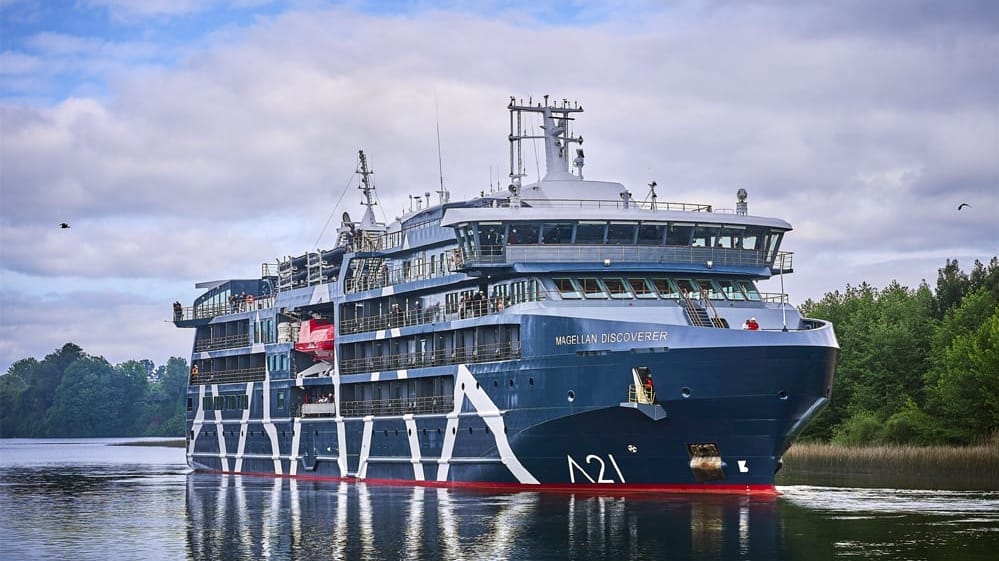
hybrid expedition cruise ship
Magellan Discovererr is the first hybrid-electric polar expedition cruise ship built in the Americas (ASENAV)

Chilean shipbuilder ASENAV (Astilleros y Servicios Navales S.A.), the biggest shipyard in Chile, highlighted the departure of the innovative new exploration cruise ship Magellan Discoverer from its shipyard this week. The cruise ship, which took about 33 months to build and involved more than 500 employees, contractors, and suppliers, departed ASENAV’s shipyard in Corral for its final trials before delivery and entry into service in December.

The 5,258 gross ton cruise ship is being hailed as the first hybrid-electric expedition cruise ship ever built in the Americas. Designed and built by ASENAV, the ship was created for long-range polar expeditions, and according to its builders and owners, Antarctica21, it will set a new standard for responsible Antarctic explorations. Antarctica21 says, “Every system on board has been engineered to reduce environmental impact while delivering an exceptional expedition experience.”

The hybrid-electric propulsion system is driven by ABB’s Onboard DC Grid, a modular platform that integrates generator power with Corvus Energy Battery Storage System to enable flexible energy management. Power and propulsion come from two MAN main engines and gensets, totaling 4,800 ekW of power for two ABB Azipod units. The marine lithium battery bank was developed by Corvus Energy. It will give the ship a speed in open waters of 14 knots.

ASENAV highlights that the systems optimize energy efficiency while reducing CO2 emissions and underwater noise. The ship was designed to operate in one of the most extreme environments on the planet. The hybrid systems give the vessel the ability to sail for up to 60 days without refueling.

It is also equipped with a heat recovery system that will allow the heat generated in the exhaust gas to be recovered and used for water heating, while the elevator technology captures and converts energy generated during braking into electricity to recharge the batteries. The Vessel Performance Management System employs approximately 100 sensors and will analyze performance, including energy consumption, generator performance, and navigation speed.

“This vessel marks a leap forward in sustainable engineering, positioning ASENAV as a leading shipyard in the local maritime industry and placing Chile at the forefront of global innovation and design for vessels of this type,” said Fernando Rodríguez, General Manager of ASENAV.

Magellan Discoverer is 94 meters (308 feet) in length with accommodations for up to 96 passengers, although it is limited to 88 passengers for the fly-cruise operations in Antarctica. The ship will have 67 staff and crewmembers. It has a reinforced hull and robust bow, giving it the ability to break through ice barriers up to 80 centimeters (2.6 feet) thick. It received a Polar Class PC6 rating and an IMO Tier III certification.

Aboard, the passengers will experience a boutique, yacht-like style experience. The ship has a large lounge and dining room as well as an observation deck, library, and prep area for expeditions.

“This new ship not only represents a technological leap in sustainability, but also a reflection of national talent and what we are capable of achieving when we strive for excellence. We are proud to collaborate with ASENAV on this project that unites cutting-edge engineering with a responsible vision of tourism in the most remote territory on the planet,” said Jaime Vásquez, president of Antarctica21.

The order for the ship was placed in 2023, expanding on ASENAV’s prior newbuild for Antarctica21, Magellan Explorer, delivered in 2019. The ship reportedly cost approximately $90 million to build, with steel cutting beginning in February 2024, and the hull was launched in October 2025. Earlier this year, the ship was moved along the Calle Calle River from the yard in Valdivia to Corral in preparation for trials.

Magellan Discoverer departed on October 26 for her final sea trials, where her operational performance, maneuverability, and systems functionality are being evaluated under real-world conditions. She is scheduled to depart for Punta Arenas, Chile, before her entry into service on December 15. She will spend the first few months operating in the Antarctic as part of Antarctica21’s fly-cruise program, where passengers fly to King George Island to join the ship, avoiding the difficult crossing of the Drake Passage.

The cruise line says her unique design will improve overall efficiency and operational flexibility, while minimizing the impact on wildlife and the environment.
 

Wednesday, November 04, 2026


Dockworkers Worldwide Strike Against Militarization, Wages and More

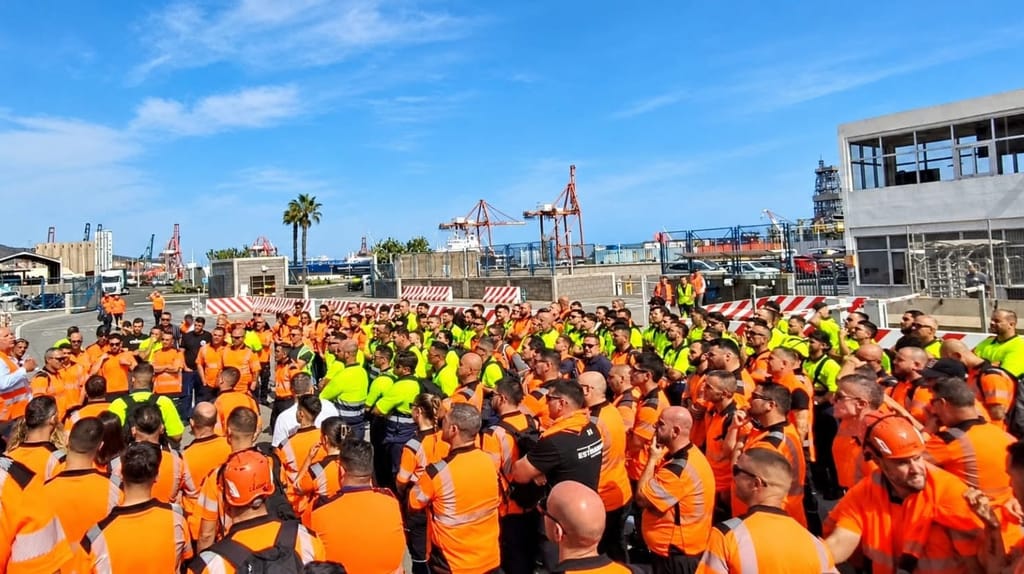
dockworkers strike
Dockworkers in Spain joined the coordinated effort (European Dockworkers Council)

In what is being called the largest action of its kind, dockworkers around the world joined a strike call on Friday that was reportedly impacting as many as 113 ports in 22 countries. What was originally billed by the organizers as an effort against militarization of ports and shipments of war-related cargoes, however, took on a local tone with demonstrations against working conditions, calls for wage increases, and other issues.

Organizers highlighted that for two years dockworkers have stopped cargoes, mostly one ship at a time, to protest military cargoes. They pointed to efforts in Tangier, Piraeus, France, Spain, and elsewhere, using the broad theme “Dockworkers do not work for war.” The individual protests did result in delaying some ships and cargoes while others were diverted. The U.S. Federal Maritime Commission recently announced it is planning penalties against Spain after Maersk Line, Ltd. ships were forced to divert over the suspicion they were carrying military-related cargoes to Israel.

In February 2026, the unions called for their first day of action. The coordinated efforts on February 6 reportedly involved 20 ports in seven countries. Organizers asserted they stopped five suspected ships.

Today’s action also started as a demonstration against militarization and specifically the war in Gaza. However, it quickly expanded to include local issues such as demands in France for increased minimum wages and higher salaries rather than bonuses, which the unions highlighted do not contribute to social security coverage. Other workers demonstrated against their working conditions.

Workers in the Port of Le Havre, France demonstrated and called for increased salaries (European Dockworkers Council)

The European Dockworkers Council led the call for action and reported it would include strikes in France, Italy, Greece, and Turkey, as well as stoppages in Morocco and Cyprus. Later reports said the ILWU in California was joining the effort at the ports of Oakland and San Francisco. The Hamburg chapter of Ver.di was also reported to have joined, while the European Dockworkers Council said it had also expanded to include more countries such as Sweden and Slovenia.

They claimed that the action was impacting ports that collectively handle 13.5 percent of global shipping and 63 percent of container activity. They said the one-day delay would result in costs of $57 million, with $2.8 billion worth of cargo not moving. Organizers claimed in the Mediterranean alone they would disrupt more than 40 percent of cargo.

It was unclear how much impact the action really had, with analysts saying one day would not have a dramatic global impact on supply chains and operations. Several companies, however, had warned of potential delays

There were also some sympathy actions. In Italy, Unione Sindacale di Base called for a 24-hour general strike, but there were reports that the government was ordering workers not to strike and to return to their jobs. In Greece, the seafarers' union also called a strike, and ferries to the islands were disrupted.  The French unions said that 24 ports were involved in the action, but it was separate from a nationwide general strike which is now scheduled for November 5.

The organizers predicted that this would not be the last of their coordinated efforts. They asserted that an international dockworkers’ movement is emerging and would continue to strike to stop the militarization of ports and the exports of war-related materials.


The Risk of a Full-Scale Conflict With Iran is at its Peak

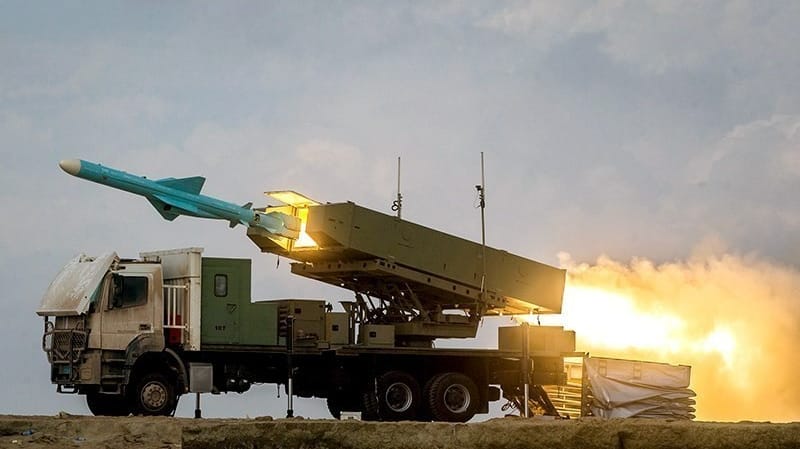
Test launch of an Iranian Noor antiship missile (Tasnim / CC BY)

Shipowners, managers and seafarers need to have a sense of where the risk of a resumption of the U.S.-Iran war currently sits, and putting aside temptations to be precise with regard to timing, the risk of a resumption of full-scale war could not be higher than it is now - and it will stay at that level for the next week. And the initiative to restart the war could be taken by Israel, Iran, the United States or even, conceivably, the Gulf states themselves.

From a political perspective, Prime Minister Netanyahu’s desire to resume hostilities has been advertised by his clashes with the Israeli chief of staff. President Trump may be tempted to do so before seats change hands in Congress. Iran is under increasing pressure domestically as the oil money runs out and imports dry up, and could leverage a patriotic war as a diversion. Some of the Gulf states do not want to see any arrangement come into play that gives Iran more control over the Strait of Hormuz than it used to have, and they might move if they were threatened with a fait accompli or a deal to which they were not a party.

From a military perspective, the United States has been clearing dependents and nonessential personnel from forward bases and embassies in the region, and it has mastered the art of prosecuting long-range warfare without giving away any indicators and warnings. Israel is always ready, and the fake full-scale attack mounted last week, which stopped just short of Iran’s borders, may have been an attempt to get the Iranians to unmask their air defense systems in order to update the electronic signatures of the systems that will need to be attacked.

A series of covert, unannounced military strikes by the United States on targets in Iran in recent days may also be viewed as an attempt to prepare the battlefield, and unexplained fires and explosions at a number of sites in Iran could likewise be part of shaping operations.

Iran may want to avoid another war, knowing the damage that will be done to its infrastructure. But its leaders evidently feel a war is imminent and have been trying to pressure the Gulf states to urge restraint on the United States and Israel by threatening attacks on a wide range of civilian targets. But if Iran feels threatened and thinks an attack is imminent, it may be tempted to make a preemptive first move.

The opinions expressed herein are the author's and not necessarily those of The Maritime Executive.


Iran Claims Strikes on Multiple Tankers, Emboldened After US Elections

Strait of Hormuz
UKMTO only received reports of one strike on Tuesday off Oman (UMTO)

Iran’s Revolutionary Guard Navy continues to issue reports of multiple tankers being struck each day in the Strait of Hormuz. The latest reports came hours after the results of the U.S. midterm elections were emerging and as Iranian leaders emphasized the Republican losses.

Today’s statement from the IRGC Navy claimed that four unidentified tankers had struck mines while attempting transits through the southern channel near the coast of Oman. It said that two of the tankers were still ablaze. At the same time, they said two other tankers had been turned back before attempting to make the illegal passage and that they had downed a U.S. MQ-9 drone, marking the 56th of its kind Iran claims to have downed since the start of the war.

Yesterday, the IRGC Navy made a similar unsubstantiated claim, saying that three oil tankers exploded and caught fire after entering an unauthorized route through the Strait of Hormuz and striking sea mines. This came after its so-called Persian Gulf Strait Authority doubled the number of vessels on its non-compliant list.

No independent verification has emerged for most of the claims, although tankers have been known of late to be delaying or not reporting incidents. CENTCOM and the Trump administration have also remained silent, although it has repeated in recent days the assertions that the shipping channels in the Strait of Hormuz have been cleared of mines.

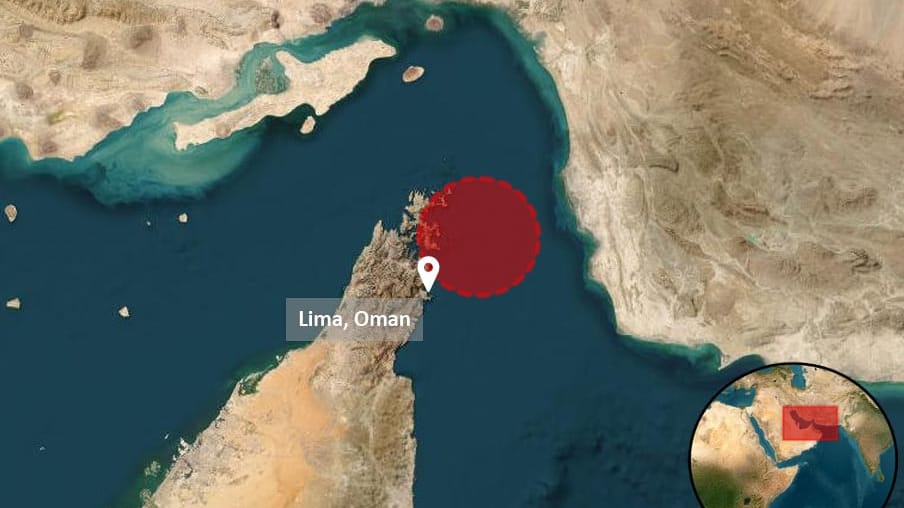
UK Maritime Trade Operations said it received details of only one attack late on Tuesday, November 3. It said a tanker reported being struck by two unknown projectiles into the engine room approximately 14 NM northeast of Lima, Oman. Vanguard Tech is identifying the vessel as the Barbados-registered shadow fleet tanker Grit (298,555 dwt). Built in 2003, it appears to be under Chinese ownership since June 2026.

Grit was one of the vessels Iran placed in the latest round on its non-compliant list. Some reports say the tanker had loaded in Qatar, while TankerTrackers.com posted that the vessel “recently transported Iraqi crude oil to the Gulf of Oman.” The tanker’s AIS signal had been turned off for more than a month.

Lloyd’s List Intelligence also reported one other strike on a bulker early on November 2. It reports the Panama-flagged bulker Era S. (46,681 dwt) was attempting to transit the Strait of Hormuz. The vessel was built in 1999 and is managed by Turkish interests.

The claims of strikes came as Iran cited the results of the U.S. midterm elections and said it was evidence the American people did not support the war. Some within Iran repeated the statements of determination to pursue the war, while others called for ending the conflict through dialogue. Iran’s chief negotiator, Mohammed Bagher Ghalibaf, posted on social media that Americans had said no to war.

Iranian officials continue to insist they gave negotiators seven points that the U.S. must meet before reopening the Strait of Hormuz and that it is the U.S. that did not respond. At the same time, Ahmad Hayat Moghaddam of the Iranian Parliament told the media that they had decided to grant exemptions for transits without limitations to vessels from China, India, Iraq, and Qatar. He noted Iran’s business relations with these four countries.

TankerTrackers.com, however, notes the tanker struck yesterday, Grit, has been transporting Iraqi oil. It also highlighted that roughly 30 percent of the cargo aboard the tankers listed by the PGSA is Iraqi. TankerTrackers.com wrote that “Iraq is not immune to the IRGC.”

Donald Trump, for his part, told reporters that the vote did not reflect views of himself, as he was not on the ballot. He said Americans might have been reacting to the high gas prices, but reiterated his determination to see the war effort through and ensure Iran never has a nuclear bomb.


Iran Increases Pressure on Shipping Doubling “Non-Compliant” List

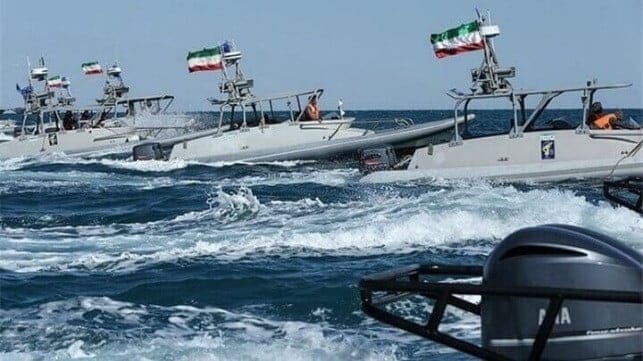
Iranian speed boats
Iran's threats against shipping continue as it doubled its list of non-compliant vessels

Iran’s so-called Persian Gulf Strait Authority, without fanfare, on Monday released a new list of vessels it calls “non-compliant,” doubling the number of vessels and reiterating its further limitations. It comes after weeks of increased attacks on shipping, broad claims from Iran, and was followed by a small retaliatory strike by the United States.

The Iranians continue to assert that ships added to the listing “shall face restrictions on future passages, including fines, detention, or confiscation.” The ships are reported not to have complied with the demand for transiting only through the northern channel near Iran and clearing their passage with the Iranians. 

The list now totals 240 vessels, with an additional 114 ships on this latest version. Risk intelligence firm Orbital issued an analysis of the update noting that only half the vessels (118 of the 240) are crude oil tankers and that they made up 65 of the additions. Other types of vessels include LPG and LNG carriers as well as a few bulk carriers and four containerships.

Orbital’s analysis shows, however, that the concentration is on the vessels of the Gulf states and their national shipping companies. The Kuwait Oil Tanker Company, Bahri and NCC, ADNOC, Nakilat and QatarEnergy, and Safeen and AD Ports are all heavily targeted, with a total of 72 of the vessels listed and 25 among the latest additions.

The single largest group, however, is vessels linked to South Korea’s Sinokor, and this follows Iran’s threat to the shipping company days earlier. On October 27, the PGSA accused Sinokor of having “committed the highest number of passage violations over the past three months.”

Orbital notes that Sinokor vessels and the Gulf States’ vessels collectively make up more than half of the list and the new additions. It notes that the list, however, includes three vessels that Iran has already sunk. Five of the vessels are under sanctions, and seven have no registered owner.

Iran’s threat extends further as it reiterates that “cargo owners shipping to/from the Persian Gulf must review the Non-Compliance List (NCL) in order to avoid potential issues.” It also says that any vessel cooperating with listed vessels (via STS, transshipment, etc.) will be added to the list.

The additions came as UK Maritime Trade Operations reported that October concluded with one more attack inside the Arabian (Persian) Gulf, the sixth attack inside the Gulf since October 7. It also received reports of three attacks in the Strait of Hormuz, bringing its total to 18 confirmed attacks since October 6. It notes that Iran continues to harass vessels as well, while it has been pointed out that vessels are delaying or not reporting some incidents to UKMTO and others.

While there have been reports of new indirect discussions through mediators in an attempt to resolve the war, the United States reportedly struck Qeshm Island overnight. Central Command has not acknowledged the strikes, but Iranian reports said there were explosions late on Monday into Tuesday. Off-the-record comments from sources to the Associated Press said U.S. forces struck Iran’s surface-to-air missile sites after a launch against a U.S. plane. 

Donald Trump dismissed the overnight strikes as minor and not the start of new efforts. U.S. officials, however, have not acknowledged the increased level of strikes against shipping in the last month. CENTCOM continues to dismiss the claims of mines, asserting the Strait of Hormuz has been cleared and remains open.

AP, however, highlights that the region remains on edge over the prospects of further U.S. strikes in the coming days or a possible resumption of full-scale operations. Trump had said the U.S. would not move before today’s midterm elections but has said he needed to decide on actions to bring the war to a close.


Indian Seafarer Killed in Strike in Strait of Hormuz

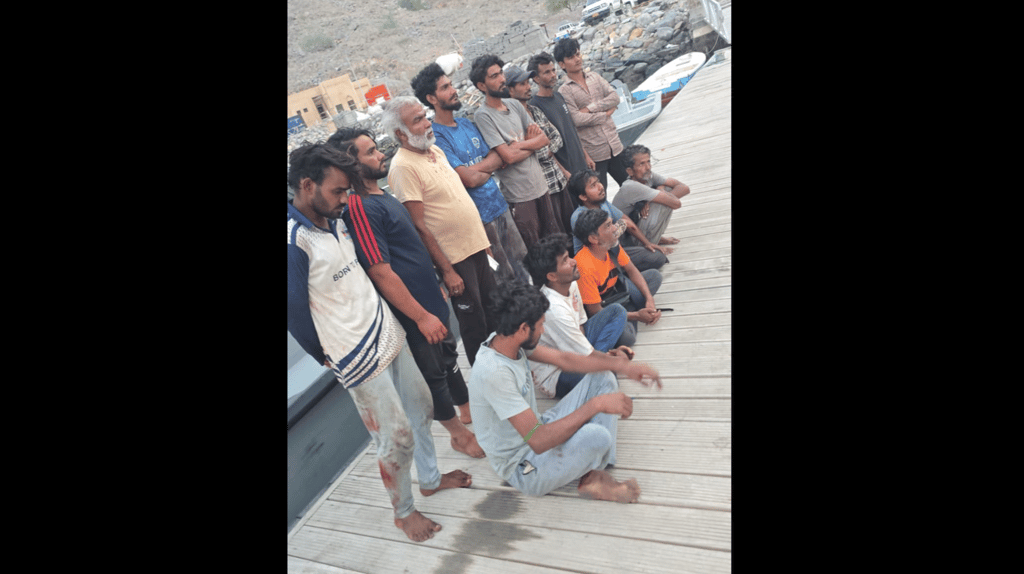
Survivors of the Al Jufuri attack, November 3 (Indian social media)

On Monday, an Indian dhow was hit at a position off Limah, Oman, the latest in a long string of vessels damaged in the ongoing U.S.-Iranian hostilities. One crewmember died of injuries sustained in the strike, and 13 were rescued by the Omani Coast Guard. 

The Indian Ministry of External Affairs confirmed the incident in a statement, and it said that its embassy in Oman is working on repatriating the survivors. 

"The targeting of commercial shipping and civilian infrastructure in the region must end, and free and unimpeded navigation and commerce through the international waterways in the region, in keeping with international law, must be restored at the earliest," the ministry said in a statement. 

The vessel was a coaster, the Al Jusufi, according to Indian shipping minister Sarbananda Sonowal. In a statement, Sonowal identified the deceased crewmember as Gujarat resident Gandhar Nahim Ajij. 

Indian seafarers have borne a disproportionate share of casualties in the Hormuz crisis, as well as the ongoing Russia-Ukraine conflict, and union FSIU called on governments everywhere for more effective intervention. 

"We demand: Immediate, enforceable protection measures; accountability for attacks on commercial shipping; full support, compensation and justice for families," FSUI said in a statement. "Advisories are not protection. Seafarers are civilians, not combatants. The world has failed them."

Strikes reported at Qeshm

Separately, U.S. forces have conducted a series of small-scale strikes against targets on Qeshm, a strategic island at the north end of the Strait of Hormuz. It is a stronghold of the Islamic Revolutionary Guard Corps, and has been hit repeatedly over the course of the monthslong conflict to secure control of the strait; U.S. officials were quick to downplay the severity of the engagement. 

The strike was first reported by the Wall Street Journal. Officials downplayed the severity of the operation, but acknowledged that it was the latest in a series of skirmishes with Iran's shoreside forces. For months, U.S. aviation assets have provided cover for an energy shipping corridor through Omani waters, undermining Iran's attempts to close off the strait to traffic from the GCC states. 

Most of the engagements involve shooting down incoming Iranian drones, but on Monday, the IRGC attempt to shoot down a U.S. fighter jet with a surface-to-air missile, the officials told the Journal - prompting a limited counterattack to remove the threat. 

President Donald Trump has declined to telegraph his thoughts on the possibility of restarting major hostilities with Iran. A large-scale force buildup in the Mideast gives him options, and he has hinted at several different outcomes: a successfully-negotiated peace agreement; continuation of the punishing blockade on Iran's economy; or a massive military strike, with plans said to incorporate attacks on Iran's energy infrastructure. 


Modular Gun Systems Might Reduce the Risk of Drone Attacks on Shipping

Hormuz
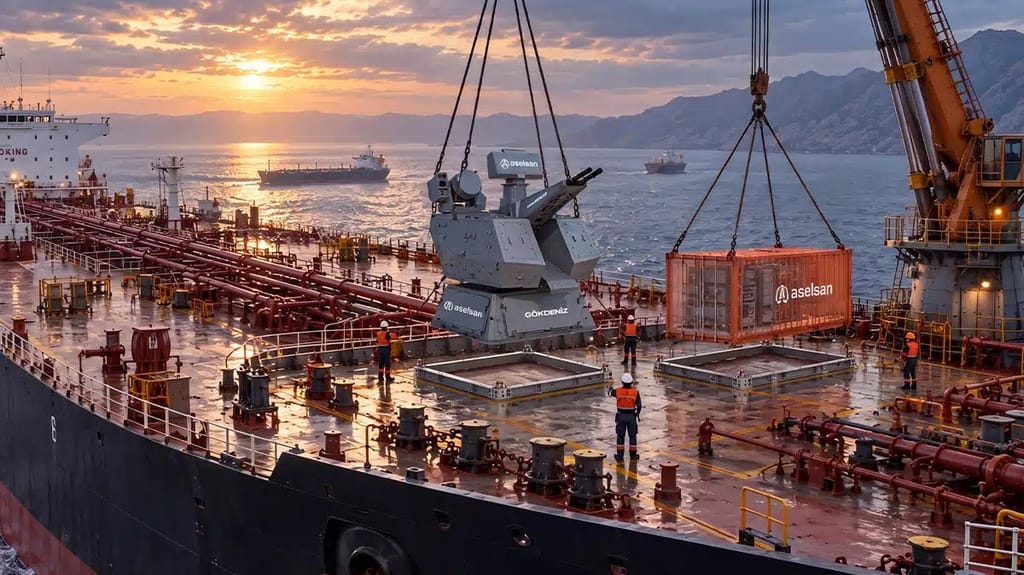
Illustration courtesy Aselsan

A small handful of shipowners have accepted drone and missile strikes as a cost of doing business on high-revenue, high-risk routes - a recurring hazard that causes damage, disrupts operations, and may injure or kill crewmembers. But there may be an alternative to accepting kinetic hits: installing air defense systems. Multiple defense contractors are coming up with modular gun and missile systems that could abate aerial threats, and the risk of suicide drone boats as well. 

At this year's Euronaval show, BAE Systems and Aselsan are both marketing self-contained deck gun systems for merchant ship installation. The units are adapted from standard-issue naval air defense systems, common on NATO warships and proven against a variety of threats. 

Merchant ships are almost universally unarmed in peacetime, and for good reason: guns on board create questions for customs authorities in any foreign seaport, and can swiftly lead to legal problems for the crew and the owner. When there is a critical need for armed guards, the generally accepted practice is to embark and disembark them (and their arms) at sea, away from any port. 

But in time of war, armed merchantmen have abundant precedent, and in the Black Sea and Strait of Hormuz, merchant vessels are already targeted in the same manner as combatant vessels (all laws aside). For vessels dedicated to high-risk routes, several defense contractors perceive an opportunity to revive the concept of defensive armament. Aselsan sees a civilian-market opening for its Gokdeniz air defense system, based on the proven Korkut ground-based antiaircraft cannon. Its twin 35mm turret dispenses proximity burst rounds at a rate of up to 1,100 per minute, putting shrapnel in the path of incoming threats. It can be lowered below the horizon for surface threats, and is effective against aircraft and helicopters. The system consists of a modular turret and a single container for supporting equipment. 

BAE Systems has a comparable solution in mind: a 40mm Bofors gun with airburst ammunition, designed for simple installation in a containerized configuration. An uprated version would come with an integrated fire control radar, turning it into a fully functioning close-in weapons system. BAE emphasizes its programmable ammunition, which can be adjusted to one of six different settings to tailor the effect to the target. 

The concept has recent precedent. China's military has tested modular air defense systems on merchant ships, up to and including high-end air defense interceptor launch modules - a warship-level capability far beyond what is needed for point defense against assymetric threats.


Cruise-Industry Tech Could Detect Man-Overboard Events on U.S. Navy Ships

USN
Port Hueneme techs mount the camera system on the Self Defense Test Ship for a static trial (Courtesy USN)

Man-overboard incidents are a tragic occurrence, especially as all too many of the events are self-initiated. To maximize the chances of recovering crewmembers alive, the U.S. Navy is testing a system that would boost early detection. 

A team at Naval Surface Warfare Center, Port Hueneme Division is testing out a camera system that can identify a body falling over the side and trigger an alarm. In testing (using a dummy), the system worked perfectly, according to the engineers involved. 

Commercial off-the-shelf software for man overboard detection exists, designed to serve the cruise industry. Port Hueneme's team adapted that software for a Navy-specific application, with funding from the Naval Innovative Science and Engineering program. 

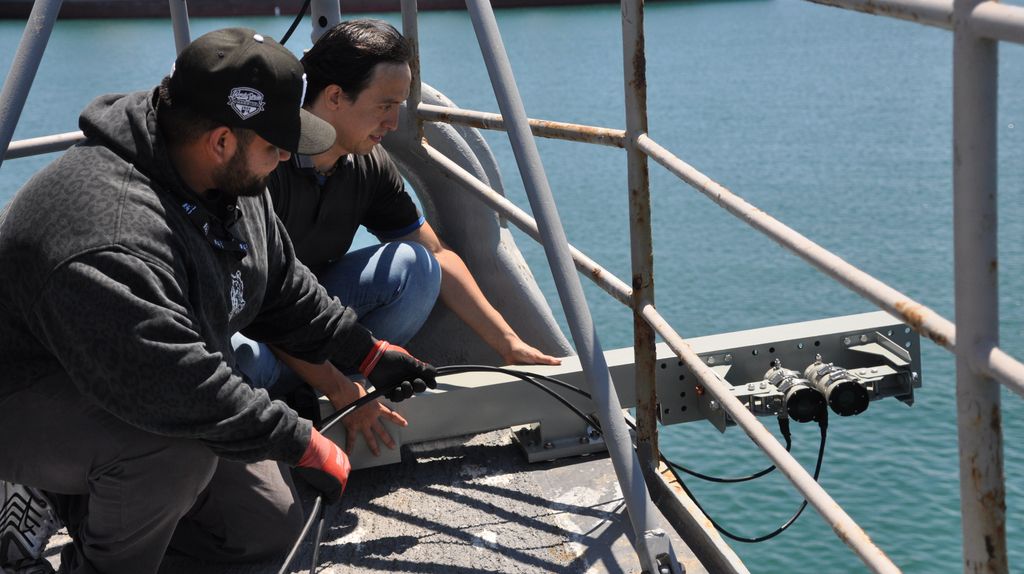
The hardware is centered on a pair of thermal cameras mounted to look out over the side. In a real-world application, the cameras would be mounted all around the perimeter of the deck, but the test involved just two units. The team temporarily installed their rig on the Self Defense Test Ship (USS Paul F. Foster, DD-964)   and tossed a rubber dummy over the side to see if it would be detected - and it was. Next steps: calculate the cost of a full-scale shipboard installation, and look for an opportunity to trial it on a ship out in the fleet.

"We needed the test results to be able to show proof of concept," Branch Manager Eric King said in a statement. "[We] have started the discussions with potential sponsors, along with the possibility of integrating the MOB system into a larger program."

Suicide prevention is a top priority for the Navy and Marine Corps, and Acting Navy Secretary Hung Cao has made it an early focus of his tenure. After the spate of reported suicide attempts in the Abraham Lincoln Carrier Strike Group, including at least one man-overboard incident aboard Lincoln, Cao released a message calling on servicemembers to "confront the rising tide of suicide head-on" through active leadership and frank conversations. With Port Hueneme's R&D work, technology from the cruise industry might also be of assistance.  


Residential Cruise Ship Seized and Departs for Singapore

cruise ship
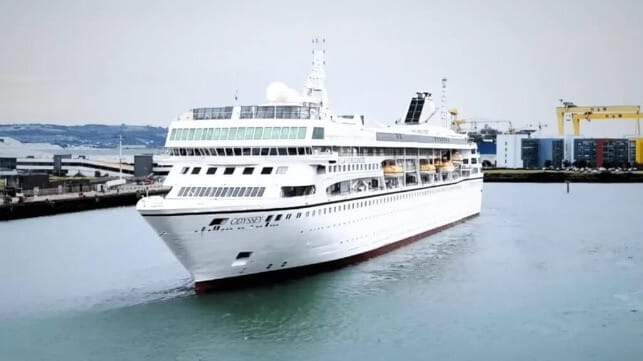
Villa Vie's Odyssey departed for Singapore with reports it has been seized by creditors (Villa Vie Residences)

Just days after the residential cruise ship Villa Vie's Odyssey ordered passengers to disembark in Cambodia, reports indicate that the ship has been seized by creditors. The cruise ship left Cambodia around midnight on Wednesday, November 4, and its AIS transmission shows it is bound for Singapore.

The former residents remain in Cambodia for the most part as they continue to figure out their next steps. Reports said that a passenger committee had launched the idea of the residents buying the ship, but they admitted in a media interview that it was a long shot.

Unconfirmed reports said that two financial institutions had financed the operation and were the primary creditors. They are reported to have moved to seize the ship and directed it into layup at Singapore. There is speculation that they would move to have the ship sold at auction.

Some of the former passengers complained that they still have possessions aboard the ship. They were initially given just hours to collect everything and leave the vessel by 2:00 p.m. local time on October 27 after some were aboard for just over two years. Others had joined the ship at different intervals during the world cruise. Everyone was transferred to a hotel in Cambodia, where they reported the government was being very helpful with arrangements and hosted a welcome dinner. Reports had said the passengers were to be able to go back aboard the day after they were evicted to claim more personal items, and now some are renting residences in Cambodia.

The failure of what was promised to be an endless 3.5-year cruise has drawn worldwide media attention. Reports have come out of poor management, a shoestring operation, and growing fears among the passengers and crew that the operation would cease. There are reports of unpaid bills, crewmembers not receiving wages, and requests to the passengers to help with money and other situations. Passengers claimed they were repeatedly asked to make additional financial contributions to the operation.

The executives from Villa Vie Residences spoke to the media and said the seizure of the ship was not necessarily the end of the operation. They said they continued to work to refinance and still hoped that they could resume operations. They, however, repeated that there were no assurances that they could refinance the operation.

The company had cited dramatic increases in fuel costs as the reason for its collapse. It said efforts were made to lower fuel costs by sailing slower or extending the stays in port. However, the ship, which was capable of carrying nearly 1,000 passengers, was reported to be sailing with just over 200 residents. The company, however, had said in July that “Villa Vie Odyssey surpasses 85 percent of its available residences sold.” The Villa Vie website says it was selling 650 residencies. 

Built in Spain, the cruise ship is a small vessel of just 24,344 gross tons.  It entered service in 1993 and went through a series of names and operators during its career. It was acquired by the UK-based Fred. Olsen Cruises in 2001 sailing as Braemar. In 2008, the vessel was stretched in an operation for Fred. Olsen, which added a new 31-meter (102-foot) mid-body to the hull. She continued to sail until the cruise industry shutdown in March 2020 during the COVID-19 pandemic. Fred. Olsen replaced all its ships during the pandemic, and Villa Vie acquired the former Braemar and took delivery in February 2024. The ship was reconditioned and finally departed on October 3, 2024, after several delays, for its endless world cruise.

Mike Petterson, the company's founder and executive chairman, did not deny the reports of financial difficulties or that they had asked the residents to contribute additional money. Speaking to CBS News, he said the company was owned by management and the residents, and as shareholders, it was natural to ask them to contribute.

CBS also highlights that Residential Cruise Holdings, the parent company of Villa Vie, had said it was acquiring at least one additional cruise ship and working on two residential cruise projects. At the end of July, the company said it had a second cruise ship to start operations in 2029 and was offering passengers a scheme to transfer between the two ships. It had promised to announce the details of the second cruise ship during a party to celebrate the second anniversary of the sailing of the Odyssey.

A sister company, Avora Residences, had also begun marketing and reported it had an agreement with Villa Vie. Avora reported that it had a nine-year charter with a nominal purchase option for the Seven Seas Navigator from Regent Seven Seas Cruises, part of Norwegian Cruise Line Holdings. It was scheduled to take over the ship in late 2027 and relaunch it as the Avora Lumina, a more upscale cruise residence. 

Petterson told CBS News that he was focused on attempting to refinance the Odyssey. There was no word on whether the other operations would survive.