Thursday, November 05, 2026


Saildrone Wins Court Challenge to USN’s New Procurement Evaluation Program
Saildrone
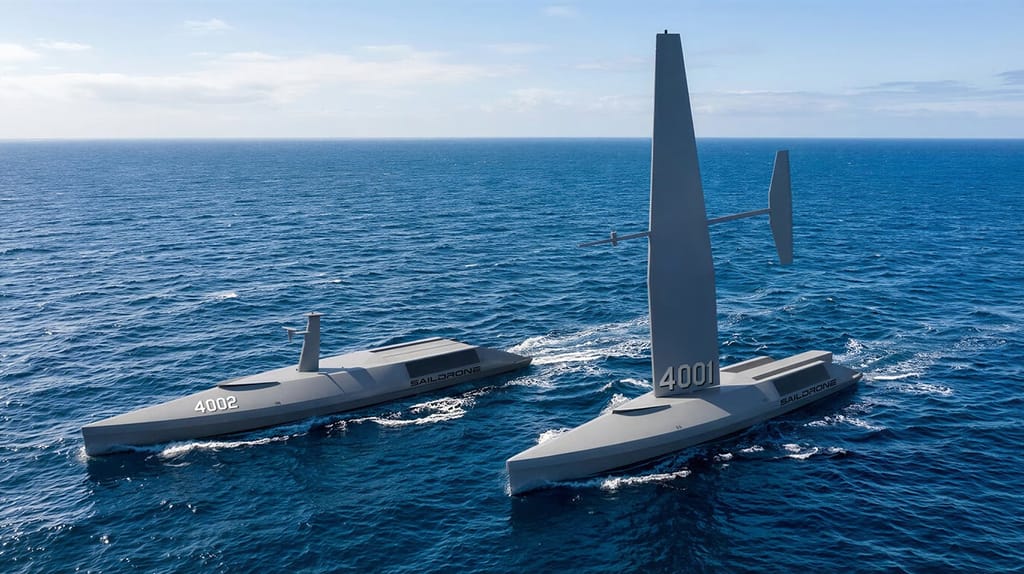
Renderings of Saildrone Spectre in Stealth Strike configuration (left) and Silent Endurance configuration (right) (Saildrone)

Saildrone, a manufacturer of unmanned surface vehicles, prevailed in court after it challenged the U.S. Navy’s new procurement evaluation program touted by the Pentagon to speed up the process. It is seen as a rare example where a supplier was able to prevail against the government and, according to lawyers, shows that the government can’t place a major procurement beyond judicial review.

The case stemmed from the U.S. Navy’s competitive program for the development of a new Medium Unmanned Surface Vessel (MUSV). The Navy has increasingly developed and deployed these drones, and this new program envisions a class of medium-size vessels, 

The Pentagon has sought to modernize and speed up the procurement process, reports The New York Times. The newspaper wrote about the selection process for this program, reporting last summer about the problems and calling the process “messy from the start.” It said participants had been left confused and frustrated. In September, the Navy reported it had awarded initial orders for 10 vessels each from Galliano Marine Services, HII, and Saronic Technologies following successful at-sea testing.

Saildrone sued, alleging that it had been unlawfully excluded after the Navy deemed Saildrone’s entry non-compliant across all three of the evaluation criteria. Saildrone was excluded from the final demonstration phase and challenged the Navy, arguing that it was being falsely deemed non-compliant.

Two of the three determinations were dropped reports Saildrone after it filed the challenge, but a third remained as a disqualifier. Saildrone took it to court along with another competitor, Blue Water Autonomy, which was also denied the right to conduct its demonstration. 

Judge Philip S. Hadji of the United States Court of Federal Claims agreed with the company, finding that the Navy “engaged in disparate treatment” and had “acted in an arbitrary and capricious manner in its review of Saildrone’s proposal.”  The judge in his ruling set aside the Navy’s decision to eliminate Saildrone from the competition.

The court determined that Saildrone was unlawfully excluded and ordered the Navy to promptly reevaluate Saildrone’s proposal using the same criteria it applied to other competitors. Until it does, the Navy cannot commit more than $1.5 billion of the program’s $2.1 billion budget to production.

Reporting on the case, The New York Times highlights that it was an “unusual victory for the industry.” It notes that most companies protesting government bidding decisions do not prevail and that it was rare for a small defense contractor to overturn a decision. 

The lawyers at the firm Selendy Gay, which represented Saildrone, commented that it is “a decision with implications far beyond a single competition.” They note that the judge rejected the government’s claim that the court “had no power to hear challenges to Other Transaction (OT) competitions,” which the lawyers note now steer billions of dollars in defense spending. 

“The government argued that the Navy’s prototype competition fell outside the court’s bid-protest jurisdiction. Judge Hadji disagreed, holding that the competition was sufficiently connected to the Navy’s ultimate procurement of the vessels,” writes Selendy Gay partners Laura King and Faith Gay, who represented Saildrone, along with Corey Stoughton, Gabrielle Kanter, John Juenemann, and Samuel Axelrod, and co-counsel Carla J. Weiss of Nichols Law.

Saildrone’s founder and CEO Richard Jenkins highlighted that the ruling is a win for fair competition, for taxpayers, and for national security. In a prepared statement, he, however, said, “The future of naval warfare will be fought on the water, not in a courtroom. We are eager to move beyond this litigation and return our entire focus to delivering world-leading maritime autonomy for the US Navy.”

The judge, however, also decided that the Navy’s evaluation of Blue Water Autonomy was “reasonable.” Blue Water’s protest was denied.

Xi Jinping Completes His Military Purge, Including PLA Navy's Top Admirals

Huazhi
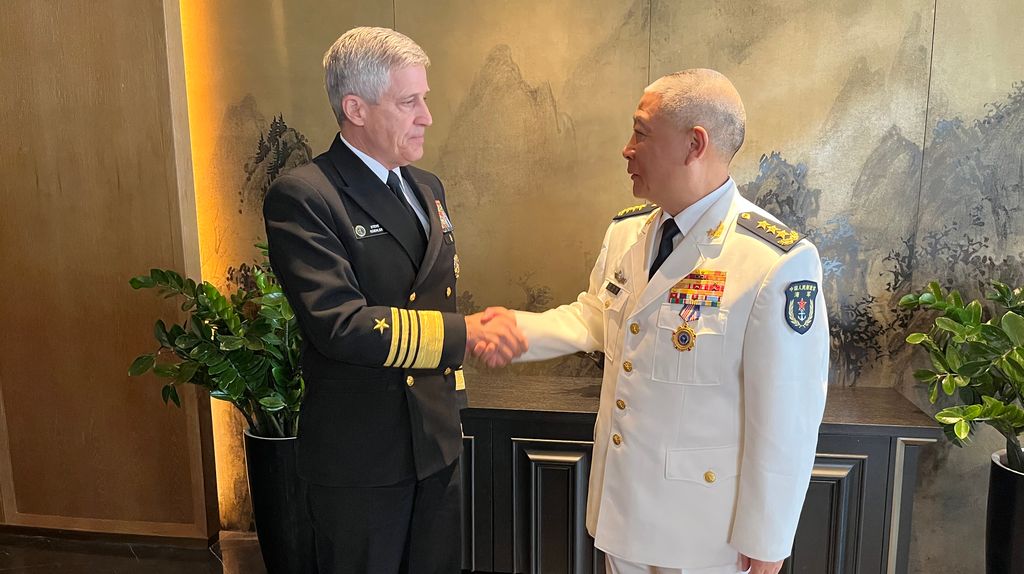
Adm. Yuan Huazhi (right), then-political commissar of the People’s Liberation Army Navy, 2024. He was ousted in a purge earlier this year. (USN)

In the latest issue of the Maritime Executive magazine, the thorough-going purge of China’s Peoples’ Liberation Army (PLA) was described, a clean-out so comprehensive that it was uncertain if there was anyone left in the high command of the PLA with the necessary experience to prepare for and to execute an invasion of Taiwan. President Xi himself has said repeatedly that the PLA must be equipped and ready to ‘recover’ Taiwan by 2027, the year in which the PLA attains its 100th anniversary and President Xi presents himself for an unprecedented fourth term in office at the 21st Chinese Communist Party (CPC) Congress.

But rather than culminating with the recently-confirmed dismissal of General Zhang Youxia, who as Vice Chairman of the Central Military Commission (CMC), the equivalent of the US Joint Chiefs of Staff, was the CMC’s most senior officer, the purge has continued. There is almost no officer left in the senior PLA hierarchy to purge – and often replacements have not been appointed, so many posts have now been left open and further purge opportunities are now limited. The PLA Navy has been particularly hard-hit.

The continuing purge was the central theme of the CPC’s Fifth Plenary Session, which concluded in Beijing this week. With President Xi Jinping speaking to an auditorium with dozens of empty seats, the communique issued afterwards stressed the importance of adopting ‘Xi Jinping Thought on Party Building’ and on taking ‘systematic steps to address both symptoms and root causes of corruption, adopting a holistic approach that combines severe punishment, targeted remedy, and effective prevention, carrying this fight through to the end." The surviving delegates voted unanimously in favor of the supporting resolutions.

President Xi railed against a lack of Party spirit amongst CPC members, and malpractices such as ‘cultivating connections’, the use of proxies to make back-room deals, contractor collusion with recently-retired officers, and the illicit use of the internet, blockchain technology and foreign currency exchanges.

Those known to have been purged earlier this year included General Zhang Youxia, CMC Deputy Chairman, and General Liu Zhenli, Chief of Staff for Joint Operations, now announced as not just dismissed but up for trial on what could be capital charges. Both were previously close friends and long-standing political allies of President Xi. 

Also dismissed earlier this year were:

General He Weidong, head strategic planner for operations against Taiwan.

Admiral Miao Hua, Head of the CMC Political Works Directorate

Admiral Yuan Huazhi, Head of the PLA Navy Political Works Department.

Admiral Wang Houbin, Commander PLA Rocket Force

Vice Admiral Li Hanjun, former Commander PLA Navy

Lieutenant General Lin Xiangyang, Commander of the Eastern Theatre facing Taiwan

Vice Admiral Wang Zhongcai, Commander East Seas Fleet facing Taiwan.

Major General Ding Laifu, Commander 73rd Army Group, in the Eastern Theatre facing Taiwan

The sixteen new names added during the CPC’s Fifth Plenary Session to the list of those purged included:

Lieutenant General Zhong Shaojun, Director CMC General Office, long-term Xi aide

Lieutenant General Fang Yongxiang, Director CMC General Office,

General Wang Haijiang, Commander Western Theatre

General Huang Ming, Commander Northern Theatre

General Liu Qingsong, Head Political Works Department Eastern Theatre

General Zhao Zongqi, retired and a former Western Theatre Commander

General Zhao Zongqi may perhaps have been targeted because he was a Chinese military hero, renowned for his exploits in the Sino-Vietnamese War and his leadership in the 2020 Galwan Valley clash with India. General Zhang Youxia may also have been dismissed just for being a bit too charismatic and effective – and hence presenting a potential challenger to the somewhat dour President Xi.

Those dismissed include all four theatre commanders, as well as the principal operational commanders in the Eastern Theatre who would be charged with ‘recovering’ Taiwan. There will also have been hundreds of junior officers, subordinates of those dismissed, who will also have been purged. One of the few senior officers to remain in post is Admiral Hu Zhongming, PLA Navy Commander since December 2023 and previously Commander North Sea Fleet. But he has not been elevated to membership of the CMC.

All were variously dismissed for ‘forming political cliques and factions, disloyalty and dishonesty toward the ruling party, abuse of office and illicit promotion assistance, and for accepting large sums in defense-related corruption’. They may also have posed a perceived political threat to Xi in the run-up to his expected bid for an unprecedented fourth term as the CCP’s top leader.


US Sanctions False-Flag Network Run from India Used for Iranian Shipping

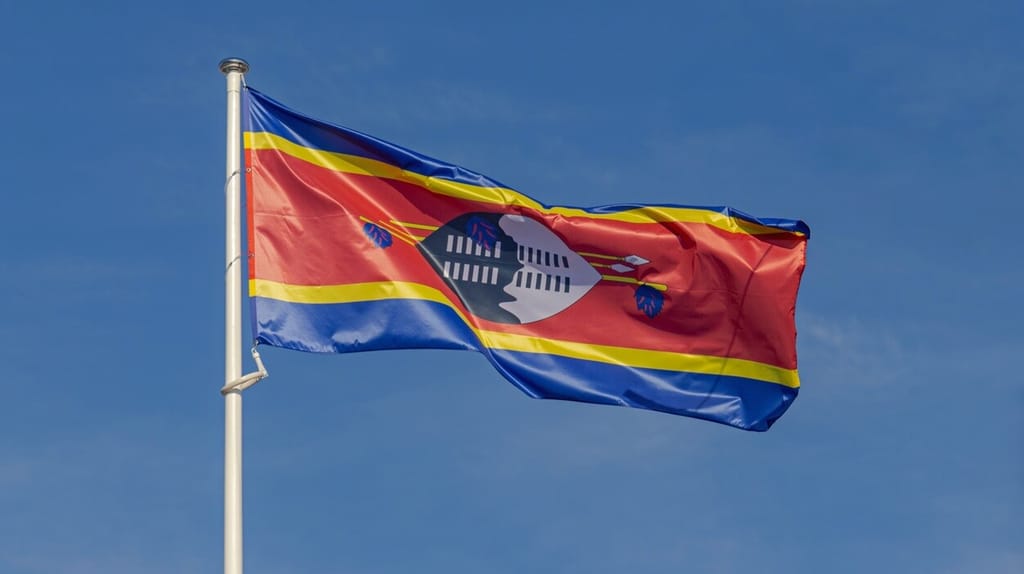
Eswatini flag
Among the false flag operations the US reports the Indian network operates the false Eswatini Maritime Affairs registry (iStock photo)

Continuing its efforts to shut down all the avenues supporting Iran’s shadow fleet, the U.S. Treasury announced new sanctions targeting a network that it says is behind a broad range of false flag operations. Treasury accuses an Indian husband and wife, Suniel Kumar Sharma and Jaspreet Preeti Shahid, of running a web of maritime fraud that provided false flags and certifications to sanctioned vessels involved in transporting Iranian petroleum.

The Treasury Department began the initiative under the name “Operation Economic Outcast” in August 2026, aiming to further go after the networks supporting the Iranian regime. It has included additional targeting of tankers as well as other elements such as money laundering and sanctions evasion. The Treasury Department reports it is working with partners, including the European Union, United Kingdom, and Gulf state partners, to map the networks, facilitators, and financial channels that Iran uses to smuggle oil, evade sanctions, and fund terror.

The U.S. says the husband-and-wife operation based in Chandigarh, India, is responsible for establishing false flagging authorities and maritime certification societies ranging from Aruba to Guyana, Mali, Mozambique, Malawi, and Sint Maarten and Timor-Leste, as well as the current false organization called Eswatini Maritime Affairs and International Ship Registry, which is actually operated from Singapore. It highlights that Eswatini authorities have publicly disavowed this organization, as have other nations for similar operations. Many of the flags listed are well-known for being associated with false flag tanker operations, both supporting Iran and Russia.

The Indian couple was accused of starting their operation as early as 2014, when the U.S. asserted the couple sought to impersonate the flagging authority of the Caribbean nation of Dominica. They assert that the Sharma network purchases web domains, creating websites that claim to offer a variety of services on behalf of a country that has not authorized it to provide any of those services. The services often include flagging, seafarer training and certification, and vessel classification, all of which are traditionally handled by legitimate organizations that hold vessels to strict international standards.

Sharma, the U.S. reports, established the Singapore-based Eswatini Maritime Affairs and International Ship Registry in 2023. They highlight that despite being publicly disavowed by Eswatini authorities, the group continues to provide flagging services for vessels transporting Iranian petroleum. They also report that the Sharma’s network can be tied to multiple active websites that purport to belong to legitimate flagging registries.

Suniel Kumar Sharma and Jaspreet Preeti Shahid are being listed along with their company, Aryavart Ship Management Private Limited. The United States is also designating Eswatini Maritime Affairs and International Ship Registry.

In addition, the Treasury Department’s Office of Foreign Assets Control (OFAC) issued a new alert to the maritime industry to warn of the sanctions risks of dealing with potentially falsely flagged vessels. It reemphasized previous warnings from Treasury to the maritime industry to screen against unscrupulous actors such as Sharma and the vessels his network supports.

Turkish-based Fugo Ground Services was also sanctioned today by OFAC for its ongoing services in support of Iran’s aviation sector. Treasury said it has repeatedly warned that it will take action against those who continue to support Iran’s aviation industry, and it renewed its warning of “serious consequences” for supporting Iranian efforts.


Design Basis Agreement Reached for 150-Passenger NYC Hydrogen Ferry

hydrogen-powered ferry concept
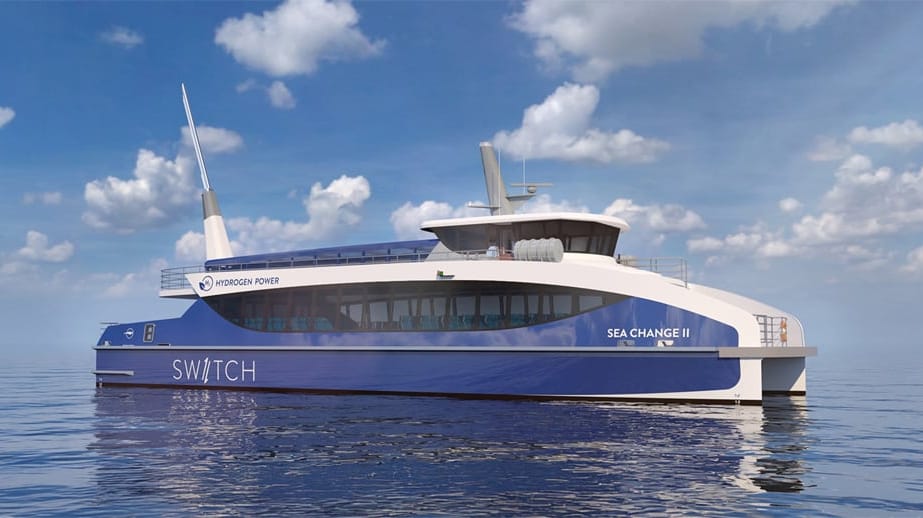
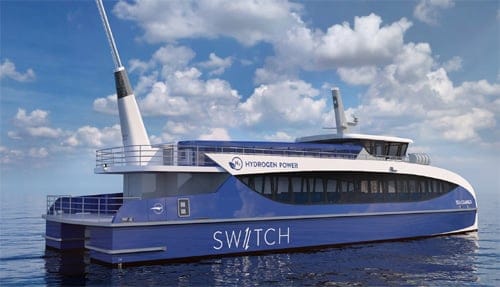
Design for a 150 passenger hydrogen-powered ferry (Incat Crowther)

A Design Basis Agreement (DBA) was secured by Incat Crowther in partnership with SWITCH Maritime from the United States Coast Guard for a proposed 150-passenger hydrogen fuel cell-electric fast ferry platform designed to operate in New York  City. The project is being called a “significant regulatory milestone,” as SWITCH, which pioneered the first hydrogen fuel cell-electric propulsion in the United States in 2024, looks to expand the commercial applications for the technology.

The companies highlighted the challenges, noting that the USCG Subchapter T regulation, the set of rules and standards that governs the design, construction, and operation of passenger vessels with a capacity of less than 150 passengers, does not currently include guidance or regulation written specifically for hydrogen fuel cell-electric propulsion and hydrogen storage. Switch, Incat Crowther, and the vessel project team worked directly with the USCG to build a regulatory framework that demonstrates sufficient equivalency in safety and risk mitigation. The International Maritime Organization (IMO) approved the Interim Guidelines for the Safety of Ships Using Hydrogen as Fuel in May 2026. These guidelines served as an important foundation for the DBA process, adding more structure while reducing time to approval.

Signing the DBA with the Coast Guard is a critical milestone in advancing the development of the SWITCH-150,” said Francisco Planells, Director of the Newbuild Program, Switch Maritime. “With the DBA in hand, Switch, our project team, and the USCG have a clear and defined framework that will inform vessel construction, commissioning, and ultimately operation.”

The program envisions a 28-meter (92-foot) ferry designed to carry 150 passengers at a cruising speed of 25 knots. It is based on Incat’s catamaran design built of aluminum and would incorporate 1576 kWh of batteries.

With 720 kilograms of stored, compressed hydrogen capacity, it will be able to run a range of routes across New York ferry networks with a full day of range. The main deck will feature comfortable seating for 150 passengers, ample luggage storage, a kiosk, three bathrooms including a wheelchair accessible bathroom, and large windows to allow passengers to enjoy the iconic views on New York’s waterways.

SWITCH-150 draws directly from the technical, regulatory, and operating framework set by Switch’s first vessel, Sea Change, a 70-foot ferry with a capacity of up to 75 passengers. Also designed by Incat Crowther, Sea Change was the first hydrogen fuel cell-electric ferry in the United States. It received its DBA from the USCG in 2020 and its Certificate of Inspection (COI) in 2024, permitting it to begin passenger service in July 2024, operating in San Francisco Bay.

“The DBA is validation of the smart engineering and safety-focused approach built into the vessel design, giving operators confidence that hydrogen fuel cell-electric propulsion can be delivered on a fast ferry of this size. With the DBA now in place, our focus moves to taking the design through detailed development and into a complete digital shipbuilding package ready for construction,” said Dan Mace, Technical Manager, Incat Crowther.

SWITCH highlights the advantages of the concept, noting that the SWITCH-150 platform is designed to align with the performance and operating specifications that ferry operators have come to expect from diesel vessels. Powered by an integrated hydrogen fuel cell-electric propulsion and hydrogen storage system, SWITCH says the vessel will have the capability to perform high-frequency, high-intensity ferry operations like an existing diesel vessel. This means parallel service speeds, a daily bunkering schedule, and no need to increase dwell time or alter service to account for vessel charging. It will not require costly and complicated shoreside charging infrastructure and power grid upgrades, instead supplied by mobile hydrogen refueling equipment. SWITCH-150, they report, can be seamlessly integrated into an ongoing ferry operation, rather than requiring scheduling changes or a system-wide reorientation, as would be required for a comparably specified battery-electric vessel.

The first SWITCH-150 is intended to operate in New York City, based at the Brooklyn Navy Yard. The development of New York’s first hydrogen fuel cell electric ferry is supported by a $2 million grant from the New York State Energy Research and Development Authority (NYSERDA).


Lobbying Over Jones Act Waiver Heats Up As Renewal Approaches

iStock
iStock

With Democrats back in control of the House and the Senate, American shipping stakeholders will have a new set of leaders to petition on the issues that matter most - starting with the Jones Act, a perennial point of contention between the American petroleum industry and the American domestic shipping industry, including its shipowners, mariners and shipbuilders. 

In parallel with the Iran conflict, the Trump administration enacted a historically-long waiver of the Jones Act for domestic energy cargoes, arguing that it could reduce the price of fuel at the pump. Independent analyses suggest that - while retail gas and diesel prices have fluctuated dramatically over the course of the year - the practice of allowing oil companies to charterer foreign-flag tankers for domestic routes has had no discernible effects on the American consumer. Critics have also questioned the national security waiver's legality, as it is unclear if the cargoes have been delivered to solve an "immediate adverse effect on military operations," as is required by the text of the statute.

Authority over the waiver lies in large part with the White House, and advocacy efforts have centered on attempting to prevent each periodic extension (now totaling 250 days). The administration's waiver comes up for renewal on November 15, and an campaign is under way to ask the White House to allow it to lapse.

"Allowing the waiver to expire is essential to avoid unintended consequences that constrain investment in the recapitalization of the American maritime industry and the growth of the American maritime workforce," said the American Maritime Partnership's Jennifer Carpenter in a statement on Tuesday. "More than 28 percent of reported waiver voyages were on vessels or companies directly tied to China, including COSCO vessels linked to alleged intelligence-gathering activity. Foreign vessels gained access to sensitive U.S. waterways and critical American cargo, while foreign companies profited and Americans saw no benefit at the pump."

On the other side of the question, the American Petroleum Institute (API), the voice of oil and gas in Washington, has "applauded" the long waiver period. Its policy platform calls for easing the emergency-waiver process and creating legal "triggers" that would turn on a new waiver whenever there are "prolonged regional fuel supply shortages, significant inventory drawdowns, refinery outages, transportation disruptions, or sustained price spikes."

Policy decisions about the Jones Act - and the power for detailed scrutiny of its implementation - also lie with Congress. After the current session of Congress ends in December, the Democratic Party will assume control of the House and Senate. One of the most active voices in questioning the wisdom of the waiver, Rep. Salud Carbajal (D-WA), is set to inherit the chairmanship of the Subcommittee on Coast Guard and Maritime Transportation in January. As chairman, Carbajal will have the power to set the subcommittee's agenda.

Carbajal's recent advocacy could provide a preview of the line of questioning the subcommittee might pursue next year. His staff began reaching out to foreign owners and operators in June, asking for details on how they were using the waiver process. In mid-October, Carbajal wrote to the Department of Homeland Security to ask about the non-disclosure of at least 25 waivered voyages, raising questions about "whether DHS and its component agencies are adequately enforcing federal law with respect to foreign vessels operating in U.S. domestic commerce." He has also raised questions about whether waivered-voyage operators have fully complied with U.S. tax law and immigration regulations. 

First Flight II LPD Heads Out on Builder's Trials

LPD
Press handout courtesy Huntington Ingalls

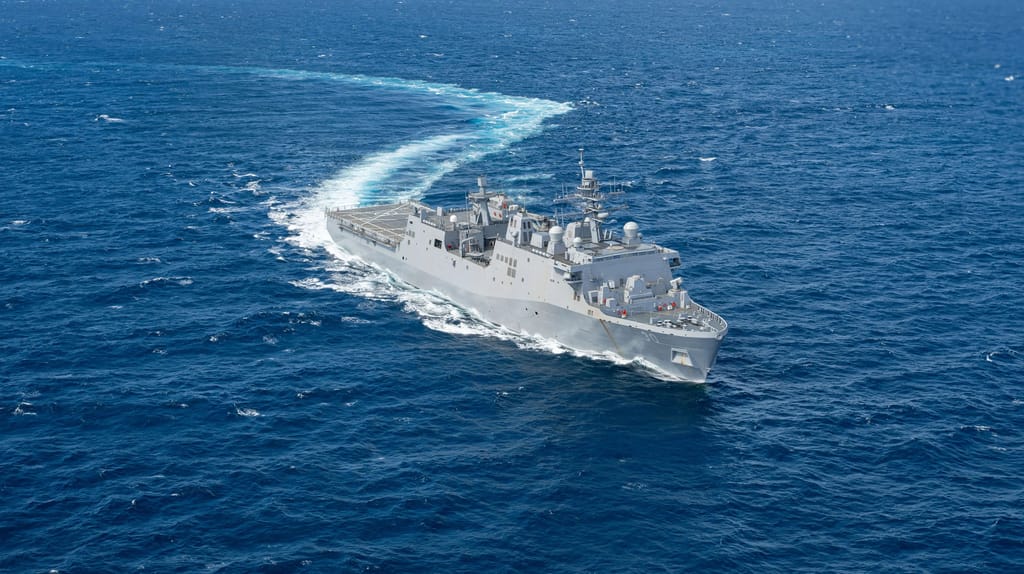
Ingalls Shipbuilding has completed builder's trials for the future USS Harrisburg (LPD 30), the first of the Flight II San Antonio-class amphibious transport dock ships. It is far from the last: the HII division and its subcontractors are in various phases of work for LPD 31 through 35, all already on contract.

The Navy decided to build a second flight of 13 San Antonio-class amphibs in 2018, and the award for LPD 30 went out the next year. LPD 30 was laid down in January 2022 and launched in October 2024. As of a September 2024 review by GAO, it was about 15 months behind schedule, consistent with other Navy shipbuilding programs. Commissioning is expected in the summer of 2027. 

From keel-laying to drydock flooding, China's state-owned shipbuilder CSSC can launch a comparably-sized Type 071 LPD in four months. China's navy is the world's largest, and is the pacing threat for U.S. Navy planning purposes. 

To accelerate progress on the LPD series, HII has adopted the idea of distributed shipbuilding - outsourcing production of subassemblies to smaller shipyards, then putting together the partially-completed hull sections at its own facility. The practice requires precision and discipline, but has worked successfully for other programs, like the Royal Navy's Queen Elizabeth-class carriers and the U.S. Navy's next generation of submarines. 

LPD 32, the future USS Philadelphia, will contain six modular units from Eastern Shipbuilding Group - the Florida Panhandle yard known for its workboats and ferries, which has made big bets on entering the defense shipbuilding space. ESG says that it is already at work on producing the units for delivery in the second half of 2027. 

"Our team is fully engaged and ready to deliver these six complex modules on schedule in 2027. This collaboration showcases the strength of the Gulf Coast shipbuilding industrial base and underscores our shared commitment to national defense," said Joey D’Isernia, CEO and Chairman of Eastern Shipbuilding Group. 


Long Beach Gets World's First Hydrofoiling Electric Pilot Boat

The Artemis EF-12 (Artemis file image)

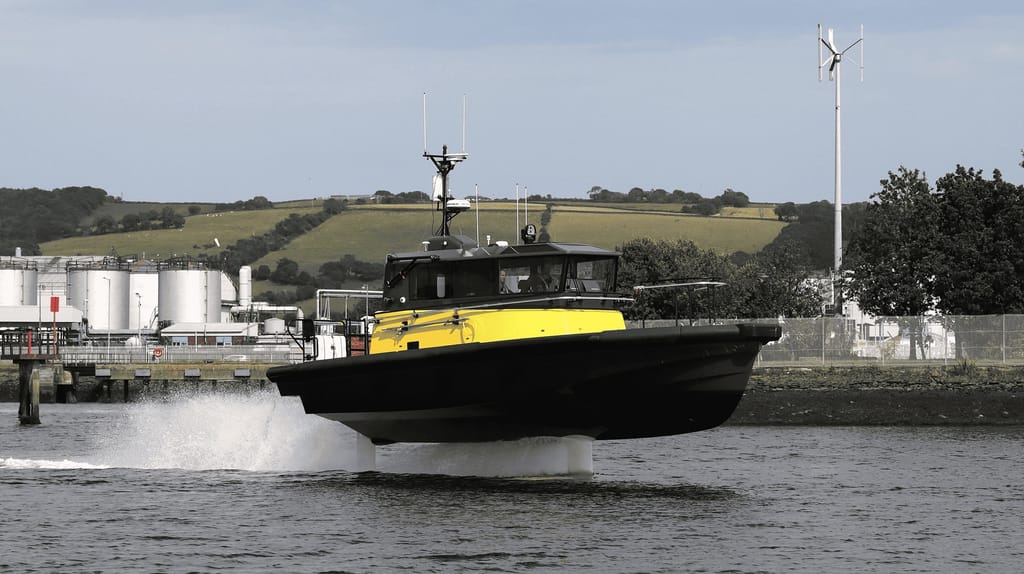
The Belfast-based electric boatbuilder Artemis Technologies has sold a specially-adapted version of its hydrofoiling electric speedboat to Jacobsen Pilot Service, the pilotage provider for Port of Long Beach. Artemis launched the first vessel in the newly-designed EF-12 Pilot class in June 2026, and announced the first sale in a social media post on Wednesday. 

Artemis says that the EF-12 is the first pilot boat in the world to combine electric propulsion and hydrofoil technology. The technologies are synergistic, the firm says: hydrofoiling gets the hull out of the water, reducing drag and boosting battery range. The heart of the design is a pair of combined hydrofoil-propeller-rudder units, which sit on struts below the centerline. 

For busy pilots in need of swift transport, the design can hit 32 knots with four passengers aboard, and it has a range of up to 40 nautical miles at cruising speed - plus a quiet and smooth ride above the waves. During development, Artemis consulted with pilot boat operators from around the world to get feedback, and conducted a series of trials with Cork Pilots at the Port of Cork to perform early testing. The  design of the hydrofoils' rudder system allows the operator a high degree of control over yaw, giving the pilot boat an advantage when making contact with the side of a ship's hull and then breaking away, according to Artemis. 


At Long Beach, the EF-12 design will see considerable use and a high degree of public exposure. The San Pedro Bay port complex is the busiest container hub in the Western Hemisphere, and Jacobsen facilitates more than 7,000 vessel movements in and out of the harbor every year. For the operator, it will save the expense of 40,000 gallons of diesel per year - upwards of $200,000 at current prices - and will reduce CO2 emissions by 400 tonnes annually. For the port, it means a reduction in NOx, SOx and PM emissions, which are priority targets because of their health effects.  

The Port of Long Beach is supporting the purchase of the Artemis pilot boat with funds from the state of California's Port and Freight Infrastructure Program. Long Beach holds $380 million in two grant awards from the program, and is using the funding to pursue zero-emissions initiatives and rail improvements. 


World's Biggest Battery-Electric Ferry Enters Commercial Service

Incat
Image courtesy Incat

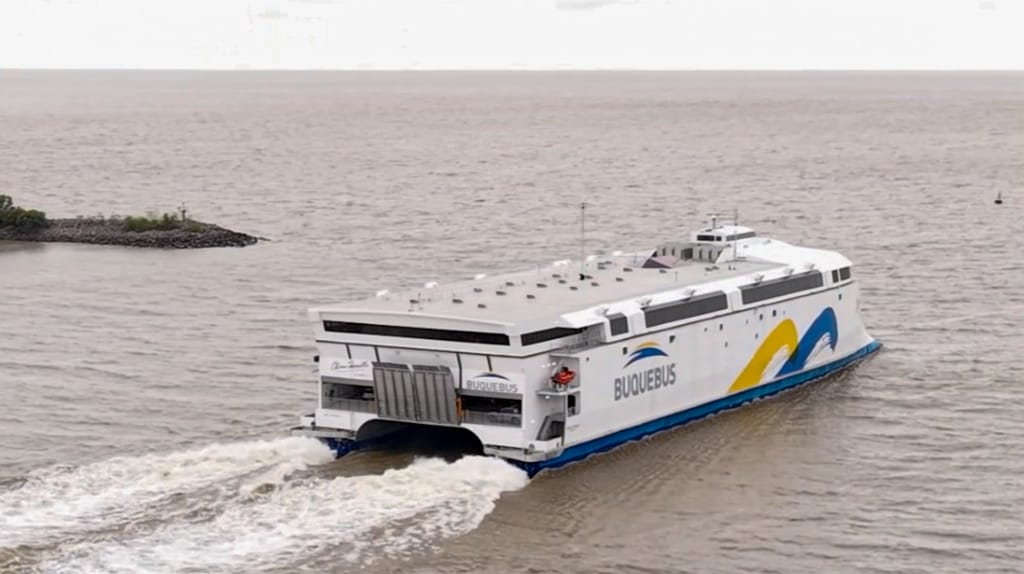
The Ecuadorian ferry operator Buquebus has begun commercial operations with the world's largest battery-powered ferry, the China Zorrilla, named after a regionally famous actress. 

China Zorrilla is an aluminum fast-ferry constructed at  Incat, a pioneer in the aluminum-multihull ferry space. After construction at Incat's yard in Tasmania, the vessel was loaded out on a heavy lift ship and transported to the Rio de la Plata. 

Capable of carrying up to 225 vehicles and 2,100 passengers, China Zorrilla is larger and has a bigger battery bank than any other battery-electric vessel. The 130-meter ropax has a deadweight capacity of about 960 tonnes, and has enough spare internal volume to accommodate a massive duty-free retail space.

According to Wärtsilä, the supplier of her power and propulsion systems, the design challenge was to build a zero-emissions ferry that could make 25 knots on a 60-kilometer route, and would be capable of shallow-water operations. The solution included 41 MWh worth of battery capacity, eight electric propulsion motors and eight axial flow waterjets. A pierside DC charging system restores the batteries to readiness with about 40 minutes, and is part of the scheduled operation for each one-way trip. 

The vessel is named for "China" Zorrilla (originally Concepción Matilde Zorrilla), a locally-famous actress who made her name in the Uruguayan and Argentinian theater scenes. She appeared in countless plays, movies and television shows from the 1950s up through at least 2007. She passed away in 2014.


BAE Systems' Sale of Dormant Australian Naval Shipyard Raises Concerns

Williamstown shipyard Australia
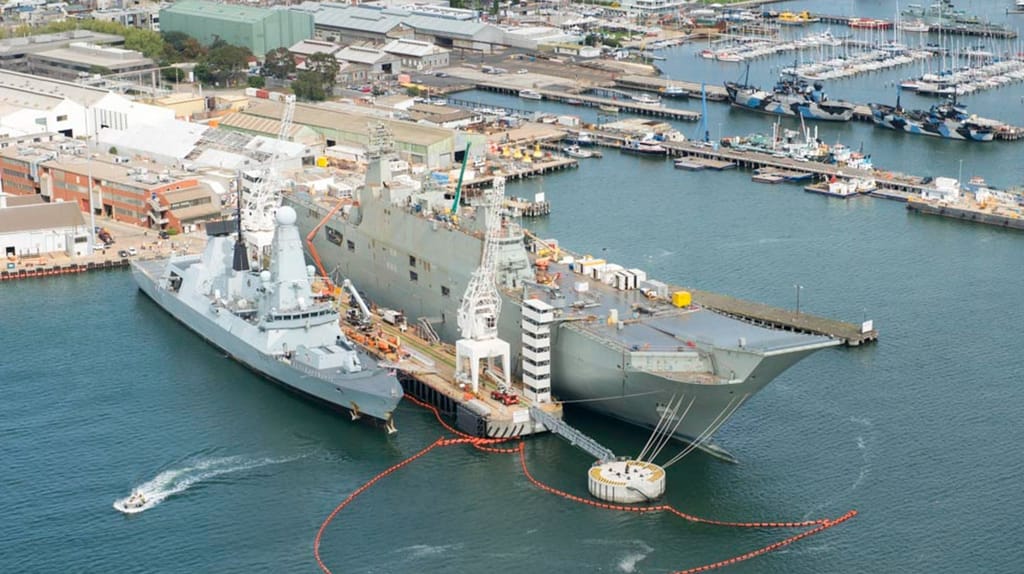
Williamstown shipyard closed a decade ago but the proposed sale to a real estate management company is attracting opposition (BAE Systems file photo)

The likelihood of a new political debate over Chinese ownership and the sale of key elements of Australian infrastructure is growing as opponents cite the proposed sale of a former shipyard site to a real estate management company in part owned by a Hong Kong-based company. The issue of Chinese control has come to the forefront over the past few years as the political debate grew over the  Port of Darwin, which was leased to a Chinese company.

News broke in mid-October with the publication Australian Defense Magazine first reporting that BAE Systems had confirmed the sale process of the Williamstown naval shipyard near the Port of Melbourne, and the last in Victoria. BAE confirmed to the magazine the sale was in process but declined further details.

A spokesperson for the real estate developer EMKC3 confirmed to the magazine that it had a sale contract. It said future uses for the site were being discussed, but as per the terms of the contract, it would not provide additional comments. EMCK3 is in part owned by a Chinese group of the same name based in Hong Kong.

The Williamstown shipyard is significant because of its location and its long history. There has been shipbuilding in the Williamstown area since the 1850s. The current site was the location of the Victorian Navy before federation in 1901, and shipbuilding commenced at the current site in 1913.

Reports highlight that the yard was the builder of the ANZAC class frigates operated by the Australian and New Zealand Navy. It also contributed blocks and internal outfitting for HMAS Canberra and HMAS Adelaide, Australia’s current ship-landing helicopter docks (LHD) and, in the case of Canberra, the Fleet Flagship of the Royal Australian Navy.

The yard became part of BAE Systems during the acquisition in 1987 of Tenix Defence, which was one of the largest defense contracts in Australia. The yard, however, lost out on newer contracts, and after the delivery of the landing helicopter docks, BAE began to wind down the operation. The yard, which just a few years earlier had employed 1,000 or more people, was closed by 2017.

Reports indicated that BAE had put the 17-hectare site up for sale in 2024 with an estimated value of A$200 million. Australian Defense Magazine believes EMCK3 has agreed to pay “considerably less.”

The state passes legislation requiring the site to remain used for marine engineering and industrial purposes. Near the entrance to the Port of Melbourne and only a few miles from the container port, it is a prime location next to a marina and oil storage facility. Critics of the sale point out it is one of only a few yards in Australia capable of building large naval ships.

Reports say it is unlikely the buyer would be seeking to use it for residential or other purposes. However, the issues of foreign control have already begun to be mentioned. The sale and future use of the site will require approval both at the Commonwealth and State levels.

Concerns over Chinese control emerged after Landbridge was given a 99-year lease on the Port of Darwin. The current Prime Minister, Anthony Albanese, has repeatedly raised the discussion of bringing the port back under Australian control. Chinese officials have objected, and the company has said it would pursue legal claims for breach of the contract for the Port of Darwin. It points out its investments and efforts to turn around the port, while opponents claim it has failed to meet its obligations.


Dominion Energy Reports Offshore Wind Farm Is 85% Complete

Wind turbine instalaltion
Dominion reports it is taking about two days for the instalaltion vessel to completed each wind turbine (Dominion Energy)

Dominion Energy gave investors a positive update on its offshore wind farm, Coastal Virginia Offshore Wind, during its most recent earnings call. While there has not been a lot of positive news in the U.S. sector, the company stresses they remain on schedule after having delayed the completion target and says the estimated power cost continues to fall significantly.

As of the end of October, Dominion Energy reports the project overall is 85 percent complete, with the focus continuing to be on the installation of the wind turbines and commissioning. It reports that 100 percent of the nacelles, towers, and blades have now been fabricated. The focus is on installation.

The company reports it is taking approximately two days from jack up to jack down for the installation of a wind turbine, excluding the time for loadout, transit, weather, and other issues, including maintenance. September and October were slowed a little by weather issues and maintenance activities for the company’s wind turbine installation vessel Charybdis, but it says the maintenance is now completed and work is proceeding.

Since the start of installations in January, a total of 44 wind turbines have been installed, and work is underway on number 45. When completed, the wind farm will consist of 176 Siemens Gamesa 14 MW wind turbines. Since achieving first power in March, the project now has installed 640 MW of generating capacity, already making it among the largest in the United States. When completed, it will be 2.6 GW, placing it not only as the largest in the United States but also among the largest projects currently commissioned globally.

The company had previously delayed its target completion date from early 2027 to year-end 2027. However, it reports that the third and final offshore substation should be energized by the end of this year. It has no time restrictions on turbine installations, versus the foundations, which had seasonal issues for installation, and it expects that the work will continue forward at a similar pace.

While the overall outlook has not changed, and it remains on track with the capital budget after adjustments for the costs of tariffs and other delays, it points to a positive contribution from the project. The company continues to have increased power demands, especially from data center development. However, it points out that the offshore wind farm is expected to generate approximately $5 billion in fuel savings for customers during its first 10 years of operation.

The estimates on the levelized cost of energy (LCOE) also continue to fall. After starting with a forecasted range of $80-$90 per MWh, and adjustments for changes after the change in administrations, they have lowered the LCOE to $62, down from an estimate of $83 presented in August. 

The company continues to strongly believe in the benefits of the wind energy project. Analysts on the call congratulated the company for its progress and efforts to reduce risk from the project.

The positive report comes as after further challenges coming from the Trump administration to the sector. The Department of Justice has filed in the courts, seeking to review the permitting for approved projects and, in the case of Revolution Wind, a project that has largely completed the installation of its turbines. Several court challenges are pending both to the efforts to review the permits as well as the administration's buying back previously issued licenses.