Canada aims to become EU's first 'associate member' by June 2027, Carney says
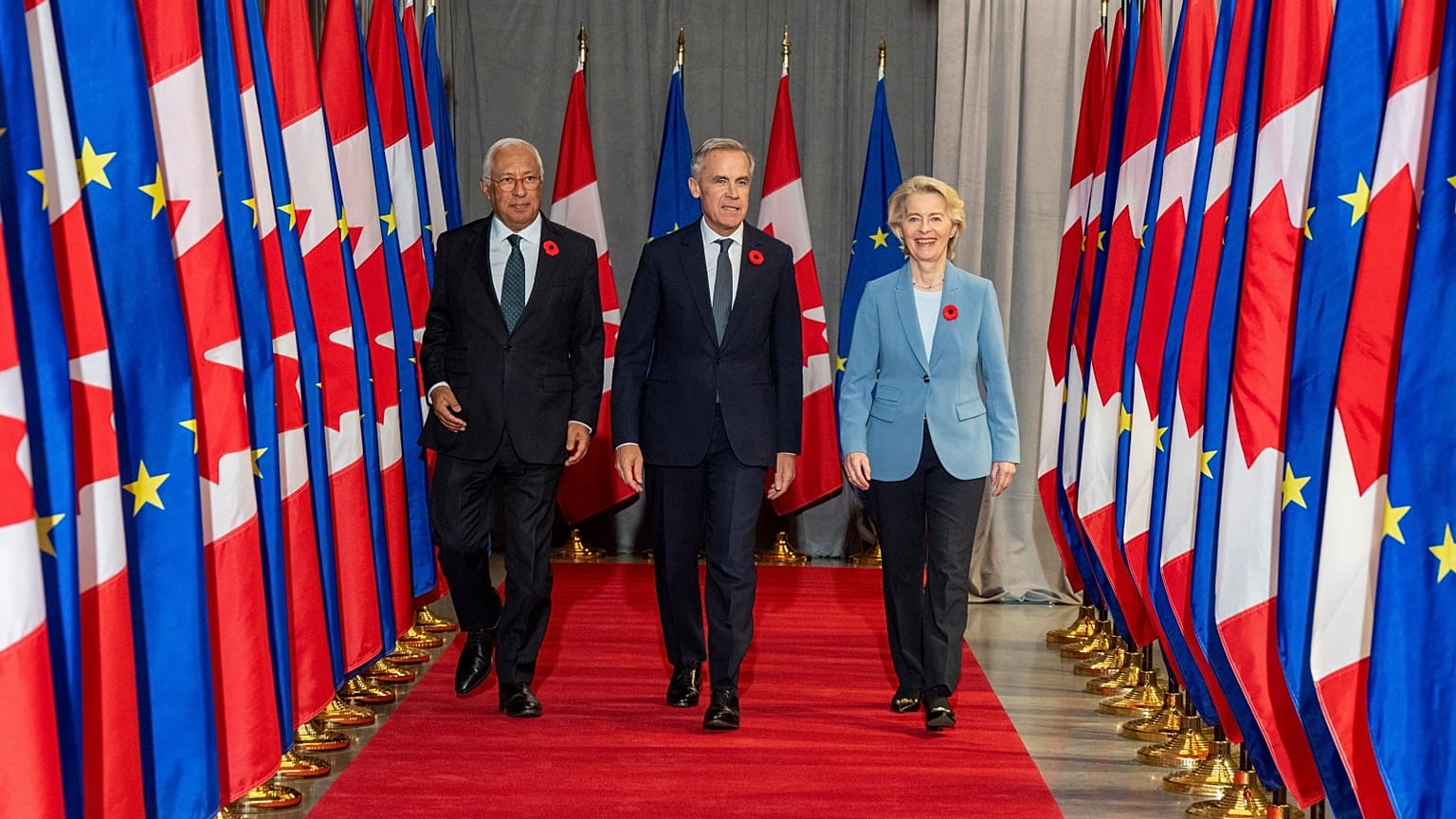 Copyright Christinne Muschi/Christinne Muschi/The Canadian Press via AP
Mark Carney has set June 2027 as the deadline to make Canada the European Union's first-ever "associate member". The category, which has no precedent, has been fiercely opposed by Germany.
Canada and the European Union aim to conclude negotiations on the country's potential "associate membership" of the bloc by June 2027, Canadian Prime Minister Mark Carney said on Friday, following a bilateral summit in Montréal.
The proposed status, which has no basis in the EU treaties, is intended to bring the two allies closer across three areas: policy, programmes and governance. Its practical implications, however, remain to be negotiated.
Ahead of the summit, Germany opposed the term "associate member" during negotiations on a joint declaration. The final text instead refers to an "ever closer association". Carney, however, appeared determined to pursue the vision.
"We are working towards the deepest possible partnership short of accession, because of our geography, with Canada becoming the European Union's first associate member," Carney said at the closing press conference.
"In the coming months, we will determine the full substance, scale and scope of this new form of membership," he added.
Standing alongside him was European Commission President Ursula von der Leyen, who surprised EU capitals in September by proposing that Canada become the bloc's first-ever associate member. The idea had not been broadly discussed with member states beforehand.
Carney, who was in the audience for her announcement, initially appeared reluctant to embrace the proposal amid concerns over its implications for Canadian sovereignty.
On Friday, however, he defended the term.
"Today, we move towards associate membership for Canada, and we launch a new alliance for the future that will deliver now and in the future with like-minded nations," he said. "We're just getting started."
Von der Leyen pointed to several immediate benefits, including Canada's full integration into the Horizon and Erasmus programmes, and the €90 billion support loan for Ukraine.
The summit also expanded cooperation on digital trade, energy, critical raw materials, supercomputing, artificial intelligence and satellite technology.
"The concept of an associate member is uncharted territory, but we have the ambition, trust and creativity to shape it together," von der Leyen said.
"And to be crystal clear: this is a partnership, not against anyone else, but for our common strength. Bilaterally, this is the highest form of partnership."
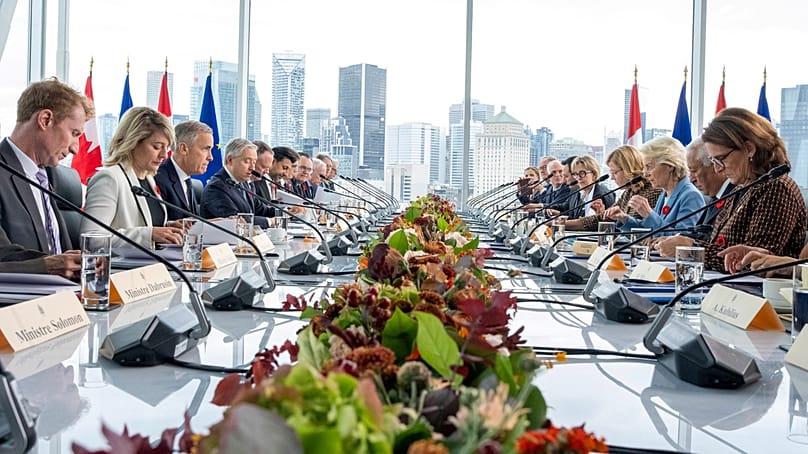 The EU-Canada summit in Montreal. Christinne Muschi/The Canadian Press via AP
The European Commission and Canadian government will hold a college-to-cabinet meeting in the spring to flesh out the proposal. Carney is then expected to attend an EU leaders' summit in June, when he hopes to conclude the negotiations.
How the arrangement would be ratified across Europe remains unclear. Carney has previously pledged to put the proposal to a vote in the Canadian parliament.
Asked about Germany's opposition, von der Leyen sidestepped the question, saying there was "broad support" among member states for bringing Canada closer to the bloc.
German Chancellor Friedrich Merz was the first to float an "associate member" definition in the context of Ukraine's own EU aspirations. Kyiv rejected the idea, saying it wants to be a full-time member.
Commission officials suspect Berlin's resistance to von der Leyen's initiative stems from the fact that Merz considers it his own.
"We would have loved to discuss full-fledged membership, but it is impossible. We know that," von der Leyen said, referring to EU treaties, which reserve membership for European states.
"This is the start of an intense work that we see here. We have the vision. We have an idea. We have to develop the framework. We have to fill it with life."
European Council President António Costa, who represents the collective position of EU countries, notably avoided the term "associate member", sticking instead to the joint declaration's wording of an "ever closer association".
"Our relationship is so special that we want to create something new, to go beyond a simple association," Costa said.
"Our association will be the closest, deepest and most unique of its kind."
Canada and the European Union aim to conclude negotiations on the country's potential "associate membership" of the bloc by June 2027, Canadian Prime Minister Mark Carney said on Friday, following a bilateral summit in Montréal.
The proposed status, which has no basis in the EU treaties, is intended to bring the two allies closer across three areas: policy, programmes and governance. Its practical implications, however, remain to be negotiated.
Ahead of the summit, Germany opposed the term "associate member" during negotiations on a joint declaration. The final text instead refers to an "ever closer association". Carney, however, appeared determined to pursue the vision.
"We are working towards the deepest possible partnership short of accession, because of our geography, with Canada becoming the European Union's first associate member," Carney said at the closing press conference.
"In the coming months, we will determine the full substance, scale and scope of this new form of membership," he added.
Standing alongside him was European Commission President Ursula von der Leyen, who surprised EU capitals in September by proposing that Canada become the bloc's first-ever associate member. The idea had not been broadly discussed with member states beforehand.
Carney, who was in the audience for her announcement, initially appeared reluctant to embrace the proposal amid concerns over its implications for Canadian sovereignty.
On Friday, however, he defended the term.
"Today, we move towards associate membership for Canada, and we launch a new alliance for the future that will deliver now and in the future with like-minded nations," he said. "We're just getting started."
Von der Leyen pointed to several immediate benefits, including Canada's full integration into the Horizon and Erasmus programmes, and the €90 billion support loan for Ukraine.
The summit also expanded cooperation on digital trade, energy, critical raw materials, supercomputing, artificial intelligence and satellite technology.
"The concept of an associate member is uncharted territory, but we have the ambition, trust and creativity to shape it together," von der Leyen said.
"And to be crystal clear: this is a partnership, not against anyone else, but for our common strength. Bilaterally, this is the highest form of partnership."
The European Commission and Canadian government will hold a college-to-cabinet meeting in the spring to flesh out the proposal. Carney is then expected to attend an EU leaders' summit in June, when he hopes to conclude the negotiations.
How the arrangement would be ratified across Europe remains unclear. Carney has previously pledged to put the proposal to a vote in the Canadian parliament.
Asked about Germany's opposition, von der Leyen sidestepped the question, saying there was "broad support" among member states for bringing Canada closer to the bloc.
German Chancellor Friedrich Merz was the first to float an "associate member" definition in the context of Ukraine's own EU aspirations. Kyiv rejected the idea, saying it wants to be a full-time member.
Commission officials suspect Berlin's resistance to von der Leyen's initiative stems from the fact that Merz considers it his own.
"We would have loved to discuss full-fledged membership, but it is impossible. We know that," von der Leyen said, referring to EU treaties, which reserve membership for European states.
"This is the start of an intense work that we see here. We have the vision. We have an idea. We have to develop the framework. We have to fill it with life."
European Council President António Costa, who represents the collective position of EU countries, notably avoided the term "associate member", sticking instead to the joint declaration's wording of an "ever closer association".
"Our relationship is so special that we want to create something new, to go beyond a simple association," Costa said.
"Our association will be the closest, deepest and most unique of its kind."
EU and Canada to seal broader, deeper alliance in Trump's long shadow
The EU-Canada summit in Montréal will expand cooperation across multiple areas, including trade, investment, supply chains, AI, climate, security and the Arctic, and advance Canada's integration into EU programmes.
The European Union and Canada have long been friends. But it was not until Donald Trump 2.0 that they realised just how inseparable they had become.
The two sides are set to bring their partnership to unprecedented depth and breadth at Friday's EU-Canada summit in Montréal, in the French-speaking province of Quebec.
"It has become clear that there's much more that we can do together," Ursula von der Leyen, the president of the European Commission, said in a speech at the C.D. Howe Institute peppered with Canadian references, from Emily Carr to Leonard Cohen.
"Canada and the European Union are two complementary systems."
The choice of venue is fitting: with its stately architecture and Baroque facades, Montréal has often been hailed as one of the most European-looking cities in North America.
The setting also reflects the bloc's ambition to make Canada its closest non-European ally, a title traditionally held by the United States.
But Trump's re-election flipped the picture on its head.
The US president's punishing tariffs, threats of annexation, affinity for Russia and relentless attacks on the multilateral system have left Europeans bruised, battered and increasingly distrustful of any policy with Washington's mark.
In Canada, the shock has been maximised by its entrenched reliance on the US economy. The search for alternative allies is now an existential imperative.
Trump's attempt to turn Canada into "the 51st state" has demolished a neighbourly bond that stretches back centuries and was believed to be immune to partisan shifts.
The shared sense of vulnerability has been on full display in the lead-up to the summit.
Von der Leyen invited Canadian Prime Minister Mark Carney to her State of the Union speech in September. The Commission chief stunned the audience when she proposed to make Canada the bloc's first-ever "associate member".
Carney delivered his own speech in Strasbourg to pitch an "alliance for the future" built on shared prosperity and security.
This alliance, Carney said ahead of the summit, should be "strong enough so that no one can dictate our choices" and "open enough that others can join", a not-so-subtle rebuke to Trump's "America First" maximalism.
The meeting is expected to expand cooperation across multiple areas, including trade, investment, supply chains, AI, climate, security and the Arctic, and advance Canada's integration into EU programmes, such as Horizon and Erasmus.
Critical raw materials and liquefied natural gas (LNG) – two strategic exports that Canada is ready to increase – are also high on the agenda.
The EU is seeking minerals to cut off its dependency on China, which Beijing has accused of weaponising, and new energy providers to bring down retail prices.
Another top-priority issue is support for Ukraine. The war-weary country is facing a €70 billion gap in its 2027 budget as Russia escalates its war of aggression, devastates the levers of the domestic economy and blockades the Black Sea routes.
The EU is willing to cover two-thirds of the shortfall, roughly €46 billion, and wants other allies, such as Canada, to take care of the remaining third. The assistance will have to be fresh and come on top of what has already been pledged, which means Canada's inclusion in the bloc's €90 billion support loan will not count.
Signalling the importance of the summit, von der Leyen is joined in Montréal by European Council President António Costa, High Representative Kaja Kallas and nine Commissioners.
The turnout reflects the institutional dimension of the new alliance. The plan envisions closer links between the governments, parliaments and courts on each side.
Brussels is considering holding a meeting between the entire College of Commissioners and the Canadian cabinet sometime next year.
This format, which is reserved for rare occasions of importance, was last used with India, another trading partner that Trump's disruption has brought closer to Europe.
"We're embarking on the start of a journey," a senior EU official said. "Let's be honest, this is a tiny bit of uncharted territory."
The summit was off to an awkward note: just hours before von der Leyen flew to Montréal, her native country, Germany, mounted a forceful push to remove all mention of "associate membership" from the final joint declaration.
Instead, the text speaks of a commitment to an "ever closer association".
Germany, it must be noted, introduced the label of "associate member" earlier this year in the context of Ukraine. Despite its mixed reviews, Berlin has never let go of the idea.
Von der Leyen, though, was undaunted by the setback. Speaking at the C.D. Howe Institute, she doubled down on her project to "open a new frontier together".
"Our idea is simple: it is an association without accession. But we can replace accession with a common ambition and vision," she said. "We can build a partnership that comes closer to membership than anything we have done before."
Later, Carney backed her call, saying "we're in the process of forging a new alliance for the future, with Canada as an associate member".
Is von der Leyen’s ‘associate membership’ for Canada already dead?
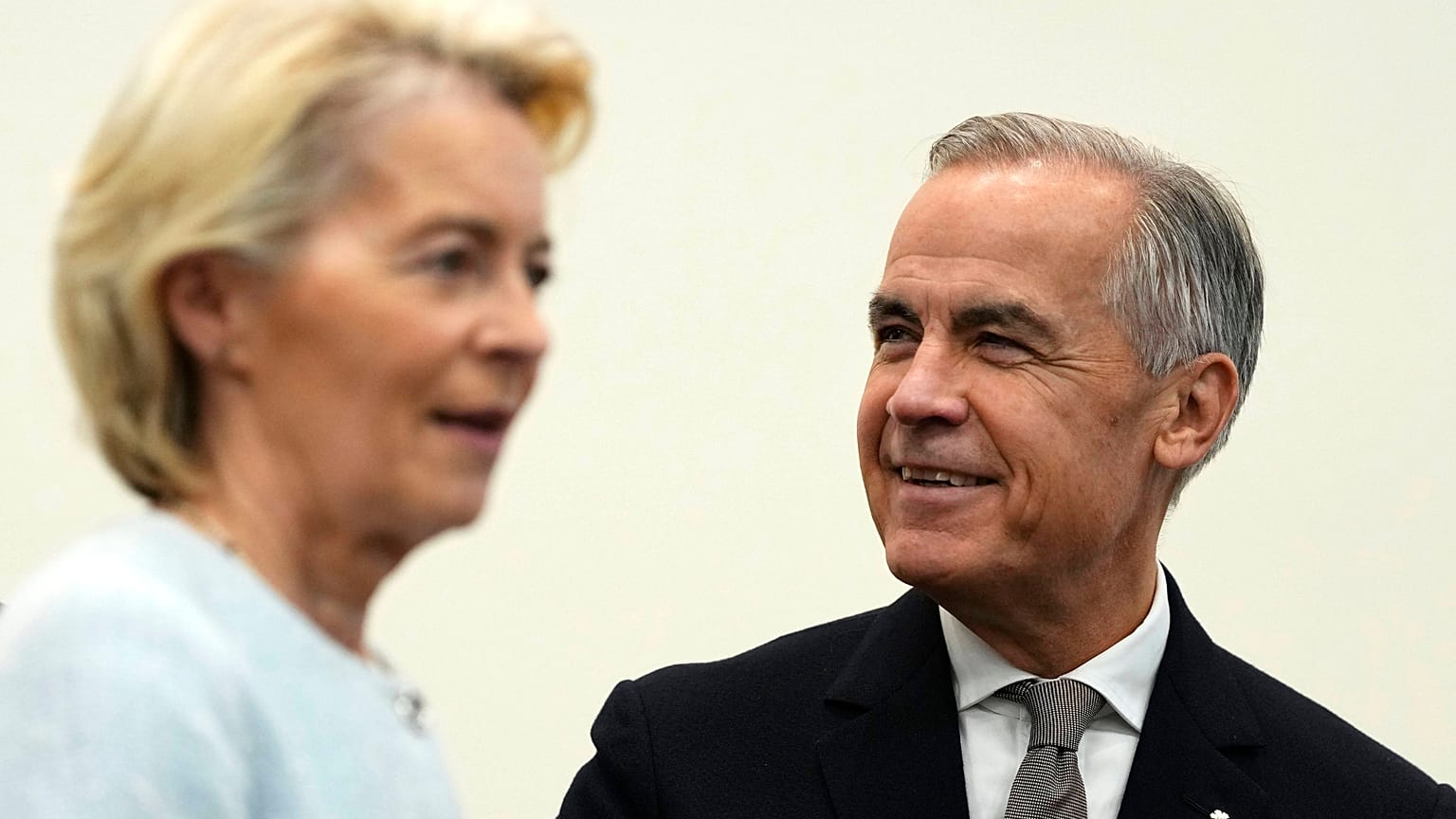
The term ‘associate membership’ was dropped from the EU-Canada summit text after German pushback, in a major blow to Commission President von der Leyen. Nonetheless, the two sides are still keen to boost their partnership.
Just weeks after European Commission President Ursula von der Leyen unveiled a bold new blueprint for relations with third countries, starting with Canada, the idea of “associate membership” has been quietly buried. Has her grand vision already run aground?
On Wednesday, all references to associate membership were scrubbed from the joint statement due to be adopted at this week's EU-Canada summit, following objections from several member states, led by Germany.
Instead, the text agreed by member states speaks of developing an “ever closer association” between the EU and Canada, stopping short of full membership.
"It would have been much better to have unity from member states on the initial wording, but we have a strong basis that is agreed. And we are fleshing out the details. But most importantly, we have a common approach in terms of what the objective is that we want to pursue," Commission chief spokesperson Paula Pinho said on Thursday.
It may look like a semantic distinction, but it amounts to an embarrassing political setback for von der Leyen, who floated the idea of Canada becoming the EU's first associate member with great fanfare in September.
Arriving in Montreal for the summit, von der Leyen appeared determined to press ahead regardless.
“We have a new ambition: bringing Canada closer to us than ever before, as associate member of the EU. And we want to take our unique partnership even further,” she wrote on X.
Yet despite the wordplay, the final text leaves little doubt that the much-hyped format failed to win the support of European governments, whom von der Leyen did not consult before making her grand pitch to Canada.
Her own country, Germany, led the charge to remove the term, arguing that the substance of the new partnership should be defined before attaching a label with potential legal implications, rather than the other way round.
There is an irony here. Associate membership was proposed last May by German Chancellor Friedrich Merz as a way of offering Ukraine security guarantees while it worked towards full EU membership.
Ukrainian President Volodymyr Zelenskyy rejected the proposal, which was never properly discussed among EU countries. Berlin, of course, denies that this is the real reason it so vehemently opposed Canada's associate membership.
“What the EU can do is technical, is a sector-by-sector approach. The ‘associate membership’ provided a package for it; it put a label on the partnership,” an EU diplomat told Euronews, speaking on condition of anonymity.
Perhaps even more telling, Canadian Prime Minister Mark Carney never fully bought into von der Leyen’s idea, preferring the notion of an 'Alliance for the Future'.
“The President used both terms. The precise nomenclature is a question for Europe,” Carney said at a press conference after von der Leyen’s speech, when asked whether he was comfortable with “associate membership”.
Again, the semantics hide different worldviews. For Carney, the Alliance for the Future is an open concept: a group of middle powers he championed in his landmark Davos speech in January as a new framework to safeguard global stability and the rules-based order.
The EU, by contrast, does not regard itself as a middle power, as officials in Brussels are fond of reminding anyone who will listen. Associate membership was intended to place the bloc at the centre of a new international coalition of democracies – not merely as one partner among equals, but as its leader.
That is why whatever arrangement the EU strikes with Canada matters beyond bilateral relations. Other like-minded countries, such as Australia, South Korea and Japan, are watching closely for a potential blueprint for how Brussels engages with third countries.
“In the world we are living in today, which is not the easiest, this is the right response: have the courage to think out of the box, have the courage to do something new, and have the courage to set out a vision,” said an EU official, also speaking on condition of anonymity.
Von der Leyen may have overplayed her hand, promising a partnership she could not deliver because she moved too far ahead of the member states. Still, it is hard to dismiss that EU-Canada ties have never been stronger in the past few months.
From joint exploitation of critical raw materials and common stockpiling to mutual market access in strategic sectors like AI and cloud, via systematic integration in EU defence programmes and early consultation on major policy areas, the relationship is on steroids.
Bernd Lange, the German MEP who chairs the European Parliament's Committee on International Trade, said that the disagreement over terminology should not overshadow the EU's growing ties with Canada.
“Getting caught up in debate over the partnership’s name only distracts from what really matters. So call it how you want, but what matters is concrete action, not words. The momentum is there,” he wrote on X.

No comments:
Post a Comment