Monday, November 09, 2026

INDIA

The Unpredictable Strike: How Pralay Shattered The Ballistic Playbook – OpEd


On 5 November 2026 DRDO successfully user-tested the Pralay quasi-ballistic missile from Dr APJ Abdul Kalam Island. Photo Credit: @rajnathsingh, X


November 9, 2026

By Girish Linganna

Key Takeaways:

On 5 November 2026 DRDO successfully user-tested the Pralay quasi-ballistic missile from Dr APJ Abdul Kalam Island, confirming it met all objectives and paving the way for near-term induction.

The solid-fuel, mobile-launched missile is designed for 150–500 km ranges with 500–1,000 kg conventional warheads, mid-course and terminal maneuverability, speeds above Mach 5 in the dive, and a CEP under 10 metres.

Indian forces have cleared roughly 370 missiles (120 for the Air Force, 250 for the Army), underscoring progress in indigenous defence technology.


Somewhere in a quiet Hyderabad laboratory, a team of Indian engineers has spent years chasing a difficult idea: how do you build a missile that an enemy cannot predict? On Thursday, November 5, 2026, that idea proved itself over the Bay of Bengal, and India moved a step closer to fielding a weapon designed, built and tested on its own soil.

The weapon is Pralay, and the Ministry of Defence confirmed that the Defence Research and Development Organisation (DRDO) launched it at about 11:10 a.m. from Dr APJ Abdul Kalam Island, off the Odisha coast. Instruments placed by the Integrated Test Range at Chandipur tracked the flight and verified that every objective was met. This was a user trial, meant to answer one question: is Pralay ready for soldiers? The ministry’s answer was yes, adding that induction into the armed forces is expected very soon.

Picture a conventional ballistic missile as a cricket ball thrown high. It generally follows a predictable curved path, so a fielder who watches the first second can judge where it will land. Defence radars do the same, estimating where a missile is heading and placing an interceptor in its path. Pralay refuses to behave like that ball. It is a quasi-ballistic missile, flying lower and flatter, and it can alter course mid-flight. The fielder is left guessing until the last moment, and that unpredictability is the whole point.


Although the Ministry of Defence has confirmed the successful test, DRDO has not separately released detailed information about the missile’s flight performance, so the finer details come from opindia.com. Shortly after lift-off, at Mach 1.6, about 1.6 times the speed of sound, the missile is said to shift direction. It then climbs, gathering speed. As it nears the target, it dives at more than Mach 5, five times the speed of sound, or roughly 6,174 kilometres per hour. According to these sources, it can still change path during the final 30 seconds. Its high speed and ability to change direction could make interception difficult for enemy air defences; some reports name systems such as Israel’s Iron Dome and China’s HQ-9, though Pralay’s actual performance against any specific system remains unproven. The same sources put the full 500-kilometre journey at just seven to eight minutes.

The missile is also highly accurate. Pralay’s Circular Error Probable, or CEP, is under 10 metres: if several missiles were fired at one spot, at least half would land within 10 metres of it. For a weapon arriving from hundreds of kilometres away, that is remarkable precision.

Pralay strikes ground targets from a ground launcher at distances between 150 and 500 kilometres, carrying 500 to 1,000 kilograms of conventional, non-nuclear warheads chosen to suit the job: high-explosive types that scatter lethal metal fragments, special warheads that break through strong structures before exploding, and others built to tear up runways and cripple airfields. It is built to be flexible rather than to deliver a single kind of punch.


Two engineering choices make Pralay practical in war. It runs on a solid-fuel rocket motor, like a battery already charged; unlike liquid-fuelled rockets filled just before launch, it can wait ready for long periods with no need to refuel before firing. And it rides on a mobile launcher, so it is not tied to a fixed site an enemy could photograph and target. It can appear, launch and vanish.

The entire project reflects Indian engineering skill. Research Centre Imarat in Hyderabad led the design with support from other DRDO laboratories, while Bharat Dynamics Limited, a partner in both development and production, manufactured the system. Defence Minister Rajnath Singh, posting on X, hailed the trial as another milestone in the nation’s pursuit of self-reliance in defence technology and praised DRDO, the armed forces and the participating companies. He said Pralay’s advanced technology will strengthen the military, sharpen its ability to employ modern weapons and leave the country better prepared for emerging security threats.

The stakes show in the numbers. According to economic times, the armed forces have cleared the purchase of around 370 Pralay missiles, 120 initially for the Indian Air Force and 250 for the Indian Army, which is expected to raise dedicated Pralay missile regiments to operate them. For those who spent years perfecting a missile that keeps its secrets until the final seconds, Thursday’s flight was more than a test. It was proof that patience, persistence and homegrown ingenuity can give India a powerful weapon to face emerging threats.


About Girish Linganna
Girish Linganna is a Defence, Aerospace & Political Analyst based in Bengaluru. He is also Director of ADD Engineering Components, India, Pvt. Ltd, a subsidiary of ADD Engineering GmbH, Germany. You can reach him at: girishlinganna@gmail.com
View all posts by Girish Linganna →
Then They Came for the Communists: Putin Regime Moves Against The KPRF – Analysis


File photo of members of the Communist Party of the Russian Federation (KPRF) holding a rally in Moscow, Russia. Photo Credit: Bogomolov.PL, Wikipedia Commons

November 9, 2026

By Paul Goble

Key Takeaways:

The Kremlin intensified pressure on radical Communist Party (KPRF) elements after the September Duma elections, arresting former candidates and charging a Komi Republic deputy with terrorism in a bid to force Moscow loyalists to discipline regional radicals.

The effort is backfiring: 80-year-old leader Gennady Zyuganov and others have become more outspoken against the war’s domestic costs, transforming much of the KPRF into a genuine opposition in the eyes of voters.

Analysts expect further repression and radicalization, setting the stage for a rare systemic-party clash that could intensify during any future succession struggle.


The Kremlin began its campaign against radical elements of the Communist Party of the Russian Federation (KPRF) even before the September Duma election was concluded. In the weeks since, it has stepped up this effort against both former deputies and their supporters in the population (Vyorstka, November 3).

Before the vote, Russian President Vladimir Putin’s regime took steps to exclude KPRF radicals from running and then to defeat them in races for the Duma and regional bodies. Despite the expectations of many, the moves against the communists did not end when the balloting was over. Moscow has since arrested former KPRF candidates and detained their supporters who have participated in protests, often held without the approval of the authorities, against the falsification of the results but with the support of radical KPRF leaders in the regions (Window on Eurasia, September 27, October 24; Novaya Gazeta Evropa, October 25).

By so doing, the Putin regime clearly hoped to force loyalist elements in the KPRF leadership in Moscow to police the KPRF itself and crack down on the far more radical party groups in the federal subjects, and even to ensure that the current KPRF leader, 80-year-old Gennady Zyuganov, would soon be succeeded by someone more prepared to cooperate with the Kremlin (Vyorstka, November 3). Despite arrests, something that has spread concern in the party about who might be next, this Kremlin effort is backfiring. These developments have prompted Zyuganov himself and his hitherto loyalist entourage to become more radical, even on issues like the way in which Putin’s war against Ukraine is hurting Russians at home (The Barents Observer, October 23; Vyorstka, November 3).


They have also had the effect of transforming much of the KPRF into a real opposition party both in legislatures at all levels but also, and more importantly, in the eyes of the population, which observers suggests increasingly views the KPRF as speaking for the people (The Barets Observer, October 29). That likely sets the stage for more repression against the communists in the coming months but also for more opposition behavior by the KPRF—behavior that may become more rather than less prominent and important as the country enters a succession crisis.

The Putin party system is based on the idea that the United Russia party will dominate the situation. The goal is for the other parties who succeed in electing candidates—and thus become “systemic” opposition parties, including the KPRF—to defer to United Russia when it comes to issues the Kremlin cares about. The system has worked relatively well in the Duma from the Kremlin’s point of view, but in the regions, often strong and more radical KPRF organizations have acted differently, not deferring to United Russia and Moscow’s representatives but instead behaving as de facto regionalist parties in opposition to the center (Window on Eurasia, March 27, 2025).

In the case of the KPRF, many Russian observers now divide the party between loyalists in Moscow and radicals in the regions. Reflecting his own desire to quiet the political system, Putin launched a campaign against the radicals in the run-up to the elections and has expanded it in recent weeks. Because most of this campaign has taken place outside the capital, of course, it initially attracted less attention.


Recently, however, the Putin regime has moved more harshly. It charged a former KPRF deputy from the Komi Republic, Oleg Mikhailov, with supporting terrorism, the first such case in recent Russian history, as well as bringing lesser charges against KPRF activists in other regions and republics far from Moscow. That has led their party comrades and voters to come out in support and, perhaps most worrisome to the Kremlin, prompted loyalist KPRF head Zyuganov to condemn these moves and take an increasingly anti-Kremlin line. As a result, what many have dismissed as a regional fronde is now seen as something far more serious, a development the independent Vyorstka news portal has documented (Vyorstka, November 3).

As Vyorstka notes, Putin’s moves against the KPRF radicals were intended both to exclude them from political life and to intimidate others in that party into deferring to the Kremlin. Many KPRF cadres in the regions have been frightened, with members asking each other who is likely to be next. Others there, however, have been radicalized by what the Kremlin is doing, speaking out on behalf of those arrested and charged. They are even raising more pointed questions about the holy of holies of the Putin years, his expanded military invasion of Ukraine.

The latter have even been joined by Zyuganov, who has asked why Russians should have to suffer to pay for the war against Ukraine, an indication that KPRF radicals are now prepared to question even that. Such dissent has deepened the divide between Kremlin loyalists within the KPRF and communist radicals even in the capital, and sparked speculation that Putin would like to orchestrate Zyuganov’s removal and replace him with the more deferential and far younger KPRF Duma faction leader, Yuri Afonin, who is 48.

For now, at least, the Kremlin shows no sign of easing pressure on KPRF radicals. Just the reverse appears likely. Many more KPRF activists and supporters are likely to face charges as the trials of those under arrest continue. Unless these repressive moves intensify quickly, however, it appears likely that while they may intimidate some, they are radicalizing many more in the KPRF who recognize that what the Kremlin is doing is a measure of their strength in the population and the Kremlin’s own weakness. As a result, they are more likely to act as a genuine opposition party not only in legislatures but also in speaking to the population. That, in turn, means actions and counteractions are likely to spiral up in the regions at first, and in the center as well.


The stage is set for something not seen before among the “systemic” parties in the Putin era—a genuine clash between the Kremlin and the radicalizing KPRF. Yevgeny Stupin, a former KPRF deputy in the Moscow city Duma, told Vyorstka:

Over the past 15 years, there have been only two structures in Russia that could organize serious protests—the FBK [the Anti-Corruption Foundation] and the KPRF. The former are recognized as extremists, and their leader, Alexei Navalny, was killed in prison. And the top of the Communist Party of the Russian Federation is united and works completely with the Kremlin … But regional branches are a different world, and the party is not a single monolith, where everyone is subordinate to Moscow (Vyorstka, November 3).

The Kremlin is thus moving not against the KPRF as a whole but against radicals in the regions. Its approach is radicalizing communists against it, including at the party’s highest levels in Moscow. Putin will likely win these battles at least initially. If he weakens, or even more likely, when he passes from the scene, and the succession struggle begins in earnest, the radicalization of the KPRF that Putin’s actions have produced may have a profound impact on Russian politics, one very different from that which the Kremlin dictator certainly intends.


This article was published at The Jamestown Foundation


About Paul Goble
Paul Goble is a longtime specialist on ethnic and religious questions in Eurasia. Most recently, he was director of research and publications at the Azerbaijan Diplomatic Academy. Earlier, he served as vice dean for the social sciences and humanities at Audentes University in Tallinn and a senior research associate at the EuroCollege of the University of Tartu in Estonia. He has served in various capacities in the U.S. State Department, the Central Intelligence Agency and the International Broadcasting Bureau as well as at the Voice of America and Radio Free Europe/Radio Liberty and at the Carnegie Endowment for International Peace. Mr. Goble maintains the Window on Eurasia blog and can be contacted directly at paul.goble@gmail.com .
View all posts by Paul Goble →


Democratic Socialists’ Surge In The US Midterms Worries Conservatives – Analysis


Cropped file photo of Bernie Sanders and Alexandria Ocasio-Cortez. 

Photo Credit: Matt Johnson, Wikipedia Commons

November 9, 2026

By P. K. Balachandran

Key Takeaways:

Democratic Socialists of America (DSA), described as a left wing of the Democratic Party with roughly 130,000 members, are credited with helping Democrats secure major midterm gains, including Senate and House majorities and 28 governorships.

The DSA platform includes calls to abolish police and prisons, end aid to Israel, legalise migration and replace the Electoral College, Senate, presidency and Supreme Court with a single congress, though figures such as AOC say capitalism and socialism can coexist.

Exit polls linked the shift to economic discontent, the Iran war and anti-incumbency, while conservatives warn of Trotskyite “entryism” and cite historical failures of socialist regimes.


Much like the Gen Z who appeared from nowhere to topple entrenched regimes in Sri Lanka, Bangladesh and Nepal, America’s Democratic Socialists, dismissed as an inconsequential fringe group by mainstream analysts, inflicted defeats on scores of right-wing Republicans in this month’s US midterm elections.

But conservatives, who represent the bedrock of American political thinking, are warning about the grim consequences of socialism, citing the But conservatives, who represent the bedrock of American political thinking, are warning about the grim consequences of socialism, citing the regimes of Stalin, Mao, Pol Pot, etc

Electoral Successes

In the Midterms, the Democratic Party took both the Federal House of Representatives and the Federal Senate. In the US, overall, the Democrats did better than the Republicans. As on November 8, according to AP, the score was 54 Democrats and 44 Republicans in the Federal Senate, and 254 Democrats and 162 Republicans in the House. 28 Governorships went to the Democrats and 20 to the Republicans.

Democratic Socialists of America

A noteworthy feature of these midterms is the role played by the socialists and their fellow travellers in the Democratic Party, who identify themselves as the Democratic Socialists of America (DSA). It is said that the DSA has 130,000 members nationwide.

The DSA is not a separate political party, but is the left-wing of the Democratic Party. It has members as well as ideological affiliates. Prominent among people associated with it are Alexandria Ocasio-Cortez (AOC) and Rashida Tlaib (both members of the US House of Representatives), Zohran Mamdani (Mayor of New York).

Founded in 1982, the socialist group was resurrected by Bernie Sanders in the 2016 US Presidential election. The DSA is now firmly entrenched within the Democratic Party, determined to thwart the schemes of the extreme right-wingers represented by MAGA (Make America Great Again) led by President Donald Trump.

MAGA got identified with White racism, White supremacy and Zionism. Animosity towards immigrants from Africa and Asia is another feature. It also lacked sympathy for the marginalised economic, ethnic and sexual communities. In foreign policy, MAGA fully backed Israel vis-à-vis Palestine, Gaza and Iran.

Bernie Sanders

Bernie Sanders, the Democratic Socialists’ guru, sought government ownership of the energy, banking, telephone, electricity, and drug industries. He has also called for a 100% marginal income tax on higher earners to help fund cradle-to-grave government services, including medical care, housing, childcare, education, Internet, and meals.
Key Structural Changes Envisaged

DSA’s 2026 manifesto said that the future it foresees will also include “fully abolishing the police and prison system”; “queer liberation”; enacting “reparations”; abolishing the Department of War; ending “all military and economic aid to Israel”; and legalising “migration.”

The DSA platform also calls for abolishing the Electoral College and the Senate. It would “replace the President and Supreme Court with an executive and judiciary chosen by and subordinate to” one Supreme People’s Congress.

Not Communism, but Quite Radical

The Democratic Socialists have said that they are not communists and have produced “new versions” of socialism like “democratic socialism,” looking like an advancement on President F.D. Roosevelt’s New Deal. New York Representative Alexandria Ocasio-Cortez is quoted in The New York Times as saying that she thinks it is “totally possible for capitalism and socialism to coexist.”


Anti-Incumbency Factor

According to Ashley Koning, assistant research professor and director of the Eagleton Center for Public Interest Polling at Rutgers University, and Kelly Dittmar, associate professor of political science at Rutgers University–Camden, many compared this election to the 1974 Watergate midterms in which anti-incumbency was a decisive factor (https://www.rutgers.edu/news/what-drove-historic-blue-wave-2026-midterms).

According to media reports on exit polls, a plurality of voters mentioned the economy as the most important problem facing the country. Nearly 9 in 10 said the cost of living was a crucial or major factor in their vote for Congress, nearly 6 in 10 said they’re very concerned about gas prices, and three-quarters rated the national economy negatively.

Corruption and the state of the country’s democracy were also on the voters’ minds. Nine in 10 voters called government corruption a crucial or major factor in their vote, and a third named democracy the most important issue facing the country—second only to the economy. More voters trusted Democrats than Republicans to handle the economy.

The elections pointed to deep dissatisfaction with President Trump, his policies, and his handling of both the economy and the war in Iran. Vice President J.D. Vance has openly said that the Iran war had caused loss of votes. The media is now predicting the impeachment of the Secretary of War, Pete Hegseth

Socialism Attracted

The polls also showed a leftward shift among key voting blocs. Every key demographic group swung toward Democrats, reversing much of their rightward shift from 2024.

As per the CBS News/YouGov survey done before the polls, Democrats overwhelmingly had a more favourable view of socialism than capitalism. Nearly 60% of party members supported socialism compared with 32% who had a favourable view of capitalism. Among those who had a college degree, 71% favoured socialism compared to 16% viewing it unfavourably.

Changing Views on Who is Electable


Women proved again that they are a key to Democratic success. Democratic women will now hold record levels of representation in the US House, US Senate, and Statewide elective executive offices, including Governors. They flipped at least 10 districts from Red (Republican) to Blue (Democratic) and won some of the toughest contests for US Senate and Governor.

Koning and Dittmar say that together, these results challenge yet again any notions that women are less electable than men. Even more, one saw historic wins for women of Colour, including the first Native American woman Governor, Deb Haaland of New Mexico, and the first Black woman Governor in the US. These women’s wins not only proved their electability but also disrupted dated views about who can and should lead at the highest levels of US politics.

Ethnic Dimension

Democrats also solidly won back Latino voters, 62% to 35%, including Latino men, who broke for Trump in 2024 but backed Democrats 56% to 41% this time around. Democrats also gained double-digit ground with Asian and suburban voters, winning about 7 in 10 Asian voters and nearly 6 in 10 suburban voters, and even made significant inroads with non-college voters, narrowly losing a group Trump won comfortably in 2024, Koning and Dittmar say.

Flip Side: Trump’s Warning

Given the rise of the Far-Left, President Trump worked to paint leftists as full-blown communists and urged Republicans to spotlight their hardcore policies heading into the midterm elections.

“Our American identity under a renewed attack. A generation after we fought and won the Cold War against the menace of communism, there is now a resurgence of the communist menace in our land, including from newcomers to our country who embrace ideas totally opposed to our way of life and our great success,” The President had said.

“No more checks and balances. No more federalism. No more republic,” commented a conservative writer.

Trotsky’s Entryism

Conservatives suspect that the Democratic Socialists are following Trotsky’s tactic called “entryism,” which means infiltrating larger movements, converting followers, taking charge of power centres, and then altering policies to the Left. The Democratic Socialists have infiltrated the Democratic Party to make it a socialist party. Sanders and his team began recruiting socialist candidates to run in primaries, it is pointed out.

Conservatives warn that the socialist experiment in every country has failed. And the authoritarianism that accompanies centralisation and state control will only alienate people in the long run.

Given the traditional conservatism of Americans and the strong trend towards some form of socialism seen in the midterms, America is at a critical political and ideological crossroads. But the dalliance with socialism is expected to continue till America’s domestic and foreign policy issues are sorted out to the satisfaction of Americans.


About P. K. Balachandran
P. K. Balachandran is a senior Indian journalist working in Sri Lanka for local and international media and has been writing on South Asian issues for the past 21 years.
View all posts by P. K. Balachandran →
The Impact Of Martial Law On Philippine Education, 1972-1986: Foregrounding Teachers’ Perspectives – Book Review


"The Impact of Martial Law on Philippine Education, 1972-1986: Foregrounding Teachers’ Perspectives" by Dr. Michael D. Pante


November 8, 2026

By Eurasia Review

Key Takeaways:

Dr. Michael D. Pante’s book, launched 26 October 2026, is the first national-scale historical account of Philippine education under Martial Law (1972–1986) that centers teachers’ experiences in both public and private institutions.

It documents how the Marcos regime’s professionalization and curricular reforms coincided with plummeting education budgets, low pay, overwork and the proletarianization of teaching, prompting teachers to organize for economic and political rights.

The work frames education history as labor history and links past contradictions to present challenges under EDCOM II, including heavy workloads and chronic underfunding.


Ferdinand Marcos Sr. once held up the professionalization of teaching as a mark of national development. Yet this recognition rang hollow as the state failed the very people expected to carry forward and benefit from its education agenda. In one of the Martial Law period’s starkest contradictions, a regime that promised to elevate the profession actually presided over its decline.

“We owe it to Marcos Sr. for the professionalization of the teaching profession. But then again, by the end of the Marcos era, teaching had lost its prestige as an occupation. Teachers, beginning with the Martial Law period, were severely underpaid, extremely overworked,” said Dr. Michael D. Pante, associate professor at the Department of History of the Dr. Rosita G. Leong School of Social Sciences, Ateneo de Manila University.

Pante examines this contradiction in his book, The Impact of Martial Law on Philippine Education, 1972-1986: Foregrounding Teachers’ Perspectives , launched last October 26 at an event jointly organized by the National Historical Commission of the Philippines (NHCP) and the Ateneo de Manila University.


Dr. Pante’s book is the first published historical account of Philippine education during the Marcos years to examine both public and private institutions, from basic to higher education, on a national scale. Drawing on teachers’ experiences, Pante places the labor behind education at the center of a history often told through government policies and institutional changes.

Written with a grant from the NHCP, the book underscores the history of education as a history of labor: of who bears the cost of education policy, whose working conditions are undervalued in reform efforts, and the mass resistance of teachers that followed.

He examines how the Marcos dictatorship’s education reforms—from sweeping curricular changes to the professionalization of teaching—reshaped classrooms, knowledge production, and teachers’ roles in society. Despite these, education’s share of the national budget plummeted, salaries remained inadequate, and working conditions deteriorated. As their profession became increasingly proletarianized, teachers organized alongside blue-collar workers to fight for their economic and political rights.

“Ang mga guro ang unang nakapansin sa mga nangyayari sa ating lipunan noong panahon ng Martial Law… Ang aklat na ito’y hindi lamang tungkol sa nakaraan. Ito rin ay tungkol sa ating kasalukuyan. Hinahamon tayo nitong isipin kung para saan nga ba talaga ang edukasyon. Ito ba ay isang karapatan para sa lahat ng Pilipino o isang kalakal na maaaring bilhin lamang ng may kakayahan?” (“Teachers were the first to notice the social upheavals of Martial Law… This book is not only about the past. It is also about our present. It challenges us to think about what education is really for. Is it a right shared by all Filipinos or a commodity that can only be bought by those who can afford it?”), shared former ACT Partylist Representative Teacher France Castro in a review of the book.


“Mike Pante has given us not only an essential history, but a moving tribute to the great awakeners and keepers of our collective conscience,” said academic Dr. Caroline S. Hau of Kyoto University.

Its release comes as the country continues to reckon with the state of its education system under the presidency of Ferdinand R. Marcos Jr. via the Second Congressional Commission on Education (EDCOM II): in its final report, released in January 2026, the body highlighted persistent problems in Philippine education, including heavy teacher workloads and chronic underfunding.

More than four decades after the dictatorship ended, Pante’s book calls for a reckoning with the promises made in the name of educational progress. Any effort to reform Philippine education must confront not only what the state promises, but what it owes the people who make education possible.

The Impact of Martial Law on Philippine Education, 1972–1986: Foregrounding Teachers’ Perspectives is available through the Official NHCP Bookstore Portal or at the NHCP Central Office Bookstore located on T.M. Kalaw Street, Ermita, Manila.
Start At The Source: Why India’s Waste-To-Energy Push Needs Segregation First – Analysis


Key Takeaways:

India’s large waste-to-energy plants fail because municipal waste is predominantly wet and unsegregated, rarely meeting the 1,500 kcal/kg calorific-value threshold; Okhla’s emissions of cadmium, dioxins and other pollutants exceeded limits by factors of 8–19.

The 2026 Solid Waste Management Rules mandate four-step source segregation and link tipping fees to segregation quality, yet top-down incineration projects still sideline informal workers and misalign incentives by rewarding volume over quality.

Successful models such as Indore’s bio-CNG plant (90 percent segregated feedstock) and Pune’s SWaCH cooperative show that modest upstream investments in segregation, composting and deposit-refund schemes are more decisive than capital-intensive end-of-pipe facilities.


India is confronted with towering landfills and deteriorating air quality, and the link between them is irrefutable: landfills and the unchecked burning of municipal solid waste are significant contributors to greenhouse gas emissions. Policymakers have increasingly turned to large waste-to-energy (WtE) plants as an answer to both waste disposal and energy supply. The logic is appealing, but the approach has proved a silver bullet on neither count. This article argues that a waste system succeeds or fails by what happens at its beginning, not its end. Segregation at source is the decisive variable, and strategies imposed from above without fixing the fundamentals are unlikely to work.

Landfills are a symptom of the mounting problems of waste mismanagement, and nothing illustrates this better than New Delhi. Dumpsites such as Bhalswa repeatedly ignite as trapped gases accumulate, and even when they do not burn, they passively release greenhouse gases. Municipalities spend heavily on collecting, hauling, and dumping waste, yet what arrives at the site is mixed, unsorted refuse. Whatever escapes the trucks is left on the streets or burnt in the open.


Segregation is a necessary condition for most WtE technologies; it determines whether a plant can functionally convert waste into energy or will end up causing even more pollution and health risks. The Solid Waste Management Rules (2026) introduce four-step segregation, in place of the simple wet-and-dry split of the previous iteration, recognising the importance of source segregation. What remains unchanged from the Solid Waste Management Rules of 2016 is that mass incineration at WtE plants is permitted only for segregated, non-recyclable waste with a calorific value of at least 1,500 kcal/kg. This is because this is the minimum calorific value required to generate energy efficiently without releasing toxic air emissions. Indian municipal waste, dominated by wet organic matter, rarely meets that threshold, particularly when unsegregated. Burning damp, mixed refuse yields poor energy recovery and, more dangerously, sends materials into the furnace that should never be there. Batteries and electronic waste, which often find their way into landfills and municipal solid waste incinerators (MSWIs), release heavy metals and other pollutants into the air and soil.

Okhla, in Delhi, illustrates the consequences. A 2024 New York Times investigation reported emissions at the plant exceeding permitted limits by a factor of eight to ten, alongside the burning of precisely such materials. The investigation spanned five years, 2019-23, and revealed extreme heavy metal and chemical contamination in the air, soil, and leftover incinerator ash. The specific pollutants are listed in the table below:

Pollutant Exceedance Level Reference Standard / Context Primary Cause / Impact
Cadmium Up to 19x higher U.S. Environmental Protection Agency (EPA) safe threshold Toxic heavy metal leakage from burned electronic/industrial waste.
Manganese Up to 11x higher Standard safety limits Heavy metal contamination impacting the surrounding air and soil.
Dioxins Up to 10x higher Indian legal regulatory limits Incomplete combustion of mixed plastics and organics at low temperatures.
Arsenic Up to 10x higher Permissible safety limits Highly toxic carcinogen released into the surrounding residential ecosystem.
Lead Up to 4x higher Permissible safety limits Heavy metal emission, posing a severe risk to cognitive and physical health.
Cobalt Up to 3x higher Standard safety limits Elevated metallic residue found in the vicinity of the plant.
Particulate Matter (PM2.5) & Hydrogen Chloride (HCl) Regularly breached specified limits Indian Solid Waste Management Rules limits Stack emissions violating continuous automated tracking parameters, contributing to hazardous AQI levels.
Source: Compiled from The New York Times and The Times of India


The Timarpur facility, built in the 1980s on the same site, failed for related reasons. Contractors were paid by tonnage, so they were rewarded for delivering volume rather than quality, and inert waste filled the incinerator. In both cases, a centrally conceived project met waste that the upstream system was not prepared to handle, regardless of how sophisticated the technology was.

Top-down approaches follow a familiar pattern. An authority selects a capital-intensive facility, contracts a private operator for infrastructure and technology, and assumes that segregated waste will arrive in usable form. It rarely does, and several factors explain why. First, incentives are misaligned. Payment by volume rewards quantity, not the quality that determines whether a plant can generate energy without releasing toxic emissions.

Second, such strategies tend to ignore local waste composition. What suits Sweden, where a largely dry, high-calorific waste stream is supported by advanced segregation and recycling systems, does not transfer automatically to India, where wet waste predominates and an army of informal workers sort truckloads of mixed refuse by hand every day.

Third, top-down approaches sideline those who already sort waste. Informal workers lose access to material, and with it their source of income, while their practical knowledge of waste composition goes unused. Funding design compounds the problem. When public support rewards a plant’s output but not the quality of the waste it receives or its compliance with emission norms, the stages that make good output possible remain unfunded.
Fixing the Fundamentals

To say that the investments that support segregation are modest in comparison to top-down solutions like MSWIs would be understating things. Clearly labelled, separate bins in homes, institutions, and streets, combined with sustained public encouragement to use them, may do more for collection efficiency than added expenditure on door-to-door services. Decentralised composting can treat India’s large organic fraction at neighbourhood scale, as a resource rather than a burden.

For recyclables, India could look to Germany’s Pfand system, under which a small refundable deposit is charged on each glass or plastic bottle at purchase and reimbursed when the bottle is returned to a retail store. It changes sorting behaviour through a price signal rather than exhortation, and it keeps containers out of landfills and open fires. Deposit Refund Schemes of this sort are at various stages of trial and implementation in different Indian states, but they will need to be adapted to local conditions.

The German system is designed for specific packaging streams and cannot be transplanted wholesale onto India’s wider municipal waste management problem without accounting for infrastructure and collection costs and the impact on the livelihoods of informal waste workers. Single-use sachets of snacks and tobacco, individually trivial, accumulate into a collective burden and lie scattered everywhere, from riversides to mountaintops. In India’s cities, they litter street corners, clog stormwater drains, and aggravate monsoon flooding. Producers should be held more accountable for collecting this packaging, with real consequences for non-compliance. Citizens, for their part, need accessible disposal points; low-cost municipal investment here can support a gradual shift in civic habit.

Where these foundations exist, the results are evident, even where some issues may persist. Indore’s bio-CNG plant operates under a public-private agreement that obliges the municipality to supply waste that is 90 percent segregated. It treats roughly 550 of the 700 tonnes of organic waste the city generates each day, and its biogas displaces diesel in the public bus fleet. Segregation was written into the contract rather than assumed. Cooperatives such as SWaCH in Pune, and the collaboration between informal collectors, NGOs, and the municipality in Bengaluru, show that informal workers can be integrated into decentralised collection, strengthening it in the process. The 2026 Rules replace the flat tipping fee, historically tied to the tonnage delivered, with segregation-linked payment, but much remains to be done on implementation.


Institutional accountability remains a critical area for improvement. The Central Pollution Control Board (CPCB) must move beyond fines that exist only on paper and enforce automatic, non-discretionary environmental compensation penalties directly against municipal commissioners, backed by independent third-party audits of compliance with the 2026 Rules. Enforcement should also extend to Extended Bulk Waste Generator Responsibility (EBWGR), as outlined in the same Rules.

Large-scale WtE plants may yet contribute to India’s energy transition, but only once the basics of waste management are firmly in place. Changing how the country handles waste requires well-organised systems, backed by research, oversight, and targeted investment in segregation and collection. 


About the author: 

Krishna Vohra is a Junior Fellow with the Centre for Economy and Growth at the Observer Research Foundation.

Source: This article was published by Observer Research Foundation.


About Observer Research Foundation
ORF was established on 5 September 1990 as a private, not for profit, ’think tank’ to influence public policy formulation. The Foundation brought together, for the first time, leading Indian economists and policymakers to present An Agenda for Economic Reforms in India. The idea was to help develop a consensus in favour of economic reforms.
View all posts by Observer Research Foundation →


China burns more coal than the rest of the world combined as its own use stalls

China burns more coal than the rest of the world combined as its own use stalls
China's coal use flattened in 2025 while India, Indonesia and the US burned more, and its coal plants are running fewer hours even as new capacity floods in. / bne IntelliNewsFacebook
By Ben Aris in Berlin November 8, 2026

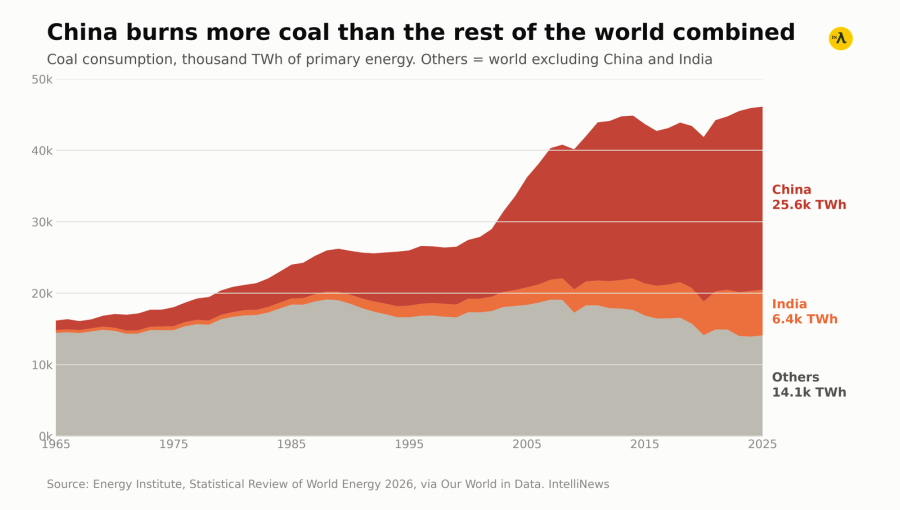
China burned 25,622 TWh of coal in 2025, 55.6% of the world total and more than every other country combined, the Energy Institute's Statistical Review of World Energy shows.

The rest of the world burned 20,498 TWh, about what it used in the late 1980s, according to the review's figures compiled by Our World in Data. China burned just over a fifth of the world's coal in 1988. It went past half in 2011 and has stayed there since.

China's share defines the climate arithmetic: a quarter-century of global coal growth is almost entirely Chinese, and the rest of the world has only shuffled its consumption between countries. Europe and the US cut, South and Southeast Asia added, and the total outside China barely moved.

China's own consumption

China's use was flat in 2025, at 25,622 TWh against 25,621 TWh in 2024, after rising by more than a tenth between 2020 and 2024. World consumption still set a record of 46,120 TWh, up 0.4%, because others kept burning more.

The pause did not last into 2026. Coal-fired generation rose 3.4% y/y in the first half after a 1% fall in 2025, the Centre for Research on Energy and Clean Air (CREA) and Global Energy Monitor said in an August review. China commissioned 30 GW of new coal power in the half, the most for a first half since 2016, and retired 2.7 GW.

The new plants are running less. Average utilisation fell to about 1,998 hours from 2,056 a year earlier, the lowest since 2021, while an estimated 360 TWh of wind and solar output was curtailed, up 49%. CREA said that wasted clean power could have covered all of the half's demand growth.

Monthly figures from think-tank Ember show the rebound fading. China's coal generation fell y/y in July, August and September, leaving January-September output 0.7% above the same months of 2025, and coal's share of the power mix slipped to 51.7% in September from 52.9% a year earlier.

CREA rejected the idea that the closure of the Strait of Hormuz had pushed China back to coal. Combined domestic coal output and imports fell 1.4% y/y in the first half, it said, even as LNG supply was disrupted.

Where the growth is now

India is the second-biggest consumer at 6,409 TWh in 2025, more than three times its use in 2000. Its coal generation was 5.6% higher in January-August 2026 than a year earlier on Ember's data, and power plants have been running down stocks as demand surges.

Indonesia burned 1,432 TWh, up 9% in 2025, and is weighing a higher 2027 output quota as prices recover. US consumption rose 10% to 2,425 TWh in 2025, its first big increase in years, while the EU's fell to 1,275 TWh, a quarter of its late-1980s level.

Some of the gas-fired growth that was meant to replace coal in Asia is also stalling: more than half of the LNG power plants and terminals planned in Vietnam, the Philippines, Thailand and Bangladesh have been cancelled or stalled since 2021.

China has 274 GW of coal power permitted or under construction, about 22% of its operating fleet, according to CREA. If all of it is built and generation stays at the 2025 level, average utilisation would fall to about 42% by 2030. CREA wants coal plants to move from baseload to flexible backup, starting with the long-term contracts that still reserve 60-70% of their previous year's output.

This article was produced with the help of the IntelliNews Lambda analytical tool

COMMENT: Twenty years in Afghanistan. What did we actually build?

COMMENT: Twenty years in Afghanistan. What did we actually build?
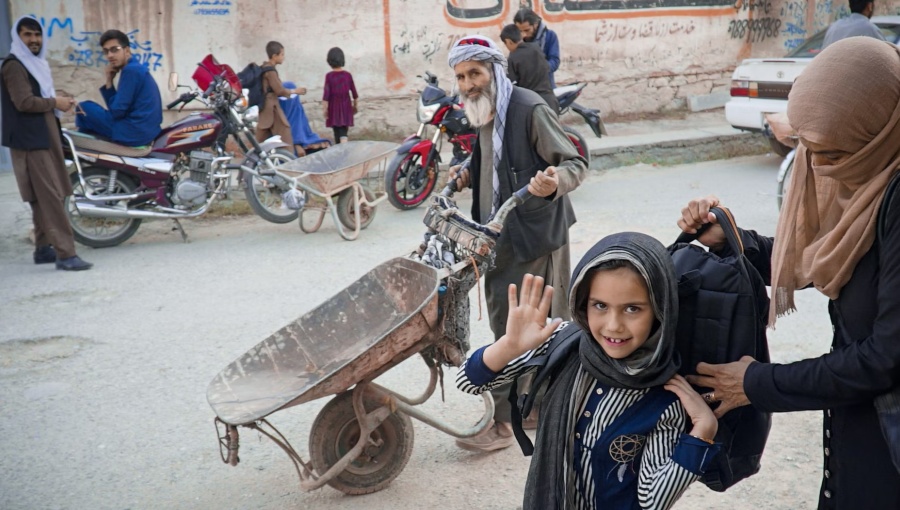
Two decades of spending, programmes and training left Afghanistan with projects but not a state able to run itself once outside support was withdrawn. / Wanman uthmaniyyah - UnsplashFacebook
By Mateusz Chrzanowski November 8, 2026

Twenty years. An international military presence, extraordinary expenditure, a new government, a trained army and an enormous reconstruction effort. Then, in August 2021, the Taliban returned to power.

What exactly did we build? That question matters more than another argument about whether the withdrawal happened too quickly.

The collapse exposed something more fundamental: Afghanistan had not acquired the independent capabilities needed to sustain the political and security order created around it. The United States spent approximately $145bn trying to reconstruct Afghanistan, including its security forces, public institutions and economy. It also spent hundreds of billions on the war itself.

The money was real. The programmes were real. But expenditure is not architecture, and activity is not a functioning state. A military force can secure roads, defend installations and defeat an opponent in battle.

It cannot, by those operations alone, create a productive economy, legitimate institutions, capable administration or a society with a credible future. For that, a country needs an operating model.

Start with employment. What does an ordinary person do when the foreign soldiers leave? Where are the factories, workshops, logistics businesses and commercial employers? Where does a young person acquire a profession? What income allows a family to pay for housing, food, education and transport without depending indefinitely on foreign assistance?

Then examine infrastructure. Electricity is not useful as an isolated construction project. It must serve homes, industry, water systems, hospitals and businesses.

A road has value when it connects productive activity. A school needs teachers, budgets and a labour market in which education becomes useful. A hospital needs trained staff, supplies and institutions capable of keeping it operational. These are not separate projects to be counted in a report. They are interdependent functions of a country. The security architecture is equally important.

An army is not independent because its soldiers possess uniforms, weapons and certificates from foreign instructors. It is independent when it can command itself, maintain its equipment, move supplies, pay personnel, gather intelligence and sustain operations without another country's contractors, aircraft or logistics. Afghanistan demonstrated the consequences of confusing trained forces with selfsustaining forces.

The Afghan military remained heavily dependent on American support. When that support was withdrawn, the military structure rapidly unravelled. A functioning state cannot have its most important dependencies permanently located outside the state. Political institutions face the same test.

A ministry is not an institution merely because it has an office, a minister and a budget. It must have an operating purpose, competent personnel, enforceable rules, reliable funding and a relationship with the population it serves. And people must see a reason to defend the order that those institutions represent.

This is where reconstruction should begin: not with a collection of contracts, but with the architecture of the future country. Define the functions required for independent operation. Determine their dependencies. Build productive capacity and public institutions together. Test whether the whole system can function when outside support is progressively removed. If the answer is no, the mission is not finished, regardless of the amount spent or the number of completed projects.

There is also a migration consequence. When an economy collapses, institutions disappear and security fails, people leave. Europe then debates fences, asylum procedures and deportations as though migration started at its border. It did not.

The causes were produced years earlier, often in regions where Western powers were deeply involved. Managing arrivals while ignoring the failures that produce displacement is another attempt to solve a systemic problem at its final stage. Afghanistan should have taught us a basic engineering lesson: a protected system is not necessarily a viable system.

Twenty years should have been enough to understand the difference. A military presence can hold a country together temporarily. Only a functioning country can hold itself together.

Mateusz Chrzanowski is a System of Systems Architect and Infrastructure System Engineer, founder of Archestral Studio, member of INCOSE, and author of The Layer Above. With 15 years of experience in system architecture and complex operations, his work focuses on the dependencies and structures that determine how complex systems function.


Europe and Central Asia debt climbs $178bn in 2025, fastest increase globally

Europe and Central Asia debt climbs $178bn in 2025, fastest increase globally
War loans and bond sales pushed the region's debt up by about $178bn in a year, and its interest bill against exports is now the heaviest in the developing world. / bne IntelliNewsFacebook

By Clare Nuttall in Glasgow November 7, 2026

External debt in developing Europe and Central Asia surged 15.3% to $1.34 trillion in 2025, the fastest increase of any developing region, driven largely by borrowing in Ukraine and Turkey, the World Bank said in its International Debt Report 2026.

The 18-country group added about $178bn in external debt during the year, compared with a 5.5% increase to a record $9.4 trillion across all low- and middle-income countries. Sub-Saharan Africa recorded the second-fastest increase, at 10.8%, while East Asia and the Pacific saw debt fall 1.8%, largely reflecting a contraction in China.

The Europe and Central Asia group covers the Western Balkans, Eastern Europe outside the EU, Turkey, the South Caucasus and Central Asia, excluding Russia and the EU's eastern members.

Debt growth outpaced the region's capacity to service its obligations. External debt reached 152.2% of exports, up 14.7 percentage points from 2024, the largest deterioration among developing regions. Interest payments alone absorbed 6.8% of export earnings, the highest regional share, while total debt service rose to 24.8% of exports from 22.9%.

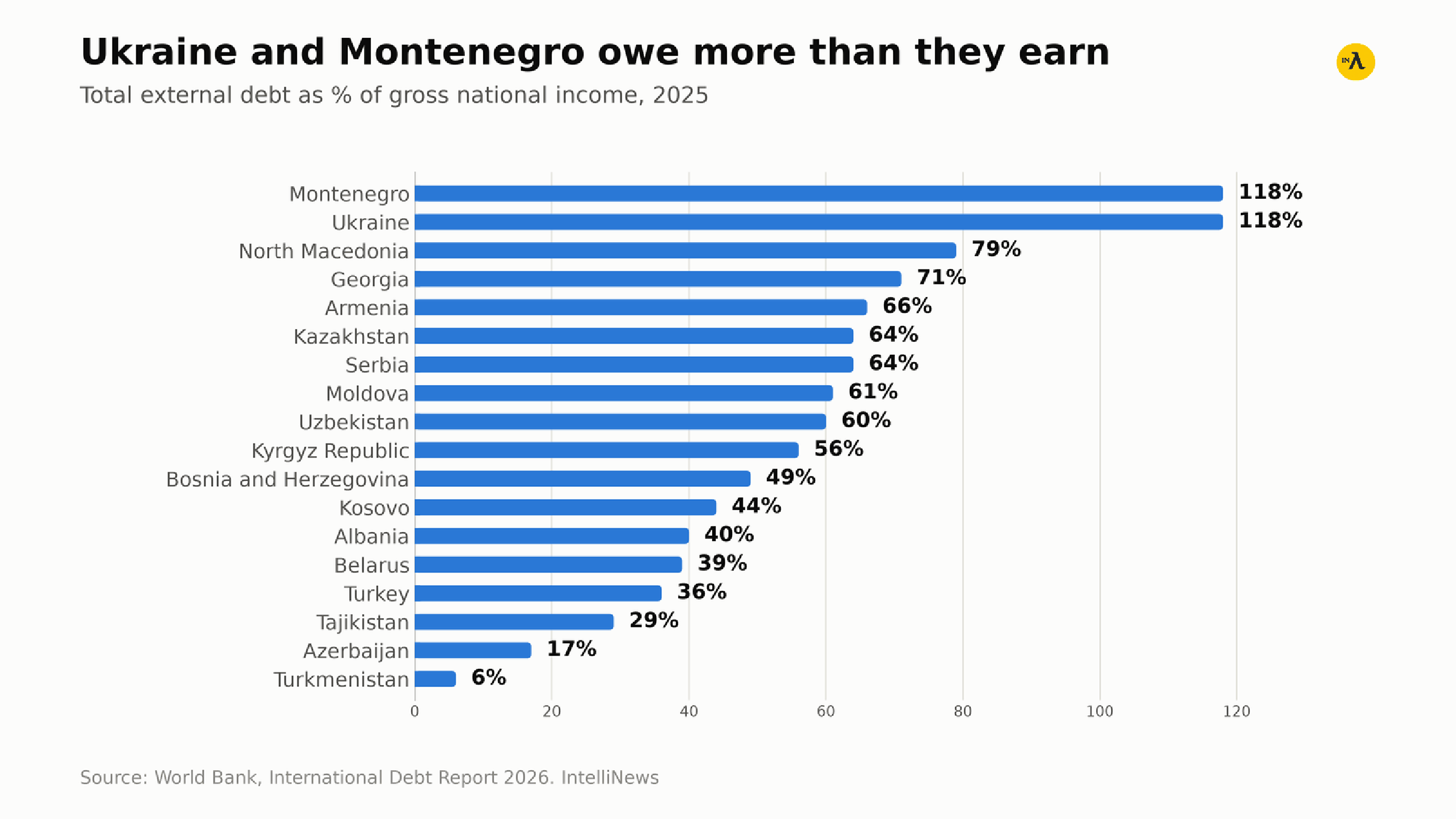
The stock of external debt amounted to 49% of gross national income, also the highest ratio among the developing regions covered by the report.

Ukraine and Turkey accounted for about two-thirds of the region's increase in debt, although their borrowing patterns differed sharply. Kyiv relied predominantly on official lending to finance its war effort, while Ankara tapped international capital markets. Kazakhstan and Uzbekistan were also major borrowers, with the four countries together accounting for 82% of the region's external debt.

"The return of private lending to low- and middle-income countries is welcome, but these countries are borrowing more, paying more, and in many cases leaving less for long-term development," said Haishan Fu, the World Bank Group's chief statistician.

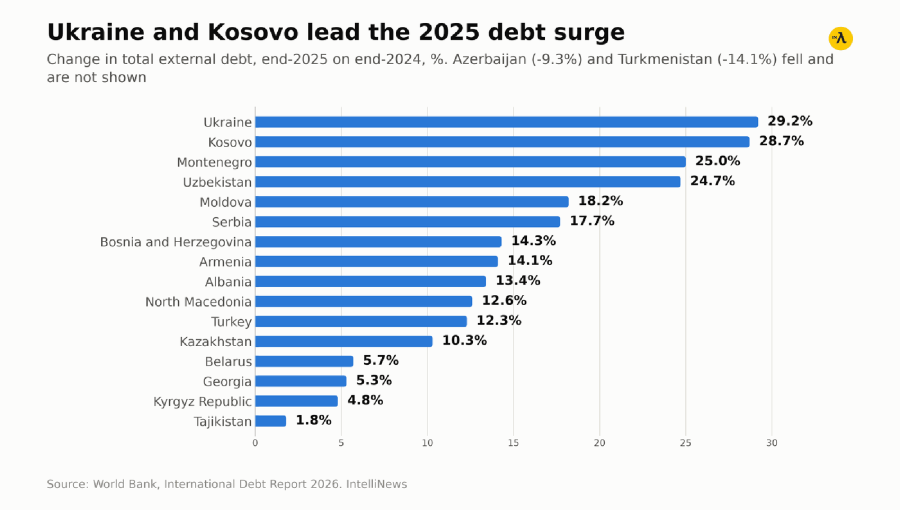
Ukraine's external debt increased 29.2% to $250.3bn, the fastest rise in the region and the largest percentage increase among the 10 biggest developing-country borrowers outside China. Debt reached 403% of exports and 118% of national income.

Multilateral creditors held $131.6bn of Ukraine's debt, with the European Union accounting for $82.3bn, almost all of the $84bn owed to the bloc by the entire region.

Official creditors disbursed $122.2bn to Ukraine in 2022-25. New official loans in 2025 carried average terms of 40 years and an interest rate of 0.2%, while debt service absorbed 17% of exports.

Private creditors have largely remained on the sidelines. Their long-term claims on Ukraine increased only from $72bn to $82bn over the decade.

Some of Ukraine's debt is serviced from proceeds generated by immobilised Russian sovereign assets rather than the Ukrainian budget. The G7's $50bn Extraordinary Revenue Acceleration loans are nevertheless recorded as Ukrainian debt because the contractual obligation rests with Kyiv. Ukraine's public debt has continued to rise, while the EU has committed a further €50bn through its Ukraine Facility.

Turkey remained by far the region's largest debtor, with external debt rising 12.3% to $572.8bn.

The country's public sector issued $27.7bn in bonds in 2025, the second-largest amount among developing countries after Mexico. Turkish private companies raised $23.5bn, second only to China. Turkey, Brazil and India together accounted for 83% of net long-term inflows to private borrowers in developing countries.

Short-term borrowing represents a significant vulnerability. Turkey's short-term external debt reached $165.8bn, equivalent to 29% of its total external debt and about 64% of the region's short-term debt. Debt service absorbed 25% of exports, although the overall debt stock was relatively modest at 36% of national income.

Central Asia presented a mixed picture. Uzbekistan's external debt increased more than sixfold over the past decade, from $13.6bn in 2015 to $88bn, including a 24.7% rise in 2025.

The country was the largest international bond issuer among borrowers eligible for concessional World Bank lending last year, raising $3.9bn. Its borrowing costs were among the region's highest. New private-creditor loans carried an average interest rate of 8.6%, while its 2028 local-currency bond yielded 15.5%, compared with 7.38% for its dollar-denominated note.

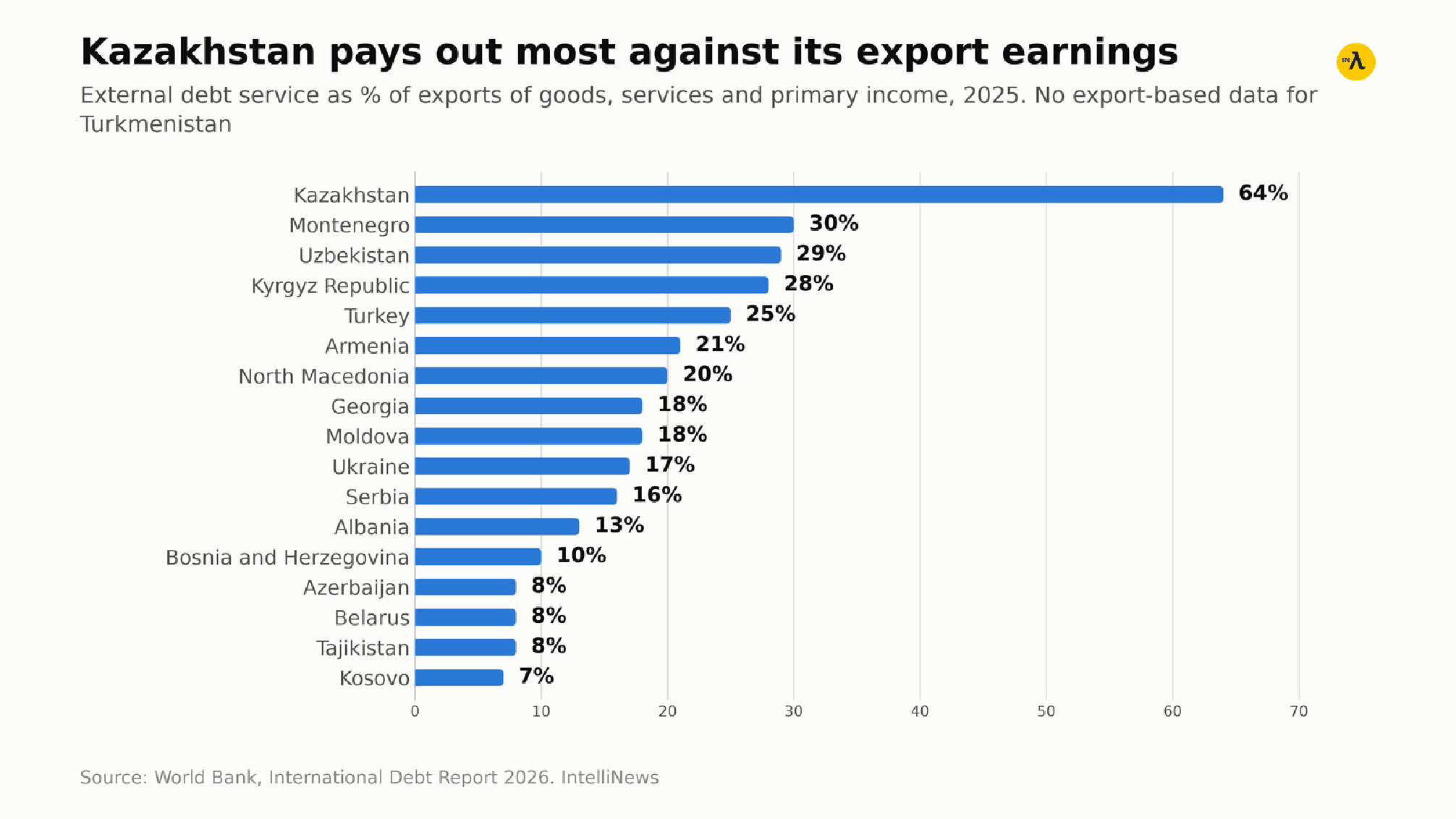
Kazakhstan's debt service amounted to 64% of exports, the highest ratio in the region, although much of its debt is not directly attributable to the state. Of its $183.1bn external debt stock, $115bn was owed by private companies without state guarantees. About half of the total consisted of intercompany lending, largely linked to foreign investment in extractive industries.

The Kyrgyz Republic's debt increased 4.8% to $12.5bn, but its debt-to-exports ratio rose 54% to 215%. Debt service jumped 186.7% to 28% of exports, suggesting a substantial decline in export earnings. The government expects to spend $1.8bn servicing external debt in 2027-29.

External debt service as a share of exports, 2025. Source: World Bank, International Debt Report 2026. IntelliNews.

China remained the dominant bilateral creditor for several Central Asian countries, holding $1.5bn of the Kyrgyz Republic's $1.9bn bilateral public debt and $738mn of Tajikistan's $894mn. Turkmenistan's reported external debt fell 14.1% to $2.9bn, although the World Bank did not provide export-based debt indicators for the country, which publishes limited financial data.

In the South Caucasus, Azerbaijan was an outlier, with external debt falling 9.3% to $12.3bn, equivalent to just 17% of national income.

Armenia's debt rose 14.1% to $18.7bn. Its debt-to-exports ratio increased 47.6% to 122%, while debt service rose 62.3% to 21% of exports, pointing to weakening export earnings.

Georgia's external debt increased 5.3% to $25.4bn, equivalent to 71% of national income, the fourth-highest ratio in the region. Its debt indicators improved, with official lenders accounting for $9.2bn of the $11.2bn in public external debt. The Asian Development Bank was its largest creditor.

The Western Balkans and Moldova also recorded substantial increases. Kosovo's debt rose 28.7% and Montenegro's 25%, among the fastest increases in the region. Moldova's debt increased 18.2%, Serbia's 17.7%, Bosnia and Herzegovina's 14.3%, Albania's 13.4% and North Macedonia's 12.6%.

Currency movements contributed to the increases. More than a quarter of the $303bn rise in public and publicly guaranteed debt across developing countries reflected the weaker dollar, which inflated the dollar value of liabilities denominated in other currencies. The World Bank did not provide a regional breakdown.

The effect was particularly relevant in the Balkans, where borrowing is heavily denominated in euros. Montenegro's central bank reported an increase of 6.6% to €10.32bn in external debt in 2025, compared with the World Bank's 25% rise in dollar terms, although the institutions use different definitions.

Montenegro nevertheless faced one of the region's heaviest debt burdens. External debt equalled 118% of national income and 252% of exports, while debt service absorbed 30% of exports, second only to Kazakhstan. Private creditors held $4.1bn of its $5.8bn public debt, while China accounted for $646mn of the $820mn owed to foreign governments.

Serbia's external debt has almost doubled since 2015 to $59.6bn. China was its largest bilateral creditor, with $3.2bn, followed by the United Arab Emirates with $1.1bn. North Macedonia owed Hungary $1.2bn, more than any other government. Albania's debt service rose 47.3% to 13% of exports, while multilaterals held $4.5bn of Moldova's $5bn public debt.

Belarus, for which the World Bank provides estimates, owed Russia $7.2bn and China $2.2bn of its $9.5bn in bilateral debt. The report showed no new public loan commitments for Belarus in 2025.

External debt as a share of gross national income, 2025. Source: World Bank, International Debt Report 2026. IntelliNews.

Borrowing has continued in 2026, with more than 10 developing countries exceeding their full-year 2025 bond issuance by mid-August. Bosnia and Herzegovina raised $1.8bn, compared with $412mn during the whole of last year.

New private-sector borrowing in the region averaged 5.3% interest and a seven-year maturity, compared with 1.9% and 29 years for official lending.

The shift towards commercial financing in countries including Uzbekistan, Montenegro and Bosnia & Herzegovina is increasing borrowing costs and shortening repayment periods, as export growth across the region struggles to keep pace with rising external debt.

CountryExternal debt, end-2025 ($bn)Change on 2024Debt/GNIDebt/exportsDebt service/exports
Turkey572.8+12.3%36%142%25%
Ukraine250.3+29.2%118%403%17%
Kazakhstan183.1+10.3%64%193%64%
Uzbekistan88.0+24.7%60%227%29%
Serbia59.6+17.7%64%108%16%
Belarus35.9+5.7%39%66%8%
Georgia25.4+5.3%71%127%18%
Armenia18.7+14.1%66%122%21%
Bosnia and Herzegovina16.0+14.3%49%108%10%
North Macedonia14.3+12.6%79%123%20%
Kyrgyz Republic12.5+4.8%56%215%28%
Moldova12.4+18.2%61%165%18%
Azerbaijan12.3-9.3%17%35%8%
Albania12.2+13.4%40%96%13%
Montenegro10.9+25.0%118%252%30%
Tajikistan7.2+1.8%29%76%8%
Kosovo5.6+28.7%44%84%7%
Turkmenistan2.9-14.1%6%n/an/a
Region1,340+15.3%49%152%25%

Source: World Bank, International Debt Report 2026, country profiles. Exports cover goods, services and primary income.